Showing posts with label Seating Guests of Honor. Show all posts

Monday, March 14, 2022

Graceful Dinner Seating Etiquette

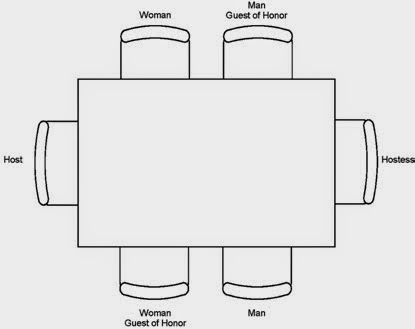
Formal Table Seating For Groups Divisible By Four, without Host and Hostess at opposite ends of the table— 
Images courtesy Bernadette Petrotta
 

“In seating one's self at table a comfortable posture is not incompatible with a dignified attitude. The shoulders should not be thrown back too far, nor should they drop forward. It is the latter pose which produces the inclination of the arms suggestive of the 'all elbows' idea which some people give of themselves.”
– Eliza M. Lavin, 1888

A 2020 Instagram query from Happy Soul —How do you take a seat the dining table i.e from the left of the chair or right of the chair or either way is correct? Then how do you leave the chair ie from left or right or either way is fine?
Reply from Maura J. Graber, Etiquipedia Site Editor: It is dependent on several factors, so common sense and some quick thought comes into play, just as it does with most other etiquette. Is it a formal dinner party in someone’s home? How many others are seating themselves at the same time? How is the table set up? Will seating yourself from the left side of the chair interfere with someone serving food? 
In the U.S., food and drinks are served on different sides — food from the left, drinks from the right. In Europe, everything is served from the right — food and drinks. Silently, ask the same question to yourself as you are walking toward the table on the right side. If one is in a restaurant, is everyone being seated at the same time? Are you joining a party already seated. Does someone have a walker, cane or other aid, sitting next to their chair that will impede your seating yourself? 

As a rule, I personally tend to “enter” the seat from the left and “exit” from the seat on my right. However, I always take a look around me before making those choices, and ask myself it it will work effortlessly, or if I will be causing discomfort or a challenge for anyone near me. Either way is fine, as long as no one else will be put out by the choice made.

Traditional Formal Table Seating For Six, Ten, Fourteen, Or Eighteen People, with Host and Hostess at Opposite Ends


 🍽Etiquette Enthusiast, Maura J. Graber of The RSVP Institute of Etiquette, is the Site Editor for the Etiquipedia© Etiquette Encyclopedia

Tuesday, March 16, 2021

Formal Dinner Seating Arrangements

This diagram shows what was, in the Gilded Age, a reportedly popular French-style, dinner party seating arrangement. This savvy seating arrangement places the host and hostess in seats across from one another, midway to the center of the table on each side. The couple, seated in such close proximity to one another, can direct or control the conversation with their guests, and help the dinner party flow along more easily throughout the evening.
These diagrams above show a popular dinner party seating arrangement for rectangular tables, at which the host sits at one end and the next male “of importance” is seated at the opposite end. At these tables, the hostess sits on that guest’s left, while the woman next in importance sits on his right. Note that “importance” is a relative term. It can refer to rank, seniority, age or even to which guest traveled the furthest distance or who will next be celebrating a birthday.
“When the party numbers 6, 10, 14 and so forth, the more modern way of dispensing with end places entirely, and seating the host and hostess directly in the center of each side, is increasingly used. To make this come out right, the number along each side, as you can see, must be an uneven one such as three, five, seven. This places the host and hostess opposite in the midst of their party, allows them to direct and control the conversation as necessary and look after the general welfare of their guests. At the usual friendly dinner party, there is seldom a special “guest of honor.” If, however, you were giving the dinner party in honor of a particular woman guest, you would seat her at the right of the host. If a man were the one to be so distinguished, you would see him at the right of the hostess.”— From Helen Sprackling, 1960


Etiquette Enthusiast, Maura J. Graber, is the Site Editor for the Etiquipedia© Etiquette Encyclopedia

Saturday, September 6, 2014

Basic Dinner Seating Etiquette

“In seating one's self at table a comfortable posture is not incompatible with a dignified attitude. The shoulders should not be thrown back too far, nor should they drop forward. It is the latter pose which produces the inclination of the arms suggestive of the 'all elbows' idea which some people give of themselves.” – Eliza M. Lavin, 1888

Formal Table Seating For Six, Ten, Fourteen, Or Eighteen People  
Traditionally at a formal dinner, the Host sits at the head of the table with the Hostess at the other end. This works whenever there are six, ten, fourteen, or eighteen people. Husbands and wives are never seated next to each other.
If the Guest of Honor is a woman, she is seated at the Host's right and her husband at the Hostess' right. The second most important woman is seated across from the Guest of Honor, on the Host's left, and her husband is seated accordingly on the Hostess' left. The remaining guests are seated in between, alternating between male and female guests.
To be fair, the word "important" can be relative to many differing situations and varying cultures. Age may play a factor, especially if there is no Guest of Honor. Giving the eldest member of a group, or the persons who have traveled the farthest distance to the dinner, special places in the seating arrangement, would be an honor. Special accommodations may be also be made for those in wheelchairs, or those using a walker or cane. Guests take note of such matters and will undoubtedly appreciate the kind gestures on a Hosts and Hostess' parts.
Formal Table Seating For Groups Divisible By Four 
When the group of people is divisible by four, it is not possible for the Hostess to sit at the end of the table. In this case, the Hostess moves one place to the left, with the man on her right sitting at the end of the table, opposite the Host. This will keep the tradition of seating guests alternately, male, female, male, female, etc... Again, husbands and wives are never seated next to each other.
For informal dining, the easiest system is to alternate between male and female guests, with the Host and Hostess on either end of the table. 


Contributor Bernadette Petrotta is the Founder and Director of the Polite Society School of Etiquette in Washington State.  She has been teaching etiquette for nearly 20 years and has written The Art of Social Graces and The Art and Proper Etiquette of Afternoon Tea.  She is currently working on her third book and continues to teach and lecture on the art and pleasures of proper etiquette and tea. 


  🍽Etiquette Enthusiast, Maura J. Graber of The RSVP Institute of Etiquette, is the Site Editor for the Etiquipedia© Etiquette Encyclopedia