Showing posts with label Knife and Fork History. Show all posts

Saturday, May 3, 2025

Gilded Age Boors and Spoons

“Whenever it is possible, a fork must be used in place of a spoon, and that same spoon, by the by, must never be left in a coffee or tea cup, but laid to rest politely and securely in the saucer.” – Ruth Ashmore  
🍴🍴🍴🍴🍴🍴🍴🍴🍴🍴🍴
Ever since forks were paired with knives, forks have been designated as the ONLY implement or utensil to use for dining, while the use of spoons at the dining table has been relegated to just breakfast cereals, soups, chili, some plain ice creams and other types of liquid or semi-liquid foods served in bowls, along with tea, chocolate and coffee.  This is a common rule many in the etiquette community either tend to ignore, or simply do not teach, though it has been the rule for nearly 2 centuries. After all, s
poons enabled those who could not pace themselves through a meal and wound up suffering from dyspeptic stomachs. One gilded age author, Ruth Ashmore, explained the basics of dining etiquette on a regular basis to young women across the United States and abroad.
🥄🥄🥄🥄🥄🥄🥄🥄🥄🥄
There is no such thing as a “dinner spoon,” though tableware companies have been trying to promote one for years now, A spoon’s function and use at a dining table is very limited and it is good to remember that fact. It may be the reason that during the latter part of the 1800’s, so many spoons became forks by way of patented designs for new utensils. Ice cream spoons became ice cream forks, terrapin soup spoons became terrapin forks, and so on. No rules were broken that way.

As a people, we Americans have been laughed at for eating too fast, and we are credited as being a nation of dyspeptics, writes Ruth Ashmore in her interesting department, “Side Talks with Girls,” in the Ladies Home Journal. Now, of course, this is generalizing, but you, the eldest daughter, have it in your power to make the boor at the dinner or tea-table one of real delight, it is an easy matter, one you will find, to start some pleasant conversation to get your father and brother interested in the talk of the day, so that you will eat your food more slowly, and you will achieve what the Frenchmen consider the great art—you will dine, not merely feed yourself.

But there are a few little questions about table etiquette of the table that some girl wants to know, and these I am going to tell her. She must hold her knife by its handle, and never let her fingers reach up to its blade. Whenever it is possible, a fork must be used in place of a spoon, and that same spoon, by the by, must never be left in a coffee or tea cup, but laid to rest politely and securely in the saucer.

Glasses with handles are held by them. A goblet should be caught by the stem, the fingers not entwining the bowl part. Don't butter a large piece of bread and take bites from it; instead, break your bread in small pieces, one at a time. Butter it, that is, if you are eating butter, and convey it to your mouth by your fingers.

Olives, celery, radishes, strawberries with stems, and asparagus are all eaten from the fingers. The old method of eating cheese with a knife has been given up, with a fork being used in its place. The use of many small dishes for vegetables is not in good taste: indeed, many vegetables should not be served at one time.—From The Ladies Home Journal, as posted in the Sacramento Daily Union, 1892


🍽️Etiquette Enthusiast, Maura J. Graber, is the Site Editor for the Etiquipedia© Etiquette Encyclopedia

Thursday, January 25, 2024

Fork History and Steel Blades on Knives

“…there are many varieties of food which deteriorate from even the slightest contact with steel, a metal still much in use for knives…” – In 1889, unless one had all silver flatware or gilded flatware, the blades of most knives were still made of steel. The steel would clash with the flavors of sauces or dressings which had citric acid in them –like orange or lemon juice– and those containing vinegar. Thus leaving fish and many salads inedible to most guests.

Although the four-pronged silver fork was in use upon the continent of Europe in the first decade of the present century, it is noticeable that the use of the knife in carrying food to the mouth is by no means obsolete among some of the most advanced of the European nations. One can easily draw a mental picture in which the dogmatists of etiquette a half century ago are seated about a tempting board, all eating with their knives, but using them daintily; and the retrospect need not go back of the times of those whose manners at table, as well as elsewhere, are defined as models of elegance.

Since then the steel fork has been banished, the knife subjugated and the spoon subdued. The reason for all this is commonly supposed to be the danger of cutting the lips with the knife, but such danger is very slight, unless one be persistently stupid in handling it. It is much more sensible to assume that mankind was not slow to perceive the more agreeable sensation of putting to the lips the delicate tines of a fork, which were close enough to convey all except liquid edibles with comfort and convenience. 
Then, too, there are many varieties of food which deteriorate from even the slightest contact with steel, a metal still much in use for knives. There is, however, an inclination to force the use of the fork to the point of affectation, and excess in this direction is quite as deplorable as the indiscriminate use of the knife. The proper use of any table implement at a table where one is a guest is no different from what it would be at the most informal meal, except as it may be influenced by the special preparation of an edible. – By Eliza M. Lavin, 1889

🍽Etiquette Enthusiast, Maura J. Graber, is the Site Editor for the Etiquipedia© Etiquette Encyclopedia
Sunday, October 1, 2023

“Queer” Old Table Manners Advice?

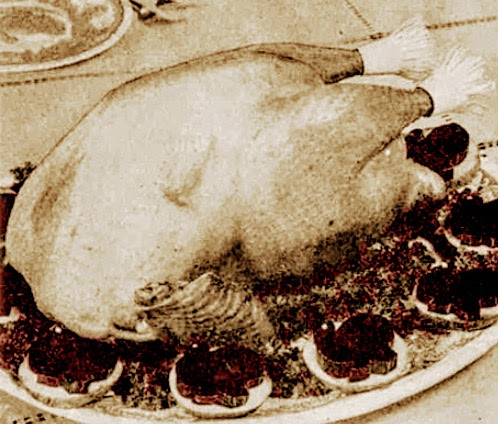
Old advertising photo of a Thanksgiving turkey, complete with paper frills on the drumsticks – “Before the carving fork was introduced, paper covers were placed over those portions of meat which had to be grasped with the left hand. The paper frills sometimes seen nowadays on cutlet bones, are said by the author, to be a survival of the old custom.” – 1913 

Some Queer Old Table Manners in Ancient Times: 
People were told not to pick their teeth with knife or fork

“Until the middle of the seventeenth century,” writes Rose M. Bradley in “The English Housewife”, “forks were a luxury, treated rather as toys, elegant, with jeweled handles, wherewith the ladies might pick daintily at their sweetmeats.” Before the carving fork was introduced, paper covers were placed over those portions of meat which had to be grasped with the left hand. The paper frills sometimes seen nowadays on cutlet bones, are said by the author, to be a survival of the old custom.

After smarting under foreign criticism on their table manners, Englishmen turned to French “Rules of Civility,” and others were compiled in English. Readers were warned “not to wipe knife or fork on bread or the cloth, but on napkins.” They were also requested “not to pick their teeth at table with knife or fork.”

“The Accomplished Ladies Rich Closet of Rarities,” published in 1653, begs each gentlewoman to “observe to keep her body straight, and lean not by any mans with her elbow, nor by ravenous gesture discover a voracious appetite.” Nor must she talk with her mouth full of meat nor “smack like a pig,” nor eat spoon meat so hot that the tears stand in her eyes.

“It is very uncomely,” the author adds, “to drink so large a draft that your breath is almost gone and you are forced to recover yourself. Throwing down your liquor as into a funnel is an action fitter for a juggler than a gentleman.” – San Pedro Daily News, 1913


🍽Etiquette Enthusiast, Maura J. Graber, is the Site Editor for Etiquipedia© Etiquette Encyclopedia

Thursday, September 28, 2023

Use of Fork an Index to Breeding

A screenshot of a dining scene in the “Cranford” series shows a young woman eating with her knife after her host models the behavior himself. The dining scene is set in 1840 England. – It is only within the last half century that the practice of eating with forks has prevailed; yet nowadays it would be regarded almost as an insult to one’s readers even to mention the fact that the knife should never be put in the mouth.”

“It is the manner which is better than all.” 
-Sir Phillip Sidney

Many persons have an idea that it is consistent with good table manners to assist the fork with a small piece of bread held in the left hand. Of course, if enough well bred persons though do so and acted accordingly it would be correct, for after all, good manners are nothing in the world but the present usage of those persons who form what, for lack of a letter term, we call the “better class.” 

This does not mean the wealthier people or the people who claim most aristocratic ancestry; but it does mean the people who take life seriously enough and care enough for their neighbors and for themselves to wish to conduct themselves in the way that will be most congenial and will be most conductive to their own success and happiness. So, although some careful persons use bread to help push food on the fork, the consensus of opinion seems to be unfavorable to the practice. As one recent authority on table manners puts it; “The resort to the bit of bread as a pusher is merely childish.”

Worse than childish is the habit of loading the fork with the knife: at least it is contrary to the best American usage. Children ought to be taught very early the knack of managing their fork, without the assistance of fingers, fork or knife. It is not easy, but to eat with chopsticks must be considerably more difficult, and very young Japanese children learn to be skillful with those implements. 

It might be said that the proper use of the fork is as much a test of the good manners of the American as the ability to use chopsticks is of the Asian. But the fork has been used as an eating implement only in comparatively recent times. The Asians were facile with chopsticks hundreds of years , ago, when the only forks in our homes were those employed in the kitchen for lifting meat in cooking. It is only within the last half century that the practice of eating with forks has prevailed; yet nowadays it would be regarded almost as an insult to one’s readers even to mention the fact that the knife should never be put in the mouth. 

About thirty-five years ago, Alfred Ayres, writing in a little handbook of good manners, warns his readers not to be inconsiderate of the feelings of others in this matter of eating with the fork. He tells his readers that if they happen to be dining at a home where only the old fashioned steel forks are used, that they should eat with their knives, as others do. “Do not let it be seen,” he says, “that you have any objection to doing so, nor let it be known that you ever do otherwise. He that advised us to do in Rome as the Romans do was a true gentleman.” – Mary Marshall Duffee, 1917


 🍽Etiquette Enthusiast, Maura J. Graber, is the Site Editor for the Etiquipedia© Etiquette Encyclopedia