Showing posts with label Gilded Age Dinners. Show all posts

Saturday, October 3, 2026

Gilded Age Bachelors Dining Out

“Dinner invitations are sent out at least a fortnight in advance. In the New York season sometimes they are issued a full month before the event. They must, under all circumstances, be answered within twenty-four hours, and cards left on your prospective host and hostess within a week. The fashionable hours for dining are between half past seven and eight o'clock. Dinners being formal evening functions, formal evening dress is essential.”


ETIQUETTE AND THE ‘DINER-OUT’

When I speak of the “diner-out,” I include under this title the bachelor guest not only at dinners, but also at luncheons and at suppers. The formal breakfast is a festivity of the past, and the first meal in a household is purely a family affair. However, luncheons on Sunday at one or two o'clock are in New York frequently called breakfasts, because I believe many fashionable people do not want the impression to go abroad that even once a week they dine in the middle of the day. The luncheon after a day wedding ceremony is also called a breakfast, but this, like the Sunday meal, is simply a title by courtesy.

Luncheons, where men are guests, are popular entertainments at all the large summer resorts, such as Newport, Long Branch, Bar Harbor, as well as at the more celebrated of the Western and Pacific watering places and the winter cities of the South. In New York and other great centers, where there exists a number of gentlemen of leisure, these entertainments are greatly in vogue, and in Washington they sometimes assume the color of diplomatic functions.

The hour for a luncheon is half past one o'clock, and sometimes it is advanced to two. All guests are expected to be punctual to the minute and to take advantage even of the quarter of an hour latitude is bad form. Better a little too early than too late. However, do not make yourself ridiculous by appearing on the scene too soon. Bear in mind that the reputation of being the “late Mr. Smith” is not enviable. A tardy guest only accentuates his own insignificance. This rule applies to dinners and suppers and to all entertainments where you are a guest, with only one exception—dances, where you have an hour's grace.

Luncheons, as a rule, are informal affairs. Men have attended them in lounge suits, but it is more courteous to your hostess to appear in afternoon dress. Overcoats, hats, and sticks are left in the hall. Your gloves are removed in the drawing room. When luncheon is announced, unless it is a very formal affair, your hostess leads the way to the dining room, and she is followed by her guests, women and men, not in procession. The men, of course, must allow the fairer sex to pass before them through the drawing-room door and into the dining room. Luncheon menus consist of oysters, clams, or grape fruit with crushed ice and saturated with maraschino for the first course. This is followed by bouillon, an entrée, a roast or chops with peas, or broiled chicken, salad with birds, ices and fruits, coffee and liqueurs. Sherry and claret are the wines, and sometimes champagne is served.

A luncheon lasts three hours at most, and the men are left to smoke at dessert. However, sometimes this formality is waived.

Dinner invitations are sent out at least a fortnight in advance. In the New York season sometimes they are issued a full month before the event. They must, under all circumstances, be answered within twenty-four hours, and cards left on your prospective host and hostess within a week.

The fashionable hours for dining are between half past seven and eight o'clock. Dinners being formal evening functions, formal evening dress is essential.

Except at very small houses and apartments, two rooms are reserved—one for the men and the other for the ladies—as dressing rooms. Your hat, coat, and outdoor attire are removed, and a servant will assist you in arranging your toilet. A nefarious practice of feeing these attendants, even at private houses, has been somewhat in vogue in a very "smart" and wealthy set in New York. It is not good form, and I would advise you against it.

The servant who announces you, hands you a small envelope on which is written your name. This incloses a card on which is the name of the lady whom you are to take in to dinner. After exchanging greetings with your hostess and removing your gloves, you should endeavor to find your partner and engage in some preliminary conversation. Should you not have been presented to her, inform your hostess of this fact, and you will be at once introduced. Dinner is announced by the butler entering the drawing room and saying, "Dinner is served." The host leads the way with the woman guest of honor, and you are assigned your place in the procession by the hostess, who comes last with the man guest of honor. Each man offers his right arm to his fair partner. In the dining room, cards are placed at each cover with the names of the guests inscribed thereon. Even should there be a retinue of servants, pull back the chair of your partner and assist her to seat herself. In some old-fashioned houses grace is said, and it is always the rule when a clergyman is one of the guests. This blessing is asked after the company is seated.

During dinner you must devote yourself to the comfort and entertainment of the woman whom you have taken in. She must be your first care, although there may be some one on your other side, or opposite, who is more congenial to you. Talking across the table is very bad form. Let your conversation be pleasant and general, but avoid politics, religion, and personal criticisms.

There is no form for refusing wine, if it is against your scruples to drink it. Do not thus force your personal prejudices on your host by making any demonstration, such as putting your finger over the glass or shaking your head at the butler. Let him fill your glasses, but do not drink the contents. The question of waste is not to be considered; and if you are a man with firm principles regarding total abstinence, in your heart you should rejoice that at least a quota of the fluid will do no harm.

The hostess gives the signal at dessert for the ladies to retire to the drawing room. Everybody rises, and the ladies leave the table in solemn procession, the man nearest the door opening it for them. A prettier custom, and one much in vogue in New York, is the escorting of the ladies by the men to the drawing room, the host leading the way. When the drawing-room door is reached the men bow and retire again to the dining room, where coffee, liqueurs, and cigars are served. At the end of a half hour they return to the drawing room. Another half hour of conversation, during which sometimes there is dancing, and the guests make their adieus to their hostess and host and leave. On bidding good-night, always assure your hostess of the pleasant evening which you have enjoyed.

Progressive dinners are sometimes given, although now almost obsolete. Small tables are arranged for these with parties of four or six at each table. The guests change places at each course, the signal for this being given by the hostess ringing a bell. The ladies remain in their seats. As there will not be a fresh napkin provided at each course, a man brings his with him from his first table.

Public dinners, except when given by certain church, debating, or literary societies, are stag affairs. The guests assemble at the restaurant, hotel, or hall where the banquet is to be held, and deposit their hats, coats, and walking paraphernalia in the cloakroom. A ticket is given with the number of your rack upon it, and a small fee—usually twenty-five cents—is expected. The guests assemble in one of the smaller drawing rooms, and each one is handed a plan of the tables with the location of his cover designated by his name upon it. A procession is formed, the guests of honor and reception committee leading, to the banquet hall. After dessert, speeches are in order.

Dinner dances are a form of entertainment where dinner is followed by a dance, other guests coming in from other dinner parties and meeting at one house which has been agreed upon as the place where the dance is to take place. A short time after dinner, at each of the other houses, the guests are conveyed therefrom in carriages, or, better yet, in stages, to the general rendezvous. Calls are due within the week at the house where you have dined as well as at the one at which you have danced.

Supper etiquette differs but little from that observed at dinners. The occasion is a bit more informal and the menu not so elaborate. The etiquette of ball suppers is treated in the chapter on The Dance, and suppers after the play, at restaurants and clubs, being favorite bachelor entertainments, will be explained in that part of this book reserved for the Bachelor as Host. — The Complete Bachelor, by Walter Germain, 1896


 🍽Etiquette Enthusiast, Maura J. Graber of The RSVP Institute of Etiquette, is the Site Editor for the Etiquipedia© Etiquette Encyclopedia

Wednesday, December 13, 2023

Etiquette and “Dinner Giving”

An invitation to dinner conveys a greater mark of esteem, or friendship and cordiality, towards the guest invited, than is conveyed by an invitation to any other social gathering, it being the highest compliment, socially speaking, that is offered by one person to another.

DINNER giving is perhaps the most important of all social observances, therefore dinner parties rank first amongst all entertainments. Dinner giving is so thoroughly understood to rest upon the principle of an equivalent, that those who do not give dinners hardly come within the category of diners out. This rule, however, is open to many exceptions in favour of privileged individuals, popular and prominent members of society whose presence at dinner parties is appreciated and welcomed in most circles. Dinner parties are of more frequent occurrence, and are of more social significance than any other form of entertainment.

Dinner Invitations:

An invitation to dinner conveys a greater mark of esteem, or friendship and cordiality, towards the guest invited, than is conveyed by an invitation to any other social gathering, it being the highest compliment, socially speaking, that is offered by one person to another. It is also a civility that can be readily interchanged, which in itself gives it an advantage over all other civilities. The orthodox dinner giver must necessarily possess a certain amount of wealth, and wealth and wit do not always go hand in hand. Oftener than not, the former rather overweights the latter; hence, the introduction of a lighter element in the form of amusing people whose métier in life it is to be amusing and to appear amused.

Dinner giving is in itself not only a test of the position occupied in society by the dinner giver, but it is also a direct road to obtaining a recognised place in society. A means of enlarging a limited acquaintance and a reputation for giving good dinners is in itself a passport to fashionable society. Dinner giving in the fullest sense of the word, is a science not easily acquired, so much depending on the talent which the host or hostess may possess for organizing dinner-parties. When a large dinner-party is contemplated, it is usual to give three weeks' notice, but of late this notice has been extended to four, five, and even six weeks.

Diners out are rather inclined to rebel against this innovation, considering that an invitation bearing the date of a month hence pledges them to remain in town, and as it were controls their movements, for the acceptance of an invitation is in the eyes of diners out a binding obligation; only ill-health, family bereavement, or some all-important reason justifies its being set on one side or otherwise evaded. Those inconsiderate enough to make trivial excuses at the last moment are not often retained on the dinner-list of a host or hostess.— From “Manners and Rules of Good Society or Solecisms to be Avoided,” by a member of the Aristocracy, 23rd Edition


🍽Etiquette Enthusiast, Maura J. Graber, is the Site Editor for the Etiquipedia© Etiquette Encyclopedia

Monday, August 29, 2022

Etiquette of the Gilded Age Table

It may well be feared that an idle and degenerate race will follow this period of elegant display and high living. Fortunately this revel in costly food and table decoration is confined to the rich; so that the sweet, simple food and clean, dainty table-service of the ordinary family will not become a memory of the past.


“Luxury in Eating”

We are returning to the splendor of the ancients in our opulence of table decorations and in the luxury of our food, and it may well be feared that an idle and degenerate race will follow this period of elegant display and high living. Fortunately this revel in costly food and table decoration is confined to the rich; so that the sweet, simple food and clean, dainty table-service of the ordinary family will not become a memory of the past. 


We all know how fair a wedding feast may be furnished from a table set with white china, with viands prepared at home, and a few clusters, here and there, of wild eglantine and ivy, and table napery of spotless linen. But a society journal informs us that, for morning and afternoon wedding entertainment, the following table napery has been prepared:

Finest double damask linen edged with silver lace, monograms of bride and bridegroom in silver work in the corner. Bands or strips of white satin, edged with white plush and silver lace, destined to be laid under the flower decorations, which are only to be white and red roses. Tiny round serviettes edged with silver lace, worked with silver monogram. Specimen flower-holder for each guest, in the shape of a mother-of pearl tiny bouquet-holder set in a silver claw-stand for the table, and having a thick fall of silver and real pointe lace round the top where the flowers will rest. These, as well as the serviettes, will be carried away by each guest as a memento of the occasion.

The afternoon tea-cloths, finger, fruit cloths, etc… are white washing silk, thickly fringed and worked with silver roses. Another feature of elegant dinners is the little boxwood easel on which the dinner-card rests. These may be simple or very ornamental, as the hostess prefers.
 
The Shakespeare cards are very suitable, and quite appropriate, each one containing a selection. “The labor we delight in.” —Macbeth. “At first and last the hearty welcome.” — Macbeth. “Eat and make good cheer.” —Henry IV. “To say you are welcome were superfluous.” — Pericles. These are gilt-edged with ornamental painted designs, and may be used as a plate-card or attached to the bouquet for the guest as a welcome card. It will save both headaches and heartaches, and literally fulfill Shakespeare's exhortation,

“Now let digestion wait on appetite, And health on both,” 

if moderation is observed in eating and drinking the good things provided. 

There is one saving clause in the modern bill of fare—the numerous light dishes which are neither rich nor nourishing, and of which Hood says:

“But, then, my fare was all so light and delicate —
The fruit, the cakes, the meats, so dainty frail —
They would not bear a bite— no, not a munch—
But melted away like ice.”


— From “Gems of Deportment and Hints of Etiquette,” by Mrs. M. L. Rayne, 1882

🍽Etiquette Enthusiast, Maura J. Graber, is the Site Editor for the Etiquipedia© Etiquette Encyclopedia

Thursday, August 5, 2021

Gilded Age Dining Etiquette


In “The Age of Innocence,” Mrs. Mingott is shown selecting the correct flatware for a dinner party to welcome Countess Olenska.


For the Gilded Age Dinner Party

Etiquette advice from 1894 …

No gentleman will ever place his arms upon the table either before, during, or after a meal. Meats are to be cut with a single gliding movement of the knife, not by converting it into a saw. Keep the elbows always close to the side, no matter how ample may be the room between the guests.
 Iced oysters or clams are to be eaten with lemon juice dropped over —never with salt and pepper. Never play with knife or fork or other table utensils; do not touch them at all, except when about to use them. Do not forget that cheerfulness “suggests good health, a clear conscience and a soul at peace with all human nature.”
 – Gilded Age dinners were multi-course, elaborate dinners
– Photo source, Pinterest


Formal dinner parties were an important part of the life of a well-to-do Gilded Age couple. The rules of etiquette and good taste dictated the dinner table’s look. Collectors can find many pieces of silver, serving dishes and large, carved furniture that were all made for a 19th century feast.

The dining room had large furniture. There was often a sideboard with carvings of dead game birds, animals and symbols of the food to be served. The sideboard held large pieces of silver that were to be used during dinner. Examples of fine silver, crystal or china were also on display.

The table was in the center of the room under a large, decorative chandelier. Ground-glass globes were preferred because they made the lighting more flattering.

The long table was surrounded by matching carved chairs. The table was covered with a white damask cloth that was large enough to fall 20 inches from the floor at both ends. The cloth was ironed and the crease was placed exactly in the middle, going the length of the table. The center of the table held a flower arrangement.

Dinners often had 12 courses, so many dishes were used. Silverware, dishes and napkins were put in place for each course. Sometimes the place setting included an individual salt dish and spoon, plus a place card and menu card.

Large, ornate serving pieces such as tureens and platters were used, and serving pieces were made for every type of food, from asparagus to tomatoes. Most of the utensils can still be used today. Never wash gold-trimmed dishes or hollow-handled silverware in the dishwasher. The heat can cause damage to them. — From a variety of sources and articles, including the Los Angeles Times, 2000


Etiquette Enthusiast, Maura J Graber, is the Site Editor for the Etiquipedia© Etiquette Encyclopedia

Sunday, December 1, 2019

Gilded Age Tabletops and Etiquette

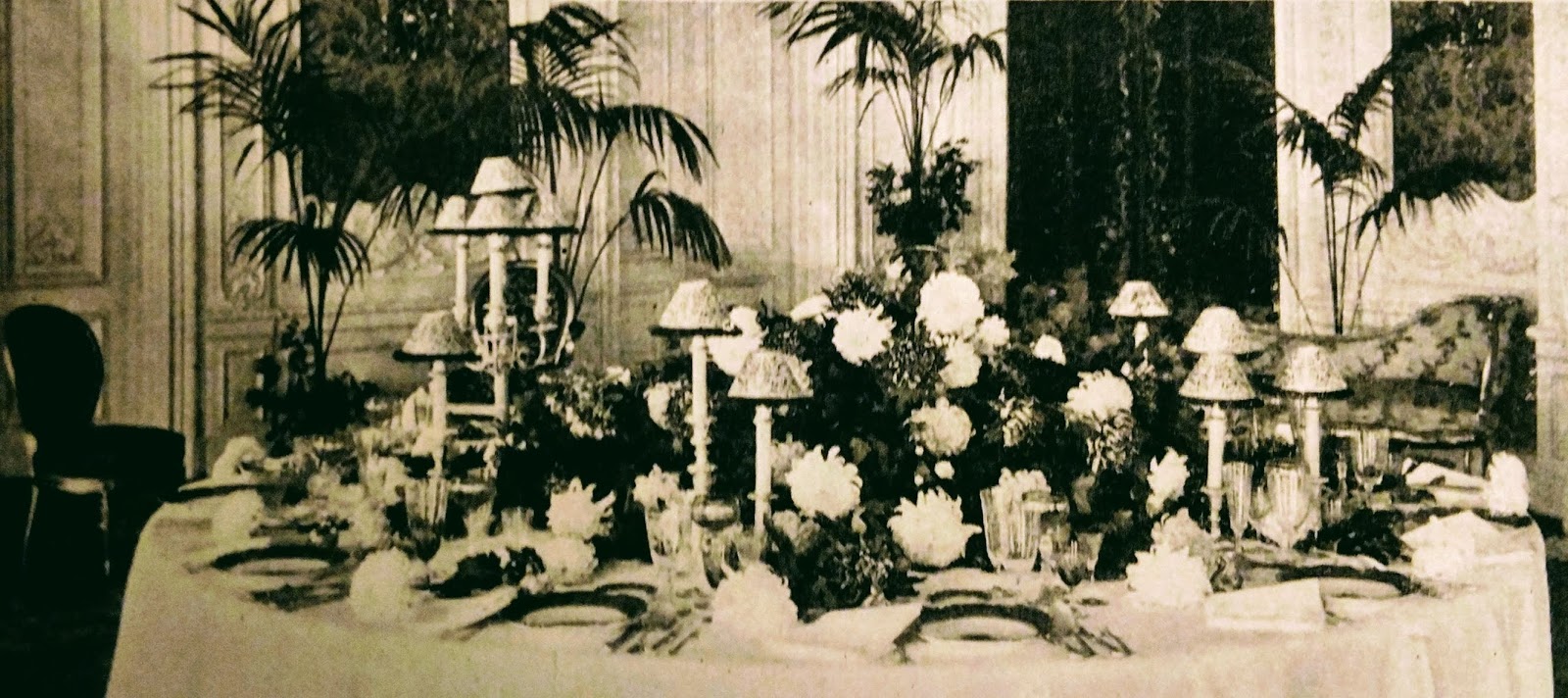
Those pretty candle shades, so much in use, were decorative to the furnishings of the table, but they prevented the most effective and becoming light at Victorian dinner parties.

Etiquette Notes for the Victorian Woman and the Home


A woman who has carefully studied the effects of light at her dinners says that unshaded candles in high, old fashioned candelabra that branch out in many directions, are absolutely the perfection of light for a table, and are, too a most becoming light to the faces of the guests gathered around it. The candelabra should be tall enough to carry the lights fairly high. The pretty candle shades so much in use are decorative to the furnishings of the table, but they prevent the most effective and becoming light.

A knitted table padding is being offered for use under table cloths. It is especially recommended because it does not grow hard after washing, as does the ordinary table pad. For a polished table, too, its protection is claimed to be more perfect. 


Cosmos and pansies are preferred for cloths intended for round tables. Sometimes entire plants are used to form a double border, with a plain linen center, and a plain strip between. The latest and most fashionable tablecloths have centers of plain linen, to which deep floral borders extend from the hem. Poppies, lilacs or goldenrod are favorite designs. Floral designs are preferred, the figures being larger and more pronounced than ever, this season.

Some damasks show the representations of whole plants or of a great branch bearing both flowers and foliage. Lace-trlmmed table linen is more fashionable than it was last season. Three new laces are used in ornamenting it. One is a French lace, resembling heavy linen torchon of elaborate patterns; another is a Russian lace of close meshes and clumsy figures.

Table linen that is not trimmed with lace, should be marked with embroidered initials. The accepted size for letters on tablecloths is two and one-half inches, and for napkins one and one-half inches. The initials should be intertwined, but the old-fashioned monogram style is no longer admissible.

In the serving of a pineapple:  Slice it, dip it in grated coconut, and pile high on a dish of fine white china.

A jelly sauce that is used for meats or the game course, requires that the jelly should be melted to the liquid state, and a tablespoonful of wine added just as it is sent around.
–Sacramento Daily Union, 1898


  🍽Etiquette Enthusiast, Maura J Graber, is the Site Editor for the Etiquipedia© Etiquette Encyclopedia 

Tuesday, July 30, 2019

Gilded Age Invitation Etiquette

IN SOCIAL LIFE – “Instead of answers to the social problems already set forth in this column, more questions continue to be sent in, which, being of themselves tacit acknowledgments that the suggestions for solving previous questions have been satisfactory, are a compliment that is appreciated since the position of social oracle is a greatness that has been thrust upon the department, rather than one with which it was born, or for which it has ever had the temerity to seek to achieve.”

Society Editor Herald – “A lady and gentleman, about to issue invitations for a society event, seeks information through your columns. As it is to be a joint invitation, by husband and wife, is it permissible to send invitations to the gentlemen friends of the host, and their wives,—all parties being of equal social standing—though the wife of the host may never, for many reasons, have called on the ladies? Would such action be just cause for unfavorable or invidious comment? Or, if it is not permissible, would it be “the proper caper” to invite the gentlemen and not their wives? Which action would show the spirit that should rule all society—true courtesy? You will, perhaps, say that the hostess should call on the ladies before the invitations are issued, but that may, under many circumstances, be impossible.”
Courtesy First—Regarding the “just invidious or unfavorable comment.” The class of persons who indulge in such witless little pleasantries are oftener actuated by a spirit of envy or narrow-minded ignorance, than with any sense of justice, unless tbe cause for such comment be a flagrant breach of etiquette; and, except in the latter case, such persons should be charitably commiserated on their unfortunate and unenviable point of view. But, in order to avoid committing a flagrant breach of etiquette, it is as well to first be sure you are right and then go ahead in social, as in other matters. And you most surely would not be right, if you invited a married man without his wife under circumstances above set forth; on the contrary, it would be little less than an open insult to both the man and his wife. 
Second—“All parties being of equal social standing” the circumstances which preclude a call before the issuance of invitations must be either ill-health on your part, or else that you have not lived here as long as the guests you would invite. Be that as it may, the wives should be invited if the husbands are to be; and since the calls have not and cannot be paid and the husbands are wanted for business or other reasons, the joint invitations should be sent to such gentlemen friends and their wives, with the visiting cards of both host and hostess enclosed. In such manner do you show not only the courtesy of an invitation, but that of a call as well from both your husband and yourself; and acceptance will follow if the guests know your reasons for not having actually paid the call; if not, and in the case of regrets, you have done all you could “under the circumstances” to show your courteous intentions. – Los Angeles Herald “Social Life”, 1895


Etiquette Enthusiast, Maura J Graber, is the Site Editor for the Etiquipedia© Etiquette Encyclopedia 
Tuesday, November 7, 2017

Etiquette and Gilded Age Pressures

The present custom of serving a number of fine wines with dinner, makes away with a very large amount of money. Giving
 four or five dinners a week, means an outlay easily of $1000.00!

Dining One’s Way to the Poor House in the Gilded Age

“Nothing is more expensive than modern dinner giving. The viands that go in to making up a modern dinner are all costly, the decorations demand a considerable expentiture and the present custom of serving a number of fine wines makes away with a very large amount of money. 

Four or five dinners a week means an outlay easily of $1000.00 and this sort of thing, taken in connection with the maintenance of an establishment at Newport and the other legitimate expenditures of a family in society, to carry it through the year, knocks very large holes in $60,000.00 and soon sweeps it away. The case here referred to is valuable as illustrating the extravagant tendencies of the times and the legitimate outcome.” – N. Y. World, 1890

Etiquette Enthusiast, Maura J. Graber, is the Site Editor for the Etiquipedia© Etiquette Encyclopedia