Showing posts with label Japanese Manners. Show all posts

Sunday, December 27, 2020

19th C. Japanese New Year Customs

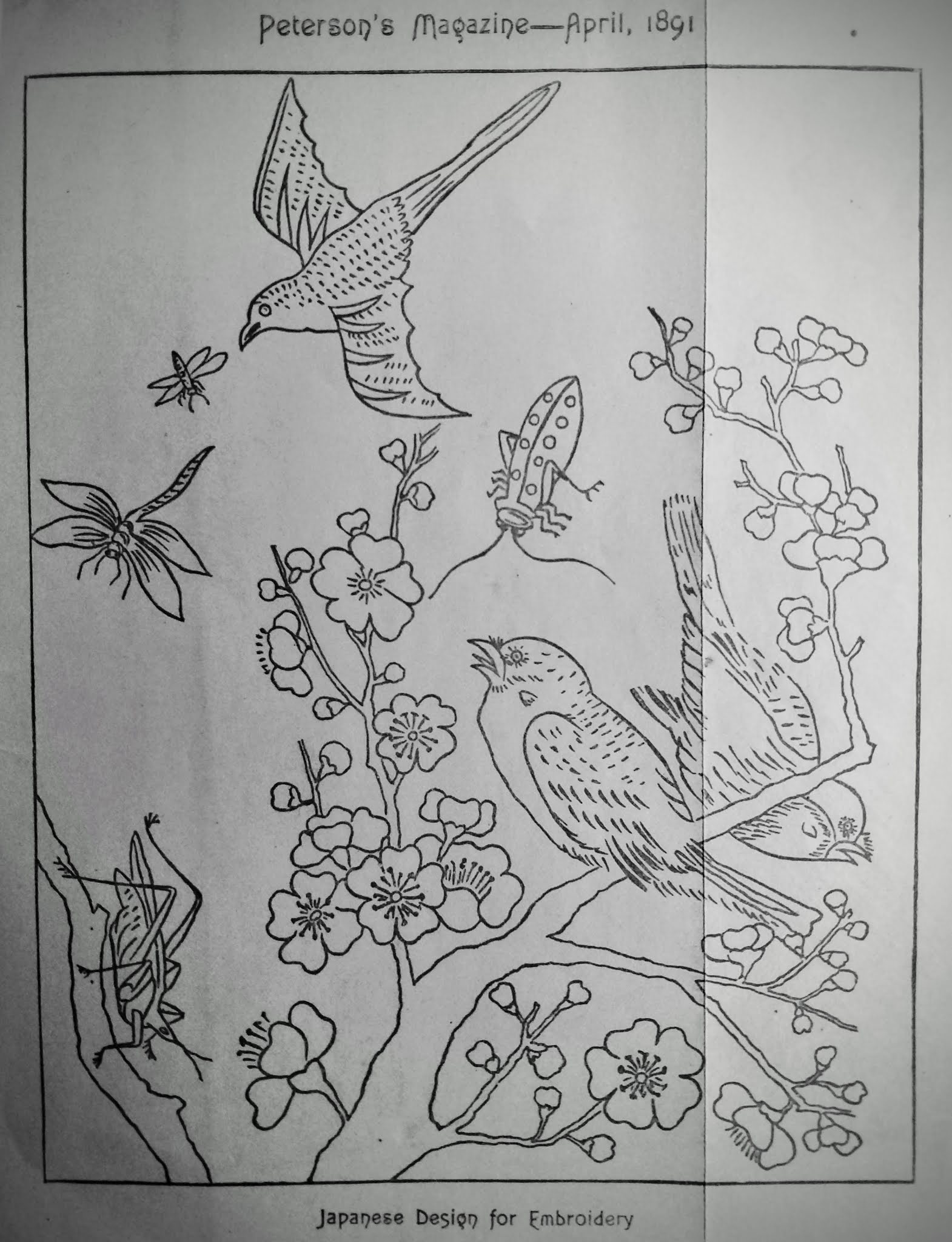
Japanese designs were popular in American decor and women’s publications of the 1880’s — In Japan, the Emperor receives in his palace, and all the high officers of the government are expected to call and pay their respects, wearing their diplomatic dress and all their decorations. They advance to the end of a long, richly-furnished room, where sits the Emperor and the Empress, and bow low and say; “Ake Mashite Omedeto,” or “Happy New Year,” and retire backward until they reach the exit. It is not etiquette for the Emperor to respond. — 1884


“Ake Mashite Omedeto”

Which is Japanese for “Happy New Year”

The Japanese celebrate the incoming of the New Year by four days of visiting and jollification, and have a grand final celebration on the fifth day, by the way of a wind-up before they settle down to fan-decorating and the other occupations carried on by them. It is not without an effort, however, that the celebration is stopped on the fifth day, and there are many who continue their visits until the end of the month, so large is their circle of acquaintances. In this country there are scarcely enough Japanese to enable this custom to be religiously observed, but the few make an effort to emulate the customs nstilled in them by early practice. 

In Japan, the Emperor receives in his palace, and all the high officers of the government are expected to call and pay their respects, wearing their diplomatic dress and all their decorations. They advance to the end of a long, richly-furnished room, where sits the Emperor and the Empress, and bow low and say; “Ake Mashite Omedeto,” or “Happy New Year,” and retire backward until they reach the exit. It is not etiquette for the Emperor to respond. 

Sixteen years ago, before the people rebelled against Tokugawa Yoshihisa and abolished the feudal system, the Emperor sat upon a platform, behind a curtain, which was rolled up when he was ready to receive callers. Now that there is no curtain, he is upon a level with those who call. Among the people, the time is one of great festivity. Everybody calls, and nearly everybody drinks sake, a liquor distilled from rice. When an intimate friend calls upon a person, he is received with great cordiality. When he enters the reception room he drops upon his knees and then sits upon his haunches. A little table is placed before him, and he is served with wine, fruit and ten different kinds of food.

Those not well acquainted, simply hand in their cards. On the first day there is a military review and fireworks in the evening The second day is much like the first. On the third day there is a procession of the volunteer and paid fire companies, which arouses great enthusiasm among the people. On the fourth day there is a slight cessation in festivities, which are renewed and reach their height the following day, when the Emperor gives a reception to the nobles and high government officers, and the people regale each other at restaurants.— Placer Herald, 1884


Etiquette Enthusiast, Maura J. Graber, is the Site Editor for the Etiquipedia© Etiquette Encyclopedia


Tuesday, November 3, 2020

The Geisha: An Exquisite Hostess

                                                                                
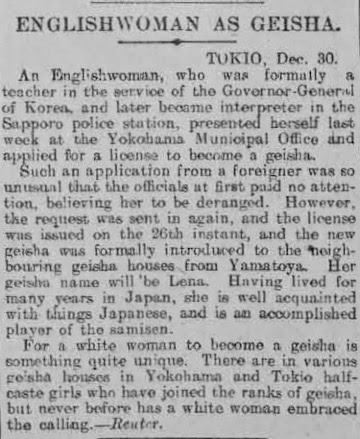
A geisha is a traditional entertainer trained in classical arts such as dance, tea ceremony, and music. In the modern era geisha are understood to be female, but historically there were male geisha as well. In 1913, an Englishwoman applied for a license to become a geisha. There were already many "half-caste" girls who were geisha in Japan, however "Lena" would be the first white woman to hold such a license.  The application was at first thought to be from someone who had to be "deranged," so it was ignored by Yokohama officials. A second application was sent in and she was granted the license on the 26th of December, 1913.


Like ghosts from another time, the real geisha seem to float silently along the streets at twilight, making their way to tea houses and restaurants where they will entertain elite, powerful men.

Trained to be exquisite hostesses, they are accomplished musicians, singers, dancers and most importantly conversationalists. To have a geisha in your company, to be in the presence of a beautiful, articulate, talented companion for the evening, is considered a status symbol. Their clients used to be samurai and shogun. Now it’s politicians, actors and corporate CEOs who hire the geisha by the hour for private dinners at ryotei (traditional Japanese restaurants) and ochaya (tea houses).

They are not courtesans or prostitutes. Before World War II, a geisha’s virginity was auctioned to the highest bidder, but sex is no longer part of the transaction. To be a geisha is to be part of a community, a vocation. They are career women. They are performance artists.

An endangered species, the numbers of real geisha in Japan are dwindling. From a reported 80,000 throughout Japan in the early 20th century, they now number only a few thousand. “In Kyoto, there are about 150 geiko geisha in the local dialect and maiko, geisha in training, left in Kyoto,” according to Anne Alene, an in-country guide for a recent trip to Japan arranged by the Carnegie Museums of Pittsburgh Travel Program.

The group toured the Gion district, one of several historically preserved neighborhoods in Kyoto and the place where the 2005 movie “Memoirs of a Geisha” was filmed. It was based on the novel of the same name by Arthur Golden.

In Kyoto, authentic geisha are not nearly as prevalent as faux geisha young women who dress in traditional Japanese kimono complete with obi, white tabi socks and wooden geta sandals. While they enjoy being stopped by tourists to have pictures taken, wearing traditional ensembles also appeals to the Japanese reverence for ritual and tradition.

“For many Japanese girls, it’s fun to dress up in something they would never ordinarily get to wear,” said Amy Boots, executive director of the Japan-America Society of Pennsylvania.

“I think it might be like doing a Renaissance or Old West-style photo shoot for us.”

Visitors can also give it a try. In Kyoto, there are several places that rent a kimono ensemble or the men’s version, a black kimono with montsuki haori, the short coat over top. 
                                                        
A hand-colored photo of a group of Geishas, 1890
—Photo source Pinterest


“Kimonos have many layers and are difficult to put on without a helper,” said Katsuko Shellhammer, education outreach coordinator for the Japan-America Society of Pennsylvania. “They are also very expensive, and seasonal patterns are important. It can be like wearing a piece of art.”

Department stores in both Tokyo and Kyoto have sections dedicated to kimono wear; you can buy off the rack or have a custom-made kimono and obi from the bolts of material offered. A less expensive option is a used kimono, and there are many stores that deal strictly in pre-owned. Kimonos are often passed down from mother to daughter.

Modernizing the look is all about the material and new, more graphic patterns. Sou Sou, a Japanese clothing company, has taken the plain tabi shoe and sock and covered them in a riot of color and designs. They have also re-imagined other traditional Japanese garments.

Just looking like geisha is not enough for some young women. Turning away from Hello Kitty and the modernity of Japanese life, they make the choice to earn a living as a geisha. Maiko as young as 15 must live in the geisha house, or okiya, learning the nuances of life under the robes and white makeup. The apprentice period lasts between three and five years, during which the okiya and the geisha mother invest in them, paying for lessons and kimonos and providing room and board. Maiko, pronounced MY-ko, are tested before they can advance. At the erikae ceremony, they don the white collar of geisha.

Twice a year, in spring and fall, the public is treated to a display of geisha talents during the Miyako Odori at the theater in the Gion district. The 142nd annual Miyako Odori was held earlier this month during the Carnegie Museums group’s visit. The travelers enjoyed a glimpse into this exclusive world, including a very brief tea ceremony with a complicated etiquette that must become second nature to real geisha.

As the living embodiment of history and fantasy, geisha are not allowed to marry ever. If they do they must leave.

“Geisha and maiko are very special to the Japanese people. They are part of a separate world from ordinary Japanese life,” Boots said. — Pittsburgh Post-Gazette, Kyoto, Japan, 2014


Etiquette Enthusiast, Maura J. Graber, is the Site Editor  for Etiquipedia© Etiquette Encyclopedia 

Wednesday, August 26, 2020

Japanese Chopstick Etiquette

Japanese chopsticks can vary in shape but are shorter and lighter weight than the Chinese version. Those for everyday use are made of woods such as bamboo, pine, cypress and white birch. Chopsticks for more formal use are often slightly longer and made of cedar, ivory or lacquered wood inlaid with abalone or mother-of-pearl.


The Etiquette of Using Chopsticks


Question: I’ve been invited to dinner at a Japanese restaurant and would like to know the traditional customs governing chopstick etiquette.

Answer: The Japanese custom of eating with chopsticks, hashi, was adopted from China almost 2,000 years ago, according to Susan Fuller Slack, author of “Japanese Cooking.” She goes on to explain that chopstick and table etiquette were developed by court aristocracy and Buddhist clergy between the 12th and 15th centuries. Later, during the Edo period (1603-1868), these customs became popular throughout the country.

Japanese chopsticks can vary in shape but are shorter and lighter weight than the Chinese version. Those for everyday use are made of woods such as bamboo, pine, cypress and white birch. Chopsticks for more formal use are often slightly longer and made of cedar, ivory or lacquered wood inlaid with abalone or mother-of-pearl.

Traditional customs still followed today include:

  • At the beginning of the meal, chopsticks are picked up with one hand, then transferred to the other for eating.
  • Ends of chopsticks are moistened before use by dipping them into soup or hot tea.
  • The clean, unused ends are used for taking food from a communal serving dish unless a pair of serving chopsticks is provided for everyone’s use.
  • When not in use, the ends of chopsticks should be placed on special chopstick rests, hashi-oki, pointing toward the left. Do not lean chopsticks against a food dish.
  • Chopsticks should not be scraped together to remove pieces of food.
  • Do not point with chopsticks.
  • Never pass food from person to person with chopsticks.
  • Do not permit chopsticks to stand upright in dishes of food.
 By Joan Drake, Times Staff Writer, 1986


Etiquette Enthusiast, Maura J Graber, is the Site Editor for the Etiquipedia© Etiquette Encyclopedia

Monday, April 13, 2015

Etiquette in Japan's Edo Era


Above: A page from the government-approved morals education textbook 'Watashitachi no Doutoku' ('Our Morals'), for 5th- and 6th-graders, describes behaviors said to be from the Edo Period. In recent years, many Japanese public schools have begun programs teaching Edo period etiquette to the students. The board of education in the city of Moriya, Ibaraki Prefecture, launched a pilot project to teach Moriya shigusa, which is inspired by Edo shigusa, to its elementary and junior high schools. The city has created a booklet that includes 24 “encouraged” behaviors to be used in its public elementary and junior high schools. US government officials in Japan during the Edo period noted the many differences in Western etiquette and Japanese etiquette; "Great inconveniences will of course be experienced by us in furnishing the necessary rooms and accommodations for so large an accession to our numbers, and especially when some will be of the highest rank, and therefore require special attention and conveniences; while all speak an unknown language, and are so unlike to ourselves in dress, in food and in manners. The Japanese, however, are distinguished for simplicity of manners, and simplicity with neatness in dress, and simplicity in diet..." Sources: Japan Times and New York Times

Jeddo, Saturday, Oct. 8, 1859

"You and your readers have been apprised long since, that, according to a provision in the treaty concluded by Mr. Harris between the United States and Japan in June, 1858, two Japanese Commissioners were to be sent to Washington in a national vessel, and at the expense of the United States, the object being to make a good impression upon the Japanese upon their first introduction into the comity of nations, and with whom the United States are destined to conduct an important commerce through the enterprise of our countrymen in California and Oregon. 

It was conditional in the treaty that the Commissioners should leave Japan on the 22d day of February; and as rumors were rife, and universally credited, that the Japanese would never fulfill the condition, it was necessary for Commodore Tatnall to visit Jeddo, and ascertain to a certainty whether the Commissioners would be ready to go at the appointed time, as also to urge an earlier day for their departure, in case they should go, since so much expense would be incurred, and discomfort experienced, by the officers and crew of the Powhatan, should their long-cherished hopes be blasted. For these reasons, leaving Shanghai Sept. 17, we cast anchor before the great and unknown City of Jeddo, Wednesday, Oct. 5, having stopped a few days at Nagasaki.

Daimyo were the most powerful feudal rulers from the 10th century to the middle 19th century in Japan, and were subordinate only to the Shogun. 
Having spent some days under the hospitable roof of Mr. Harris, I have learned all the particulars respecting the Commissioners and their future movements. There are two parties in Japan -- the Progressives and Old Fogies; the men who are attached to the institutions, the customs and the non-intercourse policy of their fathers; and others who see advantages in commerce and intercourse with other nations, or else think it is better to yield gracefully to circumstances, and freely do what they soon must do from necessity. The Emperor is always a mere cypher, and now is a boy only 16 years old, but in fact as important and influential as other Emperors, however venerable the age they attained. A Council of six members is selected from the hereditary princes, of whom there are 360, who are to the Japanese government very much what the House of Commons is to the English. The Emperor may select his Council of State from these Daimais (sic), or princes, and they may pursue the course they please, but unless it also pleases the Daimias, and they refuse to sanction it, the Emperor is obliged to dismiss them and appoint others.
Townsend Harris was a minor politician, a successful NYC merchant, and the first United States Consul General to Japan. He negotiated what is known as the "Harris Treaty" between the US and Japan. He is credited as the diplomat who first opened the Empire of Japan to culture and foreign trade during the Edo period in Japan, 1603-1868. After learning that the Japanese had a large group of men attending to them during the negotiations, Mr. Harris explained that American taste and etiquette are unlike Japanese, and that even our greatest men had no retinue so large.
When the treaty was proposed it encountered violent opposition in the Council, though it was finally sanctioned; while the majority of the Princes denounced it on all occasions, some of them declaring, as they touched their hands to the two swords which every one always carries, that it would be better to perish manfully, standing by the sacred institutions and policy of their fathers, than to open their beautiful and happy country to foreign nations, of whom they needed nothing, as centuries of seclusion had shown, when they had whatever immaterial things their wants required, and, besides, uninterrupted peace and safety. The Emperor, like Queen Victoria, was obliged to succumb to the tempest his Ministers had raised, and, dismissing them, appoint a new Board from the opposite party. Opposed, as the new Cabinet is, to the policy of the treaty, they feel obliged to observe it, which is a circumstance highly in commendation of their integrity; and when Mr. Harris inquired of them, the other day, at the request of Com. Tatnall, whether the two Commissioners would proceed to the United States under his flag, they replied that two new Commissioners had just been appointed, who would certainly be ready to embark at the specified time, but not sooner.

At first, 81 persons of different classes had been appointed to accompany them, of whom two were censors, or, in other words, spies upon the Commissioners, two lieutenant-governors, eight generals and colonels, two interpreters, or Japanese, who can speak Dutch, and perhaps some little English, two physicians, and forty servants. Mr. Harris told them that American taste and etiquette are unlike Japanese, and that even our greatest men had no retinue; so large a suite would, therefore, in no measure contribute to the honor of the Commissioners, but probably, on the contrary, would be an annoyance and disadvantage to them. They informed Mr. Harris that they had struck off ten from the list, and we earnestly hope that there will be a still greater reductio ab absurdo (or "reduction to absurdity".)

Great inconveniences will of course be experienced by us in furnishing the necessary rooms and accommodations for so large an accession to our numbers, and especially when some will be of the highest rank, and therefore require special attention and conveniences; while all speak an unknown language, and are so unlike to ourselves in dress, in food and in manners. The Japanese, however, are distinguished for simplicity of manners, and simplicity with neatness in dress, and simplicity in diet; and we hope to make a pleasant voyage with them across the Pacific to Panama, where they will cross the Isthmus and take passage in a vessel provided by the Government. In the meantime we shall be making our way around the Horn, and hope for a pleasant reunion with our Japanese friends on our own soil. May our country prove to be as interesting to them as theirs has been to us.

Leaving Jeddo in a few days, we shall run down to Shanghai and Hong Kong, and having taken in coal and provisions, return to this port, and, making all the necessary arrangements for the accommodation of the Japanese dignitaries and attendants, be ready to take a last farewell of Japan and its unequaled scenery on Feb. 22, at the first gleam of morning. We now seek the rising and not the setting sun."

Examples of Edo Era Etiquette in Japan


One example of Edo-style etiquette advocated is kasa kashige (umbrella-leaning), the practice by people passing others on a narrow street to tilt their umbrellas slightly away from each other to avoid getting others wet.

The compassion demonstrated in kasa kashige is at the root of Edo shigusa. But it’s not about imposing a certain behavior on people. . . . It’s about having the mind to care for others . . . (to) show compassion for others.

The merchant practice of kobushi ukase, which refers to the behavior of moving over on a bench to make space for others.

Proponents believe these traditions, which are not documented on paper and have been handed down only verbally, were on the brink of extinction until a man known for his pseudonym Mitsuakira Shiba, whose background is little known but who, legend has it, was a descendant of an Edo merchant, started a campaign to restore the Edo Period practices in the 1970s, based on what he had heard from his grandfather.

Some say Edo-style etiquette is not backed up by historical evidence, and that teaching such behavior as if it were a part of the nation’s history may distort Japanese moral education, which includes teaching not to lie to others.

“Lessons of Edo shigusa are indeed ethically sound . . . but that doesn’t mean they can tell a lie,” or otherwise children may mistakenly consider lying is OK as long as it is good for people, said Minoru Harada, an author and independent researcher of pseudohistory.
Source ~ Japan Times


Etiquette Enthusiast, Maura J. Graber, is the Site Editor  for the Etiquipedia© Etiquette Encyclopedia.  

Friday, November 21, 2014

Japan's Etiquette and Customs— A Victorian View

A wealthy Japanese man and his servant.

The following describes the contents of a letter from 1859 in New York, detailing to someone, the "peculiar" etiquette and customs of the Japanese people.

"In some respects they appear to be more virtuous than people boasting of a higher civilization. Malversation by a functionary, embezzlement of public funds, extortion, bribery of officials, coining of false money, murder, and robbery, are punished with death, and not only of the guilty person, but of his father, children, and even all of his male relatives, who are executed at the same moment, however distant they may be from one another. This system, which is repugnant to European notions, and to sound principles of justice, appears to be adopted by the Japanese from the belief that crime is owing to bad education.

The modes of punishment adopted in Japan are of different sorts, but all are horrible. The principle is crucifixion, and is reserved for traitors, murderers and incendiaries. The culprit is fastened on the cross head downwards, and is left to die, unless he obtains the favor of being dispatched by stabs from a poignard. For parricide and adultery, culprits are plunged into boiling oil. Petty robberies, insults, calumny, fraud, even at play, and false testimony before magistrates, are punished by hanging or beheading. If the offenders be a gentleman or soldiers, their bowels are opened -- they have even the privilege of performing the operation on themselves. Pecuniary fines are almost unknown. The corporal punishment of the whip and the bastinado are reserved for slaves and servants, and are inflicted by their masters, not by public executioners. The Japanese consider corporal punishment so degrading that mothers never strike their offspring.


Depiction of a young Japanese woman, being dressed by her servants.
The climate is enervating, yet children are brought up hardily. They are made to bear hunger, thirst, cold, pain, excess of labor, and the rigor of the seasons. Horror of falsehood and fraud, and love of modesty, justice, and virtue are diligently inculcated. One of the results of the system of education is to inspire the Japanese with a passion for books which causes surprise in European visitors.

The bookselling trade in Japan is subjected to no restriction, and they're everywhere, even in towns of small population, numerous bookshops. Great parts of literature of the Japanese is Chinese; and their knowledge of arts and agriculture is derived from the same people. The language commonly employed is every year becoming more Chinese in character. And yet the Japanese despise the Chinese; they do so because from their early age they have been taught that the Chinese are not soldiers; that in ancient times a Japanese army defeated an immense Chinese army in the Corea; and that Coxinga himself, who is the scourge of the sea and the terror of the Chinese Empire, it was a Japanese -- as were also the greater part of his companions."


Etiquette Enthusiast, Maura J Graber, is the Site Editor for the Etiquipedia© Etiquette Encyclopedia

Tuesday, August 12, 2014

Etiquette for Geisha Watching in Japan

According to JapanVisitor.com, "camera-wielding tourists" have become much more aggressive in stalking Kyoto's geisha.

Sadly, a stigma has been placed on Japan's geisha since World War II. Some believe geisha are simply glorified prostitutes. They are not. Geisha’s are artists and were originally men. The women are entertainers who train vigorously in art, music and dancing. Translated into English, "geisha" means "artist."


Geisha (or geiko in Kyoto dialect) are truly professional entertainers who attend to guests and put them at ease during meals, banquets, or other occasions. They are trained in various traditional Japanese arts, such as dance and music, as well as in the art of communication. Their role is to make guests feel welcome with conversation, drinking games and dance performances.
World War II brought a tremendous decline in geisha arts as most women had to go to factories or other places to work for Japan. The geisha name lost some status during this time also, due to prostitute referring to themselves as "geisha girls" to American military men after the war.

Geisha can be found in several cities across Japan, including Tokyo and Kanazawa, but the former capital of Kyoto remains the best and most prestigious place to experience geisha, who are known there in the local dialect as geiko.

Five major geiko districts (hanamachi) remain in Kyoto. Four of them, Gion Kobu, Gion Higashi, Miyagawacho and Pontocho, are located in or around the Gion district in central Kyoto, while the fifth, Kamishichiken, is located near Kitano Tenmangu Shrine.

A geisha is a traditional entertainer trained in classical arts such as dance, tea ceremony, and music. In the modern era geisha are understood to be female, but historically there were male geisha as well. In 1913, an Englishwoman applied for a license to become a geisha. There were already many "half-caste" girls who were geisha in Japan, however "Lena" would be the first white woman to hold such a license.  The application was at first thought to be from someone who had to be "deranged," so it was ignored by Yokohama officials. A second application was sent in and she was granted the license on the 26th of December, 1913.

To combat the pushy foreigners who wish to get photos and meet geisha when visiting Kyoto, Japan, patrols have been created. They are to protect them and escort geisha from tea house to tea house. Some common sense, respect and restraint, on the part of tourists can easily solve this growing problem.

When visiting any of the areas where one will find Geisha, try to keep the following etiquette in mind:

1. Geisha are not costumed characters like at Disneyland, and the tea houses where they work are not theme parks. 
2. The geisha are working. They are not there to pose with you for photos. They are most likely on their way to appointments. They are on a schedule. Stay out of their way.
3. Never touch the geisha. It takes many hours for her to get dressed and prepare for an evening.
4. Do not follow geisha. They are not prey to be stalked.
5. Do not enter a tea house or private residence unless you are expected there.

6. Respect body space. Do not push your camera inches from a geisha's body or face.
7. If you have a brief opportunity, take a photo or video and then move on.


From several sources, including ImmortalGeisha.com and JapanVistitor.com

Etiquette Enthusiast, Maura J. Graber, is the Site Editor  for Etiquipedia© Etiquette Encyclopedia 

Sunday, July 6, 2014

Japanese Etiquette, Customs and Manners

Bowing, bathing, greeting, eating, and all manners of established codes of conduct... 

Have you ever tried to shake hands with a Japanese only to be bowed at instead? Or have you suffered disdainful looks when you blew your nose in public, or dunked your towel in a hot springs bath, unaware you are breaking social codes? 

Japan’s many rules of etiquette may bemuse foreign visitors, while for long-term residents mastering them is a key part of embracing the culture. So what constitutes Japanese etiquette, and how do foreign residents and experts view such manners? Following are questions and answers: 

What is included in everyday etiquette? 


Posted notices and warnings against various perceived antisocial behavior are commonplace. People riding trains are advised not to take up more than one seat and are urged to refrain from talking on a cell phone or playing loud music. 

Most “onsen” (hot springs baths) ban swimsuits, advise guests to rinse themselves off before entering the bath and in cases of mixed bathing not to stare or flash oneself in front of others. But many basic social codes provide no posted directions, requiring foreigners to learn by observation and that old standby, trial and error. 

Don't do this shown above ~ If you are supplied with chopstick rests, use them instead of resting them on your bowl or other food dish. "Chopstick rests" are little ceramic objects that you rest the ends of your chopsticks on when you put them down. Also, don’t let liquids drip from your chopsticks. It can soil the table.

Put your chopsticks on the rest provided ~ If you're invited to a formal multicourse Japanese feast, remember not to stir your food with your chopsticks. It's considered an insult to the chef, or the cook, unless you're eating natto gohan (fermented soybeans on rice with a "powerful smell and slimy consistency") that is a Japanese breakfast staple.
The handling of chopsticks can be a minefield of faux pas. A guide put out by JAL Academy, a firm created by Japan Airlines to coach businesses on etiquette, directs users to first “hold the chopsticks horizontally and pull the chopsticks apart slowly, over your knees.” The book “Japanese Manners Read in English” advises never to use a chopstick to impale a food item, pass it from chopsticks to chopsticks or stick chopsticks into food in a bowl so the ends are pointing up. The latter is associated with the dead and food for the final journey. Licking one’s chopsticks is also taboo, as is waving them over food while deciding what to eat, or around while talking, the guide says. 

Bowing is also a key practice, and the degree of bending depends on the occasion. According to JAL Academy, a 45-degree bow is customary when meeting someone deemed to be superior, or to show gratitude or to apologize. A 30-degree bow is appropriate for greeting visitors or first-time acquaintances, while a 15-degree dip will suffice for a casual hello in the hallway, the book says. 

Other advice found in the guide includes keeping conversations short during initial greetings and, when visiting someone’s home, refraining from poking around in cupboards, bookcases and other personal areas — the latter taboos not being so uniquely Japanese. 

What constitutes formal etiquette? 


In addition to social codes of behavior for formal dinners and religious ceremonies, there is the practice by adults of gift-giving, which many in Japan actually consider a headache. 
"Gift-giving is extremely important in Japanese society, not only at personal and household levels, but at the national and macroeconomic levels as well." ~ Katherine Rupp.  Pictured: Boston Red Sox pitchers Koji Uehara (second from left) and Junichi Tazawa present a Boston Red Sox jersey to U.S. Ambassador to Japan, Caroline Kennedy

Gourmet food, sweets or alcohol may be given to relatives and colleagues at the turning of seasons and on special occasions. There are informal guidelines on how much money to spend on initial offerings based on the importance of the recipient, and then on return gifts. Gift-giving is not always simply a gesture of gratitude or thoughtfulness, as it can have parallels with bribery, according to Katherine Rupp, a lecturer in anthropology at Yale University. “Not only do individual Japanese people spend a lot of time, worry and money on gift-giving, but gift-giving is also a crucial part of the overall workings of the macro-economy,” she writes in “Gift-giving in Japan.” Rupp points to the subtle undertones that personal gifts to bosses or doctors, or presents given by industries to bureaucrats or politicians, may have in persuading the recipient to act to the giver’s advantage. 

How would social codes be characterized?


Like other countries, Japan’s social codes “lie somewhere between conscience or self-expression and the law,” according to Isao Kumakura, a professor emeritus at the research institute of the National Museum of Ethnology in Osaka. “Even if you are alone, there is a feeling that somewhere someone might be watching,” and this feeling is particularly strong in Japanese, he writes in “Manners as Culture” (“Bunka to Shite no Manaa”). 

According to Kumakura, Japanese etiquette has roots in the rituals of tea ceremony and martial and creative arts, although such customs were exclusive to the upper class until Japan opened its doors to the West in the mid-19th century. 

To appear sophisticated in Western eyes, commercial centers like Tokyo, Yokohama and Osaka established regional laws that imposed codes of conduct between samurai and commoners, he writes. These laws prevented men from urinating in public, and workers from walking naked to public baths carrying a change of clothes, a common habit as they did not want to change while they were still dirty from the day’s work, Kumakura explains. In modern times, instruction manuals on manners tend to focus on business situations rather than the home or society. 

How do foreign residents and experts view Japanese manners? 


Helmut Morsbach, an adjunct professor of psychology at Temple University Japan Campus and a long-term resident, writes in his book “Customs & Etiquette of Japan” that many Japanese drastically change their attitudes once they are outside their comfort zone. Such a strict adherence to social codes may indicate that, as Morsbach says, “traditional etiquette continues to be extremely important, despite whatever outward appearances of ‘Westernization’ the visitor may experience.” 

But Ronald Dore, a professor at the London School of Economics specializing in Japanese society, stresses that foreigners should not feel compelled to master Japanese etiquette, only demonstrate an attempt at it in a relaxed, open manner. “It is a perfectly viable strategy to profess a combination of total ignorance of Japanese manners and a total willingness to be instructed, and sometimes it can even be the best strategy,” rather than becoming anxious and creating tension, he says in the foreword to Morsbach’s book. 

For business settings, a common scenario for foreign visitors, Morsbach’s tips include don’t make eye contact too strong during a conversation, don’t point with a finger and don’t mistake a smile camouflaging hesitation to mean an agreement. 


Does everyone adhere to these codes? 


No, says columnist Takashi Matsuo, who insists many Japanese find such strict rules stifling. “Although it’s a country that values manners, many Japanese themselves in fact feel a kind of stiffness, and perhaps (Morsbach) isn’t aware that there are many people who want to forget such social rules and interact with people in a frank and open way,” he writes in a commentary inside Morsbach’s book. 

But some observers see an antisocial side to this relaxed mind-set, and claim anonymity in large cities and online is making people less concerned about appearing rude. “Modern Japan has been eliminating society from around them,” Kumakura says. “The fun of anonymity and the fear of losing manners are in conflict with each other. Now this has become a daily norm, and with the rise of the Internet, we ignore manners because of anonymity and abuse our rights.” 


The main article originally appeared in Japan Times, by Mariko Kato, in January, 2010 


Etiquette Enthusiast, Maura J. Graber, is the Site Editor for the Etiquipedia© Etiquette Encyclopedia
Friday, May 2, 2014

Etiquette and Japan's Politeness Police

In 2008, in Yokohama Japan, officials decided to recruit the "Smile-Manner Squadron" to guide the way on the city's packed trains, and bring back standards of "Old Japan."
In Yokohama, the Smile "politeness police" on the trains will make you give up your seat for elderly, injured, or pregnant passengers if you don't get up of your own accord. 
Metro trains are one of the prime spots for bad behaviour in Japan

By 2008, badly behaved commuters riding on Yokohama's public transport were suddenly risking a dressing-down.

Newly appointed "etiquette police" were asking travellers to turn down their headphones and give up their seats for their elders and betters.

The move came amid growing concern that etiquette was losing its hallowed place in Japanese society.
In Yokohama, as in many other large cities around the globe, metro trains are one of the prime spots for bad behaviour.

A 2008 poll found nearly nine out of ten respondents felt that the standards of public behaviour in Japan had declined.

This perceived lapse included failing to offer your seat to pregnant and elderly people, applying make-up in public, chatting loudly on mobile phones and listening to music on "leaky" headphones.

A prime hang-out for violators was identified as Japan's jammed commuter trains.
Nobuhiko Obayashi, a 70-year-old author of Why don't young people give their seats to the aged? said parents were to blame for the loss of manners and society had bred a generation too afraid to talk to one another."Young people do not feel the need of having manners in their hearts," he said. "The experiment will give people who are too shy a chance to communicate." 
Ways of showing respect have become rituals in Japan, so to try to curb some of the bad behaviour, the transport authorities in Yokohama - a port city south of Tokyo - appointed a team of manners enforcers, the Smile-Manner Squadron.

The team, mostly made up of over-60s, were well acquainted with the standards of conduct associated with the "old Japan".

But many of these enforcers were accompanied by younger bodyguards, should their etiquette advice - diplomatically given, of course - not prove welcome.
Taizo Kato, a psychologist at Waseda University, said that Yokohama's creation "symbolises the collapse of the Japanese mentality and shows that we have reached a point where citizens are not aware of basic human manners".
The team members, identifiable by bright green uniforms, never had legal powers to insist that their advice was accepted by recalcitrant passengers.

But backers of the scheme hoped their refined social skills meant they will be able to charm - or shame - culprits into reforming their ways.