Showing posts with label Place Setting Etiquette. Show all posts

Friday, May 29, 2026

Service Plate Etiquette

Image from the book, “Reaching for the Right Fork”


Removing Service Plate is Simpler and Quicker


ACCORDING to correct (formal) service, the service plate is removed with either fruit-cocktail glass, or soup plate, and exchanged for a clean plate known as an “exchange plate,” because this in turn should be exchanged for any plate with food on it. But since a kitchen-served meat and vegetables is not admitted at a formally-served dinner, an exchange plate would seem strangely out of place. Therefore, the answer is to do what is most expedient. This probably would be to remove service plates and whatever may be on them, (one double stack in each hand), and bring in the filled ones (one in each hand). 

Above, another look at silver service plates. — Photo of page from an early 1900 book on proper place settings, by Wallace Silvermiths.

This answer is to the question: “When the main course of a meal is served on plates in the kitchen and brought in by the maid (which is often done these days in this part of the country) should the service plate be removed at the time that the fruit cocktail or soup is removed, or should the place plates be left standing and only the first course removed, and the place plates be lifted as each hot plate with the main course is put down?”
As I already have said, it would seem simpler as well as quicker to remove service plate and whatever is on it and leave the place bare until the already filled, hot plates are put down. This is a “practical” service suggestion, in contrast to that which is “formally” correct." — Emily Post, 1941


🍽Etiquette Enthusiast, Maura J. Graber, of The RSVP Institute of Etiquette, is the Site Editor for the Etiquipedia© Etiquette Encyclopedia

Sunday, March 16, 2025

A Unique Opportunity for Our Readers


Join Etiquipedia Site Editor, Maura J. Graber, and Contributor, Elizabeth Soos, for a Unique Online Opportunity in April!

Online Event: Zoom
Type: Group
Course Overview:

Join us for a unique opportunity to enhance your etiquette knowledge and have your questions answered. Author, teacher and etiquette historian, Maura J. Graber will be joining Elizabeth Soós of Auersmont Etiquette for an online seminar in which they plan to enlighten, educate and entertain with the true reasons our dining etiquette rules exist, the history of the rules and the backstories behind them.

Course Contents:

This 2 hour course is designed for individuals of all backgrounds and professions, especially those in the field of etiquette! Attendees to this online seminar will discover how increasing one’s knowledge of etiquette can assist in making one more prosperous in business and social endeavours. We live in a world of many “Whys.” Why not join in the discussion?

Questions Which Need Answers:

Please submit any questions you have about dining etiquette, as the course will be tailored to address them. Please be as specific as possible in your questions. All questions must be submitted by April 15, 2025, via this link: Google Forms https://forms.gle/DXbMfA3LFvsc...

Examples of questions: 

What practical reasons lie behind the specific materials used in utensils for serving or spreading one’s caviar? 

When did handles appear on tea, chocolate or coffee cups? Some etiquette professionals say handles were not placed on cups before the early 1800's, but others say this is wrong.

Why is it best to keep one’s elbows off of the table? Was this ever an actual etiquette rule? Why was it taught?

If I have utensils above the plate for dessert, does it matter which utensil is placed above or below the other utensil? I read the spoon needs to go above the fork. Is this true?


Course Curriculum:

  • Introduction 'Where Etiquette Meets History'
  • Module 01: Understanding the Differences Between Etiquette & Manners 
  • Module 02: Popular Etiquette Myths and Troubling Trends 
  • Module 03: Understanding Table Ware 
  • Module 04: Navigation of a Multi Course Meal, the Place Setting & Utensils 
  • Conclusion: Concluding Remarks and Question Period with Participants

Certificates:
Certificate of completion - Digital certificate included.

Accessing Course Recordings for Review:
Do you have a scheduling conflict? You can always watch it at your leisure another time. A link will be sent to you a few days after the seminar.

As a beginner, is this event suitable for me?:
Beginners are welcome, and we hope that you enjoy the event.

Event pricing:
Pricing will be set as AUD - Australian dollar.

Where are my course emails? And will I be notified about the course before it starts?:

Please check your spam, or other folders that your email account might have forwarded to. We send a series of emails via Humanitix every week leading up to the event.


🍽️Etiquette Enthusiast, Maura J. Graber, is the Site Editor for the Etiquipedia© Etiquette Encyclopedia

Friday, December 29, 2023

Winning Place Settings from 2023

💂🏻‍♂️👑 🍽️ 💂🏻👑🍽️ 💂🏽👑🍽️ 💂🏻‍♂️👑🍽️ 
Presenting the Third Annual Etiquipedia International Place Setting Competition 
Favorites for 2023
💂🏻‍♂️👑 🍽️ 💂🏻👑🍽️ 💂🏽👑🍽️ 💂🏻‍♂️👑🍽️

Etiquipedia and Auersmont School of Etiquette and Protocol are happy to announce the winners have been chosen for the 3rd Annual Etiquipedia International Place Setting Competition!  

In honor of the late, great, Queen Elizabeth II and the new King Charles III and Queen Camilla, we made it a very British competition.

We hope to be posting the individual stories of the winners from 2023 shortly, but until then we are posting these photos of our favorite entrants’ tables.

There were some beautiful, elegant, period correct and colorful tables to choose from, along with some truly inspired menus.

Check back with us in 2024 to read all about the winners and their beautiful tables!


Congratulations to all the entrants and winners! 


🍽Etiquette Enthusiast, Maura J. Graber, is the Site Editor for the Etiquipedia© Etiquette Encyclopedia

Tuesday, June 20, 2023

The “Why” of Our Table Setting

Reduced to its simplest terms, arranging the flat silver is only a matter of placing it in the order of use, so that as he picks up the implement for each course, the diner will be working from the outside in.

Table setting is a simple enough procedure if you understand that the silver is placed as conveniently as possible for the user. Once you have decided on the menu and the silver to be used for each course, begin setting the table by spacing the place plates. Allow about thirty inches to each cover. And naturally if the table is larger, the places will be a little farther apart.

Reduced to its simplest terms, arranging the flat silver is only a matter of placing it in the order of use, so that as he picks up the implement for each course, the diner will be working from the outside in. Following this rule, you will have at the left the fish fork, the meat fork, and, nearest the plate, the salad fork. At the right: the soup spoon, fish knife, and, nearest the plate, the meat knife. The cutting edges of the knives should be turned in to face the plate. For the placing of flat silver see the sketch above.

Convention has decided, broadly, that soup spoons and knives go on the right of a plate because they are used primarily by the right hand, and forks on the left because as long as their fellow utensils, the knives, are in action, they are left-hand implements. If you eat according to the English method, as many Americans do, you do not change your fork to your right hand while there is anything on your plate to cut. You use the two implements continuously during the meat course. 

If, however, you prefer to eat according to the American method laying down the knife every few minutes and transferring the fork to the right hand-there is no rule against doing so; it is a manner of eating upheld by many. Of course, when a fork is the only implement necessary, it is always held in the right hand.– From “Table Setting and Service” by Elizabeth Barnard, 1935


🍽Etiquette Enthusiast, Maura J. Graber, is the Site Editor for the Etiquipedia© Etiquette Encyclopedia

Thursday, April 6, 2023

Water Glass Etiquette Advice 1930’s

From the left: the dinner napkin, the dinner fork, the service plate. The service plate would be removed, when the main-course is served, as there is no first course with this menu. On the right: the dinner knife. The water goblet is placed above the knife, and the white wine glass is placed slightly forward and to the right. The dessert fork and fruit knife are placed above the setting. The dessert flatware could also be brought in on the dessert plate. –Image source St. Andrew’s Dining Society, 1990

 
Q. When setting the dinner table, where should the water glass and the wine glass be placed?
A. Place the water glass at the top of the plate, towards the right of the knives, the wine glass to the right and beyond the water glass.

Q. When filling the water in glasses at the dinner table, how much water should be poured in each glass?
A. The glass should be two-thirds full, never more. 
Q. When a dinner guest overturns a glass or cup, what should he do?
A. If water, soup or coffee is spilled, the guest makes brief, low-voiced apologies to his hostess. The guest should not be too profuse in his apologies, as this is very bad taste.
Q. How should one use the dinner napkin?
A. The napkin should be used to wipe the mouth before using the waterglass; this will prevent smearing the glass. It is also used to dry the fingers, particularly after using the finger bowl.  
Q. When a maid is refilling a water glass at the table, should she pick up the glass while pouring the water ?
A. No. She should be skillful enough to fill the glass where it stands, without touching it. – By Roberta Lee in “Modern Etiquette.”, 1930’s


🍽Etiquette Enthusiast, Maura J. Graber, is the Site Editor for the Etiquipedia© Etiquette Encyclopedia

Wednesday, June 8, 2022

Etiquette of a Romantic Repast

Table by Mrs. William Sarnoff from the 1981 book, “The New Tiffany Table Settings” — The gold and white setting has the gilded flatware turned upside down, in the French fashion. The stemware is in the American or British fashion, and not lined up above the dinner plate. It is in a small triangular cluster. Placement of the champagne saucer is is incorrect for this setting, unless the order is with a water glass first, then a champagne, then a red or possibly rosé, or white wine. It’s possible that the soup is being served with the champagne, but that is unlikely.


The monarchical decor of the Hapsburg Court, its red velvets, its white satins, its gold laces and embroideries, and its jewels, are recalled by Mrs. William Sarnoff in this intimate dinner whose multiple richness of elements burgeons with the romance of things past.

Mrs. Sarnoff's state portrait by the court painter Winterhalter of the beautiful young Princess Elizabeth of Hungary and the Two Sicilies sets the tone. Colors are restricted to the Hapsburgs’ red and white. An antique gold lace scarf from Mrs. Sarnoff’s family decorates the satin-covered table set with “Chrysanthemum” vermeil turned down in the European fashion, gold and white “Sheffield” bone china, “Antoinette” cut crystal, and Royal Berlin birds. 

A leaf-shaped vermeil ravier holds a ruby and diamond ring tied into pearl lariats, all by Tiffany jewelry designer Angela Cummings and all reminiscent of the jewels worn by the Princess Elizabeth in her portrait. Black lacquer side tables hold a bouquet of red silk flowers and a nineteenth-century black lacquer birdcage.— The New Tiffany Table Settings, 1981
There are wine and roses and candlelight, and Viennese waltzes in the background.


🍽Etiquette Enthusiast, Maura J. Graber, is the Site Moderator for the Etiquipedia© Etiquette Encyclopedia

Thursday, May 26, 2022

Place Setting Etiquette

Lay the silver so that the piece to be used first is always on the outside. The piece or pieces for each succeeding course should follow in logical progression of use. — Above is a mid-century modern setting featuring the Franciscan Ware “Desert Rose” patterned tableware with the 1940 Grille Flatware in the “Treasure” pattern.

The Individual Place

Place plate: Mark each individual place with the place (as frequently called “service”) plate. If you have no special plates for the purpose, use a regulation dinner or luncheon-size plate. Space the plates evenly. See that those that you intend to have opposite each other are really opposite each other. The plate should be set just far enough in from the edge of the table so that it will not slip off. A plate at each place is standard table setting except at the most informal meals. Special service plates are nice if you can afford them but any sizable plate will do.

Silver flatware: Lay the silver so that the piece to be used first is always on the outside. The piece or pieces for each succeeding course should follow in logical progression of use. This brings the silver to be used last closest to the plate, which generally is the silver for the salad course.

Lay all silver pieces in a neat parallel arrangement, with the tips of the handles in line with the edge of the service plate and far enough back from the edge of the table so that they are not easily brushed off. They should be laid close enough to each other and to the service plate, yet without crowding, to give a feeling of unity to the complete place setting. Sprawling silver is a pretty sure indication of a careless hostess.

Silver used in the left hand lies at the left side of the plate; that used in the right hand at the right of the plate. In other words, forks are at the left, knives and spoons are at the right.

The oyster fork is the exception to the above rule. It is used in the right hand only and quite naturally lies at the right of the plate. The cutting edges of the knife blades are turned toward the plate.

Whatever your menu, there should be no more than three forks at the left of the plate and three knives at the right on a well-set table. This is a matter of taste and good usage. If the menu requires more knives and forks, they should be brought as needed. Dessert silver is brought later with the dessert service or may be laid at the top of the plate for an informal luncheon or dinner.

 —From “Setting Your Table... Its Art, Etiquette and Service,” by Helen Sprackling, 1960


🍽Etiquette Enthusiast, Maura J Graber, is the Site Editor for the Etiquipedia© Etiquette Encyclopedia


Thursday, May 20, 2021

Laying the Gilded Age Table of 1895

Handsome linen will give elegance to a table where ornamentation is very simple. It should be ironed without starch, or with a very little if it is not sufficiently heavy to take polish without it. It should be folded perfectly square, so that the lines will be straight, and should be of spotless and dazzling whiteness. With this as a basis, there will be no difficulty in making an attractive table.


The Table– A round or square table five feet across is a convenient size for ordinary use, giving ample room for six people, and leaving space for decoration. Large round tops are made to fit over extension-tables, which will seat from twelve to twenty or more people; and when the size of the room will permit, this is the pleasantest form of table for entertainments, and best lends itself to decorative effects, giving to each person a complete picture of the table and of the company assembled.

The Linen– A thick cotton material, which is made for the purpose, for interlining between table and cloth, is the first requisite in laying the table, and should always be used. It protects the polished surface of the table from injury, gives a more brilliant whiteness to the cloth, and prevents any noise when placing the china and silver upon the table. The linen should be as fine as the purse will allow. 

Handsome linen will give elegance to a table where ornamentation is very simple. It should be ironed without starch, or with a very little if it is not sufficiently heavy to take polish without it. It should be folded perfectly square, so that the lines will be straight, and should be of spotless and dazzling whiteness. With this as a basis, there will be no difficulty in making an attractive table.

In the way of linen, much taste may be shown in the ornamental pieces used in the center of the table. These may be of any shape or size desired, from a small square to a long scarf. They may be of embroidered linen, drawn-work, lace, plain silk or satin; but wash materials are preferable, and effects of color, when desired, can be obtained in the embroidery or linings. The attractiveness of these pieces depends on their daintiness. The fashion of a center-piece of linen is, however, a passing one, as they are not at present so generally used.

The Order of Laying the Table– After the interlining has been spread, the cloth should be laid with great care, making the center fold run perfectly straight with the room, and the cross fold again exactly divide the table at right angles to the other crease. By these straight lines, everything else is gaged. The fancy linen piece is next laid, and its center must coincide with that of the cloth. If the piece is square, it sometimes has better effect to place the points on the long lines of the cloth, giving it a diamond shape; this, however, is a matter of fancy. The center ornament is then placed on the exact point where the folds of the cloth cross in the middle of the table.

The plates are next put in position, attention being given to the decoration on the china, if it be a monogram that it is right side up, if flowers that they are in natural position, etc... Where there are an uneven number of covers it is better to place the plates at equal distances around the table, without regard to the place of the hostess being opposite to that of the host. In other cases, the plates at the head and foot of the table, and those on the sides, should be directly opposite each other. Under no circumstances must the plates be omitted. 

On the left of the plates place the forks; three or four may be put on and laid in the order in which they will be used. Three knives (one of them being a silver knife for the fish course) and the oyster fork are placed on the right of the plate; the soup spoon may go in front of the plate or with the knives on the right; the bowls of the forks and spoons should be right side up, the edges of the knives turned toward the plate.

After the plates and small silver and cutlery are in position, the decorating of the table should proceed as far as possible. The position for everything can be best determined after the plates are laid. The perishable articles, that cannot be put on until the last moment, can usually have their position located by the compotiers or the bonbon dishes which will hold them. Uniformity is not required in having two or four of these dishes to match, but such ornamental holders as are used must be placed in uniform positions, so as to balance and harmonize. Any deviation from this rule, or neglect of the small details in placing the table furniture, will give the effect of a disordered table.

Lights– The candlesticks, or candelabra, as the case may be, should be so placed as not to obstruct the views across the table. This may be determined by two persons taking seats on opposite sides of the table, viewing each other from different places, and moving the candelabra until the right position is found, which usually will not be more than an inch or two either way. It is well to give attention to this matter, as comfort is much disturbed and conversation interrupted from shutting out by this kind of screen the different persons at the table. Before being placed on the table candles should be fitted firmly and straight in their sockets, be lighted for a few minutes, and then the wicks should be cut and the shades fitted squarely upon the holders. This will prevent smoking, dripping and other annoyances that may occur if it is not done. Shade-holders that fit the top of the candle are very objectionable and dangerous, but those that clasp the candle below the heated part give little trouble.

Salt- and pepper-boxes are placed at the corners of the table, or within easy reach of every two people if more than four are used. If carafes are used the same rule is observed. After the decoration of the table is completed as far as possible, the glasses are put on. There is danger of their being broken if put on before. They are placed in uniform groups at the right of the plates: the water glass nearest the plate, and the wine-glass to be first used nearest the edge of the table. Port and Madeira glasses are not put on until the time for serving those wines, which is at the end of the dinner.

The napkin, folded in triangular shape, the embroidered monogram on top, is laid on the plate, and a piece of bread cut two inches long and one and a half inches thick, or more generally a dinner roll, is laid in the fold, but left in full sight, so that it will not be shaken on to the floor when the napkin is lifted.

Everything that will be needed in serving the dinner should be convenient to hand. 

The Sideboard– The plates to be warmed should be in the hot closet; those for the cold courses, the finger-bowls, extra small silver and cutlery, extra rolls and cracked ice, should be on the sideboard, so that there will be no delay in getting them when needed.

Foot-stools placed under the table for the ladies add much to their comfort.– Century Cook Book, 1895


Etiquette Enthusiast, Maura J Graber, is the Site Editor for the Etiquipedia© Etiquette Encyclopedia

Sunday, April 11, 2021

Etiquette and Flatware Placement

What’s wrong with this illustration? The cocktail, or oyster fork, on the left makes four forks — there should be no more than three. It would be easy to encroach on the next place setting, and better to place the cocktail fork to the right of the soup spoon.  “Place settings should be orderly and symmetrical, with convenient room on either side for each person’s comfort. The basic minimum place setting in flatware include six pieces: knife, fork, teaspoon, soup spoon, salad fork, and butter knife or spreader.”


Whatever the menu calls for, no more than three forks should be set at the left and three knives and the oyster fork at the right. If more pieces are required, they can be brought in as needed. This will avoid a cluttered appearance. Desert flatware, except at family meals, when it is placed with the rest of the utensils, is brought with the dessert service and finger bowl. The finger bowl is set on the dessert plate, with or without a doily, and the desert fork on the left and the desert spoon on the right.

The diner, following the hostess, should remove the flatware to the table, and place the finger bowl above the fork on the left. Spoons for coffee served with the dessert, come with the service at that time. Otherwise, when this service is set up in another room, to be served at the end of the meal, they are placed on each individual saucer.

The cutting edges of all knife should be turned toward the plate. Lay all flatware one inch from the edge of the table, inline with the service plate and napkin, making a neat, parallel row. The exception would be at a round table; there the row of utensils would start at the table edge, on the outside, but the last piece to be used should be one inch in, and next to the plate. Place them far enough apart for convenience, yet sufficiently close to avoid and untidy or careless appearance.

Place settings should be orderly and symmetrical, with convenient room on either side for each person’s comfort. The basic minimum place setting in flatware include six pieces: knife, fork, teaspoon, soup spoon, salad fork, and butter knife or spreader.— Patricia Easterbrook Roberts, 1960


Etiquette Enthusiast, Maura J. Graber, is the Site Editor for the Etiquipedia© Etiquette Encyclopedia

Friday, April 9, 2021

Etiquette for First Fork Placement


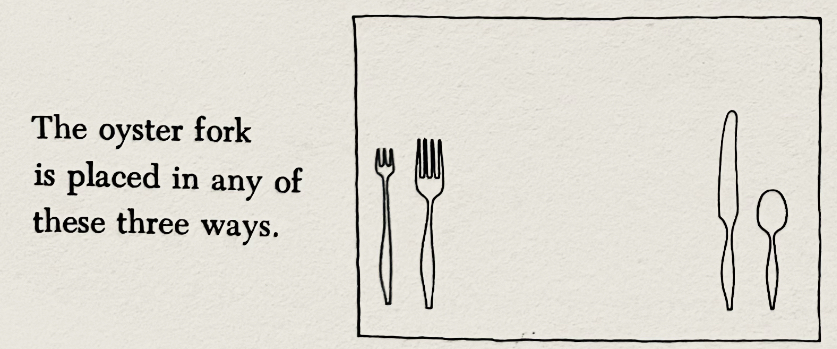
There are 3 different places you can properly find a “first” fork or “oyster fork.” 

Since the Gilded Age in the latter 1800’s, more than 3 forks on the left side of the place setting at one time has been frowned upon. “First” forks, however, cocktail forks, oyster forks, fruit forks, etc..., are allowed to be placed to the right of the setting, with the tines resting in the bowl of the soup spoon (so a diner on one’s right doesn’t think it goes with his or her forks on the left of their setting), or placed flat on the right, next to where the spoon sits. This leaves plenty of room. 

More dinner course forks can always be brought out with subsequent courses. And dessert forks are either allowed to be set above the dinner plate or may be brought out with the dessert course or finger bowl.


Images from the McCall’s “Book of Everyday Etiquette”


🍽Etiquette Enthusiast, Maura J. Graber, is the Site Editor for the Etiquipedia© Etiquette Encyclopedia

Monday, March 15, 2021

U.S. vs U.K. Crescent Plate Etiquette

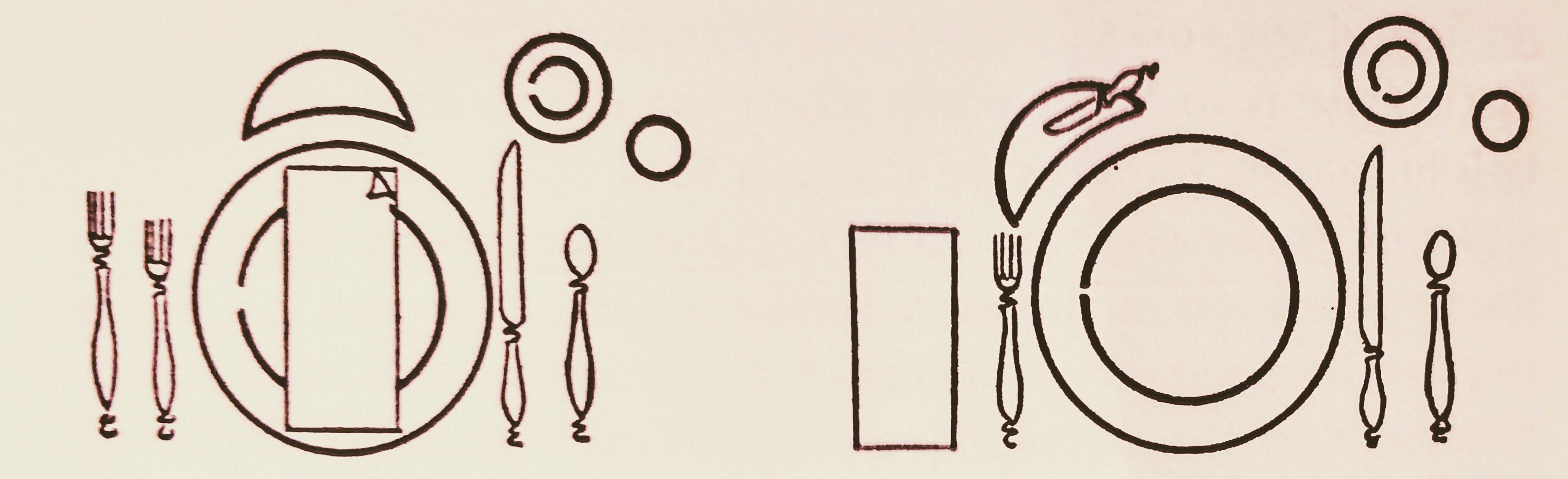
A crescent plate as side dish, is a uniquely Victorian era creation. The use of crescent plates presented some practical problems not associated with the regular salad or other side plates. The crescent plate normally sits off to the left of the main plate but the crescent plate must be placed next to the main plate in space taken by silverware. Because of this problem, the crescent plate was placed above the forks on the left, or at times, to the top of the main plate.— Diagram from “Setting Your Table” by Helen Sprackling


“Salad plates are generally smaller versions of the dinner plate and may or may not be used at a formal dinner. They're almost certainly found at an informal dinner or luncheon. If the salad course is to be served with the game course, a practical problem arises — the game is hot, and the salad is cold. Anyone who has ever eaten a congealed salad with hot meat knows the salad will melt. In addition, the salad oils tend to mix with the game. To avoid these problems, the English started using a crescent salad plate.

“In the United States, such large crescent salad plates were not often produced; however, a smaller crescent bone plate was fairly common in American patterns. The crescent bone plate was used to hold the bones that were exposed when diners deboned their fish with their knives and forks. One can readily see the difference in size between a salad plate and a bone plate.

“The use of the crescent plates presented some practical problems not associated with the regular salad or other side plates. The crescent plate normally sits off to the left of the main plate but the crescent plate must be placed next to the main plate in space taken by silverware. Because of this problem, the crescent plate was placed above the forks on the left, or at times, to the top of the main plate.” — From “Forgotten Elegance,” 2002


 🍽Etiquette Enthusiast, Maura J. Graber of The RSVP Institute of Etiquette, is the Site Editor for the Etiquipedia© Etiquette Encyclopedia

Sunday, March 14, 2021

Using Crescent Plates Properly

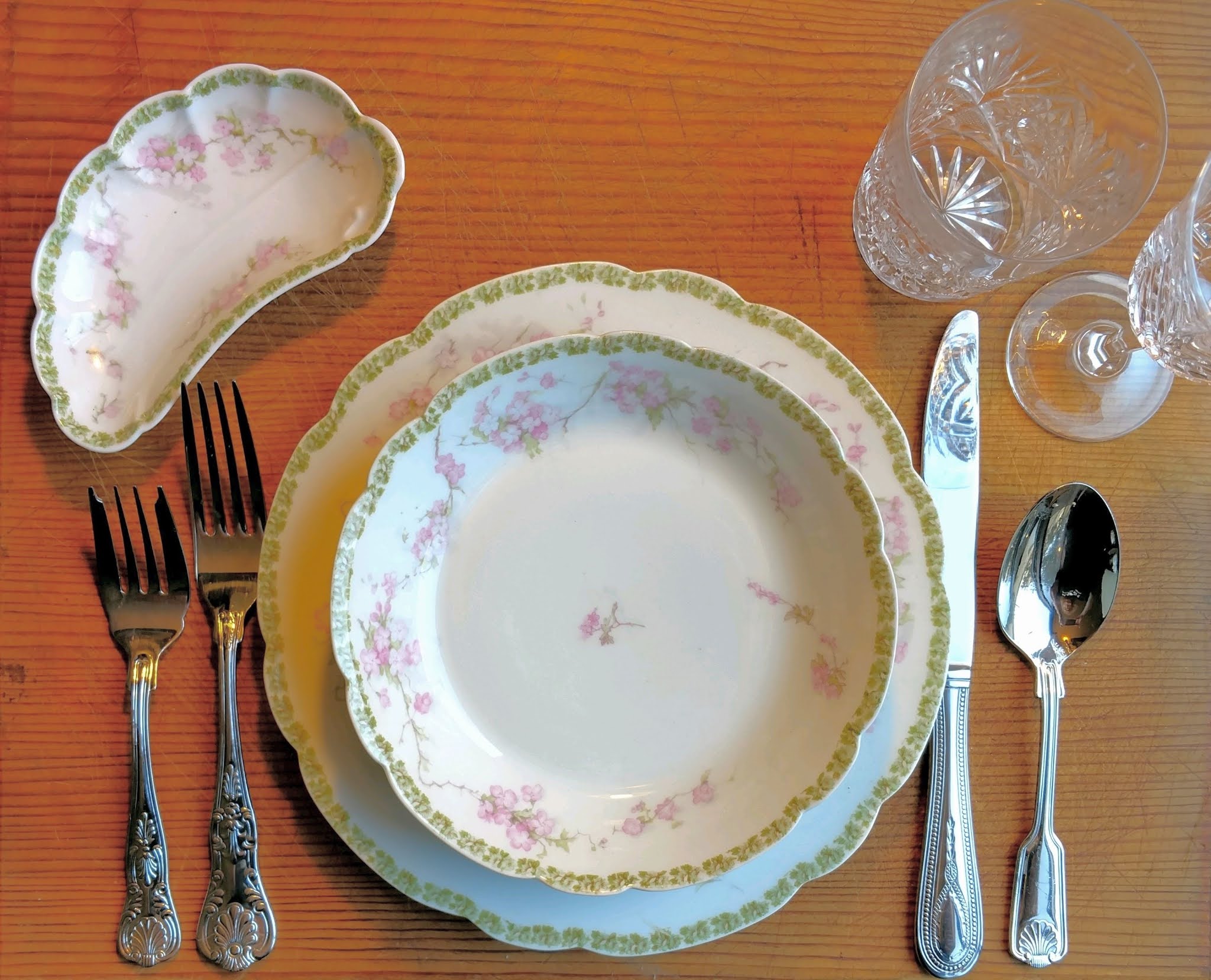
Originally, crescent side plates at place settings were for depositing bones or other indigestibles from one’s meal in the U.S. and for eating one’s salad from in Great Britain. They came in a variety of sizes and shapes, depending on the manufacturer and design. Salad plates were larger. Bone plates were smaller.

The crescent plate may be used as a salad plate with the roast course. It was used in this manner at Queen Elizabeth's coronation dinner. 

“Many hostesses who have inherited lovely old French or English china services with the crescent salad plate, are now proudly using them. The crescent plate may be used as a bread and butter plate, as in photo #2, whenever one would be needed or, more formally, as a salad plate with the roast course. It was used in this manner at Queen Elizabeth's coronation dinner. See photo #1.”

The crescent plate may be used as a bread and butter plate, as in photo #2, whenever one would be needed.


 —From "Setting Your Table... Its Art, Etiquette and Service," by Helen Sprackling, 1960


Etiquette Enthusiast, Maura J Graber, is the Site Editor for the Etiquipedia© Etiquette Encyclopedia

Monday, June 1, 2020

Table Setting Etiquette of 1957

Flatware should always be laid in the order of its use, from the outside in, toward the plate. Spoons and knives (cutting edges toward plate) go to the right —forks to the left. An exception is the oyster or cocktail fork which belongs on the extreme right, outside the spoons.


Correct Table Settings 

Make sure, you have perfectly set tables for parties and entertainment!

Every successful hostess is an artist, for she blends into colorful harmony her guests, each of whom she makes feel specially honored with her tastefully prepared food, correct table settings and the cheerful Christmas atmosphere. Following these general common sense rules which prevail for all settings and all meals, the gracious hostess will always be assured the charm of perfectly set tables whether for the big family dinner, parties during the Yuletide season or gay holiday get-togethers. 


Flatware should always be laid in the order of its use, from the outside in, toward the plate. Spoons and knives (cutting edges toward plate) go to the right —forks to the left. An exception is the oyster or cocktail fork which belongs on the extreme right, outside the spoons. Pieces called for are butter spreader, fork, knife, cereal spoon (dessert), and, frequently placed on saucer, spoon for coffee (teaspoon). 

Should your menu include fruit, cereal and a main course with coffee, use a serving plate of medium size, placing a fork at the left. On the right next to the plate lay first a knife, next a dessert spoon for cereal and then a teaspoon. Have the edge of the plate and the tips of the handles of the silverware in line about an inch from the table edge. The bread and butter plate, with an individual butter spreader, is placed in its usual position at the tip of the fork. Coffee is poured and passed with teaspoon in place on the saucer. Try to serve breakfast in the brightest, most cheerful spot in the home. 

INDIVIDUAL PLACE SETTING FOR INFORMAL LUNCHEON: 

Usually a simple meal, luncheon can be be helped along with emphasis on the attractiveness of the table appointments. A colorful cloth of individual mats and a centerpiece of poinsettias will do much for stimulating the appetite. Pieces needed are butter spreader, fork, salad fork, knife, cream soup spoon, dessert spoon or dessert fork and teaspoon for beverage would be brought in after the main course has been cleared. At each place set a bread and butter plate and individual spreader, a goblet of water and a napkin. The salad fork and the luncheon fork are at the left of the service plate with the salad fork next to the plate. On the right is the knife and outside that, the soup spoon. A teaspoon should be placed at the extreme right if a fruit cup is to be served. The spoon or fork to be used with the dessert is brought in when it is served. Coffee may be served with the main course. For the dessert, and teaspoons should be ready to pass with it. 


SERVICE FOR THE BUFFET SUPPER: 

The buffet supper has become one of America’s most convenient and most popular methods of entertaining large numbers of people during the Yuletide. Guests happily adapt themselves to the gay informality and the fun of helping themselves to tastefully prepared food. For the buffet suppers the individual pieces are laid out flat in symmetrical form in a convenient place—all spoons together, all forks together, etc... Guests take the pieces they want. Individual pieces depend upon what dishes are served, but the hostess will usually place for each guest: Fork spoon for coffee (after dinner coffee spoon if demi-tasse cups are used)—dessert spoon or fork (or salad fork) for dessert, and possibly a knife. Serving pieces are placed on table beside each dish. 

PLACE SETTING FOR INFORMAL DINNER: 

A casual, pleasant atmosphere surrounds the informal Christmas dinner — leisure, relaxation, cheer, friendly conversation. A white damask-cloth is always correct and conventional. Fewer and simpler courses are served than at formal dinner. The bread and butter plate with butter spreader is at the left directly above the forks (dinner fork on outside and salad fork next to plate). At right next to dinner plate are the dinner knife, soup spoon (oval bowl or cream soup) and the spoon for fruit or fruit cocktail (orange or teaspoon). An oyster (or cocktail) fork may be substituted when seafood cocktail is served. The dessert fork or spoon is brought in with dessert.— By Raymond A. LaJoie, Central Press Association Correspondent, December 1957


Etiquette Enthusiast, Maura J Graber, is the Site Editor for the Etiquipedia Etiquette Encyclopedia 

Tuesday, August 6, 2019

Serving Soup and Etiquette Advice

When soup is served as the first course, the soup spoon will be the first utensil on the far right of the place setting. If soup is to be the second course, a small utensil (appetizer fork, caviar spoon or spreader, individual asparagus tongs) for the first course will usually be located to the right of the soup spoon. At an informal lunch setting, soup may be served and eaten alongside another type of food, like a salad or a sandwich. 

A Kindhearted Waiter – Helpful? 
Or giving unsolicited advice? 
Etiquipedia says he was trying to be helpful, and she most gracious.

A surprising experience was that of a lady who received a bit of advice on table etiquette. She is sufficiently free from vanity to tell the story herself. She says: I know that I am not a person of impressive appearance. I am inclined to be short and stout and to dress plainly. Still, I had hoped that I had an air of acquaintance with polite society. But now I shall be more modest than ever in my idea of the impression I make upon strangers. 

At my first meal at the hotel where I passed last summer, I was pleased with the face of my waiter, it was radiant with kindliness and good nature. I began my dinner with soup and fish. As the waiter set them in front of me, he glanced at the persons of fashionable appearance who were my neighbors at table. His kind heart was suddenly struck with the fear that I might make an unfortunate impression on them. He bent down and whispered in my ear: “Eat your soup first.” – Press Democrat, 1909


Etiquette Enthusiast, Maura J Graber, is the Site Editor for the Etiquipedia© Etiquette Encyclopedia 

Sunday, April 7, 2019

Place Settings and Good Taste


The salad knife, cutting side toward the plate, is put next to the plate on the right. A silver bladed knife is especially correct for salad– but if you prefer knifeless salad eating, choose your salad accordingly and omit the knife.

Choice of Silver is Declaration of Good Taste

The silver on your table is a declaration of your taste. Whether it be sterling or plate, there is, in an excellent pattern and in the perfect form and proportion of the utensils, an unmistakeable aristocracy that gives a proud hearted splendor and distinction to your table. In your linens, you achieve the desired background for your tables and in your glass and china you have unlimited means for the expression of beautiful form. Then, in your silver utensils, you add the important accessories which are beautiful and decorative and which, because of their constant usefulness, are essential in furthering the “art of gracious living” and of table etiquette. 
Will the tops of the handles fit perfectly into the center of the palm of the hand? Determine if the handles are comfortable to hold and examine all of the pieces, when choosing your flatware.

Study All Pieces 

When you have determined upon the pattern of your silver, you must supplement its beauty by its practicality. For instance, when you choose a pattern of silver, you should examine all the pieces to be sure you are going to like the shapes of all the rest of the pieces. Determine if the handles are comfortable to hold and that the tops of the handles of the knives and forks fit perfectly into the center of the palm of the hand. Then ascertain, if possible, if the pattern is apt to be “discontinued.” 

The amount of flat silver to be placed beside each plate depends upon the menu to be served. The question of which fork or spoon to choose is no longer a problem if the table is properly set, since the outside implement is always the one you are meant to use. In setting the table, therefore, you put the fork or spoon that is to be used last next to the plate, and mentally continue through the courses backward, until the implements for the first course are on the outside or farthest from the plate. 


Placing of Forks and Knives Correctly

The dinner fork (or meat fork) is put next to the plate, prongs up, and about two and one-half inches from the edge of the table. The salad fork is placed on the left of the meat or dinner fork. The salad knife, cutting side toward the plate, is put next to the dinner knife (or meat knife) which is closest to the plate on the right. A silver bladed knife is especially correct for salad - but if you prefer knifeless salad eating, choose your salad accordingly and omit the knife. 

For “Continental Dining” the order of the courses is reversed and the dinner fork is placed to the left of the salad fork ,while the dinner knife goes to the right of the salad knife.

  
Spoons at Right 

The spoons are placed on the right of the knife in the order of the courses in which they are to be used.  The soup spoon, then, would be the spoon farthest from the knife. Some authorities affirm that it is correct to place only five pieces of sliver on the table for each cover, and that if more are required they may be brought in with the course for which they are needed. 

Glasses are put above or at the upper right of the knives. At luncheon or supper, if you serve iced tea or coffee in a tall glass, the long spoon is placed on the table beside it. – La Habra Star, 1935


Etiquette Enthusiast,Maura J Graber, is the Site Editor for the Etiquipedia© Etiquette Encyclopedia 
Saturday, October 14, 2017

Salad Etiquette


The Waldorf’ Astoria’s maître d’hôtel, Oscar Tschirky is credited with creating the Waldorf salad. After working at other establishments, including Delmonico’s, he retired in 1943, after working at the famous New York hotel  for 50 years.


Everything About Salad Etiquette
🥗 Questions and Answers on Salads 🥗 


Q. Should one eat the lettuce or salad green under the salad? 
A. Yes. It is part of the salad, is intended to be eaten, and polite guests will eat at least a little. 

Q. May lettuce be cut with a knife? 
A. Yes, if necessary—providing the knife has a sliver blade. (This custom arose because steel knives turned black.) Most hostesses serve salad that does not require cutting, but in many homes a salad knife is always provided with leafy salads. 

Q. May salad be served with the meat course ? 
A. Yes, a simple tart salad may be served right with the meat course. The individual salads are placed at left of dinner plate. When salad is a separate course, place it directly in front of the guest, after removing the dinner plate. 

Q. Where does the salad fork go, in the table setting? 
A. The salad fork goes to the left of dinner plate, then come the meat fork and left of that the fork for fish or entree. If a salad knife is used, it goes at right, next to the plate. 

Q. May salad be passed? 
A. Yes, and this is an effective way to serve salad at a party or buffet supper. Be sure, however, that each individual salad is easy to remove from the platter. 

Q. Is salad ever eaten from the dinner plate ? 
A. When garniture salad is served, such as a bit of slaw or similar mixture, to accompany meat or fish course, it may be eaten right on the dinner plate —either taken with a spoon or served as a garnish. 

Q. Must salad always have a plate to itself ? 
A. For parties, such as bridges, teas or luncheons, what the restaurants call a “club plate” may be used—the salad (in lettuce cup or shell) is then right on the large plate, with the other foods grouped on the same plate. 

Q. Should dressings be passed, even when the salad has been prepared with salad dressing? 
A. This is at the discretion of the hostess. Some salads are served without dressing, so that their beauty of arrangement will not be marred, and these require the passing of dressing. Too, some guests may prefer more dressing, and it is courtesy to permit them to have it. — Coronado Eagle and Journal, 1938

Etiquette Enthusiast, Maura J Graber, is the Site Editor for the Etiquipedia© Etiquette Encyclopedia 

Wednesday, October 4, 2017

Etiquette and Dining Intimacy

“Sharing food with another human being is an intimate act that should not be indulged in lightly.” - M.F.K. Fisher – (Above) Jacqueline Kennedy smoking at dinner. – Mrs. Kennedy understood that State Dinner guests at the White House needed more of a feeling of intimacy, so she changed the tables from the traditional, long tables at which everyone sat, to round tables. She felt people could get to know those they were dining with, if each group was dining at a smaller, round table. And at those State Dinners, smoking at meals was so commonplace, the Sunset "Host and Hostess" book on entertaining cautioned that for a properly set dining table, each place setting needed an ashtray, no less than 3 cigarettes, and matches or a lighter. It wasn't until the Clinton administration that smoking was banned in the White House at the dining tables.


“I feel now that gastronomical perfection can be reached in these combinations: one person dining alone, usually upon a couch or a hill side; two people, of no matter what sex or age, dining in a good restaurant; six people, of no matter what sex or age, dining in a good home. Dining partners, regardless of gender, social standing, or the years they've lived, should be chosen for their ability to eat - and drink! - with the right mixture of abandon and restraint. They should enjoy food, and look upon its preparation and its degustation as one of the human arts.”―from M.F.K. Fisher's, Serve It Forth


Etiquette Enthusiast, Maura J Graber, is the Site Editor for the Etiquipedia© Etiquette Encyclopedia