Showing posts with label French Fork History. Show all posts

Wednesday, July 19, 2023

Fork History: From France to the U.S.


An individual Gorham, Chantilly pattern “bird set” for carving duck, quail or Cornish game hen-sized, individual birds. – Writing in Harper's New Monthly Magazine in 1868, James Parton explained: “From spoons, Jabez Gorham advanced to fruit knives, butter knives, thimbles, napkin rings and combs– the only articles commonly made by American silversmiths thirty years ago. Silver forks were then scarcely known in the United States. They had been an article of luxury among the nobility of France for a century or more, and had been introduced from that country into England; but in the United States, as recently as 1835, their use was confined to persons who possessed considerable wealth.


When Charles Lutwidge Dodson, under his pseudonym of Lewis Carroll, wrote the line, "They pursued it with forks and hope," he attributed it to the mild-mannered baker who was hunting the Snark to serve with greens. He might well have used the same line to describe the plight of many guests at contemporary Victorian dinners, where stern, social orthodoxy decreed that "a knife or spoon is never used when a fork will suffice." Judged by the controversy that raged through the press of the time, many of the guests relied more on hope than on the implement as they pursued ice cream, berries, and other elusive foods with the correct but ill-adapted fork.

But the arbiters of fashion were not alone responsible for the changing patterns of etiquette that brought a bewildering array of forks and spoons and knives to the late Victorian table; changing patterns of eating and entertaining, rapidly altering economic and social conditions, even an increasing abundance and availability of many foods, contributed to the new concept of the art of dining.

At the beginning of the Victorian period, silver services were comparatively simple, as was serving at the table. In the section devoted to "Furniture of the Table" in The American Chesterfield, published in 1828 in Philadelphia by John Grigg, the following extract describes table setting in a fashionable house:
  • Every person at table should be provided with knife and fork, plate, bread, etc… and, before every meat dish, a carving knife, fork and spoon; and a spoon before every dish of vegetables. 
  • At the corners of the table, spoons, a salt cellar, and small spoon for the salt; and, if pickles are there placed, a small knife and fork. 
  • If the table is large, the furniture of the corners should likewise be placed at short and convenient intervals. It has lately become common, in our Atlantic towns, and particularly at tables where light wines are used with water as a long drink, to place, at convenient distances around the table, bottles of Sauterne, Claret or other light wine (the corks slightly drawn and inserted slightly in the bottle) and goblets of water. 
  • This is found, by experience, to be an admirable arrangement for convenience, and gives the waiters more time to attend, among other duties, to the frequent changes of plates which modern refinement has introduced.
  • On the sideboard should be arranged, in order, all those articles of furniture which are necessary for the tableThese are, the great supplies of knives and forks, plates of different sizes, spoons, bread, etc…, etc… but, in a particular manner, the castors. 
  • These should always consist of five bottles, at least; viz; cayenne pepper, black pepper, mustard, vinegar and sweet oil. Let the castors be filled -not half filled-with condiments of good quality, that is, the sweet oil not rancid, nor the vinegar sweet, nor the pepper in grains like hailstones, nor the mustard stale; and one word more, madame, before we dismiss the castors-a little spoon for the mustard, though it be of wood-and-and-remember the salt spoons.
After a word of caution regarding industry among servants, and a discussion of the rules of waiting, The American Chesterfield continues:
  • If there is soup for dinner, according to the number of the company, lay each person a flat plate, and a soup plate over it; a napkin, fork, knife and spoon; and to place the chairs. If there is no soup, the soup plate may be omitted.
There can be no doubt that The American Chesterfield was directed toward the sons of American families of established wealth and position; that is made clear by the references to forks in the table settings. Writing in Harper's New Monthly Magazine in 1868, James Parton explained:
“From spoons, Jabez Gorham advanced to fruit knives, butter knives, thimbles, napkin rings and combs– the only articles commonly made by American silversmiths thirty years ago. Silver forks were then scarcely known in the United States. They had been an article of luxury among the nobility of France for a century or more, and had been introduced from that country into England; but in the United States, as recently as 1835, their use was confined to persons who possessed considerable wealth. They were not common at that time in any but the best hotels, and not one person in ten had ever seen them used.” — American Silver Flatware… 1837-1910, Noel D. Turner


🍽Etiquette Enthusiast, Maura J. Graber, is the Site Editor for the Etiquipedia© Etiquette Encyclopedia

Saturday, March 11, 2023

Traveling Utensils and Fork History

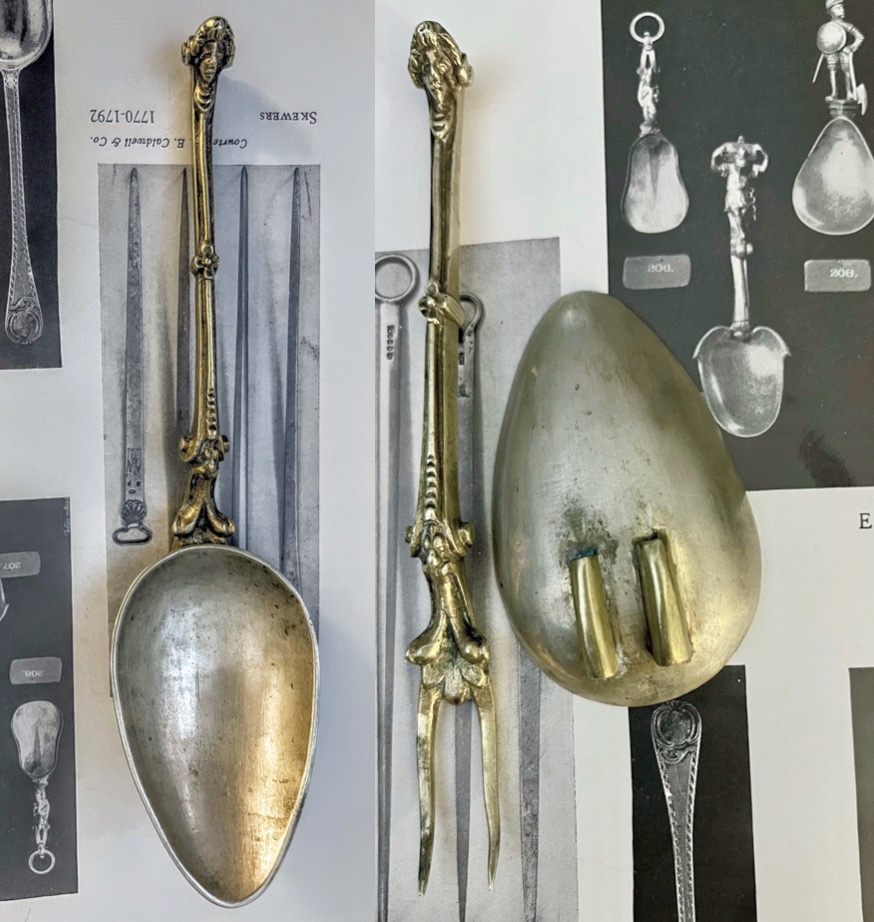
Photo of a retractable travel spoon bowl with the fork attached, alongside a photo of the back of the spoon bowl, sitting next to the two-tined fork which fits inside it to make a spoon. Presumed age is any time from the mid-1500’s to early 1700’s

Around the year 1400, when people carried their eating utensils with them, a folding silver spoon was made to fit the pocket. Later a fork was added. Even the wealthy did not provide these utensils; only royalty seemed to have had enough for their feasts and banquets.

Everyone carried his knife in a scabbard fastened to his belt, to use at mealtime and on any other occasion when a knife was needed. Those who could not afford silver used spoons, knives, and forks of pewter. Copper and brass spoons were used, too, by persons of limited means, although copper soon lost favor due to its tendency to rapid oxidation. 

During the fifteenth and sixteenth centuries, in the Tudor period, it was fashionable to give a christening gift of twelve spoons, each adorned with a miniature statue in silver of one of the twelve apostles. Sometimes a “Master” spoon bearing the figure of Christ was included. These sets are exceedingly rare today. Our “pitcher spoon” originated in Elizabethan days, when great starched ruffles were worn around the neck, making long-handled spoons a necessity.

In Italy, in the 1500s, knives and forks generally appeared on the tables of the cultured, but it was another century before they were popular in France and England. At one time in England it was considered effeminate to use a fork and it took several decades for the people other than the upper classes to adopt it. The clergy even protested its use “as a substitute for God-given fingers.”

In America, too, forks were freakish novelties: when the first fork was imported by Governor Winthrop in 1633, people thought it comical. They could not see any need for it, since most of their meats were cut up and cooked in ragouts and stews. Recipes of the time called for meat to be “y-mynced, hewed on a gobbet, hacked, diced and skerned.” Two-pronged forks to spear food were the most commonly used at first, but early models were made with three and four prongs too.— From “The Book of Old Silver,” by Seymour B. Wyler, 1937


🍽️Etiquette Enthusiast, Maura J. Graber, is the Site Editor for the Etiquipedia© Etiquette Encyclopedia

Monday, May 25, 2020

How Forks Replaced Knives

The fork was originally, and up to very modern times, used only to hold meat and other pieces of food, while the knife was cutting them. The putting of it into the mouth instead of the knife was only an afterthought, due probably to the unclean appearance of the knife blade after it had been used to shovel into the mouth, gravies, egg yolks, acids, etc... – Photo by site editor Maura J. Graber

Questioning the Fork: 
The Origins of This Very Useful Article and Why it Replaced Eating From Knives


One of those heterodox fellows, who may be found to question everything, asks upon what  sound principle is the law founded that forbids the putting of the knife into the mouth in eating. Why should a plate of steel, he asks, be interdicted from an office that the same steel, bifurcated, trifurcated or quadrafurcated, may properly perform? There is no objection to be made on the score of cutting one’s mouth, for in all ages of the past, when everybody ate with the knife, nobody ever cut his mouth. This heretic asserts that a certain consistency of food can be ‘‘hoisted,” as a western man would say, much more readily by a knife than by a fork. Of course, you can get the bulk of a mashed potato
 or turnip by dexterously fishing with a fork, but you can do it much neater and in better time with a knife, he continues; and thru the knife will secure all the gravy, which is mostly sifted out by the operation of the fork, and one thus loses the richest part of the meal. 

It is a matter of history that knives played an important part in domestic life long before forks were invented, and that when first the latter implements appeared, it was considered a mark of effeminacy or ultra refinement to use them. To such a degree was this prejudice against them indulged in France, that in the Sixteenth century the use of forks was considered sinful in monasteries, and the monks split up into two parties on the question. Forks originally came into use to save the fingers from soiling, and Italy was the first place where they were used. Ben Jonson writes of “the laudable use of forks brought into custom here as they are in Italy, to the sparing of napkins.” Some time later, a writer praises the King of Hungary for eating without a fork without soiling his clothes. An old writer explains why the Italian used the fork by saying that he could not “endure to have his dish touched with his fingers, seeing that all men's fingers are not clean alike.” 

But the fork was originally, and up to very modern times, used only to hold meat and other pieces of food, while the knife was cutting them. The putting of it into the mouth instead of the knife was only an afterthought, due probably to the unclean appearance of the knife blade after it had been used to shovel into the mouth, gravies, egg yolks, acids, etc... For this reason, silver forks were made; they are cleaner than iron and steel forks. Every step, then, from the original use of the fork as a substitute for the fingers, to its more extended use a substitute for the knife, together with the employment of silver in place of iron, has been dictated by cleanliness. —Good Housekeeping, 1880

Etiquette Enthusiast, Maura J Graber, is the Site Editor for the Etiquipedia©️ Etiquette Encyclopedia 

Wednesday, February 26, 2014

Etiquette, Forks and Chopsticks

The Latin “de gustibus” translates to “in matters of taste” – For those who dine primarily with chopsticks or with forks, it does boil down to a matter of taste and personal preference, regardless of the history involved, ease or difficulty of use, or one’s country of origin. For another point of view, we have reprinted a 1990 New York Times’ article.


De Gustibus; Older Than Forks, Safer Than Knives


THIS is a plea for chopsticks. Chopsticks for pasta. Chopsticks for string beans. Chopsticks for french fries. Chopsticks for grilled chanterelles. Indeed, chopsticks for just about anything, except perhaps a thick hunk of meat. I have one friend who even uses them to eat ice cream.

I don't mean to be demanding. I know running a restaurant or arranging a dinner party is tough enough without having to worry about additional utensils. But I have long thought most food just tastes better when eaten with chopsticks, and I think diners should have the choice. Let's face it: there is nothing sacrosanct about an eating utensil. It was not until the 18th century, after all, that most people in the United States even used a fork.

According to “From Hand to Mouth,” a history of the use of cutlery by James Cross Giblin (Thomas Y. Crowell, 1987), the wealthy began using forks in this country in the mid-1700’s. Until that time, people got by with a spoon and a sharp-pointed knife. (Potatoes, like other food, were routinely stabbed and gulped off the blade.) Indeed, the fork met with resistance for centuries.

In “Food in History” (Crown, 1989) Reay Tannahill says that although small forks were first used in the 10th century by the Byzantines (the ancient Egyptians used large forks to display sacrificial offerings), it was not until 1533 that Catherine de' Medici introduced them to France, where they were for the most part ignored.

More than 100 years later, Louis XIV still ate chicken stew with his fingers and forbade the Duke of Burgundy and his brothers to use forks in his presence. The British did not start using forks until the 17th century. As late as 1897, Miss Tannahill writes, sailors in the British Navy were forbidden to use them “because they were regarded as being prejudicial to discipline and manliness.”

In contrast, chopsticks have gracefully provided sustenance since as long ago as 1200 B.C. Nina Simonds, whose book “China's Food,” a travelogue of food in China, is to be published later this year by Harper & Row, says that chopsticks (kuaizi in Mandarin, which is derived from the Chinese word for ‘quick’) have been in common use since the Early Han Dynasty, 206 B.C. to A.D. 8.

Simply put, Mr. Giblin writes, they appear to have provided a polite alternative to knives, which Confucius said reminded the diner of the violent act of slaughter. “The honorable and upright man keeps well away from both the slaughterhouse and the kitchen,” Confucius wrote. “And he allows no knives on his table.” I agree to a certain extent, although men do have their place in the kitchen these days. Chopsticks are serene instruments that permit diners to lift food to their lips rather than spearing it. They are elegant in both their simplicity and their singularity of purpose. But so far as I am concerned, their chief appeal is not their absence of violence. It is the opportunity they provide for gustatory involvement. 

In many ways, chopsticks are the culinary equivalent of the stick shift. They enhance the act of eating and make it more participatory, tactile, not to mention fun. They give a certain ceremony to consumption and force the calorie-conscious diner to focus on the ritual of gustation, and therefore on the amount of food being shoveled into the mouth at any time. This increased awareness, in turn, enhances the attention paid to whatever is being eaten and encourages the diner to focus more on flavor.

But the advantages of chopsticks don't stop there. Chopsticks instantly promote a sense of community and conviviality at the table. Chopstick eaters are far less reluctant to lift up their individual plates and taste around. Even French foods like cassoulet, choucroute and ratatouille lend themselves, in part, to chopsticks. (Clearly a knife and fork are helpful for large chunks of duck.) But so do Indian beef curry, thick Tex-Mex chili and Greek souvlaki.

I know a lot of Westerners who do not use chopsticks. They either have little interest in them or have never learned how. Some have been exposed only to Japanese chopsticks, which are tapered, come to a point at the tip and are more difficult to maneuver than Chinese chopsticks. Like sensible shoes, Chinese chopsticks - square at the head and thick at the base - are clunkier, perhaps, but far more functional. They are perfect for eating shish kebab, asparagus spears, shrimp, linguine with clam sauce or Chicken McNuggets.

Of course, anyone can learn to use chopsticks. Chopstick users outnumber fork eaters throughout the world by at least 2 to 1, some scholars of eating habits say. They simply require a desire to learn. But be forewarned: teaching someone to use chopsticks is a little bit like teaching someone to drive a car. It is best not to be related, and better yet not to be teaching someone who is hungry. “Why can't I just use a fork?” is obviously the kind of question best left unanswered.

Norge W. Jerome, director of the office of nutrition for the Agency for International Development in Washington and a professor of nutritional anthropology at the University of Kansas School of Medicine, is pessimistic about the future of chopsticks in the United States. Knives and forks, she says, have a certain “snob appeal” and are too deeply embedded in the national sense of propriety. But I think it is time to re-evaluate this parochialism. Not that everyone should be forced to eat with chopsticks. Let fork eaters have their forks. But why should chopstick lovers always be made to feel like outcasts? Why do they always have to feel left out? Why can't they feel that they belong?

No question about it. Having to bring your own chopsticks to dinner, and to be instantly made a spectacle, is a form of discrimination - not the most heinous kind, but still a shame. At a time when East and West are being merged more than ever before, isn't it time to reaffirm our sense of tolerance, to re-evaluate our table-setting habits and to give chopstick lovers a chance? – By Dena Kleinman, NY Times, 1990 


🥢Etiquette Enthusiast, Maura J Graber of The RSVP Institute of Etiquette, is the Site Editor for the Etiquipedia© Etiquette Encyclopedia