Showing posts with label The Gilded Age 400. Show all posts

Sunday, March 15, 2026

Gilded Age Faux Pas

Etiquette Mistakes Made by “The 400”

I dropped into a very fashionable place at luncheon the other day and I got to wondering if the “400” didn't make mistakes too. So I asked Charlie – everybody knows Charlie. “Yes,” he said. “Some- times they asked me for a table near the door. Sometimes they call me ‘Captain.’ Sometimes they even use the wrong fork. But it’s easy to tell them from the new rich, because the 400 is very quiet and easy to serve. Real people never make themselves conspicuous.” – Above, a depiction of men and women outside the famous Delmonico’s restaurant in New York.
A “Second Debut” article from 2024

“Your orders, madam?”, Jeffries would ask in his beautiful English voice… 

Mistakes in Etiquette the 400 Make…
Daughter of Boss-Painter, Now High in New York Society, Tells How Social Blunders Are Made and Avoided 


Can someone of humble birth, being suddenly rich, win a place in the best society and act as “to the manor born”?

A poor girl, whose father was a painter and whose mother was a telephone operator, says it isn't hard at all to climb to the top rung of the social ladder and avoid faux pas. (And, by the way, she really did pronounce it fo pa.). For her helpful story of her conquest of society and etiquette, which appears in full in January Smart Set, we print these amusing extracts:

“It wasn't so hard to avoid social errors while we were traveling on my honeymoon. Everything was new and we moved about. constantly. The only thing that annoyed me was the restaurants. ‘What would you like to order, darling?’ my husband would say. I honestly did not know what to order. It always embarrassed me, and I got around it by saying: ‘Oh, you order. Surprise me.’ I learned from him how to order in public and I watched him like a hawk to see which knife and which fork he used.

“How those menus did confuse me. At first, I couldn’t think of a thing but beefsteak and French fried potatoes. But soon I learned to look over the Entrées. I discovered ‘chicken-hash, en bordure,’ ‘eggs Benedict’ with that delicious Hollandaise sauce, and a mixed grill - the tender little lamb chop cuddled among a tomato, mushroom, kidney, bacon and sausage.

“They soon became my favorite luncheon dishes, with hearts of lettuce with Russian dressing. I think I liked the Russian dressing on account of its beautiful pink color. Then I became bold and changed the dressing. I fell easily into selecting soup or oysters perhaps broiled chicken or one of the dishes marked ‘Ready.’ Then sweet - that meant dessert – and I loved chocolate ice-cream. I soon stopped saying ‘small black’ for after-dinner coffee and ‘demi- tasse’ rolled off my tongue as if we had always had coffee in the drawing-room at home.

“Supper! At first when I went out to supper with my husband, I was always torn between a club-sandwich or fruit salad. That had been the thing we ordered when we went out to supper in the old studio days with a ‘beau.’ But after watching Ed it didn't take me long to order lobster a la Newburg - again the pink color intrigued me - or crab meat Dewey.”

She Meets Lord Jeffries

“However, these problems were no laughing matters in those days. Further problems would await me when I got home, and walked into the beautiful house my husband had brought me into. Jeffries, the English butler who had lived with him for years and I was sure was nothing less than a United States Senator when I first saw him, frightened me almost to death, ‘Your orders for the morning, madam?’ he would ask in his beautiful English voice. Those pesky orders - would I ever get away from them? But Jeffries understood. How kind and gentle he was in his unoffensive suggestions and his many subtle moves to me from making glaring mistakes in front of the rest of the servants.” – National City Star-News, 1924


🍽Etiquette Enthusiast, Maura J. Graber of The RSVP Institute of Etiquette, is the Site Editor for the Etiquipedia© Etiquette Encyclopedia 

Saturday, October 26, 2024

Gilded Age “400’s” Etiquette Mistakes

I dropped into a very fashionable place at luncheon the other day and I got to wondering if the “400” didn't make mistakes too. So I asked Charlie – everybody knows Charlie. “Yes,” he said. “Some- times they asked me for a table near the door. Sometimes they call me ‘Captain.’ Sometimes they even use the wrong fork. But it’s easy to tell them from the new rich, because the 400 is very quiet and easy to serve. Real people never make themselves conspicuous.” – Above, a depiction of men and women outside the famous Delmonico’s restaurant in New York.

“Your orders, madam?”, Jeffries would ask in his beautiful English voice… 
Mistakes in Etiquette the 400 Make…
Daughter of Boss-Painter, Now High in New York Society, Tells How Social Blunders Are Made and Avoided 


Can someone of humble birth, being suddenly rich, win a place in the best society and act as “to the manor born”?

A poor girl, whose father was a painter and whose mother was a telephone operator, says it isn't hard at all to climb to the top rung of the social ladder and avoid faux pas. (And, by the way, she really did pronounce it fo pa.). For her helpful story of her conquest of society and etiquette, which appears in full in January Smart Set, we print these amusing extracts:

“It wasn't so hard to avoid social errors while we were traveling on my honeymoon. Everything was new and we moved about. constantly. The only thing that annoyed me was the restaurants. ‘What would you like to order, darling?’ my husband would say. I honestly did not know what to order. It always embarrassed me, and I got around it by saying: ‘Oh, you order. Surprise me.’ I learned from him how to order in public and I watched him like a hawk to see which knife and which fork he used.

“How those menus did confuse me. At first, I couldn’t think of a thing but beefsteak and French fried potatoes. But soon I learned to look over the Entrées. I discovered ‘chicken-hash, en bordure,’ ‘eggs Benedict’ with that delicious Hollandaise sauce, and a mixed grill - the tender little lamb chop cuddled among a tomato, mushroom, kidney, bacon and sausage.

“They soon became my favorite luncheon dishes, with hearts of lettuce with Russian dressing. I think I liked the Russian dressing on account of its beautiful pink color. Then I became bold and changed the dressing. I fell easily into selecting soup or oysters perhaps broiled chicken or one of the dishes marked ‘Ready.’ Then sweet - that meant dessert – and I loved chocolate ice-cream. I soon stopped saying ‘small black’ for after-dinner coffee and ‘demi- tasse’ rolled off my tongue as if we had always had coffee in the drawing-room at home.

“Supper! At first when I went out to supper with my husband, I was always torn between a club-sandwich or fruit salad. That had been the thing we ordered when we went out to supper in the old studio days with a ‘beau.’ But after watching Ed it didn't take me long to order lobster a la Newburg - again the pink color intrigued me - or crab meat Dewey.”

She Meets Lord Jeffries

“However, these problems were no laughing matters in those days. Further problems would await me when I got home, and walked into the beautiful house my husband had brought me into. Jeffries, the English butler who had lived with him for years and I was sure was nothing less than a United States Senator when I first saw him, frightened me almost to death, ‘Your orders for the morning, madam?’ he would ask in his beautiful English voice. Those pesky orders - would I ever get away from them? But Jeffries understood. How kind and gentle he was in his unoffensive suggestions and his many subtle moves to me from making glaring mistakes in front of the rest of the servants.” – National City Star-News, 1924


🍽Etiquette Enthusiast, Maura J. Graber of The RSVP Institute of Etiquette, is the Site Editor for the Etiquipedia© Etiquette Encyclopedia 

Friday, August 30, 2024

An Interview with Mrs. Astor

Mrs. Astor from the life sized portrait by the celebrated French painter, Carole’s Duran, now in Mrs. Astor’s Fifth Avenue home.


The Leader of the New York “Four Hundred,” through “The Delineator,” Sends Her First Message to the Public 

Mrs. William Astor, the oldest living member of the Astor family, who has just retired as supreme head of that exclusive set known as the New York “Four Hundred,” gives to this issue of “The Delineator” her first interview on public affairs in fact, it is her first public utterance. When the question of selecting the New York Social Register became a matter of necessity, the Astor family was found to be the oldest in New York, and so it was given precedence, and its oldest member was naturally the social leader. 

By virtue of this position she was simply Mrs. Astor, it never being necessary for her to use or sign any other name. Indeed, it would have been a breach of one of the old rules of social etiquette. Here, for the first time, Mrs. Astor tells the American people what she thinks abouť a great many subjects that are foremost in their minds. She talks very freely and very frankly, and the interview is all the more remarkable in view of her extreme conservatism and the fact that she has always successfully discouraged newspaper prominence. Mrs. Astor was Caroline Webster Schermerhorn, when in 1855 she was married to William Astor, a grandson of the first John Jacob Astor.

ABOUT two years ago I found myself in New York, having just returned from Europe, where I had been living for a number of years. There were many pleasant things in store for me on my return home, and chief among them was an interview with Mrs. Astor. I had looked forward to it for a long time, since I much admired her, not only because of her leadership in New York and Newport society, but because I had heard through her friends so many tributes to her simplicity and charm and her many intellectual interests.

Mine was an unusual opportunity for meeting her. She was aware of my appreciation of her, and she knew that she could trust me. Then, too, it happened that she was interested in many of the people and the things I had just come from; one subject led to another, and we went from scenery to society, from art to artists, from politics to the philosophy of life. I was especially impressed with her wide range of thought and her independence of judgment, by her graceful manner and choice diction. restraint and tact were as remarkable as her her to use or sign any other name. Indeed, it would have been a breach of one of the old rules of social etiquette. 

Here, for the first time, Mrs. Astor tells the American people what she thinks abouť a great many subjects that are foremost in their minds. She talks very freely and very frankly, and the interview is all the more remarkable in view of her extreme conservatism and the fact that she has always successfully discouraged newspaper prominence. Mrs. Astor was Caroline Webster Schermerhorn, when in 1855 she was married to William Astor, a grandson of the first John Jacob Astor.

Her courage of utterance. Enthusiastically patriotic, she did not hesitate to condemn certain phases of American life as seen in New York; but she was full of optimism for the future. Her own intimate knowledge of America was limited to New York and Newport, she said, and she did not allow herself to make sweeping generalizations about America or Americans.

“I Believe in a Republic”

She said she welcomed particularly what seemed to be a reaction in favor of dignity and decency in New York journalism; that it was only a few years ago that certain quiet, inoffensive women like herself were in constant terror of the papers. For that reason, she had not seen a journalist for twenty years or more. “As far as I was concerned,” she said, “they were never unkind, but rather too kind. 

I would say ‘Good morning’ in the drawing-room to some cultivated young woman or an immaculate young man, and the next day’s paper would have two or three columns of things I never even imagined! There is a good deal in English journalism that we hope to see in New York, particularly the high sense of honor and personal responsibility that English journalists manifest. “Although I have been in Europe a great deal, I and personally supervise their education at home during the critical early years. They are in love with their husbands and devoted to their interests.

“Yes, I have heard that our young women smoke and drink and do other terrible things. I know a great many of them and know them very well, I have known them since they were born, and I am quite sure there is not one in my circle who is a cigarette fiend or who drinks to excess.”

One of the principal reasons for Mrs. Astor’s life-long interest in society, she said, was her interest in young people. She enjoyed having them about her, enjoyed planning for their amusement. But she said that she felt also that a woman placed by birth or marriage at the head of a great family had no uncertain ‘call of duty to maintain the dignity of the old name.

“That consists in setting a standard for true living in the private life as well as in the public,” Mrs. Astor continued. “One must have high ideals and do the best one can to realize them. My ideals in society have always been very definite. I have not realized them, but who does realize his ideals in this world?”

Circus-Tent Entertainments

“I am not vain enough to think New York will not be able to get along very well without me. Many women will rise up to take my place. But I hope my influence will be felt in one thing, and that is in discountenancing the undignified methods employed by certain New York women to attract a following. They have given entertainments that belonged under a circus tent rather than in a gentlewoman’s home. Their sole object is notoriety, a thing that no lady ever seeks, but, rather, shrinks from. Women of this stamp are few in New York, but, alas! they are so appallingly active! They have done untold harm to the good name of American society in the minds of foreigners. 

When a distinguished man arrives from the other side, he is seized upon relentlessly, although possibly a total stranger to his hostess, and plunged into a mad whirl of extraordinary festivities. He enters upon them with much the same spirit that we would have as spectators of an Indian war-dance. And thus he forms his opinion of all of us. 

I have never entertained a foreigner in my life unless he came to me with a letter of introduction. “The best women in New York society, those of the greatest influence and those who give it its true tone, are almost unknown outside of their own circle. Society newspaper notoriety is interesting to them as it is to me, as a study, a very amusing one, too, sometimes, as one gains so much information about certain women supposed to belong to us, but whom we never see and do not know even by sight.” 

Some American Impossibilities

Mrs. Astor’s ideal of society, she said, was the old French salon in the heyday of its power and prestige. Then history was often made where charming and intellectual women held court attended by the most distinguished statesmen, poets, artists and financiers, and elegance and breeding were as imperative as reading and writing. “The political hostesses of London have a much better chance of realizing such an ideal today than we women of New York. Over there you find at the big balls and musicales a brilliant array of cabinet ministers, journalists, ambassadors, men and women of the stage, painters and poets, and the powers of the money world such as no leader in New York could bring together or would attempt to bring together thought of doing it all my life, but have never seen the possibility of success. 

In the first place, we have too many politicians in America, where in England they have statesmen. Many of our senators and congressmen seem to base their title to public favor upon their uncouth manners and lack of refinement, upon the fact that they have discarded socks or once wore blue jeans. If they were all like Mr. Roosevelt, what a difference there would be! Mr. Roosevelt is a true American, but he would be at home in the most elegant court in Europe. He is not above paying scrupulous attention to his wardrobe and his manners. Any hostess in New York or Newport would be proud to entertain him, and the men in Washington like him.

“Many people seem to think I could have done a great deal in making New York society as democratic as it is in London and open to any one of intellectual attainments, as it is over there. But one can do only one’s best under the conditions. English people all recognize a certain authority in social matters. The King is the leader of society, and the hostesses who gather about them such brilliant men and women can be as independent as they wish to be without assuming the responsibility of an onslaught upon their own domains. The King’s authority is never questioned, and the authority of the great old families is never questioned.

“We have to be more exclusive in New York because in America there is no authority in society, and Americans in general are not inclined to admit its possibility. Each woman is for herself and trying to outdo the others in lavish display and mad extravagance, with little thought of any ultimate good or any ideal.”

A Woman of Ideals

She came back so often to that word “ideal”! Mrs. Astor is a woman of ideals, and when she talks of them her face lights up in a marvelous way. Her face - how shall I describe it? It was youthful with enthusiasm, the gray eyes sparkled with animation, prepared, even eager to meet a young girl on her own ground of vigorous buoyancy and vivacity.

Very vividly do I recall my first sight of her and the picture she made as she came slowly down the broad marble stairs, not with any apparent feebleness, although a jeweled hand grasped firmly the iron balustrade. She was smiling cordially beneath the big black hat and lace veil, dressed entirely in black, unrelieved even by the conventional white at neck and throat. The gown was cut severely plain, and out-lined a youthful, supple figure, not in the least inclined to embonpoint. As she advanced, I saw that she was about medium height, a little less, perhaps, and as straight as an Indian. 

The head, well set on the rather broad shoulders, was carried high, not with arrogance but good breeding. The waves of soft black hair were youthful, too. But youth does not have the deep, sweet lines of resignation that characterize Mrs. Astor's face, nor the gentle light of her eyes, the light that comes to a woman with motherhood, and glorifies her ever afterward if she be true to that motherhood. 

The smiles of youth are not those that come bravely forth after tears have been shed and battles fought in the inner sanctuary of the soul’s retreat, the tears and the battles which are inevitable to, maturity. Whatever impassiveness Mrs. Astor may consider necessary to assume on usual occasions was thrown aside for the moment, and in her face the true woman shone forth.– In the San Jose Mercury-News, article by Rebecca H. Insley, September, 1908


🍽Etiquette Enthusiast, Maura J. Graber, is the Site Editor for the Etiquipedia Etiquette Encyclopedia 

Thursday, December 22, 2022

Etiquette of the Patriarch Ball


This is in itself not original with the “Four Hundred” —vulgar term!—but was copied from the St. Cecilia, the most exclusive affair of the kind in aristocratic Charleston, where it has existed since the days of the Revolution.

In every city there is an assembly or dancing organization on the lines of the Patriarchs and Matriarchs in New York. This is in itself not original with the “Four Hundred” —vulgar term!—but was copied from the St. Cecilia, the most exclusive affair of the kind in aristocratic Charleston, where it has existed since the days of the Revolution. 

The assemblies proper in New York are called the Matriarchs. The arrangements are in the hands of a number of fashionable women instead of men. The plan of all these organizations is practically the same. In order to make matters easy and to pilot my reader through the intricacies of a fashionable ball, I will suppose that he is a stranger in New York, with some smart friends, and that he is going either to the Patriarchs’ or to the Assembly. The rules laid down will hold good for other cities. 

Your first intimation may be while visiting at the house of one of the patrons or patronesses, when your hostess or host may ask you if you would like to go to the Assembly or the Patriarchs’. If you have no other engagement for that evening—and I think it would be policy for you to make others subservient to this—you should reply that you would be delighted to do so. Your host or hostess will then say that he or she will send you a ticket. This may be one way, or you may receive a note asking if you are free for that particular date, whether “would you like to go to the Assembly?” etc., or again, you might simply receive a note with a ticket. 

In any one of these cases, just as soon as you receive the ticket you must answer your correspondent immediately, accepting, or, if you can not go, regretting and returning it. You must remember that all tickets are personal and each Patriarch or each patroness has only a certain number. — From The Complete Bachelor, Manners for Men, 1896


Etiquette Enthusiast, Maura J. Graber, is the Site Editor for the Etiquipedia© Etiquette Encyclopedia


Tuesday, May 10, 2022

Gilded Age Tastemaker Displeased

The Southern drawl voiced, velvety smooth talking tastemaker to The 400 in New York City of the Gilded Age, Ward McAllister (brilliantly played by a restrained Nathan Lane) was knocked from his lofty perch by 1889. He was not happy about this fall from the unofficial governing board of the highest level of the social etiquette strata.
🎩🎩🎩🎩🎩
Regarding a ball he was NOT asked to oversee, an angry McAllister reveled in the aftermath: “
Even the humble reporter admits to share his enjoyment, and to them paints he the ball in the gloomiest possible colors. Doubtless the ball had its drawbacks, but still it was not quite the orgy that in his scorn he not unaccountably chooses to make it. Doubtless the throng was dense and the supper room much over crowded, and there was excess of wine, both honey-hearted and très sec. Doubtless there is an objection to launching young girls in society, even as ships are sped from the well-greased ways to the water, with the breaking over their bows of foaming bottles of champagne. Doubtless when three thousand men demand all their hats at one moment of three sable and sleepy attendants there must be confusion.”


The Wrath of McAllister
Musing yet once more the destructive wrath of McAllister, not yet appeased nor in the least likely to be so till the committee in general, and Stuyvesant Fish in particular, are covered over with shame and sent into permanent Coventry. Truly revenge is sweet even to leaders of germans, howbeit for that function the much disgusted McAllister now may seem to himself somewhat too old and rheumatic. Nathless, when he departed to sulk in his tent at the capital, he did not wholly forsake the sacred cause of society. Still his address might be had and still he might have been sent for when the intrusive committee had got things into a tangle. Doubtless a swell deputation from Stuyvesant Hamiltonides, calling him back to retrieve the results of presumptuous rashness, would have been kindly received and its message considered with patience. Even the swift-footed telegram might have brought back to the rescue (if properly winged and prepaid by the patient but few-counseled Bowen) him who alone could bring some order out of the chaos.

But the besotted committee did not do any of these things, and the lost leader comes back to amuse himself over their downfall. Even the humble reporter admits to share his enjoyment, and to them paints he the ball in the gloomiest possible colors. Doubtless the ball had its drawbacks, but still it was not quite the orgy that in his scorn he not unaccountably chooses to make it. Doubtless the throng was dense and the supper room much over crowded, and there was excess of wine, both honey-hearted and très sec. Doubtless there is an objection to launching young girls in society, even as ships are sped from the well-greased ways to the water, with the breaking over their bows of foaming bottles of champagne. Doubtless when three thousand men demand all their hats at one moment of three sable and sleepy attendants there must be confusion. If to his plans it is that we owe the success of the banquet, why were his plans for the ball not equally wise and foresighted ? 

While he was losing his rest for the sake of taking sweet counsel with learned and eminent cooks concerning suitable dishes, having especial regard to comparative quickness of service, why did he not put on record his views on the care of the cloak room? If he did so, it is but too plain that a fearful responsibility rests on the rash and wretched committee. Still it is hard to believe that a mind absorbed, like the mind of McAllister, with the abstruser points of deep gastronomical problems could at the same time find room for the consideration of hat checks. As to the famous quadrille, his view is doubtless the right one. When the officials declined the committee should have selected statesmen and sages and bards and men of weight and distinction. Personages like these might have felt very awkward and looked so, but the quadrille would have been much more impressive in history danced by a number of wretched and eminent fish out of water than if en joyed by a number of dapper and well-greaved New-Yorkers.

Now that Peleides has left his tent and come forth to take part in the battle, he engages to give us a ball that will shame the committee. Doubtless the scheme he has formed will result in something more pleasant than the crush that afflicts him still, though it happened last Monday. He may not be able to handle with ease the promiscuous nation, but to cull and arrange the flower of New-York in a ballroom is a part he is fitted to shine in by art and by nature. This fitness it is that makes us renew the suggestion of a place and a title to suit a society leader. The place is St.Thomas's Church, and the title of sexton. though humble, has been borne and exalted by Brown to the McAllisterian function. A sexton has charge of funerals and weddings as well as of balls and of banquets. As a sexton McAllister’s sphere would be widened as well as exalted, with power of revenge on committees and on Stuyvesant Hamiltonides. _The New York Times, May 4, 1899


Etiquette Enthusiast, Maura J. Graber is the Site Editor for the Etiquipedia© Etiquette Encyclopedia

Sunday, April 24, 2022

Alva Vanderbilt’s Triumph


That Mrs. Alva Smith Vanderbilt knows how to exert power has been abundantly proved times without number. It was her genius in this particular regard which directed the famous Vanderbilt fancy-dress ball some thirteen years ago. More money was expended upon that festival of wealth than on any private function in the social history of the land, and it secured for the Vanderbilts an entrance to the smart set which the Astors had long opposed. Mrs. Vanderbilt earned undying fame by that achievement, but it will be pushed far into the shade by the extravagant grandeur of the wedding which will make of her daughter a Duchess. — A newspaper artist’s rendering of Alva Vanderbilt’s New York residence.


Such Magnificence Puts Old Aladdin in the Shade
Mrs. Vanderbilt Will Dazzle Swelldom by the Lavish Display of Wealth She Will Exhibit in Her Mansion
💎💰💎💰💎💰💎💰💎
Young Duchess of Marlborough and Her Jewels

The New York Home Will Be a Wondrous Sight on the Day Miss Consuelo Becomes a Duchess
👑Some of the Art Treasures👑
The Rank She Will Take Among the English Nobility on State Occasions

At the corner of Seventy-Second Street and Madison Avenue there is a plain ordinary looking house of buff brick, with nothing particular about it to attract the attention of the passer-by. To those who know anything abont architecture it would be possible by a violent stretch of their knowledge to perceive a misty resemblance to the Renaissance in its style. There are a thousand other finer homes in the city, but the fact that this particular structure is the New York home of the future Duchess of Marlborough lends a tinge of romance to an otherwise most prosaic place. Plain and almost ugly from the street side, it is rapidly being converted into a veritable fairy palace within. The fin-de siecle synonym of Alladin's lamp is boundless and limitless wealth, and not only one good genie is commanded by it, but scores of the happy fellows.

That Mrs. Alva Smith Vanderbilt knows how to exert this power has been abundantly proved times without number. It was her genius in this particular regard which directed the famous Vanderbilt fancy-dress ball some thirteen years ago. More money was expended upon that festival of wealth than on any private function in the social history of the land, and it secured for the Vanderbilts an entrance to the smart set which the Astors had long opposed. Mrs. Vanderbilt earned undying fame by that achievement, but it will be pushed far into the shade by the extravagant grandeur of the wedding which will make of her daughter a Duchess.

It is too early to go into details, as all the arrangements are still in an embryonic condition, but it is possible to give some idea of the way the house will look when the guests bidden to the wedding reception are enjoying the festivities. The feature of the large drawing rooms on the second floor of the house, forty feet in length and sixty in depth, is the magnificent fresco work on the walls and ceiling. Mrs. Vanderbilt has always been fond of a great deal of color in the ornamentation of her numerous homes, and the mass of richness to be found in those apartments is almost oppressive. But the fact that the ceilings are very high tone which is always formal, the Duke and Duchess of Marlborough come very near to the person of the Queen in processions and at dinners. — Los Angeles Herald, 1895
To be continued…


Etiquette Enthusiast, Maura J. Graber, is the Site Editor for Etiquipedia© Etiquette Encyclopedia


Monday, April 18, 2022

The Only 400 According to McAllister


“It is incomplete and does injustice, you understand, to many eligible millionaires. Think of leaving out such names (from the official 400 list), don’t you know, as … Mr. and Mrs. Luther Kountze… and many others! Don't you understand, it is absurd, senseless.” According to Ward McAllister. Yet he himself did, when Mr. and Mrs. Luther Kountze were left off of his own list. 
Public domain image of Gilded age banker, Luther Kountze

THE ONLY FOUR HUNDRED

Ward Mc Allister Gives Out the Official List
 Here are the Names, Don’t You Know, on the Authority of Their Great Leader, You Understand, and Therefore Genuine, You See.
“The so-called Four Hundred has not been cut down or dwindled to 150 names,” said Ward McAllister yesterday. “The nonsense, don't you know, printed to that effect in the World and some other papers, has made a very had impression that will reflect badly against them, you understand. That list of names, you understand, printed on Sunday, did not come from me, don't you see. It is unauthorized, don't you know. But it is accurate as far as it goes, you understand.

“It is incomplete and does injustice, you understand, to many eligible millionaires. Think of leaving out such names, don't you know, as Chauncey M. Depew, Gen. Alexander S. Webb, Mr. and Mrs. Edward Cooper, Mr. and Mrs. Luther Kountze, Mr. and Mrs. Robert Goelet, Mrs. and Miss Wilson, Miss Greene, and many others! Don't you understand, it is absurd, senseless.

“Let me explain, don't you know. There are three dinner dances, don't you know, during the season, and the invitations, don't you see, are issued to different ladies and gentle men each time, do you understand? So at each dinner dance, you know, are only 150 people of the highest set, don't you know. So. during the season, you see, 400 different invitations are issued.

“Wait a moment and I will give you a correct list, don't you know, of the people who form what is known as the Four Hundred. Do you understand it will be authorized, reliable, and, don't you know, the only correct list.” The society leader then gave the following list of names, which, he declared, constitutes the beau monde of New York to-day:

    1. Mr. and Mrs. F. R. Appleton
    2. Fred H. Allen
    3. Mr. and Mrs. Ástor
    4. Mr. and Mrs. J. J. Astor 
    5. Mr. and Mrs. George H. Bend
    6. Miss Amy Bend
    7. Miss Beatrice Bend, 
    8. Mr. and Mrs. Lloyd Bryce
    9. Mrs. Cavendish Bentinok 
    10. Mr. and Mrs. F. Bronson
    11. Heber Bishop
    12. Miss Bishop
    13. William Harold Brown
    14. Mr. and Mrs. Edmund N. Baylies
    15. Mr. Temple Bowdoin 
    16. Mr. and Mrs. J. Townsend Burden
    17. Miss Burden
    18. Mrs. Barbey
    19. Miss Barbey
    20. Harold Brown
    21. Edward Bulkley
    22. Mr. and Mrs. James L. Barclay
    23. C. C. Baldwin
    24. Miss Baldwin 
    25. C. C. Baldwin, Jr.
    26. Gen. and Mrs. Henry L. Burnett
    27. Mr. Thomas Cushing
    28. Miss Edith Cashing
    29. Mr. F. Bayard Cutting
    30. Miss Coster
    31. Mr. Harry Coster
    32. Mr. and Mrs. Charles Carroll
    33. Mr. and Mrs. Clarence Cary 
    34. Mr. and Mrs. Winthrop Chandler
    35. Mrs Brockholst Cutting. 
    36. Mr. and Mrs. Harry Cannon
    37. Robert L. Cutting, Jr. 
    38. Col. J. Schuyler Crosby
    39. Miss Crosby
    40. Mr. and Mrs. W. Bayard Cutting,
    41. Mr. and Mrs. S. V. R. Cruger
    42. Rawlings Cottenet
    43. F. Brockholst Cutting
    44. W. Cutting, Jr.
    45. Sir Roderick Cameron
    46. Duncan Cameron
    47. The Misses Cameron
    48. Mr. and Mrs. James Cross
    49. Mr. and Mrs. Edward Cooper
    50. The Misses Chanler
    51. William P. Coster
    52. Mr. and Mrs. Elisha Dyer, II
    53. Mr and Mrs. Duncan Elliott
    54. Mr. and Mrs George B. De Forest
    55. Mr. and Mrs. Chauncey M. Depew
    56. Mr. and Mrs. Frederic de Peyster
    57. Dr. and Mrs. Francis Delafield
    58. Miss Delafield
    59. Mr. and Mrs. Paul Dana
    60. H. De Courcy Forbes
    61. Mr. and Mrs. Stuyvesant Fish
    62. Mr. and Mrs. C. G. Francklyn
    63. J. C. Furman, 
    64. Mr. and Mrs. Hamilton Fish, Jr.
    65. Theodore Frelinghuysen
    66. Augustus C. Gurnee 
    67. Mr. and Mrs. Ogden Goelet
    68. Mr. Frank G. Griswold
    69. Miss Greene
    70. McAllister Greene
    71. Miss Grant 
    72. Robert F. Hawkers 
    73. Mr. and Mrs. Thomas Howard
    74. Mr. and Mrs. Carly Havemeyer
    75. Meredith Howland
    76. Mr. and Mrs. Valentine
    77. G. Hall
    78. Miss Hall
    79. Joha A. Hadden, Jr. 
    80. Mr. and Mrs. Columbus Iselin
    81. Isaac Iselin
    82. Mrs. William Jaffray
    83. Miss Jaffray
    84. Mrs. F. R. Jones
    85. Miss Beatrix Jones
    86. Shipley Jones
    87. Mr. and Mrs. De Lancey Kane
    88. Nicholson Kane
    89. Miss Knowlton
    90. Miss Sybel Kane
    91. Mr. and Mrs. J. P. Kernochan
    92. Col and Mrs. Kip
    93. Miss Kipp
    94. Mr. and Mrs. Frederick Kernochan
    95. Clement March
    96. Mr. and Mrs. O. Mills
    97. Mr. and Mrs. B. Martin
    98. F. T. Martin 
    99. Peter Mario
    100. Mr. and Mrs. H. W. McVickar
    101. Mr. and Mrs. A.N. Morris
    102. Miss Morris
    103. Mr. and Mrs. R. Mortimer
    104. Miss Morgan
    105. Mr. and Mrs. T. Newbold
    106. Mrs. Frederick Nelson
    107. S. H. Olin
    108. Mr. and Mrs. O. Oelrichs
    109. James Otis
    110. Miss Otis
    111. Edward Post
    112. Richard Peters 
    113. Mr. and Mrs. B. C. Porter
    114. Mr. and Mrs. Frank Pendleton
    115. Julian Potter
    116. L.V. Packer
    117. Mr. and Mrs. H.N. Potter
    118. Gen. and Mrs. Pierson
    119. Miss Pierson
    120. Mr. and Mrs. George B. Post
    121. Mrs. William H. Perry
    122. Miss Perry 
    123. Gould H. Redmond
    124. Mrs. Rogers
    125. Miss Rogers
    126. J. Ritchie
    127. T. J. Oakley Rhinelander
    128. Miss Cora Randolph
    129. Mrs. Burke Roche
    130. Mr. and Mrs. S. O. Ripley
    131. D. T. L. Robinson
    132. R. K. Richards
    133. Mr. and Mrs. Douglas Robinson 
    134. Jr. Mr. and Mrs. H. Robins
    135. Miss Sands
    136. Mr. and Mrs. Willlam D.Sloane
    137. Mr. and Mrs. Philip Schuyler
    138. Mr. and Mrs. Byam K. Stevens
    139. Lispenard Stewart 
    140. Mr. and Mrs. W. W. Sherman
    141. Miss Adele Sloane
    142. Mr. and Mrs. Anson Phelps Stokes
    143. Miss Stokes,
    144. Mr. and Mrs. Walter L. Suydam
    145. Mr. and Mrs. F. K. Sturgis
    146. Miss Elizabeth Stevens
    147. G. Mead Tooker
    148. Miss Tooker 
    149. E. N. Tailer
    150. Mr. and Mrs. H. McKay Twombly
    151. Miss Taller
    152. Marquise de Talleyrand
    153. Miss Mable Van Rensselaer
    154. Miss Alice Van Rensselaer
    155. Mr. and Mrs. Cornelius Vanderbilt 
    156. George W. Vanderbilt
    157. Mrs. A. Van Rensselaer
    158. James Varnum
    159. Mr. Worthinglon Whitehouse
    160. Mr. and Mrs. W. Seward Webb
    161. Barton Willing 
    162. Miss Willing
    163. Gov. and Mrs.Wetmore
    164. Miss Wetmore
    165. Egerton Winthrop
    166. Thomas C. Winthrop
    167. F. B. Winthrop
    168. Mr. and Mrs. Buchanan Winthrop.
    169. Miss Winthrop
    170. Mr. and Mrs. Ben. Wells
    171. Mr. and Mrs. W. C. Whitney
    172. Miss Georgiana L. Wilinerding
    173. Mrs. C. A. Whittier
    174. Mr. and Mrs. Wysong
    175. M.A. Wilkes
    176. Mr. and Mrs. W. Storrs Wells 
    177. Gen. and Mrs. Alexander S. Webb
    178. Miss Carrie Webb
    179. Alexander S. Webb
    180. Miss Luck
    181. Arthur Leary
    182. Mrs. Maturin Livingston
    183. Mr. and Mrs. James Lanier
    184. Mr. and Mrs. Henry B. Livingston
    185. Edward Livingston
    186. Miss Clarissa Livingston
    187. Edward De Peyster Livingston
    188. Mr. and Mrs. Clement C. Moore
    189. Ward McAllister
    190. Mr. and Mrs. Charles N. Marshall

    “Now,” concluded Mr. McAllister, “that is all, don’t you know. Good morning.” — The New York Times, February 16,1892


    Etiquette Enthusiast, Maura J. Graber, is the Site Editor for the Etiquipedia© Etiquette Encyclopedia

    Saturday, March 5, 2022

    Gilded Age Playground of Newport

    “The Breakers,” summer residence of Mrs. Cornelius Vanderbilt – “There is a revival of the use of various wines with different courses and the rarer and more expensive the vintage the greater the glory. This champagne and scotch whiskey, which is held the favor of fashion for some years are being relegated to the background of the wine closet.” – New York Times,1899

    For the Gilded Age Four Hundred, the Newport season was mandatory. Ward McAllister suggested that Newport was “the place... to take social root in.” Elizabeth Lehr was frank: “So much prestige was attached to spending July and August at the most exclusive resort in America that to have neglected to do so would have exposed a definite gap in one's social armour.” 

    The armor reflected an impeccable pedigree, irreproachable comportment, and wealth. The “gap” was to be avoided at all costs. Each rival hostess, the queen of her palace, jealously guarded her guest lists, the armament of social power. Mrs. Lehr recalled that the six or seven summer weeks were “crowded with balls, dinners, parties of every description, each striving to eclipse the other in magnificence.” In “the spirit of rivalry. ... colossal sums were spent.”

    If elegance was the watchword, novelty was the stimulant. Elizabeth Lehr hinted at the tedium: “Another season, the same background of dinners and balls, the same The same set, the same faces.” Added May Van Rensselaer, splendours. “The restlessness of the summer colony is well known. All amusements pall after a couple of seasons.” In a kind of entertainment arms race, at “Rosecliffe,” one summer, two hundred dinner guests of Mrs. Hermann Oelrichs were treated to a performance by the Russian Ballet, imported from the city for the occasion.

    At William K. Vanderbilt's cottage, “Marble House,” the visiting Duke of Marlborough (spouse of the former Consuelo Vanderbilt, now the Duchess of Marlborough) found the indoor fountain surrounded by three hundred live hummingbirds. One especially memorable ball prompted McAllister to record the “brilliant effect” of “two grottos of immense blocks of ice” with a “jet of light thrown through each of them, causing the ice to resemble the prisms of an illuminated cavern, and fairly to dazzle one with their coloring.” As the ice blocks melted, McAllister continued, the effect was a “charming glacier-like confusion, giving you winter in the lap of summer.” “All Newport,” McAllister concluded, “was present to give brilliancy to the scene.”— From 2018’s, “What Would Mrs. Astor Do?”


    Etiquette Enthusiast, Maura J. Graber, is the Site Editor for the Etiquipedia© Etiquette Encyclopedia

    Monday, February 28, 2022

    Ward McAllister’s Society Patriarchs

    “We then resolved that the responsibility of inviting each batch of nine guests should rest upon the shoulders of the Patriarch who invited them, and that if any objectionable element was introduced, it was the Management's duty to at once let it be known by whom such objectionable party was invited, and to notify the Patriarch so offending, that he had done us an injury, and pray him to be more circumspect.”

    There is one rule in life I invariably carry out never to rely wholly on my own judgment, but to get the advice of others, weigh it well and satisfy myself of its correctness, and then act on it. I went in this city to those who could make the best analysis of men; who knew their past as well as their present, and could foresee their future. In this way, I made up an Executive Committee of three gentlemen, who daily met at my house, and we went to work in earnest to make a list of those we should ask to join in the undertaking. 

    One of this Committee, a very bright, hit upon the name of Patriarchs for the Association, which was at once adopted, and then, after some discussion, we limited the number of Patriarchs to twenty-five, and that each Patriarch, for his subscription, should have the right of inviting to each ball four ladies and five gentlemen, including himself and family; that all distinguished strangers, up to fifty, should be asked; and then established the rules governing the giving of these balls all of which, with some slight modifications, have been carried out to the letter to this day. The following gentlemen were then asked to become “Patriarchs,” and at once joined the little band:
    Ward McAllister’s List of  “Patriarchs” from his book, “Society as I Have Found It”

    The object we had in view was to make these balls thoroughly representative; to embrace the old Colonial New Yorkers, our adopted citizens, and men whose ability and integrity had won the esteem of the community, and who formed an important element in society. We wanted the money power, but not in any way to be controlled by it. Patriarchs were chosen solely for their fitness; on each of them promising to invite to each ball only such people as would do credit to the ball. 

    We then resolved that the responsibility of inviting each batch of nine guests should rest upon the shoulders of the Patriarch who invited them, and that if any objectionable element was introduced, it was the Management's duty to at once let it be known by whom such objectionable party was invited, and to notify the Patriarch so offending, that he had done us an injury, and pray him to be more circumspect. He then stood before the community as a sponsor of his guest, and all society, knowing the offense he had clever man.– Ward McAllister in, “Society as I Have Found It”


    Etiquette Enthusiast, Maura J. Graber, is the Site Editor for the Etiquipedia© Etiquette Encyclopedia

    Wednesday, July 7, 2021

    Adopting a “Healthy” Gilded Age Fashion

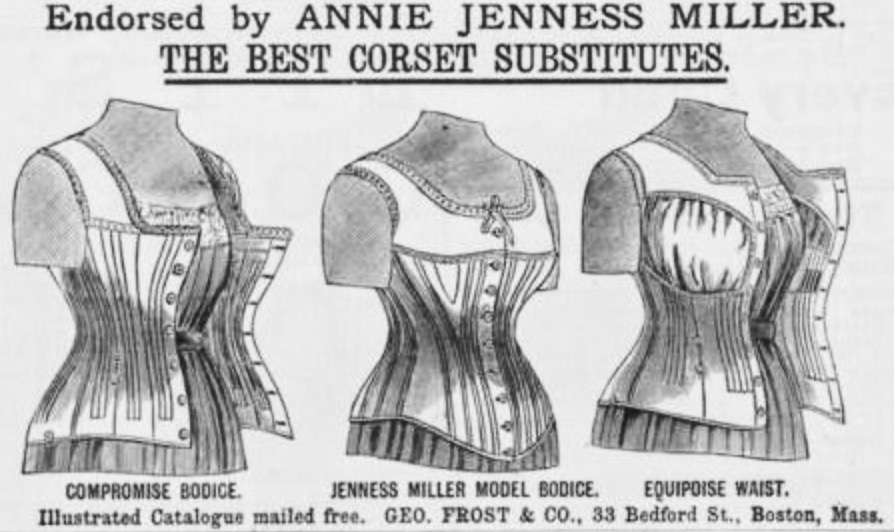
    ‘It is fashionable, too, to be clean in this day and generation and “tubbing” is English, so that the semi-weekly baths of our grandmothers have become bi-daily with her progeny; tennis, yachting, riding, and all elegant sports– facts which rather discount in the fashion world of some of Mrs. Miller‘s reforms.’ – A true pioneer in clothing design in an age when women’s roles were evolving and expanding, Annie Jenness-Miller was an advocate for reforming how women dressed. She pushed for physical development, proper posture, good hygiene and healthy living for both women and men. A popular Gilded age speaker, she lectured on a variety of healthy topics to help prevent the spread of disease, and assist with the equality and human rights for the working classes.


    Her Point Of View

    Mrs. Jenness-Miller of dress-reform fame has begun her career, if indeed, a reformer so well established may still be regarded as a beginner, in most sensible fashion. Realizing the power which the world of fashion wields far outside of its actual limit, she has interested fashionable women in her ideas and has designed her beautiful and artistic gowns upon models which the most punctilious of fashion's votaries can adopt without offense to her priestess. 

    It is not, however, the fashionable woman who most needs the “divided skirt” and the “gown form,” and Mrs. Miller suggestion about bathing exercise and physical culture are not the blessing to the so-called society woman that they will be to some of her less favorably circumstanced sisters. So far as it influences her appearance, the care of her figure and her health is nowadays a very important study in the curriculum of the developing belle. She and her elders abhor her poor stooping shoulders, angles, and prominent bones as much as Mrs. Miller herself, even if she does not resort to the same sensible and permanent means to relieve them. The majority of fashionable women carry themselves well, straight, and not ungracefully, and a plump, rounded figure, is by no means rare among the “400,” although marred and rendered less beautiful than possible by the dress and corset maker’s art. 

    It is fashionable, too, to be clean in this day and generation and “tubbing” is English, so that the semi-weekly baths of our grandmothers have become bi-daily with her progeny; tennis, yachting, riding, and all elegant sports– facts which rather discount in the fashion world of some of Mrs. Miller‘s reforms. One cannot help hoping as one listens to her forcible presentment of the evils she inveighs against, and as one admires the comfortable garments she has designed, that she may sometime bring her skill and persuasion to the cognizance of a class of laboring women to whom the adoption of such a helpful and convenient dress would be of vast value. 

    To convince convince shop girls, sales women, any woman, indeed, whose occupation necessitates tramping about the streets in all weathers or standing for hours every day at desk or counter, that they could increase their strength and comfort and actually prolong their lives by merely adopting a different dress, would be a deed of almost incalculable benefit.– New York Times, 1890


    Etiquette Enthusiast, Maura J. Graber, is the Site Editor for the Etiquipedia© Etiquette Encyclopedia

    Friday, June 4, 2021

    Gilded Age 400 Code of Floral Etiquette

    The fashion in flowers varies less with the season than can be said of almost anything else. In the vegetable line, for example, there are certain vegetables obtainable only in certain seasons. Fish and game are also governed by the time of year, but all kinds of flowers can be bought at all seasons, and as those that are offered for sale are nearly always hot-house grown the price of flowers does not vary from winter to summer nearly as much as one would suppose who is not in the habit of buying. Thus a certain code of floral laws, or what may be called a code of floral etiquette exists which is followed all the year round without regard to season. 


    What the Leading Florist of the Four Hundred Says–
    Roses are the Favorites–
    Beautiful Presents for Debutantes, Wives and Girls in Their ’Teens

    Correspondence of The Mercury– The most beautiful flowers in the world are grown in New York. California has a greater abundance of blooms, and Paris and London have each their specialties. But New York excels them all in the greatest beauty of the greater number of flowers. In New York, even in the coldest weather, it is not unusual to find violets whose outspread petals would extend over the size of a silver dollar, and American beauty roses are frequently seen as large as a big orange. 

    The fashion in flowers varies less with the season than can be said of almost anything else. In the vegetable line, for example, there are certain vegetables obtainable only in certain seasons. Fish and game are also governed by the time of year, but all kinds of flowers can be bought at all seasons, and as those that are offered for sale are nearly always hot-house grown the price of flowers does not vary from winter to summer nearly as much as one would suppose who is not in the habit of buying. Thus a certain code of floral laws, or what may be called a code of floral etiquette exists which is followed all the year round without regard to season. 

    For the debutante the favorite bouquet is made all of orchids—white orchids being the preferred ones. The size for a debutante's bouquet is about fourteen inches across and is made in conventional bouquet fashion. The cost is about $12.00. B ut, of course, a beautiful and popular young girl receives many bouquets, so there is always a struggle for something a little novel and sufficiently original that it can not be duplicated. Many varieties of the orchid bouquet, therefore, must be found. A young man who is, as you would say, “rather sweet” upon a young woman, and who wants to send her something which will catch her eye and please her, will say to his florist: “Can you send Miss A. a handsome bouquet, which shall be a little—or —different from er -anything else, don’t you know?” Then his florist will suggest a bouquet all of very rare white orchids, with white lilies on one side. When it is done, the young man drops in to see it, and perhaps he orders finishing touches, which bring the bill up to $50.00 for this one bouquet. 

    The matron who sends a bouquet to a debutante, chooses colored orchids. They may be pink or purple or variegated, but the entire bouquet is after the conventional order. The debutante, if she is at all popular, has half a hundred bouquets, but you may be sure that she has her eye upon one which she fancies more than any of the others, and by and by she will pick it up and carry it for the rest of the evening to the exclusion of the others. It is always the bouquet of white orchids and white lilies which is chosen. 

    To pass to a more sombre subject and to another use to which these same flowers are devoted, for funerals, the palm is the accepted odering, although a much greater latitude is allowed at funerals than formerly. At Jay Gould's funeral there was a greater variety than at any social gathering of the season. Mrs. August Belmont had, likewise, many exquisite floral pieces. The Rothschilds are in the habit of cabling over orders for floral pieces, and, indeed, it is not unusual to receive half a dozen cable orders for any large New York event, especially a funeral. While the palm is the accepted tribute for a funeral, there is a floral piece known as the “mat,” which is as good form as anything that can be sent. 

    This consists of many great bunches of flowers just as they are brought out of the vases of cool room. They are dropped in armfuls and are fastened to the mat foundation wherever they happen to lie, so that the whole is an exquisitely beautiful bit of extravagance, which, when floral beauty is considered, well repays tbe buyer. 

    When a man orders a bouquet for his wife or a box of flowers it is considered the prettiest idea for him to select violets, as these have clinging associations of poetry, love, constancy and all the things that ought to belong to married life. A woman in ordering flowers for her husband will ask that something be sent suitable for a buttonniere. This varies a little with the season but is sure to be a chrysanthemum as long as chrysanthemums last. 

    Flowers for old people and for young girls are nearly always cut roses. They seem to appeal especially to these two classes. Old people choose them because they are sweet smelling, and because old people do not take as kindly to fashionable floral innovations as young society people do. Girls in their “teens” like cut roses because they are poetical, and because illusions to growing maidenhood are usually couched in terms portraying the opening of the rose. It is rather a new idea with the season, almost a fad in fact, to send pots of growing plants to young men in place of birthday or New Year's gifts. Indeed, the pot ot growing plants forms in itself a gift worthy of being sent to any one. 

    Rubber plants and all kinds of hardy foliage plants are selected because they are easier to care for than a majority of plants. For home entertainments, where a very good effect is desired in small space, it is the most fashionable idea to cover one side of the wall entirely with flowers of only one variety, and if possible to introduce light behind them. This has been done repeatedly at Mrs. Whitney’s annual balls, and the result has been good that the idea has become an established one and is a fashion in itself. For the coming out of the debutante or for a wedding or a christening the effect should be bright—particularly bright—as is the case if pink carnations, yellow chrysanthemums or bright roses are used. But for ordinary social gatherings it is prettier to subdue the tone somewhat and trim with ivy, or if it be in winter, with mistletoe and holly. 

    A few weeks ago I massed holly on one side ot a ballroom and the effect was so beautiful that all the guests were talking about it. The idea was afterward repeated at the Patriarchs’ Ball, but was done too sparingly and was, therefore, not a success. A great deal of money is necessary for anything of this kind, though it may be said that the people who order such work done are so rich that the $2000. or $3000. necessary for such adornment seems nothing at all. For a christening, lilies are almost always chosen. In the spring, it is lilies ot the valley. In the fall, callas are used and later come the Easter lilies. Just a touch of color is introduced in the way of a gaily colored ribbon or a bright basket, so that it shall be plainly evident that the flowers are intended for a happy occasion and not for a funeral. 

    In sending flowers to an invalid it is considered the best form —and best form is sure to be the truest politeness to send something which shall seem to be of special interest to the invalid. Not two dozen roses all exactly alike, nor twenty lilies, nor fifty violets, but dashes of many different kinds of flowers. It is good taste to put in the invalid’s box a very white and very rare orchid, some mignonette, an extraordinary rose and so on, until a really fine collection is obtained. 

    In the way of standing orders queer things prevail. A young man who has just become engaged will order two dozen roses sent daily to his betrothed. A young man whose sweetheart is going upon a journey will request that we keep track of her movements and will make us promise to see that she receives a box of carnations or some flower that will keep on a journey, two or three times a week as long as she is upon her tour. Standing orders for actresses are usually for big flowers that can be used with good effect upon the stage. 

    In trimming state-rooms for those about to depart on European steamers it is the latest idea to use vases and ornamental pots and jars as far as possible, because those can be preserved during the trip after the flowers are cast overboard. A mass of smilax or ivy drawn across one side of a state-room like a portiere and then “stuffed" out of the porthole, gives a beautifully artistic effect which is the “fad” with outgoing tourists, lots of picturesque roses and bouquets of sentimental forget-me-nots are the flowers suitable for the occasion. With regard to a floral alphabet there is little absolutely set down in rules. The law varies with the woman. 

    A young girl will take a fancy for lilies of the valley. She wears them on all occasions, has them painted upon her fan and embroidered upon her gown. To her they mean everything pure and lovely. They constitute her “alphabet of love,” so to speak. And, of course, her admirers know her taste and choose the tiny white flowers to bear their unspoken messages. As a rule, however, the heart of the society maiden is touched by mammon, so that flowers which represent money represent also love. As a pert little maiden remarked in front of one of my windows: “Carnations and love will do for some girls: but I have educated my best boy up to orchids.”

    Many orders are left which the etiquette of my business will not permit me to fulfill. For an example, take the case of a man who dropped in here last week and left a ten-dollar bill upon my counter. “You may send Miss B., of No. 1000 Fifth avenue, a box of pansies. And—er —well—never mind the card, you know. Just send them anonymously.” Now Miss H’s mother is one of our patrons and Miss H. herself is a school girl of fifteen. So I delayed fulfilling the order until her father happened in one day, and then I told him about the man who wished me to send his daughter flowers. “Do not send them!” he thundered. “Flowers to my daughter! At her age! Impossible! Preposterous!” I did not send Miss H. the flowers, and when her elderly admirer happens in again he will be the richer by a ten-dollar bill. As a rule, though, floral orders are for the expression of pure, dignified sentiment. And into no other business does so little of the immoral ever creep.” – Charles Thorley, 1893


    🍽️Etiquette Enthusiast, Maura J. Graber of The RSVP Institute of Etiquette, is the Site Editor of the Etiquipedia© Etiquette Encyclopedia