Showing posts with label Proper Place Setting Etiquette. Show all posts

Saturday, November 4, 2023

Setting the Formal Table of 1942

“Not more than three forks and three knives belong at one place. If additional forks and knives are needed, they are put on the table as the dinner progresses.” — Don’t forget that the 3rd Annual Etiquipedia Place Setting Competition is open until November 16th!


Minding Your Manners


“How should a table be set for a formal dinner?” asks Mrs. Henry Gratz of Huntington Park…

One rule that a hostess must follow in the setting of the table is that everything must be equally spaced. The best type of cloth for a formal dinner is one of white damask.
 
Next comes the setting of places. The distance between places at the table must give ample elbow room. On the left of each plate, handle toward the edge of the table, is put the salad fork; the meat fork is next, then the fish fork. 
On the right of the plate, and nearest to it, is the salad or meat knife, then the soup spoon. Not more than three forks and three knives belong at one place. If additional forks and knives are needed, they are put on the table as the dinner progresses.

The water glass is placed above the knives at the right of the plate. Next to it at a slight. distance on the right is the tall stemmed glass for wine-if wine is to be served. The dinner napkin is folded in a square, and laid flat on the plate. — Los Angeles Daily News, 1942

 🍽Etiquette Enthusiast, Maura J. Graber, is the Site Editor for the Etiquipedia© Etiquette Encyclopedia

Sunday, September 3, 2023

Please, No Cups and Saucers...

An informal alfresco table — At the time, morning, noon or night, that coffee is served at the table any to family and/or guests, the equipment should be placed on a small tray at the hostess' place or on an adjacent small table. 

No matter how informal or casual the gathering it is neither attractive table-setting, nor good serving practice, to place a cup and saucer at each individual place on the home table. At the time, morning, noon or night, that coffee is served at the table any to family and/or guests, the equipment should be placed on a small tray at the hostess' place or on an adjacent small table. 

The cups and saucers with a spoon on each saucer to the right of the cup are grouped at the hostess' place, each to be served in turn by her. Cream and sugar on a small tray might be placed on the table and passed by the guests themselves, especially if the hostess has other serving to do. At luncheon or dinner, if there is a maid, she will bring the cup of coffee to the guest after the hostess has poured it, placing it at the right. She will then serve sugar and cream on a small tray from the guest's left. —Helen Sprackling, 1960


🍽Etiquette Enthusiast, Maura J. Graber, is the Site Editor for the Etiquipedia© Etiquette Encyclopedia

Wednesday, August 10, 2022

Correct Place Settings and Tables


The 2nd Annual Etiquipedia International Place Setting Contest is Officially On!


Here is an illustration of a great example of a perfect American place setting. We have numerous links with examples and instructions listed below. Just pick a time period and start reading! Good luck to everyone who wishes to enter.


We have articles on table settings and place settings from around the world and over centuries. Below are just a few of the labels you can search for, and read, on Etiquipedia:

To fill out a form to enter, click on the place setting photo on the top right of this page or click here


🍽Etiquette Enthusiast, Maura J. Graber, is the Site Editor for the Etiquipedia© Etiquette Encyclopedia

Friday, June 3, 2022

Etiquette and Tiffany’s Table Settings


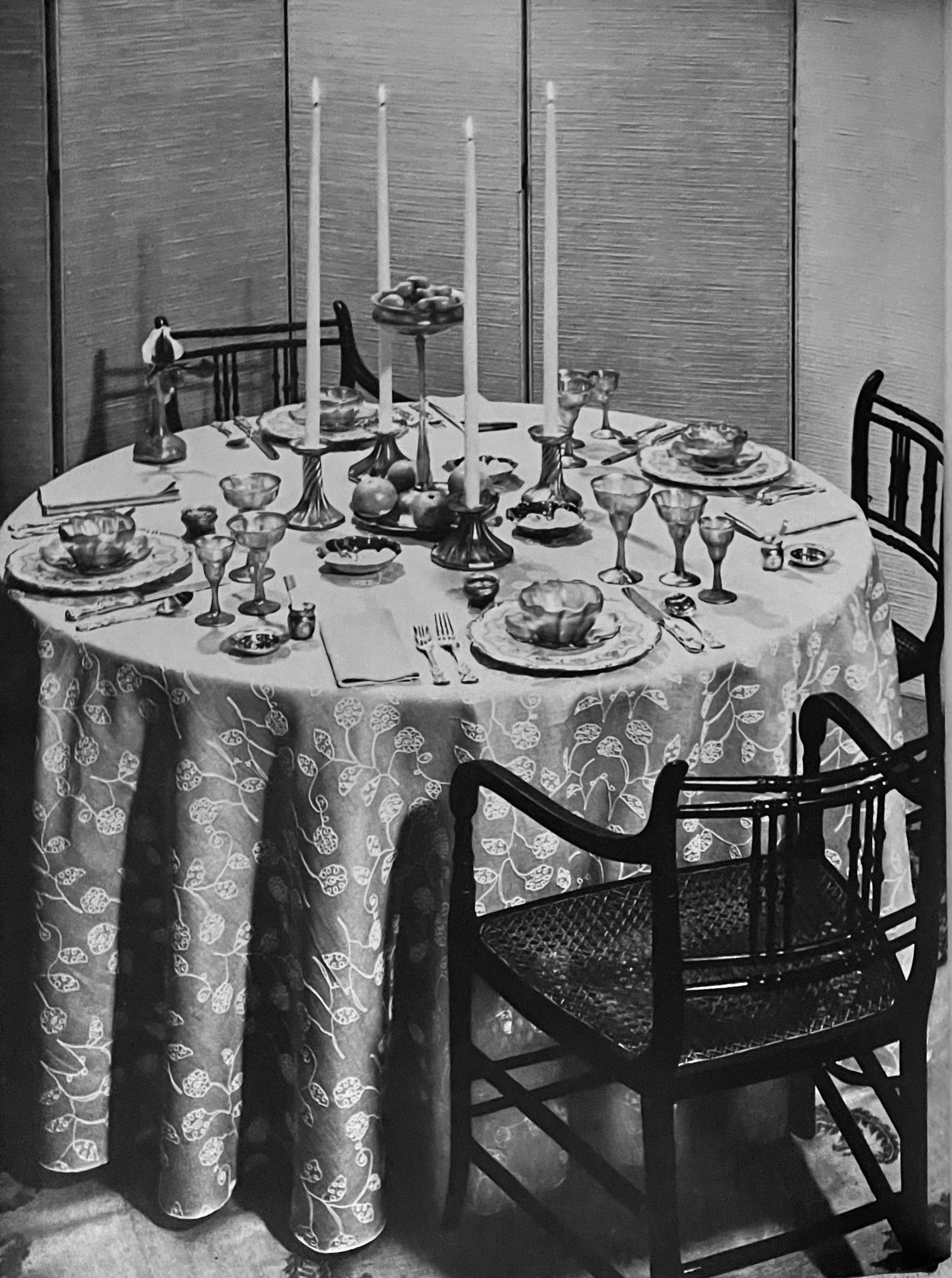
This beautifully set dining table for four features elements from Tiffany’s. It is the first of the settings shown in the 1960 book, “Tiffany Table Settings.” The book was a companion offering to the women who not only participated in the yearly event, but notably to those who couldn’t attend the popular show of tabletop artistry. Etiquipedia will be featuring more from the book in the coming days, along with etiquette critiques of the late-1950’s to 1960 settings.

In 1956 Tiffany & Co., the famous Fifth Avenue jewelers and silver smiths, inaugurated an active program to present table settings of taste and imagination to the public. The purpose of this program a continual round of exhibitions-is to inspire and provoke greater interest in this area of design. When the exhibits are held, thousands of people visit Tiffany's weekly to view the settings by New York's leading hostesses and interior decorators. The store holds that a "per fect party" implies a beautiful table as well as a distinguished menu. Those who are chosen to design tables select Tiffany china, silver, and glass as accessories on their tables, combining these elements with their own furniture, linens, and antiques.

This collection of settings has not been compiled to instruct in the "book of etiquette" sense. Rather, it is hoped that the presentation of these settings will be a source of inspiration and a focus of ideas to any hostess.

There is infinite variety of design in these tables. Some of the set tings are based on the theory of switching objects created for one purpose to other uses, as well as juggling to make new combinations of color, fabric, and shape. Some of the settings are classic examples of subtle orthodox statement. Others are frankly based on fantasy.

The common denominator of good style, however, underlies all the designs, regardless of the occasion or spirit of formality or infor mality. A table set with inexpensive earthenware, for example, on a checked cotton cloth can be as enticing and appetizing as one of rare porcelain, crystal, and silver.

The editors believe that a woman is not using her own creative abilities unless she can turn her imagination to lending a fresh look to her table. It is hoped that this book will encourage a new point of view in this field of interior design. — Tiffany Table Settings, 1960


🍽Etiquette Enthusiast, Maura J. Graber, is the Site Moderator for the Etiquipedia© Etiquette Encyclopedia
Sunday, December 13, 2020

12 Steps for Correct Dinner Tables


        Of course, every hostess knows now that the tray is no longer used in serving and that the servant holds only a folded napkin to take its place. She knows also that only one plate must be brought to the table or taken away from it at a time.


The Young Housekeeper says that she finds there is often confusion in the minds of her confreres about the proper way to set a table. Once, she says, two sisters quarreled as to whether the edges or the backs of the knives should be turned toward the plates and did not speak to each other during an entire dinner-party, to the great embarrassment of the guests. For these reasons she gives here the rules for setting the table: 

  1. Put the knives to the right of the plate with their edges turned toward it; with these go the spoons, beginning with the soup spoon and ending with the tiny coffee spoon, if coffee is served at the table. 
  2. The forks are placed at the left of the plate with their prongs turned upward. 
  3. The glasses are placed near the points of the knives, while the napkins go to the left of the plates. 
  4. Usually at dinner a piece of bread is folded within the napkin. 
  5. At a dinner or luncheon no guest is ever left without a plate before him. As the serving man or woman removes the plate of a course with one hand with the other he places another plate before the diner. 
  6. Meats are now usually served from a side table and are passed by the servant, as are the vegetables. 
  7. The only things which are placed upon the table aside from the candles, flowers and tiny other decorations there may be, are such things as olives, bon-bons, nuts, etc... 
  8. In serving dessert a plate is placed before the guest on which is a finger-bowl resting on a doily. The doily and finger-bowl are removed by the guest and placed before him and the dessert is then brought on in individual dishes or glasses which are set upon the plate. 
  9. Olives are always taken with the fingers and not with a spoon, so are candies and lump sugar and frequently salted nuts. In fact, the fingers are used whenever it is possible in order to do away with a multiplicity of implements. 
  10. A competent man or maid can serve eight guests, but that is about all that can be properly attended to by one person. 
  11. Of course, every hostess knows now that the tray is no longer used in serving and that the servant holds only a folded napkin to take its place. She knows also that only one plate must be brought to the table or taken away from it at a time. 
  12. Coffee is usually served after dinner in the drawing-room, the hostess pouring it from a pot into the little cups,  a servant passing sugar — and cream for the vandals— with it. 

Those rules are so simple that there is probably no one left in the country who does not know them, but lest there should be even one person not informed on these subjects she writes them down here.— Stockton Independent, 1915 


Etiquette Enthusiast, Maura J. Graber, is the Site Editor for the Etiquipedia© Etiquette Encyclopedia