Showing posts with label Gilded Age Fads. Show all posts

Thursday, September 4, 2025

Gilded Age Bathing à la Française

“Queen Marie Antoinette made liberal use of a “tub,” putting into the water wild thyme, laurel leaves, marjory and a little sea salt.” – on French bathing in 1893
⚜️⚜️⚜️⚜️⚜️⚜️⚜️⚜️⚜️⚜️
 
French styles in under garments, fashions, fads and fancies have always been popular with America’s young women, and were especially so during the gilded age. Above is a period advertisement for “French Model Corsets.”
Gilded Bathing in Paris

All fashionable Paris is buying a new volume entitled "Directions for Woman's Toilet," and the publication of such a book in France is not without significance as a sign of how ideas are progressing in that country.

“Unhappy ages,” says the author, “in which people were ignorant of the use of water, ‘a thousand years without a bath,’ as Michelet puts it in one of his historical works. Bad pestilences and other horrible maladies desolated poor humanity- in fact, only to read how the courtiers of Louis XIV neglected their persons makes one sick with disgust.”

Even in the unwashed ages gone by the noted beauties found out the secret of preserving their loveliness by ablutionary aids. Isabeau of Bavaria heard that chickweed was good for the skin, and had enormous decoctions brewed and bathed in them daily. Diana of Poitiers was another of the cleanly coquettes and plunged into a tub of rain-water every morning.

The Eighteenth century beauties likewise went in for tubbing, and put all sorts of funny decoctions into the water to improve their skin, such as the bouillion in which veal had been broiled, water distilled from the honey extracted from roses, a preparation of almonds, lemon juice, the milky juices of green barley and linseed distilled with Mexican balm dissolved by the yolk of an egg. These rather nasty sounding concoctions were freely used by the ladies who sunned themselves at the courts of Louis before the revolution.

Queen Marie Antoinette made liberal use of a “tub,” putting into the water wild thyme, laurel leaves, marjory and a little sea salt. Marie Czetwertynoska, the Russian beauty who exercised so great an influence over Czar Alexander I, used to bathe in Malaga wine, after which the wine was sold to persons about the court for their table consumption without disguise as to its previous use.-Paris Letter, 1893


 🍽Etiquette Enthusiast, Maura J. Graber, is the Site Editor for the Etiquipedia© Etiquette Encyclopedia

Monday, June 30, 2025

A Bejeweled Gilded Age Fad

A couture Worth gown as depicted on the cover of Harper’s Bazar magazine, in 1894. According to the Telegraph, Charles Frederick Worth was the “the Lincolnshire lad who became Queen Victoria's favourite couturier.” His fashions at his Paris, “House of Worth,” were favored by the wealthy heiresses, Duchesses and Princesses from around the world in the gilded age. Worth had died 3 years before this fad of dresses with jewel-encrusted, live tortoises chained to them was reported. One has to wonder what he would have made of the trend!


Living tortoises with their backs covered with jewels, attached by a gold chain to ladies dresses, are the rage in Paris. They cost about 16 pounds ($80). The society for the protection of animals is agitating the matter. —From the Morning Press, January 1898


🍽️Etiquette Enthusiast, Maura J. Graber, is the Site Editor for the Etiquipedia© Etiquette Encyclopedia

Tuesday, May 20, 2025

The Kangaroo Walk Explained

The “kangaroo walk” this mode of pedestrianism has already been dubbed by the women who do not admire and adopt it. The sliding and yet plunging manner in which the strides are taken gives to this name a decided character of suitability. But the new walk, however striking and fashionable it may be, will not do for all occasions.


HAVE YOU SEEN THE KANGAROO WALK?
It is queer enough upon the boulevards, but how would it be in a ballroom? And how about wedding processions and figures in the cotillion? Besides, while bearable and in some sort of keeping with heavy, man-tailored, short skirts, stiff-necked dressings, and wide-brimmed felt hats, it could not be considered at all in connection with the trailing gowns, beautifully sweetly feminine hats and bonnets to prevail during the coming season. What then? 

The "woman who walks" is very much in evidence in Los Angeles. But she does not walk at all as have done her predecessors of other pedestrian seasons. A new walk has made its appearance, and now up Spring Street it is rampant, it is by no means unknown upon Main Street. The new walk is as startling as it is unique and — peculiar. 

The walk and carriage of the fashionable woman has been really a thing of beauty for some years past. The most commendable style of walking of late years has been based upon Delsarte principles — head well up, chest out, abdomen held well back, back quite deeply indented. The Delsarte teachers and devotees were responsible for its introduction into America and the" polite world. Once introduced, the Delsarte carriage — being the proper and hygienic pose of the human body into the bargain—became almost universal.    

That it was a healthful and becoming mode of locomotion cannot be doubted. Now comes the new form of pedestrianism. It owes nothing to Delsarte or the physical culture principles. It seems to be based rather upon a desire to see to what lengths the old statement that walking, for human beings is really a series of forward tumbles with accompanying and subsequent recoveries, can be carried without resulting in dire disaster. 

The body and limbs are all held stiffly, the head — the chin particularly — is poked forward in a decidedly ungraceful and unbecoming manner, the back is bent stiffly from the waist, and the arms hang loosely and lifeless. With each forward step— and each step is a long, quick, hurrying stride—the arms swing stiffly out and back again, as though hung on pivots at the shoulders. The eyes are usually directed toward the ground or straight ahead, and the whole appearance is that of a Dutch doll unexepctedly endowed with the power of motion and in a great hurry to get back to the dollshop and exhibit

A clever and merry woman says that she believes the new walk is the direct result of the vain and fruitless efforts which women for so long made to correct and coerce the natural and innate wickedness and depravity of the short walking skirts which have become so indispensable to woman. These skirts, as every woman knows, will "sag" at the back and "hike" up in the front, no matter how good the tailor who fashioned them, how careful, graceful and stylish the wearer, and how expensive the materials from which they were constructed. 

The witty woman who claims to have invented this reason for the new walk, says that it was undoubtedly evolved by some poor feminine who had been driven to desperation and despair, almost to lunacy, by the altogether abominable conduct of a succession of these skirts. Bankrupt, despairing, at her wit's end, she decided to tip forward as she walked, thus bringing the edge of the skirt she was wearing into something like a right line. 

While this explanation of this new walk is not vouched for, it is the only one which has yet appeared, and it certainly bears with it an atmosphere of that "sweet reasonableness" which is conspicuous by its absence from the new walk itself. 

The "kangaroo walk" this mode of pedestrianism has already been dubbed by the women who do not admire and adopt it. The sliding and yet plunging manner in which the strides are taken gives to this name a decided character of suitability. But the new walk, however striking and fashionable it may be, will not do for all occasions. 

It is queer enough upon the boulevards, but how would it be in a ballroom? And how about wedding processions and figures in the cotillion? Besides, while bearable and in some sort of keeping with heavy, man-tailored, short skirts, stiff-necked dressings, and wide-brimmed felt hats, it could not be considered at all in connection with the trailing gowns, beautifully sweetly feminine hats and bonnets to prevail during the coming season. What then? 

Some provision must be made for the girls and women who cannot or will not adopt this style of carriage and locomotion, so still an advantage may be noticed in swelldom at present. The walk, or carriage has been termed, not inaptly the "religious walk." because it goes so well with the gentle, demure and sweetly serious appearance and expression which the fashionable woman cultivates upon certain occasions. 

It "looks lovely," to be appropriately feminine, when entering or leaving church, and it is "just too beautiful for anything" in the case of a wedding procession. The girl who can "do" the "religious walk" charmingly is sure of a certain amount of belledom wherever she may be. And for entering a crowded drawing-room or clubroom, for promenading at the opera, or between dances at a ball, there is nothing like it. 

The Delsarte devotee usually carried something in her hands when she went a-walking. Whatever it was, umbrella, golf stick, pocketbook, roll of music, it was so held as to accentuate the long, slender, straight, and slightly forward-tipping line of the figure. The girl with the kangaroo method of locomotion generally discards umbrellas and "small traps" of every kind. Her hands are usually clinched in decidedly enough. 

The Delsarte girl loved to wear her hat straight on her head, a la the sailor hat so beloved of the dear, impossible Gibson girl. The kangaroo maiden pulls her soft felt almost down to her eyebrows or pushes the round golf cap which replaces it almost back to her crown. The girl with the "religious walk" has taken points from both of them. She has, in fact, seized upon many of their distinguishing chnricteristics and transmuted them to uses of her own—with a difference. The mouth of the Delsarte girl was a delicious thing of sweet curves, modified by a slight degree of determination.- Los Angeles Herald, 1901


🍽️Etiquette Enthusiast, Maura J. Graber, is the Site Editor for the Etiquipedia© Etiquette Encyclopedia

Wednesday, May 8, 2024

Gilded Age Rules of Conduct

Arbitrary rules of etiquette, such as concern the proper way to shake hands, the number of cards to be left at a reception, the way to turn out your toes and the special greeting that is the current fad, all these rules are liable to change from season to season, vary in different localities and mean very little anyhow. 
Prodigious as are the manuals of etiquette issued in these days, nobody with a kind heart, a desire to please and the merest rudiments of knowledge of the simpler social responsibilities need worry about their “manners.” The self-respect that a good conscience and self-reliance give will keep you from pushing and intruding. As for “rules of conduct,” pooh ! You need hardly bother about any that your own sense does not suggest." 

Arbitrary rules of etiquette, such as concern the proper way to shake hands, the number of cards to be left at a reception, the way to turn out your toes and the special greeting that is the current fad, all these rules are liable to change from season to season, vary in different localities and mean very little anyhow. A handshake that is the result of cordial intent can never be rude nor ill done. Bad temper is always ill-bred. Conduct of any kind that puts others to distress is always “bad manners,” disrespect to age or to the dignity that office or high achievement confers is always hopeless rudeness, and your own good heart will tell you that.

The young girl just out of school is overwhelmed with mustn'ts and musts, but most of them are nonsense. If she is modest and self-respecting she will know that the inevitable “young man” must be treated with some reserve. But she need not be afraid to take his arm if she needs his assistance, nor has she committed a social crime if she doesn't take it, so long as neither course is followed to her own distress, or to his unnecessary embarrassment. 

She will know that this same young fellow should include her mother or guardian in social plans, at least till such time as the mother or guardian have judged him to be trusted with the escort of the girl alone.  Her own instinct will tell her that she should not receive rich presents from a man unless she is engaged to him, because it is never comfortable to be under obligations to any one, whether a “young man” or not, that she is not in a position to repay. All the other mustn't easily range themselves under some equally simple and reasonable rules.

Many of the remaining causes of anxiety to the neophyte come under the head of prompt and exact replies to social notes involving the making of social engagements, of equally careful keeping of social engagements, big and little, of friendly thoughtfulness of the one who is ill, or who is having an anniversary of some kind that demands a call, or a line of remembrance or greeting. Then there are “table manners,” and they are made such a bugbear that one's appetite is all lost. But even at the most formal dinner you need not be afraid. Watch the hostess. She is supposed to set the example for every one. 

Don't be frightened, and don't do anything in a hurry. Indeed, those two suggestions will bring you through almost any formal occasion if you will keep sharp lookout and remember that good temper and a modest desire to please will make up for mere awkwardness and make up handsomely. – A “Second Debut” Article by C. O. Burton, 1895


🍽Etiquette Enthusiast, Maura J Graber, is the Site Editor for the Etiquipedia © Etiquette Encyclopedia

Friday, April 19, 2024

Gilded Age Novelties

The Standard Designer illustrates some of the newest favors and gives directions for making not a few inexpensive but effective ones. 

Newest Cotillon Favors, 
Including “Queen Victoria” crowns…

The custom of giving cotillon favors during the dance comes from Germany, and the favors which come from there are very well made, though perhaps not as effective as those which are made here. 

In Paris beautiful favors are made also, but when imported here become very expensive. It is, however, no longer considered good form to give too expensive favors, and marvelously pretty articles can be made with small outlay.

The Standard Designer illustrates some of the newest favors and gives directions for making not a few inexpensive but effective ones.

To begin with, the banjo is one of the latest. It is made of cardboard and is entirely covered with tissue paper wound around and around. The strings of the banjo are made of gilt tinsel, such as is used on Christmas trees, and around the head are fastened roses made of crape or tissue paper to correspond in color. 

Satin ribbons are tied on the handle so that the favor can be worn slung over the shoulder. Some have bells instead of roses. Toy banjos can be bought and covered, and so save the expense of making them oneself.

Queen Victoria crowns are very new favors, and 100 of them have just been ordered for a cotillon to be given in New York. They are miniature crowns, made of fine wire, covered entirely with tiny pink roses and surmounted by a small gilt ball.

Large palm leaf fans may be transformed into lovely cotillon favors by pasting all over them closely on both sides small paper roses, violets, orchids or any other flower.

The cheapest cotillon favor which can be given is an ordinary tin fish horn. This is simply tied with a bow of ribbon. French horns are also much used as favors. They are generally of wood and are either gilded or silvered and tied also with ribbons. A pretty favor is the scented work bag made of satin brocade or other silken material.

Favors for men should be small. Rosettes of ribbon, different colors, to wear in the buttonhole, crape paper flowers for boutonnieres, cravat holders in silver, pen wipers, Japanese trifles of all kinds, including stamp boxes, account books, canes which pull out, forming candy boxes in the crook handle, and small lyres which are gilded and tied with ribbon. 

Only a very few of these articles can be made, but all can be bought at very little outlay. At all the large dances the favors are placed on a table and given out by one or more of the patronesses. Sometimes the leader of the cotillon takes them around from one couple to the other, as it comes their turn to dance, or else they go to the table and receive them from the patroness. -Ruth Ashmore in Ladies' Home Journal, 1897


🍽Etiquette Enthusiast, Maura J. Graber, is the Site Editor for the Etiquipedia© Etiquette Encyclopedia

Sunday, April 7, 2024

Gilded Age Fad of Young Men

There is a whole science to selecting rings for different fingers according to many online sources – Image source, Pinterest

A Young Man's Rings

Have you noticed the hands of the young man who is only swagger, not quite well-bred? He wears rings and rings – not one, or two, or even three, but six and seven, and he wears them just as his women friends do, clear up to the knuckle of the third and fourth fingers of both hands. 
Some of them are of gold and some of silver or platinum, and occasionally one sees a thin, dark band that means iron, and they are set with all kinds of stones, sometimes a diamond, sometimes a turquoise, perhaps an emerald, or a ruby, or a sapphire. 
And the young man who wears all these finger adornments always rides in the elevated cars without his gloves, and the young lady clerk sits opposite him and counts, and wonders and admires.-N. Y. Evening Sun, 1890
.

🍽Etiquette Enthusiast, Maura J. Graber, is the Site Editor for the Etiquipedia© Etiquette Encyclopedia

Friday, January 5, 2024

Gilded Age Dining is Fashionably Late

“Second Début” Post on Gilded Age Dining…
Gilded age servers for the dining room – “A marked change has taken place in the fashion. The late evening dinner has for years been steadily gaining in popularity, and promises to become even more common than it is now. Thoughtful men and women recognize the wisdom of eating lightly at midday, when they are in the full tide of business, and reserving the heartiest repast for an hour when it can be discussed leisurely and digested peacefully.” – 1890

More Fashionable is the Late Time to Dine

Twenty or thirty years ago the late dinner was not nearly so popular as it is now. The majority of people dined in the middle of the day, and not a few of them considered a six-o'clock dinner as an effort after fashion, that was unworthy the imitation of sensible men and women. Even in the large cities, servants rebelled against an alteration of the time-houored custom of serving the principal meal of the day at, or near noon, while in small towns the late dinner was so unusual that it was almost impossible to persuade domestics to consent to it.

A marked change has taken place in the fashion. The late evening dinner has for years been steadily gaining in popularity, and promises to become even more common than it is now. Thoughtful men and women recognize the wisdom of eating lightly at midday, when they are in the full tide of business, and reserving the heartiest repast for an hour when it can be discussed leisurely and digested peacefully. Mistresses have learned that there is a gain in keeping the morning free for housework, instead of devoting most of it to the preparation of the dinner.The light lunch eaten in most homes demands much less time in cooking and eating than does a dinner, and leaves those who have partaken of it more fit for work than they would be, were their stomachs burdened with the task of digesting soup, meat, vegetables and dessert.

The late dinner is a more dignified meal than can possibly be made of a similar repast eaten at noon. The festal appearance imparted by the gleam of candles, lamps, or gas upon silver, china and glass, cannot be acquired by daylight. The pleasant harmony around the board of the members of the family, whose positions and interests have been divergent since morning, the happy consciousness that the work of the day is done, the knowledge that there is no toil waiting at the door of the diningroom, all bear their share in rendering the meal cheerful and care-free. 

More ceremony can and should be preserved at the evening dinner than is feasible at noon. The orderly sequence of courses and the careful serving have a part in adding to the dignity of the meal. These suggestions should not frighten the house-keeper who contemplates introducing the late dinner into their household. Very little extra work is involved in bestowing the touch of state referred to, and, after all, it consists chiefly in a slight additional care in waiting and serving, and to these the mistress can readily accustom the maid.— Christine Terhune Herrick, in Harper's Bazaar, 1890


🍽Etiquette Enthusiast, Maura J Graber, is the Site Editor for the Etiquipedia© Etiquette Encyclopedia 

Thursday, June 8, 2023

Gilded Age Lemon Parties

Of course, everyone who received one of these mysterious summonses was consumed by curiosity. What could “Please bring a lemon” mean? The only way to ascertain seemed to be to comply with the invitation. The Washington Market seemed glutted with the meanest little dried-up lemons ever seen. Tuesday at seven p. m., with the lemons in their hands, the guests presented themselves at Mrs. Jones’ hospitable home. 
JOLLY LEMON PARTIES
The Latest Fad In Washington Social Entertainments

It soems as if the poor little lemon had arrived at the height of its usefulness when made to do duty, with the adjunct of ten cents’ worth of citric acid, for a barrel of church lemonade, but now the “Progressive Lemon Party” is brought to the front, and here it plays a part unassisted by any chemical compounds of itself. A prominent Washington lady issued invitations last week which read: 

Mrs. Jones. At home, Tuesday, 7 p.m., 
Please bring a lemon.

Of course, everyone who received one of these mysterious summonses was consumed by curiosity. What could “Please bring a lemon” mean? The only way to ascertain seemed to be to comply with the invitation. The Washington Market seemed glutted with the meanest little dried-up lemons ever seen. Tuesday at seven p. m., with the lemons in their hands, the guests presented themselves at Mrs. Jones’ hospitable home. 

They were shown in to a charming little cloak room, with yellow decorations. and after removing wraps were greeted by the hostess, who was resplendent in a black lace over a lem-on-colored satin, and carried in her hand an immense bunch of yellow roses. After greeting each guest, the hostess asked her to “take her lemon to the dining-room and register.” 

The dining-room was a blaze of golden light from tiny fairy lamps with yellow shades. The dining table had lemon-colored silk napery, which was relieved by a fiat centerpiece of delicate ferns and Catherine Mermet roses. At a side table sat a lady and gentleman, who, all were informed, composed the “Squeezing Committee.” This committee took the name on a register, and tied a ribbon, marked in such a way as to be distinguishable, on each lemon. After the arrival of all the guests and the marking of all the lemons, they were invited to again assemble in the dining-room while the “Squeezing Committee” counted the seeds.” 

Each lemon was cut in half, the seeds extracted, and after being counted and duly accredited to the owner on the register, they were placed in a beautiful transparent glass bowl. The lemon was taken by the “Squeezing Committee” and “squoze” into an immense punch-bowl. The guests were then invited to a repast of strictly lemon-made edibles —lemon ice, lemon ice-cream, lemon cake, lemon jelly, sardines and lemon, lemon-cream pie, and every conceivable sort of lemon-flavored food. Placed beside each plate was a bunch of yellow roses, tied with a satin bow of the same shade. 

After partaking of this unique repast, the glass bowl containing the seeds was placed on the table and a prize offered to her who should guess the number of seeds therein, and a “booby prize” to him who should hazard the least accurate guess. After numerous methods both fair and foul, had been resorted to, and each “guess” had been duly registered, the seeds were counted and the prizes awarded. 

The winner of the grand prize, coming within three of the correct number, received an exquisite lemon-colored glass lemonade bowl, while the “booby” was made happy with a wooden lemon-squeezer. A prize was then awarded to her whose lemon contained the most seeds, and another to her who had the fewest. Meanwhile, skillful hands had prepared a punch in the large bowl into which the lemons were squeezed.— Washington Letter, 1889


🍽Etiquette Enthusiast, Maura J. Graber, is the Site Editor for the Etiquipedia© Etiquette Encyclopedia

Monday, October 31, 2022

Opera Royalty Expects Royal Treatment

           
Adelina Patti was a wildly famous 19th C. Italian opera singer, commanding  huge sums, in both Europe and the United States, at the height of her career. — Public domain image of Adelina Patti on a carte de visite or visiting-card sized photograph. Carte de visites were popular collectible photo cards in the Gilded Age. They were often traded between collectors and special photo albums could be purchased for showing them off to friends and other collectors.

As an instance of the physical care that is bestowed upon Patti, it is related that once when she returned from her daily drive, she was exceedingly thirsty, and asked Nicolini to request some one of their long retinue to cause a glass of water to be brought to her by as quick stages as the comparatively Royal etiquette of the menage would permit. “Water?” shrieked Nicolini, in high B flat “ma mignonne, you know that you are going to sing to-morrow night, and that water will chill your blood. Oh, no; I forbid any water.” “Then give me a taste of wine,” pleaded thirsty Patti. “Wine” roared Nicolini, in his highest C. “Ma mignonne you are going to sing to-morrow night, and you know that wine will heat your blood. No, I can not permit wine.” “Please, can't I have something wet,” begged Patti, with trembling lip, as her palate clicked dryly in her throat, Nicolini pondered long and deeply, and at length, with his own hands, carefully prepared for the great singer a soothing draught of dissolved magnesia.— The Argonaut, 1885


  🍽Etiquette Enthusiast, Maura J. Graber, is the Site Editor for the Etiquipedia© Etiquette Encyclopedia

Monday, October 3, 2022

Gilded Age Resort Happenings of 1900

The scarcity of men which has been felt everywhere was accentuated this past week by the cruise of the New York Yacht Club. Newport was almost deprived of men for two days. Bar Harbor is contenting itself with very young men at the dances and a multitude of luncheons and entertainments where the fair sex is much in the majority. –Late 19th C. Newport, Rhode Island, as depicted in HBO’s “The Gilded Age”


What the secret of this Summer apathy can be, no one has been able to solve. It has been suggested that Newport is so expensive, what with this new craze for bridge, whist and the fees to the servants, and the clubs a man has to join, that the average New Yorker not a multi-million aire shrinks from attempting even a Friday to Monday visit. 

But men who are very wealthy and who live for this sort of thing seem to be as indifferent as those who have a real reason for avoiding Newport and the other very fashionable resorts. There was James J. Van Alen, who only this week, after ten days passed at Newport, deliberately left the place and went to Canada on a fishing trip. It is unmistakably an off season.

The scarcity of men which has been felt everywhere was accentuated this past week by the cruise of the New York Yacht Club. Newport was almost deprived of men for two days. Bar Harbor is contenting itself with very young men at the dances and a multitude of luncheons and entertainments where the fair sex is much in the majority. 

Southampton, of course, has its coterie and tennis and golf have attracted there quite a masculine element. But the greater number of these only remain from Friday to Monday, and the rest of the week schoolboys and juniors are to be depended upon for the small dances which have been given.

There is to be one ball at Bar Harbor and one ball at Southampton. To change an old proverb and twist it to suit the situation, it might be said that one ball does not make a Summer, and even Newport, with three dances in one week. has grown absolutely exhausted at the prospect, and Mrs. Goelet has been asked to postpone her cotillion until the week after Mrs. Stuyvesant Fish’s dance. This seems very odd, when one recalls the past history of Newport with a much smaller population than at present. – NYT’s, “Some Happenings in Good Society”, 1900


Etiquette Enthusiast, Maura J. Graber, is the Site Editor for the Etiquipedia© Etiquette Encyclopedia

Sunday, July 3, 2022

Table for One: A Hostess Sat Alone

As one of the guests said, “it was too deliciously funny to resent, and the smile which I could not repress I saw reflected from most of the other faces of the company about me.”

At a pretty dinner given recently, the guests, numbering forty, were seated, eight each, at five round tables. Each table was decorated with one variety of flower, and on arriving each guest was presented with a small bouquet of the flowers corresponding to those on the table at which he was to find his place. The table where the host and hostess were seated was placed at such an angle as to command a view of the company by one or the other of them.
This keeping in touch with the guests is a difficulty encountered by all givers of large dinners. In this regard, a New-York woman not long ago quite overreached herself. So puzzled was she at which table to sit herself, that she finally cut the Gordian knot by dining alone at a small table placed in the centre of her guests. As one of the guests said, “it was too deliciously funny to resent, and the smile which I could not repress I saw reflected from most of the other faces of the company about me.”– The New York Times, 1892


🍽Etiquette Enthusiast, Maura J. Graber, is the Site Editor for the Etiquipedia© Etiquette Encyclopedia

Saturday, July 2, 2022

Gilded Age Fads… the Ring Toss Game

The childish game of tossing rings of different sizes over a small upright pole has been transferred to the drawing room, and ever since the advent of warm weather, these ring-toss parties have been given…
–Image source, Pinterest


The hostess of the moment seems to care only for an opportunity to bestow favors at her entertainments, searching constantly for new excuses to give prizes. The childish game of tossing rings of different sizes over a small upright pole has been transferred to the drawing room, and ever since the advent of warm weather, these ring-toss parties have been given. A jewel casket of silver for the Queen prize and a diamond scarf-pin for the King prize were the favors at a recent one.– “Her Point of View” in the New York Times, June 1892


💍Etiquette Enthusiast, Maura J. Graber, is the Site Editor for the Etiquipedia© Etiquette Encyclopedia

Wednesday, March 30, 2022

Gilded Age Fad in Dinner Parties

First you decide how many courses will be desirable—eight, for instance—and then get eight women living as nearby as possible in the same neighborhood, to agree each to serve a course at her own house. After that, all is plain sailing unless it rains. The itinerary is arranged, a schedule worked out and the guests— 10 is a good number—invited to meet at a certain house at 7 o’clock for clams and soup. 


Over in Elizabeth, the society people have discovered a new form of entertainment. It is a progressive dinner—not of the ordinary, everyday sort, where the men move, up two seats with each course, so as to be able to get off the same jokes several times during the evening, but something much more novel and elaborate. It is done this way: 
First you decide how many courses will be desirable—eight, for instance—and then get eight women living as nearby as possible in the same neighborhood, to agree each to serve a course at her own house. After that, all is plain sailing unless it rains. The itinerary is arranged, a schedule worked out and the guests— ten is a good number—invited to meet at a certain house at 7 o’clock for clams and soup. 
One of the men takes charge of the progressive part, and announces that it is time to progress. The table is left instantly, for it would never do to be late at the next house, as the penalty would be cold fish. The same plan is carried through the evening, and in turn the entree. Roman Punch, roast, salad, dessert and coffee are enjoyed at different houses. Partners are changed at each house, and if the guests are well chosen a very jolly evening results.

This new method of dining certainly has some merits. It gives, for instance, each hostess a chance to show great ingenuity in the decorations of her table. At an Elizabeth dinner for the fish course, the table was covered with a fish net, the place cards were small clam shells and among the decorations were several ponds containing fish, which appropriateness would have been out of the question with other courses preceding and to follow it.
 
Then it famishes the guests with a large collection of favors, while at the same time giving great occasion for individuality and rivalry, among the hostesses in their selection. And, above all it furnishes exercise between each course and chances for innocent flirtatious under the silver moon while going on to the next house. But only think what fun it would all be in a heavy rain!—Newark (N. J.) Call, 1900


🍽Etiquette Enthusiast, Maura J. Graber, is the Site Editor for the Etiquipedia© Etiquette Encyclopedia

Saturday, December 18, 2021

Gilded Age Tattoo Trends and Manners

A London paper that ought to know better, devotes space and type to the assertion that the practice of tattooing is on the increase among American women – When it comes to good manners, one’s opinion should be left unspoken, and even if asked, one should tread carefully.
According to Etiquipedia, tattoos and other body ornamentation has always been a part of a list of subjects which are considered “Off Limits” in public discussions. This list includes the following– “Anything on a person’s body and any part of a person’s body: This includes skin color, hair color, eye color, hair style, size of nose, ears, teeth, weight, height, piercings, tattoos, birthmarks, etc... Even if you have permission to talk about these things (“Do you like my hair this way?”) be careful about what you say. People many times will ask you what you think because they want a compliment or a validation of their feelings and/or their opinions. 
– Image from Pinterest of “Tattoo Trends for Women,” 1893


The St. James's Gazetle, a London paper that ought to know better, devotes space and type to the assertion that the practice of tattooing is on the increase among American women, and suggests that if the arms of ladies are to be picture galleries or natural history museums, it would be kind to have them uncovered and these pictures open to the public gaze. Another print, with equal solemnity, boldly comes out with the hazard that “American women, cultured and charming as they are, are not likely to give much encouragement to the practice.” Which is a great relief. –The New York Times, 1893


 Etiquette Enthusiast, Maura J. Graber, is the Site Editor for the Etiquipedia© Etiquette Encyclopedia

Sunday, November 21, 2021

Gilded Age Fads for Dining, Etc…

A step further than the ices in natural fruit skins, is to hang them from a small tree, which is placed on the table where the course is served and afterward carried about to each guest, who plucks the fruit from its supporting branch.
- Photo source, Pinterest

A few fashionable notes on entertaining and being entertained in May of 1892…

Following the tall goblets of a few years ago succeeded the flat tumblers of recent date. These are in turn supplanted by a medium goblet, with not more than an inch of stem and bowl, which flares slightly at the rim.

A step further than the ices in natural fruit skins, is to hang them from a small tree, which is placed on the table where the course is served and afterward carried about to each guest, who plucks the fruit from its supporting branch.

Some of the florists are showing little sedan chairs of various sizes, which, flower-trimmed and with flowers piling the doorway, are used in decorating apartments and dinner tables.

Pink poppies and cultivated oats are announced to be the favorite London table decoration this season.

Card cases are now made to match gowns, and May shoppers get confused over heliotrope as a shade in stuffs and ribbons. The hue is a deep lilac rather than the purple shade of the flower itself. – New York Times, 1892


Etiquette Enthusiast, Maura J Graber, is the Site Editor for the Etiquipedia© Etiquette Encyclopedia

Tuesday, August 24, 2021

1893’s Etiquette Fads and Fashions

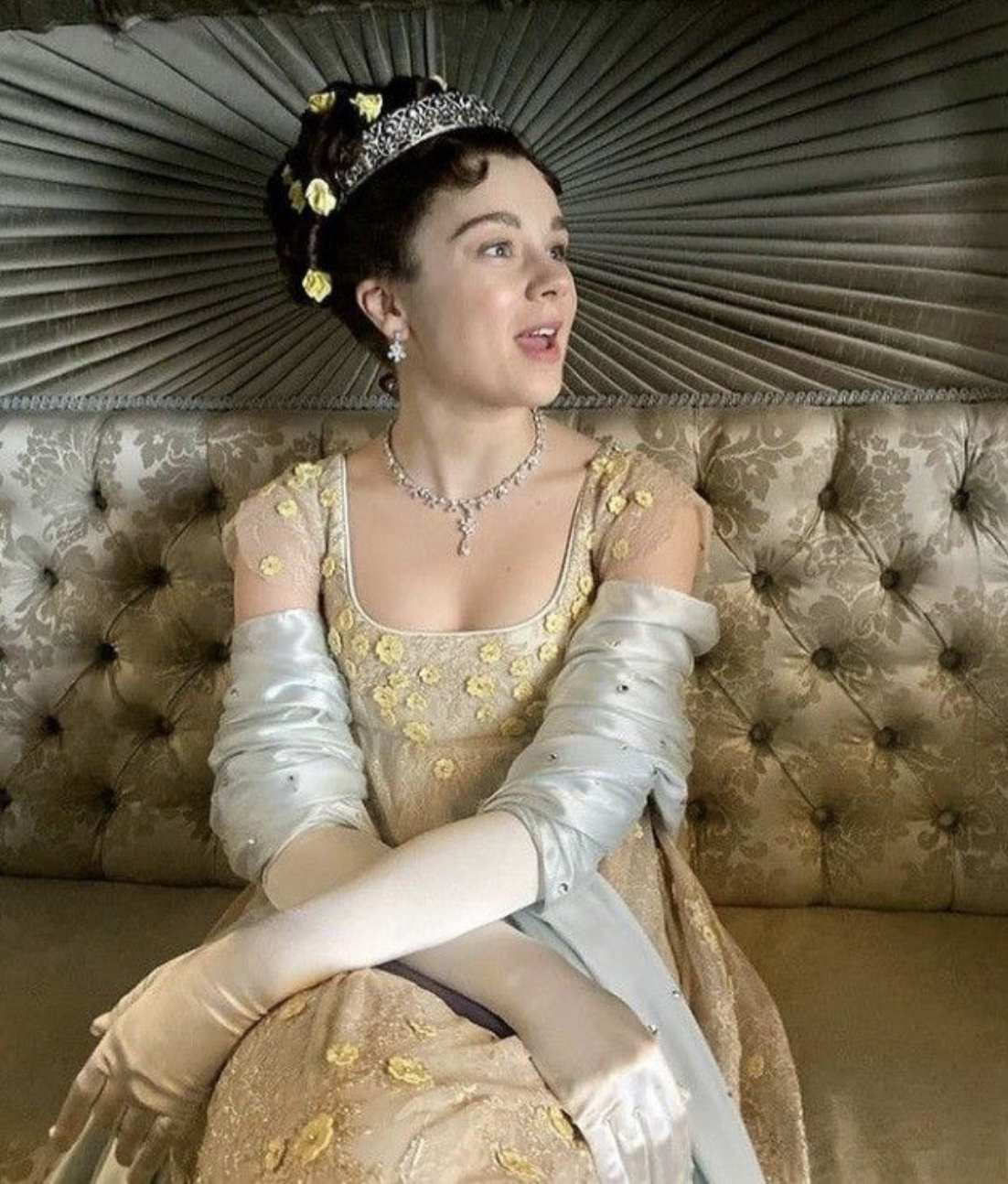
One popular girl, or popular family, can cause a raging fashion for an entire season and beyond. – Eloise Bridgerton in opera gloves.– Photo source, Pinterest

It is a caprice of the moment with a certain set of girls who strive for fads and eccentricities to omit all punctuation marks in their letters. Probably some one who couldn’t put them in, started the fashion. Just as a girl at the operá a few years ago, found that a sore finger throbbed and ached desperately if her hand lay on her lap, and was much relieved when she held it upright. So she sat all the evening in a conspicuous box, with one slender gloved-hand touching her cheek – with the result of making the attitude a marked and raging fashion that entire season.


It is a suggestion to slip a salted almond into the vacuum left by a date or French prune stone and try the surprise.

English tennis cakes are offered at the house tennis parties of the season. They are a good sized loaf cake, tasting like a pound cake, with a little fruit. A New-York caterer introduced them and still monopolizes the custom in them.

Up to a year or so ago, doilies were used in moderation for finger bowls and occasional small dishes. Then they suddenly became fashionable for nearly every separate bit of china. The table was dotted with them until it looked like the counter of a linen store. They were used to set the cup upon in one’s saucer– certainly the silliest and the furthest from neat of all napery whims. Now the reaction has set in. It is no longer form to employ doilies, save in the occasional manner of a twelvemonth.

A late Parisian novelty– Bats in diamonds are bizarre enough to attract the attention of those seeking after new and strange effects. Old jewels can be reset and rearranged in these bats, which are described as setting off to striking advantage a ball costume.

Linen collars and cuffs are again in high favor, but worn with a difference. The cuffs are no longer a mere strip of white below the sleeve, but protrude for an inch or two, like a man's wristbands. This would seem another saucy attempt to seize upon the masculine belongings. –“Her Point of View”, NYT, 1893


Etiquette Enthusiast, Maura J. Graber, is the Site Editor for the Etiquipedia© Etiquette Encyclopedia

Thursday, July 1, 2021

Summer of 1891’s Fads and Fancies

“Most of the Louis IV jackets have elaborate jabots of old Mechlin lace or of embroidered chiffon drawn to the front.”
 –
Photo source, Pinterest


What is the Proper Thing to Be Worn by Society Ladies? They say we are to wear all summer mittens up the arm. 

All the imported street dresses are made with a bias velvet ruffle running round the feet. 

Turquoises are being extensively worn, especially with necklaces, mingled with diamonds. 

Umbrellas and parasols designed to carry with mourning costumes have ebonized or onyx handles. 

A unique bracelet is the one of woven chain showing strands of silver, different golds and platinum. 

A bride's jewel-case is not complete when it does not include a diamond bracelet, earrings, finger-ring and brooch. 

It is the correct thing now to add a souvenir spoon to the conventional Christening present of pap-bowl and mug. 

Most of the Louis IV jackets have elaborate jabots of old Mechlin lace or of embroidered chiffon drawn to the front. 

Tables are now bought on purpose for the large lamps, which are so much used. White enamel tables, about knee high, are used for the delicate colored, porcelain lamps and ebony tables are used for the various kinds of iron lamps, some of these tables have a space underneath for a piece of bric-a-brac. 

This season a fancy crops out for long chains worn about the neck and hanging loosely over the bust. At the first ball of the season Mrs. Cornelius Vanderbilt wore a string of diamonds a yard long that went round her neck twice and fell almost to her belt. Mrs. Edmund Russell always wears at her art lectures a string of gold beads, superbly carved. Some of the gold chains have whole pearls introduced every two inches. Then there are the gem chains of plain polished stones, such as carbuncles, turquoises, amethysts, spinels, moonstones and onyx, none cut but the diamond. 

In favor of the woman who adorns herself, the feathers of the peacock begin to vie with rosettes and mock jewels. But let each fair maid pause and question with herself before she puts them on. There are conditions; can she fulfill them? In the days when poets and singers went about the world as troubadours they plucked the long feathers from the tails of peacocks and stripped them to leave on the midrib only the central eye. This, each troubadour wore upon his cap, and it meant that the eyes of the world were turned upon him. Are the eyes of the world turned upon you, fair maid, in attention and admiration? If so, you may wear on your cap peacock's eyes.— San Francisco Call, 1891


Etiquette Enthusiast, Maura J. Graber, is the Site Editor for the Etiquipedia© Etiquette Encyclopedia

Saturday, June 19, 2021

A Literary Gilded Age Fad


Each guest was asked to indicate about her toilet in some way, the title of one of the bard’s plays. One woman wore on her corsage, two small pictures, each of a man, and beneath a bit of ribbon with a large a surmounted with the letters “V.E.R.” to be translated “Two Gentleman of Verona.”


A Shakespeare Luncheon is something of a novelty. At one recently, on the menu cards each dish was appropriately garnished with a quotation from the “immortal William,” and the favors were pretty sketches, executed by the young hostess, of various well-known views about Stratford-on-Avon.

In addition, each guest was asked to indicate about her toilet in some way, the title of one of the bard’s plays. One woman wore on her corsage, two small pictures, each of a man, and beneath a bit of ribbon with a large a surmounted with the letters “V.E.R.” to be translated “Two Gentleman of Verona.” Another, quickly guessed, had a full page periodical illustration of a tempest neatly fitted as a girdle across the front of her waist and belt. 

A third guest created much merriment with a little pen and ink sketch, which was attached to a chatelaine. It represented a dog and cat enjoying a meal of bones with great satisfaction. Beneath pussy was the legend “This is Julia,” which was all the clue the wearer would give. A clever girl finally shouted, “Romeo and Julia eat” and the mystery was solved.- NYTimes, 1892


Etiquette Enthusiast, Maura J Graber, is the Site Editor for the Etiquipedia© Etiquette Encyclopedia

Wednesday, January 20, 2021

Skip the Fads When Entertaining

“At a recent dinner party the hostess, wishing to indulge in some novelty, had the cheese cut precisely in the shape and size of an ordinary piece of pie. When placed on the plate, it closely resembled a cut of custard pie. It was first passed to an elderly gentleman, who, without observing closely, took it supposing it to be pie, and put it down by his plate. After a time, the hostess sent the servant for it, and with a fork removed a small piece, after which it was passed to the other guests.” — Photo of a Victorian sterling silver cheese fork. 
— Source, Etiquipedia private photo library.


Hostesses Should Avoid Table Innovations

In these days, when the social aim and object of every hostess seems to be to get up something new, it would be well to have some way to indicate the use or management of novelties and thereby spare the guests much embarrassment. When dishes are to be served in any unusual way, some hint should be given to some of the guests, and others may take note of the manner of handling, and thus avoid confusion and awkwardness. 

At a recent dinner party the hostess, wishing to indulge in some novelty, had the cheese cut precisely in the shape and size of an ordinary piece of pie. When placed on the plate, it closely resembled a cut of custard pie. It was first passed to an elderly gentleman, who, without observing closely, took it supposing it to be pie, and put it down by his plate. After a time, the hostess sent the servant for it, and with a fork removed a small piece, after which it was passed to the other guests. 

There are few things more annoying than the consciousness that one has made some blunder at table. In some way, it has come to be an accepted idea that to go wrong in such things is to be in a condition of dense ignorance. As a matter of fact, there are so many changes, so many fads, so many new wrinkles and so much rivalry between ladies in the same society, that innovations are continually sought out and eagerly adopted. The wonder is not that people make mistakes, but that they make so few. 

At one time, the spoon and fork must be used in some special way. After a time, there is an entire change in this custom. People who go out but rarely cannot, or at least do not, keep up with the fads and fancies of the social swim and consequently are likely to do certain things in the old way, which is quite unlike the new, and of course are made uncomfortable by the discovery that they have violated some portion of the code of social etiquette. 

It would be well if eminent social authorities could prepare a set of rules and have them adopted and rigidly adhere to them. This would make things easier for entertainers as well as guests, and be much more satisfactory in every respect. Hostesses in places removed from fashionable centers should be specially careful about indulging in innovations. In nothing are genuine refinement and culture more clearly shown than in the avoidance of forms that may cause embarrassment to guests.—New York Ledger, 1894


Etiquette Enthusiast, Maura J Graber, is the Site Editor for the Etiquipedia© Etiquette Encyclopedia

Wednesday, January 13, 2021

Etiquette and Sleep Science

The etiquette of slumber will strike the average reader as a bit of absurdity, but, like most fads, this last new one has something in it. I believe, says a writer in the New York Press, the promulgator of this new idea, Miss Alice Cowell, names it the “Hygiene of Sleep,” and her theory is “the devitalization of the body.” That means that if you go to sleep properly and according to rule, you will be in the same state as if you were dead, save for the fact that the circulation goes on. 


A Science of Sleep

A Lady’s Plan for Preventing Insomnia and Suicide

Devitalization by the Will— The Body and Its Parts Must Be Surrendered Unconditionally— Physical Culture

Women have been instructed in almost everything that pertains to living. They have been taught how to walk and stand and talk and how to eat, and now there comes a lady from Boston to teach women how to go to sleep and how to behave after they have gone to sleep. The etiquette of slumber will strike the average reader as a bit of absurdity, but, like most fads, this last new one has something in it. I believe, says a writer in the New York Press, the promulgator of this new idea, Miss Alice Cowell, names it the “Hygiene of Sleep,” and her theory is “the devitalization of the body.” That means that if you go to sleep properly and according to rule, you will be in the same state as if you were dead, save for the fact that the circulation goes on. 

You will not dream, you will not move, neither will you talk and tell dreadful and fatal secrets, as people do in books. You simply lie an inert mass trusting to providence and the bed to take care of you and hold you up. Miss Cowell says it is “instinctive egotism” that makes people try to look out for themselves when they are asleep. They will not trust the bed for support, but cling to it frantically. As if some sudden and malicious freak of the springs might toss them on the floor. They dig their heads into the pillows as if some violent uprising might occur among the feathers. They clutch the bed-clothes, brace their feet against the foot-board, tie themselves in knots and writhe and wiggle as if they were upon red-hot spikes, it is no wonder that the sleeper gets up tired after such a night as this. 

Not long ago, I heard a lady say: “I feel as if I had been dancing all night.” Women seem to be the greatest sufferers from the antics of sleep. Miss Cowell tells of a lady in Boston who tore out whole handfuls of her husband’s hair when asleep. The poor man had either to seek another couch or buy a wig, he chose to do the former. Miss Cowell make, the statement that if people would train themselves to allow sleep its greatest mission, the woes of the world would be reduced to a minimum. Suicides would be a thing unheard of. It is this unabated state of nerve tension that brings about mental desperation. It makes people nervous and critical. Everything is awry, and the world is upside down. 

The mission of Miss Cowell is to tell people how to get unwound and lay them down in peace. She says it is the habits we take to bed with us that play the mischief with divine sleep. How shall we conquer them? Alter listening to a lecture by Miss Cowell, I deduce the following synopsis of her theory: First of all, you must learn the science of devitalization, and that is the spiritual side of physical culture. This great principle is embodied briefly in these words: “Mind active, body passive.” The physical result is the perfect independence of each member of the body. For instance, a seamstress would have not to accompany every movement of her needle with a like movement of her back and head. A school-teacher using one hand to clean the blackboard would allow the other hand to remain still. A writer would move the pen without working the lips, or gripping the pen until the whole arm ached. 

Few people converse without working the fingers in some way. There are orators who cannot speak unless they contort the body in the most absurd manner. In this way a lot of vital energy is wasted. The exercise which Miss Cowell gives begins with the head, which is supposed to be a wooden ball, and is rolled about at will, “It wont fall off,” says the teacher. “It can't fall off.” Then the arm is handled as if it were a log of wood, the leg swings like a pendulum from the hip, and thus every member of the body is devitalized. Even the eyelids are taught self-control. The results of these exercises are the calling into activity of all the muscles of the body, and at the same time rendering them wholly independent of each other. Each member is made immediately responsive to the call from the brain and wholly indifferent to anything but its own business. 

Now, how does this tend to produce restful sleep? Because the nerve, and muscles are trained to keep still when they are not wanted. Surrender yourself, lay your burden down. God will take care of you and the bed will hold you, says the disciple of devitalization. The mind and body are brought to this perfect state of obedience by the various exercises above mentioned. All the different members of the body are unlimbered, detached, so to speak. These exercises must be conducted with great seriousness and solemnity, but to the frivolous outsider, who is not familiar with the great principles of physical regeneration, these performances are awfully funny. 

After you have rendered your body entirely passive, then get into bed, sit upright and conceive of the backbone as a strand of beads. Then let yourself down slowly, bead by bead, until the head falls back inert upon the pillow. Drop the arms helplessly and let the entire body be divested of the responsibility which the bed is there to assume. You should lie upon the back if possible; if not, upon the side. Such is the Boston recipe for wholesome, restful slumber.— Pittsburgh Dispatch, 1891


Etiquette Enthusiast, Maura J. Graber, is the Site Editor for the Etiquipedia © Etiquette Encyclopedia