Showing posts with label Versailles Etiquette. Show all posts

Friday, February 26, 2021

Manners of a First Gentleman

First Gentleman of his realm... Louis XIV was also known as Louis the Great (Louis le Grand) or the Sun King (le Roi-Soleil). He was a Monarch of the House of Bourbon who ruled as King of France from 1643 until his death in 1715. His reign of 72 years and 110 days is the longest of any Monarch of a major country in Europe's history.


He might express his displeasure by a glance that terrified, by silence that froze, by a lettre-de-cachet that sent an offender to the Bastille, but he never failed in courtesy. “Never was man so naturally polite or of a politeness so measured, so graduated, so adapted to person, time, and place.” It might be possible to question his ability as a warrior, his wisdom as a statesman, even his duty as a King, but there could never be the slightest question as to his being the First Gentleman of his realm. 

He was the type, and whenever a courtier failed in dignity, in tact, in grace, in courtesy, he fell short of the model that moved before his eyes. It was, however, almost impossible for the courtiers to display in their words and actions the naturalness that accompanied the King. He was above all and supreme. He rose or sat, he smiled or bowed, he spoke or was silent, at his pleasure. 

There was never any doubt in his mind as to his attitude; there were constant difficulties in the minds as to their attitudes. His rank was unquestioned; their ranks clashed constantly. He was serene; they were anxious. On the other hand, they felt no sense of responsibility for public affairs; he had to bear the burden of the faults of his lieutenants. They could retire and relax; he was always on the stage. His courtesy never contradicted itself. — From “Versailles and the Court Under Louis XIV” by James Eugene Farmer, 1906


Etiquette Enthusiast, Maura J Graber, is the Site Editor for the Etiquipedia© Etiquette Encyclopedia


Wednesday, October 24, 2018

Pompous Etiquette at Versailles

The honor of handing the clean shirt to those persona was reserved to the sons and daughters of France, or, in their absence, to the Princes of the blood or those legitimatized, or in default of these, to the Grand Chamberlain or the First Gentleman of the Bedchamber. The shirt having been regularly and formally delivered, the First Valet of the Wardrobe and the First Valet de Chambre held up the garment by the right and left sleeves respectively, while two other valets extended a dressing gown in front of the King to serve as a screen. 
Etiquette in Ye Olden Time


A hundred years ago the court of France was ruled by an etiquette so pompons and ceremonious as to make the King’s life a burden to himself and a jest to a philosopher. He was never alone, except at rare intervals. The eyes of forty or fifty persons saw him dress and undress, and the operation of putting on his shirt was something fearful. The Grand Master of the Wardrobe drew off the King’s nightshirt by the right arm, and the First Valet of the Wardrobe by the left arm, and both of them united in handing the nightshirt to an Officer of the Wardrobe. Another Valet of the Wardrobe brought a clean shirt, but he had no right to hand it to the persons who were to put it on the King. 

The honor of handing the clean shirt to those persona was reserved to the sons and daughters of France, or, in their absence, to the Princes of the blood or those legitimatized, or in default of these, to the Grand Chamberlain or the First Gentleman of the Bedchamber. The shirt having been regularly and formally delivered, the First Valet of the Wardrobe and the First Valet de Chambre held up the garment by the right and left sleeves respectively, while two other valets extended a dressing gown in front of the King to serve as a screen. Behind this screen his Majesty at last got the shirt on his back. Every day, immediately after being dressed, the King said his prayers. And it is to be hoped that he never failed to offer up a devout thanksgiving for having passed safely through the awful process of putting on his shirt, and that the coming man would be able to make for the coming King’s shirts that could be put on with more ease and less ceremony. — Morning Press, 1883

Etiquette Enthusiast, Maura J. Graber, is the Site Editor for the Etiquipedia© Etiquette Encyclopedia

Friday, September 28, 2018

Outrageous 18th C. Fashion Etiquette


Trends in fashion etiquette, which ruled at the court of Versailles and influenced fashion beyond France, were so over-the-top outrageous, that this parody of an elaborate “hairstyle” is not too far off from some of the actual style fads of the day. Titled “The Lady’s Maid, or Toilet Headdress,” this features an anonymous woman with her hair in an overly exaggerated inverted pyramid, which fills the greater part of the hair design and is supporting a dressing-table, draped with muslin festoons and holding a large oval mirror, a pair of candlesticks, vases of flowers, a watch, a pin-cushion, toiletries, a pair of buckles, rings, a necklace, two books, a pen, small scissors and more. circa 1776 
— Source British Museum .org

Ancient Fashion Jargon 

The language of the fashion plate and the woman’s paper is sufficiently appalling to the mere man even in these days of emancipated and, we may presume, more grammatical womanhood; but, according to an extract from a fashion journal of 1787, the jargon of those days was even more astounding. 


This is how the paper described the dress of a certain Mlle. D. at the opera: “She appeared in a dress of ‘stifled sighs,’ ornamented with ‘superfluous regrets,’ the bodice cut in a ‘perfect candor’ point and trimmed with ‘indiscreet complaints.’ Her hair was dressed in ‘sustained sentiments,’ with a headdress of ‘sustained conquest,’ ornamented with several ‘flyaways’ and ‘downcast eye’ ribbons, and her collar was ‘beggar on horseback’ color.”

No doubt all these marvelous terms conveyed some meaning to the fashionable woman of the days when French society danced on the edge of the volcano of 1789, but to their descendants of today, they have absolutely no meaning. — San Bernardino Sun, 1908


Etiquette Enthusiast, Maura J. Graber, is the Site Editor for the Etiquipedia© Etiquette Encyclopedia

Thursday, September 20, 2018

Dressing Etiquette at Versailles

Another Valet of the Wardrobe brought a clean shirt, but he had no right to hand it to the persons who were to put it on the King. The honor of handing the clean shirt to those persona was reserved to the sons and daughters of France, or, in their absence, to the Princes of the Blood or those legitimatized, or in default of these, to the Grand Chamberlain or the First Gentleman of the Bedchamber.

A hundred years ago, the Court of France was ruled by an etiquette so pompous and ceremonious as to make the King’s life a burden to himself and a jest to a philosopher. He was never alone, except at rare intervals. The eyes of forty or fifty persons saw him dress and undress, and the operation of putting on his shirt was something fearful. The Grand Master of the Wardrobe drew off the King’s nightshirt by the right arm, and the First Valet of the Wardrobe by the left arm, and both of them united in handing the nightshirt to an officer of the wardrobe. Another Valet of the Wardrobe brought a clean shirt, but he had no right to hand it to the persons who were to put it on the King. The honor of handing the clean shirt to those persona was reserved to the sons and daughters of France, or, in their absence, to the Princes of the Blood or those legitimatized, or in default of these, to the Grand Chamberlain or the First Gentleman of the Bedchamber. The shirt having been regularly and formally delivered, the First Valet of the Wardrobe and the First Valet de Chambre held up the garment by the right and left sleeves respectively, while two other valets extended a dressing gown in front of the King to serve as a screen. Behind this screen, his Majesty at last got the shirt on his back. Every day, immediately after being dressed, the King said his prayers. And it is to be hoped that he never failed to offer up a devout thanksgiving for having passed safely through the awful process of putting on his shirt, and that the coming man, would be able to make for the coming King, shirts that could be put on with more ease and less ceremony. – The Morning Union, 1883


Etiquette Enthusiast, Maura J. Graber, is the Site Editor for the Etiquipedia© Etiquette Encyclopedia

Friday, June 2, 2017

A Versailles Queen's Etiquette


Maria Theresa of Spain's marriage in 1660 with King Louis XIV, was arranged with the purpose of ending the long-standing war between Spain and France. Famed for her virtue and piety, she sadly saw 5 of her 6 children die in early childhood. She is frequently regarded as an object of pity in historical accounts of her husband's reign. She had no choice, but to tolerate his many, many love affairs, and the rigid rules of etiquette at Versailles.


The bride of Louis XIV, having been thrown from her horse was dragged some distance before any Knight would risk his own life to save her, it being high treason to touch her ; and even after two, young Lords had devoted themselves, the Queen was obliged to entreat their pardon on her knees, in order to obviate the awful consequences of their generous act. — Daily Alta, 1855


Etiquette Enthusiast, Maura J Graber, is the Site Editor for the Etiquipedia© Etiquette Encyclopedia 

Sunday, April 9, 2017

Snuff and Etiquette at Versailles

Smoking was popular as well! – The active ingredient in tobacco was named “nicotine” after the French diplomat, Jean Nicot. Nicot introduced snuff tobacco to French Queen, Catherine de Medici, and the French Nobility.

After a French ambassador to Portugal returned to France with an addictive plant discovered in the New World, it caused a sensation in the French Royal Court. French diplomat and scholar, Jean Nicot, had been introduced to tobacco in Lisbon. There, it was being crushed into powder and was used as the remedy for a variety of maladies, ironically including cancer. Snuffing became a popular activity in Paris after the Queen Mother herself, Catherine de Medici, was introduced to snuffing tobacco by Nicot. He had demonstrated the inhalation of powdered tobacco, as a way to cure  de Medici's frequent headaches. It was later named the genus of tobacco cultivars “Nicotiana,” by the Swedish naturalist Carl Linnaeus in Nicot's honor. The active ingredient in tobacco was also named “nicotine” after the French diplomat.

Snuffing remained popular, and addictive, with the French Royals and Nobility. By the 18th century, snuff boxes were as socially important as fine pieces of jewelry. Anyone who was anyone needed
 to have a variété of these boxes. And as fashions changed frequently, so did the styles and designs of snuff boxes. At Versailles, showered with extravagance upon her marriage to Louis XVI, Marie Antoinette was gifted with 52 gold snuff boxes. From all accounts, Marie Antoinette was more likely to carry a box of bon-bons on her person, than a snuff box,  but she is said to have been responsible for the French standardization of the modern-day handkerchief.

Prior to the arrival and ultimate popularity of snuff tobacco in Europe, the handkerchief had become simply another object of fashion. Snuff brought the handkerchief back to its original purpose, and was indispensable for cleaning orange-brown, snuff-stained noses and fingers. White handkerchiefs were hardly appropriate for such a task, so snuff users began to employ large, colorful handkerchiefs to hide those stains. The handkerchief, up to that time, had come in many shapes; square, triangular, etc... According to legend, Marie Antoinette remarked that the square-shaped handkerchief at Versailles was the most pleasing, as well as the most convenient to use. The remark is said to have prompted Louis XVI to make mandatory that all handkerchiefs produced in France to be square in shape.


🍽️Etiquette Enthusiast, Maura J. Graber, is the Site Editor for the Etiquipedia© Etiquette Encyclopedia

Saturday, April 1, 2017

Squalor and Etiquette at Versailles

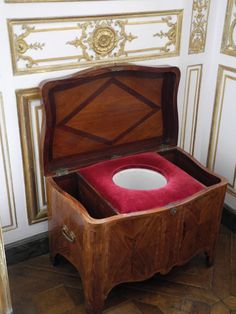
A royal chamber pot from Versailles -There were no bathrooms as we would know them. Courtiers and royalty used decorative commodes in each room, while commoners simply relieved themselves in the hallways or stairwells. No one bothered to house-train the royal dogs, and servants did not consider cleaning up after them to be part of their job description.

The palace of Versailles was once the most lavish large home in the world, the residence of the French royal family along with hundreds of their courtiers and servants. Containing half-a-million square feet, the palace compound has 700 rooms and 67 staircases. With lofty ceilings, gilded crown moldings, decorative floors, and 6000 paintings, there were also extensive servants’ quarters, kitchens, stables, and services.

Versailles was the creation of Louis XIV of France, who obsessively enlarged and enhanced his residence for more than 30 years during the 1600s. Today it’s toured by three million visitors annually, all hoping for a glimpse of the royal lifestyle.


This was the royal family’s private chapel for religious services

The Baroque aesthetic was to leave no surface unadorned. Every royal chamber has gilded paneling and crown molding; every wall has brocaded or flocked wall coverings; every ceiling is covered with allegorical paintings of Greek gods; every floor is patterned parquet or colored tiles. The hallways were done up with contrasting colors of veined marble. Everything inside, from furniture to finishes, is a visual froth of embellishments. Versailles in its day was so visually overpowering that it inspired copycat palaces all across Europe.

The chateau began as a hunting lodge built by Louis XIV’s father, fifteen miles southwest of Paris. Louis grew up during a tumultuous French civil war called the Fronde, during which he was surrounded by conspirators, had no pocket money and slept on ragged sheets. His mother even had to pawn the crown jewels. After consolidating his power as King, Louis compensated for childhood privations by building himself the most luxurious palace imaginable. He continued enlarging it throughout much of his life.


The public could watch the royals from behind the golden railing (at the bottom of the photo), so that there was no privacy for the royal family, even in bed.

The original hunting lodge was embedded within a vast series of newer buildings. Floors were added on top of existing structures, courtyards were filled in by new living spaces, wings were built, stables were constructed, staircases were built and then moved, service hallways added and then altered. The place became a complex maze containing sparkling state apartments as well as uncomfortable attic garrets tucked beneath the roof.

Ongoing construction at the palace provided job security to hundreds of masons, carpenters, plasterers, gilders, painters and landscapers. An immense support staff was maintained, consisting of cooks, valets, gardeners, grooms, hairdressers, and tailors. Vegetables and fruits to feed the masses were provided by a large potager, or kitchen garden.

But life in a palace wasn’t necessarily peaceful or enjoyable. The place was a vast hive of activity. Hundreds of courtiers lived alongside the royal family at Versailles, with their families as well. Nobles who could afford it often moved out of the crowded palace and constructed their own houses beyond the golden gates in the town of Versailles.

Versailles became a tourist destination almost from the beginning. The first visitor’s guide was published in the late 1600s. Anyone was granted entry to the grounds and the palace as long as the dress code was observed. (Hats and swords for men could be rented from the concierge at the gate.) Entry included the ability to enter into the royal apartments. 

A gilded railing separated the royal half of each room from the spectators’ portion. Behind these gilded railings, a series of private doors were built into the back paneling of the royal apartments, leading to secret hallways and stairs which allowed royalty to move from one room to another while remaining hidden from public view. Years later, in 1789, Queen Marie-Antoinette temporarily escaped the revolutionary mob by slipping through one of these doors to the king’s chamber.

Marie-Antoinette (married to Louis XIV’s great-great-grandson, Louis XVI) chafed at being on display even when in her bedroom. When she gave birth to her first child at Versailles, the entire royal family and all the major state officials came to witness the event. Hordes of other inquisitive people crowded in as well, in such numbers that spectators were crushed against the furniture and walls and movement was impossible.

It’s difficult to believe today when gazing at the gleaming golden palace, but life at Versailles was actually quite dirty. There were no bathrooms as we would know them. Courtiers and royalty used decorative commodes in each room, while commoners simply relieved themselves in the hallways or stairwells. No one bothered to house-train the royal dogs, and servants did not consider cleaning up after them to be part of their job description. The constantly-altered chimneys did not draw well, so everything inside was covered with soot. The filth and disorder at Versailles during the ancient regime were noted in many records of the time.

Life at Versailles was not just foie-gras served on golden plates. In need of cleaning, requiring expensive maintenance, and with in-laws living in the wings, Versailles was not so very different from many homes today. — A previous version of this article appeared in the Bloomington, Herald-Times in 2009


 🍽Etiquette Enthusiast, Maura J. Graber of The RSVP Institute of Etiquette, is the Site Editor for the Etiquipedia© Etiquette Encyclopedia

Friday, March 17, 2017

Etiquette and Marie Antoinette


Anne d'Arpajon, aka "Madame Etiquette" ~A French aristocrat and First Lady of Honour to Queens of France, Marie Leszczyńska and Marie Antoinette, Anne d'Arpajon was called "Madame Etiquette" by Marie Antoinette for her insistence that no minutia of court etiquette ever be disregarded or altered in any way. 

Dressing the French Queen

What a cruel ceremony was the dressing of that tame Queen! When Maria Antoinette, in the days of her cumbersome greatness, stood of a morning in the centre of her bed chamber, awaiting, after her bath, her first article of dress. It was presented to her, or rather it was passed over her royal shoulders by the "Dame d'Honneur." Perhaps, at the moment, a "Princess of the Blood" entered the room (for French Queens both dressed and dined in public), the right of putting on the primal garment of Her Majesty immediately devolved upon her, but it could not be yielded to her by the "Dame d'Honneur;" the latter, arresting the chemise de la reine as it was passing down the royal back, adroitly whipped it on, and, presenting it to the "Premiere Dame," that Noble lady transferred it to the "Princess of the Blood."

Madame d'Arpajon had once to give it up to the Duchess of Orleans, who, solemnly taking the same, was on the point of throwing it over the Queen's head, when a scratching (it was contrary to etiquette to knock) was heard at the door of the room. Thereupon entered the Countess de Provence, and she being nearer to the throne than the Lady of Orleans, the latter made over her office to the new comer, in the meantime, the Queen stood like Venus as to covering, but shaking with cold, for it was mid-winter, and muttering, "what an odious nuisance." The Countess de Provence entered on the mission which had fallen to herself, and this she did so awkwardly, that she entirely demolished a head-dress which had taken three hours to build. The Queen beheld the devastation, and got warm by laughing outright. – D. Doran, 1855


Etiquette Enthusiast, Maura J Graber, is the Site Moderator and Editor for the Etiquipedia© Etiquette Encyclopedia

Tuesday, August 30, 2016

Rigid Royal Spanish Etiquette


Victoria Eugenie of Battenberg was Queen of Spain as the wife of King Alfonso XIII

A Nurse for the Baby Prince

Many say the etiquette of the Royal Spanish Court rivaled that of the French Court of Versailles. They may be correct, but then again they may have been on par for Royal Courts of the day. The January 19th report from a London newspaper tells us, “The Madrid correspondent of the Standard says that Spain's Queen Victoria wants to nurse her coming baby herself, but will not be allowed to do so, because it is contrary to Spanish etiquette. An English nurse has been engaged.” – 1907


Etiquette Enthusiast, Maura J Graber, is the Site Editor for the Etiquipedia© Etiquette Encyclopedia

Monday, August 15, 2016

Etiquette and Defining Protocol

Benjamin Franklin at Versailles – Protocol sets the rules for seating groups of important people at a banquet, or for addressing dignitaries, or even for proper dress at ceremonies in foreign countries. 

Protocol and striped pants gave late- American, President Harry Truman, a "pain in the neck.” Few people in government would disagree with his sentiments, but protocol seems to he needed. Protocol is the code of diplomatic etiquette. It sets the rules for seating groups of important people at a banquet, or for addressing dignitaries, or even for proper dress at ceremonies in foreign countries. 

Protocol has been around for a long time. When Benjamin Franklin arrived at the court of Versailles, wigless and dressed in an old coat, he learned quickly that elegant court uniform was a must if he wanted to make a proper impression for the new "American Republic." – The Desert Sun, 1975


Etiquette Enthusiast, Maura J. Graber, is the Site Editor for the Etiquipedia© Etiquette Encyclopedia 

Thursday, June 16, 2016

Painful Versailles Etiquette Lesson

Louis XIV was also known as Louis the Great (Louis le Grand) or the Sun King (le Roi-Soleil). He was a Monarch of the House of Bourbon who ruled as King of France from 1643 until his death in 1715. His reign of 72 years and 110 days is the longest of any Monarch of a major country in Europe's history. Versailles, Europe’s grandest and most opulent palace, became a center of political power and a symbol of the king’s dominance and wealth. In addition to the royal court, the 700-room palace housed the nobility that Louis XIV had brought into his sphere as well as the thousands of staff needed for its upkeep.

The royal court of France used to be a great place for etiquette. Louis XIV once caught a severe cold owing to the fact that on his arising from his bed one cold morning, the Lord of the Chamber, whose duty it was to hand him his shirt, happened to be absent. Not one of the numerous courtiers present had the courage to trangress etiquette by handing the garment to the shivering monarch. —London Scrap Book, 1908


Etiquette Enthusiast, Maura J, Graber, is the Site Editor for the Etiquipedia© Etiquette Encyclopedia

Tuesday, April 19, 2016

Napkin Etiquette at Versailles

The Table Napkin — Curiously enough, that article now considered almost indispensable, the table napkin, was first used only by children and was only adopted by elder members of the family about the middle of the 15th century. In etiquette books of an earlier date than this, among other sage pieces of advice for children, are instructions about wiping their fingers and lips with their napkins. It seems that the tablecloth was long enough to reach the floor and served the grown people in place of napkins. When they did begin to use napkins, they placed them first on the shoulder, then on the left arm and finally tied them about the neck.—Youth's Companion, 1893


French Court Napkin Etiquette

The French court imposed elaborate codes of etiquette on the aristocracy, among them the way to use a napkin, when to use it, and how far to unfold it in the lap. A French treatise dating from 1729 stated that "It is ungentlemanly to use a napkin for wiping the face or scraping the teeth, and a most vulgar error to wipe one's nose with it." And a rule of decorum from the same year laid out the protocol:

"The person of highest rank in the company should unfold his napkin first, all others waiting till he has done so before they unfold theirs. When all of those present are social equals, all unfold together, with no ceremony."

Fashionable men of the time wore stiffly starched ruffled collars, a style protected while dining with a napkin tied around the neck. Hence the expression "to make ends meet." When shirts with lace fronts came into vogue, napkins were tucked into the neck or buttonhole or were attached with a pin. In 1774, a French treatise declared, "the napkin covered the front of the body down to the knees, starting from below the collar and not tucked into said collar."


Etiquette Enthusiast, Maura J Graber, is the Site Editor for the Etiquipedia© Etiquette Encyclopedia

Tuesday, April 12, 2016

Etiquette and Food of Louis XV

He who receives friends and pays no attention to the repast prepared for them, is not fit to have friends.


Dining in the Reign of Louis XV

Louis XV of France's reign, from 1723-1774, managed to bridge the dazzling opulence of his predecessor to the tragic exorbitance of his successor. Reflecting changes during his reign, were the culinary offerings of the kitchen of Louis VX.
According to The Physiology of Taste, by Brillat-Savarin, in 1825, “The reign of Louis XV was no less happy for gastronomy. Eighteen years of peace healed painlessly the wounds made by more than sixty years of war; wealth created by industry, and either spread out by commerce or acquired by its tradesmen, made former financial inequalities disappear, and the spirit of conviviality invaded every class of society. It is during this period that there was generally established more orderliness in the meals, more cleanliness and elegance, and those various refinements of service which, having increased steadily until our own time, threaten now to overstep all limits and lead us to the point of ridicule.”
The French born, Jean Anthelme Brillat-Savarin, gained his fame as an epicure and gastronome and helped found the genre of the gastronomic essay. He made famous the aphorism, "Tell me what you eat, and I'll tell you who you are." He believed that food defined a nation and wrote of the food in the reign of Louis XV. 
A Samplng of Brillat-Savarin's French Food Etiquette of the Era:
  •  A dessert without cheese is like a beautiful woman who has lost an eye.
  • A cook may be taught, but a man who can roast, is born with the faculty.
  •  The most indispensable quality of a good cook is promptness. It should also be that of the guests.
  • To wait too long for a dilatory guest, shows disrespect to those who are punctual.
  • He who receives friends and pays no attention to the repast prepared for them, is not fit to have friends.
  • The mistress of the house should always be certain that the coffee be excellent; the master that his liquors be of the first quality.
  • To invite a person to your house is to take charge of his happiness as long as he be beneath your roof.
And a 1740 Sample Menu for Ten
  • 1st course: the bouilli (meat with its broth); an entree of veal cooked in its own juice; an hors d'oeuvre.
  • 2nd course: a turkey; a plate of vegetables; a salad; a creamy pudding 
  • Dessert: some cheese; some fruit; a jar of preserves.
  • Plates were exchanged only three times, after the soup, at the second course, and for dessert. 
  • Coffee was very rarely served, but quite often there was a cordial made from cherries or garden pink, still something of a novelty then.
“Supper” was was not the main meal of the day, but a meal served later in the evening.
Supper eaten by Louis XV at the Chateau in September of 1755
The Soups
  • Two oilles: One of large onions, One a l'espagnole
  • Two potages: One de sante, One of turnip puree
The Entrees

  • Small pies a la balaquine, Rabbit fillets a la Genevoise, Filet mignon of Mutton with sauce piquant, Fillets of Pheasant en matelote, Quails with bay leaves, Turtle doves a la vinitienne, Partridges a l'ancient salmy, Small garnished Pigeons, Blanquette of Fowls with truffles, Marinade of Campines, Fowl wings en hatelets, Leg of Veal glazed with its own juice, Minced game a la turque, Sweetbreads St. Menehould, Rouen Ducklings with orange, Halicot with dark veloute sauce.
Four Releves
  • Roast Mutton of Choisy, Rump of Beef a l'ecarlate, Sirloin, minced with chicory, Caux Fowls with raw onion
Four Main Entremets
  • Pheasant pie, Jambon de Perdrouillet, Brioche, Croquante
Two Medium Entremets — Roasts
  • Small chickens, Campines, Ortolans, Thrushes, Guignards, Red-leg Partridges, Pheasants, Rouen Duckling
Sixteen Small Entremets
  • A Coffee Cream, Artichokes a la galigoure, Cardoons a l'essence, Cauliflower with Parmesan, Eggs with partridge gravy, Truffles a la cendre, Spinach with gravy, Cocks' crests, Animelles, Green beans with verjuice, Ham omelette, Turkey legs a la duxelles, Mixed ragout, Chocolate profiterolles, Small jalousies, Creme a la genest.


Etiquette Enthusiast, Maura J Graber, is the Site Editor for the Etiquipedia© Etiquette Encyclopedia
Thursday, January 7, 2016

Louis XIV's Exacting Etiquette

Part of Louis XIV's daily routine? Visiting the apartments of his mistress, Madame Maintenon, where he remained until 10 o’clock p.m., the hour of supper. And the supper was the great event of the day.


A Complete Look at the Daily Routine in the life of Louis XIV, at the Palace of Versailles


At 8 o’clock in the morning two servants carefully entered the chamber of the King. One, if the weather was cold or damp, brought dry wood to kindle a cheerful blaze up on the hearth, while the other opened the shutters, carried away the collation of soup, roasted chicken, bread, wine and water, which had been placed, the night before, at the side of the royal couch, that the King night find a repast at hand in case he might require refreshment during the night.

The valet de chambre then entered and stood silently and reverently at the bed-side for one-half hour. He then awoke the monarch, and immediately passed into an anteroom to communicate the important intelligence that the King no longer slept. Upon receiving this announcement an attendant threw open the double portals of a wide door, when the dauphin and his two sons, the brother of the King, and the Duke of Chartres, who awaited the signal, entered, and approaching the bed with the utmost solemnity of etiquette, inquired how his Majesty had passed the night.

After the interval of a moment the Duke du Maine, the Count de Toulouse, the first lord of the bed-chamber, and the grand master of the robes entered the apartment, and with military precision took their station by the side of the couch of recumbent royalty. Immediately there followed another procession of officers bearing the regal vestments. Fagon, the head physician, and Telier, the head surgeon, completed the train.

The head valet de chambre then poured upon the hands of the King a few drops of the spirits of wine, holding beneath them a plate of enameled silver, and the first lord of the bed-chamber presented the monarch, who was ever very punctilious in his devotions, the holy water, with which the King made the sign of the cross upon his head and his breast. Thus purified and sanctified he repeated a short prayer, which the Church had taught him, and then rose in his bed.

A noble lord then approached and presented to him a collection of wigs from which he selected the one which he intended to wear that day, and having condescended to place it, with his own royal hands, upon his head, he slipped his arms into the sleeves of a rich dressing-gown, which the head valet de chambre held ready for him. Then reclining again upon his pillow, he thrust one foot out from the bed-clothes. The valet de chambre reverently received the sacred extremity, and drew over it a silk stocking. The other limb was similarly presented and dressed, when slippers of embroidered velvet were placed upon the royal feet. The King then devoutly crossing himself with holy water, with great dignity moved from his bed and seated himself in a large arm-chair, placed at the fire-side. The King them announced that he was prepared to receive the First Entrée.

None but the especial favorites of the monarch were favored with an audience so confidential. These privileged persons were to enjoy the ecstatic happiness of witnessing the awful ceremony of shaving the King. One attendant prepared the water and held the basin. Another religiously lathered the royal chin, and removed the sacred beard, and with soft sponges, saturated with wine and water, washed the part which had been operated upon and smoothed them with silken towels.

And now the master of the robes approaches to dress the King. At the same moment the monarch announces the he is ready for his Grand Entrée. The principal attendants of royalty, accompanied by several valets de chambre and door-keepers of the cabinet, immediately take their station at the entrance of the apartment.

Princes often sighed in vain for an admission to the Grand Entrée. The greatest precautions were observed that no unprivileged person should intrude. As each individual presented himself at the door, his name was whispered to the first lord of the bed-chamber, who repeated it to the King. If the monarch made no reply, the visitor was admitted.

The Duke in attendance marshalled the new-comers to their several places, that they might not approach too near the presence of his Majesty. Princes of the highest rank, and statesmen of the most exalted station were subjected alike to these humiliating ceremonials. The King, the meanwhile, regardless of his guests, was occupied in being dressed.

A valet of the wardrobe delivered to a gentleman of the chamber the garters, which he in turn presented to the monarch. Inexorable etiquette would allow the King to clasp his garters in the morning, but not to unclasp them at night. It was the exclusive privilege of the head valet de chambre to unclasp that of the right leg, while an attendant of inferior rank might remove the other. One attendant put on the shoes, another fastened the diamond buckles. Two pages, gorgeously dressed in crimson velvet, overlaid with gold and silver lace, received the slippers as they were taken from the King’s feet.

The breakfast followed. Two officers entered; one with bread on an enameled salver, the other with a folded napkin between two silver plates. At the same time the royal cup-bearers presented to the first lord a golden vase, into which he poured a small quantity of wine and water, which was tasted by a second cup-bearer to insure that there was no poison in the beverage.

The vase was then rinsed, and being again filled, was presented to the King upon a golden saucer. The dauphin, as soon as the King had drank, giving his hat and gloves to the first lord in waiting, took the napkin and presented it to the monarch to wipe his lips. The frugal repast was soon finished.

The King then laid aside his dressing-gown, while two attendants drew off his night-shirt, one taking the left sleeve and the other the right. The monarch then drew from his neck the casket of sacred relics, with which he ever slept. It was passed from the hands of one officer to that of another, and then deposited in the King’s closet, where it was carefully guarded. The royal shirt, in the meantime, had been thoroughly warmed at the fire. It was placed in the hands of the first lord, he presented it to the dauphin, and he, laying aside his hat and gloves, approached and presented it to the King. 

Each garment was thus ceremoniously presented. The royal sword, the vest, and the blue ribbon were brought forward. A nobleman of high rank was honored in the privilege of putting on the vest, another buckled on the sword, another placed over the shoulders of the monarch a scarf, to which was attached the cross of the Holy Ghost in diamonds and the cross of St. Louis. The grand master of the robes presented to the King his cravat of rich lace, while a favorite courtier folded it around his neck.

Two handkerchiefs of the most costly embroidery and richly perfumed were then placed before His Majesty, on an enameled saucer, and his toilet was completed. The King then returned to his bedside. Obsequious attendants spread before him two soft cushions of crimson velvet. In all the pride of ostentatious humility he kneeled upon these, and repeated his prayers, while the Bishops and Cardinals in his suite, with suppressed voice, uttered responses. He then attended mass in the chapel. At 1 o’clock he dined alone, in all dignity of unapproachable majesty. 

The ceremony of the dinner-table was no less punctilious and ridiculous then at the toilet. After dinner he fed his dogs, and amused himself in playing with them. He then, in the presence of a number of courtiers, changed his dress, and leaving the palace by a private staircase, proceeded to his carriage, which awaited him in the marble court-yard.

Returning from his drive, he again changed his dress, and visited the apartments of Madame Maintenon, where he remained until 10 o’clock, the hour of supper. The supper was the great event of the day. Six noblemen stationed themselves at each end of the table to wait upon the King. Whenever he raised his cup, the cup-bearer exclaimed aloud to all the company, “drink for the King." After supper he held a short ceremonial audience with members of the royal family and at midnight went again to feed his dogs. He then retired, surrounded by puerilities of ceremony too tedious to be read.

Such was the character of one of the most majestic kings of the Bourbon race. France, wearied with them, drove them from the throne, and placed Napoleon there, a man of energy, of intellect, and of action; toiling, night and day, to promote the prosperity of France in all its varied interests. 

The monarchs of Europe, with their united millions, combined and chained the democratic Kings to the rock of St. Helena, and replaced the Bourbon. But the end is not eve yet. In view of the wretched life of Louis XIV, Madame Maintenon exclaimed: “Could you but form an idea of what a kingly life is! Those who occupy thrones are the most unfortunate in the world”. — Harper’s Magazine, 1880


Etiquette Enthusiast, Maura J Graber, is the Site Editor for Etiquipedia© Etiquette Encyclopedia

Wednesday, October 28, 2015

Louis XIV's Morning Etiquette

“The Duke of Saint-Simon, who kept the memorials of Versailles, wrote of Louis XIV: With an almanac and a watch, you could be three hundred leagues from here and say what he was doing. The King’s day was timed down to the last minute so that the officers in the service of the Monarch could plan their work as accurately as possible.” – From www.chateau versailles.fr


The following was just part an ordinary morning of the Monarch, Louis XIV of France, day after day, and year after year, in the Palace of Versailles:

At 8 o'clock in the morning to servants carefully entered the chamber of the King. One, if the weather was cold or damp, brought dry wood to kindle a cheerful blaze upon the hearth, while the other opened the shutters, carried away the collection of soup, roasted chicken, bread, wine and water, which had been placed, the night before, at the side of the royal couch, that the King might find a repast at hand in case he might require refreshment during the night. The valet de chambre then entered and stood silently and reverently at the bed-side for one-half hour. He then awoke the monarch, and immediately passed into an ante-room to communicate the importance intelligence that the King no longer slept. 


Upon receiving this announcement an attendant threw open the double portals of a wide door, when the dauphin and his two sons, the brother of the King, and the Duke of Chartres, who awaited the signal, entered, and approaching the bed with the utmost solemnity of etiquette, inquired how his Majesty had passed the night. After the interval of the moment the Duke Du Maine, the Count De Toulouse, the first lord of the bed-chamber, and the grand master of the robes enter the apartment, and with military precision took their station by the side of the couch of recumbent royalty. Immediately there followed another procession of officers bearing the regal vestments. Fagon, the head physician and Telier, the head surgeon, completed the train.

The head valet de chambre then poured upon the hands of the King a few drops of the spirits of wine, holding beneath him a plate of enameled silver, and the first lord of the bed-chamber presented the monarch, who was very punctilious in his devotions, the holy water, with which the King made the sign of the cross upon his head and his breast. Thus purified and sanctified he repeated a short prayer, which the Church had taught him, and then rose in his bed. A noble lord then approached and presented to him a collection of wigs from which he selected the one which he intended to wear that day, and having condescended to place it, with his own royal hands, upon his head, he slipped his arms into the sleeves of a rich dressing-gown, which the head valet de chambre held ready for him. 

Then reclining again upon his pillow, he thrust one foot out from the bed-clothes. The valet de chambre reverently received the sacred extremity, and drew over it a silk stocking. The other limb was similarly presented and dressed, when slippers of embroidered velvet were placed upon the royal feet. The King then devoutly crossing himself with holy water, with great dignity moved from his bed and seated himself in a large arm-chair, placed at the fire-side. The King then announced that he was prepared to receive the First Entrée. None but especial favorites of the monarch were favored with an audience so confidential. These privileged persons were to enjoy the ecstatic happiness of witnessing the awful ceremony of shaving the King. One attendant prepared the water and held the basin. Another lathered the royal chin, and removed the sacred beard, and with soft sponges, saturated with wine and water, washed the parts which had been operated upon and smoothed with silken towels.

And now the master of the robes approaches to dress the King. At the same moment the monarch announces that he is ready for his Grand Entrée. The principal attendants of royalty, accompanied by several valets de chambre and door-keepers of the cabinet, immediately take their station at the entrance of the apartment. Princes often sighed in vain for an admission to the Grand Entrée. The greatest precautions were observed that no unprivileged person should intrude. As each individual presented himself at the door, his name was whispered to the first lord of the bed-chamber, who repeated it to the King. If the monarch made no reply the visitor was admitted. The Duke in attendance marshalled the newcomers to their several places, that they might not approach too near the presence of his Majesty. 


Princes of the highest rank, and statesmen of the most exalted stations were subjected alike to these humiliating ceremonials. The King, the meanwhile, regardless of his guests, was occupied in being dressed. A valet of the wardrobe delivered to a gentleman of the chamber the garters, which in turn he presented to the monarch. Inexorable etiquette would allow the King to clasp his garters in the morning, but not to unclasp them at night. It was the exclusive privilege of the head valet de chambre to unclasp that of the right leg, while an attendant of inferior rank might remove the other. One attendant put on the shoes, and fastened the diamond buckles. Two pages, gorgeously dressed in crimson velvet, overlaid with gold and silver lace, received the slippers as they were taken from the King's feet. –New York Times, 1852


Etiquette Enthusiast, Maura J. Graber, is the Site Editor for Etiquipedia© Etiquette Encyclopedia

Tuesday, October 27, 2015

More Etiquette of Louis XIV

The Sun King's bedchamber at Versailles –The most minutely elaborate character, and governed every movement of the King and those about him from the very moment he opened his august eyes until he closed them in sleep.


Minutely Elaborate Etiquette of Louis XIV

The etiquette which prevailed at Versailles during the reign of Louis XIV was of the most minutely elaborate character, and governed every movement of the King and those about him, from the very moment he opened his august eyes until he closed them in sleep. 

He was the center of the whole. It was a drama daily repeated— the same characters, the same scenes, the same details— oppressive in its sameness, fatiguing in its constant pressure. I have neither the space nor the inclination to dwell on all the extraordinary ceremonial of the State dinner; the twenty or thirty grandees fluttering around the King’s plates and glasses, the sacramental utterances of the occasion: the gaudy procession of the retinue; the arrival of “la nef” — that is, the center piece of plate which contained, between scented cushions, the King's napkins; and pessai des plats— the tasting of each dish by the gentlemen servants and officers of the table before the King partook of it. The same custom was observed with the beverages. It took four persons to serve the King with a glass of wine and water. 

Well, might Frederick the Great, on hearing an account of all this tyranny of etiquette, exclaim that if he were King of France his first edict would be to appoint another King- to hold court in his place— all the year round.  –Scribner's Magazine, 1891


Etiquette Enthusiast, Maura J. Graber, is the Site Editor for the Etiquipedia© Etiquette Encyclopedia

Saturday, October 24, 2015

The Etiquette of Louis XIV

All brokers were enjoined to obey the rules of Louis XIV's etiquette for Versailles. Precedence was a matter of great importance.


At Versailles the importance of etiquette reached such a point, that it was carried to almost incredible extremes. The catch phrase of the time was "All the woman is in reverence," which meant that the manner in which a woman curtsied—in other words, the manner in which she followed the etiquette of the times—revealed her true qualities.

As one might expect from the creator of the 700-room Palace of Versailles, Louis XIV knew a thing or two about luxury. One of his prized possessions was an immense diamond, then called the French Blue, which purportedly produced the dazzling illusion of a sun at its center when positioned against a gold background. Stolen during the French Revolution, well after Louis XIV's death, it reemerged in Great Britain years later with a new cut and then bounced around from one owner to another. Now known as the Hope Diamond, this 45.52-carat stone, arguably the most famous jewel in the world, is housed at the Smithsonian's Natural History Museum in Washington, DC –From www.history.com
It is related to Louis XIII that, being on one occasion, obliged to visit Richelieu, who was ill at Tarascon, he lay down on the bed beside him. He was, after all, the sovereign; Richelieu has subject. Therefore it was impossible that Richelieu lie in bed, though ill, while Louis stood or sat beside him. Therefore, he took his place on the bed beside the sick man, and so preserved the royal dignity! Louis XIV visited Maréchal de Villars in the same manner when the Maréchal was lying wounded at Malplaquet."  —From Lillian Eichler


 🍽Etiquette Enthusiast, Maura J. Graber of  The RSVP Institute of Etiquette , is the Site Editor for the Etiquipedia© Etiquette Encyclopedia

Thursday, October 22, 2015

More Etiquette and Marie Antoinette

On fashion – It's “a desire to assert quality with the others, to show them that one is able to have the things they have. Then, too, imitation maybe prompted by a reverence for the person or persons imitated.”

“Of course, fashion is largely imitative. There are two distinct reasons for imitation in matters of dress. The first is a desire to be like everyone else, to avoid being thought strange or queer by one's fellows. The second is a desire to assert quality with the others, to show them that one is able to have the things they have. Then, too, imitation maybe prompted by a reference for the person or persons imitated.

“A story is told of the Duke Philip of Burgundy who, in 1461, suffered a severe illness during which his hair was completely shorn. More than five hundred nobles of the time sacrificed their hair that the Duke might not feel conspicuous. What was the necessity with the Duke became a fashion among the nobles.

“We are told that in 1775, the Queen, Marie Antoinette of France, adopted a chestnut brown colour for her gown. This color pleased the King and it is written that every lady in court had on a dress of that colour the following day. There has always been quick aping of the clothes and manners of the favourites.”
          
Marie Antoinette's image graces a square handkerchief– There has always been quick aping of the clothes and manners of the favourites.

“Many fashions were created by law. There is, for instance, a distinct order for edict concerning the shape of pocket handkerchiefs. It is dated June 2, 1785, and was issued by Louis XVI, supposedly at the request of Marie Antoinette. Up to her time, it would appear, handkerchiefs had been of all sizes and shapes. Some had been oblong, some around, some triangular, some square. The Queen believed that if the square form only were used the handkerchief would be very much more convenient. Consequently it was decreed, that, "The length of handkerchief shall equal their width, throughout my entire kingdom." Handkerchiefs have remained square since that day, and what the edict in 1785 made the fashion then, is still the fashion with us.” —From Lillian Eichler's, “The Customs of Mankind”


Etiquette Enthusiast, Maura J. Graber is the Site Editor for Etiquipedia© Etiquette Encyclopedia