Showing posts with label Tobacco Etiquette. Show all posts

Sunday, March 24, 2024

More ‘50’s Manners for Smoking

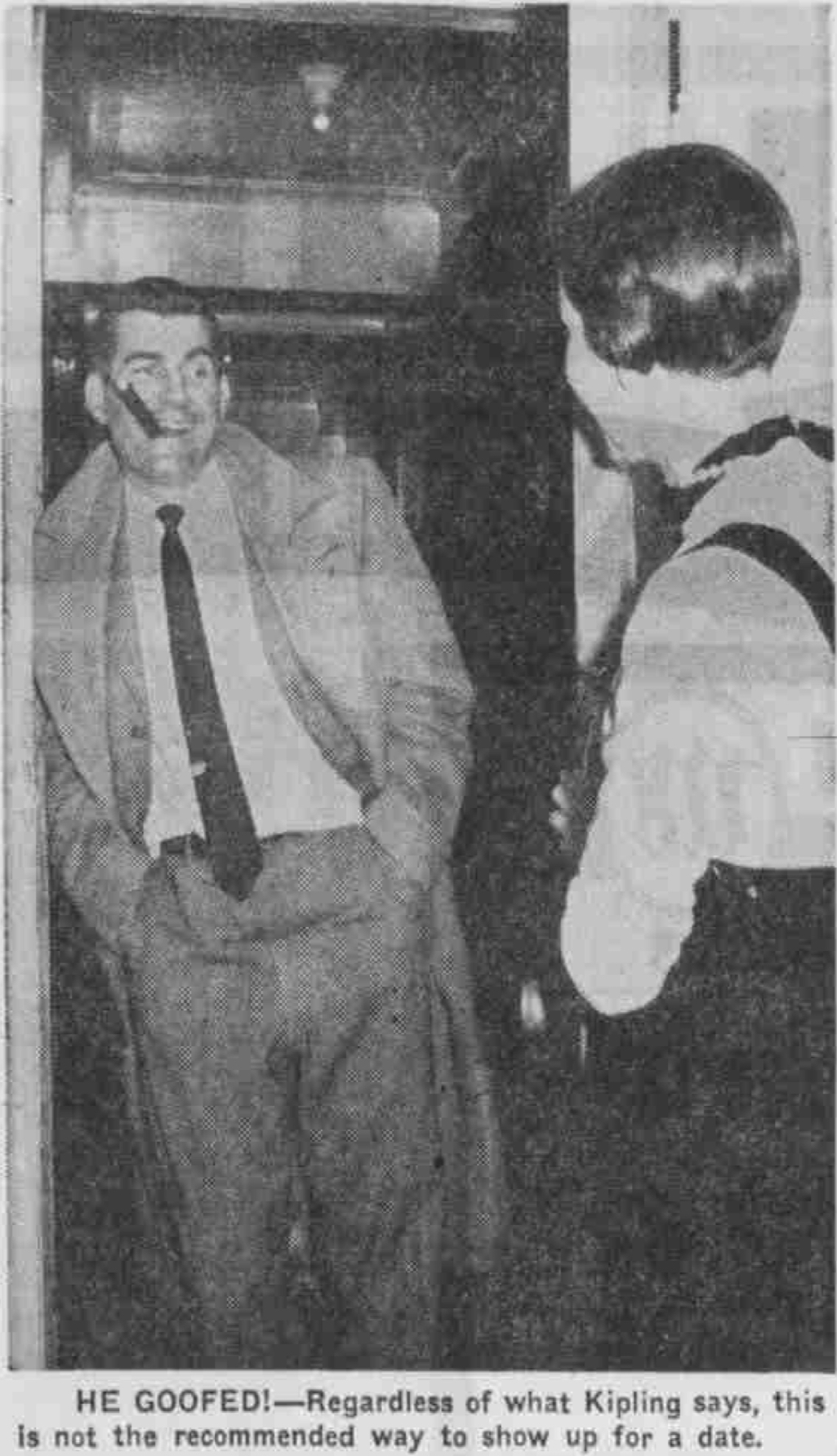
Don't be sneaky in reaching for a smoke. Take the pack out. Offer around. If a man declines, fine; don't offer the next time. If a woman declines, you re-offer every time you smoke yourself. That's etiquette for you. Say you're with a woman at the theater. Intermission comes and you're dying for a smoke. Your companion doesn't want one. What do you do? Well, Idiot, go out and smoke alone. After all, as Kipling said, a “woman is only a woman, but a good cigar is a smoke.”

Tobacco Taboos Help Clear the Air

In their eagerness to protect minority rights, lawmakers have neglected the most persecuted minority of them all: Non-smokers. The trouble with the non-smoker is that he is integrated when he would rather be segregated. In church or museum, he may find respite from the nicotine pall, but anywhere else he's fated to burning nostrils, slinging eyes and semi-suffocation. Superiority in numbers, however, doesn't give the smoker the right to spurn certain taboos with respect to his weed. 

These Include: 
  • Don't smoke at religious ceremonies.
  • Ditto at weddings, funerals, dedications. 
  • Don't smoke in sickrooms, either, unless the occupant lights up first. 
  • Don't lay your cigarette on the edge of a table or other piece of furniture. Not only does the table burn; so does the table's owner. 
  • AVOID asphyxiating people. Watch where the smoke drifts when you lay down your cigarette. 
  • And when you finally extinguish the thing, do a bang-up job. Ashes are for ashtrays. 
  • Take a hint If your host or hostess hasn't provided ashtrays, it may mean smoking is frowned upon. There are more no smoking signs than "No Smoking" signs. 
  • That goes for fancy dinner parties, too. The absence of ashtrays probably means one thing: the gourmets prefer their salads unsullied by smoke. 
  • UNLESS you're a hood in a B-movie, clear your mouth of fuming impediments and stogies when talking, shaking hands or tipping your hat. 
  • Don't be sneaky in reaching for a smoke. Take the pack out. Offer around. 
  • If a man declines, fine; don't offer the next time. If a woman declines, you re-offer every time you smoke yourself. That's etiquette for you. Say you're with a woman at the theater. Intermission comes and you're dying for a smoke. Your companion doesn't want one. What do you do? Well, Idiot, go out and smoke alone. After all, as Kipling said, a "woman is only a woman, but a good cigar is a smoke." 


Q & A ON P'S & Q'S 
(Q) "I'm job-hunting. During interviews I get jittery and light up a cigarette. Should I?" B. P.

(A) It's poor manners to light up In any stranger's office without permission. It may be disastrous in a job Interview.

By Don Goodwin in “Male Polish,” 1959


🍽Etiquette Enthusiast, Maura J. Graber, is the Site Editor for the Etiquipedia© Etiquette Encyclopedia

Saturday, December 2, 2017

Snuff Etiquette and History


A tract in the British Museum on “The Natural History of Tobacco” reads: “The Irishmen do most commonly powder their tobacco and stuff it up their nostrils.” This makes the Irish the probable inventors of snuff. In some remote and primitive parts of Ireland at a dead man's wake, a plate of snuff is placed on the body of the deceased, and the etiquette is for all those who are invited to attend the funeral, to take a pinch on entering the house of mourning.


A History of Snuff
It Antedates Generally Conceived Opinions of the Dust

In the “First Part of King Henry IV” a speech is given to Hotspur, the famous and fiery Harry Percy, which has puzzled many readers, says the Troy Times. After the battle of Holmedon, on the Scottish border, in the year 1401, Hotspur, who was victorious, describes an interview he had, after the fight was done, with a certain effeminate courtier, and says:

He was perfumed like a milliner,
And 'twixt his finger and his thumb he held
A pouncet-box, which ever and anon
He gave his nose, and took't away again:
Who, there withangry, when it next came there,
Took it in snuff.
Shakespeare’s play was written, or at least published in the year 1598, near the close of Queen Elizabeth's reign, and the question propounded is not only was snuff taken in Hotspur's time, but nearly two centuries later, in Shakespeare's time. As far as can be ascertained, what is known in modern times as snuff, was used by fashionable gentlemen in Shakespeare's time. Tobacco was in use in England years before Shakespeare made Hotspur ridicule a fop for taking snuff in an affected manner. 

From the native Virginians came the practice of smoking (taken up by the English in 1500); but a tract in the British Museum on "The Natural History of Tobacco" says: “The Irishmen do most commonly powder their tobacco and stuff it up their nostrils." This makes the Irish the probable inventors of snuff. In some remote and primitive parts of Ireland at a dead man's wake, a plate of snuff is placed on the body of the deceased, and the etiquette is for all those who are invited to attend the funeral, to take a pinch on entering the house of mourning.

In the “Life of Columbus” it is stated that the great voyager had noticed smoking and snuff-taking in Hispaniola. Las Casas, writing in 1529, also mentions it, with much minuteness of detail. Frequent mention is made in the Spectator (Addison and Steele's well-known weekly, begun in 1711) of female snuff-takers in the reign of Queen Anne. 


Fashionable ladies, it is said, of all ages freely indulged in it, even offering their boxes to their friends as they sat in the church pews during divine worship. Queen Charlotte, wife of George III and grandmother of Queen Victoria, was a perpetual snuff-taker during the whole time of her residence in England, from her arrival and marriage in 1701 to her death in 1818. She had a great partiality for accepting presents of snuff, particularly when it was given in gold snuff-boxes. The enmity exhibited by Queen Charlotte against Caroline of Brunswick, the unfortunate wife of him who finally became George IV, has been attributed to the fact that in an intercepted letter from Caroline to her mother the Queen, was ridiculed as “snuffy old Charlotte.”

Snuff has very much fallen into disuse. In our time the fair sex do not patronize snuff. The leaders of “Martin Chuzzlewit” must sympathise with Betsy Prig's remarkable objections to Mrs. Gamp's untidy ways with her snuff, when she had to entreat that admirable harrican not to "go-a-dropping none of it” into the dish of sliced cucumber, prepared in vinegar which they were to have for supper. “In gruel, barley water, apple tea, mutton broth and that, it don't signify,” Mrs. Prig added, “and it stimulates a patient, but I don't relish it myself.” – San Francisco Call, 1891


Etiquette Enthusiast, Maura J. Graber, is the Site Editor for the Etiquipedia© Etiquette Encyclopedia

Wednesday, December 28, 2016

Pipes and Proposal Etiquette


The pipe, considered as a matrimonial embassador, has at least this to recommend it— that it may be relied upon to commit no breach of confidence if its mission proves successful.
                 
               Tobacco as a Matchmaker


All the nervousness, embarrassment and febrile excitement attendant upon "popping the question" in highly civilized countries are avoided by the young men of the Tchultau Tatar variety desirous to marry, whose simple and discreet custom it is to ascertain their chances of successor failure in matrimonial enterprise by the following proceeding: The Tchulian Calebs in search of a wife, having filled a brand new pipe with fragrant tobacco, stealthily enters the dwelling of the fair one upon whom he has bestowed his affections, deposits the pipe upon a conspicuous article of furniture, and retires on tiptoe to some convenient hiding place in the neighborhood. 

Local etiquette requires that he should execute this strategic movement apparently undetected by the damsel of his choice or any member of her family. Presently he returns without further affectation of secrecy, and looks into the apartment in a casual sort of way. A single glance at the pipe he left behind him enables him to learn the fate of his proposal. If it has been smoked, he goes forth, an accepted and exulted bridegroom; if not, the offer of his hand and heart has been irrevocably rejected as not even worth a puff of tobacco. 

By this ingenious expedient, the pain and humiliation of verbal refusal and fruitless pleadings are spared to luckless wooers, and Tatar maidens are saved from importunities justly regarded as peculiarly trying to female sensibility. The pipe, considered as a matrimonial embassador, has at least this to recommend it— that it may be relied upon to commit no breach of confidence if its mission proves successful. – 1881

Etiquette Enthusiast, Maura J. Graber, is the Site Editor for the Etiquipedia© Etiquette Encyclopedia

Wednesday, November 9, 2016

Women, Tobacco and Etiquette

Dude! Where's your dudeen? — It is part of the etiquette of the "road." 


The woman smoker, far from being a result of a decadent civilization, is merely a survival of a rougher and harder life. Even today, the women who live the hardest lives compatible with twentieth century civilization smoke incessantly. Go into any tramps' lodging house and you will find not only old and young women, but bits of girls scarcely in their teens puffing contentedly, not at cigarettes, but clay pipes charged with black twist tobacco. It is part of the etiquette of the "road" for the men after they have vigorously puffed at their "dudeens" to hand them to the woman tramps who have no supply. — London Chronicle, 1910


Etiquette Enthusiast, Maura J Graber, is the Site Editor for the Etiquipedia Etiquette Encyclopedia

Gilded Age Tobacco Etiquette

The demoiselles of the Moulin Rouge and the Casino are not permitted to smoke in those temples of light amusement, and the girls of the boulevard do not smoke in the cafés.
Etiquette in Public
With regard to etiquette in the use of tobacco in public places there is not much to say, as smoke is as free as air. This is in accordance with the universal European custom. Men smoke in restaurants, cafés and at most of the hotel tables. Women do not smoke publicly. Whether or not they smoke in private is a matter for each man's experience.

I have never seen a French lady smoke. Once, in Dresden, I saw a married lady puff a cigarette after dinner in a fashionable restaurant; and once I saw two English girls, seemingly of the upper middle class, smoking cigarettes in a railroad carriage, where they were alone. Here my knowledge ends.

The demoiselles of the Moulin Rouge and the Casino are not permitted to smoke in those temples of light amusement, and the girls of the boulevard do not smoke in the cafés. At the Café Anglais, which is still nearly as chic as ever, smoking is not permitted until after eight p.m. But rules like these are resented and scarcely ever enforced. —Paris Correspondent, The Washington Star, 1892

Etiquette Enthusiast, Maura J Graber, is the Site Moderator and Editor for the Etiquipedia Etiquette Encyclopedia