Showing posts with label Seating Arrangements. Show all posts

Monday, March 14, 2022

Graceful Dinner Seating Etiquette

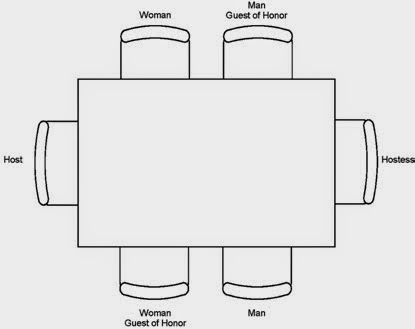
Formal Table Seating For Groups Divisible By Four, without Host and Hostess at opposite ends of the table— 
Images courtesy Bernadette Petrotta
 

“In seating one's self at table a comfortable posture is not incompatible with a dignified attitude. The shoulders should not be thrown back too far, nor should they drop forward. It is the latter pose which produces the inclination of the arms suggestive of the 'all elbows' idea which some people give of themselves.”
– Eliza M. Lavin, 1888

A 2020 Instagram query from Happy Soul —How do you take a seat the dining table i.e from the left of the chair or right of the chair or either way is correct? Then how do you leave the chair ie from left or right or either way is fine?
Reply from Maura J. Graber, Etiquipedia Site Editor: It is dependent on several factors, so common sense and some quick thought comes into play, just as it does with most other etiquette. Is it a formal dinner party in someone’s home? How many others are seating themselves at the same time? How is the table set up? Will seating yourself from the left side of the chair interfere with someone serving food? 
In the U.S., food and drinks are served on different sides — food from the left, drinks from the right. In Europe, everything is served from the right — food and drinks. Silently, ask the same question to yourself as you are walking toward the table on the right side. If one is in a restaurant, is everyone being seated at the same time? Are you joining a party already seated. Does someone have a walker, cane or other aid, sitting next to their chair that will impede your seating yourself? 

As a rule, I personally tend to “enter” the seat from the left and “exit” from the seat on my right. However, I always take a look around me before making those choices, and ask myself it it will work effortlessly, or if I will be causing discomfort or a challenge for anyone near me. Either way is fine, as long as no one else will be put out by the choice made.

Traditional Formal Table Seating For Six, Ten, Fourteen, Or Eighteen People, with Host and Hostess at Opposite Ends


 🍽Etiquette Enthusiast, Maura J. Graber of The RSVP Institute of Etiquette, is the Site Editor for the Etiquipedia© Etiquette Encyclopedia

Wednesday, December 9, 2020

Giving One’s First Dinner in 1878

“In many families, the master and mistress sit opposite at the middle of the table, so that they can attend more especially to all their guests; and this is an excellent plan...” — This was a popular French method of seating for spouses, that was adopted by many in the U.S. at the time. Sitting across from one another, a host and hostess could signal one another silently, without guests being aware.


To young housekeepers, the first dinner given to their friends is fraught with terror. Yet, by observing a few rules, the matter can be made easy enough. First of all, do not crowd your dining-room. If possible, you should invite an equal number of gentlemen and ladies, unless the party is given wholly to gentlemen, when the lady of the house does not appear, but nearest gentleman friend of the family take her place. 

In many families, the master and mistress sit opposite at the middle of the table, so that they can attend more especially to all their guests; and this is an excellent plan. When the guests are seated, the soup is served by the servants, or if the dinner is an informal one, the tureen is placed in front of the hostess, and she sends the plates by the servants, first to the right, and then the left, until all at the table are served. No one asks for soup or fish twice, and the hostess does not offer to replenish your plate, because by so doing, part of the company are usually kept waiting for the next coure. 

Sometimes the plates of soup are put upon the table before the guests are seated and when only one servant is employed this is a good plan to adopt. Oysters and clams in the shells are served before the soup, if at all, and they can also be put in place before the guests are summoned. Beside the napkin should be placed a tiny braided roll, or a square of three inches of bread, a tumbler, and glasses. 

Two large knives and forks are needed, knives at the right and forks at the left of the plate, also a soup spoon, and when the dessert is served, a silver knife, fork, and spoon are placed upon the dessert plate, with a glass finger-bowl and doily. On taking this, the guest places the knife and spoon at the right side, and the fork at the left, and spreads the doily at the left, placing the finger-bowl upon it, and when the repast is finished he dips his fingers quietly into the bowl and dries them upon his napkin. 

At some dinners, the meats are not handed around until they have been carved, and the servants will pass them to the left of each person. The vegetables are then served in a similar manner, and the various sauces and pickles then follow.— The Placer Herald, 1878


Etiquette Enthusiast, Maura J Graber, is the Site Editor for the Etiquipedia© Etiquette Encyclopedia

Saturday, September 6, 2014

Basic Dinner Seating Etiquette

“In seating one's self at table a comfortable posture is not incompatible with a dignified attitude. The shoulders should not be thrown back too far, nor should they drop forward. It is the latter pose which produces the inclination of the arms suggestive of the 'all elbows' idea which some people give of themselves.” – Eliza M. Lavin, 1888

Formal Table Seating For Six, Ten, Fourteen, Or Eighteen People  
Traditionally at a formal dinner, the Host sits at the head of the table with the Hostess at the other end. This works whenever there are six, ten, fourteen, or eighteen people. Husbands and wives are never seated next to each other.
If the Guest of Honor is a woman, she is seated at the Host's right and her husband at the Hostess' right. The second most important woman is seated across from the Guest of Honor, on the Host's left, and her husband is seated accordingly on the Hostess' left. The remaining guests are seated in between, alternating between male and female guests.
To be fair, the word "important" can be relative to many differing situations and varying cultures. Age may play a factor, especially if there is no Guest of Honor. Giving the eldest member of a group, or the persons who have traveled the farthest distance to the dinner, special places in the seating arrangement, would be an honor. Special accommodations may be also be made for those in wheelchairs, or those using a walker or cane. Guests take note of such matters and will undoubtedly appreciate the kind gestures on a Hosts and Hostess' parts.
Formal Table Seating For Groups Divisible By Four 
When the group of people is divisible by four, it is not possible for the Hostess to sit at the end of the table. In this case, the Hostess moves one place to the left, with the man on her right sitting at the end of the table, opposite the Host. This will keep the tradition of seating guests alternately, male, female, male, female, etc... Again, husbands and wives are never seated next to each other.
For informal dining, the easiest system is to alternate between male and female guests, with the Host and Hostess on either end of the table. 


Contributor Bernadette Petrotta is the Founder and Director of the Polite Society School of Etiquette in Washington State.  She has been teaching etiquette for nearly 20 years and has written The Art of Social Graces and The Art and Proper Etiquette of Afternoon Tea.  She is currently working on her third book and continues to teach and lecture on the art and pleasures of proper etiquette and tea. 


  🍽Etiquette Enthusiast, Maura J. Graber of The RSVP Institute of Etiquette, is the Site Editor for the Etiquipedia© Etiquette Encyclopedia