Showing posts with label Amy Willcock. Show all posts

Sunday, March 1, 2026

Spotlight on Amy Willcock

 Meet Amy Willcock, Cooking, Entertaining and Etiquette Authority, Writer, Hotelier, Creator of Award Winning Tablescapes, Etiquipedia Contributor and in our Contributor Spotlight for the Month of March 2026.

Amy Willcock is a successful writer of nine cookery and entertainment books. Born in Chicago, she moved to the UK in 1980. Specialising in country living and game recipes, Amy wrote a regular monthly column for The Shooting Gazette for over 19 years writing about food, country lifestyle and gundogs. During the Covid lockdown in Spring 2020, Amy started a new venture, KBO Cakes. The only way she could “send a slice of home” to her children serving in the forces and at university, was to send them a cake. “Nothing says ‘I’m thinking about you’ more than a homemade cake. Everyone needs a little morale booster every now and then.” says Amy.


Amy was previously in the hotel business - one of which, The George on the Isle of Wight, had a Michelin starred restaurant. Amy held Lifestyle, Cookery and Aga Workshops teaching people to cook, arrange flowers and set beautiful tables along with how to run a house. Her lifestyle and Aga workshops have been described as ‘finishing schools for people in their 30’s’ and Nigella Lawson wrote in Vogue, “Amy Willcock, hand holder to Aga owners everywhere.” 
Amy is a founder member of Yarmouth Women’s Institute, the subject of a BBC 4 documentary, and is a WI Cookery and Preserves judge. Amy has appeared on Market Kitchen, Kirstie’s Homemade Home, Celebrity Masterchef, and judged the perfect Sunday Lunch with John Torode and Gregg Wallace on Masterchef and is a regular Food and Lifestyle contributor to local radio. Amy lives in Yorkshire where she manages Warter Priory Shoot office, trains her gun dogs, endlessly entertaining friends and family.

Her lifestyle and Aga workshops have been described as ‘finishing schools for people in their 30’s’ and Nigella Lawson wrote in Vogue, “Amy Willcock, hand holder to Aga owners everywhere”.
Below are links to a few of Amy Willcock’s articles on etiquette and articles on her table settings you’ll find on Etiquipedia:
“Nothing says ‘I’m thinking about you’ more than a homemade cake. Everyone needs a little morale booster every now and then.” says Amy.

What was the impetus or pathway for starting a career or lifestyle involving Etiquette?
About 35 years ago I started to run cookery and lifestyle workshops in our hotel in South Wales to show people how to create and cook a menu for a three coursedinner or lunch with hints, tips and ideas to make entertaining as easy as possible and always ended the workshop with a tablesetting, at that time no one in the UK was talking about tablesettings. My catering background was very different from most Home Economists who ran cooking dems. I gave really useful “get ahead” information learned from hotel kitchens.Throughout my dems I would drop in interesting bon mots about entertaining in the past and how things came down from history and found their way onto our dining tables. A few years later we moved to the Isle of Wight opening another hotel, the George in Yarmouth. We were doing a lot of work on our house and installing a new Aga, I contacted Aga to go to an Aga dem but there weren’t any in my area as they didn’t have anyone to do the dems. I offered them my services, I went toAga who trained me and hey presto I added Aga demos to my repertoire. Word went around and I was contacted by Ebury Press to write an Aga cookbook and one book eventually became nine. 

I am passionate about old silver and love to find new uses for things, such as old silver napkin rings, you can use them for napkins but they also make super little individual tea lights when put on an old mirror. I find it really rewarding helping people become confident hosts and hostesses.

What (or who) do you find the most enjoyable with regard to Etiquette and your work? 
I am passionate about old silver and love to find new uses for things, such as old silver napkin rings, you can use them for napkins but they also make super little individual tea lights when put on an old mirror. I find it really rewarding helping people become confident hosts and hostesses. Etiquette was invented to make people feel comfortable, the difference between American and English table manners is as wide as the ocean that divides us! With good manners you can dine with duchesses and dustmen alike, and good manners puts everyone at their ease. As long as you are considerate to others you will be welcome whether you use the right fork or not! My favourite book and I have many, is a slim volume by Constance Spry called Hostess. Her advice is priceless and is as relevant now as it was when printed in the 1960’s.
Amy was our Best in Show Winner for our Etiquipedia International Place Setting Competition in 2023 after having won in 2022!

What do you find the most rewarding aspect of your career regarding Etiquette?
The most rewarding aspect of not etiquette, but good manners to me, is that my children know what to do and how to behave and are fully confident where ever they go and with whomever they are with. 

What age group do you enjoy working with most when it comes to etiquette? And why? 
I enjoy teaching and helping anyone young or old to become confident cooks and I especially like helping people to feel confident in whatever situation they find themselves in. I must admit I don’t think “sugar tongs” manners are particularly relevant to anyone and look ridiculous, but good manners, especially table manners are vital to everyday living. Nothing sets my teeth on edge more than bad table manners.  

Who are some of the older etiquette authors or authorities you enjoy reading most?
My favourite book is called Hostess by Constance Spry, I have a first edition from the 1960’s and I also have a first edition Amy Vanderbilt that was given to my father when he went off to college in the 1950’s.

What types of classes or training do you offer, if any? If you don’t offer classes or training, how do you share your expertise? 
I am going to start doing dems again, I met a woman earlier this year who reminded me how much fun they were and how she learned so much so I am going to start doing them on line, a new adventure for me.


To reach Amy, you can contact her at amy@kbocakes.co.uk or follow her on Instagram @Amy_Willcock


๐ŸฝEtiquette Enthusiast, Maura J. Graber of The RSVP Institute of Etiquette, is the Site Editor for the Etiquipedia© Etiquette Encyclopedia

Thursday, January 18, 2024

Our Best in Show Winner for 2023 – Professional Category

For our Third Annual Etiquipedia International Place Setting Competition, Amy Willcock is again our Best in Show Winner for the Professional and Etiquette Community category. She won in this category in 2022.    
Her theme choice options for the 2023 contest were: A period 1953 place setting in honor of the Coronation of Queen Elizabeth II; A 1930's nursery tea party place setting for young Princesses Elizabeth and Margaret; A mid-century modern, post-World War II tea place setting (for one or two); A complete place setting (for 2 or more) from any period in the life of King Charles III. She chose the 1930’s nursery tea party place setting for young Princesses Elizabeth and Margaret. We found her setting to be charming. Congratulations, Amy!   

Our Interview with Amy:

1. How did you choose the menu and various elements you used in your setting, and why? Please explain each of the utensils at your setting… For which of the foods on your menu (or course) was each different item intended?

My setting is for a children’s tea party – the children just happen to be princesses! It is set with 1930’s Bunnykins Royal Dalton china, the tea cups are slightly smaller than a regular sized tea cup being made for children, there is tea spoon in the saucer and the plate is an 8 inch/20 cm size. There is a bone handled tea knife ready for bread and butter with honey and cake and a spoon for jelly and ice cream. The jam pennies, a favourite of the young princesses, are eaten with the fingers. 
The tablecloth is an original 1930’s Disney table cloth made in Ireland. The honey pot is in the shape of a “skep” and wooden drizzler are sitting on a Peter Rabbit Wedgwood plate. There is a small silver teapot with a china tea strainer and a whimsical butter dish decorated with spaniels and a china milk jug by Gien decorated with circus performers. The small china hen is just for decoration.
We at Etiquipedia simply loved the vintage period details that make up this adorable table. The Bunnykins dishes with the “bone”, or celluloid handled knife and period flatware are the perfect accoutrements.

2. Why did you choose this particular period in time to set your table? Please go into as much detail as you can.

I chose this particular period as not much has changed since the 1930’s in aristocratic and upper class nursery’s, in fact all the same dishes are still great favourites today. All the china was used by my own children who are now grown up and I thought it was a great opportunity to use it. I still use the larger plates for birthday cakes as I love the running rabbits around the edge. 


3. Have you always enjoyed a properly set table? Or, if not, was the table setting something you learned to enjoy through your social life and/or business later on in life?

I grew up until the age of 12 in the United States, but my mother who was British insisted on setting a properly laid table and holding a knife and fork “properly” meaning in the English style, not cutting the food up and laying the knife on the edge of the plate and changing the fork into the right hand as they do in the USA…. and my Grandmother always had beautiful tables and insisted on cloth napkins all the time!

In my professional life as a food and lifestyle writer I have taught etiquette, historical and modern table settings for many years, and admit that I prefer simple tables now but have created many fun and elaborate tables over the years.
The menu: “Jam Pennies” were a tea time favorite of Queen Elizabeth II, as a child and throughout her life. They are small, round bread cutouts spread with butter and jam. 
4. Did you do any research on table setting etiquette before setting your elements at the table?

No, the only thing I knew I would include in the menu were the jam pennies as they were a favourite of the Princesses.

5. Do you plan on entering again next year?

Yes
๐Ÿ‘‘ ๐Ÿ‘‘ ๐Ÿ‘‘ ๐Ÿ‘‘ ๐Ÿ‘‘ ๐Ÿ‘‘
6. Do you have any special memory they had of watching the Coronation or the Queen’s funeral (if any)?

The late Queen’s lying in state was televised 24/7 and I was glued to it, I found it so calming and emotional. Of course the funeral was magnificent and moving. It doesn’t matter if it is a coronation, a state funeral, or the launching of a battleship, nothing beats the British, we are the best at pomp and ceremony! My eldest daughter is in the RAF and was involved in the Coronation and I held a tea party (using a ERII Coronation embroidered tea cloth) on the day of the Coronation for a few friends, we all watched it on the television together. One of the best bits was when all of the armed forces involved in the coronation were lined up in gardens of Buckingham Palace and gave their Majesties three cheers – that was fantastic!


More on Amy – Amy Willcock is a successful writer of nine cookery and entertainment books. Born in Chicago, she moved to the UK in 1980. Specialising in country living and game recipes, Amy wrote a regular monthly column for The Shooting Gazette for over 19 years writing about food, country lifestyle and gundogs. During the Covid lockdown in Spring 2020, Amy started a new venture, KBO Cakes. The only way she could “send a slice of home” to her children serving in the forces and at university, was to send them a cake. “Nothing says “I’m thinking about you” more than a homemade cake. Everyone needs a little morale booster every now and then” says Amy. www.kbocakes.co.uk Amy was previously in the hotel business - one of which, The George on the Isle of Wight, had a Michelin starred restaurant. Amy held Lifestyle, Cookery and Aga Workshops teaching people to cook, arrange flowers and set beautiful tables along with how to run a house. Her lifestyle and Aga workshops have been described as ‘finishing schools for people in their 30’s’ and Nigella Lawson wrote in Vogue, “Amy Willcock, hand holder to Aga owners everywhere”. She is a founder member of Yarmouth Women’s Institute, the subject of a BBC 4 documentary, and is a WI Cookery and Preserves judge. Amy has appeared on Market Kitchen, Kirstie’s Homemade home, Celebrity Masterchef, and judged the perfect Sunday Lunch with John Torode and Gregg Wallace on Masterchef and is a regular Food and Lifestyle contributor to local radio. Amy lives in Yorkshire where she manages Warter Priory Shoot office, trains her gun-dogs, and enjoys entertaining her friends and family.


๐ŸฝEtiquette Enthusiast, Maura J Graber, is the Site Editor for the Etiquipedia© Etiquette Encyclopedia

Wednesday, March 1, 2023

Cheese Course History


In Georgian times, cream was eaten in abundance and cheese was so popular that cheese mongers ran their own fleet of ships to distribute the cheeses from Liverpool to London. Stilton was named after a village near Peterborough. The landlord of the Bell Inn at Stilton was supplied by his sister- in-law, a farmer’s wife who made a variety of cheese now known as Stilton. Back then, it was eaten with a spoon so that you didn’t miss the maggots! Cheese was, for the fashionable set the end of the meal with it being eaten in pieces, or in savoury dishes such as Welsh Rabbit.

Eating is laden with booby traps. Which fork to use? Which glass? Should I use the cutlery laid for my asparagus or my fingers? Finally, and hopefully after dodging the landmines that are buried under the damask, we come to cheese...

The history of the cheese course starts in the beautiful Dairies of the great houses. The Royal Dairy at Windsor Castle, designed by Prince Albert in 1848 is one of the finest, with beautiful tiles from floor to ceiling. “The milk would be brought in, and gone in the settling pans. These pans would have kept cool throughout by water running from three fountains; a mermaid, a merman and a lady holding a jug. The water would have been running constantly under the marble trestle tops, keeping the milk at a temperature where the cream could be skimmed off and taken in the jugs and delivered to the Palaces.” Emma Clarke, Custodian of the Royal Creamery.

Dairies were a huge source of pride on Country Estates great and small, and dairymaids were well known for their beautiful complexions and soft skin. In 1796 it was discovered by Edward Jenner, the doctor who developed the first successful vaccine, that the diary maids who had contracted cowpox were protected from smallpox which killed so many and left those who lived horribly scarred. Dairymaids were so highly prized that one Gentleman in his 70’s with a fine Dairy courted and eventually married the dairymaid.

In Georgian times, cream was eaten in abundance and cheese was so popular that cheese mongers ran their own fleet of ships to distribute the cheeses from Liverpool to London. Stilton was named after a village near Peterborough. The landlord of the Bell Inn at Stilton was supplied by his sister- in-law, a farmer’s wife who made a variety of cheese now known as Stilton. Back then, it was eaten with a spoon so that you didn’t miss the maggots! Cheese was, for the fashionable set the end of the meal with it being eaten in pieces, or in savoury dishes such as Welsh Rabbit. – From The Cheese Course, by Amy Willcock @copyright 2023 reproduced with permission only


Author Amy Willcock is our newest contributor. Amy was the Best in Show Winner for the Etiquette Community in our 2nd Annual Etiquipedia Place Setting Competition. She is most well known for her books on AGA Stove cooking. Her books, "The Aga Bible," "Aga Cooking," "Aga Seasons," "Amy Willcock's Aga Baking," "Amy Willcock's Aga Know-How,"" At Home with Amy Willcock," and "B&B Know-How” are available on Amazon.


๐Ÿฝ️Etiquette Enthusiast, Maura J. Graber, is the Site Editor of the Etiquipedia© Etiquette Encyclopedia

Wednesday, October 12, 2022

An Interview with Amy Willcock

The Best in Show Winner for the Etiquette Community in our 2nd Annual Etiquipedia Place Setting Competition is Amy Willcock of the United Kingdom. Amy is shown above with her Georgian Era dinner place setting.
๐Ÿฝ ๐Ÿฝ ๐Ÿฝ ๐Ÿฝ
Amy Willcock is a successful writer of nine cookery and entertainment books. Born in Chicago, she moved to the UK in 1980. Specialising in country living and game recipes, Amy wrote a regular monthly column for The Shooting Gazette for over 19 years writing about food, country lifestyle and gundogs. During the Covid lockdown in Spring 2020, Amy started a new venture, KBO Cakes. The only way she could “send a slice of home” to her children serving in the forces and at university, was to send them a cake. “Nothing says “I’m thinking about you” more than a homemade cake. Everyone needs a little morale booster every now and then” says Amy. www.kbocakes.co.uk Amy was previously in the hotel business - one of which, The George on the Isle of Wight, had a Michelin starred restaurant. Amy held Lifestyle, Cookery and Aga Workshops teaching people to cook, arrange flowers and set beautiful tables along with how to run a house. Her lifestyle and Aga workshops have been described as ‘finishing schools for people in their 30’s’ and Nigella Lawson wrote in Vogue, “Amy Willcock, hand holder to Aga owners everywhere”. She is a founder member of Yarmouth Women’s Institute, the subject of a BBC 4 documentary, and is a WI Cookery and Preserves judge. Amy has appeared on Market Kitchen, Kirstie’s Homemade home, Celebrity Masterchef, and judged the perfect Sunday Lunch with John Torode and Gregg Wallace on Masterchef and is a regular Food and Lifestyle contributor to local radio. Amy lives in Yorkshire where she manages Warter Priory Shoot office, trains her gundogs, endlessly entertaining friends and family.
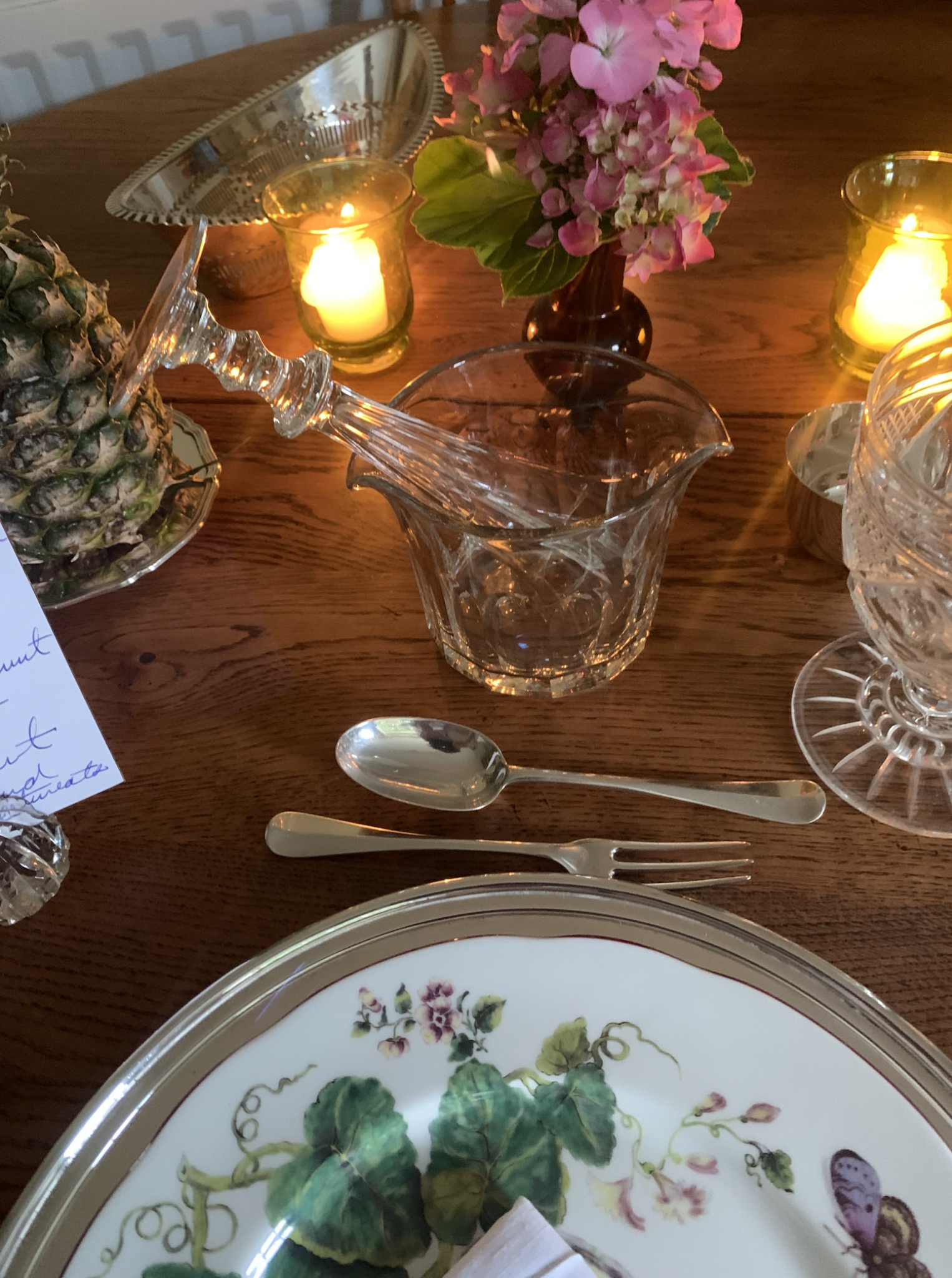
Amy’s formal Georgian setting was our Best in Show for the Professional and Etiquette Community entries. It is a mix of 18th century elements  that work beautifully together to create a real feel for the era. Starting with the candle light reflecting off of the silver and warm wood, the table is set with the pistol grip handled flatware so common to the time period. The pineapple is the quintessential Georgian fruit to accompany a fine, formal meal... all of these elements, along with the colors chosen, work seamlessly together. We’d love to dine at this table!

A few etiquette notes on Amy’s setting: 

Amy’s place setting and the overall look  and feeling it evoked was absolutely charming. She went into great detail in her description, so we only sent a follow-up request for explanations on each piece of flatware. You will find her explanation below the photo of Amy’s menu,


Six questions for Amy: 

1. How did you choose the menu and various elements you used in your setting and why? Please explain each of the utensils at your setting… For which of the foods on your menu (or course) was each different item intended? 
Amy’s menu is a perfect melange of Georgian fare and suits the setting to a T. The utensils are for the foods as follows: On the far right the small knife is a bread knife and the tablespoon is for soup. The small forks on either side are for fish (fish used to be eaten with two forks before fish knife and fork sets were created in the 19th century.) The joint knife and fork are for the lamb. The pudding-fork and spoon are for Cambridge burnt cream (“they slide down when main course is cleared”) and the small knife closest to the plate is for the dessert course.
“I always cook according to the seasons and what is easy to prepare and serve when you are the cook, hostess and bottlewasher! I collect silver it is a passion of mine along with old glass but I do love William Yeoward glasses.

“Soup spoons didn’t exist in the Georgian era, table spoons were used,which is so sensible – I do not possess a soup spoon!
In the late 17th and early 18th century knives were made of carbon steel and would taint delicate foods such as fish so two silver forks would be used. Much later in Victorian times silver fish knives and forks were used, although some are very beautiful, I use small silver forks and pistol handled knives with stainless steel blades and set two forks at dinner parties and it’s always fun to watch you guests try and figure out what is going on.

“I am rather fond of three pronged forks as you can see and my pistol handled knives do have very old blades so they need a bit of TLC every now and then. Rack of Lamb is so tender it should cut like butter and of course it is quite correct to pick up the bones and eat, just remember to give everyone a finger bowl after the main course!

“Cambridge Burnt cream is a delicious thick cold custard topped with a layer of crispy caramelised burnt sugar so a good whack with a sliver spoon will do the trick in England, apart from ice cream we always serve “pudding” as we call the sweet course, with a fork and spoon. 

The dessert course is always fruit, nuts, and sweetmeats – little candied bon bons made of marzipan and dates. That’s also where the pineapple comes in and you will see form the photo that the pineapple is taken out of it’s skin and then reassembled back inside, rather cleverly acting as a table decoration and fruit course.”

2. Why did you choose this particular period in time to set your table? Please go into as much detail as you can.


“I love everything about the Georgian period – the silver, the architecture, the china etc… that is when the dining room came into it’s own.”
Later this month we will be posting an extract from a book Amy wrote for English Heritage.
3. How, if at all, did Covid-related social restrictions affect your choice of setting? Were you ready to celebrate? Feeling in the mood to do something different? Etc…

I live in the middle of the country and covid had very little effect really except entertaining was out, but I still set a beautiful table every day.

4. Have you always enjoyed a properly set table? Or, if not, was the table setting something you learned to enjoy through your social life and/or business later on in life?

My mother always insisted on a properly laid table at every meal – breakfast lunch and dinner–  and never put a milk bottle on the table! I have always loved setting fun, beautiful tables. In the UK Tea is served around 4-5 pm and was usually served in the drawing room or sitting room, delicious little sandwiches, and cake- FYI cake would not be served with cake forks! High tea would be things like cottage pie or boiled egg and soldiers for children around 5pm. A properly laid table transforms whatever you are eating, even if it is just bread and cheese. My biggest tip is use everything all the time, don’t save anything for “best”, enjoy everything. I love Joan Didion’s reply when she was asked why she used the good silver every day, Didion replied, “Well every day is all there is.”

5. Did you do any research on table setting etiquette before setting your elements at the table? 

I entered the professional section as I have written, lectured and worked on tables in stately houses such as Castle Howard in Yorkshire extensively.


6. Do you plan on entering again next year? 

Definitely!

More on AmyWillcock–

Nigella Lawson wrote in Vogue, “Amy Willcock, hand holder to Aga owners everywhere”

Books published by Ebury Press

Amy Willcock’s Aga Bible

Troubleshooting tips for your Aga

Cooking for One

At home with Amy Willcock

Amy Willcock’s B&B Know How

Amy Willcock’s Aga Seasons

Amy Willcock’s Aga Know How

Amy Willcock’s Aga Baking

Aga Cooking

Magazines– Amy is a contributor to The Shooting Gazette, Country Life, The Lady, Aga Living, Homes and Garden, Country Kitchen, Waitrose.   

Elizabeth Soos and I would both like to congratulate Amy on her award winning setting. We are honored that she entered our contest and love meeting others who are so willing to share their talents, enthusiasm for etiquette, and their wealth of knowledge. Congratulations!


๐ŸฝEtiquette Enthusiast, Maura J. Graber, is the Site Editor for the Etiquipedia© Etiquette Encyclopedia