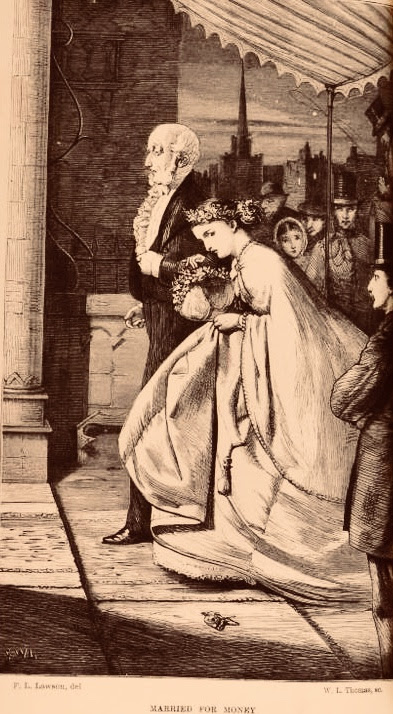
On Gretna Green and “Red Hot Marriages” : Runaway marriages were once a staple of English fiction. Readers of Jane Austen’s “Pride and Prejudice” will remember how distressed the Bennets were to find that Lydia, their flighty daughter, had not gone to Gretna Green with militia officer George Wickham, but much more socially disastrous for the family, was living with the scoundrel in London!
Historically couples married in the ancient tradition of a
'handfasting' ceremony, or 'marriage by declaration,' which was law in Scotland until as recently as 1940. This simple ceremony enabled couples to marry by declaring in front of two witnesses their wish to be husband and wife, then and they were legally bound. Gretna Green became famous for these ceremonies following the 1754 Marriage Act, which outlawed clandestine marriages in England. Lord Hardwicke, the English law lord who introduced this law, was determined to quash the desires of young couples from becoming husband and wife through this 'quickie' ceremony.
'handfasting' ceremony, or 'marriage by declaration,' which was law in Scotland until as recently as 1940. This simple ceremony enabled couples to marry by declaring in front of two witnesses their wish to be husband and wife, then and they were legally bound. Gretna Green became famous for these ceremonies following the 1754 Marriage Act, which outlawed clandestine marriages in England. Lord Hardwicke, the English law lord who introduced this law, was determined to quash the desires of young couples from becoming husband and wife through this 'quickie' ceremony.
Scotland was famous for its distinctive marriage arrangements, which owed much to pre-Reformation canon law, and were based on principles of mutual consent rather than religious ceremony. Both 'regular' and 'irregular' marriages were recognised by the law. A 'regular' church marriage, requiring marriage banns to be read in the church some weeks in advance, was the usual practice, and from 1834 'priests and ministers not of the established church' were also allowed to conduct legal marriage ceremonies. In Scotland, regular marriages did not have to take place within a church building; indeed, they were more likely to take place in private homes. Even so, at first sight, Scotland's system seemed more religious in practice than England's, because civil ceremonies in a register office were not possible until after an Act of Parliament in 1939.
But Scotland's fame for distinctive marriage practices stemmed from 'irregular' marriages. There were three ways of forming a legal marriage without banns or a minister being present.
- A couple were legally married if they declared themselves to be so in front of witnesses, regardless of whether this was followed by a sexual connection. Marriage contracted in this way without witnesses was also legal, but much harder to prove in court unless there was other evidence, such as letters that confirmed what the couple had done.
- A promise of marriage, followed by a sexual relationship, was regarded as a legal marriage - but this had to be backed up by some kind of proof, such as a written promise of marriage, or an oath sworn before witnesses.
- Marriages 'by habit and repute' were also legal if a couple usually presented themselves in public as husband and wife, even if no formal declaration of marriage was made.
Irregular marriages were frowned on by law and the churches, and couples who admitted to them were fined, but they had the same inheritance rights as regularly married couples, and their children were legitimate. Although the Church of Scotland did not approve of irregular marriages, it tolerated them because it feared that if the law did not recognize such relationships, the couple would end up 'living in sin.' The system was believed to protect women from unscrupulous men who might seduce them with promises of marriage or fake wedding ceremonies. After registration was introduced, an irregular marriage could be registered if the couple presented themselves before a sheriff or magistrate, were 'convicted' as parties to an irregular marriage, and paid a fine. Some found it quicker and cheaper to have their irregular marriage entered in the schedules by the registrar under sheriff's warrant than to go through the expense of banns and a regular marriage ceremony. Marriages established in court by a Decree of Declarator could also be registered, on production to the registrar of an extract of the Decree and payment of £1, but this was not common. In fact, irregular marriages notified to the registrar were infrequent in Scotland in the mid-nineteenth century, and fewer than 100 per year took place between 1855 and 1870. After that, the numbers rose steadily, and then rapidly in the early twentieth century, until they accounted for over 12% of all Scottish marriages in the registers in 1914. They remained at this level until the Second World War.
Contrary to the national myth, most took place not on the Scottish border, but in the larger towns. This may have been due to a decline in the influence of the churches, or to the relative cheapness of 'irregular' marriages, but it also reflected the growing number of divorces. Since many churches would not remarry a divorced person, and civil marriage was not possible in Scotland, couples in this position had no alternative but to marry by sheriff's warrant. Although so-called 'irregular' marriage by sheriff's warrant technically attracted a 'fine' until the law was changed in 1916, it was becoming a more frequent legal alternative to a church ceremony. In 1939, marriage registered by sheriff's warrant ended, and it was possible, as in England, to marry by a civil ceremony in the registrar's office. Legal textbooks described all types of marriage outside the churches as 'irregular' until the early twentieth century, but, given the rise in numbers of marriage through sheriff's warrant, the public no longer saw anything irregular in the proceedings.- An excerpt from the University of Glasgow
Etiquette Enthusiast, Maura J Graber, is the Site Editor for the Etiquipedia© Etiquette Encyclopedia