Showing posts with label 19th C. Mexican Etiquette. Show all posts

Wednesday, August 19, 2020

19th C. Wives‘ Etiquette of Mexico and Spain

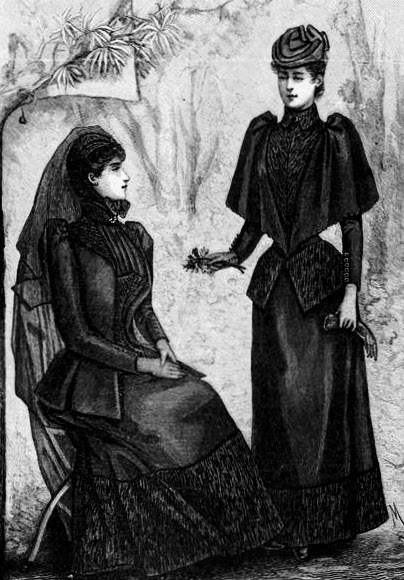
An 1891 advertisement for mourning dresses. — The etiquette of funerals in Mexico does not permit the female relations of deceased to attend. Only men attend the departed to the church and the tomb. 


The etiquette of funerals in Mexico does not permit the female relations of deceased to attend. Only men attend the departed to the church and the tomb. Funerals are so expensive that they often ruin business men. All female relatives, even to cousins and children, must wear deep mourning for two years. During the mourning none of the ladies of the household must be seen in public. Bodies are buried encased in laces and decked with precious stones. 

In Mexico, as in Spain and other southern countries, a lady retains her maiden name after marriage, and though she annexes to it, that of her husband by means of a “de,” she is universally known by her own family name. It is considered more courteous to address even elderly married ladies Señorita (Miss), instead of Señora (Madame.) The lady of the house is always called by her servants and dependents La Niña (the little girl), though she may have attained the age of eighty. — From ‘Of General Interest,’ 1884


Etiquette Enthusiast, Maura J Graber, is the Site Editor for the Etiquipedia© Etiquette Encyclopedia

Wednesday, September 16, 2015

Courting Etiquette in 19th C. Mexico

No gentleman is allowed to call upon a lady until after he has been regularly introduced by some intimate friend or relative of the family...
There is probably no country in the world where etiquette is more strictly observed than in Mexico, and the following are some of its peculiarities : The windows of all the residences in Northern, and I might say in all, Mexico are barred with an iron or wooden grating, projecting a few inches toward the sidewalk and forming a sort of balcony. The object of this is to separate all gentlemen not properly introduced and vouched for from meeting the ladies of the house. No gentleman is allowed to call upon a lady until after he has been regularly introduced by some intimate friend or relative of the family, who becomes responsible for the visitor's conduct. This is never done until his character, personal habits, and the standing of his family are known. If the introduction and standing of the party are satisfactory, he is then permitted to call upon the lady of the house, and she can receive him only in the presence of some member of the family or trusted friend, who is expected not to leave the room while the caller is present.

If the caller is a young man and he calls upon a young lady, then her mother or some lady friend of the family is always present, and she does most of the entertaining. When the young man calls three or four times, it is presumed that he knows what he wants, and it is therefore expected that he will at once seek the hand of the lady in marriage, but if he fails to declare his intentions, then the father or the oldest son, if living — if not, then the uncle or some other member of the family— invites the young gentleman to come forward and state the objects of his visits, or discontinue them. The young lady is never allowed to ride or drive alone with the gentlemen ; neither is she allowed to walk upon the street, visit any friend, nor attend a public ball, unless she is accompanied by some member of the family or a trusted lady friend. Neither gentleman or lady is expected to either converse or promenade the street or plaza, or to exchange any but the commonest courtesies.

It is a common sight to see young Mexicans standing before the windows of the houses, with one hand on the window bars, and the other holding the inevitable cigarette, laughing and chatting, as if he were the most privileged of wooers.


After being introduced, the gentleman is always expected to recognize the lady first, and if he fails to do that soon after his introduction, it is understood that he desires to cut her acquaintance. At a public ball, or at a dinner at the house of a friend, then both ladies and gentlemen may dance and converse at pleasure, for then they are in the presence ot mutual friends. If the gentleman desires to form the acquaintance of a lady, or has not been properly introduced and vouched for, then he can only admire her at a distance, send billets doux (love letters), or at least talk to her through the bars of her window, which is only large enough to admit the hand and arm. It is a common sight to see young Mexicans standing before the windows of the houses, with one hand on the window bars, and the other holding the inevitable cigarette, laughing and chatting, as if he were the most privileged of wooers. – From Correspondence Inter-Ocean, 1883


Etiquette Enthusiast, Maura J. Graber is the Site Editor for the Etiquipedia© Etiquette Encyclopedia