though 95% of these still apply today!
 |
| Send ten cents for our beautifully illustrated book “How to Set the Table” by Mrs. Rorer (Sarah Tyson Rorer) ~1901 |
Table Etiquette
A man should not seat himself at the dinner table until his wife or his hostess is seated. This rule holds good in the home, for if it is not practised there, it will not be observed gracefully in society.
Seat yourself not too close to nor too far from the table.
 |
| One should sit quietly at the table, without handling the cutlery or making useless motions, while waiting to be served. One, however, should not ever appear this bored at the dinner table. |
Erect position at table is the first requisite. One should so place one's seat that correct position is possible, and then should keep it.
Elbows should never be placed upon the table.
The hands should be kept quietly in the lap while not busy with the food.
One should sit quietly at the table, without handling the cutlery or making useless motions, while waiting to be served.
If there is some form of grace said, or some simple ceremony preliminary to the meal, one should pay respectful attention silently.
 |
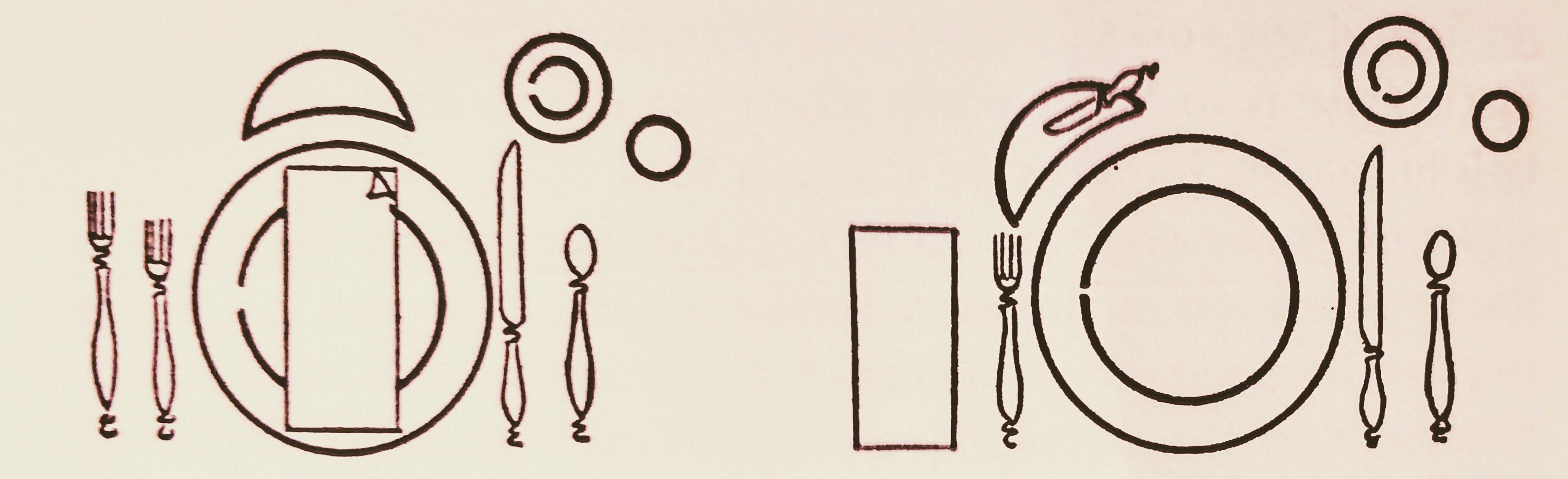
| A properly set dinner table by Mrs. Rorer |
Do not seem impatient to be served. The meal is a social occasion and the food is an adjunct to friendly intercourse. The success of the meal depends equally perhaps upon the food and the conversation. Because of the interruptions of service, conversation cannot be long continued, or deeply thoughtful. It must be on subjects of no great moment nor grave interest, or on such subjects lightly touched; but it should be on bright, cheerful topics, and as witty as the talent of the company affords.
Eating should be slow, and mastication of the food thorough, for reasons of health as well as for the sake of appearance. No meal can be eaten properly and adequately in less than thirty minutes, but more than an hour for a meal is sheer waste of both time and food, unless the company is large, the times of waiting between courses long, and the portions served very small.
Eat silently. The noise of food being masticated is very distressing, and except in cases of crusts and crisp vegetables, perfectly unnecessary.
The napkin is unfolded and spread over the lap. One is supposed to be skillful enough in raising food to the lips not to need the napkin in front of the dress or coat to prevent injury.
In case you do not care for a course, you should not refuse it. Receive it, and take what part of it you desire, trying to take some; or, if you wish, leave it untouched, but do not have the appearance of being neglected or ill-provided for, even if you do not eat of it. A little more attention to conversation on your part may make unnoticeable to those about you the fact that you do not eat of a certain course.
If your preference is consulted as to food, whether the matter be trivial to you or not, express some preference so that the one who is serving, and who has asked to be guided, may be so far assisted.
Never place food or waste matter upon the tablecloth. An exception to this may be made in regard to hard breads and celery, when individual dishes for these are not furnished. Always use the side of some one of the dishes about you for chips and scraps.
The fork is used in general except with semi-liquid sauces, where a spoon is of necessity used. It is not permissible to eat peas with a spoon.
The mouth should be closed while it contains food. It should not be too full, as it is often necessary to reply to some question when there is food in the mouth. Do not leave the table until you have quite ceased chewing.
 |
| An invitation for breakfast meant one would probably be dining on several courses, over a few hours or so. |
Be dainty and skillful in using your napkin and cutlery, avoiding soiling the tablecloth.
Discussions and unpleasant topics of conversation should never be introduced. One should regard not only one's own aversions but those of the others present.
Never put your finger in your mouth at table, nor pick your teeth.
Tidiness of personal appearance is never at a higher premium than at the dining table. Soiled hands, negligee dress, shirt sleeves, and disheveled hair are disgusting there.
It is quite proper to take the last helping of any dish which may be passed you. To refrain looks as if you doubted the supply.
Bread is not cut, but broken into fairly small pieces. One should never nibble from a large piece.
It is permissible to eat crackers, olives, celery, radishes, salted nuts, crystallized fruits, corn on the cob, bonbons, and most raw fruits from the fingers.
Apples, pears, and peaches are quartered, peeled, and then cut into small pieces.
Cherries, plums, and grapes are eaten one by one, the stones being removed with the fingers and laid upon the plate.
Cheese may be laid in small pieces on bread or crackers, and conveyed to the mouth in that way.
Asparagus should be eaten with the fork, the part which is not readily broken off by it being left.
 |
| Tidiness of personal appearance is never at a higher premium than at the dining table. |
At a formal meal a second helping of a dish is never offered, and should never be asked for; but at an informal dinner party it is not out of place to accept a second helping, if one is offered, but is complimentary to the hostess, who is responsible for the cook.
In passing the plate for a second helping, the knife and fork should be laid across it full length,—not held in the hand until the plate returns.
One may ask the waiter for a second or third glass of water, as even at a formal dinner that is always permissible.
Lettuce, cress, and chicory are never cut with a knife, but rolled up on the fork and so conveyed to the mouth.
Never leave the spoon in any cup while drinking from it.
Liquid bouillon,—not jellied,—should be drunk from the bouillon cup.
Spoons are used for grape fruit and oranges, when cut in halves and put upon a plate, for soft-boiled eggs, puddings, custards, and gelatins.
With fruit, finger-bowls should always be passed. A bowl half-full of water is placed upon a plate covered with a doily. Unless the fruit is passed upon a second plate, the bowl and doily are removed from this and set at one side, the fruit being eaten from this plate. The fingers are then dipped, one hand at a time, into the water, and wiped upon the napkin.
 |
| Supper defined by Mrs. Rorer: A full supper service consists of silver tea set, plates, bread tray, cold meat dish, silver covered hot water dish ... |
Salt should never be put upon the tablecloth, but always on the side of the plate, unless the individual salts are provided.
Never spit out a prune, peach, or cherry stone.
Never hold food on the fork while you are talking, ready as soon as you reach a period to be put into your mouth. Having once picked it up, eat it promptly.
A bit of bread, but nothing else, may be used, if necessary, to help one put food upon the fork.
If one tastes of something which one does not care to swallow, it may be removed from the mouth with the closed left hand and placed on the plate. This should be done silently and with as little attention as possible.
Never take a chicken or chop bone in the fingers. Cut the meat from the bone, leaving all that does not readily separate.
Bread and butter plates, with the butter spreader, are always used, except at formal dinners, when the dinner-roll is laid in the fold of the napkin.
The knife is used only for cutting, and for spreading butter on bread in the absence of butter spreaders.
Almost all foods are eaten with the fork, which should always be used in the right hand with the tines up. It may be held in the left hand, tines down, when one is cutting, the knife being in the right hand.
The soup spoon is an almost circular and quite deep spoon. Therefore it is obvious that the soup should be noiselessly sipped from the side of it. When the oval dessert spoon is used for soup, it is especially necessary to sip the liquid from the side.
Special spoon-shaped forks are provided for salads, ices, and creams, but for these spoons may always be substituted.
No hot drink should be poured from the cup into the saucer to cool it.
Toothpicks should not be passed at the table. They may be left on the sideboard, and if one is needed, it may be requested of the waiter or taken as you leave the room, but always used in private.
Wherein elderly people do differently from the established ways of to-day, they are not to be criticised.
Manners change even several times within a generation, and such may be simply following the customs they were taught. When the three-tined fork was the only one in common use, the blade of the knife was much more in requisition than now.
On leaving the table the dishes of the last course should be left exactly as used, and the napkin left unfolded by the side of the plate. In case one is at home, or visiting a friend, and the napkins usually serve for two or three meals, then neatly fold it. Many families have clean napkins once a day, that is, at dinner.
The chair should either be pushed quite back from the table, or close to it, so that others may easily pass by.
If obliged to leave the table in the midst of a meal, one should address the hostess, saying, “Please excuse me,” as he rises.
–From “The Etiquette of To-Day,” by Edith Ordway, 1918
Etiquette Enthusiast, Maura J. Graber, is the Site Editor for the Etiquipedia© Etiquette Encyclopedia