Showing posts with label Gilded Age Table Setting. Show all posts

Thursday, December 8, 2022

Gilded Age Tabletops and Manners


The teaching of table manners cannot be begun too soon. But children should never be allowed to trouble guests. If not old enough to behave well at table, guests should not be invited to the meals at which they are present. It is very trying to parents, guests, and servants.

It is well in all households, if possible, for the children to breakfast and lunch with their parents. The teaching of table manners cannot be begun too soon. But children should never be allowed to trouble guests. If not old enough to behave well at table, guests should not be invited to the meals at which they are present. It is very trying to parents, guests, and servants.

When luncheon is to be an agreeable social repast, which guests are expected to share, then the children should dine elsewhere. No mother succeeds better in the rearing of her children than she who has a nursery dining-room, where, under her own eye, her bantlings are properly fed. It is not so much trouble, either, as one would think– and no matter if it is trouble.

Table mats are no longer used in stylish houses, either at luncheon or at dinner. The waiter should have a coarse towel in the butler’s pantry, and wipe each dish before he puts it on the table. Menu-cards are never used at luncheon. Salt-cellars and small water carafes may be placed up and down the luncheon-table.

In our country, where servants run away and leave their mistress when she is expecting guests, it is well to be able to improvise a dish from such materials as may be at hand. Nothing is better than a cod mayonnaise. A cod boiled in the morning is a friend in the afternoon.– From “Manners and Social Usages,” by Mrs. John Sherwood, 1884


 🍽️Etiquette Enthusiast, Maura J. Graber, is the Site Editor for the Etiquipedia© Etiquette Encyclopedia

Thursday, May 20, 2021

Laying the Gilded Age Table of 1895

Handsome linen will give elegance to a table where ornamentation is very simple. It should be ironed without starch, or with a very little if it is not sufficiently heavy to take polish without it. It should be folded perfectly square, so that the lines will be straight, and should be of spotless and dazzling whiteness. With this as a basis, there will be no difficulty in making an attractive table.


The Table– A round or square table five feet across is a convenient size for ordinary use, giving ample room for six people, and leaving space for decoration. Large round tops are made to fit over extension-tables, which will seat from twelve to twenty or more people; and when the size of the room will permit, this is the pleasantest form of table for entertainments, and best lends itself to decorative effects, giving to each person a complete picture of the table and of the company assembled.

The Linen– A thick cotton material, which is made for the purpose, for interlining between table and cloth, is the first requisite in laying the table, and should always be used. It protects the polished surface of the table from injury, gives a more brilliant whiteness to the cloth, and prevents any noise when placing the china and silver upon the table. The linen should be as fine as the purse will allow. 

Handsome linen will give elegance to a table where ornamentation is very simple. It should be ironed without starch, or with a very little if it is not sufficiently heavy to take polish without it. It should be folded perfectly square, so that the lines will be straight, and should be of spotless and dazzling whiteness. With this as a basis, there will be no difficulty in making an attractive table.

In the way of linen, much taste may be shown in the ornamental pieces used in the center of the table. These may be of any shape or size desired, from a small square to a long scarf. They may be of embroidered linen, drawn-work, lace, plain silk or satin; but wash materials are preferable, and effects of color, when desired, can be obtained in the embroidery or linings. The attractiveness of these pieces depends on their daintiness. The fashion of a center-piece of linen is, however, a passing one, as they are not at present so generally used.

The Order of Laying the Table– After the interlining has been spread, the cloth should be laid with great care, making the center fold run perfectly straight with the room, and the cross fold again exactly divide the table at right angles to the other crease. By these straight lines, everything else is gaged. The fancy linen piece is next laid, and its center must coincide with that of the cloth. If the piece is square, it sometimes has better effect to place the points on the long lines of the cloth, giving it a diamond shape; this, however, is a matter of fancy. The center ornament is then placed on the exact point where the folds of the cloth cross in the middle of the table.

The plates are next put in position, attention being given to the decoration on the china, if it be a monogram that it is right side up, if flowers that they are in natural position, etc... Where there are an uneven number of covers it is better to place the plates at equal distances around the table, without regard to the place of the hostess being opposite to that of the host. In other cases, the plates at the head and foot of the table, and those on the sides, should be directly opposite each other. Under no circumstances must the plates be omitted. 

On the left of the plates place the forks; three or four may be put on and laid in the order in which they will be used. Three knives (one of them being a silver knife for the fish course) and the oyster fork are placed on the right of the plate; the soup spoon may go in front of the plate or with the knives on the right; the bowls of the forks and spoons should be right side up, the edges of the knives turned toward the plate.

After the plates and small silver and cutlery are in position, the decorating of the table should proceed as far as possible. The position for everything can be best determined after the plates are laid. The perishable articles, that cannot be put on until the last moment, can usually have their position located by the compotiers or the bonbon dishes which will hold them. Uniformity is not required in having two or four of these dishes to match, but such ornamental holders as are used must be placed in uniform positions, so as to balance and harmonize. Any deviation from this rule, or neglect of the small details in placing the table furniture, will give the effect of a disordered table.

Lights– The candlesticks, or candelabra, as the case may be, should be so placed as not to obstruct the views across the table. This may be determined by two persons taking seats on opposite sides of the table, viewing each other from different places, and moving the candelabra until the right position is found, which usually will not be more than an inch or two either way. It is well to give attention to this matter, as comfort is much disturbed and conversation interrupted from shutting out by this kind of screen the different persons at the table. Before being placed on the table candles should be fitted firmly and straight in their sockets, be lighted for a few minutes, and then the wicks should be cut and the shades fitted squarely upon the holders. This will prevent smoking, dripping and other annoyances that may occur if it is not done. Shade-holders that fit the top of the candle are very objectionable and dangerous, but those that clasp the candle below the heated part give little trouble.

Salt- and pepper-boxes are placed at the corners of the table, or within easy reach of every two people if more than four are used. If carafes are used the same rule is observed. After the decoration of the table is completed as far as possible, the glasses are put on. There is danger of their being broken if put on before. They are placed in uniform groups at the right of the plates: the water glass nearest the plate, and the wine-glass to be first used nearest the edge of the table. Port and Madeira glasses are not put on until the time for serving those wines, which is at the end of the dinner.

The napkin, folded in triangular shape, the embroidered monogram on top, is laid on the plate, and a piece of bread cut two inches long and one and a half inches thick, or more generally a dinner roll, is laid in the fold, but left in full sight, so that it will not be shaken on to the floor when the napkin is lifted.

Everything that will be needed in serving the dinner should be convenient to hand. 

The Sideboard– The plates to be warmed should be in the hot closet; those for the cold courses, the finger-bowls, extra small silver and cutlery, extra rolls and cracked ice, should be on the sideboard, so that there will be no delay in getting them when needed.

Foot-stools placed under the table for the ladies add much to their comfort.– Century Cook Book, 1895


Etiquette Enthusiast, Maura J Graber, is the Site Editor for the Etiquipedia© Etiquette Encyclopedia

Friday, February 12, 2021

Gossip from the Table of 1882

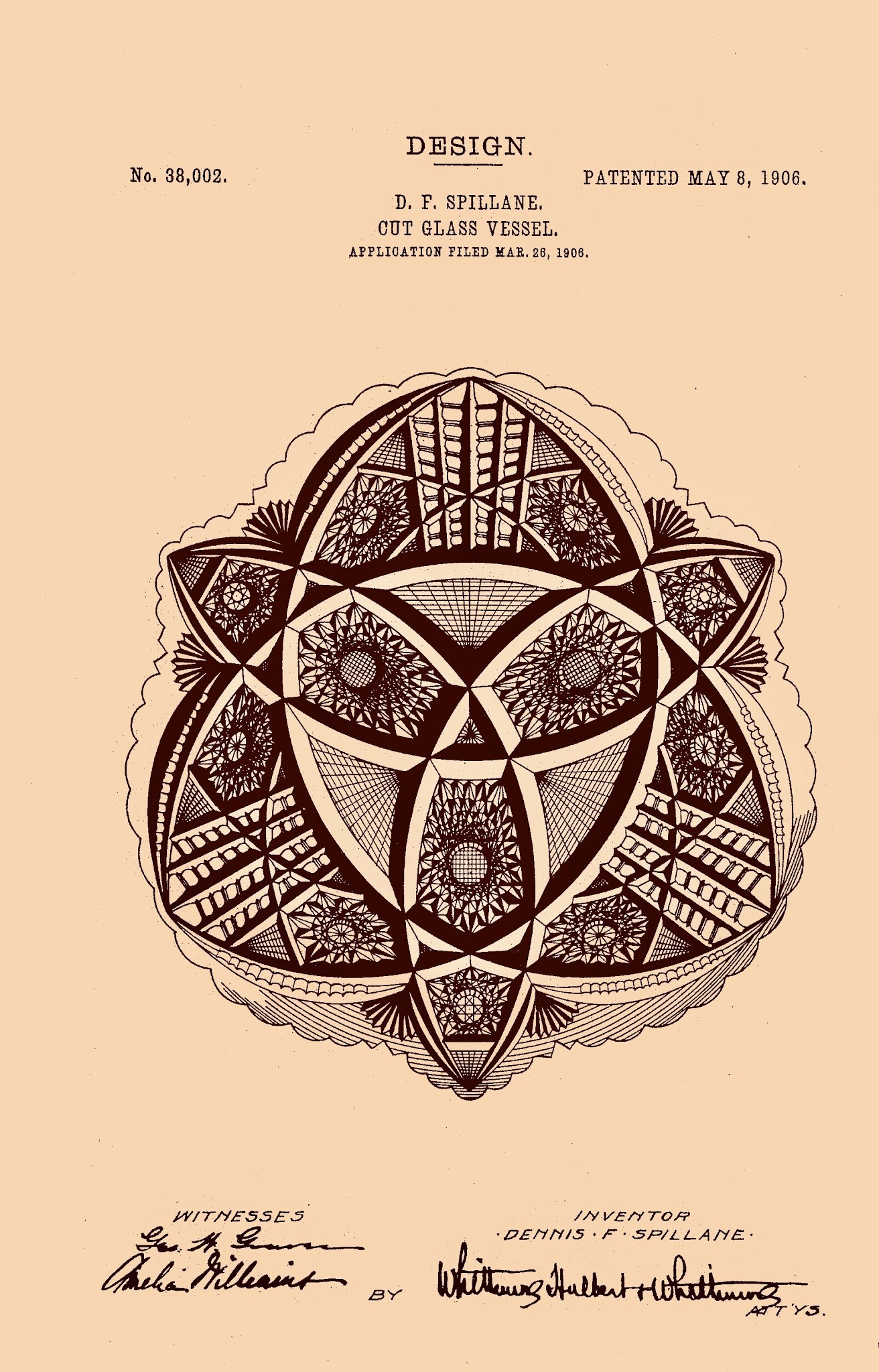
Craftsmanship and innovative, artistic design flourished in England, Europe and the United States, between the 1860’s and early 1900’s. These patents for glassware designs are all from the period. — “Very pretty pieces of glass are now in the leading stores for ‘odd’ pieces on a dinner table. They are in Sèvres glass, amber or blue in color, and are enameled and raised designs or gilt in relief. The shapes are specially novel and attractive.”


Tabletop Novelties and Trends


The newest ice cream plates are of Bohemian glass with little handles. The shape is something between an oval and a square. Others are in china, cream-colored ground, with guilt edges, and shaped like a full size grape leaf.

Very pretty pieces of glass are now in the leading stores for “odd” pieces on a dinner table. They are in Sèvres glass, amber or blue in color, and are enameled and raised designs or gilt in relief. The shapes are specially novel and attractive.

In spite of the attempt to introduce color into the table-cloth, preference in the highest circles is still given to fine white damask, but occasionally the cloths are trimmed with lace edging.

Exquisite dessert plates are in the richest Dresden china, with deep-toned centers and open-worked edges. The designs are so beautiful, that doylies are not used with them.


Single vases for each guest are no longer so popular as they were for dinner tables. The more fashionable style to-day is a central globe either of deeply cut crystal or a Bohemian glass, which rests upon a polished mirror. Some of these globes are mounted upon deep Crystal trays, thus providing a second receptacle for the flowers. Four corner pieces are sold with the globes, either for a continuous design around the center or for the ends of the table.

Some very fashionable people dispense with flowers at the dinner table entirely. In fact, they are all together lesson favor for the festive occasions then they were, probably because they are so much in request at interments. — The New York Times, 1882


Etiquette Enthusiast, Maura J. Graber, is the Site Editor for the Etiquipedia© Etiquette Encyclopedia


Tuesday, February 9, 2021

Gilded Age Guide for Wine Glasses

Above would be a glass for sherry — “A red glass is suitable for white wines; green for various kinds of Rhine wine, while white of small size signifies sherry.”


Glasses for wines should indicate, by shape or color, the kind for which they are intended. Thus, a red glass is suitable for white wines; green for various kinds of Rhine wine, while white of small size signifies sherry. Claret glasses are larger than port glasses, while those for champagne are thin in the stem and of wide brim.


Beautiful little baskets are now in fashion as liqueur stands. Each contains four bottles, while around the edges of the basket are 12 little hooks from which depend small square shaped glasses. Usually bottles and stoppers are of different colors, while the little glasses correspond by having handles unlike the body of the glass.


Brandy and bitters are served in fashionable quarters upon a little tray of exquisite Bohemian glass. The set consists of large and small bottles, sugar bowl, and two or three tumblers. — New York Times, October 1882


Etiquette Enthusiast, Maura J Graber, is the Site Editor for the Etiquipedia© Etiquette Encyclopedia


Saturday, June 6, 2020

Laying a Correct Gilded Age Table

Next are laid plates large enough to hold the oyster or soup plate which is to contain the first course, and on it, or sometimes beside it, is arranged the napkin... with the dinner roll inserted. 


How to Lay the Table Correctly for Formal Dinner

No matter how many the guests, the proper arrangement for the table for the formal dinner is unchanged. The bare table is always covered with a thickness of cotton flannel —of the sort that comes double width for about 80 cents a yard—before the cloth is laid. This is partly to protect the polished surface of the table from contact with hot dishes, but chiefly to deaden the clatter of china and sliver. The damask cloth, which is always in the best taste for dinner, 
should have been ironed with a distinct crease down the middle, as a guide in the mathematical arrangement of the places. 

Next are laid plates large enough to hold the oyster or soup plate which is to contain the first course, and on it, or sometimes beside it, is arranged the napkin. This should have been ironed so as to fold over in three rather than four thicknesses, and it should be folded first so that the upper edge is broken at the midline and brought down the crease on either side of the mid-crease. The two protruding ends of the linen are now folded back on themselves so as to leave nearly a right-angled triangle of the napkin. This arrangement is finally turned over so that the foiled ends are underneath, and the dinner roll inserted. 

The two glasses, one for plain water and a more slender one for mineral water, are placed side by side in front of the plate. Care should always be taken that every glass on the table is the same distance from the accompanying plate. The individual salt and pepper shakers are not placed on a line with our two temperance glasses, but a little to the right of the plate. When there are no individual shakers, the salt may be placed midway between every two places, but still on a line with the goblets. It is customary nowadays to lay the table with silverware with every course up to the dessert. The dessert spoon or fork is brought in on the finger bowl and the coffee spoon with the coffee. Table spoons, soup spoons and the carving utensils for the host are likewise brought on with the course for which they are intended. 

The forks, all but the oyster fork, are, of course, arranged on the left side of the plate, and the knives, soup spoon and oyster fork on the right. The oyster fork is placed farthest from the plate, the soup spoon next, then knives for butter and roast respectively—this presupposes a dinner of six courses—and continuing down the line, the fork nearest the plate is for the roast, the next one for the fish, and the third for the salad. This arrangement holds for the meal in which the host does his own carving. But where one wishes the plate be served from the butler's pantry, the carving utensils and the dinner plates are naturally in that place. 

As the plates are removed they should be sent to the kitchen immediately and fresh plates instantly substituted. Even where the roast is carved on the table, it is customary to serve the soup from the pantry. If there are no oysters to precede it, places may be served just an instant before dinner is announced. No one needs to be reminded of the old formula, “Pass to the left; remove from the right.” When the entrees and salads are passed as a final word the servant holds the dish on a folded napkin on the flat of his hand, with a large tablespoon and a fork lying across the dish. Some discretion must be used in passing to see that the dish is held low enough for the guest to help himself easily.—Buffalo Evening Times, 1909


🍽Etiquette Enthusiast, Maura J Graber, is the Site Editor for the Etiquipedia© Etiquette Encyclopedia

Sunday, October 21, 2012

Setting the Gilded Age Table

Dinner Service of 1892, the Table-Linen, Etc... 
Table-cloths of white damask, double or single, as fine as the owner’s purse admits, are used for the dinner-table, with large square white napkins to correspond.

Napkin rings are discarded by many who hold that a napkin should be used but once, and must be re-laundried before reappearing on the table. 
The table should first be covered with a mat of double-faced cotton flannel wide enough to fall six inches below the edge of the table, all around. This under mat greatly improves the appearance of the table-cloth, which can be laid much more smoothly over this soft foundation. Besides, the mat protects the table from too close contact with hot dishes. Small table mats for the purpose of protecting the cloth are not fashionable at present, though many careful housekeepers retain them rather than risk injury to fine table linen.

Carving-cloths are used when carving is done at the table, but are not needed when dinner is served à la Russe. Napkin rings are discarded by many who hold that a napkin should be used but once, and must be re-laundried before reappearing on the table. Practically, such a fastidious use of table linen would exhaust most linen supplies, and overcrowd the laundry. The neat use of a napkin renders this extreme nicety superfluous as a rule of home dining.

Care should certainly be taken to remove all soiled table linen. Nothing is more disgusting than a dirty napkin, but the snowy linen that comes spotless through one using may, with propriety, be retained in the ring to be used several times. This, of course, refers to every-day dining at home. On formal occasions no napkin rings appear on the table; the napkins are always fresh, and used for that time only. At the close of the dinner they are left carelessly on the table; not rolled or folded in any orderly shape.

Small fringed napkins of different colors are used with a dessert of fruits. Fancy doylies of fine linen embroidered with silk are sometimes brought in with the finger-bowls; but these are not for utility, the dinner napkin doing service, while the embroidered “fancy” adds a dainty bit of effect to the table decoration.


China, Glassware, Cutlery, Silverware, etc... 
Chinaware for the dinner service should be of good quality. Fashions in china decoration are not fixed; the fancy of the hour is constantly changing, but a matched set is eminently proper for the dinner table, leaving the "harlequin" china for luncheons and teas. In the latter style the aim is to have no two pieces alike in decoration, or at least, to permit an unlimited variety; a fashion that is very convenient when large quantities of dishes are liable to be needed. But for a dinner served in orderly sequence, the orderly correspondence of a handsome "set" seems more in keeping. But even with this, the harlequin idea may come in with the dessert; fruit plates, ice-cream sets, after-dinner coffees, etc., may display any number of fantasies in shape and coloring.

Artistic glassware is a very handsome feature of table furnishing. Carafes and goblets for water are always needed at dinner; wine glasses, possibly; and the serving of fruits and bon-bons gives opportunity to display the most brilliant cut-glass, or its comparatively inexpensive substitutes, which are scarcely less pretty in effect. Fine glass is infinitely more elegant than common plated-ware, and though more liable to breakage is less trouble to keep in order.


Rare, individual "Bird Knife and Fork" in the Chantilly pattern sterling handles, with steel blade and tines.


The best dinner-knife is of steel, of good quality, with handle of ivory, ebony, or silver. Silver-plated knives are much used; they do not discolor so readily as steel, and are easily kept polished. They answer the purpose for luncheon, but they rarely have edge enough to be really serviceable at dinner or breakfast. Many people who own solid silverware store it away in bank vaults and use its facsimile in quadruple plate, and thus escape the constant dread of a possible burglar. For the sense of security that it gives, one may value the finest quality of plated ware, but it should be inconspicuous in style and not too profuse in quantity, since its utility, rather than its commercial value, should be suggested. 

Any ostentation in the use of plated ware is vulgar. But one may take a pride and satisfaction in the possession of solid silver. Every ambitious housekeeper will devise ways of securing, little by little, if not all at once, a neat collection of solid spoons and forks. The simplest table takes on dignity when graced with these "sterling" accompaniments.

The fancy for collecting “souvenir” spoons, one at a time, suggests a way to secure a valuable lot of spoons without feeling the burden of the expense. Yet, on the other hand, these spoons are much more expensive than equally good plain silver, the extra price being paid for the “idea;” but the expenditure is worth while to those who value historical associations. One may find in the silver-basket salient reminders of all important epochs in our national life, a sort of primer of United States history, to say nothing of the innumerable “souvenirs” of Europe. Its subtle testimony to the intelligent taste of its owner gives the souvenir collection its chief “touch of elegance.”

The towering “castor,” once the central glory of the dinner table, is out of style. The condiments are left on the sideboard and handed from there in case any dish requires them, the supposition being that, as a rule, the several dishes are properly seasoned before they are served. Individual salt-cellars are placed on the table, and may be accompanied with salt spoons; if these are omitted, it is understood that the salt-cellar is emptied and refilled each time that it is used. 

On the family dinner-table the condiment line is not so severely drawn; vinegar in cut-glass cruets, mustard in Satsuma pots, and individual “peppers” in silver, china, or glass, and of quaint designs--are convenient and allowable. A table covered with white damask, overlaid with sparkling china and cut-glass, and reflecting the white light of polished silver, is a pretty but lifeless sight. Add one magic touch--the centre-piece of flowers--and the crystallized beauty wakes to organic life.

In arranging the modern dinner-table, when the service is to be à la Russe, floral decorations are almost indispensable. Without something attractive for the eye to rest upon, the desert stretch of linen looks like the white ghost of famine mocking the feast.


For a square or extra wide table a large centre-piece, either round or oblong, is usually chosen, with endless varieties in its component arrangement 

The shape of the table, the available space, and the nature of the occasion decide the quantity and distribution of the flowers. It is a matter in which wide latitude is given to individual taste and ingenuity, original designs and odd conceits being always in order, subject only to the law of appropriateness. For a square or extra wide table a large centre-piece, either round or oblong, is usually chosen, with endless varieties in its component arrangement. It may be low and flat, like a floral mat, in the middle of the table, or it may be a lofty epergne, or an inter-lacing of delicate vine-wreathed arches, or a single basket of feathery maidenhair fern--in fact, anything that is pretty and which the inspiration of the moment may suggest. In early autumn, in country homes or in suburban villas, nothing is more effective than masses of golden-rod and purple asters, gathered by the hostess or her guests during their afternoon drive, and all the more satisfactory because of the pleasure taken in their impromptu arrangement. Wild flowers should be neatly trimmed and symmetrically grouped to avoid a ragged or weedy appearance.

Fortunately, even quite elaborate floral decorations need not be expensive. Nature has bestowed some of her choicest touches upon the lilies of the field, and an artistic eye discerns their possibilities. At the same time, art in floriculture has produced marvels, and those who can afford it may revel in mammoth roses and rare orchids, lilies of the valley in November, and red clovers in January, if it please them to pay the florist's bill for the same. For narrow "extension" tables, slender vases ranged at intervals may be the most convenient disposition of the flowers; or, if the ends of the table are not occupied, a broad, low basket may stand at each end, with a tall, slender vase in the middle of the table.

On choice occasions a handsome centre-piece may be, for example, a large bowl of La France roses, with small bundles of the same (groups of three are pretty), tied with ribbon of the same hue, laid by each plate. Any other single flower may be disposed similarly, or variety may rule, and no two floral "favors" be alike, in which case it is a delicate compliment to give to each guest a flower known to be a favorite, or one that seems especially appropriate--a lily to Lilian, a daisy to Marguerite, etc.

These little marks of thoughtfulness never fail to be appreciated, and add much to the grace of entertaining. An elaborate centre-piece may stand upon a rich velvet mat, or on a flat mirror provided for the purpose. The latter is a clever idea for a centre-piece of pond-lilies or other aquatic plants, simulating a miniature lake, its edges fringed with moss or ferns.

The Formal Arrangements at the Dinner Table 
The mat is first adjusted upon the table, and the table-cloth smoothly and evenly laid over it. The cloth should fall about half-way to the floor all around.

The floral accessories are then put in place; and also the fruits and bon-bons, which may be commingled with the flowers in working out a decorative design, or they may be placed, in ornamental dishes, at the four corners of a wide table, to balance the flowers in the centre; or, they may be arranged along the middle of a long table. For fruit, silver-gilt baskets, or epergnes of glass are especially pretty. The fruit may later constitute a part of the dessert, or may be merely ornamental in its office. Carafes containing iced water are placed here and there on the table, at convenient points.

The next step is the laying of the covers; a cover signifying the place prepared for one person. For a dinner in courses a cover consists of a small plate (on which to set the oyster plate), two large knives, three large forks (for the roast, the game, and entrées), one small knife and fork (for the fish), one tablespoon (for the soup), one oyster-fork. The knives and forks are laid at the right and left of the plate, the oyster-fork and the spoon being conveniently to hand.

A glass goblet for water is set at the right, about eight inches from the edge of the table; if wine is to be served the requisite glasses are grouped about the water goblet. The napkin is folded square, with one fold turned back to inclose a thick piece of bread; or, the napkin may be folded into a triangle that will stand upright, holding the bread within its folds. This is the only way in which bread is put on the dinner-table, though a plate of bread is on the sideboard to be handed to those who require a second piece. It is entirely proper to ask for it, when desired.

Butter is not usually placed on the dinner-table, but is handed from the sideboard if the menu includes dishes that require it; as, sweet corn, sweet potatoes, etc. Small butter-plates are included in the "cover" in such cases. The oysters, which form the initial course, are usually on the table before the guests take their places. A majolica plate, containing four or six of the bivalves with a bit of lemon in the midst, is placed at each cover; or, oyster cocktails may be served. The soup tureen and plates are brought in to the side table. All is now in readiness.


🍽️Etiquette Enthusiast, Maura J Graber of The RSVP Institute of Etiquette, is the Site Editor for the Etiquipedia© Etiquette Encyclopedia