Showing posts with label Gilded Age Servants and Civility. Show all posts

Wednesday, June 25, 2025

Gilded Age Domestic Titles


Well-bred persons simply say, the ‘nurse,’ the ‘cook,’ the ‘chamber-maid,’ etc... and what is still better, they designate their domestics by their Christian names.

Of Propriety of Conduct in Relation to Domestic Duties

It is only among the badly educated people of the small towns that they say, the ‘maid,’ the ‘boy,’ the ‘domestic,’ the ‘servant;’ and among the proud, ill-bred fashionables, who ape grandeur; the ‘lackey,’ the ‘valet,’ ‘my people;’ well-bred persons simply say, the ‘nurse,’ the ‘cook,’ the ‘chamber-maid,’ etc... and what is still better, they designate their domestics by their Christian names. — By Elisabeth Celnart, in The Gentleman and Lady's Book of Politeness and Propriety of Deportment, 1883 

🍽️Etiquette Enthusiast, Maura J. Graber, is the Site Editor for the Etiquipedia© Etiquette Encyclopedia

Wednesday, July 21, 2021

Etiquette and English Maids in America

The English maid’s cap has ceased to be sine qua non of the English maid which it is regarded on this side of the water.
 
– Photo Source Pinterest

The maid’s cap has got into the English courts. A servant sued her employer for wages after dismissal, because she would not wear caps. They learned Q.C. admitted that the subject was a very delicate one, and seemed to be ever a cause of complaint between mistresses and maids. It was finally decided that the refusal to wear caps per se was not sufficient ground to discharge a servant out of time. The particular case in question took on some other phases, but this part of the decision implies, by inference, that the cap has ceased to be sine qua non of the English maid which it is regarded on this side of the water.

It is certain, as many housekeepers will testify, that the English maid, supposedly admirably trained and accustomed to service, gives more trouble on American soil than servants of other nationalities. She exaggerates the freedom of America, and takes not only liberty but license without restraint. Such of them as serve in the houses of our very rich countrymen are not open to this criticism; they are clever enough to show a deference to the wealth about them, if they do not feel it, but those English maids that drift into the average American household are, for the most part, intolerable in speech and manner. —The New York Times, 1895


Etiquette Enthusiast, Maura J. Graber, is the Site Editor for the Etiquipedia© Etiquette Encyclopedia

Thursday, June 25, 2020

Etiquette Regarding Servants

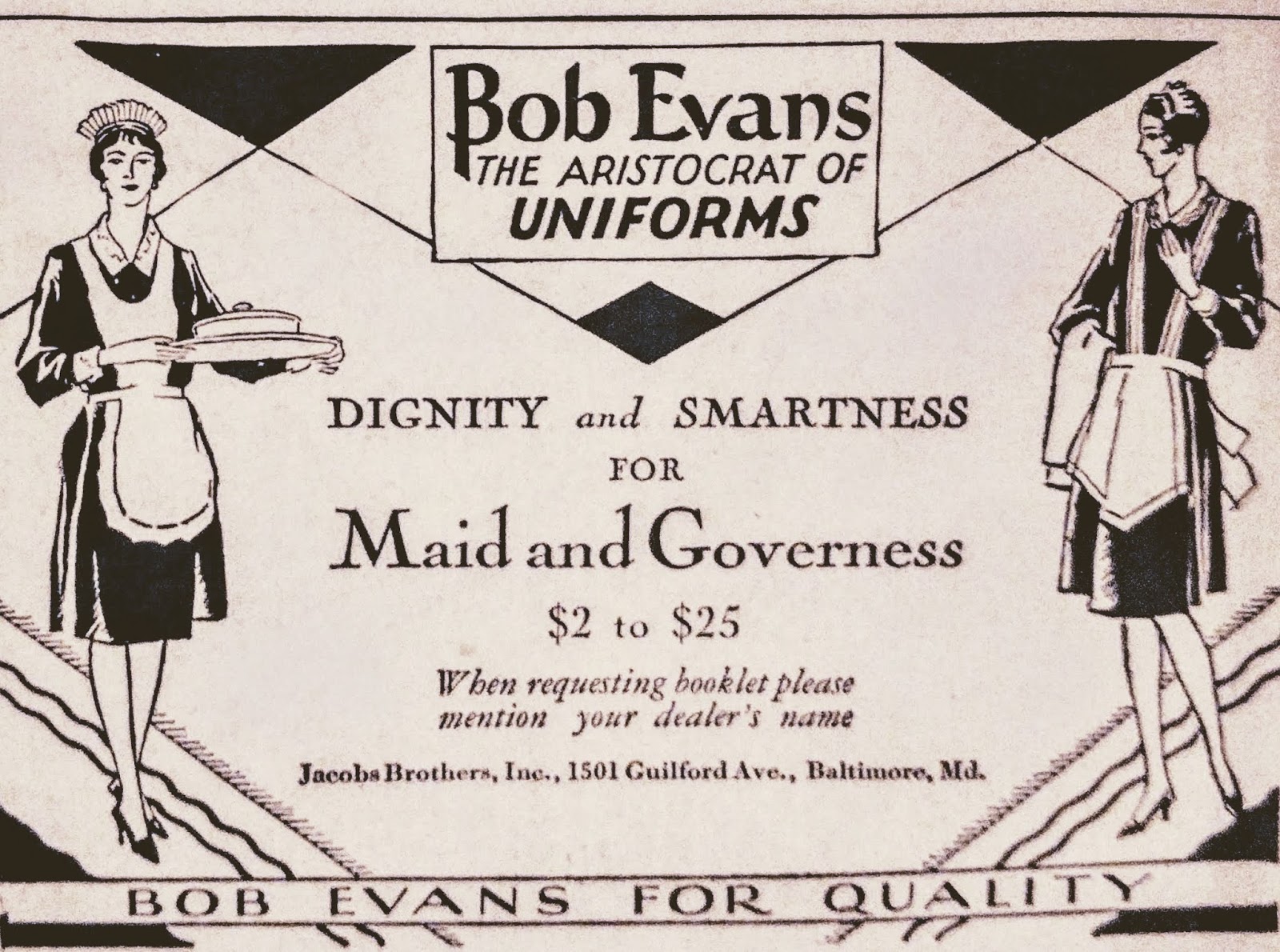
An early 19th century magazine advertisement for American maids’ outfits. —“A Housekeeper, a Lady’s Maid and a Head Nurse belong to the hierarchy of a household. A Lady’s Maid wears no cap and when in attendance on her Lady, is expected to be well, but quietly dressed, in black or some sober coloring. Her wages are from $150 to $200 a year, with the reversion of her employer’s wardrobe.” 

Servants in England 
There Are Fixed Forms of  Etiquette Governing Their Treatment

While mistresses and housemaids in this country are struggling to solve the vexed “servant problem” they do not appear to take into consideration the fixed forms of etiquette governing the treatment of servants in England, which probably do much toward promoting mutual understanding between the servants and the served over there. 

A Housekeeper, a Lady’s Maid and a Head Nurse belong to the hierarchy of a household. A Lady’s Maid wears no cap and when in attendance on her Lady, is expected to be well, but quietly dressed, in black or some sober coloring. Her wages are from $150 to $200 a year, with the reversion of her employer’s wardrobe. 

An English maid is always called by surname, “Smith” or “Jones,” but a foreign maid’s first name is used, “Marie” or “Françoise.” A Lady speaking of her maid to other upper servants, such as the Butler or the Housekeeper, would style her “Smith” or “Marie,” but when mentioning her to Housemaids or Footmen, she would he careful to allude to her as “Miss Smith” or “Mlle. Marie.”- New York American, 1905


Etiquette Enthusiast, Maura J. Graber, is the Site Editor for the Etiquipedia© Etiquette Encyclopedia


Tuesday, June 18, 2019

Treating Servants Fairly

Not all servants in the early 20th century were as well-treated or content as those characters which were depicted in television’s “Downton Abbey.” Some common courtesy and thoughtfulness of treatment by the employers would have gone a long way in the lives of those who lived in servitude.

Thoughtlessness on Part of Some Employers

There is a thoughtless group of people who ignore servants as though they might be articles of furniture instead of live things, who can feel and see and suffer mental, as well as physical, pain. This is a social class who suffer thoughtlessly inflicted pain and humiliation, with the general attitude of those who inflict it being that their feelings don’t count —if they have any. 


“I am writing of the servant class, the Bridgets and the Mary Anns. You notice I write the Ann without a final “e" the little finish which sets a gulf between the socially important and their less fortunate sisters. The particular Bridget who wrote what follows is an educated foreign woman whose education is plainly evident in her handwriting and her thinking. How would you like to be such a woman and earn your living working for some of the people whom she describes? 
‘For my class it’s take it on the chin, grin or beat it and no job. To be sure I’m British. I served in one home eight years which seems to prove that I was treated humanely. I remember the lovely room I had and often compared it with the Bridget’s quarters given me, to a long succession of dumps I’ve occupied here. I thought of it recently as I retired in my servant’s room better described as a pig sty.’ 
Walls of Room Dirty...
‘It was small, dark and had dirty walls which could be cleaned up for the cost of about $4. But when approached on the subject my mistress said ‘no.’ She considered herself a socialite but some of her neighbors called her ‘alley cat.’ And I guess she earned that. 
One former employer still owes me for two years back wages. I took it to the small claims court but find all you get there is a judgment. The court makes no effort to enforce its findings. So it’s up to me to do my own collecting. 
At another place of squatting I found the parents two drunks. The trimmings were all attached, and there was street fighting with the officers at 3 a. m. ‘Papa’ met me in the hall as he was coming in and he was wearing his real birthday suit so I packed and moved. Many maids I know have wonderful references but stay in a place only a little while.’ 
Considers Folks Funny...
‘Do you blame them? I am middle-aged and homeless but an experienced needle-woman—and so, although I hate it—l’m on relief.  And my former employers are among those who complain against the luxury I am supposed to enjoy. I should, have been content with a Bridget’s lot.  Ain’t’ folks funny?’

 Funny? No. It’s more like “thoughtless and careless.” – From an article by Estelle Lawton Lindsey, 1936


Etiquette Enthusiast, Maura J Graber, is the Site Editor for the Etiquipedia© Etiquette Encyclopedia 

Saturday, April 1, 2017

Etiquette and Swell Servants

 There is no doubt that the English nobility, have a way of employing servants which offers grand opportunities to rogues. 

The Swell Servants in England

''Although all hopes of recovering the jewels of Lady Dudley has vanished—their real value was £30,000 there is still a good deal of speculation about their disappearance, and a pretty general belief that some of His Lordship's servants must have been at least an accomplice in the transaction. It is difficult to believe that a box of such value entrusted to the care of servants could have disappeared in a railway station from unwilling hands, or that an outside thief could have known so much about the movements of the family as to have been on the spot at the precise moment. However this may be, there is no doubt that the English nobility, have a way of employing servants which offers grand opportunities to rogues.

In most cases the outside of the servants is the chief thing. If the coachman or footman is good-looking in his livery and of the required dimensions, his character is not inquired into. A well known Duke recently advertised for a footman of exactly five feet eleven and a half inches, whose sole business it would be to stand at the back of his coach beside another of like station. A youth, now in the employ of a lady of my acquaintance, applied for the advertised position, and says that his character was not asked for— he was taken into the servants' hall , and measured, and dismissed for lacking the half inch demanded by the Duke.

There is a passion tor tallness in servants, and of one noble family, at least, it is a rule to admit no man servant under six feet. There are six of these eminent personages in their fine mansions. The English servants are good-looking, neat and constitutional flunkeys and flunkeyesses. They are very shrewd, and have their class rules as well defined as any trade union. Downing street does not possess more pigeon-holes and red tape than a mansion of the wealthy. 

An upper house-maid would die at the stake before she would do a bit of work that came within the province of the under house-maid. A swell butler would throw up his position in the face of the Lord Chancellor himself if he were expected to black his own boots. There are many boys of thirteen kept in brass buttons, and in many an instance the sole duty of this boy is to brush the clothes and boots of the butler, the master of the house having his own separate valet.

Of course, it is not pride which has made the inflexible laws of etiquette among these servants, which they refuse to step out of an official groove or function. It is the determination of their class to preserve the conventional number of the servants required for any first-class household. They particularly dislike servants from other countries, especially the Germans, because if well paid, and well treated, they will do anything requested of them."— London Correspondent of the Cincinnati Commercial, 1875


Etiquette Enthusiast, Maura J Graber, is the Site Editor for the Etiquipedia© Etiquette Encyclopedia

Sunday, June 19, 2016

An Upstairs-Downstairs Etiquette Snafu

Not all cooks were keen to teach their skills to any of those living “upstairs” —When a servant is engaged, he enters the house for the first time through the front door. After that he regards the back door as his sole means of entrance and exit.
Mistress Fined for Invading Her Own Kitchen! 

LONDON, July 17.—There is no etiquette so strict as that which dominates London life “below stairs.” With all the upheavals of the world war, the dignity of cooks and butlers remains unassailed. 

A case was recently heard in the court wherein a cook took offense because the mistress invaded the kitchen and insisted on cooking some mutton chops herself. The insulted culinary queen immediately gave notice, and in this she was joined by her husband, the butler. Whereupon the mistress locked the back door and thus got herself sued for “wrongful imprisonment.” 

During the hearing of the case the judged asked why, if the mistress had only locked the back door, did not the couple go out by the front. The cook and butler nearly collapsed at the suggestion. “That,” said the butler, painfully surprised at the judge’s ignorance, “is against all kitchen etiquette. When a servant is engaged, he enters the house for the first time through the front door. After that he regards the back door as his sole means of entrance and exit. No self-respecting servant would dream of leaving his employer’s house by the front door!”

On inquiry, it was found that the etiquette ruling such matters was a very real thing to the circle of overlords and underlings of the kitchen, and the aggrieved pair were allowed £5 damages. — Los Angeles Herald, 1920

Etiquette Enthusiast, Maura J Graber, is the Site Editor for the Etiquipedia© Etiquette Encyclopedia

Saturday, May 7, 2016

Etiquette and One's Servants

Nell Ashley, Writing from a Reform School, Tells What Maids Endure from Sons and Husbands of the Fashionable Women Who Employ Them

What Shall Be Done to the House Sheik?

No one seems able to tell us why is it that a girl who goes into domestic service is looked down upon by folks inside and outside the home, while the girl who takes a business position if regarded with respect. While homemakers are theorizing about the scarcity of help, Nell Ashley, a high-school girl who became a personal maid in a rich home in order to save enough money to take a business course, comes right out with the facts. 


The true story of her experiences, published in February Smart Set reveals that there is need of a course in etiquette to teach men members of wealthy households, that the maids employed by their wives and mothers, are not there to satisfy their flirtatious desires. Here are interesting extracts from this disillusioned girl’s expose: 

“My mother, who had been a chorus girl, died when I was five years old. My Aunt Millie adopted me. She, herself, was a domestic servant. I graduated from High School when I was sixteen. That summer my aunt got me a position as chambermaid in the palatial country home of a New York millionaire. 

“It was hard work. My mistress was one of those women who are always having trouble with her servants, and in addition to my own duties, I often had to act as personal maid, parlor maid and kitchen girl. But I didn’t mind hard work, I was buoyed up by the prospect of entering business school in the fall.

“Toward the end of my vacation, the oldest son arrived. He was a student at Yale. He was nothing to write home about; a jolly, good-natured boy, full of the devil. He liked to tease me because I blushed so easy and I tried to keep out of his way as much as possible. 

“One morning as I was making his bed, he returned unexpectedly to get something. Suddenly he seized me in his arms and said jokingly, ‘Come on now, let me see you blush. Goldilocks!

Just at that moment his mother appeared in the doorway. ‘What does this mean?’ she demanded angrily. ‘You disgraceful creature! Pack your trunk and leave this house immediately.’ Bewildered, dazed, overcome with embarrassment, I stood motionless. ‘Have you no shame?’ She hissed the words, venomously like an angry snake, or a vicious cat. The young man protested halfheartedly. It wasn’t her fault, Mother—really —

And it wasn’t. It was just as I have told you. But I have never been ready with a quick answer. I am stupid like that. And her sudden attack made me dumb. My tongue was paralyzed with fear. What do you mean, lying here when I tell you to get out?' she screamed. The charming, perfectly poised society leader was a raging cat. Her friends wouldn’t have known her. 

You ungrateful baggage! Wait until I tell your aunt about this. I will see that she commits you to an institution! “While I was packing, tears blinding my eyes, I heard a piece of paper being shoved under the door. It was a note from Mr. Harry, folded around a fifty dollar bill. Sorry, Goldilocks, I can’t make mother listen to reason. it read. In case you have nowhere to go, you can probably find a room at West 50th Street. Ask for Miss Brandon. She’s a friend of mine. Be sure and let me know your address anyhow.

“I didn't hesitate to take that fifty dollars—my wages were being paid to my aunt, and I didn't have a cent of my own. Had I had time to think the matter over, I might have acted differently. As it was, I was terrified at the prospect of being sent to a ‘home.’ I took a train for New York.’ 

Miss Ashley proceeds to relate how her victimization sent her to a reform school, when she was prepared for domestic service, which led to a fresh round of humiliation. — Madera Tribune, 1925


Etiquette Enthusiast, Maura J Graber, is the Site Editor for the Etiquipedia© Etiquette Encyclopedia

Friday, October 30, 2015

Etiquette and Treatment of Servants

Policy, as well as good breeding, inculcates the necessity of gentle treatment and courteous behavior to servants... though your parents may not want you to marry one of them.
There is no surer sign of ill breeding and ill feeling than the rude treatment of dependents. The obligation of civility to servants should be inculcated especially upon the young American, who ought to learn at the earliest period that the accidental relation of advantage of position, which is ever alternating in a country free from prescriptive right, gives no title to a haughty demeanor and a domineering conduct.

The recognition of the mutual obligation of master and man, and mistress and maid, is a certain sign of the true gentleman and lady, who will never exact from those temporarily placed in subjection to them the civility they are unwilling to bestow. The “thank you,” “please,” and other courteous expressions of a kindly consideration of the obligation of the employer to the employed, will be freely proffered by all who are fully conscious of their social duties and willing to acknowledge them.

Policy, as well as good breeding, inculcates the necessity of gentle treatment and courteous behavior to servants, who will seldom fail to respond with a more zealous service and a readier obedience to exactions and commands rendered less harsh and domineering by a soft word and a subdued mastery. 
–From How to Behave and How to Amuse, by G. H. Sandison, 1895

Etiquette Enthusiast, Maura J. Graber is the Site Moderator and Editor for Etiquipedia© Etiquette Encyclopedia