Showing posts with label Lady Constance Eleanora C. Howard. Show all posts

Monday, October 12, 2020

Social Dilemma Solved by Sardines


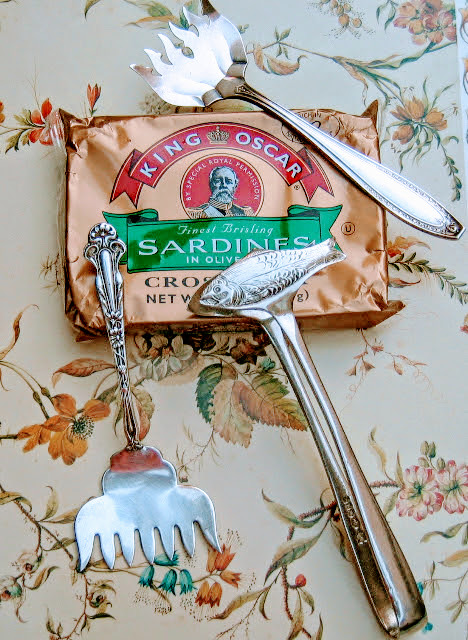
Antique silver sardine servers — Knives are really only used with any dish that requires to be cut, such as cutlets, oxtail, filets de boeuf, grenadines of veal, hashed venison or beef, for these and similar dishes, a knife is a requisite. Sweetbreads are never eaten with a knife, for if they are properly cooked, they are so tender that a knife is quite wrong and out of place. Any mince with poached eggs, or puree of meat, game, or poultry, is also eaten with a fork only. It is usual to eat salads with both knife and fork, mayonnaise also. Omelettes, both savoury and sweet, are eaten with the fork alone; toasted cheese or Welsh rarebit with both knife and fork, which would also be used for most savouries, such as “sardines on toast,” “bloaters,” Anchovy toast, with poached eggs, all kinds of  ‘devils,’ ‘ham toast.’ Forks only would be used in eating ‘macaroni au gratin,’ ‘soufflés,’ whether savoury or cheese, ‘scalloped oysters,’ ‘tartlettes,’ whether savoury or sweet, creams, jellies, iced puddings, blancmanges, indeed all kinds of sweets of sufficient consistency to admit of it. — Lady Constance Eleanora C. Howard

SOCIAL DILEMMA 

Unexpected guests for an evening will often tax your ingenuity for a suitable luncheon. You can solve this social dilemma by having on hand always Booth’s Crescent Brand Sardines. One tin will make a splendid luncheon for four, and a more delicious, tid-bit was never tasted by anyone, than these savory little fish from the Bay of Monterey. They are larger than ordinary sardines and better, so much better that you will wonder why they are called sardines. 

Try a can and you’ll buy a case, for you’ll never want to be without them. 20 cents a tin at grocers everywhere. One tin is enough for a luncheon for four. Put up by Monterey Packing Company, Monterey, California. F. K. Booth, Sole Agent, San Francisco. Booklet of recipes for serving Crescent Brand Sardines mailed free if you send the name of your grocer. — Stockton Independent, 1910

Antique porcelain sardine box with antique silver set of sardine knife and fork, sardine lifters and sardine tongs — “Early tinned and canned items were too expensive for those in the lower, and even middle-class income brackets, at the time. Sardines were one imported tinned food that the wealthy could afford to serve, so sardine servers, dishes and tongs, were offered in abundance at the time. Tinned sardines and other such foods, suddenly offered an elegant way to not only outdo one’s neighbors, but another way illuminate one’s home.” — Maura Graber in “Reaching for the Right Fork”


Etiquette Enthusiast, Maura Graber, is the Site Editor for the Etiquipedia© Etiquette Encyclopedia

Monday, May 4, 2020

Country House Banquet Etiquette

Serving pieces from French flatware catalog for ‘Service À la Russe’ — “‘À la Russe’ is the proper manner to serve large and formal luncheons; in more intimate gatherings the dishes are placed upon the table, the host and hostess carving and helping the principal dishes. Both ways are good. The simplest way is to place the joints upon the ‘buffet’ or side-table, while the entries, soup, game, fish, poultry, vegetables, sweets and fruit occupy the table. Serviettes are ‘de rigueur;’ no hostess should, even from economy or any other reason, ever deny her guests these absolute necessities... Fish knives and forks would be unnecessary, and a ‘mayonnaise’ or entree of fish would be eaten with the usual large dinner fork. Small knives are used for butter and cheese, which, with toast and biscuits and small salad, should be offered to the guests at the end of the repast.” — photo source, Etiquipedia library

Banquet is the more correct term when it is a question of public luncheons, given for instance at the opening of a bridge, laying the foundation stone of a church, opening an hospital, or any semi-official occasion; to these, formal invitations would be issued, and perhaps a month’s notice would be given.

The invitations would be as follows:—

The Mayor and Corporation of  _________,
request the honour of
Mr and Mrs G. Brown’s
Company at a Banquet at the Town Hall at D.,
on the 4th of May, at 2 o'clock,
to celebrate the Opening of D. Bridge.
R. S. V. P.

Etiquette would be strictly observed on such an occasion, as to precedence, and an immediate answer would be sent by those invited of acceptance or the contrary.

At lawn tennis, archery and croquet parties, large luncheons are usually given, which fact should be mentioned on the card of invitation.

In London, in houses where ‘carte blanche’ to come and go is not the order of the day, a week’s verbal or written invitation is generally considered long enough.

Luncheon is a form of hospitality that commends itself much to the minds of most hostesses, as at very little expense, and still less trouble (as a rule), it enables them to receive and show hospitality to a large number of friends and acquaintances, to whom they might otherwise find it impossible to show civility.

It is a meal to which elderly ladies, ‘country cousins’ coming to town for a few days’ shopping, single ladies, and very young ones can be invited; and when a fair proportion of gentlemen are present, so much the better. People can be asked to lunch that for hundreds of reasons it might be impossible, inconvenient, or undesirable, to invite to dinner.

Where a hostess gives ‘carte blanche’ to her friends to come to luncheon whenever they please without any further invitation, gentlemen, as a rule, are more disposed to accept the hospitality than ladies, the former being more diffident of accepting this informal kind of invitation.

At a formal luncheon, where the guests are asked by an invitation card or letter, the hostess would ask equal numbers of ladies and gentlemen, as it would be of material importance that such should be the case, for ladies are generally in the majority when the invitation is a permanent one, and, therefore, gentlemen when invited in the same way should make a point of going without standing upon ceremony. No hostess but what welcomes the advent of a gentleman at lunch, whether she knows he is coming or not, as they are acquisitions then, and would be ready to see that the ladies have what good things they wish. They can take any vacant place; no particular politeness is necessary with them.

When a lady arrives the hostess must show her a certain amount of attention; she must indicate a seat to her at the table, and tell one of the gentlemen present to offer her the different dishes, wine, etc..., and make himself agreeable and conversational while luncheon lasts.

Two o'clock is the usual hour in London during the summer, one-thirty in the winter. In the country, one o’clock is the time, as a rule, to allow of guests riding, driving, etc..., before their five-o’clock tea.

When the invitation is a formal one, although not absolutely imperative, good taste requires that the guests arrive within a quarter of an hour of the hour specified. It will be a breach of etiquette to be half-an hour late. No hostess should wait for any guest after a quarter of an hour has elapsed.

In some houses, both London and the country, where the daughters are old enough to do so, they dine at lunch with their governess, whether strangers are present or not, but it is a mistake that they should do so.

The presence of girls not yet out is embarrassing to all the guests present; topics of conversation that may be discussed by older persons must either be eschewed when they are present, or else indulged in just the same, which is very injurious to young girls and children. Everyone pities the governess, who, in her turn, looks forward to these ordeals with dread, and wishes herself anywhere but where she is; in a word, silence, shyness, general discomfort is the order of the entertainment, until the order for the children’s release comes, and leaves their elders free to enjoy gossip, scandal, etc..., to their heart’s content.

When a lady or gentleman arrives at a house for lunch without previously making known their intention of so doing to the hostess, and simply acting on the general invitation he or she has received, they would inquire of the servant whether their hostess was ‘at home’ and visible; and they would wait until the servant had ascertained; but where previously invited, this would not be necessary, the hostess having already told her servant the number of guests she expected. The guest, on the door being opened, would walk in, merely observing, ‘Her Ladyship expects me to-day.’

The servant then precedes the guest to the drawing-room, the usual place of assembling, if he arrives before the specified hour for luncheon; if that time has passed, then the guest is conducted direct to the dining-room, where the hostess would shake hands with him or her, and make a general introduction to those already present, introducing him thus,—

‘Lord D., Lady E., Mrs B., and Miss W.,’ thus saving three distinct and formal introductions, and so setting all the guests at their ease at once.

Luncheon should be punctual, a quarter of an hour being the outside grace allowed between the assembling of the guests and the announcement of luncheon. Those who do not arrive in that time, will have to submit to the ordeal of walking into lunch, enduring the stare of many pairs of inquisitive eyes. Hence punctuality is a virtue to be cultivated, particularly when the person invited suffers from shyness, that bugbear of many.

The butler announces ‘Luncheon is ready, My Lady,’ or ‘Luncheon is on the table,’ when the servant is a parlour-maid, as this is a simpler way than the preceding method.

On this announcement being made, the hostess would turn to the lady of highest rank present, and observe, ‘Shall we go downstairs? Luncheon is quite ready.’

The lady so addressed, with her host, if he was present, would walk to the door, talking to the host as she went downstairs; the other ladies would follow her, without regard to precedency, except when they were all strangers to each other; the ladies having all left the room, the hostess would follow, and the gentlemen in their turn would follow her.

It would be a great breach of etiquette for ladies and gentlemen to go down to luncheon arm-in-arm,—that is only done at dinner parties, or when escorting a lady to supper.

The ladies go down by themselves, sometimes two or three in a row, the gentlemen follow them in like manner; but on arriving in the dining-room, each gentleman takes a seat by a lady’s side, or between two ladies.

It is perfectly optional whether the host (when there is one) is present at lunch or not; when he means to be present, he either comes into the drawing-room, and shakes hands with his guests before luncheon is announced, the hostess introducing him to those of the guests with whom he is not already acquainted. Thus, ‘My brother,’ or ‘My husband,’ ‘Lady M.,’ or he joins them after they have sat down to luncheon, the reason for this being that gentlemen are often out at lunch time, and guests not being sent in in couples as they are at dinner, his presence is not a necessity; he may appear or stay away as he feels disposed. Of course, when the luncheon is a formal affair, his presence is imperative.

The hostess sits at the top, the host at the bottom of the table, as at dinner; the guests where they please, although, as a general rule, the lady of highest rank sits next to the host, and the hostess has the gentleman of highest position next to her.

A polite excuse would be made by the guest who arrives after the others are assembled, when he had made his way up the room to the hostess, and shaken hands with her. If the late guest were a lady, the hostess would rise and advance to meet and welcome her; if a gentleman, she would remain seated, simply shaking hands cordially with him.

The wine at luncheon is decanted, the decanters being placed upon the table; the butler fills the guests’ glasses, and then replaces the decanters; when the servants do not remain all luncheon time, the guests help themselves.

‘
À la Russe’ is the proper manner to serve large and formal luncheons; in more intimate gatherings the dishes are placed upon the table, the host and hostess carving and helping the principal dishes. Both ways are good.

The simplest way is to place the joints upon the ‘buffet’ or side-table, while the entries, soup, game, fish, poultry, vegetables, sweets and fruit occupy the table.

Serviettes are ‘de rigueur;’ no hostess should, even from economy or any other reason, ever deny her guests these absolute necessities.

The bread is placed in the serviette, and the usual cover for each person consists of three knives, two large and one small, two large and one small fork, a dessert spoon, with a table spoon, when soup is served; a tumbler and two glasses—one for sherry, the other for claret. When hock is drunk, some people use regular hock glasses, others drink it in claret glasses.

Fish knives and forks would be unnecessary, and a ‘mayonnaise’ or entree of fish would be eaten with the usual large dinner fork. Small knives are used for butter and cheese, which, with toast and biscuits and small salad, should be offered to the guests at the end of the repast.

For half-an-hour to an hour is the usual time for luncheon. Much depends upon the number of the guests. The host and hostess would do their best to make the conversation general, so that no guest should feel neglected or alone.

It is equally fashionable for the servants to remain in the room during lunch, or for only a part of the time. In large houses, where a great deal of state and ceremony is observed, the former is usually the case; but the most agreeable is for the servants to disappear when the guests have been helped to the various joints, vegetables, and wine, and then the rest of the dishes are presented to the guests by the gentlemen assembled, and the sweets, etc..., are helped by the host and hostess. When this is not the case, as at a formal dinner party, the servants hand round each dish in succession.

The host, or gentleman nearest the door, opens it for the ladies to pass out, which they do much in the way in which they entered it, the hostess being last. The hostess gives the signal by attracting, with a smile or word—rising as she does so—the attention of the lady present of highest rank.

The gentlemen follow the ladies when there is no host present; when there is, they remain with him for a few minutes, and then rejoin the ladies in the drawing-room.

If the host is not particularly engaged, he returns with his guests to the drawing-room; but it is a matter of inclination, and not an imperative civility, whether he does so or not.

Twenty minutes to half-an-hour is the longest time guests would remain after the adjournment from the dining-room, and on returning to the drawing-room, the ladies would, in as quiet a manner as possible, put on their gloves and veil, which they take off in the dining-room before sitting down to lunch; they would also remove warm winter cloaks or wraps in the hall, but not their bonnets.

The gentlemen take their hats into the dining-room with them, except at large luncheon parties, when they leave them with their gloves and stick, or umbrella, in the hall.

The servant announces to each guest the arrival of their carriage (when they have one). Ladies having carriages desire their coachmen to return for them from three to a quarter past.

If a lady requires a cab, and has not desired her servant to have one ready at a certain hour, she would ask her hostess’s permission to have one called for her when she was ready to leave.

When the hostess has shaken hands with her guest, she would ring the drawing-room bell, or request one of the gentlemen present to do so for her, that the servant might be in readiness in the entrance-hall to open the door for her, and call up her carriage or cab.

The guest would shake hands with the ladies and gentlemen present that she knew best, and take leave of the rest with a general bow, which includes by its civility everyone else present.— From “Etiquette: What to Do, and How to Do It,” By Lady Constance Eleanora C. Howard, 1885


🍽Etiquette Enthusiast, Maura J. Graber, is the Site Editor for the Etiquipedia© Etiquette Encyclopedia

Sunday, May 3, 2020

Country House Luncheon Etiquette

No precedence is observed at a luncheon party, except when Royalty is present; and the host does not give his arm to the lady of highest rank, but when luncheon is ready, the butler throws open the door of the drawing-room, and announces, ‘Luncheon is ready.’ (This announcement follows immediately after a bell has been rung or a gong has been sounded.) The host, or hostess, if there is no host, then says, “Shall we go to lunch?” and the guests leave the room, and adjourn to the dining-room.
 —   photo source, Pinterest 


Next in the order of the proceedings comes ‘luncheon,’— ‘Déjeuner a la fourchette’ or ‘le lunch,’ as the French call it.

Unlike breakfast, people in London send their friends invitations for this meal; and, during the London season, most people receive two or three or more guests each day to lunch after their morning drive, ride, or walk in ‘The Ladies’ Mile’ is over.

These invitations are either given verbally by a lady meeting a friend, to whom she says,— ‘Will you come and lunch with me to-day, at two o’clock?’ Or by a written invitation,—

Dear Mrs B.,
If you are disengaged, will you give me the pleasure of your company at luncheon next Thursday, at two o'clock? Believe me, 
           Yours sincerely,
                         May Smith

Or some people are always ‘At Home’ on Sundays or a given day in the week, at luncheon, so that their friends and acquaintances may drop in when it suits them, without any special invitation.

This is very convenient, though perhaps somewhat trying to the chef not to know exactly for how many persons he must provide, but that is a slight difficulty which a good manager soon disposes of, and when the house is a popular one, it soon becomes easy to calculate pretty accurately the number of guests who are likely to put in an appearance on each occasion.

If you ask your friends to luncheon, do not arm them downstairs as if they were incapable of walking alone, but let them come as they please, and sit where they like.

No precedence is observed at a luncheon party, except when Royalty is present; and the host does not give his arm to the lady of highest rank, but when luncheon is ready, the butler throws open the door of the drawing-room, and announces, ‘Luncheon is ready.’ (This announcement follows immediately after a bell has been rung or a gong has been sounded.)

The host, or hostess, if there is no host, then says, “Shall we go to lunch?” 
and the guests leave the room, and adjourn to the dining-room.

In some places, the servants stand in a row in the room or passage leading to the diningroom, and when the guests have taken their places, they enter the room and proceed to hand them the different dishes.

When they have done this, they take up their positions behind the guests’ chairs, so as to be in readiness to change the plates, bring them other dishes, etc...

The butler hands the plates to the footmen, and then proceeds to pour out the wine, etc.

In large houses, both in London and the country, luncheon is often served like dinners, ‘à
 la Russe.’ But in smaller establishments, with less servants and pretension, or where the guests are on less formal terms, the different dishes are placed upon the table, the guests help themselves and each other, and the host undertakes the principal part of the carving.

Then the wine is placed upon the table, and the guests pass it round the table.

At these informal luncheons, the host dismisses the servants after the covers have been removed, and only rings for them again when the next course is ready to be partaken of.

A small hand-bell is placed by the host, or the bell is connected to his chair by a cord passed along the floor, or in many modern houses an electric bell is used.

A ‘dumbwaiter’ is very useful. It is placed by the host's side, and holds pickles, sauces, etc., so that they are handy when wanted.

Luncheon tables are, as a rule, not very much ornamented; a silver cup, and specimen glasses with flowers, being sufficient.

Coffee is always served after luncheon, in the drawing-room, and liqueurs are also brought for those of the guests who like to take them.

The butler pours the coffee into the cup as each guest takes it from the tray or salver presented to them by the footman.

Hot and cold milk, cream, and sugar candy are always served with coffee, as everybody does not like ‘cafe noir.’

At luncheon, if some of the guests have finished first (which must happen when there are a great many people present), they remain seated until everyone has done, and all leave the room together.

It is not etiquette for each person to get up and leave the table the moment they have partaken of all they wish.

Finger glasses are never used after luncheon.

Conversation should be, as far as possible, general,—it is not like dinner, tete-a-tetes are more usual then.

Claret and sherry are the usual wines drunk at lunch, and pale ale and porter. Port after lunch. Some people take brandy or whisky and soda or seltzer, or other mineral waters. Some prefer champagne or hock.

Fruit is generally the conclusion of luncheon, but no other kind of dessert.

Biscuit and toast are usually provided, as many people eat them in preference to white or brown bread.

Soup is sometimes served at luncheon, and fish, but it usually consists of roast, or boiled, or stewed joints, entrees, dressed fish, sweets, and sometimes savouries.

Luncheon should always be an unceremonious meal, unless some particular reason exists to the contrary, in which case it becomes an entertainment like a dinner party or a ball, and would be given on the same scale of magnificence and hospitality. — From æEtiquette: What to Do, and How to Do It,æ – By Lady Constance Eleanora C. Howard, 1885


🍽Etiquette Enthusiast, Maura J Graber of The RSVP Institute of Etiquette, is the Site Editor for the Etiquipedia© Etiquette Encyclopedia 

Saturday, May 2, 2020

Country House Breakfast Etiquette

It is not so necessary to try and make conversation at breakfast as at other meals, as so early in the day people are less inclined to conversation,—more occupied with their letters and newspapers than they are later on. Letters are either placed on the sideboard, so that each person on entering can appropriate those that belong to them, or the host opens the post-bag and distributes the contents to his guests.
— photo source, Pinterest 


In some country houses breakfast is a meal which may be enjoyed any time between nine forty-five and eleven o'clock. Where ‘family prayers’ are held, it usually follows immediately after they are over.

Etiquette demands that either host or hostess should be present at breakfast, certainly both when the party comprises any Royal or celebrated personage, or where those assembled are of very high rank. When the guests are only relations or very intimate friends, then it would be permissible for the hostess to breakfast in her own room if she wished. When breakfast becomes the most agreeable meal, is when people drop in just when it pleases them, and can talk or be silent just as the humour takes them.

Tea and coffee are both necessities at breakfast, and often chocolate and cocoa, brown and white bread, cream, milk (hot and cold), butter, jam, honey, marmalade, fancy bread and cakes, with muffins in the winter, are the usual viands provided in large country houses.

Where the means of the host are more limited, a more simple style of entertainment would be correct. A few flowers carefully disposed upon the table always look well.

Tea and coffee are either dispensed by the host at one end of the table and the hostess at the other, or else by the butler at a side table, and handed to the guests on a silver salver, the servant saying,— ‘Tea or coffee, ma’am?’

In some houses the tables are arranged for two people only, and then each have a small teapot and one of coffee, and people help themselves. This is an excellent plan.

On the other hand, in some houses breakfast is laid upon a large table, as dinner or luncheon would be served, and then it becomes a very stiff proceeding. A side table, well laden with cold meat, game (when in season), potted fish, ham, tongue, etc., should always be provided, and plenty of hot dishes, such as kedgeree, devilled-chicken, kidneys, eggs and bacon, broiled ham, cutlets, sausages, etc...


The most agreeable way is for the gentlemen present to wait upon the rest of the guests, but sometimes a row of powdered footmen, marshalled by butler, groom of the chambers, etc..., form an imposing phalanx, who quite destroy, by their well-trained solemnity, all freedom and comfort as far as breakfast is concerned.

There is less etiquette observed at breakfast than at any other meal. Everyone sits wherever they like, without reference to rank or precedence. The gentlemen do not give their arm to the ladies to conduct them to breakfast; each person as they arrive takes the seat they prefer.

It is not so necessary to try and make conversation at breakfast as at other meals, as so early in the day people are less inclined to conversation,—more occupied with their letters and newspapers than they are later on.

Letters are either placed on the sideboard, so that each person on entering can appropriate those that belong to them, or the host opens the post-bag and distributes the contents to his guests. When all have finished, one of the gentlemen would open the door for the ladies, who would leave the room without any order of precedence; or etiquette allows that each person, when they have finished breakfast, may leave the room without reference to the rest—whether they are still eating or not.

At breakfast the hostess would inquire of her guests in what manner they would like to pass the morning until luncheon time, as a country house, to fulfill its mission, should emphatically be ‘Liberty Hall.’ When such is not the case, the hosts are seldom favoured with a second visit from those who have once been their guests.

At breakfast most of the good things are placed upon the table, which enables those present to help themselves, and then pass the dishes on to the rest of the company. — From “
Etiquette: What to Do, and How to Do It,” By Lady Constance Eleanora C. Howard, 1885


Etiquette Enthusiast, Maura J Graber, is the Site Editor for the Etiquipedia©️ Etiquette Encyclopedia 

Friday, May 1, 2020

Country House Party Etiquette

“Try the plovers' eggs,” said the MP to the Irish journalist in a London club. So he did, not knowing in what shape or form they would appear before him. They came whole, in their shells and, if the establishment was doing things the Mrs Beeton way, they would have been served boiled hard and delivered to the table in a napkin. Either hot or cold.The journalist looked at his plate and wondered. He was soon shown how, when the politician picked up one, rapped it briskly off his plate, peeled off the shards of eggshell and proceeded to eat - Irish Times, 1996

____________________________________

Brown and white bread and butter should always be served with them when plovers' eggs are in season. Plovers' eggs are usually served boiled hard, and sent to table in a napkin, either hot or cold. They may also be shelled, and served the same as eggs à la Tripe, with a good Bechamel sauce, or brown gravy, poured over them. They are also used for decorating salads, “the beautiful colour of the white being generally so much admired.” according to Mrs. Beeton


The first evening of a large party in a country house, the guests are usually sent in with due regard to the rank and precedence; on subsequent evenings so much formality is not observed. In some houses the ladies choose one evening, the gentlemen the next, who shall escort them to dinner; in other houses they draw lots.

Either are good plans, as they obviate the necessity of having the same companion for a week, maybe longer, which arrangement is sometimes very pleasant, sometimes very much the reverse.

Extra arrivals each evening would make precedence necessary again, as lots and choosing your partners, if I may so express it, for dinner, would be too unceremonious a way of arranging matters to meet the requirements as to rank, etc., of a very large country house party; and as at each of these reunions there are sure to be some who think a great deal of the respect due to them, it is as well, indeed it is simply a matter of etiquette, to conform to them.

In most country houses, also at London dinner parties, the butler usually brings in a tray with brandy and whisky, seltzer, soda-water, and ice, in case any of the guests wish to partake of anything before leaving.

Finger glasses filled with water, peppermint water, or water with a slice of lemon in it, should always be handed round after prawns, shrimps, or 'crawfish,' so that the guests may dip their fingers in, then wipe them on the serviette, to get rid of the fishy smell.

Brown and white bread and butter should always be served with all these fish, also when plovers' eggs are in season, with them also.

Awnings should always be provided at large dinner parties, and also on all occasions even when an awning is not considered necessary. 'Carriage rollers' should be provided; they are put down by the footmen prior to the dinner party, so that the guests should step upon them on getting out of their carriages, which prevents their feet getting damp, and their dresses dirty. 


Red cloth is only laid down when Royal guests are expected ; an awning then is also imperatively necessary.— From "Etiquette: What to Do, and How to Do It," By Lady Constance Eleanora C. Howard, 1885


 Etiquette Enthusiast, Maura J Graber, is the Site Editor for the
Etiquipedia© Etiquette Encyclopedia 

Saturday, April 25, 2020

After Dinner Coffee Etiquette

 “When the ladies leave the dining-room they go direct to the drawing-room, where coffee is at once brought to them.  The usual way is for the footman to carry a silver tray or salver, on which are placed small china coffee cups, those of the shape called ‘Trembleuse’ are very much the best, as the saucer is so deep in the centre that the cup fits so far into the socket that no shaking is possible.” — Lady Constance Eleanora C. Howard, 1885

At a well-chosen dinner party, harmony of tastes and mutual liking among your guests should reign supreme, and where this is the case, all the guests would adjourn at the same moment, the host following last.

The host should not propose adjourning to the drawing-room before, say twenty minutes, unless his guests seemed bored, consulted their watches, yawned, or allowed the conversation to flag, in which case, he should leave the room at once.

The host should ring the bell on leaving the dining-room, which would signify that tea should be brought into the drawing-room, which is not done until the gentlemen leave the dining-room. When the ladies leave the dining-room they go direct to the drawing-room, where coffee is at once brought to them.
             
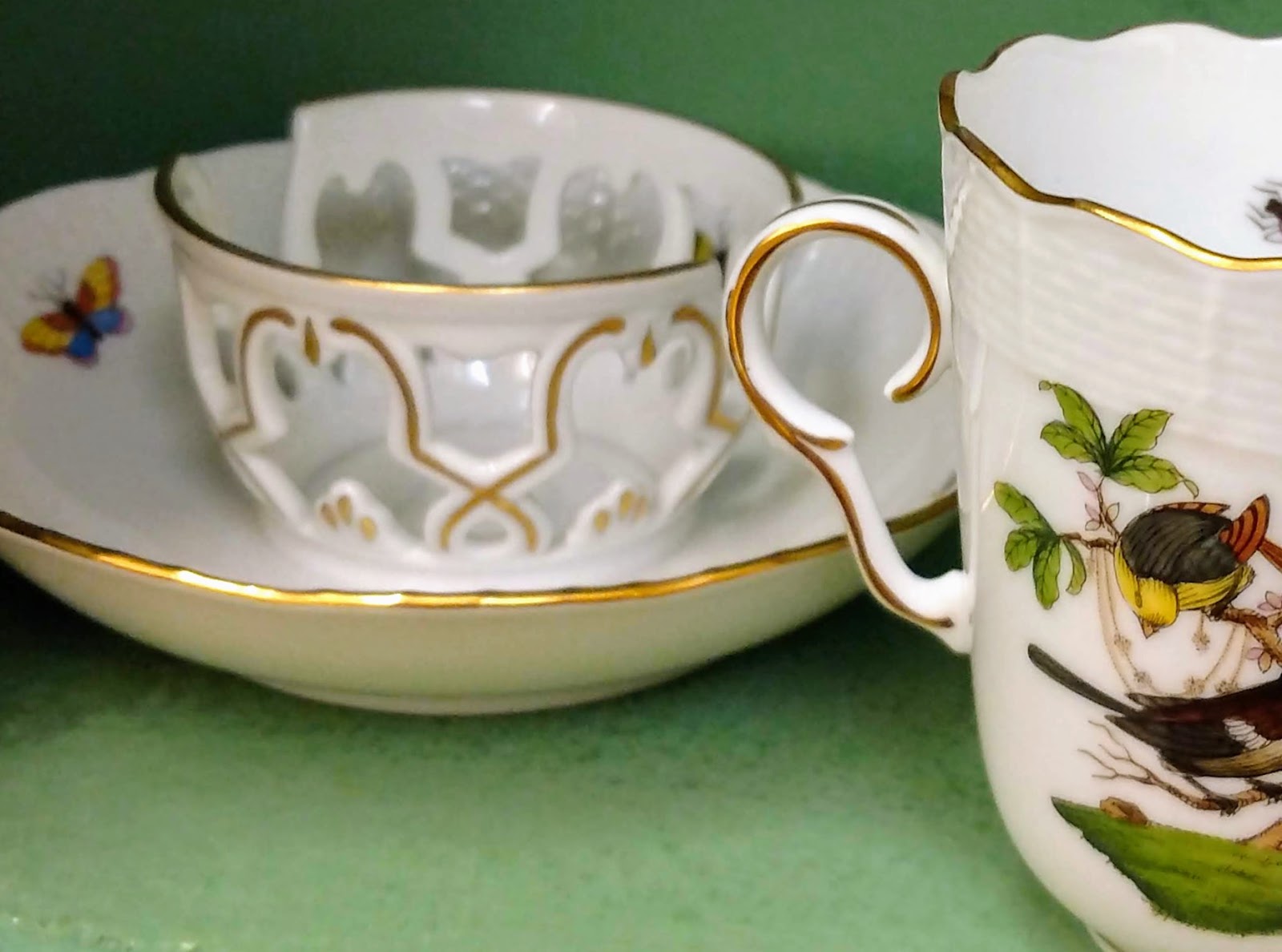
This type of trembleuse cup’s saucer has what is known as a ‘cage.’

The usual way is for the footman to carry a silver tray or salver, on which are placed small china coffee cups, those of the shape called “Trembleuse” are very much the best, as the saucer is so deep in the centre that the cup fits so far into the socket that no shaking is possible. A small silver, china, or silver gilt spoon is placed on each saucer. On the tray or salver are placed a silver or china jug of cream, the same of hot milk, and a silver or china basin of candied sugar.

Coffee may be poured into the cups before the tray is brought in, which the footman hands to each guest, and they will add sugar and cream according to their tastes; sometimes the butler carries on a salver a silver coffee-pot, and pours out the coffee as each guest takes it; sometimes, particularly in large country houses, each guest pours out their own coffee, the servant holding the tray for them with the cups.

The guests after dinner disperse themselves into groups or ‘tete-a-tete’ couples, and so commune pleasantly. — From “Etiquette: What to Do, and How to Do It,” by Lady Constance Eleanora C. Howard, 1885


Etiquette Enthusiast, Maura J Graber, is the Site Editor for the Etiquipedia©️ Etiquette Encyclopedia