Showing posts with label Regency Era Etiquette. Show all posts

Friday, February 7, 2020

Sugar Etiquette in Jane Austen’s Era

When entertaining guests with afternoon tea, sugar and milk are essential to the properly set tea table. — Socially conscious Georgian and Regency era tea drinkers would either refuse sugar in their brew or only drink their tea with non-slave trade, East India Sugar. — Above are Georgian era sugar tongs: “These early scissor-shaped sugar tongs resembled candle douters, with loop handles and scrolled stems, terminating in wide, flat, shell-shaped claws for holding the sugar.”


“The introduction of coffee, tea, and cocoa into Europe provided the well-off with an alternative to alcohol for the 1st time in history. Chocolate drinking, coffee houses, and afternoon tea all acquired a gentility far removed from ale house bawdiness, and became 1st a luxurious amenity, then by the 4th quarter of the 17th century a middle-class necessity. But all 3 were crude, often bitter, and unconsumable, it was said, without sugar. From about 1680 the fashion for these hot drinks became a potent factor in the surge in sugar demand and consequent increased production, which progressively raised the sugar trade to the point of importance which it had assumed by 1700.During the 2nd half of the 18th century the temperance cause developed into an important social movement, initiated by various Protestant denominations and therefore strongest in northern Europe, in countries such as Britain and the Netherlands. 

“Sugared tea became the respectable alternative to beer or wine long before water was safe to drink without boiling. These changes in social habits significantly increased the demand for sugar and were probably responsible for about half of the increased trade. Socially conscious tea drinkers would either refuse sugar in their brew or only drink East India Sugar. The ingenious wording of a certain English china ware-house’s advertisement for sugar basins in the early 1800s exploited the contemporary wave of liberal thinking: ‘East India Sugar not made by Slaves,’ the pots were printed, thus enabling the purchaser to display his conscience publicly. ‘A Family that uses 5lb of Sugar a Week,’ the advertisement continued, ‘will, by using East India instead of West India, for 21 Months, prevent the Slavery, or Murder, of one Fellow Creature! Eight such Families in 191⁄2 years will prevent the Slavery, or Murder of 100!’” — from “Sugar and the Slave Trade,” H. Hobhouse

In the Georgian era, lumps of sugar, cracked from the loaf with steel sugar nippers, were lifted from sugar bowl to tea cup, with the aid of sugar tongs. The earliest reference to this constituent of the silver tea-equipage appears in W. King's cookery book, published in 1708. These early scissor-shaped sugar tongs resembled candle douters, with loop handles and scrolled stems, terminating in wide, flat, shell-shaped claws for holding the sugar.

The scissor design long retained its popularity and, as with scissors themselves, included the stork design of the third quarter of the eighteenth century. In this the tongs resembled a long-beaked stork, consisting of two long has joined together by a rivet forming the bird's eyes and serving as a pivot the body was shaped and chased to resemble wing feathers and the legs ended in circular loops for the fingers. — “1500-1820: Three Centuries of English Domestic Silver,” by Bernard and Therle Hughs, 1952


Etiquette Enthusiast, Maura J Graber, is the Site Editor for the Etiquipedia©️ Etiquette Encyclopedia

Friday, January 12, 2018

Etiquette and Beau Brummell’s “Cut”

The “cut” employed by both the Prince Regent and Beau Brummell, was the ultimate social weapon of the Regency Era. It equates today, to a major “dis” of someone who is no longer a friend, but a frenemy. It’s the final social solution. It was not something to be used lightly, for using the cut, (sometimes called the “cut direct”) signaled your terminating a relationship. That “cut” was literally cutting your bonds of friendship. Rules about when and how a “cut” should be used, were as important as those rules on who could use the “cut” – Unmarried ladies were never to cut married ladies; gentlemen were never to cut a lady regardless of what she’d done; a gentleman cutting another gentleman had to be careful not to let the cut lead to a duel; a host could not cut a guest; etc... While it would seem to be a breach of etiquette to publicly cut someone, failure to follow the rules of cutting would be a serious breach of etiquette.

Shortly after Beau Brummell had joined his Hussars regiment, he inherited a large fortune from his father. He soon found military life uncongenial, and sold his commission. He then set up a bachelor establishment in the most fashionable quarter of London. Here, he entertained lavishly, and always had about him a coterie of the best dressed men of the city, who aped him in everything he did. The father of the Prince of Wales was the mainstay of Brummell's position at this time. Aside from his accomplishment that has made him famous, he was also exceedingly clever at repartee. The Prince was particularly fond of him for his witty conversation. The dandy had unlimited assurance, and even the Royal favor he was able to turn to the very best advantage. He was admitted to what was then termed the very best society, for he was extremely popular with the officers of his regiment. All that he could claim of social distinction for his own family was that his father had been secretary to Lord North. 

When Brummell reached the ago of 25 he found the proudest Dukes of England turned to him for advice in matters of dress, and with the proper spirit of the despot, he ruled on all such matters with brusque finality, “I want your opinion on this coat, Brummell.” said the Duke of Bedford. “Do you call that thing a coat, Bedford?” replied Beau. Finally his manner assumed such an arbitrary turn that he undertook to snub the Prince of Wales, who aspired to be the finest gentleman in Europe. Coolness sprang up between the two and the Prince cut the Beau. 

One story has it that when the Prince and Brummell were dining together, the latter asked him to ring the bell. It is said the Prince did ring the bell, and when the servant came, ordered Mr. Brummell’s carriage. The Beau denied the story, and gave the cause of the quarrel his own sarcasm on the Prince's increasing corpulency and his resemblance to Mrs. Fitzherbert's porter, “Big Ben.” Following his break in friendship, Brummell lounged about, made amusing remarks on his late friend and patron, swore he would “cut” him, and, in short, behaved with his usual aplomb. 

Soon after the bell affair, the “Beau” met his former friend in St. James street and resolved to cut him. Each antagonist was leaning on the arm of a friend. Jack Lee, who was thus supporting the “Beau” was intimate with the Prince, who, to make the cut more marked, stopped to talk to him without taking the slightest notice of Brummell. After a time both parties moved on, and then came the moment of triumph and revenge. It was sublime. Turning ‘round half way, so that his words could not fail to be heard by the retreating Regent, the Beau asked of his companion in his usual drawl, “Well, Jack, who's your fat friend?” The coolness, presumption and impertiness of the question perhaps made it the best thing the Beau ever said and from that time, the Prince took care not to risk another encounter with him. 

There are a great many stories told of the wit of Beau Brummell, always exercised at the expense of the defenseless or less brilliant and fashionable. On one occasion at least its unmitigated insolence brought its fair rebuke and that was when he sneeringly assured a wealthy brewer, Alderman Combe, from whom he had won a large sum at cards, that in future he would drink no one elses porter. “I wish, sir,” said Combe, “that every other blackguard in London would tell me the same.” – Sacramento Union, 1912


Etiquette Enthusiast, Maura J Graber, is the Site Editor for the Etiquipedia© Etiquette Encyclopedia

Wednesday, January 10, 2018

Etiquette and Beau Brummell

Beau Brummell influenced royals, and set trends in Regency England, including that of regular bathing. An iconic figure of the Regency Era, he was the arbiter of men's fashion, and a friend of the Prince Regent, the future King George IV – “Beau Brummel’s fashion ideals favored simple, classic and largely unadorned beauty. He eschewed the bright colors, wigs and showy fabrics of the previous generation, promoting clean lines, understated hues and impeccable tailoring. Brummell took a similar approach to bathing and grooming, refusing to douse himself with the stifling scents and lotions prized by young men and women of his day. Many of his followers would eventually adopt this simpler ethos, relying on a healthy soak in the tub rather than copious amount of perfume to smell fresh and clean.” –History.com 


Of all the famous men of fashion and devotees of the most strict in the art of manners, Beau Brummell stands at the lead, and his name has become so synonymous with the name “dandy.” that it has almost passed into the English language. George Brummell he was Christened, but “Beau” Brummell was applied to him at a very early age, and he lived up to the name through his entire life, setting the fashion of the English not alone in dress, but in deportment, in manners and etiquette. His reign as the arbiter of fashion in the early part of the nineteenth century was as extraordinary as that of any other tyrant in history. Not even Earls and Dukes were exempt in his dominant power over fashion and not even the Prince of Wales, who afterwards became George IV, dared offer any advice against his dictation in his particular field. His depotism in this respect was partly by chance and partly by nature. In the former, he had the favor of distinguished personages. 

His aunts, who were well-bred, but unfortunately having reached redticed circumstances, were given employment as gatekeepers in the comfortably furnished lodge at Greenwich by George III and were allowed to keep cows in the park and sell milk. The Prince of Wales was accustomed to frequently visit the lodge to see the gatekeeper’s cows milked. Upon one of these occasions, Brummell, who had but recently returned from Eton, had the pleasure of meeting the Prince. They struck up considerable of a friendship, and the latter used his influence to make Brummell a Cornet of Hussars in a desirable regiment. George was an exceedingly handsome youth when he got out of Eton; by no means a mere dandy, but he became so much interested in clothes and how to wear them to the best advantage, that he was shortly looked upon as the best-dressed gentleman of the day. Neckcloths were his greatest victories. At his neck they were starched. He was fastidious in trying them. “These X.” solemnly said his valet, bearing forth a pile of crumpled linen, “these are our failures.” – From 7 Famous Beaux, 1911

Etiquette Enthusiast, Maura J Graber, is the Site Editor for the Etiquipedia© Etiquette Encyclopedia

Thursday, March 24, 2016

Jane Austen Etiquette and Lexicon

I rarely read novels. And by “rarely,” I mean I read one every 10 or 20 years. I do read daily, but I read for research, from my old etiquette books and news archives. A few years ago, when I finally decided to read Jane Austen's, “Sense and Sensibility,” I was often looking up many of the words and phrases, so I listed them and created  the Georgian and Regency Era Lexicon below.


Alacrity: briskness

Apes leader: an old maid or a spinster


Assiduities: persistent personal attentions

Banditti: wild outlaws, bandits

Bartholomew Baby: a person dressed up in a tawdry manner, like the dolls sold at the Bartholomew Fair (a two-week festival celebrating the Feast of St. Bartholomew)

Batman: an orderly assigned to a military officer

Bear leader: A travelling tutor, who leads his charges as if they were trained bears

Bedlam: An insane asylum in London. The full name was the “Hospital of Saint Mary of Bethlehem”

Bit o'muslin: woman of who gives sexual favors in exchange for payment

Bluestocking: an academic female

Bonomi: Ignatius Bonomi, a well known architect at the time

Bowling Green: grassy lawn where game of ninepins could be played

Brook: put up with something painful or difficult

Casino: point-scoring card game in which players combine cards exposed on the table with the cards in their hands, the 10 of diamonds being the highest-valued card

Cavil: a trivial objection

Conjurer: someone who draws astute conclusions

Colicky gout: abdominal pain and swollen joints, especially the toes and feet

Consequences: a pencil-and-paper game for several players, in which each player adds a line of a story without knowing with the previous lines are. The resulting stories are incongruous and humorous

Consumption: a wasting away, a bout of tuberculosis


Corinthian: a dandy, a fashionable man, who is also good at sports. It can also mean “a rake.” But originally it meant profligate and derived from the elegant but dissipated lifestyle led in Ancient Corinth.

Coxcomb: a conceited and vain person. In origin, it meant “fool” as fools used to wear caps with bells and a piece of red cloth on top which was shaped like a cock's comb

Covert: a thicket providing cover for game

Cry rope on someone: give them away, to tell secrets

Curricle: a light, two-wheeled carriage drawn by two horses, side by side

Dilatoriness: slowness, procrastination

Direction: return address

Douceur: pleasantry

Dovecote: small house or box with compartments for nesting doves or pigeons

Drive unicorn: to drive a vehicle with three horses, one in front and the other 2 behind

Drury Lane: general term for the Theatre Royal; street were the London playhouse is located

Ebullition: a sudden outburst, as of emotion

Enclosure: common land, previously used by everyone, this is fenced in by the landowner so that others can't use his land for pasture or gathering fuel

Exeter Exchange: a wild animal exhibit


Exigence: exigency; urgency

Foxed: tipsy, drunk

Flying one's colors: blushing

Frank: a piece of mail marked with an official signature, so that it can be mailed for free

Fudge: a false rumor

Fustian: bombast, pompous language, pretentious speech

Gammon: nonsense (noun), to deceive or lie (verb)

Gigs: light, open, two wheeled carriages

Glebe: church land to be used by the rector

Green Girl: a girl who is young and inexperienced

Gudgeon: it derives from the name of a fish that gets easily caught and means someone who is easily duped or imposed upon


Hackney Coach:  a coach kept for hire; especially a four-wheeled carriage drawn by two horses and having seats for six persons

Had as lief: would just as soon, would just as readily or willingly

Hard by: nearby or near by


Hartshorn: smelling salts or spirits

Huswifes: pocket cases for needles, pins, thread and scissors, forerunner of “housewife”

Illiberal: narrow minded; bigoted

Importune: troublesome; overly persistent in request or demand

Incommode: inconvenience, disturb

Inferiority of parts: lack of talent or capabilities
 

“To be well received, you must always be circumspect at table, where it is exceedingly rude, to scratch any part of your body, to spit, or blow your nose, (if you can't avoid it, turn your head,) to eat greedily, to lean your elbows on the table, to sit too far from it, to pick your teeth before the dishes are removed, or leave the table before grace is said.” ~ John Tusler 1791

Knowing: fashionable

La Boulangere: a simple circle dance for a group of couples

Jarvey: driver of a hackney coach

Jointure: settlement to a wife from her husband throughout her life, which will then transfer to her children

Lush some slop: to drink some tea

Michaelmas: September 29th, the feast in honor of Saint Michael. One tradition is that if a young lady finds the ring hidden in a Michaelmas pie, she will soon marry.

Mohurs: 19th & 20th century gold coins used in British India

Moiety: one of two parts, not necessarily equal

Nabob: it comes from the Hindustani word “nawab” which was the name for the ruler in the Mogul Empire and means a rich man, a person of great wealth and prominence, especially one who made his fortune in India.

Natural child: child born out of wedlock

Nonpareil: a leader of fashion. Also known as a nonesuch

Nuncheon: also “nunchion,” a light, noon drink or snack, forerunner of the word “luncheon”

Offices: parts of the house in which servants work

Open weather: mild and free from frost

Palanquins: enclosed litters borne on the shoulders of men by means of poles

Pall-Mall: main thoroughfare in the Saint James district of London

Pinkest of the Pinks: a very fashionable man

Piquet: a card game for two players, with 32 cards

Porter: a dark brown beer made from charred or brown malt

Post-Horses: horses used or kept at inns, or post-houses, for use by mail-riders, or for hire by travelers

Public School: in England it is a private school

Queen Mab: Queen of the fairies in English literature

Red-Gum: swelling and redness due to teething

Retailed: repeated

Reticule: a woman's handbag closed with a draw string.

Round Game: game, as in cards, on which each plays on his or her own account

Rubber: session or round of playing a card game


Se’enight: similar to “fortnight,” except se’enight was short for seven nights, or one week’s time.

Serviley: in the manner of a slave

Snuff: a powdered, often scented, tobacco that was taken into the nose. It was usually carried around in small and decorated boxes

Sponging House: debtors' quarters before being taken to jail.

Stewponds: fishponds

Temple: one of two sets of buildings in London's Inns of Court, which served as residences for lawyers and law students

Town Tabby: an aristocratic dowager

Two-penny post: In 1801, the charge for mailing letters locally went from one pence (a penny), to two

Whip Hand: upper hand, advantage (the hand that holds the whip controls the carriage or horse)

Whist: a card game in which two pairs of players try to take a majority of tricks, with the trump suit being determined by the last card dealt; a forerunner of bridge

Wooly bandits: wild sheep who steal picnic baskets

Work-bags: bags for needlework


Compiled by Site Editor, Maura J Graber

Etiquette Enthusiast, Maura J. Graber, is the Site Editor for the Etiquipedia© Etiquette Encyclopedia

Friday, January 29, 2016

More Etiquette of Snuff

A nobleman with his fingers in his snuff box — Snuff is powdered tobacco, usually blended with aromatic herbs or spices. The habit of snuff-taking spread to China from the West during the 17th century and became established in the 18th century. People generally carried snuff in a small bottle. By the 20th century these bottles had become collectors' items, owing to the great variety of materials, precious stones, rock crystal, etc.... and decorative techniques used in their production.
More Snuff Etiquette

Traditionally gentlemen should never take snuff when ladies are present. However if you are in a situation where modern interaction would usually allow both sexes to smoke, for example a public house, then it is acceptable. 

Formal etiquette dictates that women abstain from tobacco until at least fifty years of age. (Wife of King George III, "Snuffy Charlotte," could have avoided that nick-name, had she heeded this advice).

The best of the Viennese tradition of gold box-making is shown in this superbly enameled snuff box, which forms part of a set. Catering for the necessities of elegant life, it comprises an étui or small case with a knife, snuff spoon, toothpick and ear pick, watch and châtelaine (from which one's watch hung) and a matching snuff-box. 

Snuff-boxes should be chosen for each varying occasion. For a formal event, a silver, ivory or mother-of-pearl snuff-box, is appropriate. A brass or teak snuff-box is much more appropriate for watching rugby, or 'rugger.' Pewter should not be used, as the metal is too soft, and a leather or cloth snuff-pouch is not considered suitable, because the snuff will often become too moist.

Take the snuff-box from your pocket and pass it into your left hand. Your inner left jacket pocket should be used to store all tobacco products.


Tap the snuff-box with your middle and fore-finger, so that the powdered tobacco gathers at one side. This will also alert your acquaintances that snuff is about to be passed around.              

Open the snuff-box and inspect the contents. Check that the tobacco is not damp and that it is finely powdered. If one finds it is unusable, or if there is insufficient snuff to provide for the group, there is no shame in returning the snuff-box to one's pocket at this point.


If one finds there is enough snuff for the present company, the proper etiquette is to present the snuff-box with a courteous bow. 

The snuff-box travels in a clockwise manner, (the opposite of food at a table) and should only be held in the left hand. It is very reminiscent of the way port is passed.

Receive the snuff-box back with the left hand.          
Above– A selection of Chinese snuff holders. French Emporer Napoleon was once given a fragile mother-of-pearl snuff-box by Empress Josephine. When it broke through his overuse, Napoleon was distraught until Josephine presented him with another.     

Gather the snuff by striking the side with the middle and forefinger. Take a pinch with the right hand, between the thumb and fore-finger. Hold the snuff for a second or two between the fingers before taking. This not only allows sufficient time to pass the snuff-box forward without keeping people waiting, but also displays that you are not greedy, nor are you hoarding the snuff-box.

Carry the pinch to the nose. Never lean towards your hand. If anything snuff should be taken with your head tilted slightly backwards. 

A fashionable, mustachioed gent's snuff holder ··· "Edward Wortley Montagu, the eccentric son of Lady Mary, is said to have possessed more snuff- boxes than would suffice a Chinese idol with a hundred noses— a collection which, perhaps, was never equaled, unless by that of King George IV, who was not less extravagant and recherche in snuff and snuff-boxes than in other things."— San Francisco Call, 1896
Snuff can also be taken from an indentation formed at the base of the thumb. If you place your hand flat on the table with your fingers spread. Then as you raise the thumb this will reveal what is known as 'The Anatomical Snuff-box' or what is sometimes known colloquially as 'The Poorman's Snuff-box.' This method is not recommended because the valuable snuff is far more likely to spill. 

One should attempt to snuff with precision by both nostrils and without grimaces or distortion of the features.
                     
Above- An ornate, wooden snuff-box, in the shape of a boot. – According to Betty Boyd Caroli, Dolly Madison, the wife of US President James Madison, used snuff. Caroli writes, "Stained fingers left little doubt that she used snuff, not an acceptable habit for 19th C. ladies, but one that was excused in her." One woman supposedly mused that in Mrs. Madison's hands, "... the snuff-box seems only a gracious implement with which to charm" according to the author. It is also said that Mrs. Madison requested a closed casket at her funeral, as snuff-taking had falllen out of vogue for women and she did not want anyone to see her stained fingers. 

A very important point of differentiation between the etiquette of British and European snuff-takers, is that in European countries it is acceptable to let out a large sneeze after taking snuff. However, in Britain, doing so is considered quite rude. 

It is also very important that you sniff but do not snort. The snuff should not enter deeply into the sinuses. (Contrary to this advice in 1820 the "double barreled snuff pistol" was invented; it was capable of packing a day's worth of snuff into the nose using an explosive charge. This kind of behavior would be considered vulgar by anyone's standards.)
          
"PARDON MY SNEEZE! —Dating from days when it was customary for gentlemen to take snuff, the two delicately, colored snuff-boxes at the entrance to the Senate chamber in Washington are kept filled while the Senate is in session. Here is Dick Oyster, in charge of stationery, filling them. Originally placed to prevent head colds, the snuff is still used liberally by the solons." — The Madera Tribune, 1937

Close your snuff-box with a flourish. Then, return it to your jacket pocket.


Always wipe your nose and collar with a handkerchief. Specialist handkerchiefs are available for this purpose. Usually found to be colorful, patterned and silken, they are made to be thrown away, as they will rapidly become soiled and a dark brown, whenever the nose runs.


🍽️Etiquette Enthusiast, Maura J. Graber of The RSVP Institute of Etiquette, is the Site Editor for Etiquipedia© Etiquette Encyclopedia

Wednesday, April 8, 2015

Etiquette for Balls, Cotillions, Dances

When taking a woman wearing evening dress to a ball or dance, a man should provide a carriage. 
CARRIAGES: When taking a woman wearing evening dress to a ball or dance, a man should provide a carriage. A man should secure his carriage− check when leaving his carriage. It is safer to take wraps and coats to the house in case of accidents.

DRESS: Evening dress is worn by men and women.

DINNER INVITATIONS. The hostess issues two sets of invitations−−one for those invited to both dinner and dance, and one for those invited to the dance only.

For the former, the hostess should use her usual engraved dinner cards, with the written words: Dancing at eleven, and for the latter her usual engraved At Home cards, with the written words: Dancing at eleven.

A less formal way is to use, instead of the At Home card, a Mr. and Mrs. card, or Mrs. and Miss card, with the following written in the lower left−hand corner: Dancing at ten. March the second. R. S. V. P.

INVITATIONS. These should be acknowledged by an acceptance, or declined, with a note of regret within one week.

On being introduced to a woman, he may ask her for a dance, and he should be prompt in keeping his appointment.
MEN and ASKING A WOMAN TO DANCE: A man asks for the privilege of a dance, either with the daughter of the hostess or with any guest of the latter or any young woman receiving with her.

On being introduced to a woman, he may ask her for a dance, and he should be prompt in keeping his appointment.

It is her privilege to end the dance, and, when it is ended, he should conduct her to her chaperone, or, failing that, he should find her a seat−−after which he is at perfect liberty to go elsewhere.

If for any cause a man has to break his engagements to dance, he should personally explain the matter to every woman with whom he has an engagement and make a suitable apology.

DEBUTANTE: At a debutante's reception the first partner is selected by the mother, usually the nearest and dearest friend, who dances but once, and the others follow.

INVITATIONS: Invitations to balls or assemblies should be answered immediately; if declined, the ticket should be returned. A man should call or leave cards a few days before the affair.

SUPPER: At balls and assemblies where small tables are provided, a man should not sit alone with his partner, but make up a party in advance, and keep together.

If a patroness asks a man to sit at her table, she should provide a partner for him. At supper the senior patroness leads the way, escorted by the man honored for the occasion.

If one large table is provided, the men, assisted by the waiters, serve the women. When small tables are used the patronesses generally sit by themselves, and the guests group themselves to their own satisfaction. 

 Patroness Lady Catherine de Bourgh ~ With a Patroness like the fictional Lady Catherine de Bourgh, who needs enemies?!
PATRONESSES: Their duties are varied and responsible−−among them, the subscription to the expenses of the entertainments.

The patronesses should be divided into various committees to attend to special duties −−as, music, caterers, supper arrangements, the ball−room, and all other details.

While affairs of this kind could be left in the hands of those employed to carry out the details, it is better and safer for each committee to follow the various matters out to the smallest details.

Those devising new features and surprises for such an occasion will give the most successful ball. The one most active and having the best business ability should take the lead.

Lists should be compared, in order to avoid duplicate invitations.The tickets should be divided among the patronesses, who, in turn, distribute them among their friends. The patronesses should be at the ball−room in ample time before the arrival of the guests, to see that all is in readiness.

They should stand together beside the entrance to welcome the guests. They should see, as far as possible, that the proper introductions are made, and that every one is enjoying the evening, their own pleasure coming last.

If time permits, a hasty introduction to the patroness beside her may be made by a patroness, but it should not be done if there is the slightest possibility of blocking up the entrance.

A nod of recognition here and there, or a shake of the hands with some particular friend, is all that is necessary. Prolonged conversation should be avoided.

A patroness should not worry over the affair, or leave anything to be done at the last minute. If she has to worry, she should not show it, lest she interfere with the pleasure of others.

They should be the last to leave as well as the first to arrive, to see that the affair closes brilliantly.

SUPPER: The senior patroness leads the way to supper, escorted by the man honored for the occasion.

If one large table is provided, the men, assisted by the waiters, serve the women. When small tables are used, the patronesses generally sit by themselves, and the guests group themselves to their own satisfaction.

If a patroness asks a man to sit at her table, she should provide a partner for him, and in case of a previous engagement, he should notify her by mail.

WOMEN: A woman should always keep any engagement made, if possible. If, for a good reason, it is desired to break one, she should do so in ample time to enable the man to secure a partner.

It is bad form to refuse one partner for a dance and to accept another for the same dance afterward. After refusing to dance, a woman should lose that dance unless previously engaged.

A woman may refuse to dance at a public entertainment.

A young woman chaperoned should not accept a man's invitation, unless he first asks permission of her chaperone.

It is not good taste to keep late hours at an informal dance.

In round dances the man supports the woman with his right arm around the waist, taking care not to hold her too closely. Her right hand is extended, held by his left hand, and her left hand is on his arm or shoulder, her head erect.

When tired, the woman should indicate a desire to stop dancing.When the dancing ends, the woman takes her partner's arm and strolls about a few minutes. He then conducts her to her seat by her chaperone, and, after a few remarks, excuses himself.

When supper is announced, and the young woman and her chaperone are in conversation with the man who danced with her last, they should accept his offer as escort if they are not already provided with one.

If a woman is without escort when supper is announced, she must rely upon attendants or members of the host's family.

At balls and assemblies where small tables are provided for the supper, the woman should not sit alone at a table with her partner, but she should have others present also.

DEBUTANTE: At a debutante's reception the first partner is selected by the mother, usually the nearest and dearest friend, who dances but once with her, and the others follow.

DANCES (FORMAL):

A man should seek out those women who, for some reason, are neglected by selfish men, especially unmarried women, and invite them to dance.
HOST: When supper is announced, the host leads the way with his partner, followed by hostess and escort, the rest following.

HOSTESS: She should limit the number of guests to the capacity of the house.

Invitations should include more men than women, for some men may not attend, and of those who do come, some may not dance.

An awning and carpet should be spread from curb to steps. The man stationed at the curb should open carriage doors for arriving and departing guests, distribute carriage− checks, and tell the drivers at what hour to return.

The servant opening the door directs the guests to their respective dressing−rooms.

A small orchestra should be provided and concealed behind palms or flowers.

In the absence of polished floors, carpets should be covered with linen crash, tightly and securely laid, in order to stand the strain of dancing.

Friends may assist in taking care of the guests, making introductions, etc.

SUPPER: Supper may be served at one large table or many small ones, as desired.

DANCES (INFORMAL): Dances of this character lack all possible formality. The invitations may be written or verbal.

Piano music is all that is required, played by one of the family or a professional.

Refreshments of a suitable nature are provided. See also Chaperone. Dances.


DANCING:
At balls all men should dance, and those who do not, have no place there, though invited. "In inviting a lady to dance with you, the words, "Will you honor me with your hand for a quadrille?" or, "Shall I have the honor of dancing this set with you?" are more used now than "Shall I have the pleasure?" or, "Will you give me the pleasure of dancing with you?" If she answers that she is engaged, merely request her to name the earliest dance for which she is not engaged, and when she will do you the honor of dancing with you." Samuel R. Wells

Before asking a chaperoned woman to dance, the man should ask permission of her chaperone.

A man should pay especial attention to the women of the house, and invite them to dance as early as possible.

A man should seek out those women who, for some reason, are neglected by selfish men, especially unmarried women, and invite them to dance.

Men should keep engagements a few minutes
before each dance.

If for some good reason it is desired to break an engagement, it should be done so as to leave ample time for the other to secure a partner for that dance.

In round dances, the man supports the woman with right arm about her waist, taking care not to hold her too closely. His left hand holds her right one, both extended.

The woman should indicate when she desires to stop dancing.

All persons should be at a formal dance not later than half an hour after the hour set.

A man should secure his carriage−check. It is safer to take wraps and coats to the house in case of accidents.

GLOVES: Gloves should be worn at formal dances, and should be put on before entering the room.

SHAKING HANDS: It is not customary to shake hands at formal dances.

SMOKING: Smoking should not be allowed in the dressing−room, but a special room should be provided. Men who dance should not smoke until leaving the house. 
Young women should be chaperoned at all formal dances by their mother...
WOMEN. The time for the formal dance is indicated on the invitation, and all should be there not later than half an hour after the time set.

At private dances the maid takes and calls for the young woman in the absence of a male escort.

Young women should be chaperoned at all formal dances by their mother or others.

Introductions should be made as much as possible before the dancing begins.  —
From "The Book of Good Manners"


Etiquette Enthusiast, Maura J. Graber, is the Site Editor for the Etiquipedia© Etiquette Encyclopedia

Friday, April 3, 2015

19th C. Etiquette for the Sick

Of Duties Toward the Sick, Infirm, and Unfortunate

Victorian Era and Edwardian Era, Medicine Spoons and Invalid Spoons

The Unfortunate

Propriety, the guide of all our relations, cannot remain a stranger to the unfortunate; that which takes possession of all our sentiments, cannot forget to pity. It is in this light that it is peculiarly touching, that it is almost religious, since it even contributes to bind closer this first, this powerful tie of humanity.
Silver Georgian Era medicine spoon (circa 1755), shown front and back, with a green case, inscribed ‘Gift of the Dutchess of Queensberry to Lady Carbery’; an ‘S’ engraved on the stem for ‘Stafford’, Lady Carbery’s maiden name. The modest silver spoon makes for an intriguing part of the Symons Collection at the Royal College of Physicians in England
                 
The Sick and the Infirm

When any one of your acquaintance is ill, you should regularly send a domestic, to inquire after their health, every day, or every other day, according to the virulence and nature of the disease. If there is immediate danger, we should send to inquire even twice a day. From time to time, you should send to know whether the sick person can see any one, because in that case you must go and testify in person, all your interest. You should continue to obtain information about their health until their recovery or death.

Our visits to the sick should be very short, silent, and reserved. We should address to them words of interest in a low voice, and speak softly to the member of the family who takes charge of them. We ask him who is his physician, what is the treatment; we urge every motive of consolation and hope; we ought hardly to reply to the questions the person in attendance asks, with regard to our own health, or business, and we retire reiterating the proofs of our interest. 

                          
A patented improvement made for medicine spoons, 1873
If the person is convalescent or only indisposed, you address a thousand questions concerning their complaints; you sympathize with them, praise their patience, and describe to them the pleasant image of returning health. You must be on your guard not to say that you find their features much changed, that their recovery may be slow, etc...

To speak these truths is very malapropos, and with reason; you would pass for having an unfeeling heart, or rather, a limited understanding. When sufferings and troubles assume a virulent aspect, and resist all the efforts of medical skill, they are infirmities indeed, and a silence the most absolute and rigorous with respect to them, should be observed.

Not only ought you never to speak to an infirm person of his misfortune, but you should also carefully avoid mentioning any person who is afflicted in the same way, and of thus alluding indirectly to his own case. The only occasion when this is allowed, is where you can make it appear to him that the comforts of which he is deprived are not so permanent but that you have experienced similar inconveniences from the same cause.                        

Victorian era photo of a baby given medicine ~ Young, old or in-between, feeding and giving medicines to the infirm, has always been difficult.

Thus to a lame person, you might say that you yourself are fatigued with walking, that your own legs are not firm, etc... If the infirmity is not too visible, and the poor subject speaks to you of it, assure him earnestly that you should not have observed it. If he complains to you, offer him motives of consolation, and take care that you change the subject of conversation before he does, for you might make him think that you are importuning him about his malady. 

Finally, do all in your power to comfort him. If he is afflicted with imperfect sight, place objects near him, but without affectation, and without having the air of making him think that he requires your assistance, neither permit him to thank you. If he is troubled with deafness, you must not speak unreasonably loud; bring back the attention of the unfortunate person to the subject of your conversation by skilful and delicate transitions, and not abruptly say to him, We were speaking of such a thing. This is much trouble, perhaps you will say. Trouble to console people! Why, you take more to please them!

The etiquette and manners for dealing with the infirm or injured, has not changed much over the centuries.

Persons who are reduced in circumstances, keep up in their misfortune (at least in society) their habits of opulence; and to manage with such persons requires not a little skill. If they invite you to their frugal repasts, if they offer you any presents, let not the fear of occasioning them expense, induce you to refuse with warmth, and with obstinacy; you would wound them deeply. Accept them, and seek an opportunity of repaying with interest, these proofs of their politeness. 

Do not speak to them first of their sad situation; but if they introduce the subject themselves, receive their confidence with a respectful and affectionate attention. Show how much you are affected with that which grieves them, and without forgetting discretion, endeavor, in appearance at least, to render them confidence for confidence.


From “The Gentleman and Lady's Book of Politeness and Propriety of Deportment, Dedicated to the Youth of Both Sexes.” by Elisabeth Celnart, translated from the Sixth, Paris Edition, 1833 


🍽️Etiquette Enthusiast, Maura J. Graber of The RSVP Institure of Etiquette, is the Site Editor for Etiquipedia© Etiquette Encyclopedia

Thursday, March 19, 2015

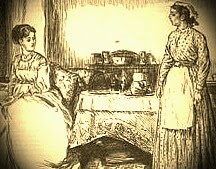
Regency Etiquette, Servants and Society

Regency Era British Authoress, Frances "Fanny" Trollope, was a keen observer of the life and people she met on her travels.

The greatest difficulty in organising a family establishment in Ohio, is getting servants, or, as it is there called, "getting help," for it is more than petty treason to the Republic, to call a free citizen a servant. The whole class of young women, whose bread depends upon their labour, are taught to believe that the most abject poverty is preferable to domestic service. Hundreds of half-naked girls work in the paper-mills, or in any other manufactory, for less than half the wages they would receive in service; but they think their equality is compromised by the latter, and nothing but the wish to obtain some particular article of finery will ever induce them to submit to it. A kind friend, however, exerted herself so effectually for me, that a tall stately lass soon presented herself, saying, "I be come to help you." The intelligence was very agreeable, and I welcomed her in the most gracious manner possible, and asked what I should give her by the year.


"Oh Gimini!" exclaimed the damsel, with a loud laugh, "you be a downright Englisher, sure enough. I should like to see a young lady engage by the year in America! I hope I shall get a husband before many months, or I expect I shall be an outright old maid, for I be most seventeen already; besides, mayhap I may want to go to school. You must just give me a dollar and half a week, and mother's slave, Phillis, must come over once a week, I expect, from t'other side the water, to help me clean." I agreed to the bargain, of course, with all dutiful submission; and seeing she was preparing to set to work in a yellow dress parseme with red roses, I gently hinted, that I thought it was a pity to spoil so fine a gown, and that she had better change it. "'Tis just my best and my worst," she answered, "for I've got no other."


And in truth I found that this young lady had left the paternal mansion with no more clothes of any kind than what she had on. I immediately gave her money to purchase what was necessary for cleanliness and decency, and set to work with my daughters to make her a gown. She grinned applause when our labour was completed, but never uttered the slightest expression of gratitude for that, or for any thing else we could do for her. She was constantly asking us to lend her different articles of dress, and when we declined it, she said, "Well, I never seed such grumpy folks as you be; there is several young ladies of my acquaintance what goes to live out now and then with the old women about the town, and they and their gurls always lends them what they asks for; I guess you Inglish thinks we should poison your things, just as bad as if we was Negurs." And here I beg to assure the reader, that whenever I give conversations they were not made À LOISIR, but were written down immediately after they occurred, with all the verbal fidelity my memory permitted.
                               
"I fear it may be called bad taste to say so much concerning my domestics, but, nevertheless, the circumstances are so characteristic of America that I must recount another history relating to them." Fanny Trollope, in her book "Domestic Manners of the Americans" 

This young lady left me at the end of two months, because I refused to lend her money enough to buy a silk dress to go to a ball, saying, "Then 'tis not worth my while to stay any longer." I cannot imagine it possible that such a state of things can be desirable, or beneficial to any of the parties concerned. I might occupy a hundred pages on the subject, and yet fail to give an adequate idea of the sore, angry, ever wakeful pride that seemed to torment these poor wretches. In many of them it was so excessive, that all feeling of displeasure, or even of ridicule, was lost in pity. One of these was a pretty girl, whose natural disposition must have been gentle and kind; but her good feelings were soured, and her gentleness turned to morbid sensitiveness, by having heard a thousand and a thousand times that she was as good as any other lady, that all men were equal, and women too, and that it was a sin and a shame for a free-born American to be treated like a servant.


When she found she was to dine in the kitchen, she turned up her pretty lip, and said, "I guess that's 'cause you don't think I'm good enough to eat with you. You'll find that won't do here." I found afterwards that she rarely ate any dinner at all, and generally passed the time in tears. I did every thing in my power to conciliate and make her happy, but I am sure she hated me. I gave her very high wages, and she staid till she had obtained several expensive articles of dress, and then, UN BEAU MATIN, she came to me full dressed, and said, "I must go." "When shall you return, Charlotte?" "I expect you'll see no more of me." And so we parted. Her sister was also living with me, but her wardrobe was not yet completed, and she remained some weeks longer, till it was.
             
The famous Georgian era painting, "Heads of Six of Hogarth's Servants," was seen as almost subversive in its day. It is unique among other paintings of the time, as the artist William Hogarth, chose to depict 5 servants of his household, in a manner more like those of the wealthier classes in the mid to late 1700s.  With the butler, closely surrounded by the others in the center of the painting, it depicts a close knit group. And it is just their heads depicted, as opposed to the servants performing their routine household duties. Thus, the artwork not only dignifies them, but humanizes them as well. The painting was displayed conspicuously in his estate home in full view of Hogarth's somewhat bemused guests, while at the same time the servants' facial expressions were purposely painted to convey all of the sincerity and deference expected of servant-class members of the era.
                   
I fear it may be called bad taste to say so much concerning my domestics, but, nevertheless, the circumstances are so characteristic of America that I must recount another history relating to them. A few days after the departure of my ambitious belle, my cries for "Help" had been so effectual that another young lady presented herself, with the usual preface "I'm come to help you." I had been cautioned never to ask for a reference for character, as it would not only rob me of that help, but entirely prevent my ever getting another; so, five minutes after she entered she was installed, bundle and all, as a member of the family. She was by no means handsome, but there was an air of simple frankness in her manner that won us all. 

For my own part, I thought I had got a second Jeanie Deans; for she recounted to me histories of her early youth, wherein her plain good sense and strong mind had enabled her to win her way through a host of cruel step-mothers, faithless lovers, and cheating brothers. Among other things, she told me, with the appearance of much emotion, that she had found, since she came to town, a cure for all her sorrows, "Thanks and praise for it, I have got religion!" and then she asked if I would spare her to go to Meeting every Tuesday and Thursday evening; "You shall not have to want me, Mrs. Trollope, for our minister knows that we have all our duties to perform to man, as well as to God, and he makes the Meeting late in the evening that they may not cross one another." Who could refuse? Not I, and Nancy had leave to go to Meeting two evenings in the week, besides Sundays.


One night, that the mosquitoes had found their way under my net, and prevented my sleeping, I heard some one enter the house very late; I got up, went to the top of the stairs, and, by the help of a bright moon, recognised Nancy's best bonnet. I called to her: "You are very late." said I. "what is the reason of it?" "Oh, Mrs. Trollope," she replied, "I am late, indeed! We have this night had seventeen souls added to our flock. May they live to bless this night! But it has been a long sitting, and very warm; I'll just take a drink of water, and get to bed; you shan't find me later in the morning for it." Nor did I. She was an excellent servant, and performed more than was expected from her; moreover, she always found time to read the Bible several times in the day, and I seldom saw her occupied about any thing without observing that she had placed it near her.


At last she fell sick with the cholera, and her life was despaired of. I nursed her with great care, and sat up the greatest part of two nights with her. She was often delirious, and all her wandering thoughts seemed to ramble to heaven. "I have been a sinner," she said, "but I am safe in the Lord Jesus." When she recovered, she asked me to let her go into the country for a few days, to change the air, and begged me to lend her three dollars. While she was absent a lady called on me, and enquired, with some agitation, if my servant, Nancy Fletcher, were at home. I replied that she was gone into the country. "Thank God," she exclaimed, "never let her enter your doors again, she is the most abandoned woman in the town: a gentleman who knows you, has been told that she lives with you, and that she boasts of having the power of entering your house at any hour of night." She told me many other circumstances, unnecessary to repeat, but all tending to prove that she was a very dangerous inmate. 


I expected her home the next evening, and I believe I passed the interval in meditating how to get rid of her without an eclaircissement. At length she arrived, and all my study having failed to supply me with any other reason than the real one for dismissing her, I stated it at once. Not the slightest change passed over her countenance, but she looked steadily at me, and said, in a very civil tone, "I should like to know who told you." I replied that it could be of no advantage to her to know, and that I wished her to go immediately. "I am ready to go," she said, in the same quiet tone, "but what will you do for your three dollars?" "I must do without them, Nancy; good morning to you." "I must just put up my things," she said, and left the room. About half an hour afterwards, when we were all assembled at dinner, she entered with her usual civil composed air, "Well, I am come to wish you all goodbye," and with a friendly good-humoured smile she left us.


This adventure frightened me so heartily, that, notwithstanding I had the dread of cooking my own dinner before my eyes, I would not take any more young ladies into my family without receiving some slight sketch of their former history. At length I met with a very worthy French woman, and soon after with a tidy English girl to assist her; and I had the good fortune to keep them till a short time before my departure: so, happily, I have no more misfortunes of this nature to relate.
 
          
Such being the difficulties respecting domestic arrangements, it is obvious, that the ladies who are brought up amongst them cannot have leisure for any great development of the mind: it is, in fact, out of the question; and, remembering this, it is more surprising that some among them should be very pleasing, than that none should be highly instructed. 

Had I passed as many evenings in company in any other town that I ever visited as I did in Cincinnati, I should have been able to give some little account of the conversations I had listened to; but, upon reading over my notes, and then taxing my memory to the utmost to supply the deficiency, I can scarcely find a trace of any thing that deserves the name. Such as I have, shall be given in their place. But, whatever may be the talents of the persons who meet together in society, the very shape, form, and arrangement of the meeting is sufficient to paralyze conversation. The women invariably herd together at one part of the room, and the men at the other; but, in justice to Cincinnati, I must acknowledge that this arrangement is by no means peculiar to that city, or to the western side of the Alleghanies.

Sometimes a small attempt at music produces a partial reunion; a few of the most daring youths, animated by the consciousness of curled hair and smart waistcoats, approach the piano forte, and begin to mutter a little to the half-grown pretty things, who are comparing with one another "how many quarters' music they have had." Where the mansion is of sufficient dignity to have two drawing-rooms, the piano, the little ladies, and the slender gentlemen are left to themselves, and on such occasions the sound of laughter is often heard to issue from among them. But the fate of the more dignified personages, who are left in the other room, is extremely dismal.

The gentlemen spit, talk of elections and the price of produce, and spit again. The ladies look at each other's dresses till they know every pin by heart; talk of Parson Somebody's last sermon on the day of judgment, on Dr. T'otherbody's new pills for dyspepsia, till the "tea" is announced, when they all console themselves together for whatever they may have suffered in keeping awake, by taking more tea, coffee, hot cake and custard, hoe cake, johny cake, waffle cake, and dodger cake, pickled peaches, and preserved cucumbers, ham, turkey, hung beef, apple sauce, and pickled oysters than ever were prepared in any other country of the known world. After this massive meal is over, they return to the drawing-room, and it always appeared to me that they remained together as long as they could bear it, and then they rise EN MASSE, cloak, bonnet, shawl, and exit.


From "Domestic Manners of the Americans," first published in 1832, by Frances 'Fanny' Trollope, 1780—1863 (Mother of the author Anthony Trollope)


Etiquette Enthusiast, Maura J. Graber, is the Site Editor for the Etiquipedia © Etiquette Encyclopedia