Showing posts with label Samuel R. Wells. Show all posts

Monday, May 5, 2025

Etiquette, Conformity and Harmony

Above, a tea out in the country. – It is related of a certain King that on a particular occasion he turned his tea into his saucer, contrary to his custom and to the etiquette of society, because two country ladies, whose hospitalities he was enjoying, did so. That King was a gentleman; and this anecdote serves to illustrate an important principle; namely, that true politeness and genuine good manners often not only permit, but absolutely demand, a violation of some of the arbitrary rules of etiquette.


Conformity
You must conform, to such an extent as not to annoy and give offense, to the customs, whether in dress or other matters, of the circle in which you move. This conformity is an implied condition in the social compact. It is a practical recognition of the right of others, and shows merely a proper regard for their opinions and feelings. If you can not sing in tune with the rest, or on the same key, remain silent. You may be right and the others wrong but that does not alter the case. Convince them, if you can, and bring them to your pitch, but never mar even a low accord.

So if you can not adapt your dress and manners to the company in which you find yourself, the sooner you take your leave the better. You may and should endeavor, in a proper way, to change such customs and fashions as you may deem wrong, or injurious in their tendency, but, in the mean time, you have no right to violate them. You may choose your company, but, having chosen it, you must conform to its rules til you can change them. You are not compelled to reside in Rome; but if you choose to live there, you must “do as the Romans do.” The rules which should govern your conduct, as an isolated individual, were such a thing as isolation possible in the midst of society, are modified by your relations to those around you.

This life of ours is a complex affair, and our greatest errors arise from our one-side views of it. We are sovereign individuals, and are born with certain “inalienable rights;” but we are also members of that larger individual society, and our rights can not conflict with the duties which grow out of that relation. If by means of our non-conformity we cause ourselves to be cut off, like an offending hand, or plucked out, like an offending eye, our usefulness is at once destroyed. 

It is related of a certain King that on a particular occasion he turned his tea into his saucer, contrary to his custom and to the etiquette of society, because two country ladies, whose hospitalities he was enjoying, did so. That King was a gentleman; and this anecdote serves to illustrate an important principle; namely, that true politeness and genuine good manners often not only permit, but absolutely demand, a violation of some of the arbitrary rules of etiquette. The highest law demands complete HARMONY in all spheres and in all relations. 


From the book by Samuel R. Wells, “How to Behave, A Pocket Guide to Republican Etiquette and Guide to Correct Personal Habits,” 1856


🍽️Etiquette Enthusiast, Maura J. Graber, is the Site Editor for the Etiquipedia© Etiquette Encyclopedia

Sunday, May 4, 2025

Etiquette and Equality

New Zealand Suffragette Political Cartoon from late 1800s 


EQUALITY 


In the qualified sense which no doubt Mr. Jefferson affixed to the term in his own mind, “all men are created free and equal.” The “noble Oracle” himself had long before as explicitly asserted the natural equality of man. In 1739, thirty-seven years before the Declaration of Independence was penned, Lord Chesterfield wrote: “We are of the same species, and no distinction whatever is between us, except that which arises from fortune. For example, your footman and Lizette would be your equals were they as rich as you. Being poor, they are obliged to serve you. Therefore you must not add to their misfortune by insulting or ill- treating them. A good heart never reminds people of their misfortune, but endeavors to alleviate, or, if possible, to make them forget it.”

The writer in Life Illustrated, quoted in a previous chapter, states the case very clearly as follows: “It is in the sacredness of their rights that men are equal. The smallest injustice done to the smallest man on earth is an offense against all men; an offense which all men have a personal and equal interest in avenging. If John Smith picks my pocket, the cause in court is correctly entitled, ‘The PEOPLE versus John Smith.’ The whole State of New York has taken up my quarrel with John, and arrays itself against John in awful majesty; because the pockets, the interests, the rights of a man are infinitely, and therefore equally, sacred. 

“The conviction of this truth is the beginning and basis of the science of republican etiquette, which acknowledges no artificial distinctions. Its leading principle is, that courtesy is due to all men from all men; from the servant to the served; from the served to the servant; and from both for precisely the same reason, namely, because both are human beings and fellow-citizens!”

From the book by Samuel R. Wells, “How to Behave, A Pocket Guide to Republican Etiquette and Guide to Correct Personal Habits,” 1856


🍽️Etiquette Enthusiast, Maura J. Graber, is the Site Editor for the Etiquipedia© Etiquette Encyclopedia

Thursday, September 16, 2021

Gilded Age Good Taste in Dress

“Good taste is indispensable in dress, but that, united to neatness, is all that is necessary—that is the fabled Cetus of Venus which gave beauty to its wearer.”

Mrs. Manners, the highest authority we can possibly quote in such matters, has the following hints to girls, which we can not deny ourselves the pleasure of copying, though they may seem, in part, a repetition of remarks already made: 

“Good taste is indispensable in dress, but that, united to neatness, is all that is necessary—that is the fabled cestus of Venus which gave beauty to its wearer. Good taste involves suitable fabrics—a neat and becoming ‘fitting’ to her figure—colors suited to her complexion, and a simple and unaffected manner of wearing one's clothes. A worsted dress in a warm day, or a white one in a cold day, or a light, thin one in a windy day, are all in bad taste. Very fine or very delicate dresses worn in the street, or very highly ornamented clothes worn to church or to shop in, are in bad taste. Very long dresses worn in muddy or dusty weather, even if long dresses are the fashion, are still in bad taste. 

“Deep and bright-colored gloves are always in bad taste; very few persons are careful enough in selecting gloves. Light shoes and dark dresses, white stockings and dark dresses, dark stockings and light dresses, are not indicative of good taste. A girl with neatly and properly dressed feet, with neat, well-fitting gloves, smoothly arranged hair, and a clean, well-made dress, who walks well, and speaks well, and, above all, acts politely and kindly, is a lady, and no wealth is required here. Fine clothes and fine airs are abashed before such propriety and good taste. Thus the poorest may be so attired as to appear as lady-like as the wealthiest; nothing is more vulgar than the idea that money makes a lady, or that fine clothes can do it.”– 
Samuel R. Wells's How to Behave: The Pocket Manual of Good Manners and Model Behavior, 1870


🍽Etiquette Enthusiast, Maura J. Graber of The RSVP Institute of Etiquette, is the Site Editor for the Etiquipedia© Etiquette Encyclopedia

Sunday, January 14, 2018

Victorian Etiquette of Hair

“Hair is to the human aspect, what foliage is to the landscape.” 
Gentleman from New York City, in 1889, with fashionable beard and moustache. – “There is no worthier accomplishment for a man with a moustache than to take soup in an inoffensive manner… and by no means should the moustache be used to strain the soup.” ~ Cornelia Dobbs


The hair and beard, in one of their aspects, belong to the dress. In reference to the style of wearing them, consult the general principles of taste. A man to whom nature has given a handsome beard, deforms himself sadly by shaving—at least, that is our opinion; and on this point fashion and good taste agree. The full beard is now more common than the shaven face in all our large cities.

In the dressing of the hair there is room for the display of a great deal of taste and judgment. The style should vary with the different forms of face.

Victorian hairstyles and bonnets for women.
Lardner's “Young Ladies' Manual” has the following hints to the gentler sex. Gentlemen can modify them to suit their case:

“After a few experiments, a lady may very easily decide what mode of dressing her hair, and what head-dress renders her face most attractive.”

“Ringlets hanging about the forehead suit almost every one. On the other hand, the fashion of putting the hair smoothly, and drawing it back on either side, is becoming to few; it has a look of vanity instead of simplicity: the face must do every thing for it, which is asking too much, especially as hair, in its pure state, is the ornament intended for it by nature. Hair is to the human aspect what foliage is to the landscape.”

“Light hair is generally most becoming when curled. For a round face, the curls should be made in short, half ringlets, reaching a little below the ears. For an oval face, long and thick ringlets are suitable; but if the face be thin and sharp, the ringlets should be light, and not too long, nor too many in number.”

“When dark hair is curled, the ringlets should never fall in heavy masses upon the shoulders. Open braids are very beautiful when made of dark hair; they are also becoming to light-haired persons. A simple and graceful mode of arranging the hair is to fold the front locks behind the ears, permitting the ends to fall in a couple of ringlets on either side behind.”

“Another beautiful mode of dressing the hair, and one very appropriate in damp weather, when it will keep in curl, is to loop up the ringlets with small hair-pins on either side of the face and behind the ears, and pass a light band of braided hair over them.”

“Persons with very long, narrow heads may wear the hair knotted very low at the back of the neck. If the head be long, but not very narrow, the back hair may be drawn to one side, braided in a thick braid, and wound around the head. When the head is round, the hair should be formed in a braid in the middle of the back of the head. If the braid be made to resemble a basket, and a few curls permitted to fall from within it, the shape of the head is much improved.”–
From “How To Behave: A Pocket Manual Of Republican Etiquette, And Guide To Correct Personal Habits” by Samuel R Wells, 1887

Etiquette Enthusiast, Maura J Graber, is the Site Editor for the Etiquipedia© Etiquette Encyclopedia 

Friday, January 13, 2017

Finger Bowl Etiquette and Fashion


The dining era, host's and hostess's purses and country one is dining in, have always determined the requisites of the dinner setting etiquette, menus, accoutrements and table manners needed. While finger bowls, and finger bowl usage, have fallen in and out of fashion over decades and centuries, clean fingers at the dining table have always been fashionable.

 On Regency Era Finger Bowls and Rinsing At Table:

“Custom allows ladies at the end of an entertainment to dip their fingers into a glass of water, and to wipe them with their napkin; it allows them also to rinse the mouth, using their plate for this purpose; but, in my opinion, custom sanctions it in vain.” – Elisabeth Celnart, 1833

On Gilded Age Desserts of Fruit, Napkins and Finger-Bowls: 

Small fringed napkins of different colors were used with a dessert of fruits. “Fancy doylies (sic) of fine linen embroidered with silk"were sometimes brought in with the finger-bowls; but they were not for utility. The dinner napkin was employed by the diner, while the embroidered ‘fancy’ added a dainty bit of effect to the table decoration.” – Samuel R. Wells, 1887


Etiquette Enthusiast, Maura J. Graber, is the Site Editor for the Etiquipedia© Etiquette Encyclopedia

Friday, April 10, 2015

Gilded Age Etiquette of Evening Parties

“Versailles” was a Gilded Age flatware pattern. This pattern was a “multi-motif, figural pattern” which made it very popular. The Gilded Age unofficially is believed to be the period between 1870-1900, though many people count the period all the way up to the U.S. involvement in WWI. “Gilding” is to cover, or coat, with gold, as many silver items were at the time. The period also got its name from the title of a book. “The Gilded Age: A Tale of Today” was an 1873 novel by Mark Twain and Charles Dudley Warner.

EVENING PARTIES
Evening parties are of various kinds, and more or less ceremonious, as they are more or less fashionable. Their object is or should be social enjoyment, and the manners of the company ought to be such as will best promote it. A few hints, therefore, in addition to the general maxims of good behavior already laid down, will suffice.
                 
A married man should never accept an invitation from a lady in which his wife is not included. 

1. Invitations
Having accepted an invitation to a party, never fail to keep your promise, and especially do not allow bad weather, of any ordinary character, to prevent your attendance. A married man should never accept an invitation from a lady in which his wife is not included.

2. Salutations
When you enter a drawing-room where there is a party, you salute the lady of the house before speaking to any one else. Even your most intimate friends are enveloped in an opake (sic) atmosphere until you have made your bow to your entertainer. You then mix with the company, salute your acquaintances, and join in the conversation. You may converse freely with any person you meet on such an occasion, without the formality of an introduction.
The Vanderbilts at a Gilded Age, fancy dress, costume ball. The Vanderbilts were one of the richest American families at the time. 
3. Conversation 
When conversation is not general, nor the subject sufficiently interesting to occupy the whole company, they break up into different groups. Each one converses with one or more of his neighbors on his right and left. We should, if we wish to speak to any one, avoid leaning upon the person who happens to be between. A gentleman ought not to lean upon the arm of a lady’s chair, but he may, if standing, support himself by the back of it, in order to converse with the lady partly turned toward him. The members of an invited family should never be seen conversing one with another at a party. 
French leave is a leave of absence, without announcing one’s departure. This includes leaving a party without bidding farewell to the host. With food and entertainment like that of the Gilded Age, would one really want to leave early? An not thank the host and hostess?!?
4. French Leave 
If you desire to withdraw before the party breaks up, take “French leave” — that is, go quietly out without disturbing any one, and without saluting even the mistress of the house, unless you can do so without attracting attention. The contrary course would interrupt the rest of the company, and call for otherwise unnecessary explanations and ceremony. 
5. Sports and Games 
Among young people, and particularly in the country, a variety of sports or plays, as they are called, are in vogue. Some of them are fitting only for children; but others are more intellectual, and may be made sources of improvement as well as of amusement. Entering into the spirit of these sports, we throw off some of the restraints of a more formal intercourse; but they furnish no excuse for rudeness.  
You must not forget your politeness in your hilarity, or allow yourself to “take liberties,” or lose your sense of delicacy and propriety. The selection of the games or sports belongs to the ladies, though any person may modestly  propose any amusement, and ask the opinion of others in reference to it. The person who gives the party will exercise her prerogative to vary the play, that the interest may be kept up.   
If this were the proper place, we should enter an earnest protest against the promiscuous kissing which sometimes forms part of the performances in some of these games, but it is not our office to proscribe or introduce observances, but to regulate them. No true gentleman will abuse the freedom which the laws of the game allows; but if required, will delicately kiss the hand, the forehead, or, at most, the cheek of the lady. A lady will offer her lips to be kissed only to a lover or a husband, and not to him in company. 
A lady will offer her lips to be kissed only to a lover or a husband, and not to him in company. 
 
The French code is a good one: “Give your hand to a gentleman to kiss, your cheek to a friend, but keep your lips for your lover.” Never prescribe any forfeiture which can wound the feelings of any of the company, and “pay” those which may be adjudged to you with cheerful promptness. — From “How to Behave,” 1887


 🍽Etiquette Enthusiast, Maura J. Graber of The RSVP Institute of Etiquette, is the Site Editor for the Etiquipedia© Etiquette Encyclopedia

Thursday, April 9, 2015

A Gilded Age Etiquette Primer


Ice Cream Fork in the Love Disarmed Pattern. The silver pattern is the most ornate of the Art Nouveau period: The Gilded Age unofficially is believed to be the period between 1870-1900, though many people count the period up to the U.S. involvement in WWI. Others say the era continued on until 1929 and the start of the Great Depression. “Gilding” is to cover, or coat, with gold, as many silver items were at the time. The period also got its name from the title of a book. “The Gilded Age: A Tale of Today” was an 1873 novel by Mark Twain and Charles Dudley Warner 

You may, as a general rule, decline invitations to dinner parties without any breach of good manners, and without giving offense, if you think that neither your enjoyment nor your interests will be promoted by accepting; or you may not go into what is technically called “society” at all, and yet you are liable, at a hotel, on board a steamer, or on some extraordinary occasion, to be placed in a position in which ignorance of dinner etiquette will be very mortifying and the information contained in this section be worth a hundred times the cost of the book.

We now proceed to note the common routine of a fashionable dinner, as laid down in books and practiced in polite society. On some points usage is not uniform, but varies in different countries, and even in different cities in the same country, as well as in different circles in the same place. For this reason you must not rely wholly upon this or any other manners book, but, keeping your eyes open and your wits about you, wait and see what others do, and follow the prevailing mode.
You must go to a dinner party in “full dress.” Just what this is, is a question of time and place. Strictly interpreted, it allows gentlemen but little choice. 

1. Invitations
Invitations to a dinner are usually issued several days before the appointed time—the length of time being proportioned to the grandeur of the occasion. On receiving one, you should answer at once, addressing the lady of the house. You should either accept or decline unconditionally, as they will wish to know whom to expect, and make their preparations accordingly.

2. Dress
You must go to a dinner party in "full dress." Just what this is, is a question of time and place. Strictly interpreted, it allows gentlemen but little choice. A black dress coat and trowsers (sic), a black or white vest and cravat, white gloves, and pumps and silk stockings were formerly rigorously insisted upon. But the freedom-loving "spirit of the age" has already made its influence felt even in the realms of fashion, and a little more latitude is now allowed in most circles.

The “American Gentleman's Guide” enumerates the essentials of a gentleman's dress for occasions of ceremony in general, as follows: “A stylish, well-fitting cloth coat, of some dark color and of unexceptionable quality, nether garments to correspond, or in warm weather, or under other suitable circumstances, white pants of a fashionable material and make, the finest and purest linen, embroidered in white, if at all; a cravat and vest of some dark or neutral tint, according to the physiognomical peculiarities of the wearer and the prevailing mode; an entirely fresh-looking, fashionable black hat, and carefully-fitted modish boots, white gloves, and a soft, thin, white handkerchief.” 

A lady's “full dress” is not easily defined, and fashion allows her greater scope for the exercise of her taste in the selection of materials, the choice of colors, and the style of making. Still, she must “be in the fashion.”

3. Punctuality
Never allow yourself to be a minute behind the time. The dinner can not be served till all the guests have arrived. If it is spoiled through your tardiness, you are responsible not only to your inviter (sic), but to his outraged guests. Better be too late for the steamer or the railway train than for a dinner!

4. Going to the Table
When dinner is announced, the host rises and requests all to walk to the dining-room, to which he leads the way, having given his arm to the lady who, from age or any other consideration, is entitled to precedence. Each gentleman offers his arm to a lady, and all follow in order. If you are not the principal guest, you must be careful not to offer your arm to the handsomest or most distinguished lady.

5. Arrangement of Guests
Where rank or social position are regarded (and where are they not to some extent?), the two most distinguished gentlemen are placed next the mistress of the house, and the two most distinguished ladies next the master of the house. The right hand is especially the place of honor. If it is offered to you, you should not refuse it. It is one of the first and most difficult things properly to arrange the guests, and to place them in such a manner that the conversation may always be general during the entertainment. If the number of gentlemen is nearly equal to that of the ladies, we should take care to intermingle them. We should separate husbands from their wives, and remove near relations as far from one another as possible, because being always together they ought not to converse among themselves in a general party.

The Vanderbilt's grand residence on Fifth Avenue in New York, taken on Easter Sunday, when everyone was strolling on “parade.” 

6. Duties of the Host

To perform faultlessly the honors of the table is one of the most difficult things in society; it might indeed be asserted, without much fear of contradiction, that no man has as yet ever reached exact propriety in his office as host. When he receives others, he must be content to forget himself; he must relinquish all desire to shine, and even all attempts to please his guests by conversation, and rather do all in his power to let them please one another. Help ladies with a due appreciation of their delicacy, moderation, and fastidiousness of their appetites; and do not overload the plate of any person you serve. 

Never pour gravy on a plate without permission. It spoils the meat for some persons. Do not insist upon your guests partaking of particular dishes; never ask persons more than once, and never put anything by force upon their plates. It is extremely ill-bred, though extremely common, to press one to eat of anything. 

The host should never recommend or eulogize any particular dish; his guests will take it for granted that anything found at his table is excellent. The most important maxim in hospitality is to leave every one to his own choice and enjoyment, and to free him from an ever-present sense of being entertained. You should never send away your own plate until all your guests have finished.

The second course is fish, which is to be eaten with a fork, and without vegetables. Obviously, these are for the fish course, however they would have only been used by the parvenus or those with “new money.” 

7. Duties of the Guests

Gentlemen must be assiduous but not officious in their attentions to the ladies. See that they lack nothing, but do not seem to watch them. If a “grace” is to be asked, treat the observance with respect. Good manners require this, even if veneration fails to suggest it. 

Soup will come first. You must not decline it; because nothing else can be served till the first course is finished, and to sit with nothing before you would be awkward. But you may eat as little of it as you choose. The host serves his left-hand neighbor first, then his right hand, and so on till all are served. Take whatever is given you, and do not offer it to your neighbor; and begin at once to eat. You must not suck soup into your month, blow it, or send for a second plate.

The second course is fish, which is to be eaten with a fork, and without vegetables. The last part of this injunction does not, of course, apply to informal dinners, where fish is the principal dish. Fish, like soup, is served but once. When you have eaten what you wish, you lay your fork on your plate, and the waiter removes it. 

The third course brings the principal dishes—roast and boiled meats, fowl, etc., which are followed by game. There are also side dishes of various kinds. At dessert, help the ladies near you to whatever they may require. Serve strawberries with a spoon, but pass cherries, grapes, or peaches for each to help himself with his fingers. You need not volunteer to pare an apple or a peach for a lady, but should do so, of course, at her request, using her fork or some other than your own to hold it.

We have said in our remarks on table manners in general, in a previous chapter, that in sending your plate for anything, you should leave your knife and fork upon it. For this injunction we have the authority of most of the books on etiquette, as well as of general usage. There seems also to be a reason for the custom in the fact, that to hold them in your hand would be awkward, and to lay them on the table-cloth might soil it; but the author of the "American Gentleman's Guide," whose acquaintance with the best usage is not to be questioned, says that they should be retained, and either kept together in the hand, or rested upon your bread, to avoid soiling the cloth. 

Eat deliberately and decorously (there can be no harm in repeating this precept), masticate your food thoroughly, and beware of drinking too much ice-water. If your host is not a “temperance man,” that is, one pledged to total abstinence, wine will probably be drunk. You can of course decline, but you must do so courteously, and without any reflection upon those who drink. You are not invited to deliver a temperance lecture. Where finger-glasses are used, dip the tips of your fingers in the water and wipe them on your napkin; and wet a corner of the napkin and wipe your mouth. Snobs sometimes wear gloves at table. It is not necessary that you should imitate them. 

The French fashion of having the principal dishes carved on a side-table, and served by attendants, is now very generally adopted at ceremonious dinners in this country, but few gentlemen who go into company at all can safely count upon never being called upon to carve, and the art is well worth acquiring. 

Ignorance of it sometimes places one in an awkward position. You will find directions on this subject in almost any cook-book; you will learn more, however, by watching an accomplished carver than in any other way. Do not allow yourself to be too much engrossed in attending to the wants of the stomach, to join in the cheerful interchange of civilities and thoughts with those near you. 

We must leave a hundred little things connected with a dinner party unmentioned; but what we have said here, together with the general canons of eating laid down in Chapter VI, (Section 7, “Table Manners”), and a little observation, will soon make you a proficient in the etiquette of these occasions, in which, if you will take our advice, you will not participate very frequently. An informal dinner, at which you meet two or three friends, and find more cheer and less ceremony, is much to be preferred. — From “How to Behave,” 1887


 🍽Etiquette Enthusiast, Maura J. Graber of The RSVP Institute of Etiquette, is the Site Editor for the Etiquipedia© Etiquette Encyclopedia

Friday, November 21, 2014

Etiquette and the Anti-Flirt Club

Depiction of a Gilded Age / Victorian Era “lounge lizard” or “slick, dandified cake eater” flirting with two young women. By the early 1920’s, one woman, in particular, Miss Alice Heighly, was wary of men like this dandified cake eater, who would drive by in automobiles or hang out on street corners.

“Why do we flirt? Flirting is much more than just a bit of fun: it is a universal and essential aspect of human interaction around the world. Flirting is a basic instinct, part of human nature. This is not surprising: if we did not initiate contact and express interest in members of the opposite sex, we would not progress to reproduction, and the human species would become extinct. According to some evolutionary psychologists, flirting may even be the foundation of civilisation as we know it. They argue that the large human brain – our superior intelligence, complex language, everything that distinguishes us from animals – is the equivalent of the peacock’s tail: a courtship device evolved to attract and retain sexual partners. Our achievements in everything from art to rocket science may be merely a side-effect of the essential ability to charm.” from Kate Fox for Social Issues Research Centre


The Anti-Flirt Club of Washington D.C. 

Charter members of the Washington D.C. “Anti-Flirt Club” 

The Anti-Flirting Club began in the early '20s in Washington D.C, as a reaction against young women recieving unwanted attention from men, usually in “automobiles or in street corners.” Apparently, just like today, flirting and harassment were pretty interchangeable in the 1920s.


Miss Alice Heighly was the Anti-Flirt Club President 


Apart from establishing ‘Anti-Flirt Week,’ the club also created a set of rules, or etiquette, to help young ladies avoid the “slick, dandified cake eaters” they might come across. The rules are as follows:
  • Don't flirt: those who flirt in haste oft repent in leisure. 
  • Don't accept rides from flirting motorists—they don't invite you in to save you a walk. 
  • Don't use your eyes for ogling—they were made for worthier purposes. 
  • Don't go out with men you don't know—they may be married, and you may be in for a hair-pulling match. 
  • Don't wink—a flutter of one eye may cause a tear in the other. 
  • Don't smile at flirtatious strangers—save them for people you know. 
  • Don't annex all the men you can get—by flirting with many, you may lose out on the one. 
  • Don't fall for the slick, dandified cake eater—the unpolished gold of a real man is worth more than the gloss of a lounge lizard. 
  • Don't let elderly men with an eye to a flirtation pat you on the shoulder and take a fatherly interest in you. Those are usually the kind who want to forget they are fathers. 
  • Don't ignore the man you are sure of while you flirt with another. When you return to the first one you may find him gone. 

“Flirting, and a too obtrusive manifestation of preference, are not agreeable to men of sense.” Marilyn Monroe gets flirtatious with Cary Grant, in “Monkey Business”


Women reach maturity earlier than men, and may marry earlier—say (as an average age), at twenty. The injunction, “Know thyself,” applies with as much emphasis to a woman as to a man. Her perceptions are keener than ours, and her sensibilities finer, and she may trust more to instinct, but she should add to these natural qualifications a thorough knowledge of her own physical and mental constitution, and of whatever relates to the requirements of her destiny as wife and mother. The importance of sound health and a perfect development, can not be overrated. Without these you are NEVER fit to marry.

Having satisfied yourself that you really love a woman—be careful, as you value your future happiness and hers, not to make a mistake in this matter—you will find occasion to manifest, in a thousand ways, your preference, by means of those tender but delicate and deferential attentions which love always prompts. “Let the heart speak.” The heart you address will understand its language. Be earnest, sincere, self-loyal, and manly in this matter above all others. Let there be no nauseous flattery and no sickly sentimentality Leave the former to fops and the latter to beardless school-boys. Though women do not “propose”—that is, as a general rule—they “make love” to the men none the less; and it is right. The divine attraction is mutual, and should have its proper expression on both sides. 

If you are attracted toward a man who seems to you an embodiment of all that is noble and manly, you do injustice both to him and yourself if you do not, in some way entirely consistent with maiden modesty, allow him to see and feel that he pleases you. But you do not need our instructions, and we will only hint, in conclusion, that forwardness, flirting, and a too obtrusive manifestation of preference are not agreeable to men of sense. As a man should be manly, so should a woman be womanly in her love. From “How to Behave,” by Samuel R. Wells, 1887 


Etiquette Enthusiast, Maura J Graber, is the Site Editor for the Etiquipedia© Etiquette Encyclopedia

Friday, October 3, 2014

Etiquette of a Gilded Age Dinner Ball


“What is the chief end of man? – To get rich. In what way?–dishonestly if we can; honestly if we must.” Mark Twain, 1871 


A gilded macaroni server, circa 1880 ~ The Gilded Age unofficially is believed to be the period between 1870-1900. “Gilding” is to cover, or coat, with gold, as many silver items were at the time. The period also got its name from the title of a book. "The Gilded Age: A Tale of Today" was an 1873 novel by Mark Twain and Charles Dudley Warner 

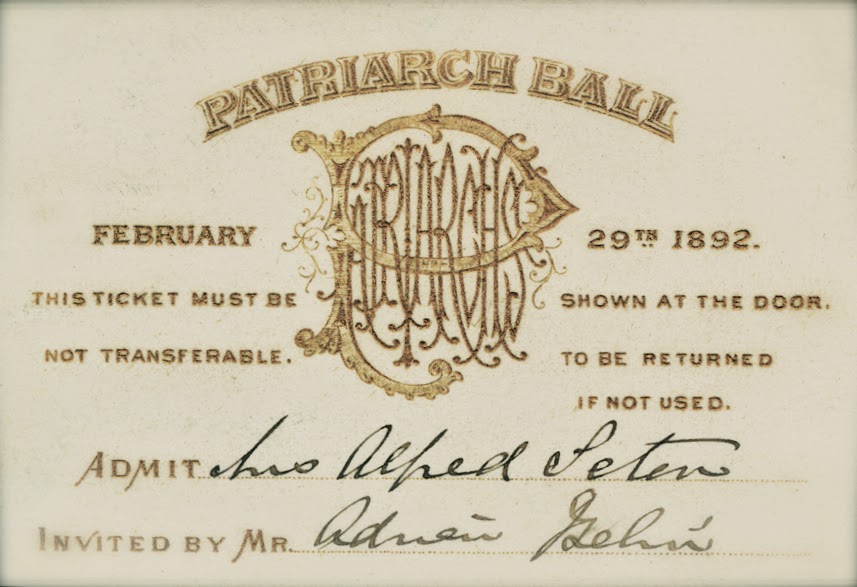
During the “Gilded Age,” every man was a potential Andrew Carnegie, and Americans who achieved wealth celebrated it as never before. In New York, the opera, the theatre, and lavish parties consumed the ruling class’ leisure hours. Sherry’s Restaurant hosted formal horseback dinners for the New York Riding Club. Mrs. Stuyvesant Fish once threw a dinner party to honor her dog, who arrived sporting a $15,000 diamond collar. 

This gilded age ball at the Astors’ 5th Avenue residence, a “double mansion” according to the news’ account, hosted nearly 300 guests. All of whom were “prominent representatives of New York society.” The midnight supper (menu below) required the entirety of Mrs. Astor’s “solid silver table service” as any menu of that size and amount would require, in the Gilded Age. The menu was as follows:

Consommé à la Princesse 
Térapène
Filet de boeuf aux champignons frais et truffes
Canard canvasback rôti
Salade de céleri et laitue
Sandwiches assortis
Glaces de fantaisies
Biscuit glacé biscuit Tortoni
Gâteaux assortis
Gelée macédoine 
Charlotte Parisienne
Fruits 
Bonbons
Café Champagne Claret Cup Lemonade Poland water

The supper was immediately followed by the cotillion. The party favors were “novel and artistic” and were pulled in “by ribbon bands, on an old French Sleigh, mounted on castors, a copy of one formerly used by Louis Quatorze.” The goodies given to guests were quite a haul! The swag for the guests included; “Wands of roses with little bells attached, tartan plaid silk sashes, with the monogram of Mrs. Astor in gold, with the date of the ball; Beardsley poster blotters, and sachets with large bouquets attached.” (Aubrey Beardsley was one of the most controversial artists of the Art Nouveau Era, and he died a year after this ball was held.) For the men, favors included; “Handsome leather tobacco pouches, with silver tops, gold and silver trimmed golf sticks and golf balls, and jeweled orders with gold chains.”

Guests were required to attend a dinner party like the Astor’s in “full dress.” Just what that meant, was a question of time and place. Strictly interpreted, it allowed gentlemen very little choice. 

A black dress coat and trowsers (sic), a black or white vest and cravat, white gloves, and pumps and silk stockings were formerly rigorously insisted upon. But the freedom-loving “spirit of the age” has already made its influence felt even in the realms of fashion, and a little more latitude is now allowed in most circles.

–––––––––––––––––––––––––––––––––––––––––––

The “American Gentleman’s Guide” enumerates the essentials of a gentleman's dress for occasions of ceremony in general, as follows: 
“A stylish, well-fitting cloth coat, of some dark color and of unexceptionable quality, nether garments to correspond, or in warm weather, or under other suitable circumstances, white pants of a fashionable material and make, the finest and purest linen, embroidered in white, if at all; a cravat and vest of some dark or neutral tint, according to the physiognomical peculiarities of the wearer and the prevailing mode; an entirely fresh-looking, fashionable black hat, and carefully-fitted modish boots, white gloves, and a soft, thin, white handkerchief.”
A lady’s “full dress” in 1897 was not as easily defined, and fashion allowed her much greater scope for the exercise of her taste in the selection of materials, the choice of colors, and the style of making. However, she had to arrive dressed “in the fashion.” 

The following is a list of just some of the notable female guests, and notes on what they wore:


Articles with highlights of what the socialites wore, written about in great detail and featured in the nationwide and international newspapers, were precursors to modern day, award shows and red-carpet, "Best Dressed and Worst Dressed" lists given out in entertaining television shows, magazines and blogs. 

While the rich wore diamonds, many wore rags. In 1890, 11 million of the nation's 12 million families earned less than $1200 per year; of this group, the average annual income was $380, well below the poverty line. Rural Americans and new immigrants crowded into urban areas. Tenements spread across city landscapes, teeming with crime and filth. Americans had sewing machines, phonographs, skyscrapers, and even electric lights, yet most people labored in the shadow of poverty. 

To those who worked in Carnegie's mills and in the nation's factories and sweatshops, the lives of the millionaires seemed immodest indeed. An economist in 1879 noted "a widespread feeling of unrest and brooding revolution." Violent strikes and riots wracked the nation through the turn of the century. The middle class whispered fearfully of "carnivals of revenge."

For immediate relief, the urban poor often turned to political machines. During the first years of the Gilded Age, Boss Tweed's Tammany Hall provided more services to the poor than any city government before it, although far more money went into Tweed's own pocket. Corruption extended to the highest levels of government. During Ulysses S. Grant's presidency, the president and his cabinet were implicated in the Credit Mobilier, the Gold Conspiracy, the Whiskey Ring, and the notorious Salary Grab. 

Europeans were aghast. America may have had money and factories, they felt, but it lacked sophistication. When French prime minister Georges Clemenceau visited, he said the nation had gone from a stage of barbarism to one of decadence -- without achieving any civilization between the two.


Sources for this post: PBS, Maura Graber Etiquette Sleuth, The “American Gentleman's Guide” and 1887's “How to Behave” by Samuel R. Wells

 🍽Etiquette Enthusiast, Maura J. Graber of The RSVP Institute of Etiquette, is the Site Editor for the Etiquipedia© Etiquette Encyclopedia

Thursday, October 10, 2013

Conformity and Etiquette

... in the Victorian Era
"La mode universelle."
You must conform, to such an extent as not to annoy and give offense, to the customs, whether in dress or other matters, of the circle in which you move. This conformity is an implied condition in the social compact. It is a practical recognition of the right of others, and shows merely a proper regard for their opinions and feelings. 

If you cannot sing in tune with the rest, or on the same key, remain silent. You may be right and the others wrong but that does not alter the case. Convince them, if you can, and bring themto your pitch, but never mar even a low accord. So if you cannot adapt your dress and manners to the company in which you find yourself, the sooner you take your leave the better. 
You may and should endeavor, in a proper way, to change such customs and fashions as you may deem wrong, or injurious in their tendency, but, in the mean time, you have no right to violate them. You may choose your company, but, having chosen it, you must conform to its rules 'til you can change them. You are not compelled to reside in Rome; but if you choose to live there, you must "do as the Romans do."

You are not compelled to reside in Rome; but if you choose to live there, you must "do as the Romans do.
The rules which should govern your conduct, as an isolated individual, were such a thing as isolation possible in the midst of society, are modified by your relations to those around you. This life of ours is a complex affair, and our greatest errors arise from our one-side views of it. We are sovereign individuals, and are born with certain "inalienable rights;" but we are also members of that larger individual society, and our rights can not conflict with the duties which grow out of that relation. If by means of our non-conformity we cause ourselves to be cut off, like an offending hand, or plucked out, like an offending eye, our usefulness is at once destroyed.
King Abdullah and Hu Jintao drink tea together.

It is related of a certain king that on a particular occasion he
turned his tea into his saucer, contrary to his custom and to the
etiquette of society, because two country ladies, whose hospitalities he was enjoying, did so. That king was a gentleman; and this anecdote serves to illustrate an important principle; namely, that true politeness and genuine good manners often not only permit, but absolutely demand, a violation of some of the arbitrary rules of etiquette.
 
From "How to Behave: A Pocket Manual of Republican Etiquette,
and Guide to Correct Personal Habits Embracing An Exposition
Of The Principles Of Good Manners"
By Samuel R. (Roberts) Wells, 1877

Monday, August 5, 2013

Gilded Age Correct Personal Habits

Lady in striped dress with a hat and an umbrella, Newark, NJ, 1880s 

Dress 
“From little matters let us pass to less, And lightly touch the mysteries of dress; The outward forms the inner man reveal; We guess the pulp before we eat the peel.” —O. W. Holmes. 

I.—THE LANGUAGE OF DRESS 

Dress has its language, which is, or may be, read and understood by all. It is one of the forms in which we naturally give expression to our tastes, our constructive faculties, our reason, our feelings, our habits—in a word, to our character, as a whole. This expression is often greatly modified by the arbitrary laws of Fashion, and by circumstances of time, place, and condition, which we can not wholly control; but can hardly be entirely falsified. Even that arch tyrant, the reigning Mode, whatever it may be, leaves us little room for choice in materials, forms, and colors, and the choice we make indicates our prominent traits of character.

II.—THE USES OF DRESS
Playing croquet 
“Dress,” that admirable Art Journal the Crayon says, “has two functions—to clothe and to ornament; and while we can not lose sight of either point, we must not attribute to the one a power which belongs to the other. The essential requirement of dress is to cover and make comfortable the body, and of two forms of dress which fulfill this function equally well, that is the better which is most accordant with the laws of beauty. But fitness must in nowise be interfered with; and the garb which infringes on this law gives us pain rather than pleasure. We believe that it will be found that fitness and beauty, so far from requiring any sacrifice for combination, are found each in the highest degree where both are most fully obtained—that the fittest, most comfortable dress is that which is most graceful or becoming. Fitness is the primary demand; and the dress that appears uncomfortable is untasteful (sic).

“But in the secondary function of dress, ornamentation, there are several diverse objects to be attained—dignity, grace, vivacity, brilliancy, are qualities distinguishing different individuals, and indicating the impression they wish to make on society, and are expressed by different combinations of the elements of beauty, line, or form, and color. When the appareling of the outer being is in most complete harmony with the mental constitution, the taste is fullest.”

III.—THE ART OF DRESS 
True art adapts dress to its uses, as indicated in the foregoing extract. It is based on universal principles fundamental to all art. The art-writer already quoted says, very truly, that “Dress is always to be considered as secondary to the person.” This is a fundamental maxim in the art of costume, but is often lost sight of, and dress made obtrusive at the expense of the individuality of the wearer. A man's vest or cravat must not seem a too important part of him. Dress may heighten beauty, but it can not create it. If you are not better and more beautiful than your clothes you are, indeed, a man or a woman of straw.

The next principle to be regarded is the fitness of your costume, in its forms materials, and colors, to your person and circumstances, and to the conditions of the time, place and occasion on which it is to be worn. Fashion often compels us to violate this principle, and dress in the most absurd, incongruous, unbecoming, and uncomfortable style. A little more self-respect and independence, however, would enable us to resist many of her most preposterous enactments. But Fashion is not responsible for all the incongruities in dress with which we meet. They are often the result of bad taste and affectation.

The first demand of this law of fitness is, that your costume shall accord with your person. The young and the old, we all instinctively know, should not dress alike. Neither should the tall and the short, the dark and the light, the pale and the rosy, the grave and the gay, the tranquil and the vivacious. Each variety of form, color, and character has its appropriate style; but our space here is too limited to allow us to do more than drop a hint toward what each requires, to produce the most harmonious and effective combination. In another work, now in the course of preparation, this important subject will be treated in detail.

“In form, simplicity and long, unbroken lines give dignity, while complicated and short lines express vivacity. Curves, particularly if long and sweeping, give grace while straight lines and angles indicate power and strength. In color, unity of tint gives repose—if somber, gravity but if light and clear, then a joyous serenity—variety of tint giving vivacity, and if contrasted, brilliancy.”

Longitudinal stripes in a lady's dress make her appear taller than she really is, and are therefore appropriate for persons of short stature. Tall women, for this reason, should never wear them. Flounces are becoming to tall persons, but not to short ones. The colors worn should be determined by the complexion, and should harmonize with it. "Ladies with delicate rosy complexions bear white and blue better than dark colors, while sallow hues of complexion will not bear these colors near them, and require dark, quiet, or grave colors to improve their appearance. Yellow is the most trying and dangerous of all, and can only be worn by the rich-toned, healthy-looking brunette."

In the second place, there should be harmony between your dress and your circumstances. It should accord with your means, your house, your furniture, the place in which you reside, and the society in which you move.
Ladies in Walking Dresses; “... your costume should be suited to the time, place, and occasion on which it is to be worn.” 

Thirdly, your costume should be suited to the time, place, and occasion on which it is to be worn. That summer clothes should not be worn in winter, or winter clothes in summer, every one sees clearly enough. The law of fitness as imperatively demands that you should have one dress for the kitchen, the field, or the workshop, and another, and quite a different one, for the parlor; one for the street and another for the carriage, one for a ride on horseback and another for a ramble in the country. Long, flowing, and even trailing skirts are beautiful and appropriate in the parlor, but in the muddy streets, draggling in the filth, and embarrassing every movement of the wearer, or in the country among the bushes and briers, they lose all their beauty and grace, because no longer fitting.

The prettiest costume we have ever seen for a shopping excursion or a walk in the city, and especially for a ramble in the country, is a short dress or frock reaching to the knee, and trowsers of the common pantaloon form, but somewhat wider. Full Turkish trowsers might be worn with this dress, but are less convenient. The waist or body of the dress is made with a yoke and belt, and pretty full. The sleeves should be gathered into a band and buttoned at the wrist. A saque or a basque of a different color from the waist has a fine effect as a part of this costume. Add to it a gipsy hat and good substantial shoes or boots, and you may walk with ease, grace, and pleasure. This was the working and walking costume of the women of the North American Phalanx, and is still worn on the domain which once belonged to that Association, though the institution which gave it its origin has ceased to exist. If you reside in a place where you can adopt this as your industrial and walking costume, without too much notoriety and odium, try it. You must judge of this for yourself. 

We are telling you what is fitting, comfortable, and healthful, and therefore, in its place, beautiful, and not what it is expedient for you to wear. The time is coming when such a costume may be worn anywhere. Rational independence, good taste, and the study of art are preparing the way for the complete overthrow of arbitrary fashion. Help us to hasten the time when both women and men shall be permitted to dress as the eternal principles, harmony, and beauty dictate, and be no longer the slaves of the tailor and the dressmaker.

But without adopting any innovations liable to shock staid conservatism or puritanic prudery, you may still, in a good measure, avoid the incongruities which we are now compelled to witness, and make your costume accord with place and occupation.

In the field, garden, and workshop, gentlemen can wear nothing more comfortable and graceful than the blouse. It may be worn loose or confined by a belt. If your occupation is a very dusty one, wear overalls. In the counting-room and office, gentlemen wear frock-coats or sack coats. They need not be of very fine material, and should not be of any garish pattern. In your study or library, and about the house generally, on ordinary occasions, a handsome dressing-gown is comfortable and elegant.

A lady, while performing the morning duties of her household may wear a plain loose dress, made high in the neck, and with long sleeves fastened at the wrist. It must not look slatternly, and may be exceedingly beautiful and becoming.

In reference to ornament, “the law of dress,” to quote our artist-friend again, "is, that where you want the eye of a spectator to rest (for we all dress for show), you should concentrate your decoration, leaving the parts of the apparel to which you do not want attention called, as plain and negative as possible—not ugly, as some people, in an affectation of plainness, do (for you have no right to offend the eye of your fellow-man with any thing which is ugly), but simply negative.

IV.—MATERIALS, ETC…
Ladies in outdoor dresses, in the 1880s 
The materials of which your clothes are made should be the best that your means will allow. One generally exercises a very bad economy and worse taste in wearing low-priced and coarse materials. For your working costume, the materials should of course correspond with the usage to which they are to be subjected. They should be strong and durable, but need not therefore be either very coarse or at all ugly. As a general rule, it costs no more to dress well than ill.

A gentleman's shirts should always be fine, clean, and well-fitted. It is better to wear a coarse or threadbare coat than a disreputable shirt. The better taste and finer instincts of the ladies will require no hint in reference to their "most intimate appareling." True taste, delicacy, and refinement regards the under clothing as scrupulously as that which is exposed to view.

The coverings of the head and the feet are important and should by no means be inferior to the rest of your apparel. Shoes are better than boots, except in cases where the latter are required for the protection of the feet and ankles against water, snow, or injury from briers, brambles, and the like. Ladies' shoes for walking should be substantial enough to keep the feet dry and warm. If neatly made, and well-fitting, they need not be clumsy. Thin shoes, worn on the damp ground or pavement, have carried many a beautiful woman to her grave. If you wish to have corns and unshapely feet, wear tight shoes; they never fail to produce those results.

The fashionable fur hat, in its innumerable but always ugly forms, is, in the eye of taste, an absurd and unsightly covering for the head; and it is hardly less uncomfortable and unhealthful than ugly. The fine, soft, and more picturesque felt hats now, we are glad to say, coming more and more into vogue, are far more comfortable and healthful. A light, fine straw hat is the best for summer.

The bonnets of the ladies, in their fashionable forms, are only a little less ugly and unbecoming than the fur hats of the gentlemen. A broad-brimmed or gipsy hat is far more becoming to most women than the common bonnet. We hope to live to see both “stove-pipe hats” and “sugar-scoop bonnets” abolished; but, in the mean time let those wear them who must.

V.—MRS. MANNERS ON DRESS 
“Good taste is indispensable in dress, but that, united to neatness, is all that is necessary—that is the fabled cestus of Venus which gave beauty to its wearer.”

Mrs. Manners, the highest authority we can possibly quote in such matters, has the following hints to girls, which we can not deny ourselves the pleasure of copying, though they may seem, in part, a repetition of remarks already made:

“Good taste is indispensable in dress, but that, united to neatness, is all that is necessary—that is the fabled cestus of Venus which gave beauty to its wearer. Good taste involves suitable fabrics—a neat and becoming 'fitting' to her figure—colors suited to her complexion, and a simple and unaffected manner of wearing one's clothes. A worsted dress in a warm day, or a white one in a cold day, or a light, thin one in a windy day, are all in bad taste. Very fine or very delicate dresses worn in the street, or very highly ornamented clothes worn to church or to shop in, are in bad taste. Very long dresses worn in muddy or dusty weather, even if long dresses are the fashion, are still in bad taste.

“Deep and bright-colored gloves are always in bad taste; very few persons are careful enough in selecting gloves. Light shoes and dark dresses, white stockings and dark dresses, dark stockings and light dresses, are not indicative of good taste. A girl with neatly and properly dressed feet, with neat, well-fitting gloves, smoothly arranged hair, and a clean, well-made dress, who walks well, and speaks well, and, above all, acts politely and kindly, is a lady, and no wealth is required here. Fine clothes and fine airs are abashed before such propriety and good taste. Thus the poorest may be so attired as to appear as lady-like as the wealthiest; nothing is more vulgar than the idea that money makes a lady, or that fine clothes can do it.”

VI.—WEARING THE HAIR AND BEARD
Gentleman with moustache wearing a hat, NY in 1889
The hair and beard, in one of their aspects, belong to the dress. In reference to the style of wearing them, consult the general principles of taste. A man to whom nature has given a handsome beard, deforms himself sadly by shaving—at least, that is our opinion; and on this point fashion and good taste agree. The full beard is now more common than the shaven face in all our large cities.
Victorian hairstyles and bonnets 

In the dressing of the hair there is room for the display of a great deal of taste and judgment. The style should vary with the different forms of face. Lardner's “Young Ladies' Manual” has the following hints to the gentler sex. Gentlemen can modify them to suit their case:

After a few experiments, a lady may very easily decide what mode of dressing her hair, and what head-dress renders her face most attractive.

Ringlets hanging about the forehead suit almost every one. On the other hand, the fashion of putting the hair smoothly, and drawing it back on either side, is becoming to few; it has a look of vanity instead of simplicity: the face must do every thing for it, which is asking too much, especially as hair, in its pure state, is the ornament intended for it by nature. Hair is to the human aspect what foliage is to the landscape.

Light hair is generally most becoming when curled. For a round face, the curls should be made in short, half ringlets, reaching a little below the ears. For an oval face, long and thick ringlets are suitable; but if the face be thin and sharp, the ringlets should be light, and not too long, nor too many in number.

When dark hair is curled, the ringlets should never fall in heavy masses upon the shoulders. Open braids are very beautiful when made of dark hair; they are also becoming to light-haired persons. A simple and graceful mode of arranging the hair is to fold the front locks behind the ears, permitting the ends to fall in a couple of ringlets on either side behind.

Another beautiful mode of dressing the hair, and one very appropriate in damp weather, when it will keep in curl, is to loop up the ringlets with small hair-pins on either side of the face and behind the ears, and pass a light band of braided hair over them. 

Persons with very long, narrow heads may wear the hair knotted very low at the back of the neck. If the head be long, but not very narrow, the back hair may be drawn to one side, braided in a thick braid, and wound around the head. When the head is round, the hair should be formed in a braid in the middle of the back of the head. If the braid be made to resemble a basket, and a few curls permitted to fall from within it, the shape of the head is much improved. 

VII.—ART VS. FASHION 
Fine gentleman greeting a lady on the street 

Observe that we have been laying down some of the maxims deduced from the principles of art and taste, in their application to dress, and not promulgating the edicts of Fashion. If there is a lack of harmony on some points, between the two, it is not our fault. We have endeavored to give you some useful hints in reference to the beautiful and the fitting in costume, based on a higher law than the enactments of the fashion-makers. You must judge for yourself how far you can make the latter bend to the former. We have been talking of dress as an individual matter. In future chapters we shall have occasion to refer to it in its relation to the usages of society.


VIII.—SIGNS OF “THE GOOD TIME COMING.” 
N. P. Willis, in the Home Journal, writing on the dress-reform agitation, thus closes his disquisition:

“We repeat, that we see signs which look to us as if the present excitement as to one fashion were turning into a universal inquiry as to the sense or propriety of any fashion at all. When the subject shall have been fully discussed, and public attention fully awakened, common sense will probably take the direction of the matter, and opinion will settle in some shape which, at least, may reject former excesses and absurdities. 

“Some moderate similarity of dress is doubtless necessary, and there are proper times and places for long dresses and short dresses. These and other points the ladies are likely to come to new decisions about. While they consult health, cleanliness, and convenience, however, we venture to express a hope that they will get rid of the present slavish uniformity—that what is becoming to each may be worn without fear of unfashionableness, and that in this way we may see every woman dressed somewhat differently and to her own best advantage, and the proportion of beauty largely increased, as it would, thereby, most assuredly be.”


FOOTNOTE: “Hints toward Physical Perfection; or, How to Acquire and Retain Beauty, Grace, and Strength, and Secure Long Life and Perpetual Youth.” 
From the book “How To Behave: A Pocket Manual Of Republican Etiquette, And Guide To Correct Personal Habits” 
by Samuel R Wells, 1887


 🍽Etiquette Enthusiast, Maura J. Graber of The RSVP Institute of Etiquette, is the Site Editor for the Etiquipedia© Etiquette Encyclopedia