Showing posts with label Etiquette for Tipping. Show all posts

Tuesday, May 12, 2026

Beauty Parlor Tipping

While it is customary to tip in large shops where the service is more or less impersonal, in a small shop where the owner does all the work and the service is more personal, a tip might offend rather than please. 

Q. — How does one tip gracefully in a beauty parlor, when and what does one say at the time? High as shampoos are, I resent tipping anyhow, but understand one does in this city anyway. 

A. —As for tipping, I don't believe it requires either grace or conversation. The tip is given when a service has been performed and it is not necessary for the giver to say anything. While it is customary to tip in large shops where the service is more or less impersonal, in a small shop where the owner does all the work and the service is more personal, a tip might offend rather than please. 

In both cases many patrons prefer to express their appreciation by gifts now and then, but only when they go to the same operators all the time. — From the Log of Life, 1943


🪞Etiquette Enthusiast, Maura J. Graber, of The RSVP Institute of Etiquette, is the Site Editor for the Etiquipedia© Etiquette Encyclopedia💇🏻‍♀️

Saturday, December 24, 2022

Christmas Tipping Etiquette

“A Christmas bonus is something you give to someone who has served you all year,” said Judith Martin, whose syndicated persona is the etiquette expert Miss Manners. “It is not something you do because you are afraid not to.”

Christmas Cookies? Cash? Or a Mink? The Annual Tip…


Dale Burg would love to know something about her neighbors, something she says she would never dare to ask. She drops oblique hints, hoping they will volunteer a fact or two. She wonders about them when they’re not around and glances at them as they walk by. But she doesn't say a thing. “Of course I wouldn't ask them how much they tip,” she said of the holiday gifts she and other tenants give the staff of her Upper East Side building. “I wouldn't ask them how much they tip like I wouldn't ask them how much they earn.”

Tipping at Christmastime has become a rule without rules: Almost everyone feels he is supposed to do it, but few are sure exactly whom to tip and how much. The experts offer guidelines: “A Christmas bonus is something you give to someone who has served you all year,” said Judith Martin, whose syndicated persona is the etiquette expert Miss Manners. “It is not something you do because you are afraid not to.”

Professionals offer insights: “As a rule, people who overtip more tend to be insecure,” said Dr. Norman Sussman, a Manhattan psychiatrist. “People who tend to be strict in their tipping are not cheap, they may just be more secure.”

Most of the specifics of Christmas tipping, however, are decided by individuals making their own rules as they go along, guided by feelings that range from generosity to a sense of obligation to a fear of retribution.

Some, for example, think of a tip as a way to give thanks. “I'm more likely to give Christmas bonuses to people I have a personal relationship with, people who have gone out of their way for me,” said Debra Goldberg, a Connecticut writer.

Others see a tip as a bribe of sorts. “I value that table by the window,” said one businessman, who plans to give $150 to the 
maître d'hôtel of the Four Seasons to insure that he gets his prized table all next year.

Still others see a tip as protection of another kind. “A friend of mine in the houseware business tipped his doorman with a set of kitchen counter canisters,” said Miss Burg. “Then he wondered why he was the only one in the building getting robbed.”

And then there are those who do not tip at all. “I had my last haircut on Dec. 6, I'll have my next one in the middle of January because I can’t deal with a Christmas tip,” said Joy Marcus, a New York University law student.

In short, as many tips can change hands this time of year as there are encounters in a day and for as many reasons. Doormen, superintendents and other personnel often receive tips, as do garage attendants, newspaper boys, gardeners, deliverymen and housekeepers. It is against the law to give gifts to postal workers but many get them nonetheless. Employees receive money from their employers, but the gift is called a Christmas bonus. And employees give gifts to their bosses as well; then it is usually called a Christmas present.

One Long Island doctor gives a bonus to all the employees in his office (from $100 to a week’s salary, depending upon how long they have worked there), the postman (“I know I'm not supposed to but I give him $25 anyway”), the two men who deliver supplies to his office ($5 each), the newspaper boys ($5 each), the sanitation department ($25 to be divided as they wish), the hairdresser who cuts the entire family’s hair (a gift worth about $25) and the woman who makes appointments at the hairdresser ($10). The bill adds up, he says, but, now that his children are grown, at least he no longer has to give something to the school bus driver and to all their teachers.

Gweno Mattes, in contrast, is just beginning to tip the bus driver and the schoolteacher. Her son, Dylan, is 7 years old and attends the United Nations International School. The parents of the 10 children at his bus stop have collected a fund for the driver, and his teacher gets a present as well. “He's very fussy about what he gives her,” Mrs. Mattes said. “He wants it to be the best present in the class.” Last year the gift was a bottle of champagne and some Danish cookies, and this year’s present has not been determined yet. “It’s always a gift, not money,” Mrs. Mattes said. “You can’t give money to a teacher.”

Therein lies the annual problem: to give cash or to give creatively.

“The business world runs on money,” said Judith Martin. “If you do a good job, do you want your boss to go out and buy you a sweater you don't need?”

To help tenants give money, many buildings, particularly large ones, distribute lists of personnel. One Lincoln Plaza, for example, lists 40 names, from security men to elevator operators to office secretaries, along with the length of time each person has worked at the building. There is a locked box in the lobby, and tenants can either submit envelopes for individual workers or a larger amount to be divided equally among the staff. The usual gift per person runs from $10 to $40. In smaller buildings the tip would be more, from $20 to $50 in each employees' envelope.

Other people who often receive cash tips are restaurant employees (the equivalent of an average bill to be divided among the service staff as a whole, with something extra, from $10 to $50 depending upon the prices of the restaurant, for the
maître d'hôtel and the bartender), parking garage staff (between $20 to $50 to be divided among the staff), hairdressers (roughly the cost of one visit or a gift worth that amount), house cleaners (the equivalent of one month's pay) and newspaper boys and girls (about $5).

Many people, however, are uncomfortable giving an envelope filled with impersonal green money.

“I prefer to give gifts instead of giving cash,” Mrs. Goldberg said. “Then it somehow comes under the heading of a Christmas present rather than a tip.”

Last year, those gifts included a mink coat given to the owner of a hair salon and a diamond ring to a travel agent. A Manhattan couple gave their live-in nanny a fur jacket. “Something practical, not sable or anything,” said Linda Lee, the personal shopper at Macy's who helped select the coat. “She had been with the family for 20 years. She had raised their three children.”

In a more practical realm, robes and lingerie, she said, are a popular gift for housekeepers, and fresh food, such as a whole side of smoked salmon or a tin of caviar, are good gifts for anyone. It is common for bosses and secretaries to get each other scarfs, gloves, leather goods and umbrellas, she said.

Lenore Valery, for example: “I don't give cash, it's crass,” said Miss Valery, owner of a facial salon, who once presented a ribbon-ringed bouquet of small umbrellas to a member of her staff who was always buying the items and misplacing them. The card read: “For the woman who has everything, but keeps losing it.”

Other people give gifts rather than cash because it is all they can afford - a $10 gift is less expensive to give than a $20 bill; homemade presents are the least expensive gifts of all.

Nancy Conroy and Barclay Leib were married this summer and plan to give Christmas cookies and cash to the superintendent and the handyman in their building on the East Side: tollhouse cookies and, if they have extra time, sugar cookies with colored sprinkles. “It's a good supplement,” Miss Conroy said. “It makes the tip seem bigger.”

Then, as if hearing her own words and wondering if they would be quite as convincing to her superintendent, she asked, “It's O.K. to do it this way, isn't it?” – By Lisa Belkin for the NYT, 1984


🍽Etiquette Enthusiast, Maura J. Graber, is the Site Editor for the Etiquipedia© Etiquette Encyclopedia

Thursday, May 12, 2022

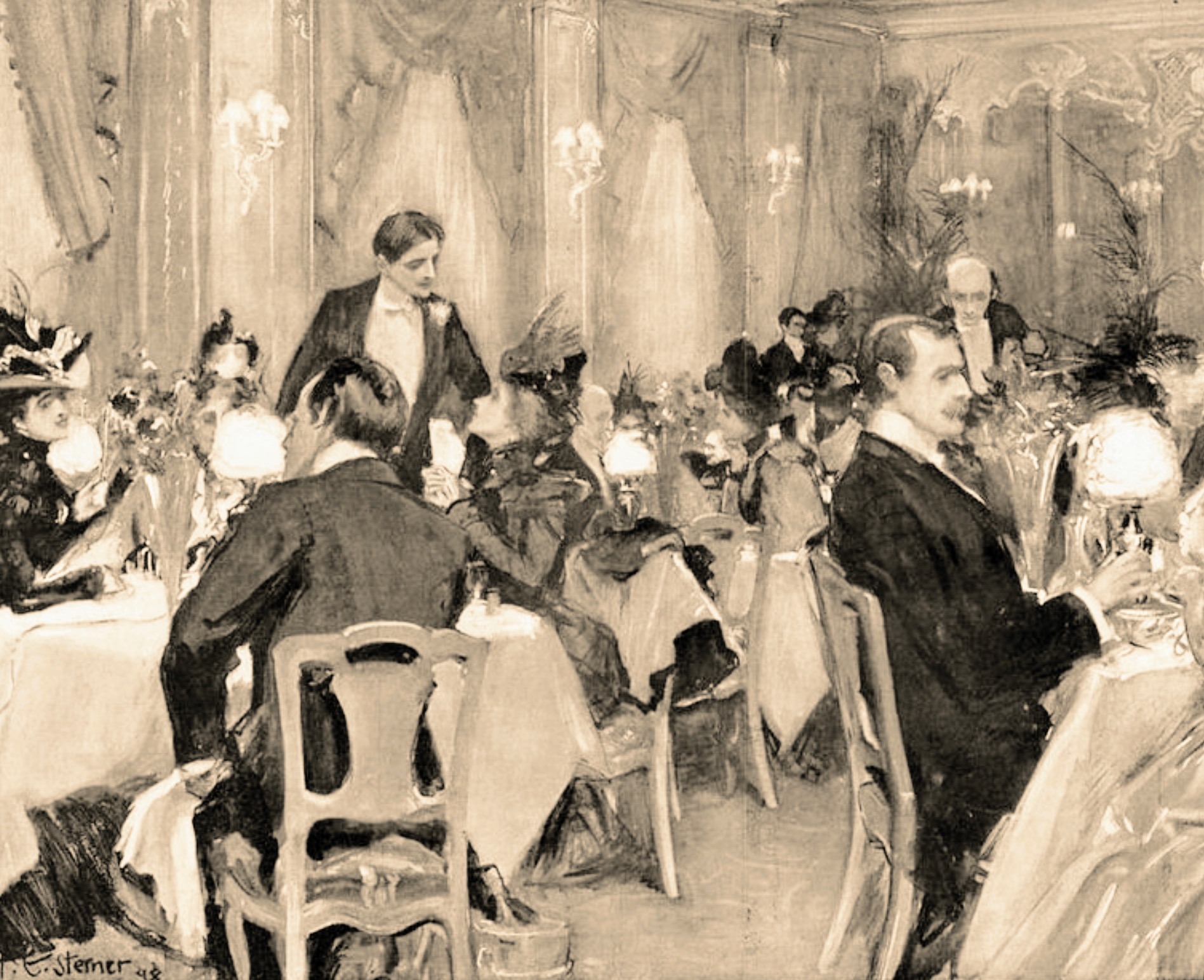
Etiquette and “Feeing” Waiters

“Not long ago I saw a man in a New-York restaurant tuck a five-dollar bill in the waiter’s hand at the beginning of a luncheon he was ordering for his party of two ladies and himself. This seemed to me as bad in its way as the five cent fee. We Americans do not take kindly to the fee system. It is contrary to the principles of our institutions, but it, is apparently beyond control, and we women, with the rest, must accept, if in moderation.”

Gilded Age Tipping in America

“Women are accused of being inclined to meanness in the matter of feeing waiters,” commented a woman recently, “but I think, perhaps, those who are take their cue from a meanly-inclined husband or brother. On a dining car recently a man sat opposite me who ate stolidly through the courses of the dollar dinner, had a bottle of Apollinaris opened for him, and left 5 cents by his plate when he had done. The waiter pointedly allowed the nickel to remain until every dish had been removed, undoubtedly hoping that the persons at the adjacent tables would see the small coin before, with an indescribable flip, he pocketed it.

“Not long ago I saw a man in a New-York restaurant tuck a five-dollar bill in the waiter’s hand at the beginning of a luncheon he was ordering for his party of two ladies and himself. This seemed to me as bad in its way as the five cent fee. We Americans do not take kindly to the fee system. It is contrary to the principles of our institutions, but it, is apparently beyond control, and we women, with the rest, must accept, if in moderation.

“Among my women friends I find no general rule in regard to the matter. One woman whom I consider rather fast doesn't fee because ‘it's vulgar’; another, who is proverbially extravagant, because she ‘can't afford it’; still another because the waiter won’t expect it from a woman, and so on. I’ve seen a rich woman leave 5 cents and a poor one leave 50 cents. A favorite practice when several women are lunching together is to divide the fee, each contributing an equal part. Men, I believe, never do this, though I don't see why it isn’t a sensible notion. I should really be glad of some authoritative utterance concerning the etiquette of women’s feeing.”– New York Times, 1892


Etiquette Enthusiast, Maura J. Graber, is the Site Editor for the Etiquipedia© Etiquette Encyclopedia

Tuesday, March 2, 2021

Etiquette for Tipping Outside the U.S.


“The most glaring way to show you’re an American — besides your accent — is to over-tip. In some countries, particularly Asia, it isn’t even considered polite to tip. When you do it in these places, you’re saying that the person you’re tipping isn’t hospitable enough to provide service without a bribe.”

Overseas travelers, here’s a tip: Don’t

Pssst! I’ve got a secret that can save you money.

You tip too much when you travel overseas. In some cases, you hand out so much money in gratuities that people think you’re crazy — and a little foolish.So please stop. Otherwise, in no time at all, the entire world will be ponying up 18% every time they buy pommes frites in the Caribbean or tamales de pollo in Guatemala.

Anna Post, one of the etiquette mavens at the Emily Post Institute, learned this lesson the hard way while living in Italy.

“It was difficult for me not to over-tip,” she said. “But eventually, I heard from some of the workers in restaurants I visited regularly that Americans tend to over-tip. Of course, they said it with a smile. Then I realized I was doing it too.”

Lynn Staneff, of Magellan’s travel supply company, spent several months researching overseas tipping. Her findings: “We over-tip outrageously,” she said.

“The most glaring way to show you’re an American — besides your accent — is to over-tip. In some countries, particularly Asia, it isn’t even considered polite to tip. When you do it in these places, you’re saying that the person you’re tipping isn’t hospitable enough to provide service without a bribe.”

Tipping is a relatively recent custom, even in the United States. It was considered demeaning here until the 20th century, etiquette expert Miss Manners, a.k.a. Judith Martin, has written in her columns. Before that, many Americans thought that accepting a bit of extra money from a customer, besides your regular pay, seemed like a handout. It smacked of old-world servitude.

We got over that, to some people’s dismay. As Miss Manners is fond of saying, "[I have] been railing against tipping for years, as a vile system that brings out the worst in both giver and receiver.”

Unfortunately, as we wander to the far corners of the world, we’re spreading that “vile system.”

“The more Americans travel, the more countries expect tips,” Staneff said. “Pretty soon everyone will tip 15% everywhere.”

And some countries still consider it demeaning.

In Japan, for instance, tipping is viewed as insulting. In other countries, it’s considered disrespectful to hand a tip to a waiter. That’s why small trays are left on the table in those regions, Post said.

“It’s so important to be considerate and respectful of the countries or culture you’re visiting,” she said. “You need to remember you’re not at home.”

Respect is what it’s all about, many experts agree.

“As the world shrinks, it behooves us to learn the nuances of other cultures,” said Ramani Durvasula, associate professor of psychology at Cal State L.A. “To do so is the most fundamental way of showing respect.”

There’s another ethical issue involved in tipping abroad. Some people think they should spread the wealth, especially in developing nations, where poverty is prevalent. They think tipping is ethically correct, even if it is a cultural error.

“Are Americans tipping to ‘pay it forward’ and share a few dollars with someone who would greatly benefit, or [are they doing it in] ignorance of the local customs because they couldn’t be bothered to learn them?” Durvasula asked.

“At the end of the day,” she said, “the responsible traveler does her homework, learns the social mores and applauds excellent service with a compliment.”

How does one go about doing that homework?

“Check guidebooks in the region you’re going to,” Post suggested. “Or ask the concierge. Just say, ‘We’re from out of town, and we don’t know what the custom is on tipping.’ ”

You may find that a tip is included in the bill. That’s true in many European restaurants and hotels.

You may learn that tipping is common in the larger cities in a region but not in the countryside.

Or you may be told that there’s no tipping at all, such as in Vietnam, Thailand, Fiji and in parts of the South Pacific.

And that’s information you wouldn’t want to ignore.— R. McClure, LA Times, 2007


Etiquette Enthusiast, Maura J. Graber, is the Site Editor for the Etiquipedia© Etiquette Encyclopedia