Showing posts with label Mexican Etiquette History. Show all posts

Sunday, November 2, 2025

Dance Etiquette vs Cultural Customs


“In Mexico it was a serious breach of etiquette for a woman to refuse a dance and then allow another man to have the same dance.” In the United States, it has actually always been considered ill-mannered to refuse a man a dance when asked politely, then to go on to dance with another gentleman who was not already written in on your dance card. Presumably, this was the reason for the popularity of the dance card and for dance cards filling up so quickly at the beginning of an evening. Gentlemen would ask for certain dances and their names would be written on the line for that particular numbered dance. A young woman’s escort or date to the dance was noted by an X on the lines for the particular dances promised to him.–   Public domain image of “Lolita & Juan” on a postcard.
RESENTS “QUEER” U.S. CUSTOMS AND LANDS IN JAIL

Ignacio Martinez. 21, Mexican, can’t understand American customs. Because his wife refused to dance with him a second time on Saturday night at a dance held by Mexicans in El Centro, and because she then accepted the dance with another man, Ignacio objected. He made such a disturbance that a city police officer was summoned and the young husband was placed under arrest. He was fined $30.00 in police court this morning. Failing to raise the money be was taken to the county jail to begin a 15 day term.
 
Ignacio said that in Mexico it was a serious breach of etiquette for a woman to refuse a dance and then allow another man to have the same dance. Martinez was recently arrested on a charge of wife abandonment, but when he agreed to provide a home for his wife and to support her, he was released. The two are said to have separated again since then. – Imperial Valley Press, 1924


šŸ½Etiquette Enthusiast, Maura J. Graber of The RSVP Institute of Etiquette, is the Site Editor for the Etiquipedia© Etiquette Encyclopedia

Thursday, December 9, 2021

Dining Table Customs in Mexico

If your food doesn’t arrive to the table in the tortillas, you can use them as they were used in 1883. Just don’t try spitting on the floor. It’s definitely fallen out of fashion, and in restaurants, is most likely illegal and violates health codes.
-Image source, Etiquipedia private library

Fannie Brigham Ward, in a letter from the City of Mexico to the St. Paul Pioneer-Press, thus relates some experiences in dining in that suburb of the United States: “During eight months’ residence in Mexico, I have not seen a bit of butter, potato, chop or steak, egg cooked by itself, tea, sauce, cake, pie or pudding, or those common vegetables which we consider so indispensable. Napkins are rarely used, each person wiping his or her face and hands on that portion of the tablecloth which happens to be nearest, and afterward, patronizing one of the before mentioned corner wash-stands. 

Eating with the fork is not at all according to etiquette, but the knife or spoon must be used, or – more properly– a tortilla. Mexicans manage the latter with as much dexterity as a Chinese does his chop-sticks, curving it between the fingers till it forms a something like a spoon, and scooping up the food with it– eating spoon and all. The very old people and the lower classes use tortillas altogether instead of knives, forks or spoons, the latter “new fangled notions” being of comparatively recent introduction. It requires considerable practice to successfully manage the tortilla scoop, as I have learned from sad experience. 

After the banquet is ended, and at intervals during its progress, if one feels so inclined, the mouth is filled with water from the goblet, rinsed with more or less emphasis between the teeth, and then the water is squirted upon the floor. In this process they all become expert, from the lady of the house to the smallest child. When fresher water is required, that in the glasses is carelessly tossed up on the dirt floor, where it can do no harm. – The Napa Register, 1883

 Etiquette Enthusiast, Maura J. Graber, is the Site Editor for the Etiquipedia© Etiquette Encyclopedia

Friday, October 16, 2020

Yucatecan Etiquette

A Yucatecan treat, pan dulce, or “sweet bread.”
Photo from the Etiquipedia Private Library


Some of the Commendable Traits of Our Spanish-American Neighbors

YucatĆ”n gentlemen, higher in the social scale than John the Baptist, are less extravagant in their expressions of gallantry. In saluting ladies they still observe the Spanish form “a los pies de usted,”— “at your feet:" to which figure of speech the correct response is “Beso a usted la mano,” —“I kiss the hand to you." In closing an ordinary letter of business or friendship every body in this part of the world always adds B. S. M., meaning “Beso sus manos,” — “I kiss your hands." 

The Spanish-American, like his Latin brethren across the sea, talks quite as much with hands and eyes, as with his tongue, and shrugs his shoulders as frequently as a Frenchman. One of the prettiest of the many gestures in general use here, is called the “beso soplado” — throwing kisses by gathering the fingers of the right hand into a close group, touching the lips, then throwing them out like a fan, at the same time, blowing on the hand as it is outstretched toward the person for whom the demonstration is intended, thus signifying that five kisses are given at once. 

Gentlemen manifest their appreciation of female beauty by gazing intently into the faces of the ladies, whether in the street, in the church or at the opera. This custom, which elsewhere would be resented as an impertinence, is here accepted as it is meant, merely as a flattering tribute to the fair one’s charms. Between acts of the opera, men rise to their feet, and with leveled glasses, pay admiring homage to those dark-eyed seƱoritas, whose beauty has attracted them. Then the pretty language of the fan comes into play, and the well-pleased maidens carry away blissful memories of gallant knights and “eyes that spake again.”

In ascending a stairway, the lady takes the gentleman’s arm, as at the North: but in descending, he always goes a step or two ahead, holding her firmly by the hand, to avoid accidents, with as much solicitude as if she were an invalid or a cripple. The same careful attention is offered to the veriest stranger, as naturally, and with far more regularity and promptitude than our own countrymen show in relinquishing a seat in a crowded car to one of the weaker sex. 

On leaving the house after having made a friendly call, the salutation with the hand, the oft repeated bow and the “a los pies de usted,” are continued, just as long as one is in sight, and instead of finding any thing tedious and wearisome in this long-drawn-out civility, one feels as if he had been transported back to the days of chivalry. One highly commendable trait of Yucatecan character is that they will never say any thing disagreeable to you, either on their own account or in repeating the gossip to others. For instance, in alluding to one’s age, the greatest delicacy is always exercised. 

If one is considered advanced in years, he is spoken of as “viejito — “a little old.” A girl may remain unwedded thirty years or more before she is considered “a soltera,” or, in plain English, an old maid; and after that, nothing more offensive is ever said than that she is “very fastidiosa,”— “very difficult to please,” and they sometimes add that she is “good to dress the Saints,” meaning that, having no family of her own to make garments for, she may devote her time to the holy work of making vestments for the sacred images. — Fannie B.Ward, in Troy, N.Y. Times, 1888


Etiquette Enthusiast, Maura Graber, is the Site Editor for the Etiquipedia© Etiquette Encyclopedia

Thursday, October 15, 2020

Etiquette and The Lover's Secretary

                                              
“The significance of the varied wearing and handling of the sombrero” is actually the etiquette and significance of any hat. The word “sombrero” translates to “hat” in English. “Cachucha” is the Spanish word for “cap,” as in “baseball” or “trucker’s cap.” “Gorro” is also a Spanish word for “hat.”


The “Lover’s Secretary”
or
“Mexican Lover” Guide 


There is on sale everywhere, and in universal use, a cheaply printed little pamphlet entitled “El Secretario de los Amantes.” It is the guide and handbook of lovers. It contains the language of flowers, the significance of the varied wearing and handling of the sombrero, the language of fan, the language of fruits, the meanings of the varied use of the handkerchief, emblems in designating the hours of day and night in making appointments, the use of the numerals in cipher writing, several short chapters on the conduct of a love affair, and the deaf mute alphabet for one hand. This literary gem seems to be more studied than any other in the republic. —Napa Weekly, 1888

This 19th century etiquette book from a Mexico is filled with numerous chapters denoting the languages of colors, fruits, flowers, handkerchiefs, hats, etc..., as well as a handy code for sending secret messages to a lover.


Etiquette Enthusiast, Maura Graber, is the Site Editor for the Etiquipedia© Etiquette Encyclopedia

Wednesday, August 19, 2020

19th C. Wives‘ Etiquette of Mexico and Spain

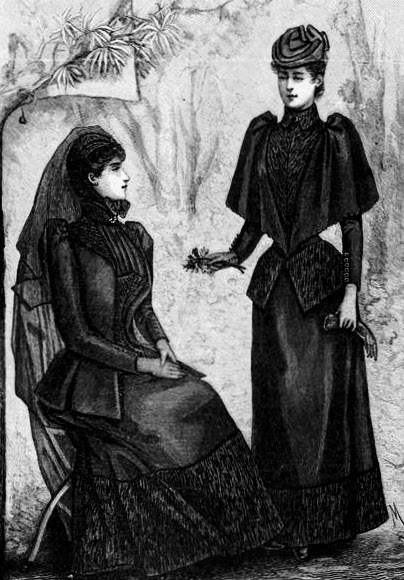
An 1891 advertisement for mourning dresses. — The etiquette of funerals in Mexico does not permit the female relations of deceased to attend. Only men attend the departed to the church and the tomb. 


The etiquette of funerals in Mexico does not permit the female relations of deceased to attend. Only men attend the departed to the church and the tomb. Funerals are so expensive that they often ruin business men. All female relatives, even to cousins and children, must wear deep mourning for two years. During the mourning none of the ladies of the household must be seen in public. Bodies are buried encased in laces and decked with precious stones. 

In Mexico, as in Spain and other southern countries, a lady retains her maiden name after marriage, and though she annexes to it, that of her husband by means of a “de,” she is universally known by her own family name. It is considered more courteous to address even elderly married ladies SeƱorita (Miss), instead of SeƱora (Madame.) The lady of the house is always called by her servants and dependents La NiƱa (the little girl), though she may have attained the age of eighty. — From ‘Of General Interest,’ 1884


Etiquette Enthusiast, Maura J Graber, is the Site Editor for the Etiquipedia© Etiquette Encyclopedia
Wednesday, August 1, 2018

Mexican Courtesy and Hospitality

The hospitable Mexican offers his best to the guest. The best chair, the best bed, the best food and the head of the table is reserved for the guest. - Photo Source Pinterest

The courtesy and hospitality of the Mexican people have never been affected or changed by the rush of life in the United States, regardless of the economic level, or the amount of education a Mexican posseses. Courtesy is still a chief characteristic of the older Mexican residents of the local colony. Frequently, goods will be purchased from a peddler which are not desired rather than give offence by refusal, or to appear discourteous.

Regardless of how busy a host or hostess may be, the Mexican never expresses by word or action the slightest impatience at the length of your call. The hospitable Mexican offers his best to the guest. The best chair, the best bed, the best food and the head of the table is reserved for the guest. Deference to the slightest desire of a guest is always shown, regardless of the discomforts of the remainder of the family group. - LaHabra Star News- 1932


Etiquette Enthusiast, Maura J. Graber, is the Site Editor for the Etiquipedia© Etiquette Encyclopedia

Tuesday, January 19, 2016

Old Mexican Royal Etiquette

The visit of the Empress Elisabeth at the Castello di Miramare in 1861; Charlotte of Belgium (in white dress) welcomes Elisabeth, while her husband Ferdinand Maximilian and his brother Emperor Franz Joseph I, wait on the boat.

Mexican etiquette puts on the newcomer the responsibility of making all the social advances. Visitors to any principal Mexican city, whatever their rank, foreign ministers not excepted, must in solemn print give notice to every family, of any consideration resident in the municipality, that they have arrived and put themselves and their homes at the disposition of the residents. Otherwise, they will receive no social attention whatever.

Intending visitors to that country need to be equipped with this knowledge of the customs prevailing there. The point of etiquette involved is peculiar to that country, having no known existence elsewhere. The people are very kind and hospitable when approached in their own way, and none other is understood or taken any notice of by them. —Red Bluff Daily News, 1905


Etiquette Enthusiast, Maura J Graber, is the Site Editor for the Etiquipedia© Etiquette Encyclopedia