Showing posts with label German Etiquette History. Show all posts

Monday, November 10, 2025

An Emperor Abandoned Etiquette

It was not a fortnight ago that Herbert Bismarck was entertaining a party of friends in his bachelor quarters when, all of a sudden, the Emperor walked in. A seat was put for his Majesty at the table, and for an hour or so the Emperor chatted gayly with the guests; then, apologizing graciously for his intrusion, the Kaiser bade the company good evening and went his way.– Portrait of Herbert von Bismarck, done 1892 by C.W.Allers.

THE GERMAN EMPEROR
Some of the Whims and Hobbies 
of His Nibs

In one particular at least the young emperor of Germany seeks to emulate the example of the famous Caliph of Bagdad. He makes a practice of prowling around to find out by means of his own eyes and ears the will and the wants of his people. The military people do not fancy this this sort of thing, for they are (in Germany of all countries) severe stickiers at etiquette, and they regard it as shockingly degrading. that their sovereign should snoop around barracks in the darkness of night, in the disguise sometimes of a patrolman and sometimes of an officer.

Another practice of William’s is to call informally upon his acquaintances in Berlin; at any hour of the day or evening he is likely to make his appearance in the house of a friend, and, of course, being the Kaiser, he has to be made welcome. It was not a fortnight ago that Herbert Bismarck was entertaining a party of friends in his bachelor quarters when, all of a sudden, the Emperor walked in. A seat was put for his Majesty at the table, and for an hour or so the Emperor chatted gayly with the guests; then, apologizing graciously for his intrusion, the Kaiser bade the company good evening and went his way.– Fresno Weekly Expositor. 1890

🍽Etiquette Enthusiast, Maura J. Graber of The RSVP Institute of Etiquette, is the Site Editor for the Etiquipedia© Etiquette Encyclopedia

Saturday, April 6, 2024

Etiquette Teaches Legal Lesson


Sharp, steel bladed knives like this gilded age “Bird Knife” (above) designed for cutting an individual game or fowl course, could be disastrous if it was being used also to eat one’s food from, as opposed to just using it for the cutting of one’s food. – Image of Gorham’s Chantilly pattern, “Bird Knife and Fork Set” from the Etiquipedia private library.


Taught Him a Lesson

Etiquette is responsible for a queer legal decision. A traveler on a German railway train attempted to eat a lunch, and, while in the act of conveying food to his mouth, the train stopped suddenly, and his cheek was badly eut on the edge of the knife he was using.
 
The man sued the railway company for damages, but his claim was defeated on the grounds that it was a breach of etiquette for him to eat with a knife. The court recited unto him the chestnut that, “A man can not take advantage of his own wrong.” – The Morning Union, 1890


🍽Etiquette Enthusiast, Maura J. Graber, is the Site Editor for the Etiquipedia© Etiquette Encyclopedia

Monday, December 6, 2021

Etiquette and the “Emperor’s Pancake”

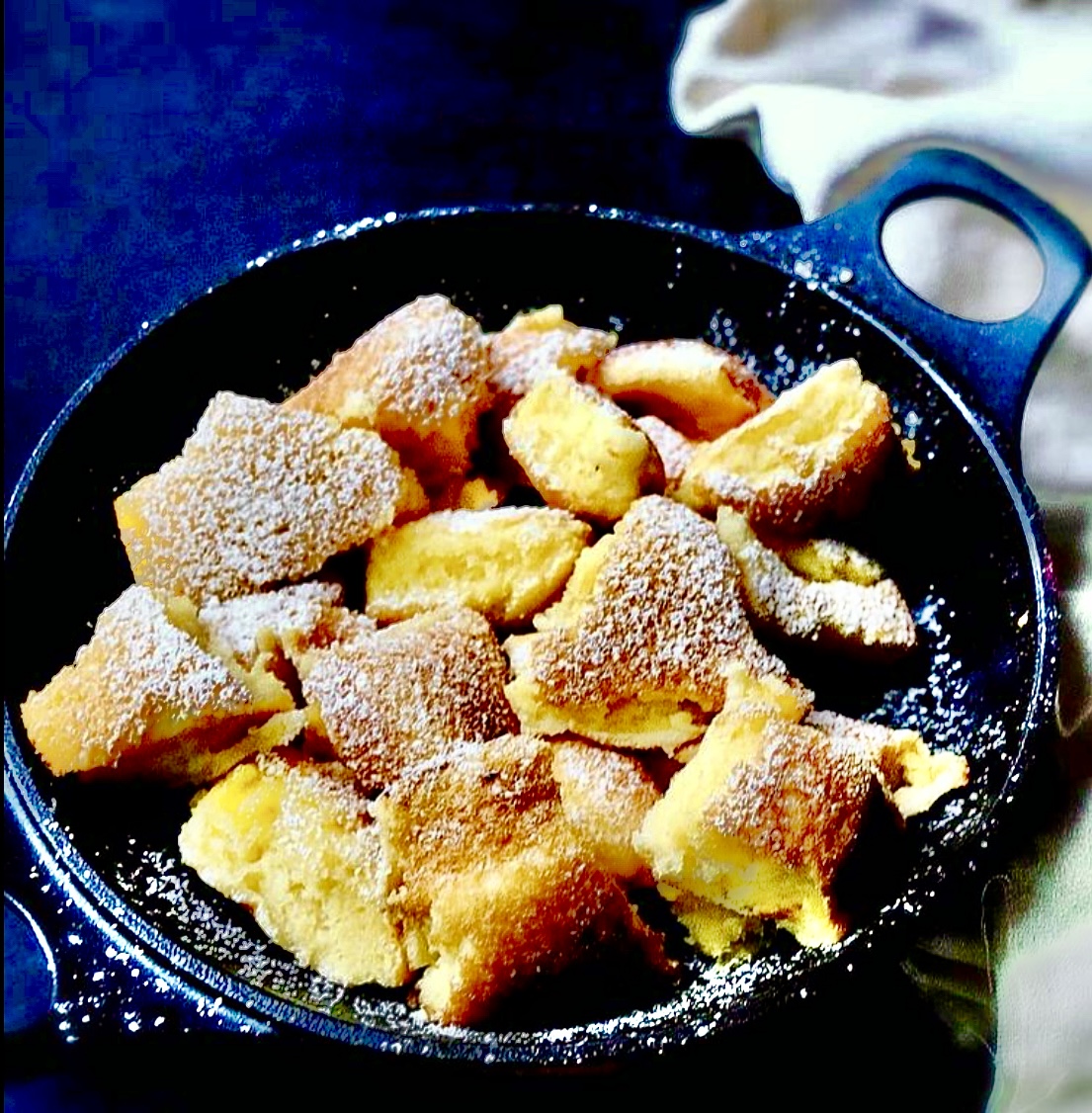
It was a lot like eating with Queen Victoria… As you left her table, you were still famished –‘As Royal Court etiquette dictated that everyone stop eating as soon as the Kaiser put down his fork, the young officers at the end of the table often managed no more than a tantalizing smell of the delicious “Kaiserschmarrn.”’


A Famous German Pancake


Near the turn of the century, Austrian Emperor Franz Josef I, reportedly ate the pancake with such relish that he frequently finished eating before the rest of the Royal table had been served.

As Royal Court etiquette dictated that everyone stop eating as soon as the Kaiser put down his fork, the young officers at the end of the table often managed no more than a tantalizing smell of the delicious “Kaiserschmarrn.”

“Schmarrn” soon came to mean “nothing,” as someone is not worth a “schmarrn.” It also translates as “fluff” which accurately describes the golden, souffle-like pancake.


Kaiser’s Pancakes

Truly fit for a King, this oven baked pancake is an easy adaptation of the German-Austrian “Kaiserschmarrn” or Emperor's Pancake. 

Serve the pancake immediately, hot from the oven, dusted with powdered sugar or with a fruit sauce. Divide the pancake into servings by tearing with two forks.

For variation, fresh fruit or raisins soaked in rum may be added as the last ingredient before baking. Pour 2 cup of blueberries, apples or peaches into the center of the batter in the Dutch oven. Stir lightly. Soak raisins in rum 2 hour, drain and add to batter.

Recipe may be doubled. Add 15 minutes to the baking time.

2 tablespoons butter/mar.


garine 2 eggs, beaten


1½ cups milk 1 cup flour


1/4 teaspoon baking powder


1/4 teaspoon salt


1. Preheat oven to 325°.

2. Melt butter in a 5-quart non-stick finished Dutch Oven or a 10-inch skillet over low heat. Combine remaining ingredients and mix until nearly smooth. Pour into Dutch Oven or Skillet. Bake 45 to 50 minutes in preheated oven until golden brown. Slide pancake onto serving plate. Cut or tear into wedges. Garnish with powdered sugar. – Recipe from The
 Desert Sun, 1979


Etiquette Enthusiast, Maura J Graber, is the Site Editor for the Etiquipedia© Etiquette Encyclopedia

Monday, October 18, 2021

Improving Soviet Etiquette and More

In 1969, publishers Funk and Wagnalls came out with a replica edition of Emily Post’s 1922 book, “Etiquette” for $10.00– for $6.95, they also came out with Elizabeth Post’s revised 12th edition of the same book. A writer compared the two books. – Photo above, Elizabeth Post, circa 1969


In a Manner of Speaking, Etiquette in Soviet Is Improving

SOCIAL behavior in at least one Socialist state is undergoing an unmistakable refinement, according to the woman who has updated Emily Post's “Etiquette.” Elizabeth Post, whose husband is a grandson of Emily Post, made the observation following a recent European tour.

“A realization that tourists are being alienated has prompted campaigns in the Soviet Union to improve the service of waiters, taxi drivers and bellboys,” said Mrs. Post. But, she added, the over-all attitude remained “just plain unhelpful.” Mrs. Post also said that attempts were being made to glamorize the assembly-line approach to weddings and that the Soviet Government was encouraging engagements – complete with formal announcements – something previously considered unnecessary and bourgeois.

In Germany, the second stop on her tour, she found that United States servicemen and their wives could upset the local population by seemingly small matters – by having cookouts or washing cars on Sunday (the Germans observe the Sabbath strictly) or by leaving clothes lines up with no clothes on them. In England, her last stop, she found things had changed vastly since Emily Post used the British as the models of formal behavior. She found them as relaxed as Americans, and more interested in discussing the miniskirt than manners.

Mrs. Post plans to write a book about “individual differences in etiquette abroad” for the benefit of travelers. She feels it is important because “if we have better manners on a big scale, we will have less war and more understanding.” Her updating of Emily Post's “Etiquette” is published by Funk and Wagnall. Pocket Books will publish a condensed version next month.

When Emily Post was asked to write the original book, which was published in 1922, she is reported to have sniffed and said: “It’s the most ridiculous thing I ever heard of.” It was only when she was shown some manuscripts and found them to be unduly concerned with salad forks and impressing the neighbors that she capitulated. “I got involved somewhat by mistake – just as Emily did,” Mrs. Post said recently, from behind her desk at the Emily Post Institute in the Pan Am Building. 

“The Institute decided, not long after Emily's death in 1960, that the book should be updated. Several writers were tried but they either wrote well and knew nothing about etiquette or vice versa. One night my husband brought home one of the manuscripts to look at,” she continued. “He showed it to me and, without thinking, I said I could do it better myself.”

Now that her four children are grown, Mrs. Post can devote time to answering the many letters received on etiquette questions at the Institute – most of which are from women. Meanwhile, Mr. Post is more concerned with equipping heavy-duty trucks. He is president of Hobbs Equipment in Norwalk, Conn. “Etiquette isn't going out of style, judging by the tremendous amount of interest people show in it,” Mrs. Post said. “It's just that the emphasis has changed – and should have changed. It used to be rather a rigid business. I think the basis now is consideration.”– 
By Nan Ickeringill, NYT, 1967


Etiquette Enthusiast©, Maura J. Graber, is the Site Editor for the Etiquipedia Etiquette Encyclopedia

Tuesday, September 28, 2021

Dinner with a Sleeping Prince


 Luitpold Karl Joseph Wilhelm Ludwig, Prince Regent of Bavaria. He was the regency ruler from 1886 to 1912, due to the incapacity of his nephews, King Ludwig II (for 3 days) and King Otto (for 26 years.) –
 Public domain image, of Prinzregent Luitpold (or Prince Leopold) 


He Served a Fine Dinner 
This Prince Enjoyed It, and the Famished Guests Politely Smiled

Prince Leopold, the late-Regent of Bavaria, was extremely hospitable, receiving many guests and keeping open house, to which came in turn officers, scientists, artists, manufacturers —all the best society in Munich. Himself, the wielder of an excellent knife and fork, he took the pleasures of the table seriously and desired that all his guests should do the same.

Some weeks before his last illness he fell asleep at a dinner party immediately after the first course. His guests were restrained by respect for etiquette from waking him, but continued their conversation in low tones. The servants did not dare to continue serving the dinner. The Prince continued to sleep and soon began to snore. The guests continued their conversation in somewhat louder tones, but the Prince slept for two hours, during which time, no one left his place The guests sat famished in the same room with a marvelously appointed dinner. 

At length, Prince Leopold awoke. He gave a hurried glance round the table and saw only a number of well-mannered guests, successfully pretending to have noticed nothing. Persuaded that his doze had passed completely unobserved, he said. “Now let us go and take coffee.” The guests rose accordingly and proceeded to the drawing room. They were served with coffee, liqueurs and cigars. The Prince, thoroughly refreshed by his sleep, indulged in a great deal of excellent conversation which lasted till midnight. The party then broke up. and the guests departed, famished with hunger, with an official smile upon their lips. – Blue Lake Advocate, 1913


Etiquette Enthusiast, Maura J. Graber, is the Site Editor for the Etiquipedia© Etiquette Encyclopedia

Friday, August 21, 2020

A German Society of Etiquette

“What could he be hiding?” — It has always been considered rude to keep one’s hands in one’s pockets. Nowadays, it can display an uncaring casualness, a defensiveness or even sloppiness of posture, but in decades and centuries past, it showed a cavalier attitude that was overtly rude and showing no respect to one’s ‘betters’ or those of higher social rank. It was also a way of concealing a weapon and continues to be so in modern times. Keeping a gloved hand in a pocket is especially suspicious. 
Photo source, Pinterest 


Edwardian Era Societies 

Germany, like England and America too, is full of societies and clubs with curious names and purposes. The newspapers announce that a very bizarre one has been set up in Berlin: the partners who co-operate in politics are obliged never to commit acts of bad manners and, above all, to never stand with their hands in their pockets. Someone who, by distraction, shows up with his hands in his pockets, is sentenced to pay five Deutschmark in fines. 
And if a serious club member commits some bigger rudeness, such as scratching his head, spitting, or something else, he pays a greater fine. What would you say if a society of this kind, which angers us, were to set itself up? Of course, in Italy we would give it a slightly more agile name than it has in Germany. Do you know what they call it? Simply “The Hand Holding the Pocket Association.” — Translated from Italia News, San Francisco, 1913 


Etiquette Enthusiast, Maura J Graber, is the Site Editor for the Etiquipedia© Etiquette Encyclopedia

Saturday, April 25, 2020

Dining Etiquette in Legal Decision

His claim was defeated on the ground that it was a breach of etiquette for him to eat with a knife. 


Taught Him a Lesson


Etiquette is responsible for a queer legal decision. A traveler on a German railway train attempted to eat a lunch, and while in the act of conveying food to his mouth, the train stopped suddenly and his cheek was badly cut on the edge of the knife he was using. The man sued the company for damages, but his claim was defeated on the ground that it was a breach of etiquette for him to eat with a knife. The court recited unto him the chestnut that, “A man cannot take advantage of his own wrong.” —Chicago Times, 1892


Etiquette Enthusiast, Maura J Graber, is the Site Editor for the Etiquipedia© Etiquette Encyclopedia

Thursday, October 17, 2019

Finger Glass Etiquette

The use of "finger glasses," or "finger bowls" after dinner is quite a modern innovation in Germany, introduced from England.


The use of finger glasses after dinner is quite a modern innovation in Germany, introduced from England. Until about ten years ago, glasses were indeed brought round at dessert at the very end of the meal, but this was for the purpose of rinsing the mouth, and a very comical sight it was indeed to see gentlemen and ladles, in plain dress or en grande tenue. washing their mouths at a sumptuously furnished table —or for the matter of that, in any private or public assembly room—instead of retiring to some private chamber for this purpose. In Bavaria it often happens that persons of talent, but without much knowledge of the manners of what is called polite society, are invited to dine with royalty, and not unseldom has the mistake above referred to been made there. 

The following little anecdote, however, contains the details of a practical joke played by a number of artists on a colleague still living who had for the first time received an invitation to dine with the Prince Regent at the schloss at Munich. Several masters of the brush had received similar invitations, and, as the painter in question was somewhat elated and excited by the honor conferred upon him, and at the same time singularly nervous and inquiring as to the way he would be expected to behave at the royal table, his confreres put their heads together and determined to play a practical joke upon him. He was accordingly told: 
“The first time anybody is invited to dine at Court, a special drink is handed round in glass bowls and the newly-invited guest is expected, according to strict etiquette, to take one of these bowls in his hand and to rise and exclaim, ‘I drink to the health of his Royal Highness,’ and then to quaff the contents of the bowl at a draught, make a profound bow towards the Prince Regent, and so resume his seat!’” The gentleman in question acted to the letter according to the instructions given him. To the manners of the Court must be attributed the suppression of all suspicion of a giggle, and it is stated that the royal host did not appear in the least disconcerted, but afterwards over the beer the merriment was unrestrained.— London Telegraph, 1901 


Etiquette Enthusiast, Maura J Graber, is the Site Editor for the Etiquipedia© Etiquette Encyclopedia

Saturday, May 6, 2017

Black Forest Table Etiquette

The Black Forest, or "Schwarzwald," as it is called in German, is not precisely a land unknown to American tourists, though it is not so well known as it deserves. Pedestrians find it a kind of paradise in good weather. No part of Europe is better situated for excursions.

European Letter —

One of the best centres in the Black Forest is Frieberg, where there is an excellent hotel—the "Schwarzwald," — in an excellent situation. From this point the tourist can branch out in all directions. It has a railway station, and the line of the railway from Frieberg to Hausach is one of the most remarkable pieces of engineering in Europe, and quite as remarkable as the Semmering between Vienna and Gratz. Frieberg is famous for clocks and watches; and it is to be remarked that over one of the largest clock-making establishments in the village there is a large clock which has no hands, and that, almost without exception, every clock to be seen in the hotels or other places is either stopped altogether, or is entirely wrong as to the time.

The etiquette of German bathing places is very peculiar. In one of them the following is written in French on the bedroom doors; "Those persons recently arrived will place themselves at the foot of the table. A bather desiring to have a visiting friend near him at the table, may be accorded this privilege for one repast only. Such favors as selecting a place of his own choice, passing immediately to the head of the table, or of sitting opposite whom one pleases, will not be accorded for the reason that they would result in the juxtaposition of persons not agreeable to one another." 

The advancement to the head of the table is not coveted merely as a matter of distinction; for it includes the appreciable advantage of a first presentation of dishes at dinner and supper; and the difference of a plate as it comes from the chef, and the same plate when it has passed a file of hungry Germans, male and female, after their kind, is very marked. But the final right to sit opposite whom one pleases has possibly a more romantic signification, and may be intended as a check on the too ardent gallantry of susceptible youths who want to sit opposite the prettiest girls. – From C. A. S. in The Marin Journal, 1878

Etiquette Enthusiast, Maura J. Graber, is the Site Editor for the Etiquipedia© Etiquette Encyclopedia

Wednesday, March 29, 2017

Royal Birthday Etiquette – No Insults

Kaiser Wilhelm I of the House of Hohenzollern, was the King of Prussia (January 1861 – March 1888) and the first German Emperor (January 1871 – March 1888), as well as the first Head of State of a united Germany.

A silly story is telegraphed that the German Court is now discussing the question whether Minister Sargent ought to be invited to the Emperor's birthday reception, coupled with the prediction that if he attends "'he will certainly be personally affronted." It is safe to assert that the etiquette of the Court of Berlin does not permit it to invite anybody — least of all a foreign minister— to a reception for the express purpose of insulting him. – The Daily Alta, 1884


Etiquette Enthusiast, Maura J. Graber, is the Site Editor for the Etiquipedia© Etiquette Encyclopedia

Friday, January 27, 2017

Alcohol, Etiquette and the Kaiser

According to strict etiquette, alcoholic drinks would be banished from all dinners at which his Majesty was present in the ordinary way.

Contrary to popular belief, the amount of beer drunk per head of population in Germany every year is considerably less than the amount drunk in England. Very little alcohol is drunk by the German Royal family though the Kaiser is the only absolute teetotaler. 

When he is invited to dinner, he drinks a special temperance drink that is supplied to his host in advance, and is served to the Emperor in champagne bottles. The reason for this is that according to strict etiquette, alcoholic drinks would be banished from all dinners at which his Majesty was present in the ordinary way. But the Kaiser waives etiquette and drinks mock champagne while the guests are drinking real variety. - Healdsburg Enterprise, 1913


Etiquette Enthusiast, Maura J Graber, is the Site Editor for the Etiquipedia© Etiquette Encyclopedia

Tuesday, January 24, 2017

Cross-Cultural Etiquette: 19th C. Insults

In England, if a friend is visiting another and stays to dinner, he may ask for the loan of a hairbrush without giving offense, but in Hungary he may not. 

Unintentional Insults? 
Persons Must Be Very Careful When In a Foreign Country

A short time back a message was received by the authorities through the Chinese legation that the gentleman representing her majesty in China had been guilty of conduct unbecoming an embassador and a gentleman; that he had insulted the Chinese cabinet. Investigation, however, showed that the only conduct of which he had been guilty was thumping the table at which he was sitting to emphasize a remark. Of course no notice was taken of the affair, but, all the same, the diplomatists of China were offended, for in that country it is an insult to the assembled company to thump the table. It only shows how careful one should be in a foreign country.

In England, if a friend is visiting another and stays to dinner, he may ask for the loan of a hairbrush without giving offense, but in Hungary he may not. To attempt to borrow that useful article is one of the greatest insults which can be offered to a Hungarian and one which will in most cases cause a duel.

In France there are several insults which the unwary foreigner may offer without knowing it. For example, he may be visiting a friend and may put his hat upon the bed. This is a grievous form of insult, but why it is not known. It is a very ancient one, and so probably results from an old superstition. 

Again, there are two ways of pouring out wine in France, as everywhere else. One of these is to hold the bottle so that while pouring the thumb is facing the tablecloth. The second way is to hold the hand reversed—that is, with the knuckles downward—and this is a great insult to the assembled guests and the host, a far greater insult than drinking a health in water, and that is pretty serious in France.

Germany has some curious forms of insult. To begin with, to offer a rose or any other flower without any green or leaves with it to a lady is to deeply insult her, though why this should be so is not known precisely. The German students are formed into corps, some of which are fighting corps and others not. Each corps has its distinctive cap, and when a member of one meets another in the street it is etiquette for each to doff his cap. Should the other not respond, a complaint is made to his corps, and a duel is fought—a real duel, with sabers or pistols, not the fencing duel which is pastime in Germany, just us foiling or single stick is in England—for the insult is nearly the worst that can be offered.

There is one worse, and that is spilling or flicking beer over another student purposely. No apology will wipe out this offense. Nothing will, except a duel to the death or a duel which is continued until one of the combatants is too badly wounded to continue the fight. A minor insult is to refuse to drink with a student if invited or to refuse to respond with “Prosit” when he raises his glass and says, “Icth Komme vor,” but this is more a breach of good manners than an actual insult.

We might finish with two Spanish examples of curious insults in South America. The first of these is to refuse to smoke a cigarette which another man offers you after he has bud it in his mouth, and the second is to refuse drink out of the same glass that a man has just drunk from, or, worse still, to wipe it before drinking.—London TitBit, 1898


Etiquette Enthusiast, Maura J Graber, is the Site Editor for the Etiquipedia© Etiquette Encyclopedia

Tuesday, October 18, 2016

Etiquette Perplexed the Royals

Thousands will not breathe freely until Germany's Emperor has left.

The Kaiser's Travels
 English Society Excited Over the Coming Event
*****************
Queen Victoria Confers With the Prince of Wales on Matters of Etiquette


London, July 1891 —The Prince of Wales today had a long interview with the Queen,who summoned him for the purpose of discussing and settling a number of perplexing questions of Court etiquette and precedence on account of the approaching visit of the Emperor and Empress of Germany. 

Court and military society, and nearly all other circles, are more or less stirred up by the Emperor's coming, and thousands will not breathe freely until Germany's Emperor has left. German detectives, British detectives and police of all kinds are already attending to business, for the fact that there are hot-headed Emperor hating Germans and Frenchmen in Great Britain, is not lost sight of by the authorities. — Los Angeles Herald, 1891

Etiquette Enthusiast, Maura J Graber, is the Site Moderator and Editor for the Etiquipedia©Etiquette Encyclopedia

Monday, October 3, 2016

Etiquette When Emperors Meet

The Hohenzollerns have always been distinguished for their contempt of the stage trickeries of royalty. They have from the earliest days been devoting themselves to facts in this world. Not so, however, with the Hapsburgs. They have always been stern defenders of etiquette. There is no ruling family which has been more devoted to the artificialities of the purple than they. 


The Rules for Emperors

"For two men of the ordinary grade to meet for the transaction of business is ordinarily a very simple matter. In that case there is nothing to do but fix the time and place, walk in, shake hands and go to work. With Emperors, however, it is a different thing. Imperious etiquette must be satisfied beforehand on a great many points which to general mankind appear to be not only trivial but absurd. 

Every motion has to be satisfactorily settled before the royal personages can come together. There must be no doubt as to which is to be the host and which the guest — which is to advance to meet the other; the manner in which salutations are to be exchanged; the extent to which personal freedom is to be allowed; how they are to be seated and how they are to be got off the stage when the interview comes to an end. 

Before that extraordinary pageant was enacted at Versailles, in which the King of Prussia assumed the title and insignia of Emperor of Germany, he could have no speech with Francis Joseph unless he had previously kissed his hand in token of submission and inferiority. The two Emperors are now on an equality. Francis Joseph has been expelled from Germany and William reigns there in his stead. It is clear that if there is to be hand-kissing now, the operation will have to be mutual, if such, indeed, be possible — that one cannot sit on a higher seat than the other — that there must be equality in ceremony and equality in general demeanor. 

The telegraph has not informed us of the cause of the delay in the meeting of the two Emperors; or of the secret of the evident coyness of the Austrian Potentate, or of the reason of the change from Gastein to Salsenburg, as the telegraph gives the name, but probably correctly Salzburg, but we have but little doubt that it was something of the weighty character above set forth that was at the bottom of it.

Not that we think that Kaiser William is at all a stickler for such trivialities. Rugged old soldier that he is he probably, if he had his own way, would have preferred to stride into the place designated for the interview, with a military attendant or two, shake Frances Joseph by the hand, deposit his iron helmet on the table and proceed to business without further fencing.

The Hohenzollerns have always been distinguished for their contempt of the stage trickeries of royalty. They have from the earliest days been devoting themselves to facts in this world. Not so, however, with the Hapsburgs. They have always been stern defenders of etiquette. There is no ruling family which has been more devoted to the artificialities of the purple than they. The ceremony at the Austrian Court is as rigid, and unbending as in the palace of the brother of the Sun and the Moon at Pekin, for it not unfrequently happens that when the substance of power has faded away the forms under which it was originally exercised are adhered to with a tenacity all the greater. It is more than likely, therefore, that the coyness which the Austrian Emperor has been exhibiting is to be attributed not so much to any deep political purpose, as to some disagreement in relation to handshaking or bowing.

Be this as it may, it is at least certain that there is some historical significance in the substitution of Salzburg for Gastein. In it is a cave, in the hill in the rear of that city, that old Barbarossa, in German legend, is supposed to have been sitting for centuries past, his red beard grown through the table upon which his elbows rest, sitting there in profound silence waiting for the regeneration of Germany. Can he look down on the strange meeting which is now about to take place and still maintain his stony composure? 


Germany is consolidated now, at least, or nearly so. She will now present as solid a front as when he raised his shield on the Roncalic plains, giving notice to all who passed that way that if aggrieved justice could be obtained by an appeal to him. One thing is certain, if this interview is ever to be transferred to canvas, it is tolerably clear that Kaiser William will be the central figure, no matter how etiquette may now decide, or how rigidly it may provide for Austrian preeminence. It is he who has realized the dream of the red-bearded Emperor, who has so long been waiting for the resurrection of Germany in the gloomy caverns of the hill of Salzburg. (break)" — The Daily Alta, 1871


Etiquette Enthusiast, Maura J Graber, is the Site Editor for the Etiquipedia© Etiquette Encyclopedia

Wednesday, September 7, 2016

German Imperial Court Etiquette

French champagne was avoided... The Kaiser was very precise about the table settings and frequently planned the menus himself. 

German Imperial Court etiquette required that a man invited to a luncheon at the Emperor's Imperial Palace must wear a special white tie and frock coat.

When the Emperor and Empress entered, all rose to their feet in silence, and remained standing until their Imperial host permitted them to resume their seats by a wave of the hand.

The Kaiser was very precise about the table settings and frequently planned the menus himself. The Imperial table at Potsdam was probably the only one in Europe that was never graced by a French menu card. Emperor Wilhelm favored the more comprehensible, if less appetizing, native phraseology.

The style of the table decorations was always the same, roses being the only flowers the Empress would tolerate. Wine was the sole beverage. French champagne was avoided and guests were required to converse in an undertone.


Etiquette Enthusiast, Maura J. Graber, is the Site Editor for the Etiquipedia© Etiquette Encyclopedia

Thursday, March 31, 2016

Etiquette and Diplomacy in Berlin

Aaron Sargent, was the the U.S. minister to Germany from May 1882 to June 1884. A political appointee as the Head of the U.S. Legation at Berlin, Sargent had a reputation as being loud-mouthed and disrespectful toward Otto von Bismarck, (the conservative Prussian statesman dominating German and European affairs from the late 1860's to 1890.) He also conferred openly with Bismarck’s liberal opponents who favored free trade, threatening retaliation for Germany’s prohibition of meat imports from America. When Eduard Lasker died in early 1884, the U.S. House of Representatives passed a provocative resolution mourning the death of the leader of the German Liberals. Sargent then delivered the resolution to the German government. But Bismarck declared that Sargent’s continued presence was an insult to Germany, adamantly refusing to accept the resolution. Sargent subsequently resigned and was replaced by a much more tactful diplomat, John Kasson.

A silly story is telegraphed that the German Court is now discussing the question whether Minister Sargent ought to be invited to the Emperor's birthday reception, coupled with the prediction that if he attends, "he will certainly be personally affronted." It is safe to assert that the etiquette of the Court of Berlin does not permit it to invite anybody — least of all a foreign minister— to a reception for the express purpose of insulting him. — Daily Alta California, 1884


🍽Etiquette Enthusiast, Maura J Graber, is the Site Editor for the Etiquipedia© Etiquette Encyclopedia

Friday, March 18, 2016

Etiquette and Lèse Majesté

In feudal Europe, some crimes were classified as “lèse-majesté” even if they were not intentionally directed against the crown. An example is counterfeiting, so classified because coins bore the monarch's effigy and/or coat of arms. With the disappearance of absolute monarchy in Europe, lèse-majesté came to be viewed as less of a crime. However, certain malicious acts that would have once been classified as the crime of lèse-majesté could still be prosecuted as treason. The crime of lèse-majesté is still in affect in some European countries today, but with less severe punishments than in the rest of the world.

All the principal comic papers in Germany were confiscated this week on account of their publication of cartoons ridiculing the Emperor and the police. Some of these papers will be prosecuted on the charge of lèse-majesté. 

Herr Lieber, the Centrist leader, has started for the United States. While the quarrel between Emperor William and the Regent of Lippe-Detmold is only a storm in a teacup, over a miserable question of court etiquette, it has occupied the press to the exclusion of almost everything else. A high official of the Ministry of the Interior has briefly outlined the facts in the case to the correspondent of the Associated Press. They are as follows:

The Regent was already offended on account of various alleged slights, for which he blamed the Emperor, when the general commanding the troops in the principality ordered his soldiers henceforth not to make the salute prescribed in the case of ruling sovereigns or to show the customary marks of respect to the Regent's family. The Regent, thereupon deeming his rights under the military convention of 1878 to have been slighted, appealed to the Emperor in a personal letter for redress. 

This letter contained several passages which were construed by his Majesty to be purposely offensive, whereupon he sent the Regent a telegram which traversed a dozen hands and thence reached the newspapers substantially verbatim. Then followed the deeply offended Regent's appeal to the sovereigns of Germany and to the Bundesrath. The matter is expected to remain in status quo for some time. 

The correspondent of the Associated Press learns from another source that Emperor William's anger was particularly aroused by certain references in the Regent's letter to the Empress and her family, a parallel being drawn on the question of rank in both cases, and his Majesty's ire was increased by the fact that the Legislature of Lippe-Detmold, at the Regent's behest and without awaiting the direction of the Bundesrath, passed a law in March prejudicing the chances of the succession of Prince Adolph of Schaumburg -Llppe, Emperor William's brother-in-law. — The San Francisco Call, 1898


Etiquette Enthusiast, Maura J. Graber is the Site Editor for the Etiquipedia© Etiquette Encyclopedia

Thursday, March 17, 2016

Etiquette, Bismarck and Victoria

Victoria, Princess Royal, German Empress, Queen of Prussia,  detested Prussia's emphasis on its army. This was to be expected, however, considering her British upbringing. “Vicky,”  as she was known, hoped to influence Prussia away from the tradition of “Warrior Kings” in favor of "a new line of enlightened executives." Though supported by her husband, she was bound to clash with Bismarck's rising force. The Chancellor Otto von Bismarck's most important legacy is the unification of Germany. Germany had existed as a collection of hundreds of separate principalities and Free Cities since the formation of the Holy Roman Empire. Over the centuries various rulers had tried to unify the German states without success until Bismarck. Resulting largely from his efforts, the varying German kingdoms united into a single country. Bismarck's psychology and personal traits have not been so favorably received over time, and historian Jonathan Steinberg portrays a demonic genius who was deeply vengeful, even toward his closest friends and family members. 

Bismarck and the Crown Princess Victoria


London, November 25th— Court circles in Berlin are discussing the reconciliation which has just been effected between Crown Princess Victoria and Prince Bismarck. Their hostility had been of many years' duration, and was known to all the world, although it was thinly veiled by court ceremony. Many reasons have been assigned for it, but its real origin was the utter incompatibility of the Chancellor and the Princess. 

Prince Bismarck scorns and condemns the little niceties of polite society, and estimates women only as a factor in the problem of the continuance of the German nation. The Crown Princess had her education in a court and country where women arc treated with much deference, and where the canons of etiquette cannot be violated without serious consequences. The Princess has been, next to the aged Empress, the first lady in Germany, and refused to submit to what she termed Bismarck's boorishness. The result was warfare, sometimes open, sometime covert, as the necessities of court life required. 

Now there has been a reconciliation, and the question is; Which power conquered? The story most current in Berlin is as follows ... The Crown Princess, powerful as she is now, will be still more so when she becomes Empress of Germany. This must happen soon, and may happen at any time. 

The Chancellor is cultivating the friendliest relations with the Crown Prince, who may soon be Emperor, and has fouud it also desirable to propitiate the Crown Princess. He has, therefore, instituted certain reforms in his household and in his manners which makes his personality less disagreeable to her Imperial Highness. — Sacramento Daily Union, 1884


Etiquette Enthusiast, Maura J. Graber is the Site Editor for the Etiquipedia© Etiquette Encyclopedia

Tuesday, March 15, 2016

Royal Etiquette Relaxed for Holiday

Potsdam at Christmas.... Potsdam was a residence of the Prussian Kings and the German Kaiser, until 1918.

The 1895 German Christmas season, according to reports made by the leading shops in Berlin, shows a boom in business. The sale of the cheaper class of goods has been slack in favor of the higher and more costly class, and the casual onlooker would consider that the merchants, as well as the public, have been having a fine time all around. The "North German Gazette" says that Berlin has received and sent out Christmas parcels far exceeding in number those sent and received during Christmas week of 1894.

The celebration in the new palace at Potsdam on Christmas Eve was even more brilliant than usual. The Emperor and Empress and the members of their family entered the Shell Hall at 5 o'clock in the afternoon, attended by the members of the Imperial household. The presents were spread out upon tables placed along the walls, and the young Princes could hardly be restrained from infractions of etiquette by rushing forward to admire the handsome gifts before all of the company had assembled. 

Immediately after the company had taken their positions, the members of the Emperor's suite, the court ladies, the Emperor, the Empress and the Princes, with their suite, having been assigned to places forming a square with a plastic representation of the nativity at Bethlehem in the cener, the Kaiser allowed court etiquette to relax, and everybody mixed freely with the others. The young Princes ran about, discovering fresh sources of delight upon each table, but after an hour's enjoyment of this kind, the children were obliged to retire.

The Emperor dined with his intimate circle, Dr. Von Tucanus, General Von Hahnke and others of his private Cabinet. — Sacramento Daily Union, 1895


Etiquette Enthusiast, Maura J Graber, is the Site Editor for the Etiquipedia© Etiquette Encyclopedia
Monday, March 14, 2016

Etiquette Breached by Dom Pedro

The 19th century Imperial family of Brazil, Dom Pedro II his wife and grandson

Dom Pedro's indifference to the rules of palace etiquette, during his stay in Berlin, horrified the German courtiers. He appeared at the Empress' reception wearing a black cravat instead of the regulation white necktie, which, as the Cologne Gillette observes, "is indispensable even at the White House in Washington." 

Kaiser William and his Empress called by appointment at the Hotel de Rome to return Dom Pedro's visit, but the Brazilian tourist was not in. Astonished and somewhat chagrined, the Kaiser gave directions to his coachman to drive back to the palace, when a droshke rapidly drove up, and a stout, elderly man in a gray overcoat, crying, "Sire! Sire!" alighted, and springing to the Imperial carriage, helped the German Empress out. 

The Emperor William followed, and on reaching Dom Pedro's apartments the latter apologized for his apparently rude conduct by saying he had gone to Professor Helmholtz without previously setting his watch to Berlin time, and a discussion on physiological optics had so much interest for him that he overstayed his time. 

The Brazilian sovereign had no desire to see the barracks and parade-grounds of Berlin, but the university, the art galleries, the scientific institutions, and above all, the palace library, underwent his careful inspection. — Mariposa Gazette, 1877


Etiquette Enthusiast, Maura J Graber, is  the Site Editor for the Etiquipedia© Etiquette Encyclopedia