Showing posts with label Maura Graber on Etiquette. Show all posts

Saturday, December 16, 2023

Wedding Traditions and Superstitions

From the “Gilded Age,” which truly was the golden age of flatware design, comes and 1895 advertisement for Pairpoint Manufacturing Company, placed in Harper’s Bazaar Magazine. It was touting the etiquette correctness of using the proper serving accoutrements for “Luxurious Fruits” and the “Garden’s Tempting Dainties.” These gilded age utensils are some of the most popular antique flatware pieces and sets sold on sites like Ruby Lane, eBay and Etsy. Their diminutive size and uniqueness make them an ideal wedding gift and they were so plentiful, it’s often easy to find some which match, or mix and match, with a pattern they have registered for or already own.

With all of the variables involved in planning and executing the picture perfect wedding, (i.e. Will it be raining or will the sun shine? Will certain family members call a ‘cease-fire’ for the day? Will more guests than those who “r.s.v.p.’d” actually show up? Will I make a fool of myself and trip down the aisle?) it’s no wonder that brides have for so long, maintained that time honored tradition of calling for good luck on their big days, with the use of one easily recited poem. 

All together now; “Something old, something new, something borrowed, something blue”. Yes, it is very easy to remember, even easier to recite, and for some strange reason that I can’t understand, reserved just for the wedding day itself. With that in mind, I have a truly novel idea for today’s bride to be. Why just reserve the call for good luck for your big day? Why not also spread your wishes for good luck, all throughout the planning and partying stages of your impending nuptials? 

Incorporating the Victorian Era’s superstition-based prose of those somethings old, new, borrowed and blue, in your plans, certainly couldn’t hurt anything. It might even bring you more luck, by sparking a sudden burst of creativity that can carry you smoothly, from the start of the engagement to all the way down that aisle. Just think of the possibilities. Why, I can think of four already. Here’s just one:
“Something old” is actually one of the fastest growing trends of bridal registry in recent years. Old silver patterns are hot, especially among the couples who have already made one or two trips down the aisle before. According to those who track retail trends, registering for Continental sized flatware and previously archaic sounding or obsolete serving pieces, have made a big comeback in the last few years. Big enough that silver sales online are booming on sites like Ruby Land, eBay and Etsy, and silver manufacturers are dusting off some of those patterns that were previously discontinued for numerous years, and are producing them once again. 
Ornate and showy pieces from the era of opulence, the Gilded Age, are gracing the dining tables of newlyweds at a head-spinning pace. Who are the couples that are selecting styles like the elaborate, art nouveau period designed “Love Disarmed”, or more masculine appealing “Lion” pattern, for their wedding gift registry? Those who already have the toaster, not to mention the entire kitchen, and who possibly didn’t get the good stuff the first time around. They are the couples who are registering for sets of individual salt spoons, asparagus tongs, orange spoons, and ice cream forks. For entertaining in style as newlyweds, they would like pâté servers, aspic servers, jelly roll cake servers, and fish slices. 
These brides and their grooms making such tasteful selections for their new lives together, are more settled financially, as are their friends, who are obligingly snapping up the pricey gifts for the lovebirds. The trend is so hot, even wedding fashion designer to the A-list celebrity crowd, Vera Wang weighed in with her own line of flatware. However it just doesn’t hold a candle to the splendor and luster of the grand designs of yesteryear that have found a whole new legion of followers. 
So when you are doing your registering, keep in mind this century old missive from one silver manufacturer’s advertisement promoting sales of its petite silver berry forks, “Luxurious fruits and the garden’s tempting dainties are made more appetizing if correctly served”. 
If you remain superstitious however, the original Victorian poem does have one oft forgotten line at the end you might want to heed. The actual wording was; “Something old, something new, something borrowed, something blue, and a silver sixpence in her shoe”. The last line is one which many brides aren’t even aware of, and it’s no wonder to me. I’m guessing that over the years, brides have happily ignored it, even if they did know of it. After all, what bride really wants to push her luck, hobbling around in brand new designer shoes for an entire day with a coin stuck in one of them? — From an article by Etiquipedia Site Editor, Maura J. Graber, for Inland Empire. Magazine, 2007


🍽Etiquette Enthusiast, Maura J. Graber, is the Site Editor for the Etiquipedia© Etiquette Encyclopedia

Monday, May 1, 2023

A Special Event with Maura J. Graber and Elizabeth Soos


To reserve your space for this free event, click here,

Site Editor, Maura J. Graber of The RSVP Institute of Etiquette, and the founder of the Etiquipedia Etiquette Encyclopedia along with Elizabeth Soos from the Auersmont School of Etiquette and Protocol, are hosting a free online session discovering the origins of dining etiquette and the unique utensils which helped etiquette evolve at the dining table.

In this session, you will learn from Maura about the early history of dining etiquette and how the use of utensils affected early dining etiquette. She will also cover the golden era of flatware design — the “Gilded Age,” training utensils for children and even “able ware” for those with physical challenges. Items shown and discussed will range from the 1600’s to modern day.

Some of what we will be discussing… 

• The Highlights and Timeline of Flatware History with Maura Graber

• Changes in Dining Etiquette Due to the Invention of the Table Fork and Travel Utensils

• The Golden Era of Flatware Design… The “Gilded Age and Edwardian Era”

• Training Utensils for Children from the 19th - 21st Century 

• Able Ware 

• Modern Etiquette Rules for Flatware

Moving to the modern era Elizabeth Soos will provide etiquette tips and tricks to ensure dining elegance with ease and confidence. 

Elizabeth will demonstrate…

• How to use a spoon correctly

• How to use a fork with elegance

• How to use a knife with ease.


When is this event happening?

The event will be on via Zoom, Saturday, 20th May 2023, 4 pm - 5 pm, Pacific Standard Time, (PST, California USA).


Will I be able to watch the event at another time?

We are recording the event and posting it via YouTube.


As a beginner, is this event suitable for me?

Beginners and welcome and we hope that you enjoy the event. 


How much is the event?

This event is free.


Questions can be sent to the Administrator prior to the event and during the presentation. Maura will answer as many as possible in the Question & Answer session following the presentation. 


Please email your questions to: theetiquettechannel@gmail.com


 🍽Etiquette Enthusiast, Maura J. Graber, is the Site Editor for the Etiquipedia© Etiquette Encyclopedia

Wednesday, March 15, 2023

Iced Tea Etiquette


Iced tea is believed to have been invented at the 1904 St. Louis World Fair by expatriate Englishman, Richard Blechynden. More Americans drink their tea iced, as opposed to hot tea. 

Richard Blechynden, a British expatriate, is credited with inventing “iced tea” at the St. Louis World’s Fair in 1904, though it is believed that many Americans in the deep Southern American states had already been drinking their tea chilled by that time. It is the most popular way of drinking tea in the United States.

 Fresh-brewed tea is usually served in a tall glass with ice cubes, a slice of lemon slotted to the rim, and a long spoon for stirring in sugar or honey. Combination “Straw-Spoons” were produced in silver, aluminum and stainless steel, throughout the 19th and 20th centuries to  enable stirring and drinking one’s iced tea, so that the spoon did not have to be removed, thus avoiding staining one’s table or tablecloth.

Iced tea is the only beverage that you can properly drink with a spoon still in the glass. If you are not given a straw or straw spoon for drinking your iced tea, clever hostesses  will use a “butter pat” or similarly sized, iced tea spoon caddy  (a tiny silver plate to the right of your glass) to rest the bowl of your spoon in. Most restaurants will serve your iced tea on a saucer for the same purpose. 
If you are offered none of these options above,  it’s best to leave the spoon in the glass. The spoon handle can be held in place with the tip of the index finger, while sipping from the glass.— Maura J. Graber, 1990


 🍽️Etiquette Enthusiast, Maura J. Graber, is the Site Editor for the Etiquipedia© Etiquette Encyclopedia

Thursday, February 25, 2021

Better Bed Manners and Disrobing

Some of the principle sins against good breeding are committed in the process of removing the clothes. In putting them on most people are conferring such a favor on the sensitive eye that lapses of etiquette are more pardonable. Whatever you do, avoid the habit of getting undressed by gravity. The appearance of puddles of male or female clothing on the bedroom floor never caused a tremor of love in the most sensitive person.

 
From Chapter 2 — Getting Undressed


If you were sentenced to spend nine years of your life working at one job for eight hours a day— Sundays included— you would think harshly of the judge. At best you would be forced to consider him a meanie.

Statistics prove, however, that the average one-family man, with a life span of seventy years, spends this amount of time taking off his clothes and putting them on again.*  The amount of time similarly spent by the average woman can be measured only in light years.

Being condemned to the slavery from birth, one would think people could learn how to do the job with a little finesse. On the contrary, clothes seem to be like a delicatessen salad. In the store window they are a thing of beauty. Once start to take them apart and—
  
Avoid the habit of getting undressed by gravity!
To most people undressing is not so much an art as it is coming to pieces. This is a mistake. Failure to correct it has been responsible for the development of a good-sized city in the West, composed of exiled husbands. If the average ignorant bird should hurl his feathers around the nest in imitation of man, there would be no more eggs.

Some of the principle sins against good breeding are committed in the process of removing the clothes. In putting them on most people are conferring such a favor on the sensitive eye that lapses of etiquette are more pardonable.

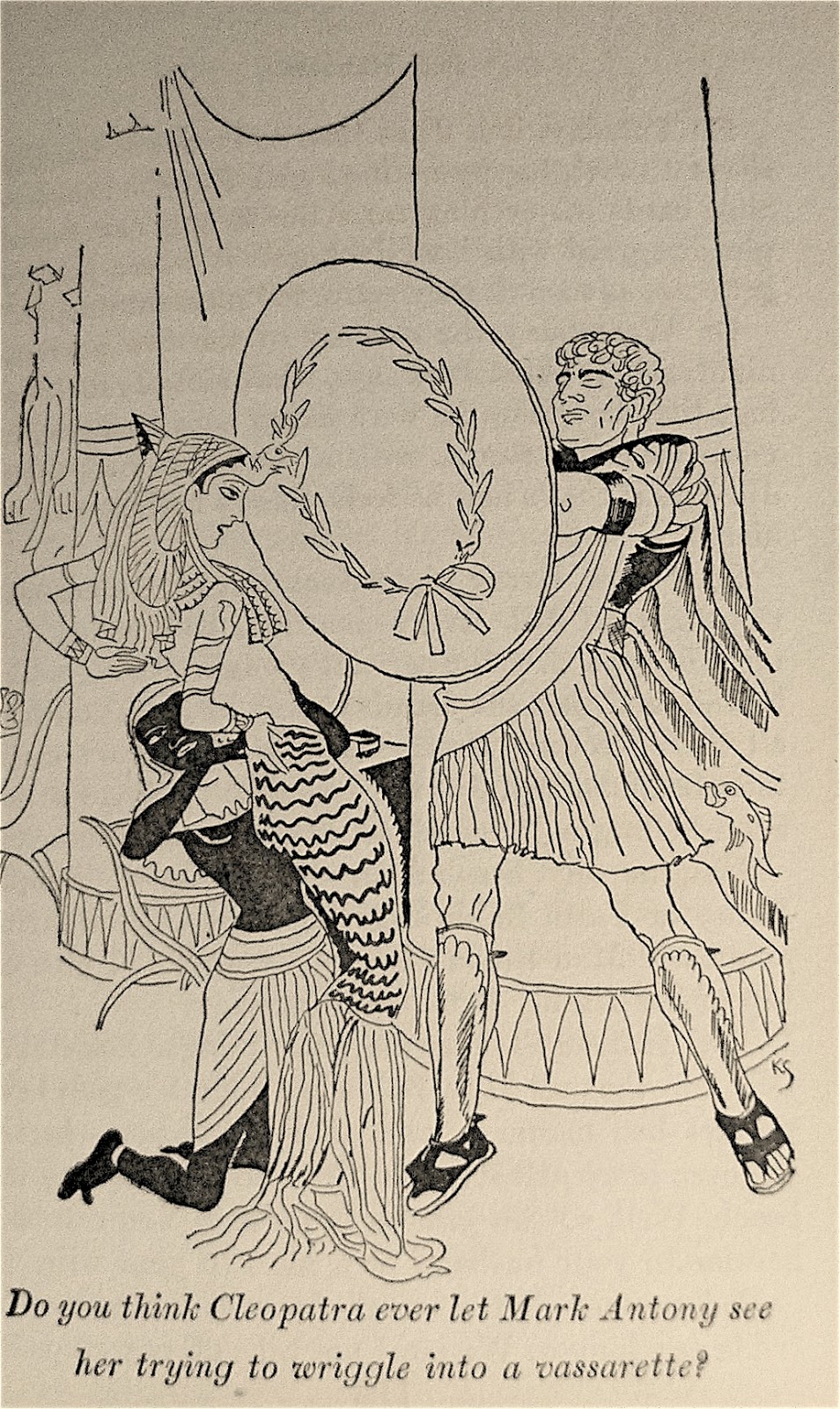
Whatever you do, avoid the habit of getting undressed by gravity. The appearance of puddles of male or female clothing on the bedroom floor never caused a tremor of love in the most sensitive person. Our researches show that women are particularly prone to this moult-and-walk off process. They have one strange garment they call a step-in. All of them might be called step-outs. They also have a rubber fabric strait-jacket called a vassarette. Getting into it is a job for a contortionist. Getting out of it is a bit easier, if your grandmother was a snake and you inherited the knack of shedding your skin.

Most men are partly sloppy undressers. One group practices what is known professionally as the drop-kick. This consists of allowing the sub-waist clothing to slide down the legs, lifting one foot out of the resulting nest, and propelling the entire mass at the nearest chair with a toe. Avoid it.

An even larger school spends futile years throwing odds and ends of clothes at bedroom chairs. These men argue that bedroom chairs serve no other useful purpose. No one has ever been known to sit on them. We advise against it, however, even if it is done in the purest spirit of sportsmanship.

Regardless of how clothes may be worn they should be taken off unostentatiously. Once off, they should not be treated like Christmas tree decorations. Get them out of sight. Far better to shove them under the bed with the foot than to wake up each morning to the sordid contemplation of their wilted forms. The seeds of many fashionable divorces have been sown by these early-morning vistas. What man can shave with a loving heart while contemplating a bedraggled brassiere hanging on the bathroom scales? What woman, lying in bed because it is too cold to get up, has not wondered sadly how the handsome lad of yesterday can possibly fill out a pair of unions like that?

This brings us to the question of getting dressed, which is so buttoned up with a number of other things, that we will treat it somewhere else, if the matter should come up.

*These figures do not include Nudists, Esquimos (sic), Bedridden People, or Fan Dancers.


Contributor Maura Graber has been teaching etiquette to children, teens and adults, and training new etiquette instructors, for over 30 years, as founder and director of The RSVP Institute of Etiquette.  She is also a writer, has been featured in countless newspapers, magazines and television shows and was an on-air contributor to PBS in Southern California for 15 years. 


Etiquette Enthusiast, Maura J Graber, is the Site Editor for the Etiquipedia© Etiquette Encyclopedia 

Monday, May 19, 2014

A Book of Retro Bedroom Etiquette


Claudette Colbert wasn't taking any chances in the motel room, alone with Clark Gable ~ "Even the kindest people are savage at night." Sir Walter Scott

 I have an odd habit of giving away copies of the 1936 book, "Bed Manners and Better Bed Manners." This, and its 1934 predecessor, "Bed Manners." It's not that I don't want the book. I just bought another copy a month or so back. It's that I try to show my etiquette instructor trainees that there is a whole world of etiquette out there to ponder.  The world of etiquette isn't just tea parties or sending out notes of thanks. It surrounds us. It is kinetic. And it is also, sometimes, hysterically funny. Take for example the sales pitch that permeates the first two chapters that I have posted here. I will post more of this tomorrow.   
Much human misery would be eliminated if fathers took their boys aside and talked with them frankly about many things.
Acknowledgement 
This book is based upon Harford Powel's epoch-making article entitled "Bed Manners," which appeared in Vogue. As Mr Powel said, the subject has never before been discussed in print, and deserves the careful study which we have given it. We extend thanks to numerous readers who have helped us by describing the heinous errors in good taste and etiquette committed by their husbands, wives, sweethearts, college roommates, etc. May this little book fill your nights with sunshine.
Ralph Y. I Hopton, PhD
Anne Balliol

How to Use This Book

What? A new etiquette book in a world already groaning under the weight of thousands of etiquette books? Yes. Because this book pioneers in a new field of good manners in good form.

Every etiquette book written up to now has a missing chapter, which would be the most valuable of all if the writer had only dared to print it. Such a chapter would follow the section on Table Manners, and the section on Party Manners. It would be called Bed Manners, and fully instruct you how to behave in a nice way between bedtime and breakfast time.

Of course, you may be living all alone on a desert island, to which you have fled to escape your creditors, your wife, or the like. If so, it doesn't matter how you behave at night. Only the owls and the fireflies can see you, and it makes no difference to them if you snore, mutter in your sleep, kick the clothes off the bed, or commit any other breach of social etiquette.

But probably you are not alone, or don't want to stay that way.

Civilized life is full of strange adventures. Some people explore the jungles, others work in laboratories with deadly germs, others get a kick out of polo, or mountain climbing, or cruising in deep water in tiny boats like cockleshells.

But the strangest adventure of all is to find yourself locked in a bedroom with a person of the opposite sex, with whom you are required to go to bed and get up for thousands and thousands of nights. This is called "marriage." It may have happened to you already. Or it may happen just when you least expect it and are least prepared.
Did Cleopatra own a dreaded vassarette?
Very well. How are you going to act? How are you going to make the other person act? The schools of America teach many valuable subjects like geometry, ancient history, football and algebra, but they do not teach bed manners. As a result, our young graduates plunge into marriage with no idea how to behave. They can read the etiquette columns in the newspapers and the etiquette books in the library until they are black in the face, and still fail to find a single word of advice on this important topic.

During the past year, to prove our point, we have studied more than one million words written by every authority on etiquette in America. We have listened to the radio as well. Make this test yourself, and what do you get?

You get a lot of information about visiting cards, and lawn fetes, and the right way to eat asparagus, and how to write a letter to a United States Senator, and how to set the table for a formal luncheon. This is all good, as far as it goes. But it never goes past bedtime. You might think these authorities wanted you to sit up all night in the parlor, writing formal letters, or practicing the correct way to grip asparagus, or something.

Now, you know better than that. You know that you can't sit up all night for more than a very few nights without feeling very tired and wanting to get some sleep. Very well. This little book which you are now reading tells you, in a few practical lessons, everything you need to know about good form in the bedroom.

Knowledge is power.

Grasp it firmly, and you will be able to remodel the behavior of the person who sleeps with you. This person has no doubt been behaving very badly, for lack of good, practical information, such as this book supplies. If this is not checked, at once, it will lead to quarrels, injured feelings, and eventually to divorce. You probably will not be able to afford a divorce this year. Avoid all such expense by leaving this book in plain sight, where your bedfellow will see it and absorb its lessons. If it doesn't work a cure, nothing can.

If you wish to do good in your community, like a good citizen, you should extend the usefulness of this book by giving it to every married couple who are beginning to crack under the strain. In the very next home on your street, you may have reason to know that the husband is a boor. Or the wife may behave is if she has been brought up in the monkey cage at the zoo. Your course of action is obvious. Buy a copy of this book and leave it on their pillow. They may be surprised when they see it, but they will thank you in the end, when they learn how much happier it will make them.

You have a duty to young people, too. Instead of letting them grow up and marry in blind ignorance of the natural pitfalls caused by imperfect bed manners, you must see that a copy of this book goes to every prospective bride and groom in town. A young woman who finds it in her bridal shower will appreciate your kind thoughts. So will the college student who receives it as a graduation gift from you.

Another splendid use of this book is as a gift to your physician. He meets dozens of discontented married people in his daily rounds. He will want to prescribe this book to all of them, as soon as he has read it, digested it, and learn what it can do to make his own married life bearable, even happy.

One word of warning. This is the first and only book ever printed about Bed Manners. The subject is a vast one. The happiness of many million people depends on it. Therefore, do not attempt to read this book rapidly. Meditate each chapter before you take up the next one. You must think as you read. You can do this in the privacy of your home, or in the subway, or out riding with friends, or in odd moments at the office or factory where you work.

For this reason, you cannot rent this book at a library, and gallop through it, and expect to get its full benefit. Own your own copy it all times. Carry it around with you, and give its magic a full chance to work.


Contributor Maura Graber has been teaching etiquette to children, teens and adults, and training new etiquette instructors, for nearly a quarter of a century, as founder and director of The RSVP Institute of Etiquette.  She is also a writer, has been featured in countless newspapers, magazines and television shows and was an on-air contributor to PBS in Southern California for 15 years. 


Etiquette. Enthusiast, Maura J Graber, is the Site Editor for the Etiquipedia© Etiquette Encyclopedia