Showing posts with label Table Manners. Show all posts

Tuesday, August 2, 2022

Etiquette: Dinner Do’s and Don’ts

Yum… Bonbons! - The only articles of food that should be touched with the fingers are bread, biscuits, olives, asparagus, celery, bonbons and small whole fruit. 

Dinner Etiquette

  • The only articles of food that should be touched with the fingers are bread, biscuits, olives, asparagus, celery, bonbons and small whole fruit. 
  • Don’t talk about the food provided. It is bad form. 
  • Never cut your bread with a knife. Break it with your fingers. 
  • Curry is eaten with a spoon and a fork, vegetable entrees with a fork only. 
  • It is a safe rule never to use a knife or spoon if a fork will do. 
  • When meat or poultry is placed before you wait for vegetables, sauces, etc…, before beginning. 
  • With sweets or anything of that that is complete in itself, begin at once.– Morning Tribune, 1905


 🍽Etiquette Enthusiast, Maura J. Graber, is the Site Editor for the Etiquipedia© Etiquette Encyclopedia 

Friday, February 26, 2021

Etiquette for When Done Eating


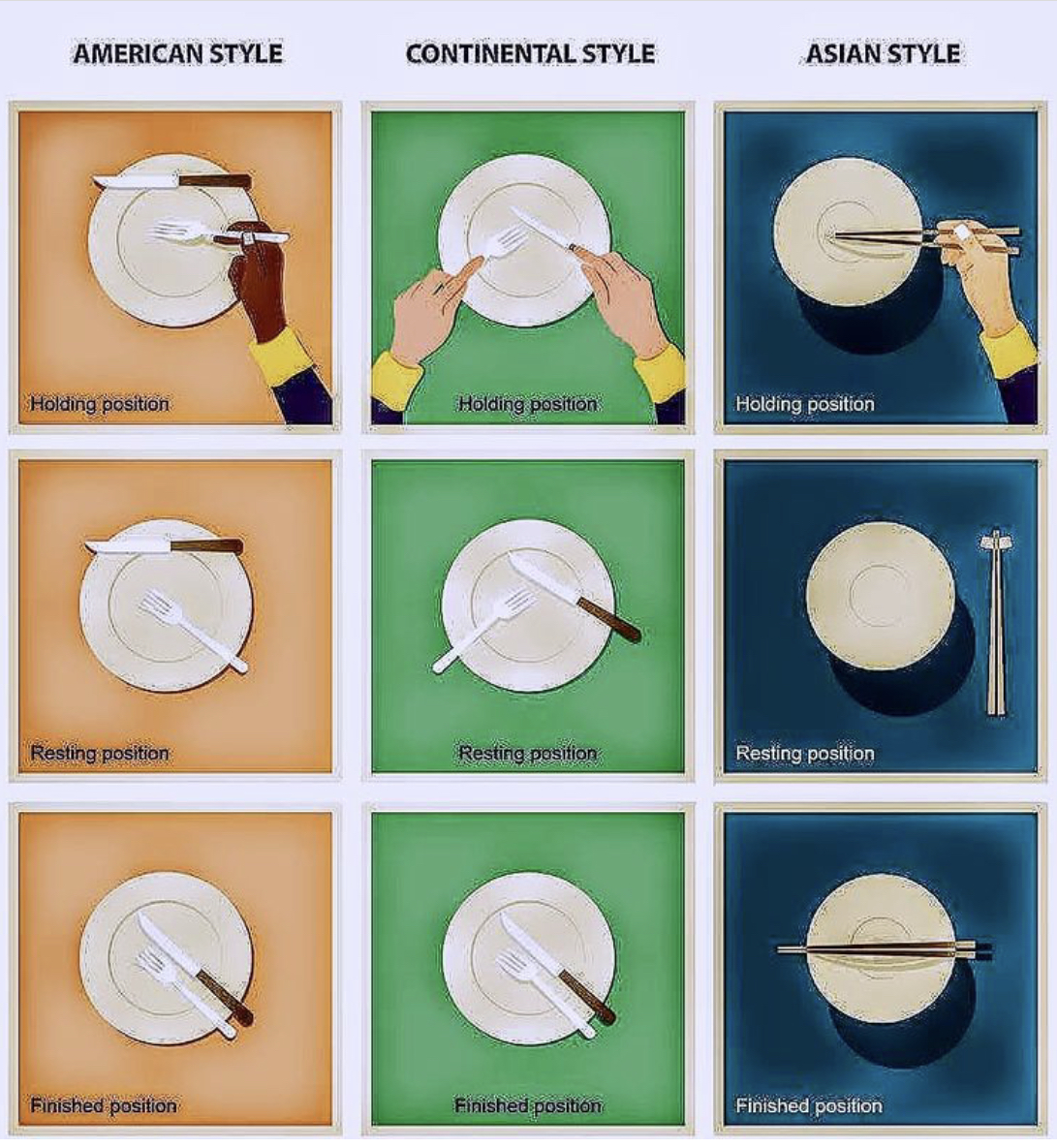
If you must have your plate cleared and wish to silently signal the waiter, these images of signals are probably the most easily and readily recognized as correct. —When done eating, one is not supposed to inform the waiter. Technically, the waiter or the waitress is not supposed to remove any plate until everyone at the table is done eating. How comfortable would you feel if you were still eating while everyone else was done and rushing to have the table cleared? 
Photo source, Pinterest 

When You’re Done Eating, How Do You Notify The Waiter?


Maura Graber, who has been teaching manners to children and adults since 1990 and is the director of The R.S.V.P. Institute of Etiquette, says, “First of all, when done eating, one is not supposed to inform the waiter. Technically, the waiter or the waitress is not supposed to remove any plate until everyone at the table is done eating. How comfortable would you feel if you were still eating while everyone else was done and rushing to have the table cleared?

“I realize many people do not agree with this, and when I do staff training for restaurants or the service industry, this subject comes up often. Waiters and waitresses do not want to offend, yet they also do not want their tips compromised. It is a difficult situation to be put in. If I am out to eat with clients I try to pace my meal with theirs, and make sure they are well taken care of by the wait staff. If the clients want their plates removed early I step in and explain one should wait until everyone is finished. Sitting with an empty plate in front of you for another five or ten minutes should not be looked upon as a chore, but as an opportunity to enjoy the company one is with.”

She further explains, “Dining in the U.S. should be enjoyed more leisurely and more thoughtfully. Meals are very ceremonial things. One is supposed to be concentrating on the companionship with others, not necessarily rushing through the food. Anything humans do of any importance in our lives has food connected to it. For example, birthdays have a birthday cake, weddings have a wedding cake. If someone is sick, we send over a casserole. Even our religious rituals have food involved. If you are at a business lunch or business dinner or even at a social lunch or dinner, you are supposed to sit down and enjoy it with the company at hand. Company is an old Latin root word for the word companionship; the word literally means ‘to break bread with another person.’

“If the table does need to be cleared for some reason, such as not enough ‘elbow room’ (which is technically a contradictory term when it comes to proper etiquette —you should never put your elbows on the table) or the server has not come back after the main course to whisk away the empty dishes and offer you desert, it is best to not let your irritation get the best of you. Never whistle, comment loudly or shake the ice in your empty beverage glass to get the attention of your server. Quietly ask the nearest restaurant or catering employee to ask for your server to come to the table, if he or she is not anywhere nearby. It’s helpful to know your server’s name.

“Speaking from personal experience, not ‘checking back’ in a timely matter is usually due to circumstances beyond the waiter’s or waitress’s control. There could be a disaster in the kitchen. It could be an unusually busy night and/or the establishment is short on staff. Even if it is a lack of foresight on the server's part, he or she is rarely, if ever, purposely performing ‘bad service.’ Some tend to forget that people in the ‘public service’ business are human too; the best waiters and waitresses have ‘off’ nights just like the rest of us. Remember, almost all servers count on their tips for their own ‘bread and butter’ so to speak. Therefore, it doesn't make a lot of sense that they would mess with yours.”— By Maura Graber for Expert Village, 2001


Etiquette Enthusiast, Maura J. Graber, is the Site Editor for the Etiquipedia© Etiquette Encyclopedia

Wednesday, September 30, 2020

Table Manners for Fruit

Cherries, berries, strawberries (they are not actually berries), oranges, grapes, grapefruit, mangoes and lemons all had utensils specifically made for enjoying them. Many other fruits had none. Peaches, apricots, apples, pears, pineapples, papayas, kiwi, nectarines and plums are among the many fruits which were overlooked. When it came to the etiquette of eating them, the small fruit knife and fruit fork would have to suffice.
— Photo source, Etiquipedia private library


How to Eat Peaches


“The art of eating a peach” is, it appears, one of the questions of the day. According to one authority on the etiquette of the dinner table, a peach should be picked with the fork, quartered, peeled and eaten piece-meal. But, as so much manipulation would evidently leave all the juice of the fruit on the plate this method, to be palatable, requires the courage of the young lady in the story who, at her first appearance at a dinner party, raised her dessert plate with her two hands and calmly drank the sweet juice of the nectarines. The French rule of eating peaches will, therefore, be accepted with much favor, and that rule is, “D’y mordre a pleines dents.”—Pall Mall Budget, 1891


Etiquette Enthusiast, Maura J Graber, is the Site Editor for the Etiquipedia© Etiquette Encyclopedia 

Tuesday, September 1, 2020

Etiquette for Twirling Pasta


Tools for Twirling Spaghetti —In her “Guide to Excruciatingly Correct Behavior,” the impeccable Miss Manners insists that the fork is the only tool acceptable for the eating of spaghetti. Using a spoon, she says, is outrageous. “The definition of civilized,” she adds, “is a society that does not consider it correct to eat spaghetti with a spoon.”
— Photo, Etiquipedia’s private library


A Real Cro-Magnon When It Comes to Fork and Knife


No matter how civilized we think we are, most of us have little chinks in our armor through which our cave person past is revealed.
We occasionally flare up in anger, as our ancestors must have, reacting to the dangers and mysteries of primitive life. Sometimes our manners fail, in small things like eating at table, and we are prehistoric slobs once more.

I think of myself as civilized in every respect: I read, I like music, I drive, I vote, I pay taxes, I don’t jaywalk, I subscribe to the paper, I wear shoes, I drink wine and I use a fork. It is my virtuosity with the fork, however, in which I may be the least polished. I know which fork to use, when there are no more than two, but I find the fork, in some encounters with edibles, less efficient than nature’s own tools--the fingers and the teeth.

The fork is, at best, an inadequate instrument for grasping certain morsels, such as chicken legs. One must hold the piece down with the fork, then attempt to slice meat from it with a knife--an awkward exercise at best. There is always the danger, too, that the leg will shoot from the plate and land in some other guest’s plate, or worse, her lap.

My particular bete noire is spaghetti and other forms of stringy pasta. I am quite incapable of wrapping these strands around a fork to form a ball without long loops hanging from the fork to the plate. When I find myself in that predicament, my only recourse is to bite off the strings and let them fall back in the plate.

From the look of horror or disgust this brings to my wife’s face, I assume that it is bad manners. She will say, “Like this,” wrapping a ball of spaghetti around her fork and popping it, without strings, into her mouth.

I simply do not have that skill. I have found no useful instructions in books on etiquette. In her “Guide to Excruciatingly Correct Behavior,” the impeccable Miss Manners insists that the fork is the only tool acceptable for the eating of spaghetti. Using a spoon, she says, is outrageous. “The definition of civilized,” she adds, “is a society that does not consider it correct to eat spaghetti with a spoon.”

She concedes: “Actually, there simply is no easy, foolproof way to eat spaghetti. . . . The fork is planted on the plate, and the spaghetti is then twirled around the tines of the fork. . . . The twirled forkful is then presented to the mouth. If this were an ideal world, all the spaghetti strands would begin and end in the same place, so that the mouth could receive the entire forkful at once. However, we have all learned that compromises must often be made, and the fact is that one will often find a few long strands hanging down outside the mouth. As you may not spit these parts back into the plate, what are you to do with them? Well, for heaven’s sake. Why do you think God taught you to inhale?”

I am shocked. Evidently Miss Manners is suggesting that we suck up those hanging strands into our open maws. Now that is truly outrageous. Can you imagine the rude sucking sound that would accompany such a practice? As I say, my solution has always been simply to bite off the hanging strands. They fall back noiselessly into the plate to await another assault. It is not elegant, I grant, but it certainly is a lot more graceful than sucking up the loose spaghetti.

One does not need a perfect bite to accomplish this feat, I might add. One simply pushes the spaghetti up against one’s upper incisors with one’s tongue, and, voila!, the elusive pasta plops to the plate. What inspires this essay is the present my French daughter-in-law gave me for my recent birthday. She is a rather cheeky young woman, and I usually suspect her of insidious motives.

However, she seemed to have nothing but good intentions this time. Her present consisted of four parts. A box of 18-inch spaghetti, a bottle of spaghetti sauce, a bib of the kind Italian men wear at table and a 6 1/2-inch fork with a wooden handle ending in a crank by which one can turn the fork, thus winding the spaghetti around its tines.

She didn’t have to explain. It was her way of improving, rather late in my life, my table manners. It might work, but I see two problems. How does one transport the fork to the dining table to which one has been invited? And how does one get home with the dirty fork afterward?


Etiquette Enthusiast, Maura J Graber, is the Site Editor for the Etiquipedia© Etiquette Encyclopedia

Thursday, July 2, 2020

Table Manners on the Rails

Good manners, evidently! — The finger bowl, according to Pollock, is only one of a number of table refinements popularised by the dining car. Steak knives and a large variety of cutlery and silverware are included in the list. 

Americans Excelled In 1920’s Table Manners

Evolution in the table manners of the nation is laid at the door of the railway dining car, by Allan Pollock, manager of dining car service for Southern Pacific Company. The finger bowl, according to Pollock, is only one of a number of table refinements popularised by the dining car. Steak knives and a large variety of cutlery and silverware are included in the list. 

Equipment of the new $60,000 dining cars, eleven of which have been ordered especially for the company’s new 63 hour trains to the East this Fall will include such novelties as individual silver butter dishes with tiny ice compartments beneath the butter. “Twenty years ago,” says Pollock, “finger bowls were practically unknown in the homes and restaurants of America. People first became accustomed to using them on dining cars. Now few homes are without them. 

“Ten years ago dining car stewards seldom came in from a trip without telling of some passenger who carefully squeezed the segment of lemon into his finger bowl and tossed off the contents, as a sort of after-dinner chaser. It doesn’t happen today. American people now exhibit the best table manners of any nation.”— Eagle Rock Sentinel, 1926


Etiquette Enthusiast, Maura J Graber, is the Site Editor for the Etiquipedia© Etiquette Encyclopedia

Thursday, May 14, 2020

The History of Etiquette

As the civilized race now stands, either man or woman can be refined, regardless of shape of hat he or she wears. This was true in any century, but 200 years ago and back of that period a gentleman and lady could, according to approved etiquette, gobble food with their hands from a common dish...

Morality, Ethics and Table Manners 
All Tie in Together to Guide Us 


Etiquette is a form of fashion more important than style in dress, for the reason that the varying codes of manners have influenced morals, something changing the cut of a coat cannot be said to have done. When etiquette demanded that a gentleman accept a challenge or acknowledge himself a coward in the minds of his fellow citizens, it encroached sharply upon ethics. Now that it has gone out of fashion to kill, gentlemen find small difficulty in keeping the sixth commandment. The less formal etiquette becomes, the less wanton taking of life there is among those who consider good breeding of consequence. 

As the civilized race now stands, either man or woman can be refined, regardless of shape of hat he or she wears. This was true in any century, but 200 years ago and back of that period a gentleman and lady could, according to approved etiquette, gobble food with their hands from a common dish set in the center of the dining table and filled with the entire fashionable bill of fare, prepared for the occasion. Gratefully, we now acknowledge such proceedings to be “bad form” and in so doing, pronounce ourselves two centuries removed from the table manners of swine and one point away from that brute, no matter how similar to him our turn of mind may remain in some other respects. — National Magazine, 1901


Etiquette Enthusiast, Maura J Graber, is the Site Editor for the Etiquipedia©️ Etiquette of Encyclopedia

Thursday, November 22, 2018

Dining Etiquette~Soup to Nuts

Cake is broken into pieces, the size of a mouthful, and then eaten with fingers or fork.
Apples should be pared, cut into small pieces, and eaten with finders or forks.

Artichokes are eaten with the fingers, taking off leaf by leaf and dipping into the sauce. The solid portion is broken up and eaten with a fork.


Asparagus stalks may be taken between the finger and the thumb, if they are not too long, or the green end may be cut off and eaten with a fork, scraping off with the knife what is desired from the remaining part.

             
Banana skin should be cut off with a knife, peeling from the top down, while holding in the hand. Small pieces should be cut or broken off, and taken in the fingers, or they may be cut up and eaten with a fork.

Bread should be broken into small pieces, buttered, and transferred with the fingers to the mouth. The bread should be placed on the small plate provided for the purpose.


Cake is broken into pieces, the size of a mouthful, and then eaten with fingers or fork.


Celery is eaten with the fingers.


Cheese is first cut into small bits, then placed on pieces of bread or cracker, and lifted by the fingers to the mouth.


Corn on the cob is eaten with the fingers of one hand. A good plan is to cut off the kernels and eat them with the aid of a fork.


Crackers should be broken into small pieces and eaten with the fingers.


Eggs are usually broken into a glass and eaten with a spoon.


Finger-Bowl: The fingers should be dipped in the water and gently rubbed together, and dried on the napkins.


Fish should be eaten with a fork held in the right hand and a piece of bread held in the left hand. The bones should be removed from the mouth with the aid of a fork or with the fingers. If by the latter, great delicacy should be used.


Fruit (all raw fruit), except melons, berries, and grapefruit, are eaten with the fingers. Canned fruits are eaten with a spoon.


Grapes should be eaten one by one, and the pits allowed to fall noiselessly into the half−closed hand and then transferred to the plate.


Knfe and Fork: The knife is always held in the right hand, and is only used for cutting the food. The fork is used not only in eating fish, meat, vegetables, and made dishes, but also ices, frozen puddings, melons, salads, oysters, clams, lobsters, and terrapin. The knife should never be used to carry food to the mouth.


Lettuce leaves should not be cut, but folded up with a fork, and then lifted to the mouth. In the event of these being too large for this treatment, they should be broken into suitable pieces with the fork.


Olives are eaten with the fingers.


Oranges served in divided sections, sweetened, and the seeds removed, should be eaten with the fork. If served whole, cut into suitable portions. Remove seed and skin.


Peaches should be quartered and the quarters peeled, then taken up by the fingers and eaten.


Peas are eaten with a fork.

Plums should be eaten one by one, and the pits allowed to fall noiselessly into the half−closed hand and then transferred to the plate.


Salt is best taken up with the tip of the knife.


Salted Nuts are eaten with the fingers.


Seeds should be removed from the mouth with the aid of a fork, or dropped into the half−closed hand.


Soup should be taken from the side of the spoon without noise and without the plate being tipped. Men with mustaches are privileged in this respect, and may take the soup from the end of the spoon.


Spoons: The spoon should never be in the cup while drinking, but should be left in the saucer. It is used in eating grapefruit, fruit salads, small and large fruit (when served with cream), puddings, jellies, porridges, preserves, and boiled eggs.


Table Etiquette: It is correct to take a little of all that is offered, though one may not care for it. Bend slightly over the plate when carrying the food to the mouth, resuming upright position afterward.


When drinking from a cup or glass, raise it gracefully to the mouth and sip the contents. Do not empty the vessel at one draught.


Guests should not amuse themselves by handling knife or fork, crumbling bread, or leaning their arms on the table. They should sit back in their chairs and assume an easy position.


A guest at a dinner should not pass a plate or any article to another guest, or serve the viands, unless asked to do so by the hostess.


Upon leaving the table, push the chair back far enough to be out of the way of others.


Accidents, or anything that may be amiss at the table, should be unobserved by a guest unless he is the cause of it. In that event some pleasant remark as to his awkwardness should be made and no more. The waiter should attend to the matter at once. If a fork or a spoon is dropped it should not be picked up by the guest, but another used, or ask the waiter to provide one.


Conversation: Aim at bright and general conversation, avoiding all personalities and any subject that all cannot join in. This is largely determined by the character of the company. The guests should accommodate themselves to their surroundings.


Toothpicks: Toothpicks should not be used in public. If necessity requires it, raise the napkin over the mouth, with the hand behind it, using the toothpick as quickly as possible.


Wine: A guest not caring for wine should turn down his glass and leave it in that position, or a mere sign of dissent when it is offered is sufficient.


From The Book of Good Manners, W.C. Green

Etiquette Enthusiast Maura J. Graber is the Site Editor for Etiquipedia© Etiquette Encyclopedia

Monday, October 23, 2017

Table Etiquette Customs Explained

Table etiquette is not, as is often alleged, merely a matter of fashion, although some things that were in vogue a generation or two ago, are no longer deemed polite.The reason is that manners and table furniture have undergone so many changes, have really so much improved, as to require a mutual adjustment. 

While certain forms of table etiquette may seem altogether conventional, even fantastic, the forms usually observed are founded on good sense, and adapted to general convenience. Table etiquette is not, as is often alleged, merely a matter of fashion, although some things that were in vogue a generation or two ago, are no longer deemed polite. The reason is that manners and table furniture have undergone so many changes, have really so much improved, as to require a mutual adjustment. 

For example, everybody was accustomed, twenty or thirty years since, to use the knife to carry food to the mouth, because the fork of the day was not adapted to the purpose. Since the introduction of the four-tined silver fork, it has so entirely supplanted the knife, that the usage of the latter, in that way, is not only superfluous, but is regarded as a vulgarism. Another example is the discontinuance of the custom of turning tea or coffee from the cup into the saucer. Although small plates were frequently employed to set the cup in, they were not at all in general use; and even when they were used, the tea or coffee was likely to be spilled upon the cloth. The habit, likewise, of putting one’s knife into the butter arose from the fact that the butter-knife proper had not been thought of. Such customs as these, once necessitated by circumstances, are now obviously inappropriate. 

Certain habits, however, are regulated with good taste and delicacy of feeling, and the failure to adopt them argues a lack of fine perception or social insight. One of these is eating or drinking audibly. No sensitive person can hear any one taking his soup, coffee or other liquid, without positive annoyance. Yet those who would be very unwilling to consider themselves ill bred are constantly guilty of such breaches of politeness. The defect is that they are not so sensitive as those with whom they come in contact. They would not be disturbed by the offence; they never imagine, therefore, that any one else can be. It is for them that rules of etiquette are particularly designed. Were their instinct correct, they would not need the rule, which, from the absence of instinct, appears to them irrational, and purely arbitrary. To rest one’s elbow on the table is more than a transgression of courtesy, it is an absolute inconvenience to one’s neighbors. 

All awkwardness of position, such as sitting too far back from, or leaning over the table, are reckoned as rudeness, because they put others ill at ease through fear of such accidents as are liable to happen from any uncouthness. This and kindred matters are trifles; but social life is so largely composed of trifles, that to disregard them wholly is a serious affront. We can hardly realize to what extent our satisfaction of dissatisfaction is made up of things in themselves insignificant, until their observance or nonobservance is brought directly home to us. —Scribner’s Monthly, 1875


Etiquette Enthusiast, Maura J Graber, is the Site Editor for the Etiquipedia© Etiquette Encyclopedia  
Monday, May 22, 2017

Etiquette, Elbows and Emily

One blogger unaware of her 1937 stance, states that Emily Post's position​ evolved on many subjects but,"There was one standard, she refused to relax, which was the importance of chaperones." In Victorian society which she came of age in, "no proper young lady would risk the damage to her reputation that might be incurred by an unchaperoned trip or overnight stay with a young man. Until the end, Emily Post believed that was sage advice."


The fountains of sacred rivers flow upward, everything is turned topsy turvy. This plaint of Euripides is echoed 23 centuries after the Greek dramatist by no less a modern mentor of manners and morals than Emily Post, whose name is synonymous with etiquette. Mrs. Post is nonplussed by the confusion of modern life, by the way in which the younger generation has taken the bit in its teeth. 


But she is not worried as to the basic goodness of her fellow women, she told a New York audience. Instead of deploring the disappearance of the ancient institution of the chaperone, she chuckles over the interesting problems that have resulted; instead of teaching the conventions to her young readers she finds she must adapt the conventions to fit modern behavior. 

Etiquette means something more important in human conduct than choosing the right fork, a lapse of which Mrs. Post herself frequently is guilty since she is both near-sighted and absentminded; she also, let it be whispered so that your children do not hear, puts her elbows on the table at dinner when she feels like it, and says, "it really makes no difference." 


What does make a difference is eternal vigilance to be considerate of the rights of others, and to be kind. At the moment, Mrs. Post is deep in the study of a great problem; Is it correct for a woman to pay all or part of the dinner and entertainment check? She is brooding about this to the exclusion of all others and will write a book about it when she has completely made up her mind. 

In the daytime in the business world, she muses, a man and woman are equals, work as companions, lunch as co-workers. But in the evening matters are changed, the woman becomes a woman again and the man pays and pays. Is that fair, she wonders, when women are earning as much or more than the men who entertain them? Would it not be fairer if he takes her out once and she takes him another time? We await with bated breath her decision on this vital question. – San Bernardino Sun, 1937


Etiquette Enthusiast, Maura J Graber, is the Site Editor for Etiquipedia© Etiquette Encyclopedia

Friday, April 22, 2016

Table Etiquette Topics

(Pictured above, a newly weaned piglet, or "shoat")
The coarse husband who causes a watermelon rind to meet behind his ears every time he makes a pass at it, has induced many a trustful wife to view the table manners of the shoat with increasing admiration. 

The watermelon is the cause of more bum table etiquette than the Irish potato served with the jacket on, which has to be impaled at the waist line and disrobed before the eyes of a polite company. 

We don’t know which is worse—the man who inhales a vertical section of watermelon with a gulping intake, like the suction of a steam pump, or the guest who runs a nervous finger over his rear gums in order to round up an overflow of green corn. 

The coarse husband who causes a watermelon rind to meet behind his ears every time he makes a pass at it, has induced many a trustful wife to view the table manners of the shoat with increasing admiration. 

A prominent Eastern society journal conveys the discouraging information that the mold of fashion in New York and Newport, is about to discard the time honored practices of swabbing a piece of rye bread in the gravy, and for wiping one’s fingers on the nearest doily. The decrees of fashion become more cruel and arbitrary every year. — Sacramento Union, 1911


🍽Etiquette Enthusiast, Maura J Graber, is the Site Editor for the Etiquipedia© Etiquette Encyclopedia

Tuesday, January 12, 2016

An Etiquette Tip and Tipping

"My fines," he said, "constitute my tips." Mournfully the waiter watched him depart. "How I wish." he sighed, "that I had known him in his sloppy days." 

An Unprofitable Etiquette Reformation

In a restaurant that strives to inculcate good manners, a man who admitted that he was rather slow on etiquette, but was trying to learn, besought the waiter to assist in the reformation. "My chief trouble," said he, "is splashing. I used to splash like anything. But by degrees I am curing myself. Know how? 


Well, sir, I have made it a rule to cover all the spots I make on the table cloth with silver money, nickels, dimes, quarters, halves, whatever it takes to cover them, and then give the money away. As I am not a rich man, that nearly broke me and I began to reform." The waiter nodded encouragingly and said he was glad to hear it. 

The man ate a substantial meal. When he had finished, the cloth was disfigured with only one small coffee stain which a dime easily covered. He handed the dime to the waiter.

"My fines," he said, "constitute my tips." Mournfully the waiter watched him depart. "How I wish.' he sighed, "that I had known him in his sloppy days."
— San Francisco Call, 1912


Tipping Etiquette and Stereotypes
From TIME Magazine, 2014

Some stereotypes about tipping appear to be true. Certain ethnic groups are perceived to be less generous tippers than others. Apparently, these theories are not simply urban myths. 

One recent study found that Hispanics tipped less at restaurants than whites after controlling for factors such as bill size and the customer’s personal feelings about the quality of the service and food, while the conclusion in another survey declared “restaurant servers and their managers can expect below average tips from black customers regardless of their social class.” 

Only 11% of Italians in a recent survey, meanwhile, said that they “always” tipped for service on vacation, compared with 60% of Americans.

Millennials are bad tippers too. Millennials are known to love tasting new foods and tend to dine out in “upscale, casual-dining” establishment more than older generations, yet roughly one-third of  Gen Y tips less than 15% at restaurants. 

Only 16% of people in demographics older than the millennials admit to tipping less than 15%.


Etiquette Enthusiast, Maura J. Graber, is the Site Moderator and Editor for Etiquipedia© Etiquette Encyclopedia

Saturday, October 17, 2015

Etiquette Tips for the Table

Hey... Cover that cough, please!

Coughing at the Table

Ordinary coughing at table is done behind the hand, without excuse, but a coughing fit, brought on by something being caught in the windpipe, indicates that you must leave the table immediately without excuse (you can't talk, anyhow). If necessary, your partner at table offers help in the next room a pat on the back or a glass of water. If there is a servant present he or she attends to this unless the hostess indicates to some member of the family or to a nearby guest that help might be better from that source.

And if you're sick, just stay home.
Blowing One's Nose at the Table


If the nose must be blown at table, it is done as quietly as possible, without excuse to draw attention to the fact.
Don't serve it to your guests!
"Foreign Matter" in Foods

Foreign bodies accidentally taken into the mouth with food gravel, stones, bird shot are removed with thumb and forefinger, as are fish bones and other tiny bones. If a gnat gets into a beverage or some other unappetizing creature turns up in or on a diner's food, he fishes it out, unobserved (so others won't see it and be upset), and then either proceeds or leaves the drink or dish untouched, depending on the degree of odiousness of the intruder. 

A gnat or a tiny inchworm on lettuce shouldn't bother anyone, but most fastidious people draw the line at a fly or worse. If the hostess notices an untouched dish, she may say, "Do let me serve you a fresh portion," and she has the dish or drink removed without remarking clinically as to the need for the move. Or if a servant notices, she asks if the guest would like a fresh serving. In a restaurant, if host or hostess does not notice (and both should be alert for this sort of thing) that something is amiss, the guest may tactfully murmur to the waiter that the dish or drink needs changing preferably when host or hostess's attention is directed else- where.
Use the serving utensils provided, not your own. If the serving utensils have been forgotten, pause long enough for the hostess to notice what's happened. 
When You Need Silverware

Your own wet spoon should never be placed in a sugar bowl, nor your butter knife in the jam or butter dish. If the serving utensils have been forgotten, pause long enough for the hostess to notice what's happened.   
This is informal but only permissible, if a fresh fork or spoon is used, with the possessor of the dish then handing the "taste" implement, handle first, to the other person. As this is an adult and child, Etiquipedia allows it!

Tasting Another's Food

Sometimes a couple dining in a restaurant wish to taste each other's food. This is informal but permissible, though only if a fresh fork or spoon is used, with the possessor of the dish then handing the "taste" implement, handle first, to the other person. The other must not reach
across the table and eat from a companion's plate, no matter how many years they have been married. If one of the two has had included some item say French fried potatoes in his order and doesn't wish them, he asks the waiter to serve them to the other, if desired he doesn't take them on his plate, then re-serve them.
Oh, to be a toddler again and have an actual food pusher to use!

Using Bread as a "Pusher"

A bit of bread, if available, is used to push food onto a fork never use the fingers. At formal dinners when bread is not served one may always switch to the Continental style, if one is adept, and chase the peas onto the back of the fork held in the left hand, pressing them down before conveying the fork, upside down, to the mouth. Or, holding the fork in the right or (French and Italian fashion) left hand, tines up, on plate, one may guide difficult food onto it with the side of the knife.   
Reaching at table is now preferred to asking neighbors to pass things ...
Reaching at Table

Reaching at table is now preferred to asking neighbors to pass things one can well take up himself, but one should not have to rise out of his seat. – Amy Vanderbilt


Etiquette Enthusiast, Maura J. Graber is the Site Editor for Etiquipedia© Etiquette Encyclopedia

Tuesday, July 21, 2015

Etiquette and Charles Dickens

Carving was most often reserved for the master of the house or for distinguished guests. All gentlemen were expected to know the exact way to carve any dish before them.

Charles Dickens’s picturesque story of the life of David Copperfield is a classic tale. When Copperfield marries his childlike bride, Dora, they set up housekeeping. Dora has few domestic skills and very little common sense, however. One of their first attempts at housekeeping was to invite David’s good friend Tommy Traddles to dinner. Dickens’s description of the ensuing scene is one of the most amusing dining scenes in English literature. Copperfield starts to recount the evening: “I could not have wished for a prettier little wife at the opposite end of the table,” but the table, and the entire room, are hopelessly cramped and cluttered. Their dog, Jip, is another distraction:
I could have wished ... that Jip had never been encouraged to walk about the table-cloth during dinner. I began to think there was something disorderly in his being there at all, even if he had not been in the habit of putting his foot in the salt or the melted-butter. On this occasion he seemed to think he was introduced expressly to keep Traddles at bay; and he barked at my old friend, and made short runs at his plate ...

All of this is quite hilarious and is captured in the illustration. Another problem in the ill-fated meal is that Copperfield fails in his attempt to carve the “boiled leg of mutton.” Carving was most often reserved for the master of the house or for distinguished guests. All gentlemen were expected to know the exact way to carve any dish before them. Etiquette books at that time were full of carving instructions for every type of fowl or animal. As he struggles with the joint of meat, Copperfield asks Dora about another dish at the table. 

Dora had innocently purchased a little barrel of oysters. In the mid-19th century, oyster-knives, and all other appropriate flatware, were laid on all of the best tables to suit a host's and hostess' menu. Alas, the Copperfields “had no oyster-knives—and couldn’t have used them if we had; so we looked at the oysters and ate the mutton.” From the Personal History of David Copperfield was originally published in London in serial parts in 1849-50


Etiquette Enthusiast, Maura J. Graber, is the Site Moderator for Etiquipedia© Etiquette Encyclopedia

Wednesday, July 8, 2015

Table Manners of the Well Bred

 Too much care cannot be given in any family to the ethics of the dining-room. 


AT THE FESTAL BOARD

Table Manners are the Surest Test of Good

Breeding

Probably in no one way does a woman better indicate her early home life than through her table. Its service and belongings, the manners of her children, and her own demeanor show quickly if she be to the manner born. If, as it is said, it takes a hundred years to make a perfect lawn, it may also be asserted that several generations are required to produce a perfect mistress of a gentleman's board, whether she be presiding at the ordinary family meal or with guests assembled about her.

The ease that can come only from a lifetime familiarity with a well-appointed table and the adjustment of herself with her surroundings, which is a part of having known no other environment, is a charm that not all hostesses possess. Too much care cannot be given in any family to the ethics of the dining-room. At its best, the eating process has in it the elements of coarseness, and the most ‘delicate feasting’ partakes of the animal side of life. 

No matter how simple the routine household may be, nor how moderate the domestic purse, it is possible, if the mistress be so educated, to have at all times a well-served, well-mannered and well-ordered table. From such are graduated children who will suffer no mortifications in afterlife on the score of table etiquette, but who will be ready ‘to sup with Princes and eat in the palaces of Kings ‘ at any time.— From The New York Times, 1890


Etiquette Enthusiast, Maura J. Graber, is the Site Editor for the Etiquipedia© Etiquette Encyclopedia

Monday, June 15, 2015

Gilded Age Table Etiquette

This post is in honor, and memory, of one of our closest friends and finest contributors, Demita Usher. Her death was sudden and unexpected. Demita had always dreamt of a more polite world, but sadly passed away yesterday. The last post on her blog was the following quote ~ “Life is short, but there is always time enough for courtesy.” - Ralph Waldo Emerson
   

  • Gloves are not to be worn at the table under any circumstances. 
  • No argumentative, or in any way unpleasant topic, should be broached at the table. 
  • There should be no difference between " company manners " and those in daily use. 
  • The napkin is not folded, but is simply crushed and laid beside the plate on rising. 
  • Coffee may be served at any time during breakfast, but should come at the end of dinner. 
  • Do not overload the plate of a guest, or press upon any one that which he has once declined. 
  • Remember the maxim of Confucius: "Eat at your own table as you would at the table of the King." 
  • Never say or do, or countenance in others the saying or doing, of anything rude or impolite at the table. 
  • Never notice or comment upon any accident, but render unobtrusively any assistance which may be necessary and possible. 
  • The side of the spoon is to be placed in the mouth, except in the case of a man wearing a moustache, when the point of the spoon leads the way. 
  • Where wine is served at dinner it may be declined without breach of courtesy, and should no more than any other article be pressed upon the guest. 
  • Teach the children to eat at table with their elders, and do it in a dignified manner. 
  • It is impossible to foretell what moment may require them to exemplify their home training. 
  • Letters, newspapers or books should never be brought to the table, though a very important message may be received and attended to, permission being asked of the hostess.
—From Good Housekeeping Magazine, 1893


  Rest in peace, Demita. Your smile, enthusiasm and grace will be missed by all who knew you!  


 🍽Etiquette Enthusiast, Maura J. Graber of The RSVP Institute of Etiquette, is the Site Editor for the Etiquipedia© Etiquette Encyclopedia

Sunday, May 24, 2015

Etiquette Classes at Kansas College, 1911

To be a veritable Chesterfield at table,"Don't eat pie so ravenously that it will get in your ears!" 

At the Kansas Agricultural College— by means of formal and informal lunch and dinner parties under an instructor's supervision—the whole senior class will study how to eat according to the laws of etiquette. 
"Practical Cookery and The Etiquette and Service of the Table, Manhattan Department of Printing, Kansas State College of Agriculture and Applied Science" ~ The book went through many revisions over the years, and at first was mainly recipes and instructions. This revised copy is from 1941
A rather pleasant study, by the way, if the college cooks will do their best. Already have these seniors made out a list of nine "dont's" for their own use and that of younger students, which assures one of their firm determination to be veritable Chesterfields at table. 

Thus: 

  • Don't balance peas on your knife. 
  • Don't eat potatoes with a spoon. 
  • Don't eat pie so ravenously that it will get in your ears. 
  • Don't tie your napkin around your neck as if you were getting a shave. 
  • Don't dip your soup into your vest pocket.
  • Don't make the extraction of soup from a spoon sound like escaping steam.
  • Don't leave your spoon in your coffee and run the risk of knocking your eye out.
  • Don't butter your bread with your thumb.

Hereafter, when anyone scoffingly inquires, "What's the matter with Kansas?" the question can have no possible reference to her table manners. 

—From the Pacific Rural Press, March 1911


Etiquette Enthusiast, Maura J. Graber, is the Site Moderator for Etiquipedia© Etiquette Encyclopedia

Tuesday, May 12, 2015

Etiquette and Mother’s Ingenuity

Mom sees a need for table etiquette lessons, and fills the need herself, in a very creative way... 

Teaching table manners to the children was once a common sight in homes throughout the world.


Children’s Table Manners

“After a long illness in the hospital I returned home to find that my children's table manners had suffered a complete demoralization. They ‘gobbled,’ used knife and fork indiscriminately and always awkwardly, regarded their spoons as shovels and, in short, were perfect little savages. 

“In order to remedy this quickly I started a series of ‘company luncheons,’ at which I was the hostess and the children the guests. I set the table as prettily as possible and made funny little place cards. The children played up delightedly, took grown-up names and even washed their hands without a murmur.
Teaching children in Canada, 1898

“We made a set of simple rules: The guests who behaved perfectly received three pieces of candy, the guests who made only one mistake received one piece of candy, while any unfortunate guest who committed three breaches of table etiquette received no candy at all. 

“Questions on table manners were in order at any time, to be answered by the hostess. I chose dishes for these luncheons which are not always easy to eat elegantly, and I was very happy to see how quickly the children improved in table manners and other manners as well, for our ‘company luncheons’ seemed to help genial courtesy quite wonderfully. 

“The best of it was that there was no nagging nor cross words. It was all good fun, and my four youngsters can now go anywhere and eat anything, and mother has the proud consciousness that they will always appear to good advantage.” – Contributed to the Los Angeles Herald by J. Appleton, June, 1910
This 1950 "training implement for infants" had a "swivel" feature that I am sure kept toddlers entertained, but probably did little to teach the child to move the spoon in the swivel motion himself, or herself.


🍽Etiquette Enthusiast, Maura Graber, is the Site Editor for the Etiquipedia© Etiquette Encyclopedia