Showing posts with label Buckingham Palace. Show all posts

Thursday, January 11, 2018

Puzzling “Niceties of Etiquette”

Though the King and his family were not in attendance for dinner, President and Mrs. Wilson were photographed with the British Royal Family at Buckingham Palace, in 1918

Mr. and Mrs. Wilson Will Occupy “Belgian Suite” While in London; Some Puzzled Over Niceties of Etiquette

“The Belgian suite,” reserved exclusively for Royal guests until now, will be occupied by President and Mrs. Wilson during their stay in London. In the years of its interesting history, it has had within its walls many Crowned Heads, one of the latest, but the least mentioned at Buckingham Palace, being the former German Emperor. It was given its name during Queen Victoria’s reign, and was always known as the “House of the King of the Belgians,” when Royalty was entertained here. 

At the request of President Wilson, who evidently found that too much is being crowded into his short stay in England, the proposed dinner at Lancaster House Saturday night has been eliminated. This was to have been a function only second to the banquet at Buckingham Palace Friday night. Instead of the Lancaster House banquet, Premier Lloyd George will entertain the President at dinner Saturday, to meet the War Cabinet. 

Those in charge of the arrangements, particularly the officials at Buckingham Palace, are puzzled at times over the niceties of etiquette, the result of the unique situation that there will be no Royal guests at the Palace. These puzzles, however, have been only of momentary duration, except among some of the aged attendants who have been casting about for guidance. It is understood that they have been informed that it will be plain “Mr. Wilson” and “Mrs. Wilson,” much to their relief. – Sacramento Union, 1918

Etiquette Enthusiast, Maura J. Graber, is the Site Editor for the Etiquipedia© Etiquette Encyclopedia

Sunday, December 17, 2017

Edward Forgave American Solecisms

One successful American in Edwardian era London promoted himself ~ In 1906, following a vacation to London, American businessman, the savvy and brash, Harry Gordon Selfridge, returned to England and invested £400,000 in his own department store. Built in what was then the “unfashionable” western end of Oxford Street, the store opened in 1909 to the public, and his 20-year leadership of “Selfridges” led to his becoming one of the most respected and wealthy retail magnates in the United Kingdom. He was known as the “Earl of Oxford Street.” Sadly, his solecisms and downfall were to follow, from lavish spending, gambling debts and affairs with showgirls.

“The social promoter abroad, whether male or female, is not always the happiest of mortals. The recent disaster which befell some Americans who trusted too much to the savoir faire of their sponsor in London has produced disastrous results. English society is still a stickler, and the rumor that a gentleman and his wife, trusting to an American in London, who has had some position, in engineering them through, committed some kind of solecism, being present at a ball at Buckingham Palace without previously having been presented, has been the talk of the clubs this week. However, the matter is much more serious from the point of an American in London, than otherwise. 
Very few Americans have been honored with invitations to state balls at Buckingham Palace, which are very stupid functions and empty honors at best.

King Edward is very liberal in his ideas, especially toward Americans, but extremely narrow where his own subjects are concerned. He has been known to send to Coventry, men of prominence—and women, too, for that matter—for very slight breaches of etiquette. But he is most lenient in the case of people from this side. There is reason to believe, in the present story as retailed, that there is a slight animus in the American colony in London. However, the incident bears fruit, and Americans who go to London for social recognition there, are becoming more and more wary of the promoter who has not been in favor recently. The social promoter is not unknown in New York, and there has existed in late years, a certain prejudice against him. The male promoter is disappearing, and the man who can secure a comparatively unknown person membership in exclusive clubs is becoming rarer each day. Ten years ago there were many such men, members of the most fashionable New York clubs. Today there are strong local prejudices to fight, and Wall Street is often a factor.” –The Los Angeles Herald, 1904

Etiquette Enthusiast, Maura J. Graber, is the Site Editor for the Etiquipedia© Etiquette Encyclopedia 


Tuesday, December 12, 2017

Victorian Royal Ball Dress Etiquette

A gentleman ventured to appear in the regulation Court coat and vest, but with trousers. A functionary beckoned him into a corner, and communicated to him the awful fact that be had been guilty of a breach of breeches, which must never happen again. 

Of Bare Shoulders and Breeches

Low dress is de rigueur at the balls at Buckingham Palace, and a few ladies who have thus far ventured to depart from it have been severely commented on by others of their sex. One great lady took the precaution of writing to the Lord Chamberlain, explaining that her shoulders had recently grown so dreadfully thin during a long illness, that they were not fit to be seen, and should be grateful to be allowed to wear a half high dress. This was graciously permitted. 


At the St. Patrick's Day ball at Dublin, a few years ago, a gentleman ventured to appear in the regulation Court coat and vest, but with trousers. A functionary beckoned him into a corner, and communicated to him the awful fact that be had been guilty of a breach of breeches, which must never happen again. When the culprit faltered out that he had been informed that trousers were now permissible, the functionary replied, severely, “at a levee, sir, but breeches, always breeches at a ball!” – Daly Alta California, 1876

Etiquette Enthusiast, Maura J. Graber, is the Site Editor for the Etiquipedia© Etiquette Encyclopedia 

Wednesday, December 6, 2017

Christmas Etiquette for Elizabeth II

While in London, the Queen also will slip out one day for her only shopping expedition of the year to choose personal Christmas presents. All her clothes and wants of the year are brought to her at the palace or purchased by a Lady-in-Waiting in accordance with Court etiquette. But she can shop in public if she is buying gifts for somebody else. 


Queen Elizabeth Seeks Yule Tree at Windsor

By MARGARET SAVILLE LONDON (UPl)—Queen Elizabeth II is keeping her eyes open literally for a Christmas tree. During her horseback rides at weekends on her estate surrounding Windsor Castle, she is looking for a tall fir which can be cut just before the long Christmas weekend. The family will spend the holidays at Windsor. The tree, part of the Christmas tradition which the Queen loves, will be gaily decorated and set up in a corner of the castle ballroom to be illuminated at dusk on Christmas Day. Holly and mistletoe will be brought in to decorate the rooms, along with masses of white chrysanthemums from the hot houses. The kitchens will be busy cooking roast turkey, Christmas pudding and mince pies for the traditional dinner. 


Chief Guest 

Before leaving Buckingham Palace for the castle, about 25 miles up the Thames River from London, the Queen will be the chief guest at what must rank as the world’s most exclusive Christmas staff party. The Buckingham Palace Social Club gives the annual buffet dance for the staff of the Royal household. The Queen dons a ballgown, lends one of her white and gold state rooms for the evening, and goes along to dance with her chauffeur or telephone operator or perhaps the chef. Prince Philip, her husband, partners with a housemaid or sewing maid. Princess Margaret, the Queen’s sister, once danced with a junior footman who long had cherished a secret admiration of her and enlivened the moment by reciting a long romantic poem he had composed in her honor. Once Queen Elizabeth, the Queen Mother, faced with a blushing gardener who had never been round a dance floor before, said, “Well, just hold my hand and walk round but please don’t tread on my toes.” He didn’t. 

While in London, the Queen also will slip out one day for her only shopping expedition of the year to choose personal Christmas presents. All her clothes and wants of the year are brought to her at the palace or purchased by a Lady-in-Waiting in accordance with Court etiquette. But she can shop in public if she is buying gifts for somebody else. So she makes the most of the opportunity at one of the big department stores. She drives up to a side door and is escorted around by the manager as she goes through the long list—four children and 21 godchildren for a start, not to mention friends and relatives. 

Not Cash 

The Queen does not pay cash. The checks go later in triplicate to the treasurer at Buckingham Palace. For the Christmas weekend, Elizabeth invites the Queen Mother, Princess Margaret and Lord Snowdon with their two children, the Duke and Duchess of Kent with their two, Princess Alexandria and her businessman husband, Angus Ogilvy, with their two, and the Duke and Duchess of Gloucester with their younger son, Prince Richard. The elder, Prince Michael, is abroad in the diplomatic service. Prince Philip’s widowed mother, Princess Andrea of Greece, who now makes her home at Buckingham Palace, is expected to join the party attend a carol service in the local church and exchange their gifts on returning home. These are generally modest because expensive presents are reserved by custom for birthdays. The children find their gifts in their stockings when they wake up on Christmas morning. They also get to see Prince Philip the way the public never does—dressed up as Santa Claus. –The Desert Sun, 1967


Etiquette Enthusiast, Maura J. Graber, is the Site Editor for the Etiquipedia© Etiquette Encyclopedia 


Monday, March 17, 2014

Etiquette and Creation of Modern State Banquets in Great Britain

HRH Queen Elizabeth II ~ Address her as ‘Your Majesty’ at first and after that, as ‘Ma'am’ - rhyming with jam or ham, not palm, or harm.


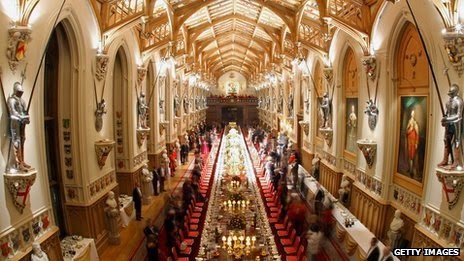
The Royal Household staff start laying the table for a banquet two days before the event, although preparations will have been underway for days before this. One of the most striking elements on the banqueting table is the magnificent service of silver gilt. It comprises not only the dining place itself, but also decorative items such as dessert stands and centerpieces. Numbering over 4,000 pieces, the service was commissioned by George IV when he was Prince of Wales, and it was supplied by the Royal goldsmiths Rundell, Bridge and Rundell.

At a famous dinner held at Carlton House in 1811, the Prince sat against a backdrop of silver guilt at the head of a table that stretched the entire length of the building. Along the centre of the table was running stream of water with banks of moss and aquatic flowers, cascading from a waterfall and falling into a series of pools at the foot of the table. Real fish swam in the stream. In this contemporary caricature (below), the fish are disconcerting the guests by staring at them.

29 June 1811, Hand-coloured etching ~ A farmer (John Bull) and his family gape in amazement at the arrangements for the Regency fête on 19 June. The narrow table extends across the design receding from left to right, the cloth hanging over the seats of chairs in the foreground. The famous canal decorates the centre of the table with its gold and silver fish, and the table is laid with gold plate, and ornate cut-glass goblets and decanters labelled 'Dry Champain', 'Claret', and 'Burgundy'. There are three-branched gold candelabra. The Prince's chair is on the extreme right; beside it stand a man in livery and an attendant in plain clothes. Behind the chair large ornate gold salvers are arranged on shelves covered with white drapery. This was 'a kind of circular buffet . . . lined by festoons and antique draperies of pink and silver'. The sightseers are on the farther side of the table (left) with their backs to the windows, John in the centre; he says, pointing: "Why Odd Zookers this is marvellous fine indeed. Oh Nan how we should relish a rasher on one of they monstracious beautifull Plates, why now I think I shan't grumble to pay three or four Bank Tokens towards this grand treat—methinks I should Just like a nippikin too." His wife puts out her hands protestingly: "Oh John one of our milk white Chickens roasted by myself by our wood fire would be Luscioscious indeed." His daughter says: "La Feather do zee how they gilded Fishes be stareing at yow." There are three loutish sons; one says: "I say Sue I thinks I should not like that dry Shampain, but a Dobbin of our home brewed in that there gilded gold thing would be dreadfully noice indeed"; another (looking up at the (invisible) ceiling : "Dang it if the top 0 the pleace beant all Eel pottles I'll be hang'd.
👑👑👑👑👑👑👑👑👑👑👑


The Grand Service includes 14 tureens, 20 sauce tureens, 140 dishes, 288 dinner plates, 118 salts, 12 ice pails, 12 mirrored plateaux, 58 desert stands and centerpieces and 107 candelabra. Unlike a modern dinner service, it has no single style of decoration. The goldsmiths of the day were influenced by Greek, Roman, Egyptian and other styles.

Originally some parts of the service for plain silver, although items intended for the desert course we're always gilt. However, George IV gradually ordered every piece to be gilded. This may have been because of the impression gained by one visitor to a ball at Carton House in n 1814: "All was in gold or silver gilt which made the silver plate, set out in the deep recessed windows, look cold and poor, although in reality it was very massive and handsome."

Today the Grand Service is kept under the care of the "Yeoman of the Silver Pantry." When not in use, it is kept in a controlled atmosphere. For a State Banquet it must be at its most gleaming and every piece is taken apart, thoroughly washed and cleaned with soft brushes, then dried and polished with soft cloths before being placed on the table. When everything is dismantled, there are over 8,000 components to clean. It takes 8 people 3 weeks to prepare.The Grand Service provides cutlery for every course and includes more obscure items like marrow scoops, ice spades and olive spoons. Today over 2000 pieces of cutlery are needed to serve and eat the banquet all drawn from the Grand Service.

The Queen's table is always decorated in the most magnificent style. She and her most important guest are usually flanked by the grandest pair of candelabra in the service -- which stand at 1.25 metres (4 ft) tall. These were designed by the sculptor John Flaxman and relate episodes from myths of Bacchus and Mercury. The Queen uses a salt that is not part of the Grand Service but was made much earlier, in 1721, by Nicholas Clausen.
 
Don't think about asking the Queen to "Please pass the salt."  She has her own salt dip, or salt cellar, and it is not part of the 8,000 plus pieces used for State Dinners.

At Windsor, on the single long table, a candelabrum portraying St. George and the Dragon is used -- this stands even taller at almost 1.5 metres (5 ft.) This huge piece was William IV's contribution to the elder brother's dinner service -- a final addition to the grandeur that has served every monarch since George IV.
  • Takes two days to lay the 175ft-long dining table at Buckingham Palace
  •  Each place setting measures 45cm and a rod is used to achieve the exact alignment of chair and table
  • 1,104 glasses are used, six for each guest
  • George IV's 4,000-piece Grand Service is used
  • Takes eight people three weeks to clean the service
  • 170 linen napkins, with the Queen's monogram, are folded by one man in the shape of a Dutch bonnet 

The Etiquette at the Table: 


At the dining table, don't start eating until the The Queen has started her meal. 

When it comes to utensils, start at the outside (with the outermost spoon or fork) and work in. If you drop something, don't make a fuss - servants will spot it and deal with it.


Watch for clues and cues with regard to how to properly use your utensils.  Let others who have been there before, guide your actions.


It goes without saying that taking large gulps of your wines, talking with your mouth full, any loud slurping or chewing, and eating with your mouth open, are all the poorest of table manners.


Don't think about asking the Queen to "Please pass the salt."  She has her own salt dip, or salt cellar.


When she has finished her course and stops eating, you have finished your course, too.


Asking for seconds is never allowed, as is asking to be excused to use the restroom facilities. 


Sources; BBC News, The Royal Collection and "For the Royal Table: Dining at the Palace"

🍽Etiquette Enthusiast, Maura J. Graber of The RSVP Institute of Etiquette, is the Site Editor for the Etiquipedia© Etiquette Encyclopedia