Showing posts with label Servants' Hierarchy. Show all posts

Saturday, June 27, 2020

Etiquette of Servants’ Balls

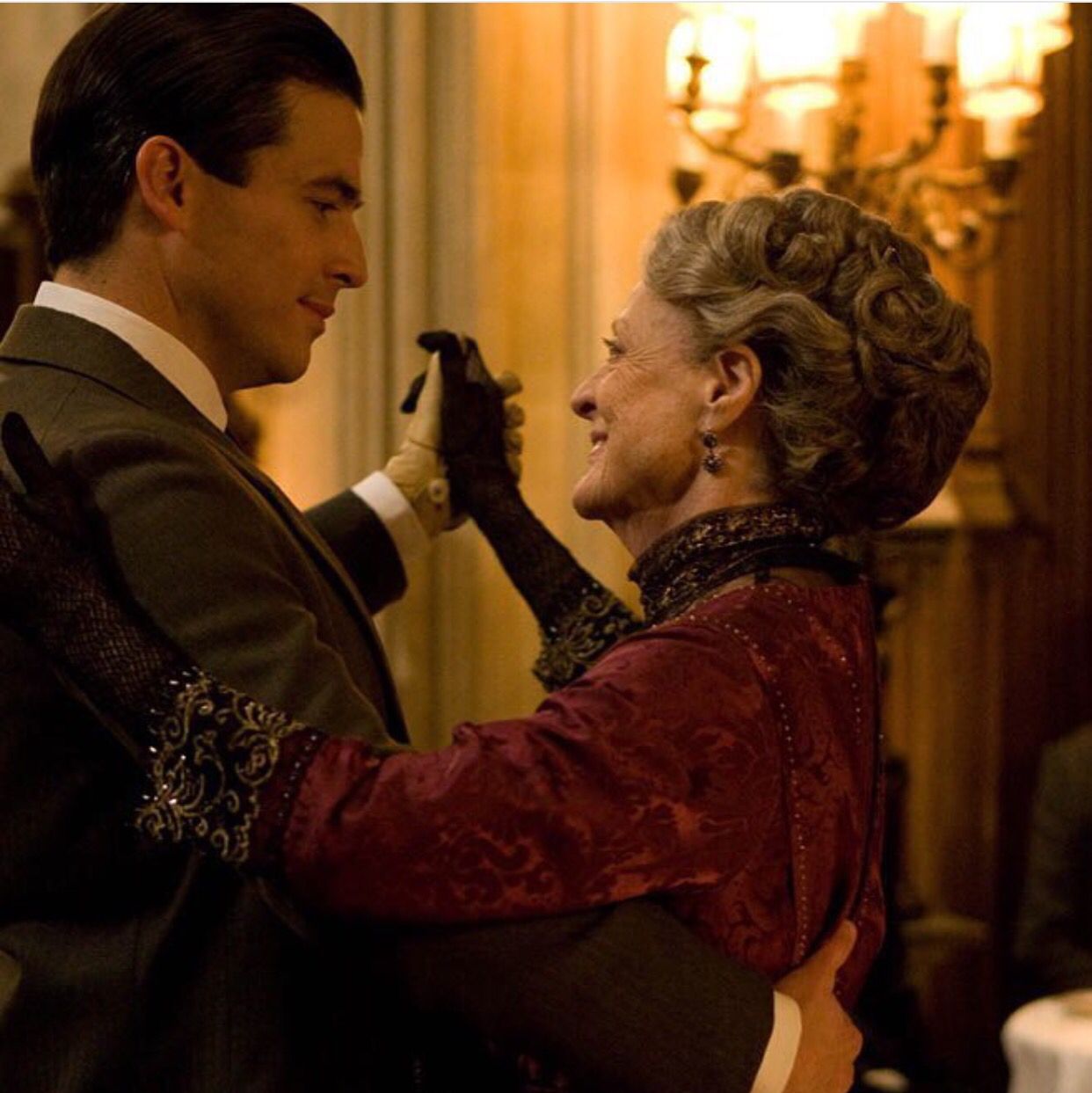
English aristocracy glories in this annual abjuration of pride and prejudice and on the truly republican instincts which permits, nay commands, a Duchess to dance with her cook or coachman, and encourages her daughters to waltz with a footman. Lady Salisbury, after performing a similar act, observed to a foreigner; “If you want to see true democracy, here it is.” This sentiment is not sincere, and does not deceive either the one who emits it or the recipients of these honors.
— Photo source, Pinterest

Lord Salisbury’s Annual Ball
Aristocracy Dancing with the Servants— Annual Abjuration of Pride

When the long table is surrounded by women glittering with the diamonds so profusely worn, when the magnificent gold and silver plate lends its massive splendor to the wealth of crystal, flowers and fruit, the lofty apartments in the white chaste light involuntarily recalls the gorgeous scenes painted by Veronese. The liveries worn by the twenty tall footmen of the noble are at once simple and tasteful—black coat, blue breeches and white waistcoat, and silken hose gartered with silver. The servants’ ball takes place in the winter dining-room, decorated with some flowers and greenery and provided with a small orchestra. Refreshments are adjoining apartment and a stand-up supper in the marble hall. 

English aristocracy glories in this annual abjuration of pride and prejudice and on the truly republican instincts which permits, nay commands, a Duchess to dance with her cook or coachman, and encourages her daughters to waltz with a footman. Lady Salisbury, after performing a similar act, observed to a foreigner; “If you want to see true democracy, here it is.” This sentiment is not sincere, and does not deceive either the one who emits it or the recipients of these honors. The upper and under servants preserve a stifled and embarrassed, almost an antagonistic, attitude as long as their superiors are present, and eye the quality with ill-concealed distrust. They flatten themselves stiffly against the wall while Lady Salisbury passes with her guests, and addresses a word to each before the dancing commences. 

There is more of feudal pomp than hearty equality in the custom. The French chef, to whom the visitor was rather ostentatiously introduced by the son of the house, admitted that he had been several years in the establishment, and liked England well enough. Then he suddenly and almost angrily exclaimed: “But I did my duty in 1870. I served in the Carabineers, and am not one of them.” He was evidently not won over by the mock favor, and rather resented it than otherwise, as an added display of superiority and a showing off of the number of retainers and generosity of employers. The upper servants themselves stand on their dignity, and rarely condescend to dance with the underlings, this being considered an infringement of domestic etiquette. 

The real enjoyment only begins after midnight, when the hostess retires with her friends. With the exception of the ladies’ maids, the women are absurdly and grotesquely attired—cotton velvet, red gloves, short muslins being common features. Each servant is authorized to issue two invitations. No control is placed on the duration of the revels, the housekeeper and head butler assuming the functions of Master of the Ceremonies: but the next morning all must return to their respective duties, and no trace remains of the festivities of the night, while the whole palatial establishment of Hatfield resumes the even, aristocratic tenor of its way. —London Correspondent, New York Sun, 1886


Etiquette Enthusiast, Maura J Graber, is the Site Editor for the Etiquipedia© Etiquette Encyclopedia

More English Servant Etiquette

The English servants are good-looking, neat and constitutional flunkeys and flunkeyesses. They are very shrewd, and have their class rules as well defined as any trade union. Downing Street does not possess more pigeon-holes and red tape than a mansion of the wealthy. An upper house-maid would die at the stake before she would do a bit of work that came within the province of the under house-maid.

Swell Servants in London

Says a London correspondent of the Cincinnati Commercial: “Although all hopes of recovering the jewels ot Lady Dudley has vanished—their real value was £30,000 there is still a good deal of speculation about their disappearance, and a pretty general belief that some of his lordship's servants must have been at least an accomplice in the transaction. It is difficult to believe that a box of such value intrusted to the care of servants could have disappeared in a railway station from unwilling bauds, or that an outside thief could have known so much about the movements of the family, as to have been on the spot at the precise moment. However this may be, there is no doubt that the English nobility, have a way of employing servants which offers grand opportunities to rogues, in most cases the outside of the servants is the chief thing. 


If the coachman or footman is looking in his livery and of the required dimensions, his character is not inquired into. A well known Duke recently advertised for a footman of exactly five feet eleven and a half inches, whose sole business it would be to stand at tbe back of his coach beside another of like station. A youth, now in the employ of a lady of my acquaintance, applied for the advertised position, and says that his character was not asked for— he was taken into the servants’ hall and measured, and dismissed for lacking the half inch demanded by the Duke. There is a passion tor tallness in servants, and of one noble family, at least, it is a rule to admit no man servant under six feet. There are six of these eminent personages in their fine mansions. The English servants are good-looking, neat and constitutional flunkeys and flunkeyesses. They are very shrewd, and have their class rules as well defined as any trade union. Downing Street does not possess more pigeon-holes and red tape than a mansion of the wealthy. An upper house-maid would die at the stake before she would do a bit of work that came within the province of the under house-maid.

A swell butler would throw up his position in the face of the Lord Chancellor himself if he were expected to black his own boots. There are many boys of thirteen kept in brass buttons, and in many an instance the sole duty of this boy is to brush the clothes and boots of tbe butler, the master of the house having his own separate valet. Of course, it is not pride which has made the inflexible laws of etiquette among these servants, which they refuse to step out of; an official groove or function. It is the determination of their class to preserve the conventional number the servants required for any first class household. They particularly dislike servants from other countries, especially the Germans, because; if well paid and well treated they will do anything requested of them. — Sacramento Daily Union, 1875


Etiquette Enthusiast, Maura J Graber, is the Site Editor for the Etiquipedia© Etiquette Encyclopedia

Below Stairs’ Etiquette

Many don’t realize that the pecking order and social hierarchy in the servants’ hall was just as rigid as that of that of the Lords and Ladies of the manor. There was a natural expectation that one’s manners would be commensurate with one’s position in service.

The Case of Muggins, Who Wished She Were Dead

The terrors of etiquette below stairs! There once strayed into employ a housemaid whose career hitherto had been confined to lodging houses. Upstairs she always looked frightened, and her face had a great attraction for “smuts,” but she was very willing and very competent. “It is not for me to ask madam to send Muggins away, but the rest of us will go if Muggins stays. I don't know where she has lived out before, but she drinks out of her saucer and does not even know that we expect her to be down in our sitting room at half past 4:00, dressed in her black and ready to pour out the servants tea.” 

Of course I gave Muggins notice, recognizing that the lodging house was her proper sphere, and in the month that followed, I knew she suffered martyrdom. She used to wipe her eyes stealthily, and as she was not proud, I showed her some sympathy. “They ain't nice to me downstairs like you are, ma’am,” she sobbed, “though I'm doing my best. Cook says she won’t wipe up the dishes for the likes of me.” “Never mind, Muggins. You’ll be going soon, and, after all, you have learned a good deal here.” I consoled her. “I wish,” said Muggins. “I was dead.” —Mrs. John Lane, Harper’s Bazar, 1905


Etiquette Enthusiast, Maura J Graber, is the Site Editor for the Etiquipedia© Etiquette Encyclopedia
Thursday, June 25, 2020

Etiquette Regarding Servants

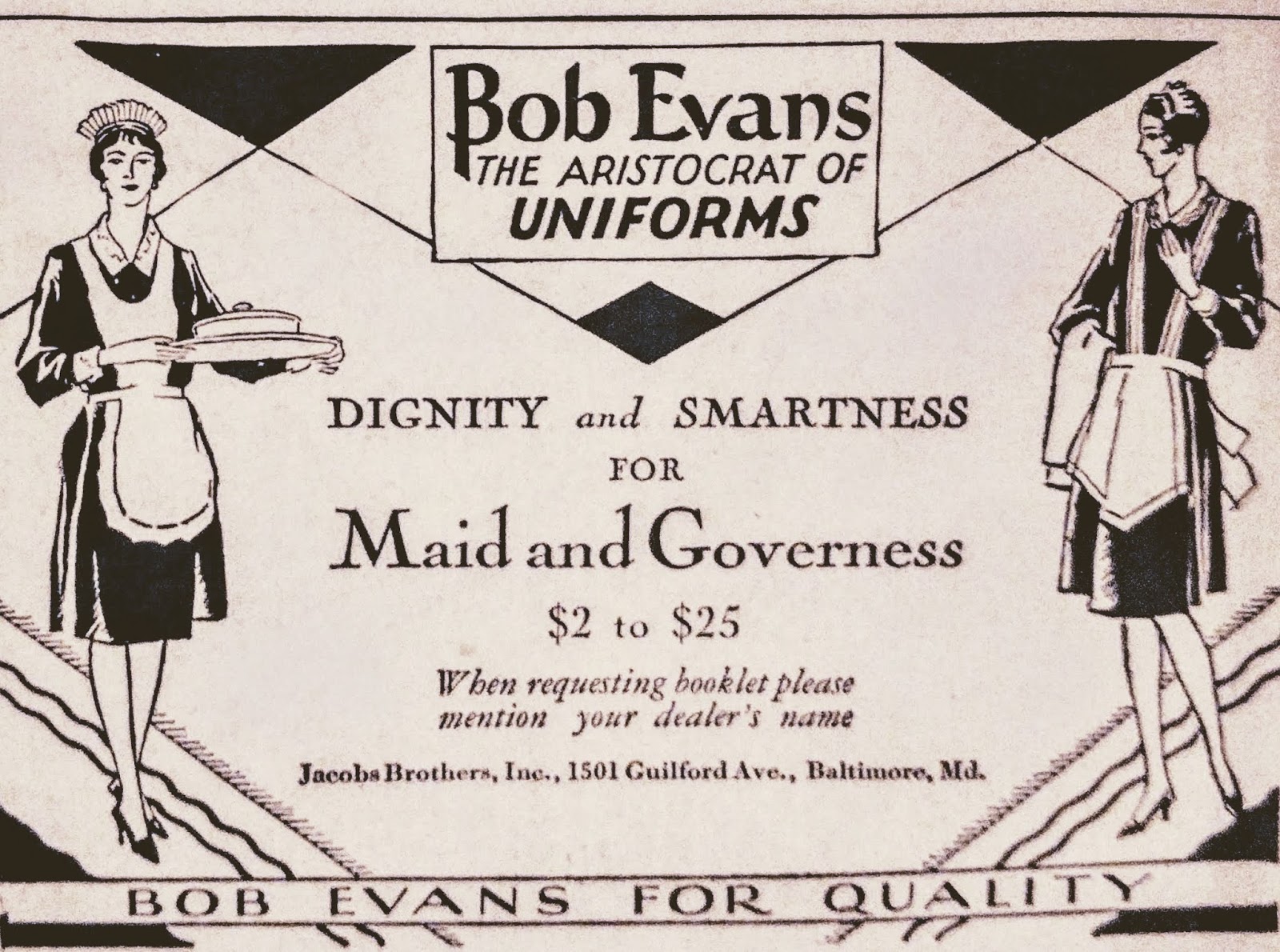
An early 19th century magazine advertisement for American maids’ outfits. —“A Housekeeper, a Lady’s Maid and a Head Nurse belong to the hierarchy of a household. A Lady’s Maid wears no cap and when in attendance on her Lady, is expected to be well, but quietly dressed, in black or some sober coloring. Her wages are from $150 to $200 a year, with the reversion of her employer’s wardrobe.” 

Servants in England 
There Are Fixed Forms of  Etiquette Governing Their Treatment

While mistresses and housemaids in this country are struggling to solve the vexed “servant problem” they do not appear to take into consideration the fixed forms of etiquette governing the treatment of servants in England, which probably do much toward promoting mutual understanding between the servants and the served over there. 

A Housekeeper, a Lady’s Maid and a Head Nurse belong to the hierarchy of a household. A Lady’s Maid wears no cap and when in attendance on her Lady, is expected to be well, but quietly dressed, in black or some sober coloring. Her wages are from $150 to $200 a year, with the reversion of her employer’s wardrobe. 

An English maid is always called by surname, “Smith” or “Jones,” but a foreign maid’s first name is used, “Marie” or “Françoise.” A Lady speaking of her maid to other upper servants, such as the Butler or the Housekeeper, would style her “Smith” or “Marie,” but when mentioning her to Housemaids or Footmen, she would he careful to allude to her as “Miss Smith” or “Mlle. Marie.”- New York American, 1905


Etiquette Enthusiast, Maura J. Graber, is the Site Editor for the Etiquipedia© Etiquette Encyclopedia


Tuesday, April 5, 2016

New Etiquette for "Below Stairs"

The ladies' maids and valets of the guests will not dine with the help of the house, and the chambermaids, according to the etiquette of high life below stairs, will not sit down with the scrubwoman, and in some places will also decline to eat at the same table as the bellboys. 
Are All Dreadfully Particular 

In the furnishing and fitting of some of the new apartments, and apartment hotels, several interesting features have been under discussion, says the New York Sun. In other days, in the old class of such buildings in this city, a dining room for children and servants was considered sufficient for all requirements. 

To-day in building a hotel, there must be a succession of dining rooms. The ladies' maids and valets of the guests will not dine with the help of the house, and the chambermaids, according to the etiquette of high life below stairs, will not sit down with the scrubwoman, and in some places will also decline to eat at the same table as the bellboys. 

The clerks, telephone girls and numerous other members of the staff form another set. At some of the hotels the clerks are served in the cafe, but it has been found that it is better that the clerical force and the housekeeper and the different heads of departments have a dining room of their own. 

The chauffeur still remains an indefinite proposition. Until lately he has declined in private houses to be classed as a servant, and only last year there was a protest about his wearing livery.  It is quite à la mode this season to register at a resort hotel “Mr. and Mrs. and chauffeur,” just as it has been “maid” or “man servant” on the out going ships— Sausalito News, 1908


Etiquette Enthusiast Maura J Graber is the Site Editor for the Etiquipedia© Etiquette Encyclopedia

Wednesday, May 14, 2014

Upstairs-Downstairs; Etiquette and Lives of Household Servants

“We are all dependent, in one way or another, upon others. At one time we serve, at another we are served, and we are equally worthy of honor and respect in the one case as in the other. The man or the woman who serves us may or may not be our inferior in natural capacity, learning, manners, or wealth. Be this as it may, the relation in which we stand to him or her gives us no right beyond the exaction of the service stipulated or implied in that relation. The right to tyrannize over our inferiors in social position, to unnecessarily humiliate them, or to be rude and unkind can not exist, because it would be an infringement of other rights. Servants have rights as well as those whom they serve, and the latter have duties as well as the former. We owe those who labor for us something more than their wages.”– From “How to Behave” 1887
Servants: A life below stairs

From Upstairs, Downstairs to Gosford Park and Downton Abbey, TV dramas and films have made us care about the characters below stairs. Domestic service was Britain's biggest employer a century ago, but how have things changed over the years?


"It is a form of marriage to a point as you are devoted to that family," says 78-year-old Rick Fink.
The servants clear from the dinner.
If there are guests, those servants will be expected to stay upstairs to wait on the family during the rest of the evening as well.
Fink has more than 55 years of experience managing estates and working as a butler. He started off in the Royal Navy in 1953, and one of the first guests he served as a young steward was Prince Phillip.

"I was petrified, but this was the Queen's husband. He just came aboard and he was tanned with blonde hair and looked fabulous and I had to ask him what he wanted to drink."

Now Fink runs the Butler-Valet School, training butlers for service in stately homes and private residencies. Some aspects of the role are timeless and governed by an unspoken etiquette and code of conduct.
"The true gentleman is never arrogant, or overbearing, or rude to domestics or employees. His commands are requests, and all services, no matter how humble the servant, are received with thanks, as if they were favors. We might say the same with still greater emphasis of the true lady. There is no surer sign of vulgarity than a needless assumption of the tone of authority and a haughty and supercilious bearing toward servants and inferiors in station generally. It is a small thing to say, "I thank you," but those little words are often better than gold. No one is too poor to bestow, or too rich to receive them." From "How to Behave" 1887
"[A butler] needs to be reliable, discreet, trustworthy, and your life revolves around your employer," says Fink.

"I would never sit in the drawing room or have dinner at their dining room table. I keep myself the other side of the baize door."
Lady Sybil learns to cook from the help: A great deal of nostalgia surrounds the traditional notion of domestic service, with the scandals above and below stairs in Downton Abbey proving a ratings success. But life for a domestic worker has evolved.
There is a great deal of nostalgia surrounding the traditional notion of domestic service, with the scandals above and below stairs in ITV's Downton Abbey proving a ratings success. But life for a domestic worker has evolved.

With the help of labour-saving devices, a household can now be run by fewer people. Employers can contact staff on a mobile phone rather than have to ring a bell or track them down in the grounds of the estate.

The inventory is itemised on a computer so there is no need to count the silverware and the dishwasher takes on the burden of washing up. Although not the Waterford Crystal.

According to the Office for National Statistics from the 2012 Labour Force Survey, about 65,000 people are employed as domestic workers by households in the UK.

This includes domestic personnel "such as maids, cooks, waiters, valets, butlers, laundresses, gardeners, gatekeepers, stable-lads, chauffeurs, caretakers, governesses, babysitters, tutors, secretaries", to name just a few.

It excludes the provision of services such as cooking, gardening etc by independent service providers (companies or individuals).
Dinner in the servant's hall: Servant status was reinforced at mealtimes. "There would be a strict order of coming in to eat and strict rules about where different ranks of servants sit, and you might also have rules such as no speaking unless you were addressed by one of the senior servants," says Dr. Lucy Delap.In 1901 the vast majority of the 1.5 million people employed as domestic servants in Britain lived with their employer to attend to their every whim, whatever the time of day.
The figure includes those who may work for more than one household and may live in or away from their employer. Fink is surprised at just how many job adverts he sees these days for "live-out" domestic workers.

The situation was very different in 1901 when the vast majority of the 1.5 million people employed as domestic servants in Britain would have lived with their employer to attend to their every whim, whatever the time of day.
Attending to their every whim, whatever the time of day... The ladies maid - the mistress of the house's personal attendant, helping her to dress and do her hair.
Many aristocrats could afford a large team of live-in servants at their country estate, and there was a distinct social hierarchy in the servants' quarters.

According to Dr Lucy Delap, director of studies in history at St Catharine's College, Cambridge, servant status was reinforced at mealtimes.

"There would be a strict order of coming in to eat and strict rules about where different ranks of servants sit, and you might also have rules such as no speaking unless you were addressed by one of the senior servants," says Delap.

"The senior servants had a great deal of power, so the butler for example in some households would put down his knife and fork, and everyone else had to fit in whether you had finished or not. So servants had to learn to be fast eaters."
The pecking order and "who's who" of domestic service ~ Poor manners and classism recommended in "The Laws of Etiquette," from 1836. No wonder the author wanted to remain anonymous, and simply calls himself "A Gentleman."
"When women appear at the door of the coach to obtain admittance, it is a matter of some question to know exactly what conduct it is necessary to pursue. If the women are servants, or persons in a low rank of life, I do not see upon what ground of politeness or decency you are called upon to yield your seat. Etiquette, and the deference due to ladies have, of course, no operation in the case of such persons. Chivalry -- (and the gentleman is the legitimate descendant of the knight of old) -- was ever a devotion to rank rather than to sex. Don Quixote, or Sir Piercy Shafestone would not willingly have given place to servant girls. And upon considerations of humanity and regard to weakness, the case is no stronger. Such people have nerves considerably more robust than you have, and are quite as capable of riding backwards, or the top, as yourself."
The butler - in charge of the house, coachmen and footmen. He looked after the family and the wine cellar

The housekeeper - responsible for the housemaids and carried the keys to the china and linen cupboards

The ladies maid - the mistress of the house's personal attendant, helping her to dress and do her hair

The valet - the master's manservant, attending to his requests and preparing his clothes and shaving tools

The cook - ran the kitchen and larder, overseeing the kitchen, dairy and scullery maids

The governess- educated and cared for the children with the head and under nurse

The hallboy - worked 16-hour days, lighting all the lamps and candles and polishing the staff boots before they woke up

The tweeny - in-between stairs maid earned £13 a year, worked seven days a week from 5am-10pm and looked after slop duty.


Main article by Lucy Wallis for BBC News, published 21 September 2012


🍽️Etiquette Enthusiast, Maura J. Graber of The RSVP Institute of Etiquette, is the Site Editor for Etiquipedia© Etiquette Encyclopedia