Showing posts with label Fanny Trollope. Show all posts

Thursday, March 19, 2015

Regency Etiquette, Servants and Society

Regency Era British Authoress, Frances "Fanny" Trollope, was a keen observer of the life and people she met on her travels.

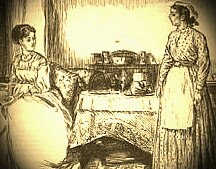
The greatest difficulty in organising a family establishment in Ohio, is getting servants, or, as it is there called, "getting help," for it is more than petty treason to the Republic, to call a free citizen a servant. The whole class of young women, whose bread depends upon their labour, are taught to believe that the most abject poverty is preferable to domestic service. Hundreds of half-naked girls work in the paper-mills, or in any other manufactory, for less than half the wages they would receive in service; but they think their equality is compromised by the latter, and nothing but the wish to obtain some particular article of finery will ever induce them to submit to it. A kind friend, however, exerted herself so effectually for me, that a tall stately lass soon presented herself, saying, "I be come to help you." The intelligence was very agreeable, and I welcomed her in the most gracious manner possible, and asked what I should give her by the year.


"Oh Gimini!" exclaimed the damsel, with a loud laugh, "you be a downright Englisher, sure enough. I should like to see a young lady engage by the year in America! I hope I shall get a husband before many months, or I expect I shall be an outright old maid, for I be most seventeen already; besides, mayhap I may want to go to school. You must just give me a dollar and half a week, and mother's slave, Phillis, must come over once a week, I expect, from t'other side the water, to help me clean." I agreed to the bargain, of course, with all dutiful submission; and seeing she was preparing to set to work in a yellow dress parseme with red roses, I gently hinted, that I thought it was a pity to spoil so fine a gown, and that she had better change it. "'Tis just my best and my worst," she answered, "for I've got no other."


And in truth I found that this young lady had left the paternal mansion with no more clothes of any kind than what she had on. I immediately gave her money to purchase what was necessary for cleanliness and decency, and set to work with my daughters to make her a gown. She grinned applause when our labour was completed, but never uttered the slightest expression of gratitude for that, or for any thing else we could do for her. She was constantly asking us to lend her different articles of dress, and when we declined it, she said, "Well, I never seed such grumpy folks as you be; there is several young ladies of my acquaintance what goes to live out now and then with the old women about the town, and they and their gurls always lends them what they asks for; I guess you Inglish thinks we should poison your things, just as bad as if we was Negurs." And here I beg to assure the reader, that whenever I give conversations they were not made À LOISIR, but were written down immediately after they occurred, with all the verbal fidelity my memory permitted.
                               
"I fear it may be called bad taste to say so much concerning my domestics, but, nevertheless, the circumstances are so characteristic of America that I must recount another history relating to them." Fanny Trollope, in her book "Domestic Manners of the Americans" 

This young lady left me at the end of two months, because I refused to lend her money enough to buy a silk dress to go to a ball, saying, "Then 'tis not worth my while to stay any longer." I cannot imagine it possible that such a state of things can be desirable, or beneficial to any of the parties concerned. I might occupy a hundred pages on the subject, and yet fail to give an adequate idea of the sore, angry, ever wakeful pride that seemed to torment these poor wretches. In many of them it was so excessive, that all feeling of displeasure, or even of ridicule, was lost in pity. One of these was a pretty girl, whose natural disposition must have been gentle and kind; but her good feelings were soured, and her gentleness turned to morbid sensitiveness, by having heard a thousand and a thousand times that she was as good as any other lady, that all men were equal, and women too, and that it was a sin and a shame for a free-born American to be treated like a servant.


When she found she was to dine in the kitchen, she turned up her pretty lip, and said, "I guess that's 'cause you don't think I'm good enough to eat with you. You'll find that won't do here." I found afterwards that she rarely ate any dinner at all, and generally passed the time in tears. I did every thing in my power to conciliate and make her happy, but I am sure she hated me. I gave her very high wages, and she staid till she had obtained several expensive articles of dress, and then, UN BEAU MATIN, she came to me full dressed, and said, "I must go." "When shall you return, Charlotte?" "I expect you'll see no more of me." And so we parted. Her sister was also living with me, but her wardrobe was not yet completed, and she remained some weeks longer, till it was.
             
The famous Georgian era painting, "Heads of Six of Hogarth's Servants," was seen as almost subversive in its day. It is unique among other paintings of the time, as the artist William Hogarth, chose to depict 5 servants of his household, in a manner more like those of the wealthier classes in the mid to late 1700s.  With the butler, closely surrounded by the others in the center of the painting, it depicts a close knit group. And it is just their heads depicted, as opposed to the servants performing their routine household duties. Thus, the artwork not only dignifies them, but humanizes them as well. The painting was displayed conspicuously in his estate home in full view of Hogarth's somewhat bemused guests, while at the same time the servants' facial expressions were purposely painted to convey all of the sincerity and deference expected of servant-class members of the era.
                   
I fear it may be called bad taste to say so much concerning my domestics, but, nevertheless, the circumstances are so characteristic of America that I must recount another history relating to them. A few days after the departure of my ambitious belle, my cries for "Help" had been so effectual that another young lady presented herself, with the usual preface "I'm come to help you." I had been cautioned never to ask for a reference for character, as it would not only rob me of that help, but entirely prevent my ever getting another; so, five minutes after she entered she was installed, bundle and all, as a member of the family. She was by no means handsome, but there was an air of simple frankness in her manner that won us all. 

For my own part, I thought I had got a second Jeanie Deans; for she recounted to me histories of her early youth, wherein her plain good sense and strong mind had enabled her to win her way through a host of cruel step-mothers, faithless lovers, and cheating brothers. Among other things, she told me, with the appearance of much emotion, that she had found, since she came to town, a cure for all her sorrows, "Thanks and praise for it, I have got religion!" and then she asked if I would spare her to go to Meeting every Tuesday and Thursday evening; "You shall not have to want me, Mrs. Trollope, for our minister knows that we have all our duties to perform to man, as well as to God, and he makes the Meeting late in the evening that they may not cross one another." Who could refuse? Not I, and Nancy had leave to go to Meeting two evenings in the week, besides Sundays.


One night, that the mosquitoes had found their way under my net, and prevented my sleeping, I heard some one enter the house very late; I got up, went to the top of the stairs, and, by the help of a bright moon, recognised Nancy's best bonnet. I called to her: "You are very late." said I. "what is the reason of it?" "Oh, Mrs. Trollope," she replied, "I am late, indeed! We have this night had seventeen souls added to our flock. May they live to bless this night! But it has been a long sitting, and very warm; I'll just take a drink of water, and get to bed; you shan't find me later in the morning for it." Nor did I. She was an excellent servant, and performed more than was expected from her; moreover, she always found time to read the Bible several times in the day, and I seldom saw her occupied about any thing without observing that she had placed it near her.


At last she fell sick with the cholera, and her life was despaired of. I nursed her with great care, and sat up the greatest part of two nights with her. She was often delirious, and all her wandering thoughts seemed to ramble to heaven. "I have been a sinner," she said, "but I am safe in the Lord Jesus." When she recovered, she asked me to let her go into the country for a few days, to change the air, and begged me to lend her three dollars. While she was absent a lady called on me, and enquired, with some agitation, if my servant, Nancy Fletcher, were at home. I replied that she was gone into the country. "Thank God," she exclaimed, "never let her enter your doors again, she is the most abandoned woman in the town: a gentleman who knows you, has been told that she lives with you, and that she boasts of having the power of entering your house at any hour of night." She told me many other circumstances, unnecessary to repeat, but all tending to prove that she was a very dangerous inmate. 


I expected her home the next evening, and I believe I passed the interval in meditating how to get rid of her without an eclaircissement. At length she arrived, and all my study having failed to supply me with any other reason than the real one for dismissing her, I stated it at once. Not the slightest change passed over her countenance, but she looked steadily at me, and said, in a very civil tone, "I should like to know who told you." I replied that it could be of no advantage to her to know, and that I wished her to go immediately. "I am ready to go," she said, in the same quiet tone, "but what will you do for your three dollars?" "I must do without them, Nancy; good morning to you." "I must just put up my things," she said, and left the room. About half an hour afterwards, when we were all assembled at dinner, she entered with her usual civil composed air, "Well, I am come to wish you all goodbye," and with a friendly good-humoured smile she left us.


This adventure frightened me so heartily, that, notwithstanding I had the dread of cooking my own dinner before my eyes, I would not take any more young ladies into my family without receiving some slight sketch of their former history. At length I met with a very worthy French woman, and soon after with a tidy English girl to assist her; and I had the good fortune to keep them till a short time before my departure: so, happily, I have no more misfortunes of this nature to relate.
 
          
Such being the difficulties respecting domestic arrangements, it is obvious, that the ladies who are brought up amongst them cannot have leisure for any great development of the mind: it is, in fact, out of the question; and, remembering this, it is more surprising that some among them should be very pleasing, than that none should be highly instructed. 

Had I passed as many evenings in company in any other town that I ever visited as I did in Cincinnati, I should have been able to give some little account of the conversations I had listened to; but, upon reading over my notes, and then taxing my memory to the utmost to supply the deficiency, I can scarcely find a trace of any thing that deserves the name. Such as I have, shall be given in their place. But, whatever may be the talents of the persons who meet together in society, the very shape, form, and arrangement of the meeting is sufficient to paralyze conversation. The women invariably herd together at one part of the room, and the men at the other; but, in justice to Cincinnati, I must acknowledge that this arrangement is by no means peculiar to that city, or to the western side of the Alleghanies.

Sometimes a small attempt at music produces a partial reunion; a few of the most daring youths, animated by the consciousness of curled hair and smart waistcoats, approach the piano forte, and begin to mutter a little to the half-grown pretty things, who are comparing with one another "how many quarters' music they have had." Where the mansion is of sufficient dignity to have two drawing-rooms, the piano, the little ladies, and the slender gentlemen are left to themselves, and on such occasions the sound of laughter is often heard to issue from among them. But the fate of the more dignified personages, who are left in the other room, is extremely dismal.

The gentlemen spit, talk of elections and the price of produce, and spit again. The ladies look at each other's dresses till they know every pin by heart; talk of Parson Somebody's last sermon on the day of judgment, on Dr. T'otherbody's new pills for dyspepsia, till the "tea" is announced, when they all console themselves together for whatever they may have suffered in keeping awake, by taking more tea, coffee, hot cake and custard, hoe cake, johny cake, waffle cake, and dodger cake, pickled peaches, and preserved cucumbers, ham, turkey, hung beef, apple sauce, and pickled oysters than ever were prepared in any other country of the known world. After this massive meal is over, they return to the drawing-room, and it always appeared to me that they remained together as long as they could bear it, and then they rise EN MASSE, cloak, bonnet, shawl, and exit.


From "Domestic Manners of the Americans," first published in 1832, by Frances 'Fanny' Trollope, 1780—1863 (Mother of the author Anthony Trollope)


Etiquette Enthusiast, Maura J. Graber, is the Site Editor for the Etiquipedia © Etiquette Encyclopedia 

Tuesday, March 17, 2015

Regency Etiquette, Creoles and Quadroons of New Orleans

“I left England with feelings so strongly opposed to slavery, that it was not without pain I witnessed its effects around me.” Frances Trollope, in Chapter 2 of “Domestic Manners of the Americans,” first published in 1832 
"On first touching the soil of a new land, of a new continent, of a new world, it is impossible not to feel considerable excitement and deep interest in almost every object that meets us. New Orleans presents very little that can gratify the eye of taste, but nevertheless there is much of novelty and interest for a newly arrived European. The large proportion of blacks seen in the streets, all labour being performed by them; the grace and beauty of the elegant Quadroons, the occasional groups of wild and savage looking Indians, the unwonted aspect of the vegetation, the huge and turbid river, with its low and slimy shore, all help to afford that species of amusement which proceeds from looking at what we never saw before. 
The town has much the appearance of a French Ville de Province, and is, in fact, an old French colony taken from Spain by France. The names of the streets are French, and the language about equally French and English. The market is handsome and well supplied, all produce being conveyed by the river. We were much pleased by the chant with which the Negro boatmen regulate and beguile their labour on the river; it consists but of very few notes, but they are sweetly harmonious, and the Negro voice is almost always rich and powerful. 
By far the most agreeable hours I passed at New Orleans were those in which I explored with my children the forest near the town. It was our first walk in "the eternal forests of the western world," and we felt rather sublime and poetical. The trees, generally speaking, are much too close to be either large or well grown; and, moreover, their growth is often stunted by a parasitical plant, for which I could learn no other name than "Spanish moss;" it hangs gracefully from the boughs, converting the outline of all the trees it hangs upon into that of weeping willows.
The chief beauty of the forest in this region is from the luxuriant undergrowth of palmetos, which is decidedly the loveliest coloured and most graceful plant I know. The pawpaw, too, is a splendid shrub, and in great abundance. We here, for the first time, saw the wild vine, which we afterwards found growing so profusely in every part of America, as naturally to suggest the idea that the natives ought to add wine to the numerous production of their plenty-teeming soil. The strong pendant festoons made safe and commodious swings, which some of our party enjoyed, despite the sublime temperament above-mentioned. 
Notwithstanding it was mid-winter when we were at New Orleans, the heat was much more than agreeable, and the attacks of the mosquitos incessant, and most tormenting; yet I suspect that, for a short time, we would rather have endured it, than not have seen oranges, green peas, and red pepper, growing in the open air at Christmas. In one of our rambles we ventured to enter a garden, whose bright orange hedge attracted our attention; here we saw green peas fit for the table, and a fine crop of red pepper ripening in the sun. 
Agostina Bruins’ “Women of Color with their Children and Servants in a Landscape”
A young Negress was employed on the steps of the house; that she was a slave made her an object of interest to us. She was the first slave we had ever spoken to, and I believe we all felt that we could hardly address her with sufficient gentleness. She little dreamed, poor girl, what deep sympathy she excited; she answered us civilly and gaily, and seemed amused at our fancying there was something unusual in red pepper pods; she gave us several of them, and I felt fearful lest a hard mistress might blame her for it. How very childish does ignorance make us! and how very ignorant we are upon almost every subject, where hearsay evidence is all we can get! I left England with feelings so strongly opposed to slavery, that it was not without pain I witnessed its effects around me. At the sight of every Negro man, woman, and child that passed, my fancy wove some little romance of misery, as belonging to each of them; since I have known more on the subject, and become better acquainted with their real situation in America, I have often smiled at recalling what I then felt. 
The first symptom of American equality that I perceived, was my being introduced in form to a milliner; it was not at a boarding-house, under the indistinct outline of "Miss C—," nor in the street through the veil of a fashionable toilette, but in the very penetralia of her temple, standing behind her counter, giving laws to ribbon and to wire, and ushering caps and bonnets into existence. She was an English woman, and I was told that she possessed great intellectual endowments, and much information; I really believe this was true. Her manner was easy and graceful, with a good deal of French tournure; and the gentleness with which her fine eyes and sweet voice directed the movements of a young female slave, was really touching: the way, too, in which she blended her French talk of modes with her customers, and her English talk of metaphysics with her friends, had a pretty air of indifference in it, that gave her a superiority with both. 
I found with her the daughter of a judge, eminent, it was said, both for legal and literary ability, and I heard from many quarters, after I had left New Orleans, that the society of this lady was highly valued by all persons of talent. Yet were I, traveller-like, to stop here, and set it down as a national peculiarity, or republican custom, that milliners took the lead in the best society, I should greatly falsify facts. I do not remember the same thing happening to me again, and this is one instance among a thousand, of the impression every circumstance makes on entering a new country, and of the propensity, so irresistible, to class all things, however accidental, as national and peculiar.
“Our stay in New Orleans was not long enough to permit our entering into society, but I was told that it contained two distinct sets of people, both celebrated, in their way, for their social meetings and elegant entertainments.”
On the other hand, however, it is certain that if similar anomalies are unfrequent in America, they are nearly impossible elsewhere. In the shop of Miss C— I was introduced to Mr. M'Clure, a venerable personage, of gentlemanlike appearance, who in the course of five minutes propounded as many axioms, as "Ignorance is the only devil;" "Man makes his own existence;" and the like. He was of the New Harmony school, or rather the New Harmony school was of him. He was a man of good fortune, (a Scotchman, I believe), who after living a tolerably gay life, had "conceived high thoughts, such as Lycurgus loved, who bade flog the little Spartans," and determined to benefit the species, and immortalize himself, by founding a philosophical school at New Harmony.
There was something in the hollow square legislations of Mr. Owen, that struck him as admirable, and he seems, as far as I can understand, to have intended aiding his views, by a sort of incipient hollow square drilling; teaching the young ideas of all he could catch, to shoot into parallelogramic form and order. This venerable philosopher, like all of his school that I ever heard of, loved better to originate lofty imaginings of faultless systems, than to watch their application to practice. With much liberality he purchased and conveyed to the wilderness a very noble collection of books and scientific instruments; but not finding among men one whose views were liberal and enlarged as his own, he selected a woman to put into action the machine he had organized.  
As his acquaintance with this lady had been of long standing, and, as it was said, very intimate, he felt sure that no violation of his rules would have place under her sway; they would act together as one being: he was to perform the functions of the soul, and will everything; she, those of the body, and perform everything. The principal feature of the scheme was, that (the first liberal outfit of the institution having been furnished by Mr. M'Clure,) the expense of keeping it up should be defrayed by the profits arising from the labours of the pupils, male and female, which was to be performed at stated intervals of each day, in regular rotation with learned study and scientific research. 
Famous creole, Madame Pierre Gautreau, in a painting by John Singer Sargent. The term "creole" was first used by French settlers to distinguish between someone born "from away" and anyone born in Louisiana. Someone could be African Creole, Native American Creole, French-Creole or Spanish-Creole.


But unfortunately the soul of the system found the climate of Indiana uncongenial to its peculiar formation, and, therefore, took its flight to Mexico, leaving the body to perform the operations of both, in whatever manner it liked best; and the body, being a French body, found no difficulty in setting actively to work without troubling the soul about it; and soon becoming conscious that the more simple was a machine, the more perfect were its operations, she threw out all that related to the intellectual part of the business, (which to do poor soul justice, it had laid great stress upon), and stirred herself as effectually as ever body did, to draw wealth from the thews and sinews of the youths they had collected. When last I heard of this philosophical establishment, she, and a nephew-son were said to be reaping a golden harvest, as many of the lads had been sent from a distance by indigent parents, for gratuitous education, and possessed no means of leaving it. 
Our stay in New Orleans was not long enough to permit our entering into society, but I was told that it contained two distinct sets of people, both celebrated, in their way, for their social meetings and elegant entertainments. The first of these is composed of Creole families, who are chiefly planters and merchants, with their wives and daughters; these meet together, eat together, and are very grand and aristocratic; each of their balls is a little Almack's, and every portly dame of the set is as exclusive in her principles as the excluded but amiable Quandroons, and such of the gentlemen of the former class as can by any means escape from the high places, where pure Creole blood swells the veins at the bare mention of any being tainted in the remotest degree with the Negro stain. 
Of all the prejudices I have ever witnessed, this appears to me the most violent, and the most inveterate. Quadroon girls, the acknowledged daughters of wealthy American or Creole fathers, educated with all of style and accomplishments which money can procure at New Orleans, and with all the decorum that care and affection can give; exquisitely beautiful, graceful, gentle, and amiable, these are not admitted, nay, are not on any terms admissable, into the society of the Creole families of Louisiana. They cannot marry; that is to say, no ceremony can render an union with them legal or binding; yet such is the powerful effect of their very peculiar grace, beauty, and sweetness of manner, that unfortunately they perpetually become the objects of choice and affection. If the Creole ladies have privilege to exercise the awful power of repulsion, the gentle Quadroon has the sweet but dangerous vengeance of possessing that of attraction.
The unions formed with this unfortunate race are said to be often lasting and happy, as far as any unions can be so, to which a certain degree of disgrace is attached. There is a French and an English theatre in the town; but we were too fresh from Europe to care much for either; or, indeed, for any other of the town delights of this city, and we soon became eager to commence our voyage up the Mississippi. Miss Wright, then less known (though the author of more than one clever volume) than she has since become, was the companion of our voyage from Europe; and it was my purpose to have passed some months with her and her sister at the estate she had purchased in Tennessee. This lady, since become so celebrated as the advocate of opinions that make millions shudder, and some half-score admire, was, at the time of my leaving England with her, dedicated to a pursuit widely different from her subsequent occupations. Instead of becoming a public orator in every town throughout America, she was about, as she said, to seclude herself for life in the deepest forests of the western world, that her fortune, her time, and her talents might be exclusively devoted to aid the cause of the suffering Africans.
Her first object was to shew that nature had made no difference between blacks and whites, excepting in complexion; and this she expected to prove by giving an education perfectly equal to a class of black and white children. Could this fact be once fully established, she conceived that the Negro cause would stand on firmer ground than it had yet done, and the degraded rank which they have ever held amongst civilized nations would be proved to be a gross injustice.
This question of the mental equality, or inequality between us, and the Negro race, is one of great interest, and has certainly never yet been fairly tried; and I expected for my children and myself both pleasure and information from visiting her establishment, and watching the success of her experiment.
“On the first of January, 1828, we embarked on board the Belvidere, a large and handsome boat...”
The innumerable steam boats, which are the stage coaches and fly waggons of this land of lakes and rivers, are totally unlike any I had seen in Europe, and greatly superior to them. The fabrics which I think they most resemble in appearance, are the floating baths (les bains Vigier) at Paris. The annexed drawing will give a correct idea of their form. The room to which the double line of windows belongs, is a very handsome apartment; before each window a neat little cot is arranged in such a manner as to give its drapery the air of a window curtain. This room is called the gentlemen's cabin, and their exclusive right to it is somewhat uncourteously insisted upon. The breakfast, dinner, and supper are laid in this apartment, and the lady passengers are permitted to take their meals there. On the first of January, 1828, we embarked on board the Belvidere, a large and handsome boat; though not the largest or handsomest of the many which displayed themselves along the wharfs; but she was going to stop at Memphis, the point of the river nearest to Miss Wright's residence, and she was the first that departed after we had got through the customhouse, and finished our sight-seeing.
We found the room destined for the use of the ladies dismal enough, as its only windows were below the stem gallery; but both this and the gentlemen's cabin were handsomely fitted up, and the former well carpeted; but oh! that carpet! I will not, I may not describe its condition; indeed it requires the pen of a Swift to do it justice. Let no one who wishes to receive agreeable impressions of American manners, commence their travels in a Mississippi steam boat; for myself, it is with all sincerity I declare, that I would infinitely prefer sharing the apartment of a party of well conditioned pigs to the being confined to its cabin.
I hardly know any annoyance so deeply repugnant to English feelings, as the incessant, remorseless spitting of Americans. I feel that I owe my readers an apology for the repeated use of this, and several other odious words; but I cannot avoid them, without suffering the fidelity of description to escape me. It is possible that in this phrase, "Americans," I may be too general. The United States form a continent of almost distinct nations, and I must now, and always, be understood to speak only of that portion of them which I have seen. In conversing with Americans I have constantly found that if I alluded to anything which they thought I considered as uncouth, they would assure me it was local, and not national; the accidental peculiarity of a very small part, and by no means a specimen of the whole. "That is because you know so little of America," is a phrase I have listened to a thousand times, and in nearly as many different places. It may be so—and having made this concession, I protest against the charge of injustice in relating what I have seen.

From “Domestic Manners of the Americans,” first published in 1832, by Frances 'Fanny' Trollope, 1780—1863 (Mother of the author Anthony Trollope)


Etiquette Enthusiast, Maura J. Graber, is the Site Editor for the Etiquipedia  Etiquette Encyclopedia