Showing posts with label The Merry Affair and Diplomacy. Show all posts

Sunday, October 15, 2017

Jeffersonian Etiquette and Style


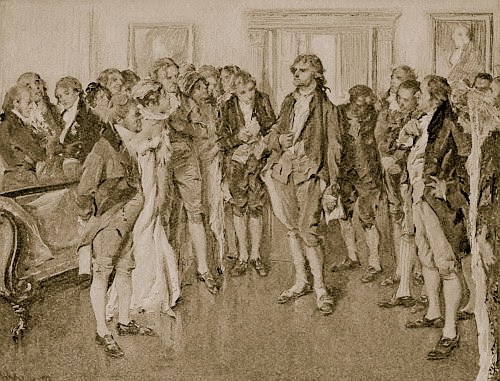
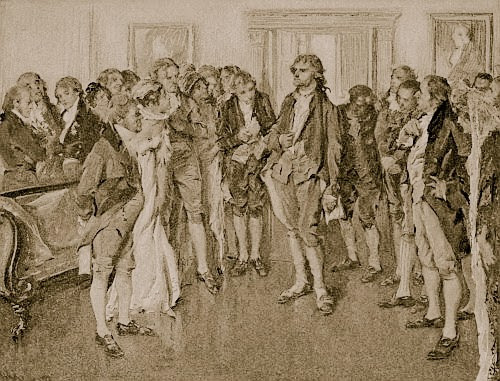
 The new British diplomatic representative to the United States, Anthony Merry, and his wife were shocked and insulted when the president received them in worn clothing and slippers. In December 1803 at a formal dinner in the White House, no one offered to escort Mrs. Merry to dinner. In the dining room, Merry and his wife had to scramble for places at the table in competition with the other guests. Others had the same experience. Read more on Jefferson’s “Pell-Mell Etiquette” on Etiquipedia©


The habits of the last century in respect to decorum were just receding ; men were — for better or worse — ceasing to occupy themselves about peronal externals, and the customary suit of solemn black was only just coming into vogue. The old regime was dying, and its disappearance was as conspicuous in England as in France, in America' as in England. This is easily illustrated. If we were to read in some old collection of faded letters a woman's animated description of a country visit paid to one who seemed the counterpart of Addison's Sir Roger de Coverley, we should naturally assume that the date and address of the letter must be very far away in space and time. 


Suppose that the narrator should tell us of a fine country house, surrounded by lofty elms forming two avenues, the one leading to the high road, the other to the village church. There are family portraits in the hall, a book-case containing the first edition of the Spectator, and a buffet of old plate and rare china. The guest remains over Sunday, and her host, wearing wig and cocked hat and red cloak, escorts her down the avenue of elms through the rural churchyard to the village church. At every step they pass villagers,who make profound obeisance, and at the conclusion of the service the whole congregation remains standing until this ancient gentleman and his friends have passed down the broad aisle. Who would not fancy this a scene from some English hamlet in the days of Queen Anne? Yet it all look place in the present century, and in the quiet village of Harvard, Massachusetts, little more than thirty miles from Boston, and now only noted as the abode of a little Shaker community and the scene of Howell's "Undiscovered Country." 

The narrator was the late Mrs. Josiah Quincy, and her host was Harry Bromfield, elder brother of the well known benefactor of the Boston Athenaeum. He was simply a "survival "of the old way of living. He spoke of State Street as King Street, and Summer Street as Seven-Star Lane, and his dress and manners were like his phrases. Such survivals were still to be found, here and there all over the country, at the precise time when Jefferson became President, and shocked Mr. Merry with his morning slippers, and Mr. Sullivan by opening his doors to the world. 

Thomas Jefferson's way of living in Washington exhitbited a profuse and rather slovenly hospitality, which at last left him deeply in debt. He kept open house, had eleven servants (slaves) from his plantation, beside a French Cook and Steward and an Irish Coachman. His long dining-room was crowded every day, according to one witness, who tested its hospitality for sixteen days in succession ; it was essentially a bachelor establishment, he being then a widower, and we hear little of ladies among its visitors. There was no etiquette at these great dinners ; they sat down at four and talked till midnight. 

The city of Washington was still a frontier settlement, in that phase of those outposts when they consist of many small cabins and one hotel, at which everybody meets. The White House was the hotel ; there was no "society" anywhere else, because nobody else had a drawing-room large enough to receive it. Pennsylvania Avenue was still an abyss of yellow mud, on which nobody could walk, and where carriages were bemired. Governor Morris, of New York, described Washington as the best city in the world for a future residence. " We want nothing here," be said, "but houses, cellars, kitchens, well-informed men, amiable women, and other little trifles of this kind, to make our city perfect." -T. W. Higginson, in Harper’s Magazine, 1884


Etiquette Enthusiast, Maura J Graber, is the Site Editor for the Etiquipedia© Etiquette Encyclopedia 

Thursday, March 31, 2016

Etiquette and the Merry Affair

Rudeness is no proper response to another’s rudeness! Portrait of Mrs Elizabeth Merry, wife of the new British diplomatic representative to the United States, Anthony Merry– “The two diplomats and their wives sought to retaliate. At their parties, for instance, no one escorted the wives of the Cabinet members to the dinner table. This social war greatly enlivened Washington.”

Thomas Jefferson's Washingtonian Merry Affair

Jefferson believed that the President's dress and manners should reflect the republican simplicity and informality of the country. Pomp and show reminded him too much of the European courts. In fact, Jefferson worked so hard to avoid ostentation that he began to dress not merely plainly, but sloppily.

As for manners, he refused to observe the rules of protocol in seating his dinner guests. First come, first served was the rule in the Presidential mansion, the White House. Jefferson explained: In social circles, all are equal, whether in, or out, of office, foreign or domestic; and the same equality exists among ladies and gentlemen … “pell mell” and “next the door” form the basis of etiquette in the societies of this country.

The new British diplomatic representative to the United States, Anthony Merry, and his wife were shocked and insulted when the president received them in worn clothing and slippers. In December 1803 at a formal dinner in the White House, no one offered to escort Mrs. Merry to dinner. In the dining room, Merry and his wife had to scramble for places at the table in competition with the other guests. The Marquis d'Yrujo, the Spanish diplomat, had the same experience. He and Merry agreed that this treatment was an insult to them and to their countries.

The two diplomats and their wives sought to retaliate. At their parties, for instance, no one escorted the wives of the Cabinet members to the dinner table. This social war greatly enlivened Washington. The President refused to retreat from his pell mell rule, and Merry and Yrujo became increasingly angry and receptive to the plottings of Jefferson's opponents, the Federalists and Aaron Burr.

From www.knowsouthernhistory.net


Etiquette Enthusiast, Maura J Graber, is the Site Editor for the Etiquipedia© Etiquette Encyclopedia

Saturday, February 15, 2014

“Pell-Mell” Etiquette

Pell-Mell:
Adverb
In a confused, rushed, or disorderly manner.
“the contents of the sacks were thrown pell-mell to the ground”

Synonyms:
helter-skelter, headlong, (at) full tilt, hotfoot, posthaste, hurriedly, hastily, recklessly, precipitately

“The new British diplomatic representative to the United States, Anthony Merry, and his wife were shocked and insulted when the President received them in worn clothing and slippers. In December 1803 at a formal dinner in the White House, no one offered to escort Mrs. Merry to dinner. In the dining room, Merry and his wife had to scramble for places at the table in competition with the other guests. The Marquis d'Yrujo, the Spanish diplomat, had the same experience. He and Merry agreed that this treatment was an insult to them and to their countries. The two diplomats and their wives sought to retaliate.” 
The Merry Affair
Jefferson believed that the president's dress and manners should reflect the republican simplicity and informality of the country. Pomp and show reminded him too much of the European courts. In fact, Jefferson worked so hard to avoid ostentation that he began to dress not merely plainly, but sloppily. As for manners, he refused to observe the rules of protocol in seating his dinner guests. First come, first served was the rule in the presidential mansion, the White House. Jefferson explained: In social circles, all are equal, whether in, or out, of office, foreign or domestic; and the same equality exists among ladies and gentlemen … “pell mell” and “next the door” form the basis of etiquette in the societies of this country.
Rudeness is no proper response to another's rudeness! Portrait of Mrs Elizabeth Merry, wife of the new British diplomatic representative to the United States, Anthony Merry – “The two diplomats and their wives sought to retaliate. At their parties, for instance, no one escorted the wives of the Cabinet members to the dinner table. This social war greatly enlivened Washington.” 

The new British diplomatic representative to the United States, Anthony Merry, and his wife were shocked and insulted when the president received them in worn clothing and slippers. In December 1803 at a formal dinner in the White House, no one offered to escort Mrs. Merry to dinner. In the dining room, Merry and his wife had to scramble for places at the table in competition with the other guests. The Marquis d'Yrujo, the Spanish diplomat, had the same experience. He and Merry agreed that this treatment was an insult to them and to their countries. The two diplomats and their wives sought to retaliate. At their parties, for instance, no one escorted the wives of the Cabinet members to the dinner table. This social war greatly enlivened Washington. The president refused to retreat from his pell mell rule, and Merry and Yrujo became increasingly angry and receptive to the plottings of Jefferson's opponents, the Federalists and Aaron Burr. -From www.knowsouthernhistory.net

Dinner Etiquette

When President of the United States, Thomas Jefferson promoted “pell-mell” etiquette. It was a much more informal style of dinner etiquette than that observed by his predecessors. In 1788 Jefferson consoled a French diplomat disillusioned by his initial experience of the new American republic: “I am sorry that your first impressions have been disturbed by matters of etiquette, where surely they should least have been expected to occur.” Such matters, he said, “are the most insusceptible of determination, because they have no foundation in reason,” adding that “it would have been better, in a new country, to have excluded etiquette altogether.”
Thomas Jefferson, third president of the United States (1801-1809) 
In March 1801, when he took up residence in the President's House, he seized his chance to banish etiquette at the highest executive level and to reorganize the social mechanism of the national capital on a rational plan. First to go was the presidential levee, the weekly focal point for society in the capital in the two previous administrations. Jefferson replaced it with a series of small, informal dinners, but retained the established custom of open house on New Year's Day and the Fourth of July.

To ensure that the American public should never mistake its president for a king, he adopted a purposeful informality in his own behavior as chief executive: shaking hands instead of bowing, riding without an attendant servant, issuing his dinner invitations in his own name rather than as president, and dressing informally for official receptions. As one foreign visitor observed, "It was the object of Mr. Jefferson to preserve, in every trifle, that simplicity which he deemed the most appropriate characteristic of a republic. . . . He wisely judged that in this matter, as in most others, example was better than precept, and set about new-ordering the manners of the city."

The new Jeffersonian order became most famous for the policy of “pell-mell,” especially as applied to a moment charged with significance for those conscious of their rank - the procession of dinner guests to their appointed places at the table. Defying custom of long standing, especially in diplomatic circles, Jefferson declared, “At public ceremonies, to which the government invites the presence of foreign ministers and their families, a convenient seat or station will be provided for them, with any other strangers invited and the families of the national ministers, each taking place as they arrive, and without any precedence.”

The deprivation of his precedence in the pell-mell passage to the dinner table was too much for British minister Anthony Merry. Bolstered by his large and equally offended wife and another sensitive diplomat, Merry withdrew from official Washington society. The ensuing social tempest came close to clouding the course of American foreign and domestic policy, but Jefferson stood firmly behind the principle at the root of pell-mell: “When brought together in society, all are perfectly equal, whether foreign or domestic, titled or untitled, in or out of office.”


United States Capitol, Completed Northern Wing (circa 1801)

Many American observers concluded that Jefferson had been too systematic in his application of republican principles to social forms. His two Republican successors pursued the Jeffersonian political course but tempered the leveling social practices of the first Republican administration. The Madisons instituted a weekly “drawing room” and introduced more formality into official dinner parties.
The ancient and universal custom of drinking healths at the dinner table.

There was, however, one practice abolished by Jefferson that was restored by neither Madison nor Monroe - the ancient and universal custom of drinking healths at the dinner table. The tradition of capping a meal with a session of toast-drinking was firmly entrenched in the early American republic. 

Increase Mather and other seventeenth-century Puritans had fulminated against the practice. Post-war patriots had recommended throwing out offensive English customs, including health-drinking, to complete the revolution. Yet the habit of raising a glass to drink the health of fellow guests, absent friends, and political figures and principles seems to have been almost universal at the tables of upper-class Americans.
“In a penetrating study of political life in Washington during the Jeffersonian period, The Washington Community, 1800-1828, James S. Young described the dinners as one of Jefferson's 'power techniques'. The only President to give dinners extensively, he had abolished the aristocratic levees which were a hallmark of the Federalist administrations. Considering political distinctions to be important, Jefferson rarely mixed Federalists with Republicans, nor did he invite Cabinet members along with Congressmen. Just as the guest list was planned, so a great deal of attention was given to physical surroundings. To encourage conviviality and discourage a feeling of inequality, a round table was used; to insure privacy, a dumbwaiter was used in place of servants. A French chef, imported wines and Jefferson's informal wardrobe completed the picture. Politics were subtly removed as a province of conversation, and everyone was invited to participate freely in verbal exchanges.
 
“Another recent historian, Claude Bowers, also found the dinners to be useful instruments for 'conciliating political opponents' in Jefferson in Power. But, he noted that when Congress was out of session, Jefferson invited members of the local community to share his hospitality. They were not disappointed, for frugality was never in evidence at the President's House. Etienne Lemaire, Jefferson's head of household, estimated that he spent fifty dollars a day on food and wine.” –www.monticello.org


🍽️Etiquette Enthusiast, Maura J Graber of The RSVP Institute of Etiquette, is the Site Editor for the Etiquipedia© Etiquette Encyclopedia