Showing posts with label Etiquette of Romantic Attachments. Show all posts

Thursday, June 21, 2018

Etiquette and Engagement Season

The Christmas holidays, they say, full of gaiety and high spirits (I allude to those of nature’s providing are apt to lead to engagements; hasty manners, perhaps, but none the less agreeable.) Spring, of course, has always been considered a happy time for lovers’ boughs budding with green fire, the livelier iris of the dove, and all the rest of it July, August and early September are languid...


“Anne Gives Advice on Etiquette”

“Can you tell us,” writes a firm which shall be nameless, “if there are any special seasons of the year, in which people become engaged? We should appreciate what information you have on the subject.“ – "A. B. & C."


At first sight, this appeared as impossible an etiquette question to answer as any I ever received and I've received some difficult ones! It seemed to me that Pan, Cupid, Propinquity, Chance, any of the higher powers or the natural forces that govern humanity, might better be consulted. I thought of Tennyson’s pleasant line “In the Spring, a young man's fancy lightly turns to thoughts of love,” but nothing else occurred to me. However, I dined with a newly married nephew that evening, and I thought I would confide my problem to him. “I can tell you that,” he replied with the fine readiness of youth. “The Christmas holiday, the early spring, also the months of July, August and half of September.” 


I have talked to other young men since. The Christmas holidays, they say, full of gaiety and high spirits (I allude to those of nature’s providing are apt to lead to engagements; hasty manners, perhaps, but none the less agreeable.) Spring, of course, has always been considered a happy time for lovers’ boughs budding with green fire, the livelier iris of the dove, and all the rest of it July, August and early September are languid, white moon months, very wisely devoted to the selection of a companion in sentiment who may before one knows it, become a companion for life, or part of it, at any rate. This leaves autumn and later winter as the only periods to be devoted to book learning or business. Will any man give me more ideas on this subject? –By Anne Singleton, 1931 

Etiquette Enthusiast, Maura J. Graber, is the Site Editor for the Etiquipedia© Etiquette Encyclopedia

Wednesday, November 1, 2017

Etiquette and Scottish Courtship

 “In the lower grades of society it may be supposed that courtship is equally delightful, but appearances are decidedly against it. There is nothing approaching restraint in the code of etiquette here.” 
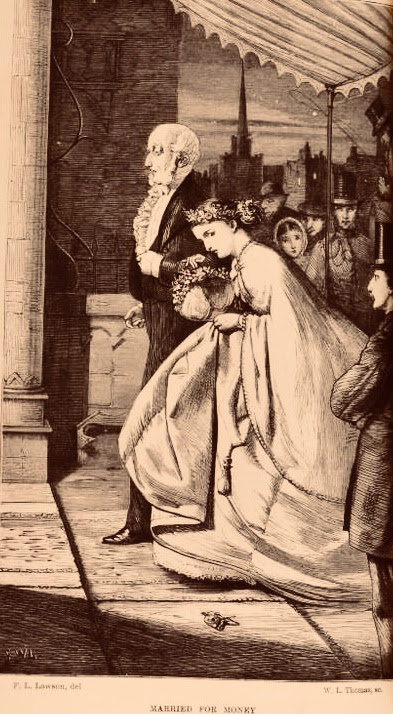
 Pictured above–– “Married for the Money” from Belgravia Magazine. 


In Scotland it is difficult for a man to draw the line between courtship and a connubial condition. That which in the Englishman is but a flirtation would become in the Scotchman rank matrimony. Most people in Scotland are married, but they are not aware of the fact, as Monsier Jourdain did not know that he had been talking prose all his life; the distinction is drawn when they do so become aware, and then the marriage is avowed. In Wales, courtship takes a material form — among the humbler classes at least — and resolves itself into what we call romping. 

In England there are different ways of doing the same thing. When Lady Clara Vere de Vere was a pretender in her own rank of life (and she has not always trifled with the “foolish yeoman” of Tennyson's poem), the arrangements between the pair were conducted with reference to a certain degree of etiquette; but etiquette does not rule entirety, and the Lady Claras have the same tendencies to make tbe most of the situation us ladies and gentlemen who are not quite her equals in rank. She is not restrained to the same extent she would be in France; and it is hard if in the course of walks, drives and dances, croquet, cantering, exhibition-seeing, picnicking, and all the various incidents of town and country life, the pair do not manage to meet some seven days in the week, and to give the chaperone now and then the go-by. 

In the lower grades of society it may be supposed that courtship is equally delightful, but appearances are decidedly against it. There is nothing approaching restraint in the code of etiquette here. When Miss Jemima Higgs  has “her young man,” and he is on such terms with her family as not to be turned out of doors, he may go to the house and take her out whenever he pleases, and no one dreams of interfering. Jemima is probably a presentable style of girl — girls of her class are far more so than they were, and especially dress better than they did, albeit in rather an exaggerated style — but her betrothed is decidedly rough. See him when he comes to take her out to walk in Battersea or Victoria Park, or it may be to go by the steamer to Greenwich, he is far from being on a par with her, either in manners or attire, especially if the latter be his holiday costume. 

He is tolerably sure, too, to have a pipe or a cigar in his mouth ; for this appendage, among certain classes of young men, seems to be considered a necessary part of fall dress. His talk is sad slang, and not over-refined. The girl goes off gaily with him, but one cannot help wondering at her taste, and the question inevitably occurs — what do they talk when they are alone? She has read a few novels, and picked up a certain vocabulary of sentiment ; but he cannot have an idea on this head, and his range of subjects must be a very narrow one— very different from the world of beautiful fancies open to Lady Clara Vere de Vere and the young “lord lover” who pays his homage at her shrine. It is not to be supposed that humble station and want of culture prevent people from loving as deeply as our aristocratic friends. 

The late Robert Brough, in a poetical version of a tale from Boccaccio, writes very prettily of a pair of lovers who sat together saving nothing, but simply “engaged in loving,” which, the writer adds, “is quite an occupation, I assure you in its way.” Jemima and “her young man,” doubtless bring all their tender instincts toward the “occupation” in question ; but it is sad to think she will express her regret at having to sit opposite him in the bus on their way home, and that when his words take an affectionate form they will connect her with the description of “old gal.” 

However, I am here writing of miserable cockneys. Village courtships must be very different affairs, or poets would not have glorified them as they have done, from the earliest period to the present time. I have my suspicions that rustic lovers are not always Damons and Philises ; but they are not likely to be without a certain rural simplicity, and are at least free from the slang of the town. The saddest kind of courtships must be those of couples who do not care about one another. It is easy enough to make people believe you love them less than you do, but very difficult to make them believe you love them more.— Belgravia, 1874


Etiquette Enthusiast, Maura J Graber, is the Site Editor for the Etiquipedia© Etiquette Encyclopedia 

Tuesday, December 15, 2015

Etiquette of Declaring or Declining Love

When the opportunity offers to settle the matter, there is little doubt in the mind of the lover and little hesitation on the part of the woman. 
Finding and Declaring Love in the Victorian or Edwardian Era
In a great majority of cases in America, at least, where access to the young woman is gained through a thousand social channels, the real declaration of love comes spontaneously, and is accepted or rejected before there is opportunity even for the formal proposal. For by a thousand half-unconscious signs does that state of mind reveal itself. So it happens that when the opportunity offers to settle the matter, there is little doubt in the mind of the lover and little hesitation on the part of the woman.
Parents should carefully watch the young men who frequent their houses, in order to see that undesirable intimacies are not formed with their daughters, for friendships and intimacies soon lead to love. Many a girl, feeling convinced that she had loved unwisely, has entered upon the married state with heart and reason at variance, when she might have given up the acquaintance, in the beginning of it, very easily. 
The most perfect reserve in courtship, even in cases of the most ardent attachment, is indispensable to the confidence and trust of married life to come. All public display of devotion should be avoided, for it tends to lessen mutual respect, and it makes the actors ridiculous in the eyes or others. It is quite possible for a man to show every conceivable attention to the one to whom he is engaged, and yet to avoid committing the slightest offence against delicacy or good taste. 
It is quite possible for a man to show attention, and even assiduity up to a certain point, without becoming a lover; and it is equally possible for the girl to let it be seen that he is not disagreeable to her, without actually encouraging him. No man likes to be refused, and no man of tact will risk a refusal. 
Long engagements are usually entered into by people who are quite young, but who, for some reason, cannot marry. As the years go on their tastes may change, and yet each may feel that honor binds the one to the other. The woman chosen by a man when he is twenty-one is seldom the woman he would chose when he is forty. When people marry young they grow accustomed to each other, and, oddly enough, they grow to be alike; but during a long engagement their tastes are apt to change, and the result is apt to be anything but a happy one. Of course, there are exceptions, but, generalizing, the long engagement is to be feared.
This is true in that society where really well-bred and noble-minded women hold sway, for no woman of character permits the man to be long in doubt of her withdrawal of herself, when she sees he is attracted and yet knows that she cannot respond to his advances. The method of proposing is not a matter for a book on etiquette. It concerns, along with all major matters of morals, those deeper things of life, for which there is no instruction beyond the inculcation of high ideals.          


Declining Love 
A young girl’s own safety, as regards her present and future happiness, demands that she receive attentions from only the best of young men,—those of whom her reason would approve, if the acquaintance should lead to more than acquaintance. 
In many circles to-day it is enough to say that an engagement has been broken mutually, even though no reason is obvious. This should be so, for if too much comment attaches to the breaking of a marriage engagement, marriages will be entered into the almost certain outcome of which is the divorce court. 
A lady should never accept any but trivial gifts, such as flowers, a book, a piece of music, or a box of confectionery, from a gentleman who is not related to her. Even a marriage engagement does not make the acceptance of costly gifts wise.

 🍽️Etiquette Enthusiast, Maura J. Graber, is the Site Editor for the Etiquipedia© Etiquette Encyclopedia