Showing posts with label 1950’s Place Setting Etiquette. Show all posts

Tuesday, August 1, 2023

Formal Dinner Etiquette of 1952

A formal dinner setting — From “Your Reference Book of Silver Etiquette” by Emily Post for the Home Decorators Consultants, 1952


The truly formal dinner, the most ceremonious social function that exists, is rarely given by the American hostess of today.In fact, it is safe to assume that the formal dinner is now given only on State occasions in the few remaining great houses of this present day.

All other dinner parties, including the buffet dinner, may, therefore, be classed as informal dinners, regardless of how elaborate they may be. Too few of us have the houses, the servants, or the purses necessary to permit us to follow every last, exacting rule required by the formal dinner. For example: 

At the formal dinner butter is never served; rolls are placed on the tablecloth— never on a bread and butter plate; there must be a footman at least for every four chairs at the table.

However, all the correct rules governing the dinners originate with the formal pattern which is modified to suit the possibilities of each hostess. She may give her dinner parties whatever degree of formality she wishes, or finds practical. — From the Home Decorators Consultants, 1952


🍽Etiquette Enthusiast, Maura J. Graber, is the Site Editor for the Etiquipedia© Etiquette Encyclopedia

Wednesday, June 14, 2023

Table Setting – Service Plates

A service plate is a background plate on which other plates are placed. Since its function is largely decorative, it should be as handsome as your circumstances permit. 

Service or “Cover” Plates, Chargers, Place Plates or Lay Plates

A service plate (sometimes called a “place plate” or “lay plate,” and, most appropriately, a “cover plate”), which is about one inch larger than a dinner plate, is used in formal service. A service plate is a background plate on which other plates are placed. Since its function is largely decorative, it should be as handsome as your circumstances permit.

Service plates are usually of beautiful china, though sometimes they are of gold or silver or silver plate or even glass. If they are of china, they do not match the rest of the china in design, since they are usually far more ornate. In advance of the meal, the service plate is set in the center of each cover, one inch, or sometimes two inches, from the edge of the table. No food is served directly on the service plate. On it are placed the plates containing the first courses of the meal, such as fruit, oysters, and soup. It is not removed until it is exchanged for the plate of the first hot course after the soup.

Large service plates are not used for breakfast, and it is usually inconvenient to use them in homes where there is no service, or in homes where the food is served at the table by the hostess or host or both. – From “The American Woman’s Cookbook,” 1951


🍽Etiquette Enthusiast, Maura J. Graber, is the Site Editor for the Etiquipedia© Etiquette Encyclopedia
Tuesday, May 30, 2023

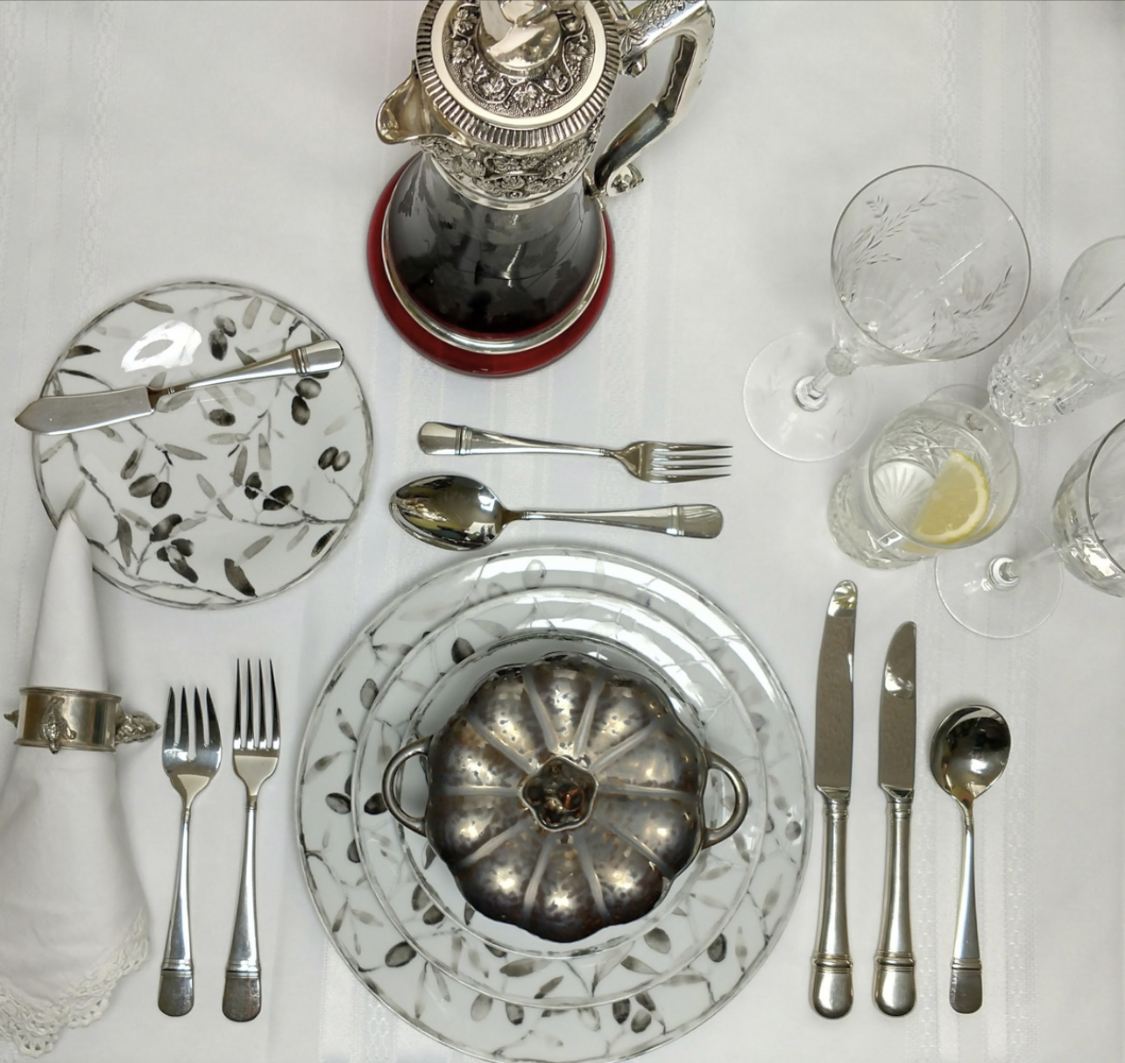
Table Setting — The Glass

Goblets are always provided with a foot, however small. The goblet is the dominant member of the “place glass” group, and all glasses of a service take their shape from it, following its contours very closely.
GLASS of late years, an awakening appreciation of the charm of glass has taken place. Perhaps the appeal of glorious color, so striking in this substance, accounts for it. Blue in varying tones was some years ago in wide favor; then amethyst dis placed it. Rapidly came amber, and green, which maintain a deserved respect, because of their adaptability. Rose, canary, sapphire, in quick succession-no color today is unrepresented. Glass is often selected to “go with” certain tones of china.

The hostess with a sense of fitness has a glass service for each of her dinner services. For her severely formal tables she uses glittering crystal, etched or cut, engraved or gold decorated. But there is ample opportunity for her to indulge her love for color to the full, to arrange tables with an eye to the dining-room effects, or to build them according to her own color preferences.

Kinds of Glasses

GOBLET. The goblet is the aristocrat of table glass. In its usual form it is a flaring round bowl resting on a tall slender stem. In certain styles, however, the “stem” becomes a mere button. Goblets are always provided with a foot, however small. The goblet is the dominant member of the “place glass” group, and all glasses of a service take their shape from it, following its contours very closely.

OTHER PLACE GLASS. In addition to the goblet, there may be placed at each cover at least one other glass for the cup or other beverages. At very formal dinners two extra glasses are often placed, but never more.

The shapes and sizes of these supplementary glasses vary as their purposes. On the continent, for example, there is a definite type of glass placed for certain wines. Thus a glass for sherry is differently shaped from one for claret: it is more sharply tapered and considerably smaller.

For the most part the glasses of this type that we see in America are either the claret, or the tall shallow champagne glass. The claret, whose capacity makes it a fine utility glass, is used for almost any kind of cup. On the other hand the tall champagne glass is often placed for its high decorative value. Few glasses are as graceful as this shallow bowl on its slender shaft.

SHERBET. The sherbet glass is a medium depth broad bowl on a short stem. In it are served sherbets, ice-cream, frozen desserts. Much used now, however, for this purpose is the tall shallow champagne glass, perhaps because of its more imposing height and dignity.

HOLLOW STEM CHAMPAGNE. This glass is similar to the tall champagne glass, except that the stem instead of being solid is hollow to the very bottom. While its primary use was for serving champagne, today we often serve in it ginger ale, and other carbonated drinks. The hollow stem releasing a train of sparkling bubbles is picturesque indeed.

FINGER BOWL. The finger bowl is a low broad bowl, variously shaped. It is usually seen without a “foot,” but certain styles have such supports. Finger bowls are fitted with matching under-plates, but their use is optional.

GRAPEFRUIT BOWL. This is a double bowl for chilled food cocktails. It consists of a large bowl on a stem. Within it is placed a smaller “cup” or “lining,” The grapefruit or other cocktail is put in the small cup, and the space is filled with crushed ice. between the cups.

TUMBLER. In its simplest form, a tumbler is simply a glass cylinder with one end closed. But the glass designer does wonders with it. He mounts it on a foot: he shapes its sides in lovely contours: often he makes it angular instead of round.

The sizes commonly used are:

Apollinaris Tumbler. This is a small, narrow tumbler used for liquids that are served in small quantities, such as orange juice, grape juice, mineral water. It is often used for water when space is at a premium, as on breakfast trays, or at bridge tables. It holds about five ounces.

Table Tumbler. Also called water tumbler. It is a low tumbler, containing about ten ounces, and is used to serve water informally, at simple meals. There is also a water tumbler of about the same capacity, but narrower and taller, sometimes called the “Ale tumbler.”

Highball Tumbler. A tall tumbler, used to serve “long drinks,” or iced tea, iced coffee, iced chocolate, and so forth. It holds about 12 ounces.

Iced Tea Tumbler. A normal iced tea tumbler, sufficiently large to contain plenty of ice. Its capacity runs from 14 to 16 ounces.

BESIDES THE PIECES IN GENERAL USE DESCRIBED ABOVE, there are all manner of articles blown for special uses: trays for hors d'oeuvres; salad bowls, salt dips, saucers for berries, and plates of various sizes.— From “The American Woman’s Cookbook,” 1951


🍽Etiquette Enthusiast, Maura J. Graber, is the Site Editor for the Etiquipedia© Etiquette Encyclopedia

Saturday, June 4, 2022

Etiquette of Tiffany Hostesses' Show

Etiquipedia’s initial thoughts: This is a strange order of courses for a formal, mid-century dinner. It appears to be a soup course, a fish course, a salad course and then a main course. Typical for the era would have been a soup, fish, a sorbet as palate cleanser, a main course, and then a salad. There are no dessert utensils, but at a formal dinner, these would be brought to the table with or without a finger bowl, but with the dessert plate. — Above is “A Dinner with Antique Silver, by Mrs. Charles Suydam Cutting, for Tiffany Hostesses' Show” 

Mrs. Charles Suydam Cutting has set a table that is a jewel of antique silver. She has used her own table ornaments: cigarette boxes for each place with hunting scenes sculptured in low relief; an Irish potato ring for the center of the table; columnar Irish candlesticks; cups, bowls, and all sorts of objects from the Charles II, Queen Anne, and early Georgian periods. 

She has made an unusual arrangement of pomegranates and grapes, red ampelopsis, and brown cypripedium from her greenhouses for the center decoration. Mrs. Cutting's écru fine linen cloth is embroidered with “Dixiana.” The finely monogrammed napkins are from France. She uses a simple English reproduction sterling flatware pattern, and a very plain stemware pattern. The dinner plates are white, with a subtle gold scratch-line decoration on the scalloped border.

Mrs. Cutting has grouped her antique silver objects on the table for decorative as well as for utilitarian purposes. The warm tone of the cream-colored cloth brings forth the glow of the old silver.— From Tiffany Table Settings, 1960


🍽Etiquette Enthusiast, Maura J. Graber, is the Site Moderator for the Etiquipedia© Etiquette Encyclopedia 
Friday, June 3, 2022

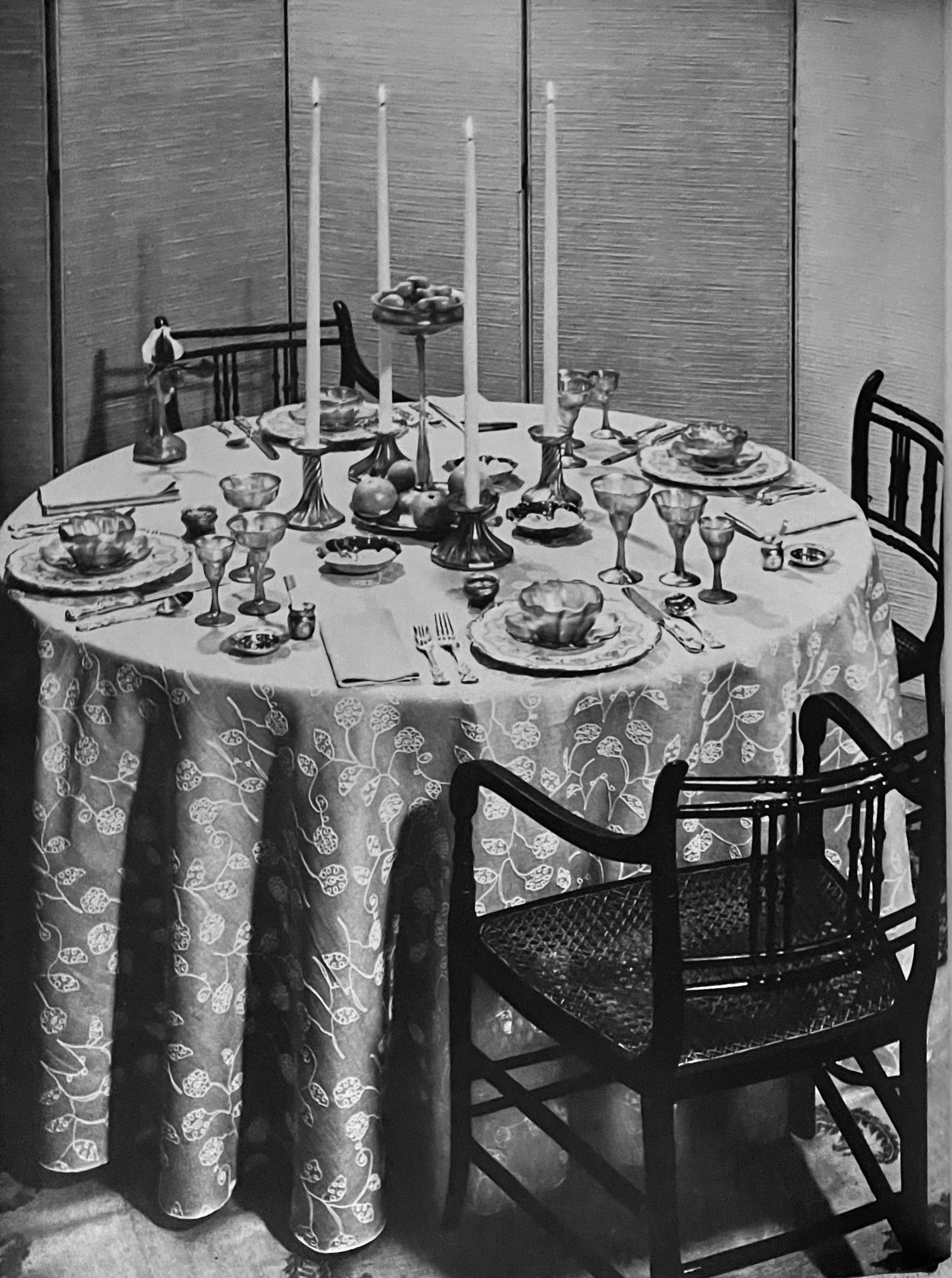
Etiquette and Tiffany’s Table Settings


This beautifully set dining table for four features elements from Tiffany’s. It is the first of the settings shown in the 1960 book, “Tiffany Table Settings.” The book was a companion offering to the women who not only participated in the yearly event, but notably to those who couldn’t attend the popular show of tabletop artistry. Etiquipedia will be featuring more from the book in the coming days, along with etiquette critiques of the late-1950’s to 1960 settings.

In 1956 Tiffany & Co., the famous Fifth Avenue jewelers and silver smiths, inaugurated an active program to present table settings of taste and imagination to the public. The purpose of this program a continual round of exhibitions-is to inspire and provoke greater interest in this area of design. When the exhibits are held, thousands of people visit Tiffany's weekly to view the settings by New York's leading hostesses and interior decorators. The store holds that a "per fect party" implies a beautiful table as well as a distinguished menu. Those who are chosen to design tables select Tiffany china, silver, and glass as accessories on their tables, combining these elements with their own furniture, linens, and antiques.

This collection of settings has not been compiled to instruct in the "book of etiquette" sense. Rather, it is hoped that the presentation of these settings will be a source of inspiration and a focus of ideas to any hostess.

There is infinite variety of design in these tables. Some of the set tings are based on the theory of switching objects created for one purpose to other uses, as well as juggling to make new combinations of color, fabric, and shape. Some of the settings are classic examples of subtle orthodox statement. Others are frankly based on fantasy.

The common denominator of good style, however, underlies all the designs, regardless of the occasion or spirit of formality or infor mality. A table set with inexpensive earthenware, for example, on a checked cotton cloth can be as enticing and appetizing as one of rare porcelain, crystal, and silver.

The editors believe that a woman is not using her own creative abilities unless she can turn her imagination to lending a fresh look to her table. It is hoped that this book will encourage a new point of view in this field of interior design. — Tiffany Table Settings, 1960


🍽Etiquette Enthusiast, Maura J. Graber, is the Site Moderator for the Etiquipedia© Etiquette Encyclopedia