Showing posts with label Corn on the Cob Etiquette. Show all posts

Tuesday, September 16, 2025

Etiquette for Eating Green Corn

“… when folks, even the most refined folks - folks that won’t even permit a poodle to sleep with them - start in on their boiled corn part of the menu, past precedent is thrown to the winds. The book of rules is consigned, with all other etiquette, to a warmer place, and every man is content to get his corn off the cob in the fastest and most convenient way in which he is able to operate.” –Even with the plethora of tools and forks for eating corn from the cob, and the seemingly endless 19th century creativity of design elements in making those tools and forks, inventors and designers never quite came up with a solution for making the task of eating corn from the cob appear “civilized.”  Above is a selection of patented tools, including strippers or scrapers, forks and holders, designed for eating corn on the cob.

GREEN CORN – HOW TO EAT IT!

The world is able to classify a man by two things his table manners and the style of his hand baggage. For instance, if, in your travels, you encounter an individual at a hotel who can cover his knife with mashed potatoes to the hilt and then get them all off without injury to his tonsils, you immediately have this man’s social number. On the other hand, if he carries a canvas telescope or “knee knocker” reinforced by a part of his wife’s clothes line, then you are also able to classify him properly.

You may have an inkling of a man's “bringing up” by the tools he chooses in eating his pie, or by the manner in which he muffles his exhaust in eating soup. Yet when it comes to green corn, every known rule is violated.

Some ways for eating certain things are planned for economical reasons. Thus the country hotel keeper serves his olives in a bottle and expects you to get them out with your fingers. He also furnishes you with possibly a grapefruit or orange in the morning and expects you to keep your ears clean with a paper napkin. There are recognized ways of taking soup into the system and these ways all call for a limit to the noise zone.

But when folks, even the most refined folks - folks that won’t even permit a poodle to sleep with them - start in on their boiled corn part of the menu, past precedent is thrown to the winds. The book of rules is consigned, with all other etiquette, to a warmer place, and every man is content to get his corn off the cob in the fastest and most convenient way in which he is able to operate.

No, neighbor, we shall never have to worry about any styles relative to denuding the cob of its succulent kernels. We may have worried whether it is proper to remove jelly from the nose with a fork or a napkin, and it may have annoyed us to remember whether it is better form to sneeze under or over the table, but we shall never have to tax our brain on new rules for eating green corn from the cob. It is a catch-as-catch-can proposition and the farm hand is just as refined and just as mannerly at this delectable pursuit as the guy who learned his table manners from a young woman’s seminary. – Imperial Valley Press, 1915

🍽Etiquette Enthusiast, Maura J. Graber of The RSVP Institute of Etiquette, is the Site Editor for the Etiquipedia© Etiquette Encyclopedia

Sunday, November 28, 2021

Gilded Age Food and Drink Etiquette

“The menu of to-day is simple. It consists of oysters or clams, according to season, soup, fish, entrée, roast and vegetables, game and salad, ices and dessert… In New Orleans, boiled shrimps are often served at small dinners. The skins and heads are on, and you remove these with your fingers. After this course, finger bowls with orange leaves are passed around, and the perfume of the water will remove the odor of fish from your fingers.”

I have compiled a list of certain viands, which society does require should be eaten at a special meal and in only one manner…

Breakfast and Luncheon Dishes

Eggs —It is much better form to have egg cups than egg glasses for boiled eggs. Cut the top of the egg off with a dexterous blow of a sharp knife and eat it in the shell with a small egg spoon.

Sugar —Lump sugar if served is always taken with the sugar tongs.

Butter —Butter is only served at breakfast or luncheon. It is passed around in a silver dish, with a little silver pick with which to spear it. Butter plates—i. e., the small round silver or china affairs—have given place to bread and butter plates, which are of china and are somewhat larger than an ordinary saucer. The butter plate of a few years ago was never seen outside of America, and is now destined to vanish from our tables. It is needless to add that butter is never served at dinner.

Radishes —Radishes appear at luncheon. Put them on your bread and butter plate and eat them with a little salt.

Cantaloupes are served cut in half and filled with ice. They are eaten as a first course, a fork being better to eat them with than a spoon. Salt is the condiment to use with them, but sugar is allowable. In southern climates they are sometimes served at dinner as a separate course between the fish and roast. This is a Creole custom.

Grape fruit is served as a first course (vide chapter Diner-Out) at a late breakfast or luncheon. It is eaten with a spoon.

Dinner

The menu of to-day is simple. It consists of oysters or clams, according to season, soup, fish, entrée, roast and vegetables, game and salad, ices and dessert. Sorbets or frozen punches are not served, except at public banquets and hotel table-d'hôtes.

Oysters or clams are placed on the table in plates for the purpose before dinner is announced. They are imbedded in ice and arranged around a half-sliced lemon, which is in the middle of the plate. Oysters or clams are eaten with a fork only. Gourmets say that they should not even be cut with it, and should be swallowed whole. I would not advise any one to try this with large oysters. The oyster fork is the first in the number of the implements placed beside your plate. Condiments, such as pepper and salt, will be passed you. Sauterne is served with oysters.

Oyster cocktails have been in vogue in place of oysters. These are a mixture of the bivalve with Tabasco sauce and vinegar, and they are said to be excellent appetizers. They are eaten with a small fork from cocktail glasses. Bachelors frequently serve them in place of oysters.

Soup —At large and formal dinners a clear soup is in vogue. Your soup spoon will be on the knife side of your plate. Soup is eaten from the side and not from the end of the spoon. The motion of the hand guiding the spoon is toward and not from you. Take soup in small spoonfuls, and use your napkin in wiping your mouth and mustache after each, especially if the soup is thick or a purée. This will avoid the dripping of that liquid from your upper lip. Never after this operation throw your napkin back into your lap with the greasy side toward your clothes, but use the inside of it for this purpose.

Fish is eaten with a silver fish fork. Chasing morsels of fish around your plate with bits of bread is obsolete. Silver fish knives have been put in use, but they are not generally the vogue.

Cucumbers are served with fish on the same plate. Little plates or saucers for cucumbers, vegetables, or salads are bad form.

Sherry is served with fish.

Celery, olives, and salted almonds are placed on the table in small dishes. Sometimes the guests are asked to help themselves, but at formal dinners they are passed around after the fish. Celery is eaten with the fingers and dipped in a little salt placed on the tablecloth or on the edge of your plate. It is also served as an entrée raw, the stalks stuffed with Parmesan cheese. It should then be eaten with a fork.

Entrées require a fork only. Among these are patties, rissoles, croquettes, and sweetbreads.

Mushrooms are eaten with a fork, and served as a separate course in lieu of an entrée.

Terrapin is served sometimes in little silver saucepans either as an entrée or as fish, and again in a chafing dish, and sometimes with salad. It is more of a supper than a dinner plate, and should be eaten with a fork.

Asparagus is eaten, except in the intimate privacy of your own family circle, with a fork. Cut the points off with the end of the prongs. The stalk or white part is not eaten. It is allowable to eat it with your fingers, as I have said, in private. It is served after the roast as a special course. One can not drink champagne with asparagus except at the risk of a severe headache.

Artichokes are served as a separate course after the roast. They should be placed in the center of your plate and the inside tips of the leaves alone eaten. The leaves are removed with the fingers and dipped in salt, sauce vinaigrette, or melted butter. The center of the artichoke is called the heart. The hairy part is removed with the fork, and the heart itself, which is deliciously tender, is conveyed to the mouth with the fork.

Champagne is served in small tumblers or claret glasses. The champagne stem glasses are out of fashion. The dry may be served from the fish to the close of dinner, but the old rule was to give it with the roast, claret with the entrée, and Burgundy with the game.

Salad is eaten with a fork only. In cutting game or poultry, the bone of either wing or leg should not be touched with the fingers, but the meat cut close off. It is better to sever the wing at the joint.

Savories, a species of salt fish and cheese sandwich, is served in England hot, about the end of dinner. They should be eaten with a fork. Undressed salad is sometimes served with them, or radishes, butter, and cheese. This is the only occasion when one sees butter on a dinner table, and this at informal dinners. The salad undressed can be eaten with the fingers. At bachelor dinners and at luncheons cheese is served with salad. The French soft cheeses are the favorites.

Pastry, ices, and desserts are eaten with a fork.

Fruit, such as peaches, pears, and apples, are served frequently already pared. When this is the case, finger bowls are dispensed with, but as yet this is not a general rule. Usually at dessert there is placed before you a finger glass and doily and a dessert plate, with the dessert knife and fork on either side. Remove the glass and doily; put it in front of your plate a little to the right. Fruit must be pared or peeled with a silver knife.

Strawberries are now served with the stems on, and sugar and cream are passed around and are taken on your dessert plate.

Pineapples are eaten with a fork. 

A cracker is used for nuts, and silver picks are brought in with the dessert.

Corn on the cob is a favorite at small informal dinners as a separate course. In polite society you must remove the grains of the corn with your fork or your knife and fork, and never eat it off the cob holding the end with your fingers. By holding one end with your napkin, you can plow down the furrow of the grains with your fork, and you will find that they will fall off easily. Corn is always served, when given in this style, on a white napkin. You help yourself to the ear with your fingers.

Macaroni and spaghetti should only be eaten with a fork. 

In New Orleans boiled shrimps are often served at small dinners. The skins and heads are on, and you remove these with your fingers. After this course, finger bowls with orange leaves are passed around, and the perfume of the water will remove the odor of fish from your fingers.

Black coffee is served after dinner. Milk or cream does not accompany it, except in the country, where sometimes a little silver pitcher of cream is placed on the tray. Coffee is drunk from small cups. 

Coffee and milk are never served during dinner, nor again is iced milk. These are barbarisms. 

Chartreuse, kümmel, curaçoa, and cognac are the liqueurs usually served after dinner.

Claret, in many French families, especially those of the middle class, is placed on the table in decanters. You are expected to help yourself. There are also carafons or decanters of water to mix with the wine. The claret decanters are called carafes. Claret is drunk at the twelve o'clock déjeuner, as well as at dinner.

Tea is passed around in old-fashioned English houses about an hour after dinner. In some places buttered muffins accompany it, but this extra refreshment is only seen now in very old-fashioned houses.

Scotch whisky and hot water or mineral waters are served in country houses before bedtime. — 
The Complete Bachelor, by Walter Germain, 1896


Etiquette Enthusiast, Maura J. Graber, is the Site Editor for the Etiquipedia© Etiquette Encyclopedia

Wednesday, October 13, 2021

Etiquette Humor for Corn Eaters

“Fork never made to eat corn on the cob”?!? Au contraire! Victorian “Green Corn” was a popular food to serve in the late 1800’s and early 1900’s. Over a sixty to seventy year period, numerous green-corn forks were invented and patented for eating ears of corn on the cob. – The corn fork shown above was made in the 1920’s, as was the patented dish with cover for serving corn on the cob.


Fork Never Made to Eat Corn on the Cob…
May Be Breach of Table Etiquette, But the Fellow Who Attacks the Ear With Two Hands is the One Who Gets the Thrills


There isn't much joy in eating corn on the cob with a fork, is there? I'll say there isn't. At least not for the fellow who likes to get all the thrills that go with hold ing a big, juicy ear in both your mitts. This may not be according to Hoyle, and may be a violation of the rules of table etiquette.

But the fellow who is guided by the old rule that “fingers were made before knives and forks and other eatin’ utensils” and attacks the said big, juicy ear in a way that would make John D. Rockenfeller green with envy, is the guy who gets the thrills and all the trimmings thrown in.

Saw a person a few days ago in a crowded eating place trying to pry corn off a cob with a fork. That may be good, straight-laced table etiquette, but to me that fork seemed about as much in place as the Kaiser in Paris.

Really, I felt sorry for the person, for nearby were others who were getting every bit of the kernels clear down to the place where they were fastened onto the cob. One fellow made the remark that it was so good that he felt like taking it back and asking the waiter to put more corn on his cob.

The only way to eat an ear of corn is to butter it well, with a sprinkling of salt and pepper and then make a “head-on” attack. The fellow who has insecure teeth at a time of this kind is out of luck. The man who eats his corn this way is never happier than when he has finished the job and is licking his mouth with his tongue, unless it is when he is in the middle of the operation.

The same rule applies to watermelons. There is no pleasure using a fork, the real pleasure is running your mouth into the red, juicy fruit, getting every drop of the sweet flavored thing. Yum! Yum!– By Al Falfa of Riverside Daily Press, 1920


Etiquette Enthusiast, Maura J. Graber, is the Site Editor for the Etiquipedia© Etiquette Encyclopedia 

Tuesday, November 14, 2017

Corn on the Cob Etiquette


The American Corn on the Cob 
Etiquette Conundrum  
The serving in eating of corn on the cob has been an enduring issue for American authorities on table manners. In “Hints on Etiquette,” 1844, Charles Day decreed that rather than gnaw at the cob, the diner should scrape the kernels into his or her plate and eat them with a fork. Frederick Stokes’, “Good Form: Dinners Ceremonious and Unceremonious,” of 1890, contrasted the crude gnawing from end to end with the more polite grasping with a folded napkin or a folded doily. 
Food writer and Ladies Home Journal editor, Sarah Tyson Rorer, America's first dietitian, proposed more demanding method of scoring each row of kernels and pressing out the content with the teeth, leaving the hulls attached to the cob. The ever practical Emily Post simply discounted corn on the cob as suitable food for formal dining, yet her friends all thought she had lost her mind, when Post served barbecue at a Martha’s Vineyard afternoon tea.

Etiquette Enthusiast, Maura J Graber, is the Site Editor for the Etiquipedia© Etiquette Encyclopedia  
Friday, September 15, 2017

Table Etiquette of 1899


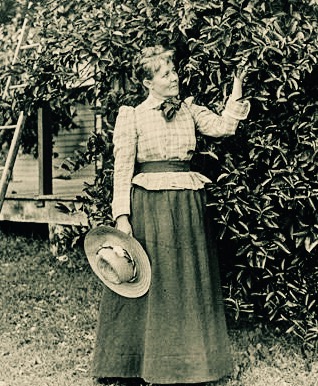
Mary Barr Munroe was a Miami pioneer who contributed much to the community life of Coconut Grove. Mrs. Munroe founded the southern Tropical Audubon Society. As a member of the Florida Federation of Women's Clubs, she was instrumental in the establishment Royal Palm Park (later the Everglades National Park.) Mrs. Munroe also started the Coconut Grove Library in 1895 and taught many children in Coconut Grove how to read. She strongly believed, and proved, that women can make a great difference.
Helpful Hints on the Uses of Knives, Forks, Spoons and Fingers
Those who are very particular, hold the large end of a spear of asparagus with a fork, while with the tip end of a knife they daintily separate the tender green tops from the white end, which is then put aside. Others take the white end between the fingers and carry it to the mouth. Both are correct, but the former is much more dainty and easily done. 

The etiquette of eating a soft boiled egg has been the subject of more than one clever essay. The English custom is to eat it directly from the shell, when of course a small egg cup and egg spoon are necessary. The American way is to break the egg into a cup or glass by striking the egg in the center and turning the contents into the glass. In this case it is usually eaten with a teaspoon, as an egg spoon, unless extra large, would be too small, and we have seen the egg held by a corner of the napkin, but this is not only tiresome but difficult to do nicely without soiling the napkin. 

Celery is always taken from the dish and carried to the mouth by the fingers. If individual salts are not provided, it is etiquette to use one half of the butter plate for salt. If salt shakers are used, hold the celery in the left hand just over the rim of your plate and gently sprinkle it with salt, and the old custom of putting a spoonful of salt on the cloth is still in practice. 

When corn is served on the cob it must be taken in the fingers, only managed very daintily. We have seen pretty little doylies for the purpose of holding it, but it is a question if that is not carrying table linen too far. Many housekeepers, and especially in the south, serve corn as a separate course, when finger bowls are placed by each plate and removed with the course. 

Lettuce when served without dressing is always pulled to pieces with the fingers. This is usually the lady’s duty and there is no prettier picture than that of a young lady preparing a plate of fiesh, crisp lettuce leaves in this way, for the tender green shows off to perfection her dainty white hands and she may be as exquisitely neat about it as she likes, and it is one of the most fascinating and becoming of table duties that a hostess can possibly provide for her lady guests, to assist in helping the gentlemen at a social or informal meal. 

Watercress is also taken in the fingers and the prettiest way of serving it is to obtain a long low sided basket or dish, in the bottom of which lay a folded napkin, then heap the cress so as to fill the basket and you have not only an enjoyable, but a very ornamental dish for the breakfast table. 

When a slice of lemon is served with fish or meat it is much more correct to take the slice in the fingers, double the ends together and gently squeeze the juice over the article than to use a knife for that purpose, as is sometimes done. It is always proper to help one's self to bread, cheese and lump sugar, if tongs arc not provided, with the fingers. 

Never use your own knife, fork or spoon to take from the dish. It is also correct if a plate of hot, unbroken biscuits is passed, to not only break off for yourself with your fingers, but for your neighbor also. When things are passed, help yourself as quickly as possible, for you must not keep others waiting and never insist on some one else being served before you, if the host or hostess has honored you first. —Mary Barr Munroe in Good Housekeeping, 1899

Etiquette Enthusiast, Maura J. Graber, is the Site Editor for the Etiquipedia© Etiquette Encyclopedia