Showing posts with label Teaspoon Etiquette. Show all posts

Monday, May 25, 2020

Well Bred Table Etiquette of 1901

Do not leave your spoon in your tea cup. Do not sip your tea or coffee with a spoon. Do not drain the cup.

Table Etiquette: 
How to Eat According to the Rules of Good Breeding

  • Do not leave your spoon in your tea cup. 
  • Crack the top off your egg instead of peeling it. 
  • If you have bacon or fish, have a separate plate for your bread or toast and butter, but not when only having boiled eggs, which require very careful eating, by the by, as nothing looks so nasty as yolk of egg spilled all over the plate and egg cup. 
  • Do not sip your tea or coffee with a spoon. Do not drain the cup. 
  • For fish do not use a dessert knife instead of the fish knife. If there be no fish knife, use a small crust of your bread, but leave that piece of crust on your plate. Do not eat it afterward, as so many people do. 
  • Do not be dainty and fringe your plate with bits of meat. Eat what you can and put any skin or bone on the edge of your plate in one little heap, which moves down from the edge when you have finished. 
  • Do not crumple up your table napkin. If you are only a guest for the day, do not fold it up, but if you are staying on and in a quiet household, fold it up. If you are staying in a big house where everything is done “en grand prince,” do not fold it up. Just place it on the table when you leave, as in rich establishments, there are clean table napkins every day. 
  • After eating it is well before you drink to wipe your lips, otherwise you leave a smeary mark on the glass. 
  • Do not gulp liquids and bolt food. 
  • Do not masticate or swallow audibly. 
  • Do not pile your plate with food or grasp your knife, fork or spoon as if it were a weapon of warfare. 
  • Do not crumble the bread by your side or drain your glass to the last drop. 
  • On the other hand, do not be affected and eat as if an appetite were a crime, drink as if you were a dicky bird, and hold your knife, fork and spoon as if they were red-hot needles. – Hanford Journal, 1901


Etiquette Enthusiast, Maura J Graber, is the Site Editor for the Etiquipedia© Etiquette Encyclopedia 

Friday, April 13, 2018

French Etiquette Peculiarities

Beautifully monogrammed, French Damask linen napkin – It is more universal, perhaps, than elsewhere, in families, hotels, restaurants and all places where meals are served, to furnish any person with a serviette at table. If it is a place one is in the habit of frequenting, he is expected to fold his serviette, and mark it in some way to be retained for him till he comes again, as this saves washing and such.

French Habits and Peculiar Customs?

We have no idea that our customs and habits are peculiar or different from those of anybody else till we see them described by someone to whom they are familiar. Indeed, it is more universal, perhaps, than elsewhere, in families, hotels, restaurants and all places where meals are served, to furnish any person with a serviette at table. If it is a place one is in the habit of frequenting, he is expected to fold his serviette, and mark it in some way to be retained for him till he comes again, as this saves washing and such. But if one is invited to dine once, or only occasionally, it is almost an insult to fold his serviette on leaving the table, as this is as much as to say he expects to be invited again soon.

A gentleman who did not know this custom, dined and returned home without suspecting that he had failed in any point of etiquette. The next day a servant came to tell him that dinner was waiting. “Dinner,” he exclaimed in surprise, “but I did not know that anyone expected me to dinner; I have received no invitation.” “Why, you folded your napkin yesterday.” This information only increased his amazement, as he had no idea what the act had signified. In some parts of the country it would not have been a hint that he expected to come again the next day, but only that he hoped to come soon. I was saved from such a mortification by hearing a family exclaim one day after some guests had departed: “What vulgar people; did you not see they folded their napkins.” I had not remarked it, of course, as I did not know that it was a matter of any consequence, and should certainly have done the same myself the next day, where it would have been almost a disgrace, had I not been thus put upon my guard.

On speaking of it to a lady who had been in America, she said it was a custom similar to ours of putting the teaspoon in the saucer, if one wished another cup of tea, and leaving it in the cup to call signify the contrary. Not knowing this she had been served with two or three cups of tea more than she wished the first time she had been invited among strangers to partake of this beverage, yet it never occurred to us before that it was anything peculiar. – Daily Alta, 1863

Etiquette Enthusiast, Maura J. Graber, is the Site Editor for the Etiquipedia© Etiquette Encyclopedia 

Tuesday, May 19, 2015

Etiquette of the "Well Bred"

Though the original, priggish "Dame Grundy" may, or may not, have been a fictional character, one can find her in real life and in period dramas. Titanic's Ruth DeWitt Bukater was so overly pretentious and conscious of everyone's manners around her, she wasn't aware she was breaking a cardinal rule of glove etiquette. Molly Brown may have been viewed as ill-bred and vulgar, but she certainly wasn't having her tea with her gloves on! ~ Countess of Rothes: "Look, here comes that vulgar Brown woman." Ruth DeWitt Bukater : "Quickly, get up before she sits with us!"

Little, things so often indicate good breeding, and the manners of those with whom one associates, that a person can not be too careful in observIng the rules of etiquette. For instance, to say "What?" as an interrogation, when not understanding a remark or question, is considered rude and bad form. It is too brusque, according to the theories of Dame Grundy.   
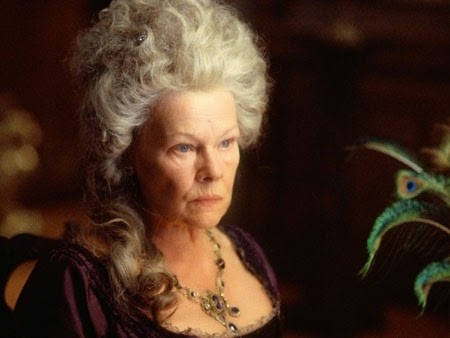
Curiosity, amusement or disdain? Upon observing the "well-bred," the emotions can sometimes be hard to distinguish.
Either "I beg your pardon" or "well," as an interrogation, is correct, and children, particularly, should be trained on these points. To go in front of a person without saying "Excuse me," denotes carelessness in minor points of breeding; also leaving the room without going through the form of asking permission is a solecism, "Excuse me a moment," if the person is soon returning, is correct, or should the absence be for an indefinite time, "Excuse me" is enough to say. 

To seal an envelope the whole length of the gum on the flap is another trifling matter for which a person is judged unfavorably. Unless the envelope contains an enclosure that might slip through an opening, only the very tip of the flap should be fastened. And, while on the subject of stationery, no two things are more indicative of ill breeding than to put a stamp on the left side of an envelope or, indeed, any place but squarely in the upper right-hand corner; and for a woman to sign her name with a prefix of Mrs. or Miss. to a note or letter, if she wishes to indicate her formal name she should put the prefix in parenthesis beside her name in full, or, in the case of a married woman, she signs her own name with her formal name in brackets beneath, as "Mary Jane Smith." and below, ("Mrs. John James Smith"). This is a form that should never be forgotten. 
 Pride and Prejudice's Elizabeth Bennet found that "nothing was beneath this great lady's (Lady Catherine DeBourgh) attention, which could furnish her with an occasion of dictating to others." The Lady Catherine De Bourgh is another priggish, Dame Grundy, tsk-tsking at every perceived lack of "good breeding."
Leaving a spoon in a tea or coffee cup is not uncommon but it is ill bred, and to butter a whole slice of bread at once and eat from it is another social mistake. The slice must be broken into small pieces and each buttered as it is eaten. Loud talking in public places is vulgar, as it is to push and shoulder in a crowd. If every person would remember his or her manners at such times crowds would cease to be objects for dread. —From The Los Angeles Herald, 1909


Etiquette Enthusiast, Maura J. Graber, is the Site Editor for Etiquipedia© Etiquette Encyclopedia