Showing posts with label Etiquette and the Sexes. Show all posts

Friday, October 2, 2026

Business Etiquette Diversity IQ Test

Today’s workplace is nothing like your great grandparents’. Workplace etiquette is continuously evolving, as is what is considered one’s actual “workplace.” This Workforce Diversity Quiz is from the mid-1990’s, though the advice given is perfect for many situations in the workplace of today.
—————

4. You are a white male. Several new positions have been created at your company, but the informal buzz is that they are being reserved for “a certain type of person.” You want to apply but fear that you are not the right color or gender. How do you handle the situation? * A. You ask your boss whether you should apply * B. You let it slide and complain to your colleagues in private that white men just don’t stand a chance at this place * C. You apply


Work Force Diversity...

 Test Your Diversity IQ


Here’s a chance to test your diversity-etiquette IQ by matching your answers against those of our experts in this multiple-choice test. Not everyone will agree with the answers our experts have provided. Clearly, there often is no right or wrong answer. Still, we offer this tentative road map to the evolving new manners of the workplace.

1. A woman in your office is very private about her personal life. You suspect she’s a lesbian, but you want her to know that’s OK with you. So you:

* A. Tell a few lesbian jokes to provoke comment

* B. Invite her out for a drink to talk about it

* C. Mind your own business

The answer is C. She has every right to keep her personal life as private as she wants to, and many lesbian and gay men in the workplace have reason to be fearful of their sexual orientation becoming known. However, if you are supportive and she’s ready to talk about it, she will. You cannot force the issue. As for the other two choices, the first option could be construed as harassment, and inviting her out for a drink might also be construed as sexual harassment, whether you’re a man or a woman.

2. Your male boss has taped a photo of a scantily clad woman from a lingerie catalogue on the wall of his office cubicle. Each time you confer with him, you are forced to see this photo, which you find inappropriate for the workplace. What do you do?

* A. Put up a Chippendale’s male dancer poster

* B. Talk to him about it

* C. Talk to his supervisor about it

The answer is B. Our experts recommend using the most informal method initially. You might say, “That photo makes me uncomfortable, and I’d appreciate it if you took it down.” If talking individually to him doesn’t work, you could ask him to meet with a group of women co-workers to show that you are not the only one who finds the picture offensive. Do not post your own poster; you do not want to escalate the situation by stooping to his level.

3. You are an executive in a medium-sized company. Lately you have been hearing a lot of grumbling and complaints about Susan, a mid-level manager. After some investigation, it becomes apparent that Susan is not doing her job, although there’s no smoking gun that would allow you to fire her immediately. Plus, you have another problem: Your company needs to show that its management ranks include a certain percentage of women and minorities, and Susan is both. Still, you are increasingly worried about flagging morale. What do you do?

* A. Fire Susan

* B. Ignore the situation; eventually it will go away

* C. Explain to the staff why firing Susan would cause a problem

* D. Talk with Susan

The answer is D. In fact, our experts say not talking with Susan on a regular basis could have caused the problem in the first place. Part of your job includes providing employees with feedback about how to improve their performance. As a boss, you have a responsibility to develop her talents and communicate with her regularly so things don’t degenerate to the point where you have to fire her. However, if after talking and coaching Susan, you conclude that she is still not performing up to company standards, fire her and document it. Otherwise, you would be supporting an incompetent person to the detriment of everyone.

4. You are a white male. Several new positions have been created at your company, but the informal buzz is that they are being reserved for “a certain type of person.” You want to apply but fear that you are not the right color or gender. How do you handle the situation?

* A. You ask your boss whether you should apply

* B. You let it slide and complain to your colleagues in private that white men just don’t stand a chance at this place

* C. You apply

The answer is A. Our experts advise being as direct and upfront as possible in this situation. Tell your boss you are interested in the position but that you have heard the job may be reserved. Then ask whether it’s appropriate for you to apply. If you have a good boss, he or she will be honest in answering. The boss has a responsibility to tell you whether the job is reserved and why. The boss may tell you, “We need a person of that gender or race in this company because we realize we need different points of view and voices as we make our business decisions.”

5. You are a woman working in a mostly male office. You feel shut out of social interactions with your colleagues and bosses because the men cluster together at every opportunity to discuss sports. You couldn’t be more bored by the topic, but you realize you are missing important opportunities to schmooze and bond socially with higher-ups. You also have a nagging feeling they are doing this to exclude you. You should:

* A. Seethe silently

* B. Bone up on sports so you can take part in this important ritual

* C. Say something

The answer is C. You don’t want to stop men from enjoying their sports confabs, but you also want to feel included and to reap the benefits of these informal relationships. You might say, “Hey, I’m really not interested in sports, but I’d like to be included in conversations, so can we find some other topic in common that we can discuss?” The trick is not to imply that the men are behaving badly, which will only alienate them, but to make it clear what your needs are and that you want to feel included.

6. You work with a person of color. You like this person and want to become more friendly but feel awkward in conversation. You’re not sure how to refer to him or her. As a black? African American? Nor are you sure how to refer to Mexican Americans. By that term or Hispanic? Chicano? Latino? What is the appropriate and sensitive way to proceed?

* A. You play it safe and avoid the topic

* B. You float a term like a trial balloon and wait for the person’s reaction

* C. You ask the person what he or she would like to be called

The answer is C. The reason you feel uncomfortable is because in our society we think it’s inappropriate to introduce and discuss such topics. You might tell your colleague that while you feel awkward about being so blunt, you are bringing up the subject so you can learn. This sets the tone for further communication and dialogue.

7. You are Japanese American. Your boss and some of her colleagues are discussing where to go for lunch. They want Chinese food. Your boss sees you and exclaims happily, “Let’s ask May! She’ll know.” You:

* A. Say, “Why don’t we ask a Chinese American person; I’m Japanese American.”

* B. Make an ethnic joke

* C. Say, “How would I know?”

The answer is A. Don’t assume your boss is a racist, but don’t let it pass unregarded. Take the middle ground. Try to engage your boss in a conversation that will educate her.

8. You’re walking into your office building when you see someone who is apparently partially paralyzed struggling to open the door. You:

* A. Rush up and hold the door open

* B. Stand back and wait for the person or go to another door to avoid the situation

* C. Ask if the person would like help

The answer is C. Don’t make any assumptions— ask instead. When people see someone with a disability, they often assume they don’t have to ask for permission to help. But that is condescending. However uncomfortable it may be, ask first.

9. You are a black female manager. Yesterday you were having lunch in a restaurant with a colleague when you overheard a conversation between Brad, one of your young, white, male employees, and his lunch companion. Brad was complaining vehemently about the lack of opportunity for white men in your group. He said all the recent promotions have gone either to women or people of color, and he threatened to see an attorney because he believes he is a victim of reverse discrimination. What do you do?

* A. Stop by Brad’s table on the way out to say ‘hello‘

* B. Ignore what you heard because Brad was on his own time

* C. Enroll Brad in the company’s next diversity training workshop

* D. Talk to Brad about what you heard

The answer is D and possibly C. Although it might be easier to ignore what you heard, the situation should be handled in a more direct way. Talk to Brad and explain that you inadvertently overheard his conversation and ask him to share more of his thoughts and opinions with you.

Many white men today feel “out of the loop” and passed over for promotions. Some also fail to see women and people of color as individuals, instead focusing on them as representatives of groups that are taking something away from them because of affirmative action programs or government intervention.

In your talk, try to help Brad explore why he’s not being promoted and others are. Also try to help him realize that he is still valued as a member of your staff. It is your job to help Brad see that diversity is a workplace reality that will not go away. You could send Brad to a diversity training course, but this should not be seen as a punishment, and it must be reinforced by discussions before, during and after the training.

10. You’re a male employee who’s receiving love notes from a female co-worker. She wears low cut blouses, leans over your desk, brushes up against you whenever she gets a chance. Everyone in the office thinks it’s a joke, including your boss, but you’re not laughing. You’ve already told her to stop, but she won’t. What should you do?

* A. Complain to a co-worker and find a way to retaliate

* B. Go to your boss, even though he thinks the whole thing is a joke

* C. File an EEOC complaint

The answer is B. You need to go through your direct supervisor first, even if he thinks it’s a joke. You should also put your complaints in writing so there will be a paper trail. Your complaint will then have to make its way up the ladder through the company. It is necessary to follow the chain of command and exhaust in-house remedies before seeking outside action.

11. Maria is a Latina being interviewed for a corporate position. She feels the interview is going well. As it winds down, Maria’s prospective boss says: “Gee, I really admire your ambition. It must have been tough for you to leave your roots behind in order to succeed in the business world.” How should Maria respond?

* A. Let it pass, fearing that if she calls him on his racist comment, she won’t get the job

* B. Make a snide comment back

* C. Regardless of whether Maria gets the job, she should remind him of what he said and explain why she found it upsetting

The answer is C. Whether Maria gets the job or not, she should tell her interviewer afterward that she was offended. Of course, this is a measured risk. Sometimes, when unpleasant comments are made, one has to ask: “Is this a battle I want to fight?” You can win the war, but you can’t win every battle. On the other hand, Maria may decide she doesn’t want to work at a company where people feel free to make such comments.

12. You are a woman who regularly attends management meetings that are dominated by men. One of the men has a penchant for telling sexist jokes. He thinks they’re funny; you find them offensive. What should you do?

* A. Say nothing and hope it doesn’t happen again, but secretly prepare your own sexist jokes aimed at men

* B. Boycott the meetings

* C. Challenge the man and his joke. Say, “I don’t believe this is happening in this room and I find it offensive.”

* D. Go to the boss

There are several ways to handle this common office problem. One choice is C, challenging the joke teller. However, our experts say that if the man persists in telling such jokes, complaining to the boss is the next step.

13. You supervise a group that is composed of three-person teams. Today, one of your white employees came in to talk to you about two other team members. She says they frequently speak Spanish when the three of them are working together and she feels left out. She also thinks they are talking about her. She wants you to stop them from speaking Spanish during working hours. You:

* A. Tell her you think she’s overreacting

* B. Have a group meeting and talk to all of your employees about the issue

* C. Agree to the employee’s request and issue a written memo saying that only English will be spoken in the workplace

* D. Talk to the three people involved

The answer is D and possibly B. Although you cannot stop the two employees from speaking their native language, you can talk about the impact of speaking in a language that other team members don’t understand.

It would also be helpful to determine if there’s a valid reason for their choosing to speak Spanish on the job. Often, employees find it more convenient to communicate work problems in the language they are most comfortable with. If these employees are not fluent in English, perhaps you should provide language training.

The white employee’s complaint is not unusual. She feels left out and assumes that the other two people are talking about her. You should make it clear that you are not forbidding the employees to speak in their native language, but rather asking them to include her and be sensitive to her feelings.

14. John is a 30-year-old black man who has worked in your group for three years. He has an MBA from one of the best business schools in the country and is one of your top performers. An opportunity for a promotion just came up in the corporate office, and you recommended John for the job.

A colleague in the corporate office has other thoughts. Although he is complimentary of John’s work, he doesn’t feel John is “right for the job.” The problem is that John is viewed as arrogant and cocky. Further, John ruffled a few feathers when he challenged the company president about his commitment to diversity during an open forum meeting.

Your colleague said he would interview John but offered little hope that John would get the job. He even hinted that you’d be jeopardizing your own career by sponsoring John. What should you do?

* A. Sponsor John for the position and let him take his chances during the interview

* B. Heed your colleague’s warning. After all, you don’t want to put your career in jeopardy

* C. Sponsor John but give him some coaching before the interview

The answer is C. You should give John as much help as possible in assessing whether this is the right job for him, as well as in preparing for the interview. It would probably be inappropriate for you to share what your colleague said, but it might be useful to give John feedback on how some people perceive him.

Part of a manager’s job is to support their employees and act as sponsors or mentors, which often involves giving feedback based on subjective information. You should be prepared to talk to John about your own view of his work and his behavior.

Assessment of someone’s self-confidence is often based on other feelings we have about the person. Minority men have complained that their self-confidence is perceived as arrogance, while the same trait is viewed more positively in their white colleagues.

If you feel John’s self-confidence is unnecessarily inflated and unseemly, he needs to hear this and have the opportunity to improve.

15. You are a corporate manager interviewing applicants for a marketing job that would include some travel and putting on seminars. One of the applicants, Mel, uses a wheelchair. You have concerns about whether his disability would interfere with the job requirements. You want to bring up the subject but aren’t sure how to handle it. You:

* A. Level with Mel, telling him that despite his qualifications, you worry that his disability will affect his ability to do the job

* B. Ignore the issue, thank Mel and put his application in the circular file

* C. Ask Mel to describe how he would handle the job on a daily basis

The answer is C. With reasonable accommodation, 90% of all jobs can be done by 90% of all working-age people with disabilities. Chances are that if Mel is qualified, his disability will pose no problem.

You should focus on Mel’s experience, qualifications and ability to do the job, not his disability. But don’t be afraid to discuss in an open, straightforward manner how he would approach his job duties and what accommodations, if any, might be necessary. Under the federal Americans With Disabilities Act, answer B would constitute discrimination. Answer A could be discriminatory.

The Diversity IQ Experts
The answers to our “diversity IQ” test were provided by the following group of experts.
* Ed Mickens, a business columnist for the Advocate and publisher of Working It Out, the Newsletter for Gay and Lesbian Employment Issues.
* Alan Reich, of the National Organization on Disability, a Washington-based nonprofit group that promotes full participation of Americans with disabilities in all aspects of life.
* Gerda Steele, a Pasadena-based diversity expert.
* Joy Hawkins, Los Angeles-based, specializing in diversity and leadership issues.
* Elsie Cross, who runs Elsie Y. Cross Associates, in Philadelphia.

— By Denise Hamilton, Los Angeles Times, 1994

Etiquette Enthusiast, Maura J Graber, is the Site Editor for the Etiquipedia© Etiquette Encyclopedia

Tuesday, November 5, 2024

Etiquette and Modern Chivalry

Chivalry in the Modern Age

Hikers on a MountaintopImage Source: manopphimsit; "Silhouette of couple teamwork hiker helping each other on top of mountain.", 2024. Accessed via https://www.123RF.com/photo_90536179, Standard License.

The concept of chivalry has evolved significantly since its medieval origins as a code of conduct for knights.  Discussions of chivalry in the modern age often spark debate about gender roles, social expectations, and the intersection of traditional values with modern equality. As someone who believes in equality of personhood, the thought of requiring people to believe in and practice customs of chivalry may seem odd.  But let's explore how chivalry has transformed in the 21st century and examine its relationship with feminism and basic civility.

The Evolution of Chivalric Values

The word chivalry brings to mind gallant knights rescuing damsels in distress.  Although the word itself is still closely connected to the order of knighthood, it feels a bit antiquated when associated with rescuing or extending courtesies to women.

When the feminist movement went into full swing in the 1970s, some women began rejecting acts of chivalry.  Until then, men were known to: 

  • Hold doors open
  • Take a lady’s coat when they were out and be responsible for getting it back to her (and putting her back into it)
  • Carry books, bags, and packages
  • Help push a lady’s chair in when she sits down at a table
  • Open car doors
  • Stand when a lady entered a room, or when she stood, and remain standing until she sat
  • Shake a lady’s hand only when she offered it first

Each of these acts are admirable and based on the desire to show respect.  But from a modern perception, they may also highlight the idea that women are weak or vulnerable. Over time, as the appreciation for these indulgences faded, many men have ceased extending them.  Thus, leading to the lament, “Chivalry is dead.”

The Equality Adjustment

The feminist and civil rights movements have significantly influenced how society views chivalrous behavior.  Critics argue that traditional chivalry perpetuates gender stereotypes and implies women need protection or special treatment.  However, chivalry in the modern age advocates for a reformed understanding of the tradition that aligns with equality.

When I referred to my collection of etiquette books for opinions on this topic, I failed to find the word “chivalry,” except in Letitia Baldridge’s New Complete Guide to Executive Manners. The chapter title is, “Chivalry Isn’t Dead. It’s Just No Longer Gender-Based.”

What a revelation!

Key changes in chivalric practices influenced by equality include:

  • Recognition that anyone can perform acts of courtesy
  • Emphasis on consent and personal preference
  • Rejection of behaviors that assume feminine weakness
  • Focus on mutual respect rather than protective behavior
  • Consideration for others regardless of their individuality
  • Situational awareness and appropriate assistance
  • Recognition of individual autonomy and preferences

Though we still have a way to go as far as equality goes, there is no reason to exclude kindness and consideration to everyone equally.  Think of it this way: if “chivalry” is used synonymously with “civility”, then it isn’t dead at all!

In an equally chivalrous society, expressions of courtesy may look like this:

  • If you arrive at a door first, open it for the person behind you
  • If you are closest to the elevator door when it opens, you exit first, or step out or aside so those exiting can get by you
  • Noticing others have been standing for a bit, you offer your seat
  • If someone is having a difficult time with a chair, you assist that person as a kind gesture
  • When you tell someone you intend to do something, you keep your word
  • Extend your hand for a friendly handshake when meeting or greeting someone

Modern relationships benefit from combining the best aspects of both chivalry and civility. This balanced approach focuses on:

  • Mutual consideration: Both partners showing care and respect
  • Situational awareness: Recognizing when help is needed
  • Personal choice: Respecting individual preferences about traditional gestures
  • Equal partnership: Sharing responsibilities and courtesies

A Continuous Evolution

Chivalry in the modern age represents an evolving set of values that combines traditional courtesy with civil equality in our day. The degree of this evolution will be determined by our individual attitudes and acceptance of one another, while maintaining civility's core focus on respect and consideration for others. 

Respect for our fellow humans is anchored in kindness and compassion.  When applied thoughtfully, modern chivalry and etiquette rules enhance rather than contradict principles of equality. It shows that consideration for others enhances our commitment to treating everyone with respect and dignity.


 Contributor, Candace Smith is a retired, national award-winning secondary school educator, Candace Smith teaches university students and professionals the soft skills of etiquette and protocol. She found these skills necessary in her own life after her husband received international recognition in 2002. Plunged into a new “normal” of travel and formal social gatherings with global leaders, she discovered how uncomfortable she was in many important social situations. After extensive training in etiquette and protocol, Candace realized a markedly increased confidence level in meeting and greeting and dining skills and was inspired to share these skills that will help others gain comfort and confidence in dining and networking situations. Learn more at http://www.candacesmithetiquette.com/


🍽Etiquette Enthusiast, Maura J. Graber, is the Site Editor for the Etiquipedia© Etiquette Encyclopedia

Monday, October 23, 2023

Introductions and Good Impressions

A woman never rises when a man is introduced unless he's much older, very distinguished, or presented by a much older woman.
Poor Mabel! So eager to make a good impression! Instead, her ignorance of the etiquette of introduction surprises this young man—to say the least! 
A woman never rises when a man is introduced unless he's much older, very distinguished, or presented by a much older woman. She always rises when introduced to a much older woman. If she’s hostess she rises for all introductions.
A man always rises unless at the theater or any place where rising would be awkward. The general rule for introductions is to present a man to a woman, the younger person to the older. — Santa Ana Journal, 1936


 🍽Etiquette Enthusiast, Maura J. Graber, is the Site Editor for the Etiquipedia© Etiquette Encyclopedia

Sunday, July 2, 2023

Early 20th C. Etiquette of the Sexes

Should the independence of women compel men to abandon common courtesy? No! Regardless of who wears the pants, or who wears the skirts, common courtesy knows no gender. – Photo source, Etiquipedia private library.

Big Changes in Etiquette? No... Courtesy Must Not Be Abandoned for Neutrality! 
Courtesy shows respect to others, regardless of one’s sex. It is more than opening doors and pulling chairs out. Courtesy is helpfulness and small acts of kindness.

A conversation between a young man and his mother:
“Well, mother, this new order of things is making great changes in etiquette. Do you realize it?” 
“What do you mean? What new order?”
“Why, feminism, the independence of woman, of course. She has put herself on the same platform with men, and it is up to us to recognize this fact and respect it.” 
“I hope you do respect it.”
“Oh, yes, I try. We must abandon courtesy for neutrality, of course. So I keep my hat on in elevators, as if all the woman occupants were men; keep to my seat in the street cars; never hold a door open to let even a lady pass before me. If she drops her handkerchief, I don't pick it up any more. In short, if she needs any little service I refrain from offering it. I know she is able to look after herself as well as any man.” 
“You rude boy! You have none of the gallantry of your father before you, and I can only ask if you are not ashamed of yourself!”          — Judge, 1915


Etiquette Enthusiast, Maura J. Graber, is the Site Editor for the Etiquipedia© Etiquette Encyclopedia

Wednesday, November 9, 2022

Follow Etiquette on Dance Floor

Men, do not spend the entire evening with one partner. As a courtesy, invite the hostess to dance and her daughter or sister.
Rules of etiquette always should be followed when on the dance floor

Just like any other sport or social function, there also are good manners in dancing. According to Arthur Murray Dance Studios, the following etiquette should be observed; 
  • Clap at the end of each dance for the band and for your partner. 
  • Be concerned with others on the floor besides yourself.
  • Dance in line of dance 
  • Rock steps are to be kept under one’s own body. 
  • Control of arms is a must.
  • Men, do not spend the entire evening with one partner. As a courtesy, invite the hostess to dance and her daughter or sister. 
  • Ladies, do not refuse one gentleman and then accept another, nor tie strings by holding on to him. 
  • Men, escort your partner back to her seat and thank her for the pleasure of the dance.
  • Ladies, always precede the man to the dance floor. – Desert Sun, 1988


🍽Etiquette Enthusiast, Maura J Graber, is the Site Editor for the Etiquipedia© Etiquette Encyclopedia

Wednesday, November 2, 2022

Strange 1954 Etiquette Advice

This “man’s meal” pictured above is from the 1940’s. One would think that advice for what to prepare to win a man’s heart would improve in tens years’ time. We were shockingly incorrect! We at Etiquipedia cannot guarantee the advice of this particular maitre d'hotel below. It’s possible he knew quite a bit about the dining habits of gents, but this seems very questionable. It was a sad day in 1954 when a can of beans and bottle of wine served by candlelight was considered a meal.

🫘🍷🕯

The New Etiquette (from a wire service interview with a New York maitre d'hotel): 

“A can of beans, served with candles and the proper wine, will win the heart of any real gentleman.” – Press Democrat, 1954

This “Man’s Meal” above is brought to you courtesy of American women of the mid-1940's. Made up of a Swiss Steak, Baked or Mashed Potatoes, Cabbage Slaw, Baking Powder Biscuits, and Apricot Pie a la Mode. (Why this is not also a “Woman's Meal” is anybody’s guess.)

To eat this meal, a young man would benefit from the following dining etiquette rules from a 1940’s Fraternity Pledge Manual –
  • Place knife and fork on plate when not in use.
  • Turn the blade of the knife in. 
  • Break a slice of bread into at least four pieces, no less, and butter a bite at a time. 
  • Chew slowly and thoroughly.
  • Use a napkin frequently. 
  • Sit erect. 
  • Take small mouthfuls. 
  • Hold elbows close to body. 
  • Place spoon in proper saucer. 
  • Stir liquids briefly and quietly. 
  • Place your prongs up on plate. 
  • Hold fork in left hand when cutting foods with knife.
  • Eat salads and vegetables with fork. 
  • Take soup from side of spoon, scooping thitherwardly.
  • Converse quietly and not volubly.
  • Be natural and at ease. 
  • Place napkins at left of plate when rising.


🍽Etiquette Enthusiast, Maura J. Graber, is the Site Editor for the Etiquipedia© Etiquette Encyclopedia

Wednesday, October 26, 2022

Young Women and Chivalrous Men

Don't belittle masculine chivalry by violating these rules of etiquette.

A young miss who is taken out by an escort for the first time to dine is reminded that it is a gentleman's prerogative to order for her. Although this piece of advice is directed to the youngster, there are older women who might also profit from the tip. According to masculine squawks, too many women for get that a man does the honors when he takes a lady guest out to dine.

A man not only orders a restaurant meal for his guest but he relays to the waiter any questions which she wishes to ask concerning the food listed on the menu. Don't belittle masculine chivalry by violating these rules of etiquette.

Etiquette also decrees that a man calls out the address to the driver when he accompanies a woman in a taxi. Even if you know the address and your boyfriend doesn't, you permit him to exercise his masculine prerogative by telling him where you are going and allowing him in turn to inform the cabbie.— Nell Drake, 1948


🍽 Etiquette Enthusiast, Maura J. Graber, is the Site Editor for the Etiquipedia© Etiquette Encyclopedia

Sunday, October 2, 2022

Early 20th C. Smoking Etiquette

Was this advice from 1864 the impetus for smoking jackets? “A host who asks you to smoke, will generally offer you an old coat for the purpose.” —The Addams Family character “Gomez Addams’” in his smoking jacket. -Photo source, Pinterest


A gentleman may smoke in the presence of ladies—especially in the presence of those who smoke themselves—but a gentleman should not smoke under the following circumstances:

When walking on the street with a lady.

When lifting his hat or bowing.

In a room, an office, or an elevator, when a lady enters.

In any short conversation where he is standing near, or talking with a lady.

If he is seated himself for a conversation with a lady on a veranda, in an hotel, in a private house, anywhere where “smoking is permitted,” he first asks, “Do you mind if I smoke?” And if she replies, “Not at all” or “Do, by all means,” it is then proper for him to do so. He should, however, take his cigar, pipe, or cigarette, out of his mouth while he is speaking. One who is very adroit can say a word or two without an unpleasant grimace, but one should not talk with one's mouth either full of food or barricaded with tobacco.

In the country, a gentleman may walk with a lady and smoke at the same time— especially a pipe or cigarette. Why a cigar is less admissible is hard to determine, unless a pipe somehow belongs to the country. A gentleman in golf or country clothes with a pipe in his mouth and a dog at his heels suggests a picture fitting to the scene; while a cigar seems as out of place as a cutaway coat. A pipe on the street in a city, on the other hand, is less appropriate than a cigar in the country. In any event he will, of course, ask his companion's permission to smoke.– From Emily Post's 1922, “Etiquette”


Etiquette Enthusiast, Maura J. Graber, is the Site Editor for the Etiquipedia© Etiquette Encyclopedia

Saturday, August 13, 2022

Etiquette of the Sexes in Restaurants


“If men dine alone, 10 men together, how they dress*** I really don't mind. I'm not there. But if a man takes me out to dinner, I like him to smell of a nice soap, to wear his best suit, maybe a black tie, so that I can wear my nice little dress. I will know then he has kindness of heart, he has said to himself, ‘I will make a little effort so that she can look her best’.” – Louise De Vilmorin

Her point is well taken. Then, there are a few things she should remember, as well, and I am sure she does.

For one, not to keep him waiting too long before they even start out, while she decides that her makeup base is too light or her stockings too, well, purplish or something, and changes them. In most fair to good restaurants these days you need a miner's cap to read the menu by, anyway. Ten gets you twenty the man you're with won't notice what color stockings you're wearing, if any, but he'll certainly notice the three cigarettes he had to smoke while he waited.

She should carry the minimum equipment. If she knows she'll need a complete ballot and ring job by mid-evening, it's simpler to bring along a veil. I know a girl who tapes a lipstick, a dime, and a folded dollar bill above her knee (is she could slip them into her bra too) before she goes dining and dancing. This makes great sense – no swollen velvet pouch to end up in a man's pocket and make him heavy on his feet, or hers. (Of course, a girl must carry a small bag she is lost without Compact, cigarettes, and so forth. But it should have a wrist strap or loop, so she can wear it while she dances.)

As for mad money, you don't hear much about these days, a charge account at a cab company can be handy. It is a no-host evening, she won't need much money along, either. Sonia Goodkid always hands Bill Youngenbroke her contribution before they leave. Or if it is entirely her celebration, she'll have stopped in earlier and arranged with the restaurant to bill her later. (However, she better watch her step with this routine, or Bill will get the habit, and first thing you know, she'll be putting him through med school.)

A working girl, at any age in any job, pays for own lunch when she lunches with a man. Or, at any rate, she is expected to, unless this is a budding office romance (as most wives will assume it is, if their spouses lunch money starts disappearing with twice its usual feverish rapidity). She can give him a few dollars before they go into the restaurant – for her share of the bill – and hope she gets her change back.

Or, if she knows he isn't sensitive about these things – and there's no reason he should be, at a business lunch – she can simply pay her own check and leave her own tip. Either way.

By the way, these financial matters should always be clearly understood all around, whether the situation is business or social. A woman I know gave a lavish restaurant party for three couples – she had been visiting in the city and this was the only way she could return their royal hospitality. The champagne flowed; she urged upon them the pressed duckling, the grapes after the fashion of Suzette, the brandy; and her guests needed little urging. Finally, when she asked for the check, it developed that one of the gentleman had already paid it. She protested, but he was adamant. All she could do was send him a note and a gift – a desk clock, it was. He owned to already, but she still feels indebted to her friends.

The worst female restaurant menace, according to men is the woman who stops to chat – standing – with acquaintances at another table. A man feels ungentlemanly if he doesn't rise, and uncomfortable if he can't sit down immediately thereafter. A sweet smile from the lady, and a brisk hello, are sufficient, before she strides on. If she has to say something, she can send a note by the waiter.

Finally, to the matter of ordering. This is a male prerogative. Giving the order to the waiter will – back to our original touchstone – somewhat build the male ego, if he is knowledgeable about these things, and cares. But not if he isn't and doesn't. He'll properly consider it's not worth the effort, if the menu is abstruse, or if the lady shuffles nervously from Crab Thermidor to the Lamb Chops, with a short but dramatic pause at the Curry Indienne along the way. If she can see her way clear, or if she wants to discuss sauces with the waiter, she'd better do her own ordering.

If there are more than two people at the table, each had better order. The hosts usually can't remember all that. Like a wraparound skirt in a high wind, the whole thing is apt to blow up.

And so to a few rough notes on the Social Gathering, as it concerns men and women, and etiquette.

It is true that a man gets gold stars on a ladies ledger – which cancel some of the black marks on his rap sheet – when he tells her how pretty she looks ( or handsome or well put together, as the case may be) before they go to a party, or while they are en route. But he gets double credit for telling her once they get there, for then it has twice the impact. The reason is this: Before she leaves home, a woman is tolerably satisfied with how she looks (or she wouldn't have left). Indeed, she is often delighted with her appearance – the naked black basic, the company face – wholly different from the rather soul – shattering reflection the mirror handed her early that morning. But once they arrive, her innocent glory is apt to be dimmed by all the other naked black basics and company faces, which in her excitement she had forgotten would be there. At this point, especially, she must know how she stacks up, this is the time to tell her.

Still, this is a minor point. A major one – or, to put it another way, what makes women the maddest – is the male tendency to herd together, drinking and talking shop. Many a woman asked for it, with her crossfire chitchat about purely female concerns, which drives the man perforce into the tall timber where the bottle is. But many a woman who doesn't ask for it gets it, too, which can have unhappy repercussions. After all, she didn't put on her company face and her nice little dress just to swap tatting patterns with Irene and Thelma. She'd be glad to do it for a while, mind you, but not all night.

The fact is that the virtuous housewife – if she doesn't work outside the house – sees and talks to few males alone, except for the milkman and the little old codger in the Blanket Department twice a year at White Sales. And this party – she thought – would be a chance to shine a little, showing a few pretty facets that may have rested a bit at the kitchen sink. If she doesn't get to go – if, on the contrary, she goes home feeling like the little woman in the tight permanent, with a pocket full of tuna recipes – she'll feel like kicking the cat.

This sorry state of affairs, with the sexes is getting no practice in attracting and interesting each other, is often reflected in a certain lackluster performance in the bedroom, particularly where our heroine is concerned. Nothing has come alive for her, including herself, though the moon shine ne'er so brightly over the cow shed. 

* "An almost outmoded grace that still thrills me actually is to have a man take his hat off an elevator when I enter. It makes me feel feminine and cherished – makes me feel, and act, much nicer for at least half an hour." ~ Kay Taylor 

** I don't know what makes them think they're auricles. It's common knowledge that female writers and resemble either horses or birds, and their fingers are usually smudgy from changing typewriter ribbons. 

***This goes for the convention hats with the funny tassels, too. Sometimes the boys forget, and keep them on and restaurants.

From Peg Bracken's 1959, "I Try To Behave Myself"


🍽Etiquette Enthusiast, Maura J. Graber, is the Site Editor for the Etiquipedia© Etiquette Encyclopedia

Monday, August 1, 2022

Tactfully Teaching Table Etiquette

“James,” she said, with quick tact, looking all around among the tables, “did you ever notice that men and women eat differently? When a man finishes a meal he always places his knife and fork across each other, while a woman invariably places them side by side. It's funny, but I've often noticed it.”


A Tactful Girl:
The Way She Gave James a Lesson in Table Etiquette


They were an engaged young couple and were having a quiet dinner while the band played alluring music. The girl was sweet and refined looking and the man big and strong. Her manners were perfect, but his left much to be desired as far as etiquette is concerned. After they had finished their meal an interested observer noticed that the big, wholesome man placed his knife and fork like the crossbones under the skull. With a blush the girl, whose own implements were placed correctly side by side, noticed the break.

“James,” she said, with quick tact, looking all around among the tables, “did you ever notice that men and women eat differently? When a man finishes a meal he always places his knife and fork across each other, while a woman invariably places them side by side. It's funny, but I've often noticed it.”

“Which is correct?” anxiously questioned her fiance while he gingerly toyed with the objects of comment.

“Why, placing them side by side, dear, of course,” she said. “But, then, men are so busy that I suppose they have no time for such details.” And then she became interested in the band leader, while the erring James slyly adjusted his knife and fork according to regulations.

“There's a woman who is going to manage her husband without letting him know it,” observed a sweet old lady who had overheard. “It all depends upon the way you do it, whether you can get a man to come round.” Philadelphia Record, 1905


🍽Etiquette Enthusiast, Maura J. Graber, is the Site Editor for the Etiquipedia© Etiquette Encyclopedia

Tuesday, September 21, 2021

1950’s School Dance Etiquette


Might as well teach them early that when they take a girl to a party they have to look out for her.– 1950’s school dance. 
 – Image source Etiquipedia personal library.

Teach Early Social Etiquette

“Do I dance with Janie all the time?” asked a junior high schooler getting ready to go to his first dance. His mother explained he must dance the first and last dances with the girl he was taking to the party and a few others in between. But she assured him he could dance with other girls, too, just so he was sure Janie had someone to dance with. Might as well teach them early that when they take a girl to a party they have to look out for her. – San Bernardino Sun, 1953


Etiquette Enthusiast, Maura J. Graber, is the Site Editor for the Etiquipedia© Etiquette Encyclopedia

Sunday, August 1, 2021

Emily Post on Receiving Lines


Hands in Greeting 


Dear Mrs. Post: Etiquette suggests that a man wait for a woman to extend her hand in greeting first. But what is a man to do when a hostess receiving at a party for her daughter fails to put out her hand in spite of the fact that etiquette also says that a guest should shake hands with a hostess and her daughter in the receiving line at such a party? 

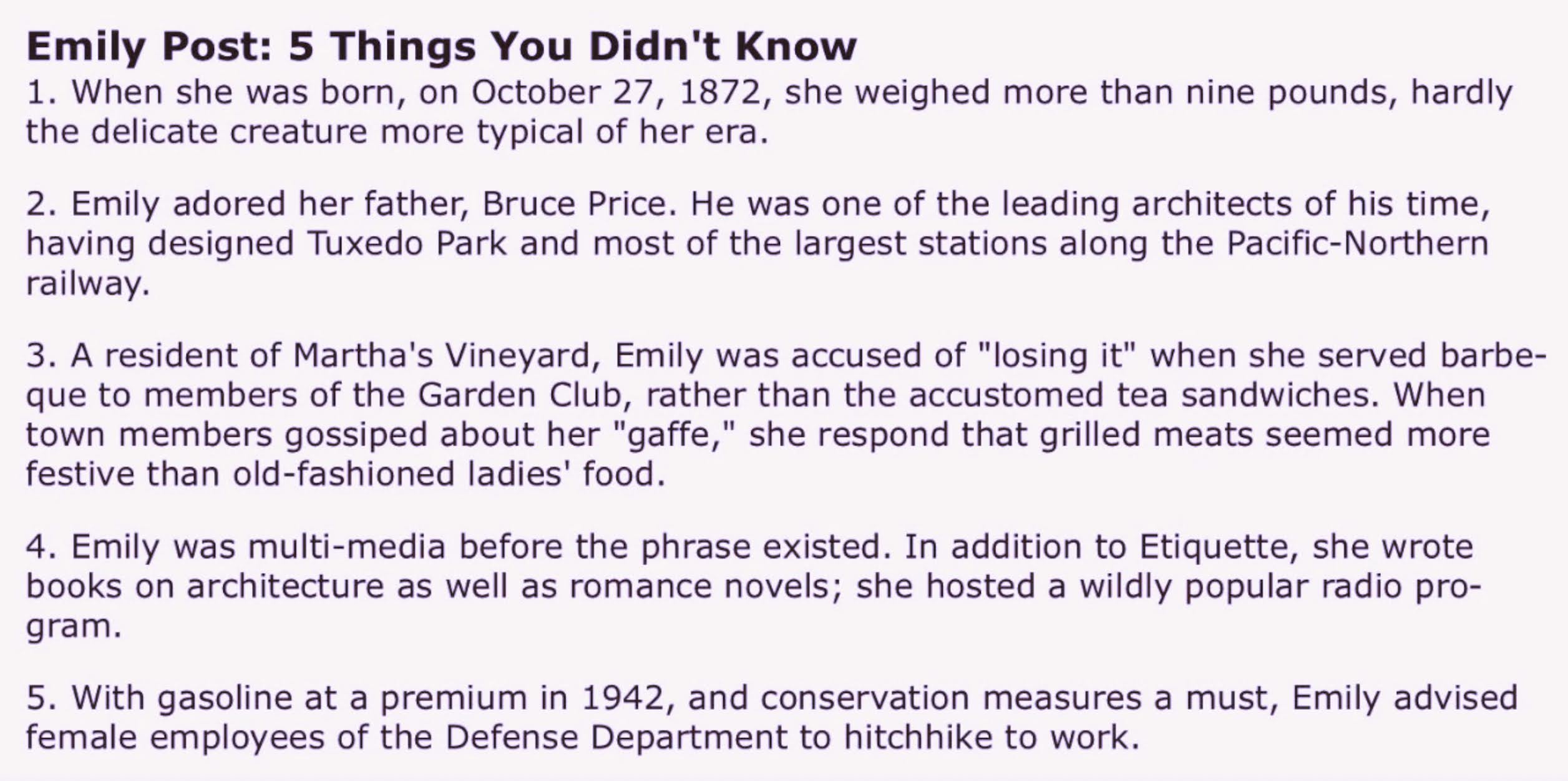
Answer: If she does not hold her hand out to him, then he behaves as he was taught in dancing school when a small boy. In other words, he takes one step, cracks his heels and bows from the waist and says, How do you do, Mrs. Brown.” – By the World's Foremost Authority on Etiquette © Emily Post, 1937


 Etiquette Enthusiast, Maura J. Graber, is the Site Editor for the Etiquipedia© Etiquette Encyclopedia

Monday, July 26, 2021

Edwardian London Club Etiquette

The most famous American Duchess of them all, Consuelo Spencer-Churchill, Duchess of Marlborough, was a member of the prominent American Vanderbilt family. Her marriage to Charles Spencer-Churchill, 9th Duke of Marlborough became an international symbol of the socially advantageous, but loveless, “Dollar Princess” marriages, which were so common during the Gilded Age.


The American Duchess, followed by her motor, led Miss Cochon of Chicago out St. James Street. “Oh, there’s the Duke!” cried Miss Cochon of Chicago as they passed Brooks club, but the Duchess said hurriedly: “Don't look at him, my dear, or he will cut you. Don’t you understand club etiquette?” “No; not if it differs from other etiquette.” “Well,” said the Duchess, “it differs altogether. The club, you see, originated in London. The club has been defined as the weapon wherewith the savage keeps the white woman at a distance. In club etiquette, women are ignored. As you pass White's or the Carlton, the Junior Carlton or Brooks, you will see your best friends, top hat pushed back and hands folded on stick, glaring solemnly at you from this window or from that, but your best friends won't speak to you. It isn't club etiquette. And if you spoke to them it would be a worse faux pas than if you appeared at court under the influence of liquor.”—Cincinnati Enquirer, 1911


Etiquette Enthusiast, Maura J. Graber, is the Site Editor for the Etiquipedia© Etiquette Encyclopedia

Thursday, July 15, 2021

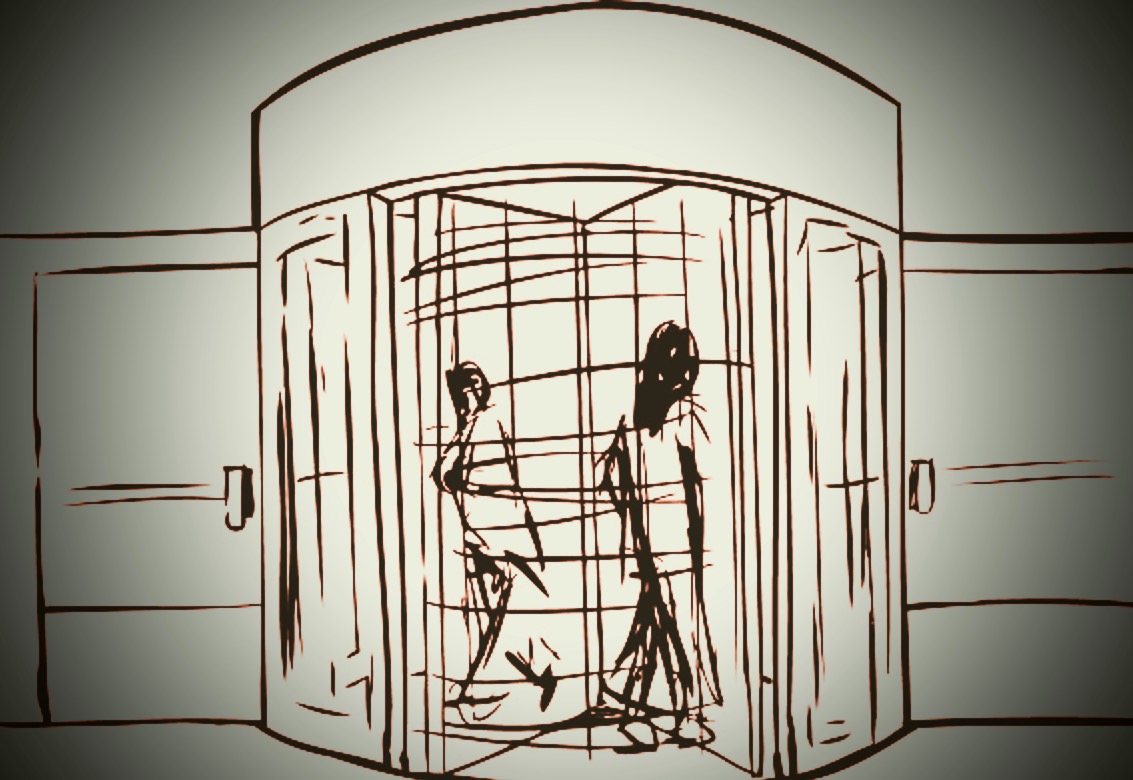
Revolving Door Etiquette

Some think the man should precede the woman furnishing the motive power, while she follows idly in the next compartment. Others hold that the rule “Ladies first” can have no exception…
The following chapter is from the book is entitled “Concerning Revolving Doors.” Listen to a bit of it: 
There has been some discussion of late as to the etiquette of the revolving door. When a man accompanied by a woman is about to be revolved in it, which should go first? Some think the man should precede the woman furnishing the motive power, while she follows idly in the next compartment. Others hold that the rule “Ladies first” can have no exception, therefore the man must stand aside and let the female of his species do the rough work of starting the door’s revolution, while the man, coming after, keeps it going and stops it at the right moment.

 “Starting something” is perhaps of all pastimes in the world, the most popular with the sex we are accustomed to call the gentle sex; one might almost say that “Starting something” is woman’s prerogative; on the other hand there is nothing on earth so abhorrent to that same gentle sex as the thing called Consistency; and though she may be perfectly charmed to start a revolution in South America, or in silk pajamas, or suffrage, or the rearing of children, it does not follow that she will take kindly to the idea of starting the revolution of a revolving door. – La Jolla Light, 1923


Etiquette Enthusiast, Maura J. Graber is the Site Editor for the Etiquipedia© Etiquette Encyclopedia

Tuesday, July 6, 2021

1950’s Dating Etiquette for Teens

“Everything was just so. And he knew exactly what to do!” is what teen-age girls love to tell their admiring congregation of girl friends, after they have had the “big dates.” 


In a Restaurant 

“He took me to the fanciest place. Everything was just so. And he knew exactly what to do!” is what teen-age girls love to tell their admiring congregation of girl friends, after they have had the “big dates.” There is no doubt about it, a boy must know what to do always. 

If he accidentally makes a mistake, on the other hand, he need not be ashamed. It is best for him to learn how and what to do before he takes his young girl friend out, however. For instance, when the boy takes the girl to a restaurant, he should know that he must step to the door, open it, hold it open until his girl friend companion enters the food center, then he must follow her in. 

Usually there is a head waiter or waitress to take care of the new arrivals, but if he doesn't get there immediately, the young couple should stand a little to the side and wait. The boy should be ready to tell the head waiter he wishes a table for two. The girl then follows the waiter and the boy again follows her. Should there be no head waiter, the boy leads the way and selects the table, for he is the host of this little party! — Grace Ramquist. 1953


Etiquette Enthusiast, Maura J. Graber, is the Site Editor for the Etiquipedia© Etiquette Encyclopedia 
Monday, July 5, 2021

Retro 1950’s Etiquette for Teens

As soon as you come to the car, become delicate. If that is difficult, then pretend you don't know how to turn the handle. A boy would feel insulted if you open the door for him. 


In the automobile, don't touch that car door handle, girls! As soon as you come to the car, become delicate. If that is difficult, then pretend you don't know how to turn the handle. A boy would feel insulted if you open the door for him.


It would be embarrassing to have a young man say “Thanks for opening the door for me. I'm too weak.” There is no doubt if he ever said such a thing, he would say it with all the sarcasm he could muster.


Most young men take great pleasure and pride in getting out of their cars, going around the back of them, and then coming around to the side to open the door for their girl friends. Most of the time, it is the fault of the girl if she does not get the proper treatment from the boys. She rushes in when she should have waited.


Girls must remember that it takes time to get around the opposite side of the car, they must be patient! — By Grace Ramquist, 1953


Etiquette Enthusiast, Maura J. Graber, is the Site Editor for the Etiquipedia© Etiquette Encyclopedia

Tuesday, April 27, 2021

Gilded Age Seaside Chivalry


If one has no donkey or other mode of conveyance at the beach, a gallant young man may be a welcome sight when slippers start to fill with sand!


Etiquette at the Beach 


A seasonable bit of gallant etiquette is offering to empty a lady's slipper of the sand gathered during a stroll on the beach. The lady hops on one foot while her cavalier, very much in the same way he would pick a stone from a horse’s hoof, deftly extracts the gritty particles which have made the fair one “go lame.” Fashionable slippers were not made for country walking, but they are a “boon,” as Artemus Ward once said of the Tower of London, to idle youngsters, who pose as gallants of the deepest dye at summer resorts.— Boston Beacon, 1886


Etiquette Enthusiast, Maura J. Graber, is the Site Editor for the Etiquipedia© Etiquette Encyclopedia
Sunday, January 3, 2021

New ‘Approved Etiquette’ of 1880

“I certainly would consider sharing this carriage ride with you if you weren’t wearing such an outlandish suit. That loud plaid won’t be fashionable for several years!” — The fashionable girl now lays her head on the shoulder of her male companion when traveling, according to a Cincinnati Enquirer writer...


Filed Under “Sensible Advice”

The fashionable girl now lays her head on the shoulder of her male companion when traveling, according to a Cincinnati Enquirer writer, who says: “The nicest girls do it, and they are so demure, so innocent, so unconscious in their manner that nobody could deem the practice harmful. They have the unconcerned air of using a pillow. This would have been reprehensible a year ago; now fashion and mothers permit it. But the man must not so far forget himself as to slyly hug the girl. If he does, she pops bolt upright, and will lean on him no more forever. That is new but approved etiquette.” — The Daily Herald, 1880


Etiquette Enthusiast, Maura J. Graber, is the Site Editor for the Etiquipedia© Etiquette Encyclopedia

Saturday, October 10, 2020

Strict Spanish Etiquette was Deadly

The strictest etiquette in Spain would prevent a young man from ever being left alone with his fiancée.


Courtship in Spain is regulated by the strictest etiquette. As is well known, a young man is never left alone with his fiancée. Near Malaga, a beautiful young girl of twenty, committed suicide by drinking a cup of coffee in which phosphorus had been dissolved. It appears that the girl had been driven to the deed by the adverse comments of neighbors who became aware that she had given her sweetheart a kiss.—London Mail, 1906


Etiquette Enthusiast, Maura J Graber, is the Site Editor for the Etiquipedia© Etiquette Encyclopedia