Showing posts with label Victorian Dining Etiquette. Show all posts

Sunday, July 14, 2024

Basic Spoons and Spoon Etiquette

The Gilded Age in the late 19th C. was a time of great growth in flatware design. Basic spoons for tea and coffee or soup, evolved into a variety of shapes and lengths and styles to satisfy the etiquette for every need, from citrus fruits to sorbets, to eggs, pots-de-crème and chocolate. Above, various sized-chocolate spoons and a long chocolate “muddler,” alongside Limoges pots-de-crème cups with lids and demi-trembleuse cups in saucers for hot chocolate, photographed with a mid-century modern hot chocolate pot.

Tea Spoon

The tea spoon is perhaps the most common place piece existing. Almost every set had these in their basic sizes, whether the bride chose dinner, place, or lunch-sized knives and forks. Over the years the weight of these was slightly adjusted to cut or further increase company profit margins. In 1914, Gorham offered four different weights of silver content for the tea spoon.

Youth or Breakfast Spoon

The next spoon is a smaller, lighter version of a standard tea spoon. It is referred to as a youth or breakfast spoon to match the youth and breakfast knives and forks being marketed by manufacturers.

Five O'Clock Spoon

The small, or five o'clock, tea spoon shown next, was fairly un usual even in the days of afternoon teas, as the regular tea spoon was often used. The size difference was merely a matter of personal preference on the part of the buyer.

Four O'Clock or P.M. Spoon

A smaller version of the five o'clock tea spoon was also made. This is referred to by collectors as a four o'clock tea spoon and is shown next. Many patterns had three sizes of spoons for tea. A regular tea spoon, a small tea spoon, and a four o'clock or P.M. spoon. Calling one size a five o'clock spoon and the other a four o'clock spoon facilitates distinguishing between the two sizes in price lists and when talking over the phone. In much the same way, a large-size round soup spoon is called a gumbo spoon. 

It is very doubtful the Victorians had different spoons depending on whether you drank your tea at four or five o'clock. Victorian etiquette books pay little attention to different types of silverware and their usage, a sure sign that it was not an important screening device. It is therefore hard to know if these different sizes reflect personal preference on the part of the buyer. It should be noted that the normal time for the nursery tea for children was four o'clock. It may be the four o'clock teaspoon is in effect a child's tea spoon. – From “Forgotten Elegance,” 2003


Etiquette Enthusiast, Maura J. Graber, is the Site Editor for the Etiquipedia© Etiquette Encyclopedia

Wednesday, October 21, 2020

Etiquette of 19th - Early 20th C. Dining

An informal table set with a service plate, an under plate, a ramekin dish in a silver holder with handle, holding the first course for the meal, for each diner at the table. Victorian meals by 1900, were so elaborate, that books were written to explain how to serve the food. Setting the table might have required as many as seven sterling silver forks for all of the various dishes that were to be served. By the 1920s though, casual dining ushered in Fiesta ware, which continues to be popular with collectors today.


     How Dishes Have Changed 

Table manners, just like clothes, have become less formal and less complicated in the past 50 years. A set of dishes today will have about six pieces for a place setting, and a set of tableware (often made of stainless steel, which doesn’t need to be cleaned like silver) will have six or seven pieces to a place setting.

The Victorian dinner table seemed to be filled with hundreds of styles of silverware and dishes. Etiquette demanded the correct utensils for each type of food. A set of silver could have more than 100 pieces. There could be a special fork for oysters, salad, dinner, lunch, dessert, cake, pie and cold meat, and all sorts of serving forks.

Even dishes had special uses. How many people today use a ramekin (a small, straight-sided dish used for custards), a cream soup dish (shaped like a small bowl with two handles), a teacup, coffee cup, demitasse cup, after-dinner cup and many other dishes? Collectors can rarely identify a mush-and-milk set, herring dish, asparagus bowl, berry set or even a shredded-wheat dish. Each was made in a special shape but with the same pattern. Modern examples are not even made. — By Ralph and Terry Kovel in the Times, 1999

Old advertisement for a berry set. These pressed glass sets make entertaining a bit more special and can be found in antique shops or online.
— Photos from Etiquipedia’s private library

Etiquette Enthusiast, Maura J. Graber, is the Site Editor for the Etiquipedia© Etiquette Encyclopedia

Monday, October 12, 2020

Social Dilemma Solved by Sardines


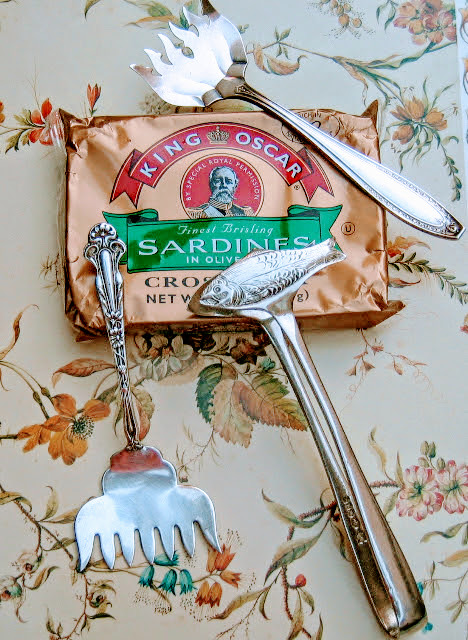
Antique silver sardine servers — Knives are really only used with any dish that requires to be cut, such as cutlets, oxtail, filets de boeuf, grenadines of veal, hashed venison or beef, for these and similar dishes, a knife is a requisite. Sweetbreads are never eaten with a knife, for if they are properly cooked, they are so tender that a knife is quite wrong and out of place. Any mince with poached eggs, or puree of meat, game, or poultry, is also eaten with a fork only. It is usual to eat salads with both knife and fork, mayonnaise also. Omelettes, both savoury and sweet, are eaten with the fork alone; toasted cheese or Welsh rarebit with both knife and fork, which would also be used for most savouries, such as “sardines on toast,” “bloaters,” Anchovy toast, with poached eggs, all kinds of  ‘devils,’ ‘ham toast.’ Forks only would be used in eating ‘macaroni au gratin,’ ‘soufflés,’ whether savoury or cheese, ‘scalloped oysters,’ ‘tartlettes,’ whether savoury or sweet, creams, jellies, iced puddings, blancmanges, indeed all kinds of sweets of sufficient consistency to admit of it. — Lady Constance Eleanora C. Howard

SOCIAL DILEMMA 

Unexpected guests for an evening will often tax your ingenuity for a suitable luncheon. You can solve this social dilemma by having on hand always Booth’s Crescent Brand Sardines. One tin will make a splendid luncheon for four, and a more delicious, tid-bit was never tasted by anyone, than these savory little fish from the Bay of Monterey. They are larger than ordinary sardines and better, so much better that you will wonder why they are called sardines. 

Try a can and you’ll buy a case, for you’ll never want to be without them. 20 cents a tin at grocers everywhere. One tin is enough for a luncheon for four. Put up by Monterey Packing Company, Monterey, California. F. K. Booth, Sole Agent, San Francisco. Booklet of recipes for serving Crescent Brand Sardines mailed free if you send the name of your grocer. — Stockton Independent, 1910

Antique porcelain sardine box with antique silver set of sardine knife and fork, sardine lifters and sardine tongs — “Early tinned and canned items were too expensive for those in the lower, and even middle-class income brackets, at the time. Sardines were one imported tinned food that the wealthy could afford to serve, so sardine servers, dishes and tongs, were offered in abundance at the time. Tinned sardines and other such foods, suddenly offered an elegant way to not only outdo one’s neighbors, but another way illuminate one’s home.” — Maura Graber in “Reaching for the Right Fork”


Etiquette Enthusiast, Maura Graber, is the Site Editor for the Etiquipedia© Etiquette Encyclopedia

Saturday, November 11, 2017

Gilded-Age Tablescape Etiquette

Victorian, gilded-age hostess would undoubtedly have these ingenious sets on hand for entertaining any tremble-prone guests. Specifically designed for a person who suffered from “the trembles,” trembleuse cups and saucers were “spillproof” combinations. Created to avoid spillage of hot liquids by a trembling hand, the deep inset of the saucer in which the cup firmly rests and the saucer’s very wide border, work beautifully together for this antique, Dresden china trembleuse set.

A Table Decoration

A very beautiful table decoration was seen at a dinner party given last week by a hostess noted for her taste and originality. The cloth, which was of the finest damask, displayed a design of ferns, the center figure being an exquisitely drawn wreath of fern fronds, while the border was formed by sprays of the most delicate maiden-hair variety, had been ordered of a great linen house in Belfast; with special reference to the decoration of living ferns, intended to be used for a “summer dinner party.” 


The table was circular, and in the middle stood one of the giant tulip vases now so fashionable. This graceful receptacle was filled with the loveliest and rarest specimens ot ferns, the spreading, feathery fronds reaching far over the heads of the assembled company, and forming, as it were, a vacant tent through whose interstices shone the electric lights of the chandelier. No candles, no flowers were used, but each sliver dish was surrounded by a wreath of ferns, which kept perfectly fresh during the serving of the course. All the crystal ware was exquisitely engraved with ferns, while the Dresden china service gave the one touch of warmth and color with its pure rose and gold tints. An ideal July dinner decoration was the universal comment, and far more effective than the elaborated floral banquets which have prevailed duriug the past season. —Boston Herald, 1891

Etiquette Enthusiast, Maura J. Graber, is the Site Editor for the Etiquipedia© Etiquette Encyclopedia 
Friday, September 8, 2017

Gilded Age Food and Etiquette


Spoons are sometimes used with puddings, but forks are the better style and a spoon should never be turned over in the mouth.


  • A cream-cake, and anything of similar nature, should be eaten with knife and fork, never bitten. Asparagus may be taken from the finger and thumb. 
  • Peas and beans, as we all know, require the fork only. 
  • Potatoes, if mashed, should be mashed with the fork. 
  • Green corn should be eaten from the cob, but it must be held with a single hand. 
  • Celery, cresses, radishes, and all that sort of thing, are, of course, to be eaten from the fingers; the salt should be laid upon one's plate, not upon the cloth. 
  • Fish is to be eaten with the fork,without the assistance of the knife; a bit of bread in the left hand sometimes helps one to master a refractory morsel. 
  • Berries, of course, are to be eaten with a spoon. 
  • It is not proper to drink with a spoon in the cup; nor should one, by the way, ever quite drain the cup or glass. 
  • Spoons are sometimes used with puddings, but forks are the better style. 
  • A spoon should never be turned over in the mouth. 
  • Ladies have frequently an affected way of holding the knife half way down its length, as if it were too big for their little hands, but this is as awkward a way as it is weak. The knife should be grasped freely by the handle only, the forefinger being the only one to touch the blade, and that only along the back of the blade at its root, and no further down. 
  • In sending one's plate to be helped a second time, one should retain one's knife and fork, for the convenience of waiter and carver. 
  • At the conclusion of a course, where they have been used, kuife and fork should be laid side by side on the plate, never crossed; the old custom of crossing them was in obedience to an ancient religious formula. 
  • The servant should offer everything at the left of the guest, that the guest may be at liberty to use the right hand. 
  • If one has been given a napkin-ring, it is necessary to fold one's napkin and use the ring; otherwise the napkin should be left unfolded. 
  • One's teeth are not to be picked at the table; but if it is impossible to hinder it, it should be done behind the napkin. 
  • One may pick a bone at the table, but, as with corn, only one hand is allowed to touch it; yet one can usually get enough from it with knife and fork, which is certainly the more elegant way of doing; to take her teeth to it gives a lady the look of caring a little too much for the pleasures of the table; one is, however, on no account to suck one's fingers after it. 
  • Wherever there is any doubt as to the best way to do a thing, it is wise to follow that which is the most rational, and that will almost invariably be found to be the proper etiquette. – Harper’s Bazaar, 1879


Etiquette Enthusiast, Maura J. Graber, is the Site Editor for the Etiquipedia© Etiquette Encyclopedia

Saturday, July 29, 2017

Etiquette and Francatelli's Legacy

"At Windsor Castle, Francatelli, and then the royal chefs who followed him during Victoria’s long reign, had at least two Yeomen of the Kitchen and 24 assistant chefs to prepare these meals, and then, of course, all kinds of servers and lackeys were involved in washing, table-setting, serving and clearing away." —M.F.K. Fisher 


"Her Majesty’s (Queen Victoria's) French? Italian? English? chef, Charles Edme Francatelli, wrote ''The Modern Cook'' in 1846, and it sold almost as well in America as in England. Few kitchens here could follow all its directions for the light Gallic dainties Francatelli introduced to counteract the basic heaviness of royal dining habits, but gradually his style of making two courses of a meal, with a predominance of sweet dishes in the second, was adapted by our housekeepers to shape the way we now eat lunch and dinner.

In the Queen's menus, there were often three soups, three fishes, a kind of savory (for instance, marrow patties with a fines-herbes sauce), four dishes and eight entrées in the first course, all served at once. In the second there were three roasts and poultry and game, three sweet desserts, two more side desserts of pastry, and 12 entremets, including vegetables, aspics and fruit tartlets.

At Windsor Castle Francatelli, and then the royal chefs who followed him during Victoria’s long reign, had at least two Yeomen of the Kitchen and 24 assistant chefs to prepare these meals, and then, of course, all kinds of servers and lackeys were involved in washing, table-setting, serving and clearing away. 


Nonetheless, American housewives as far west as Iowa and then beyond, helped by one or two immigrant servants, read ''The Modern Cook'' and its lesser imitators and gradually changed the accustomed pattern of one long hodge-podge of dishes served together, even in a plain Family Meal, to two courses, with sweets alone finally constituting the second course. This might consist of two kinds of pies or tarts, a cool pudding, a jelly and a tall layered cake, but at least these did not appear side by side with roast pigeons, asparagus soup and a haunch of venison flanked by boiled vegetables." — From Food: The Arts (Fine and Culinary) of 19th Century America
By M. F. K. Fisher

Friday, May 19, 2017

Dinner Seating Etiquette, 1895

Dinner tables of society hostesses, in the latter part of the Victorian Era, featured unique and ornate silver patterns. The more silver laid on a dining table, the better. Silver reflected candlelight, illuminating dining rooms that were not yet fitted with electric lights.

A New Dinner Table Fashion!

The new heraldry, or rather etiquette, for large public dinners, annual​ dinners and the like—to which more and more​ frequently ladies are invited—places the wife at the table by her husband's side. She has for some years sat side by side with bim on the box seat when he drives his four-in-hand, and now it is the recognized thing, even in London,where innovations come slowly, to have this arrangement at dinner. 


"It seems very odd," writes an English woman, describing the annual dinner of the Newsvendors Benevolent and Provident Institution at the Grand Hotel, "very odd to go down with Richard, this being one of the particulars in which the public banquet differs from the private dinner. Opposite us were a husband and wife, to the left of us another couple, and a little further off another married pair. None of us quarreled with each other. 

Richard talked to his friend, who occasionally threw me a crumb of the conversation, and I made friends with my other neighbor, admired the lovely tulips on the table and made energetic efforts to see what Lady E_____ looked like. She sat beside the chairman, her husband, her father, the Earl of Arran, supporting her on the right. So you see it was intensely British​, a family arrangement of the most pronounced kind." 

The first time that such an arrangement was tried in Philadelphia was at the dinner given to Dr. James Mac Allister by Mr. Edward T. Steel and a number of other friends. There, husbands sat by their wives, and the novelty and ease of this arrangement was very much enjoyed. Since then the arrangement has become quite a general one for public functions, when other placing of the body of guests would be awkward or impossible. — Philadelphia Public Ledger, 1895

Etiquette Enthusiast, Maura J Graber, is the Site Editor for the Etiquipedia© Etiquette Encyclopedia

Wednesday, December 21, 2016

Victorian Fork Etiquette and Fashions

Eating olives with proper etiquette was a particular form of art—it was rumored that one imposter nobleman in France in the 1800s was recognized as a fraud by the way he ate his olives. The accused barbarian dared to eat his olives with a regular fork, instead of locating a proper olive fork—one which was designed with tiny, appropriately-sized tines.

Forks come in all shapes and sizes. Specialized designs for flatware exploded in number during the Victorian Era. In a panic to keep up with the latest serveware, aspiring couples accumulated a ridiculous number of pieces of cutlery. It was all a reflection of the culture at the time, which equated abstruse formal dining rules and etiquette with civilized society.

This was especially the case in America, where status wasn't as set in stone as in Europe. In the younger nation, social standing for the upwardly mobile was far more dependent on displays of wealth and class through, among other things, hosting and attending formal dinner parties. As formal dining evolved, so did the demand for increasingly nuanced (and perhaps absurd) silverware, resulting in giant horizontal tongs for asparagus, tiny yard-rake-like implements for spearing whole sardines, and a hybrid knife-fork for convenience in slicing and eating pie.
A late-Victorian variation on original pie forks.
The pie fork, unlike some other Victorian cutlery, can be praised for its usefulness. The left side of the fork features a thick, sharp-edged tine for slicing into pie or tarts, but blunt ends for using the fork to eat the pie as you would a normal fork. – Saveur Magazine, 2016

Etiquette Enthusiast, Maura J. Graber, is the Site Moderator and Editor for the Etiquipedia© Etiquette Encyclopedia

Sunday, September 4, 2016

Breaking Royal Etiquette

Prince Albert with Queen Victoria ~ In Prince Albert's days the etiquette of the Court was extremely severe...


Court Etiquette

In Prince Albert's days the etiquette of the Court was extremely severe, and some of the young ladies in attendance had occasionally to be reminded that they were expected to remain standing when the Queen or the Prince was in the room, and that, moreover, they must not mix in the conversation by word or laughter, unless requested. A certain maid of honor who had a beautiful singing voice, and has since become a charming peeress, relates Truth, was one day bidden to sit down at the piano and play something. She declined, forgetting thut the Queen's wishes were a command. The Queen insisted kindly, but the maid urged that she had a cold. "Well, then, you had better go to bed," said her Majesty, " Oh, no thank you," was the answer, " but, if you don't mind, I'll sit down," and she did.

On another occasion, a maid of honor who had accompanied the Queen to the opera, and who ought by rights to have taken a seat at the back of the box, heedlessly sat down in a chair reserved for the Prince Consort. A glance from the Queen warned her that she had committed a blunder, but the girl was either obtuse or stubborn, for she merely removed to the next chair in the front row, intended for another member of the royal family, and this time she not only stuck to her place, she ignored the fitness of things by applauding throughout the performance, like the rest of the audience. 


This, however, is not so bad as the conduct of the newly appointed equerry, who had been told that he must appear in knee-breeches at the Royal dinner table, but who came down in trousers, and naively apologized to the Queen, saying that he had found his new breeches too tight. – Mariposa Gazette, 1879

Etiquette Enthusiast, Maura J. Graber, is the Site Editor for the Etiquipedia© Etiquette Encyclopedia

Sunday, July 31, 2016

1890's Scotch Breakfast Etiquette

“So according to the up-to-date etiquette, in the year 1896, Scotsmen will eat their breakfast porridge while standing.”
Eating Porridge
A new fashion has arisen in Scotch country houses during the last few years. All sporting men like porridge for breakfast. Now, it is not a pretty spectacle to see mustached and bearded men eat porridge and cream; so now that delectable compound is placed upon a side table behind a screen, or in a little ante-room, and when the lords of creation stroll down on a Sunday or rush down on a week day to breakfast, according to up-to-date etiquette, they eat their first breakfast course standing. This fashion reminds an observer of the Russian habit of eating Zakuski, or hors d'oeuvres, at a side table in the drawing-room, before descending to the dining-room. — Sacramento Daily Union, 1896


Etiquette Enthusiast, Maura J Graber, is the Site Editor for the Etiquipedia© Etiquette Encyclopedia 

Tuesday, May 17, 2016

Children's Etiquette for Dining


It is polite to wait until all or nearly all are helped before beginning to eat; and children should never begin before older people.


Manners at the Table


It is not polite to linger after being called to the table. When the bell is rung, or any other summons given, it is to be supposed that the meal is ready, and the call should be promptly obeyed. Food does not improve by waiting, and unnecessary delay is rudeness to the persons at whose table we sit, whether our own parents or strangers. When we know the hours for meals we should plan to be ready for them.

Until the lady of the house takes her seat, other persons should not take theirs. In taking our seats we should be careful not to jar the table. Each one should quietly wait his turn to be helped. Children sometimes pass their plates as soon as they are seated, or begin to handle knife, fork, and spoon as if they were in hungry haste. They should wait for visitors and older persons to be helped first, and brothers should wait for their sisters.

A story is told of a little girl, five years old, who at a large dinner party was overlooked until the company had finished the first course. She waited before her empty plate in perfect quietness until some one noticed her,—bravely trying to keep back the tears,—because she thought it was the polite and proper thing to do. This was carrying polite waiting further than was necessary, but was much better than the rude haste too common among children.

It is polite to wait until all or nearly all are helped before beginning to eat; and children should never begin before older people.

It is not polite to ask for things at other tables than our own or those of intimate friends who expect it of us. The persons at whose table we sit are expected to supply our wants without our making them known. In asking we must not forget to say, "Please pass the bread," or whatever we wish for, and to say, "If you please," "Yes, thank you," or "No, thank you," when we accept or decline what is offered. We should ask for any article by name, and never point at the dish. 


Ill-mannered children sometimes ask for pie or pudding or oranges before they are brought on, instead of waiting for the courses in their proper order, and even have been known to make their entire dinner on the dessert. One is apt to think such children are not accustomed to dainties in their own homes, or they would not be so greedy for them.

We should never say, "I don't like that," if something is offered we do not wish to eat, but simply decline it beforehand or leave it upon our plates without remark; and under no circumstances should we criticise what is on the table.

There is a proper, graceful way to handle napkin, knife, fork, and spoon, and we should study to learn this way and to avoid the clumsy awkwardness in these little things that marks the person unused to good society.

To eat fast is one of the bad habits of American people which we ought to avoid. If acquired in childhood, it will be hard to overcome, and will cause us much mortification when, later in life, we find ourselves with empty plates long before well-bred people in the company have finished theirs. Since we do not leave the table before others, there is nothing gained, even in time, while much is lost in health and in good manners.
– From Edith E. Wiggin's 1884, “Lessons on Manners / For School and Home Use.”


Etiquette Enthusiast, Maura J Graber, is the Site Moderator and Editor for the Etiquipedia© Etiquette Encyclopedia

Tuesday, February 2, 2016

Etiquette at Victoria's Table

Above ~ One of the few, rare photos of Queen Victoria dining with family members. Queen Victoria ate a great deal of food (mostly meat and fowl) and she ate extremely fast. According to Kate Hubbard, in her book, “Serving Victoria: Life in the Royal Household” Victoria, “loved her food. She was greedy and she gobbled. She liked her dinners to last no more than half an hour. Guests would quite often find their plates whisked away while they were still eating because once she had finished, all the plates were removed. She was a hearty eater and she was a fast eater.” And as for courtly conversation" at the table? She did not like politics to be brought up, and, oddly, “She didn't like marriage being discussed in front of her youngest daughter, Beatrice, before Beatrice married. Anyone who mentioned marriage at dinner was swiftly reprimanded.”
“It's no fun for a hungry person to dine with Queen Victoria. It is not etiquette to eat of anything after she has finished with it, and as her Majesty eats very little the courses are hurried over. After dinner there is hardly time to take even one glass of wine before coffee is brought in.  
The Queen does not put her cup on the table, but sips a little as the servant holds it on the salver. Then Her Majesty rises, and of course the guests all rise and stand back from the table. The Queen then makes the round of the room, stopping to talk for a few minutes to any of the guests whom she may delight to honor.”– News Report from The Daily Alta, 1880

🍽️Etiquette Enthusiast, Maura J. Graber, is the Site Editor for the Etiquipedia© Etiquette Encyclopedia 

Saturday, January 9, 2016

Victorian Era Dinner Etiquette

I hope no one took bon-bons from the table! – Upon returning to the drawing-room the gentlemen should never cluster round the door, but join the ladies at once, striving to repay the hospitality of the hostess by making themselves as agreeable as possible to the guests. And none but a low-bred clown will ever carry fruit or bon-bons away from the table! 


Etiquette for 1870’s - 1880’s Dining


If you make any general remark, do not look up at the waiters to see what effect it has upon them. If they are well-trained they will not move a muscle at hearing the most laughable story, nor will they give any sign whatever that they have not closed their ears like deaf adders to all that has been going on. In any case, however, you must refrain from noticing them.

If you want anything, take the occasion of a waiter being near to you, to ask for it in an undertone. To shout out "Waiter!" or order one about, as if you were in a restaurant, is a certain mark of ill-breeding.

Unless the party is a very small one, general conversation is impossible. In such a case, you must converse with those on either side of you, not confining your remarks exclusively to one.

Talk in a low, quiet tone, but never in a whisper. To affect an air of mystery or secrecy at a dinner-table, is an insult to your companion and company assembled.

It is in bad taste to force the attention of the company upon yourself by loud talking or loud laughing.

Too many jokes or anecdotes are in bad taste, but the subjects for conversation should not be too serious.

Any gentleman propounding a conundrum at the dinner-table deserves to be taken away by the police.

To use one's own knife, spoon or fingers, instead of the butter knife, sugar-tongs or salt-spoons, is to persuade the company that you have never seen the latter articles before, and are unacquainted with their use.

Never eat all that is on your plate, and above all never be guilty of the gaucherie of scraping your plate, or passing your bread over it as if to clean it.

Never fill your mouth so full that you cannot converse; at the same time avoid the appearance of merely playing with your food.

Eat in small mouthfuls, and rather slowly than rapidly.

Peel fruit with a silver knife in your right hand. Eat it in small slices cut from the whole fruit, but never bite it, or anything else at table. Need I say no fruit should ever be sucked at the table?

If upon opening fruit you find it is not perfect, or there is a worm in it, pass your plate quietly and without remark to the waiter, who will bring you a clean one.

None but a low-bred clown will ever carry fruit or bon-bons away from the table.

Drinking wine with people is an old custom, but it will nowadays be found to exist only among the past or passing generation.

When the hostess thinks her lady friends have taken as much
dessert as they wish, she catches the eye of the principal among them; an interchange of ocular telegraphing takes place, the hostess rises, and with her all the company rise; the gentlemen make a passage for the ladies to pass; the one who is nearest to the door opens it, and holds it open until all the ladies have passed out of the room.

As soon as the ladies have retired the gentlemen may resume their seats for more wine and conversation, but it is a very poor compliment to the lady guests to linger long in the dining-room.

The ladies upon leaving the dining-room, retire to the drawing-room, and occupy themselves until the gentlemen again join them.

It is well for the hostess to have a reserve force for this interval, of photographic albums, stereoscopes, annuals, new music, in fact, all the ammunition she can provide to make this often tedious interval pass pleasantly.

If you dine in the French fashion, the gentlemen rise with the ladies, each offering his arm to the lady he escorted to dinner, and all proceed to the drawing-room together.

If the gentlemen remain to have coffee served in the dining-room, tea may be served in the drawing-room to the ladies.

Upon returning to the drawing-room the gentlemen should never cluster round the door, but join the ladies at once, striving to repay the hospitality of the hostess by making themselves as agreeable as possible to the guests. 

From two to three hours after dinner is the proper time to leave the house.– From Sarah Annie Frost, 1877


Submitted by Sisters, Toni and June, at "Etiquette Facts"


Etiquette Enthusiast, Maura J. Graber, is the Site Editor, for Etiquipedia© Etiquette Encyclopedia

Thursday, November 27, 2014

Victorian Dining Etiquette Changes


With regard to forks: “There were some practical limits. Clearly if the hostess put out the 8 or 10 forks one would use at a formal meal, the diners would be too spread out to comfortably talk to each other. Convention quickly settled on 3 or 4 forks as the maximum number the hostess could put out so guests could still talk easily to their neighbors.”

Victorian Era Dining and 3 Forks on the Left 

The change over (from Service à la Française) to Service à la Russe caused the established ways of serving and eating meals to undergo a major modification.
In the colonial period the only silver on the table was a knife, a fork, and perhaps a spoon. Part of the reason for this was that the tablecloth was removed after every course. To have a lot of silver and many glasses on the table would have made the removal of the tablecloth too hard. 
When the change to service a la Russe took place in the 1860s and 1870s, the tablecloth stayed in place throughout the entire meal. In addition, the servants were busy carving and serving food. It now made sense to put out all the silver the diner would need and leave it there throughout the entire meal. The footman had other things to do and less time to hand out silverware. In addition, the mechanization in the production of silverware, together with a drop in the price of silver, meant that the host now acquired more silverware. 
There were some practical limits. Clearly if the hostess put out the 8 or 10 forks one would use at a formal meal, the diners would be too spread out to comfortably talk to each other. Convention quickly settled on 3 or 4 forks as the maximum number the hostess could put out so guests could still talk easily to their neighbors. 
A rare Chantilly pattern "bird" or "game" knife and fork set. These were also sometimes known as "duck knives and forks" and were the predecessors to the steak knives of today.
For some twenty years after the Civil War there was disagreement about whether 3 or 4 forks were proper. In the end 3 forks won out-- perhaps because the game course became less common. But, because this was a change and an arbitrary number, it was necessary to keep reminding people that they should never put out more than 3 forks at a table setting. We personally like the look of 4 forks and knives it creates an exotic and opulent look, and visually sends the cue that this meal will be something a little different. – From Forgotton Elegance


Etiquette Enthusiast, Maura J Graber, is the Site Editor for the Etiquipedia© Etiquette Encyclopedia 

Wednesday, September 11, 2013

Victorian Etiquette in England

On “The Dinner Table”
   
George Routledge –1812-1888 
To be acquainted with every detail of the etiquette pertaining to this subject is of the highest importance to every gentleman. Ease, savoir faire, and good breeding are nowhere more indispensable than at the dinner-table, and the absence of them are nowhere more apparent. How to eat soup and what to do with a cherry-stone are weighty considerations when taken as the index of social status; and it is not too much to say, that a man who elected to take claret with his fish, or ate peas with his knife, would justly risk the punishment of being banished from good society. As this subject is one of the most important of which we have to treat, we may be pardoned for introducing an appropriate anecdote related by the French poet Delille:

Delille and Marmontel were dining together in the month of April, 1786, and the conversation happened to turn upon dinner-table customs. Marmontel observed how many little things a well-bred man was obliged to know, if he would avoid being ridiculous at the tables of his friends. "They are, indeed, innumerable," said Delille; "and the most annoying fact of all is, that not all the wit and good sense in the world can help one to divine them untaught.

A little while ago, for instance, the Abbé Cosson, who is Professor of Literature at the Collège Mazarin, was describing to me a grand dinner to which he had been invited at Versailles, and to which he had sat down in the company of peers, princes, and marshals of France. "'I'll wager, now,' said I, 'that you committed a hundred blunders in the etiquette of the table!' "

'How so?' replied the Abbé, somewhat nettled. 'What blunders could I make? It seems to me that I did precisely as others did.'

"'And I, on the contrary, would stake my life that you did nothing as others did. But let us begin at the beginning, and see which is right. In the first place there was your table-napkin–what did you do with that when you sat down at table?'"

'What did I do with my table-napkin? Why, I did like the rest of the guests: I shook it out of the folds, spread it before me, and fastened one corner to my button-hole.'

"'Very well, mon cher; you were the only person who did so. No one shakes, spreads, and fastens a table-napkin in that manner. You should have only laid it across your knees. What soup had you?'"

'Turtle.'

"'And how did you eat it?'"

'Like every one else, I suppose. I took my spoon in one hand, and my fork in the other'

"'Your fork! Good heavens! None but a savage eats soup with a fork. But go on. What did you take next?' "

'A boiled egg.'

"'Good and what did you do with the shell?' "

'Not eat it certainly. I left it, of course, in the egg-cup.'

"'Without breaking it through with your spoon?' "

'Without breaking it.'

"'Then, my dear fellow, permit me to tell you that no one eats an egg without breaking the shell and leaving the spoon standing in it. And after your egg?' "

'I asked for some bouilli.' "'For boulli! It is a term that no one uses. You should have asked for beef–never for boulli. Well, and after the bouilli?' "

'I asked the Abbé de Radonvillais for some fowl.'

"'Wretched man! Fowl, indeed! You should have asked for chicken or capon. The word "fowl" is never heard out of the kitchen. But all this applies only to what you ate; tell me something of what you drank, and how you asked for it.' "

'I asked for champagne and bordeaux from those who had the bottles before them.'

"'Know then, my good friend, that only a waiter, who has no time or breath to spare, asks for champagne or bordeaux. A gentleman asks for vin de Champagne and vin de Bordeaux. And now inform me how you ate your bread?' "

'Undoubtedly like all the rest of the world. I cut it up into small square pieces with my knife.'

"'Then let me tell you that no one cuts bread. You should always break it. Let us go on to the coffee. How did you drink yours?' "

'Pshaw! At least I could make no mistake in that. It was boiling hot, so I poured it, a little at a time, in the saucer, and drank it as it cooled.'

"'Eh bien! then you assuredly acted as no other gentleman in the room. Nothing can be more vulgar than to pour tea or coffee into a saucer. You should have waited till it cooled, and then have drank it from the cup. And now you see, my dear cousin, that, so far from doing precisely as others did, you acted in no one respect according to the laws prescribed by etiquette.'"

                                  
French poet Delille, 
1738-1813 

On "Invitation to Dine" 

An invitation to dine should be replied to immediately, and unequivocally accepted or declined. Once accepted, nothing but an event of the last importance should cause you to fail in your engagement. To be exactly punctual is the strictest politeness on these occasions. If you are too early, you are in the way; if too late, you spoil the dinner, annoy the hostess, and are hated by the rest of the guests.

Some authorities are even of opinion that in the question of a dinner-party "never" is better than "late;" and one author has gone so far as to say, if you do not reach the house till dinner is served, you had better retire to a restaurateur's, and thence send an apology, and not interrupt the harmony of the courses by awkward excuses and cold acceptance.

When the party is assembled, the mistress or master of the house will point out to each gentleman the lady whom he is to conduct to table. If she be a stranger, you had better seek an introduction; if a previous acquaintance, take care to be near her when the dinner is announced, offer your arm, and go down according to precedence of rank. This order of precedence must be arranged by the host or hostess, as the guests are probably unacquainted, and cannot know each other's social rank. 

When the society is of a distinguished kind, the host will do well to consult Debrett or Burke, before arranging his visitors. When rank is not in question, other claims to precedence must be considered. The lady who is the greatest stranger should be taken down by the master of the house, and the gentleman who is the greatest stranger should conduct the hostess. Married ladies take precedence of single ladies, elder ladies of younger ones, and so forth.
    
A sumptuous table set for 18 for dinner. 

When dinner is announced, the host offers his arm to the lady of most distinction, invites the rest to follow by a few words or a bow, and leads the way. The lady of the house should then follow with the gentleman who is most entitled to that honour, and the visitors follow in the order that the master of the house has previously arranged. The lady of the house frequently remains, however, till the last, that she may see her guests go down in their prescribed order; but the plan is not a convenient one. It is much better that the hostess should be in her place as the guests enter the dining-room, in order that she may indicate their seats to them as they come in, and not find them all crowded together in uncertainty when she arrives.

The number of guests at a dinner-party should always be determined by the size of the table. When the party is too small, conversation flags, and a general air of desolation pervades the table. When they are too many, every one is inconvenienced. A space of two feet should be allowed to each person. It is well to arrange a party in such wise that the number of ladies and gentlemen be equal.

It requires some tact to distribute your guests so that each shall find himself with a neighbour to his taste; but as much of the success of a dinner will always depend on this matter, it is worth some consideration. If you have a wit, or a particularly good talker, among your visitors, it is well to place him near the centre of the table, where he can be heard and talked to by all. It is obviously a bad plan to place two such persons in close proximity. They extinguish each other. Neither is it advisable to assign two neighbouring seats to two gentlemen of the same profession, as they are likely to fall into exclusive conversation and amuse no one but themselves.

A little consideration of the politics, religious opinions, and tastes of his friends, will enable a judicious host to avoid many quicksands, and establish much pleasant intercourse on the occasion of a dinner party. The lady of the house takes the head of the table. The gentleman who led her down to dinner occupies the seat on her right hand, and the gentleman next in order of precedence, that on her left. The master of the house takes the foot of the table. The lady whom he escorted sits on his right hand, and the lady next in order of precedence on his left. The gentlemen who support the lady of the house should offer to relieve her of the duties of hostess.

Many ladies are well pleased thus to delegate the difficulties of carving, and all gentlemen who accept invitations to dinner should be prepared to render such assistance when called upon. To offer to carve a dish, and then perform the office unskilfully, is an unpardonable gaucherie. Every gentleman should carve, and carve well.

As soon as you are seated at table, remove your gloves, place your table napkin across your knees, and remove the roll which you find probably within it to the left side of your plate. The soup should be placed on the table first. Some old-fashioned persons still place soup and fish together; but "it is a custom more honoured in the breach than the observance." Still more old-fashioned, and in still worse taste is it to ask your guests if they will take "soup or fish." They are as much separate courses as the fish and the meat; and all experienced diners take both. In any case, it is inhospitable to appear to force a choice upon a visitor, when that visitor, in all probability, will prefer to take his soup first and his fish afterwards.

All well-ordered dinners begin with soup, whether in summer or winter. The lady of the house should help it and send it round, without asking each individual in turn. It is as much an understood thing as the bread beside each plate, and those who do not choose it, are always at liberty to leave it untasted. In eating soup, remember always to take it from the side of the spoon, and to make no sound in doing so. If the servants do not go round with wine the gentlemen should help the ladies and themselves to sherry or sauterne immediately after the soup. You should never ask for a second supply of either soup or fish; it delays the next course, and keeps the table waiting.

Never offer to "assist" your neighbours to this or that dish. The word is inexpressibly vulgar--all the more vulgar for its affectation of elegance. "Shall I send you some mutton?" or "may I help you to grouse?" is better chosen and better bred. As a general rule, it is better not to ask your guests if they will partake of the dishes; but to send the plates round, and let them accept or decline them as they please. At very large dinners it is sometimes customary to distribute little lists of the order of the dishes at intervals along the table. It must be confessed that this gives somewhat the air of a dinner at an hotel; but it has the advantage of enabling the visitors to select their fare, and, as "forewarned is forearmed," to keep a corner, as the children say, for their favourite dishes.

If you are asked to take wine, it is polite to select the same as that which your interlocutor is drinking. If you invite a lady to take wine, you should ask her which she will prefer, and then take the same yourself. Should you, however, for any reason prefer some other vintage, you can take it by courteously requesting her permission. As soon as you are helped, begin to eat; or, if the viands are too hot for your palate, take up your knife and fork and appear to begin. To wait for others is now not only old-fashioned, but ill-bred. Never offer to pass on the plate to which you have been helped. This is a still more vulgar piece of politeness, and belongs to the manners of a hundred years ago. The lady of the house who sends your plate to you is the best judge of precedence at her own table.

In helping soup, fish, or any other dish, remember that to overfill a plate is as bad as to supply it too scantily. Silver fish-knives will now always be met with at the best tables; but where there are none, a piece of crust should be taken in the left hand, and the fork in the right. There is no exception to this rule in eating fish. We presume it is scarcely necessary to remind the reader that he is never, under any circumstances, to convey his knife to his mouth.

Peas are eaten with the fork; tarts, curry, and puddings of all kinds with the spoon. Always help fish with a fish-slice, and tart and puddings with a spoon, or, if necessary, a spoon and fork. Asparagus must be helped with the asparagus-tongs. In eating asparagus, it is well to observe what others do, and act accordingly. Some very well-bred people eat it with the fingers; others cut off the heads, and convey them to the mouth upon the fork. It would be difficult to say which is the more correct.

In eating stone fruit, such as cherries, damsons, etc..., the same rule had better be observed. Some put the stones out from the mouth into a spoon, and so convey them to the plate. Others cover the lips with the hand, drop them unseen into the palm, and so deposit them on the side of the plate. In our own opinion, the last is the better way, as it effectually conceals the return of the stones, which is certainly the point of highest importance. Of one thing we may be sure, and that is, that they must never be dropped from the mouth to the plate. In helping sauce, always pour it on the side of the plate.

If the servants do not go round with the wine (which is by far the best custom), the gentlemen at a dinner-table should take upon themselves the office of helping those ladies who sit near them. Ladies take more wine in the present day than they did fifty years ago, and gentlemen should remember this, and offer it frequently. Ladies cannot very well ask for wine, but they can always decline it. At all events, they do not like to be neglected, or to see gentlemen liberally helping themselves, without observing whether their fair neighbours' glasses are full or empty. Young ladies seldom drink more than three glasses of wine at dinner; but married ladies, professional ladies, and those accustomed to society, and habits of affluence, will habitually take five or even six, whether in their own homes or at the tables of their friends.

The habit of taking wine with each other has almost wholly gone out of fashion. A gentleman may ask the lady whom he conducted down to dinner; or he may ask the lady of the house to take wine with him. But even these last remnants of the old custom are fast falling into disuse. Unless you are a total abstainer, it is extremely uncivil to decline taking wine if you are invited to do so. In accepting, you have only to pour a little fresh wine into your glass, look at the person who invited you, bow slightly, and take a sip from the glass. It is particularly ill-bred to empty your glass on these occasions.

Certain wines are taken with certain dishes, by old-established custom--as sherry, or sauterne, with soup and fish; hock and claret with roast meat; punch with turtle; champagne with whitebait; port with venison; port, or burgundy, with game; sparkling wines between the roast and the confectionery; madeira with sweets; port with cheese; and for dessert, port, tokay, madeira, sherry, and claret. Red wines should never be iced, even in summer. Claret and burgundy should always be slightly warmed; claret-cup and champagne-cup should, of course, be iced. Instead of cooling their wines in the ice-pail, some hosts have of late years introduced clear ice upon the table, broken up in small lumps, to be put inside the glasses. This is an innovation that cannot be too strictly reprehended or too soon abolished. Melting ice can but weaken the quality and flavour of the wine. Those who desire to drink wine and water can ask for iced water if they choose, but it savours too much of economy on the part of a host to insinuate the ice inside the glasses of his guests, when the wine could be more effectually iced outside the bottle.

A silver knife and fork should be placed to each guest at dessert. If you are asked to prepare fruit for a lady, be careful to do so, by means of the silver knife and fork only, and never to touch it with your fingers. It is wise never to partake of any dish without knowing of what ingredients it is composed. You can always ask the servant who hands it to you, and you thereby avoid all danger of having to commit the impoliteness of leaving it, and showing that you do not approve of it. Never speak while you have anything in your mouth.

Be careful never to taste soups or puddings till you are sure they are sufficiently cool; as, by disregarding this caution, you may be compelled to swallow what is dangerously hot, or be driven to the unpardonable alternative of returning it to your plate. When eating or drinking, avoid every kind of audible testimony to the fact.


A doily or, as they were originally known, a "d'Oyley." 

Finger-glasses, containing water slightly warmed and perfumed, are placed to each person at dessert. In these you may dip the tips of your fingers, wiping them afterwards on your table-napkin. If the finger-glass and d'Oyley are placed on your dessert-plate, you should immediately remove the d'Oyley to the left of your plate, and place the finger-glass upon it. By these means you leave the right for the wine-glasses.
                     
Know the shapes of the various kinds of wine-glasses commonly in use. 

Be careful to know the shapes of the various kinds of wine-glasses commonly in use, in order that you may never put forward one for another. High and narrow, and very broad and shallow glasses, are used for champagne; large, goblet-shaped glasses for burgundy and claret; ordinary wine-glasses for sherry and madeira; green glasses for hock; and somewhat large, bell-shaped glasses, for port. Port, sherry, and madeira, are decanted. Hocks and champagnes appear in their native bottles. Claret and burgundy are handed round in a claret-jug.

Coffee and liqueurs should be handed round when the dessert has been about a quarter of an hour on the table. After this, the ladies generally retire. Should no servant be present to do so, the gentleman who is nearest the door should hold it for the ladies to pass through. When the ladies leave the dining-room, the gentlemen all rise in their places, and do not resume their seats till the last lady is gone. The servants leave the room when the dessert is on the table. If you should unfortunately overturn or break anything, do not apologize for it. You can show your regret in your face, but it is not well-bred to put it into words.

Should you injure a lady's dress, apologise amply, and assist her, if possible, to remove all traces of the damage. To abstain from taking the last piece on the dish, or the last glass of wine in the decanter, only because it is the last, is highly ill-bred. It implies a fear that the vacancy cannot be supplied, and almost conveys an affront to your host.

In summing up the little duties and laws of the table, a popular author has said that--"The chief matter of consideration at the dinner-table--as, indeed, everywhere else in the life of a gentleman--is to be perfectly composed and at his ease. He speaks deliberately; he performs the most important act of the day as if he were performing the most ordinary. Yet there is no appearance of trifling or want of gravity in his manner; he maintains the dignity which is so becoming on so vital an occasion. He performs all the ceremonies, yet in the style of one who performs no ceremonies at all. He goes through all the complicated duties of the scene as if he were 'to the manner born.'" To the giver of a dinner we have but one or two remarks to offer. If he be a bachelor, he had better give his dinner at a good hotel, or have it sent in from Birch's or Kühn's. 

If a married man, he will, we presume, enter into council with his wife and his cook. In any case, however, he should always bear in mind that it is his duty to entertain his friends in the best manner that his means permit; and that this is the least he can do to recompense them for the expenditure of time and money which they incur in accepting his invitation.

"To invite a friend to dinner," says Brillat Savarin, "is to become responsible for his happiness so long as he is under your roof." Again:--"He who receives friends at his table, without having bestowed his personal supervision upon the repast placed before them, is unworthy to have friends." A dinner, to be excellent, need not consist of a great variety of dishes; but everything should be of the best, and the cookery should be perfect. That which should be cool should be cool as ice; that which should be hot should be smoking; the attendance should be rapid and noiseless; the guests well assorted; the wines of the best quality; the host attentive and courteous; the room well lighted; and the time punctual.

Every dinner should begin with soup, be followed by fish, and include some kind of game. "The soup is to the dinner," we are told by Grisnod de la Regnière, "what the portico is to a building, or the overture to an opera." To this aphorism we may be permitted to add that a chasse of cognac or curaçoa at the close of the dinner is like the epilogue at the end of a comedy.

One more quotation and we have done: "To perform faultlessly the honours of the table is one of the most difficult things in society. It might indeed he asserted without much fear of contradiction, that no man has as yet ever reached exact propriety in his office as host, or has hit the mean between exerting himself too much and too little. His great business is to put every one entirely at his ease, to gratify all his desires, and make him, in a word, absolutely contented with men and things. To accomplish this, he must have the genius of tact to perceive, and the genius of finesse to execute; ease and frankness of manner; a knowledge of the world that nothing can surprise; a calmness of temper that nothing can disturb; and a kindness of disposition that can never be exhausted. When he receives others he must be content to forget himself; he must relinquish all desire to shine, and even all attempts to please his guests by conversation, and rather do all in his power to let them please one another. 

He behaves to them without agitation, without affectation; he pays attention without an air of protection; he encourages the timid, draws out the silent, and directs conversation without sustaining it himself. He who does not do all this is wanting in his duty as host-- "he who does, is more than mortal." In conclusion, we may observe that to sit long in the dining-room after the ladies have retired is to pay a bad compliment to the hostess and her fair visitors; and that it is a still worse tribute to rejoin them with a flushed face and impaired powers of thought. A refined gentleman is always temperate. – From “Routledge’s Manual of Etiquette,” by George Routledge and Sons, c. 1860s


 🍽Etiquette Enthusiast, Maura J. Graber of The RSVP Institute of Etiquette, is the Site Editor for the Etiquipedia© Etiquette Encyclopedia