Showing posts with label Tiffany Table Settings. Show all posts

Monday, June 6, 2022

A Gilded Age Tiffany Table

A gilded age luxury table by Mrs.William Randolph Hearst features a sterling flatware pattern accented with inlaid copper called ‘The Aztec,” designed exclusively for her by Tiffany's in the early twentieth century. Each handle has a different Indian motif sculptured on it. The excitement of the “Far West” permeated American design in this epoch. Note the dessert utensils of just a knife and spoon. Etiquipedia would love to know the planned menu!

“The Turn of the Century”
Mrs. William Randolph Hearst 
For the Tiffany Hostesses’ Show


Mrs. William Randolph Hearst has set a table to recall with nostalgia another era-the turn of the century. In the “Mauve Era” the most elaborate of centerpieces would dominate the dinner party (Mrs. Hearst's is a monumental arrangement of fruit, vegetables, lilies, gardenias, and orchids).

On a green satin cloth she has used richly-decorated service plates Tiffany made for her many years ago, as well as a sterling flatware pattern accented with inlaid copper called ‘The Aztec,” designed exclusively for her by Tiffany's in the early twentieth century. Each handle has a different Indian motif sculptured on it. The excitement of the “Far West” permeated American design in this epoch.

In the close-up we see the detail on the intereting flatware, as well as the rococo candlesticks and Charles II covered cups flanking the center piece. The stemware is all Tiffany glass–the translucent iridescent "favrile glass" invented by Louis Comfort Tiffany. It became one of the leading elements of the “art nouveau” movement.

This whole table represents imaginative design and elegance from another era, a period of rapid growth in America's history, as well as in her economic power and cultural sophistication. — Tiffany Table Settings, 1960


🍽 Etiquette Enthusiast, Maura J Graber, is the Site Editor for the Etiquipedia© Etiquette Encyclopedia


Sunday, June 5, 2022

Gilded Table Setting Etiquette

It is a shame that the Tiffany Table Settings book was not done fully in color. This table with gilded silver must have been a spectacular sight!

From “Luxury Tables” :
The White House Vermeil Collection

For four weeks Tiffany had the pleasure, courtesy of President and Mrs. Eisenhower, of showing to the public the late Margaret Thompson Biddle's collection of antique vermeil (sterling silver gilt), which had been willed to the White House. Everything from punch sets to cigarette boxes, from knight figurines to wine coolers, was included in the White House collection. 

Shown here is part of a large formal dinner table, set entirely in vermeil with the exception of the crystal goblets, which was part of the exhibition. The center footed tureen is a very famous seventeenth-century piece of silver: it was the gift of Louis XV to the Prussian Ambassador to the Royal Court. 

The artichoke finial lends an attractive accent to this handsome piece. To the left of it is one of a pair of covered tureens made by the English silversmith Paul Storr in 1806. The three-light candelabra are Sheffield (1821); the service plates, shell salt dishes, and flatware are also English, of a later period.— Tiffany Table Settings, 1960


🍽Etiquette Enthusiast, Maura J. Graber, is the Site Moderator for the Etiquipedia© Etiquette Encyclopedia
Saturday, June 4, 2022

Etiquette of Tiffany Hostesses' Show

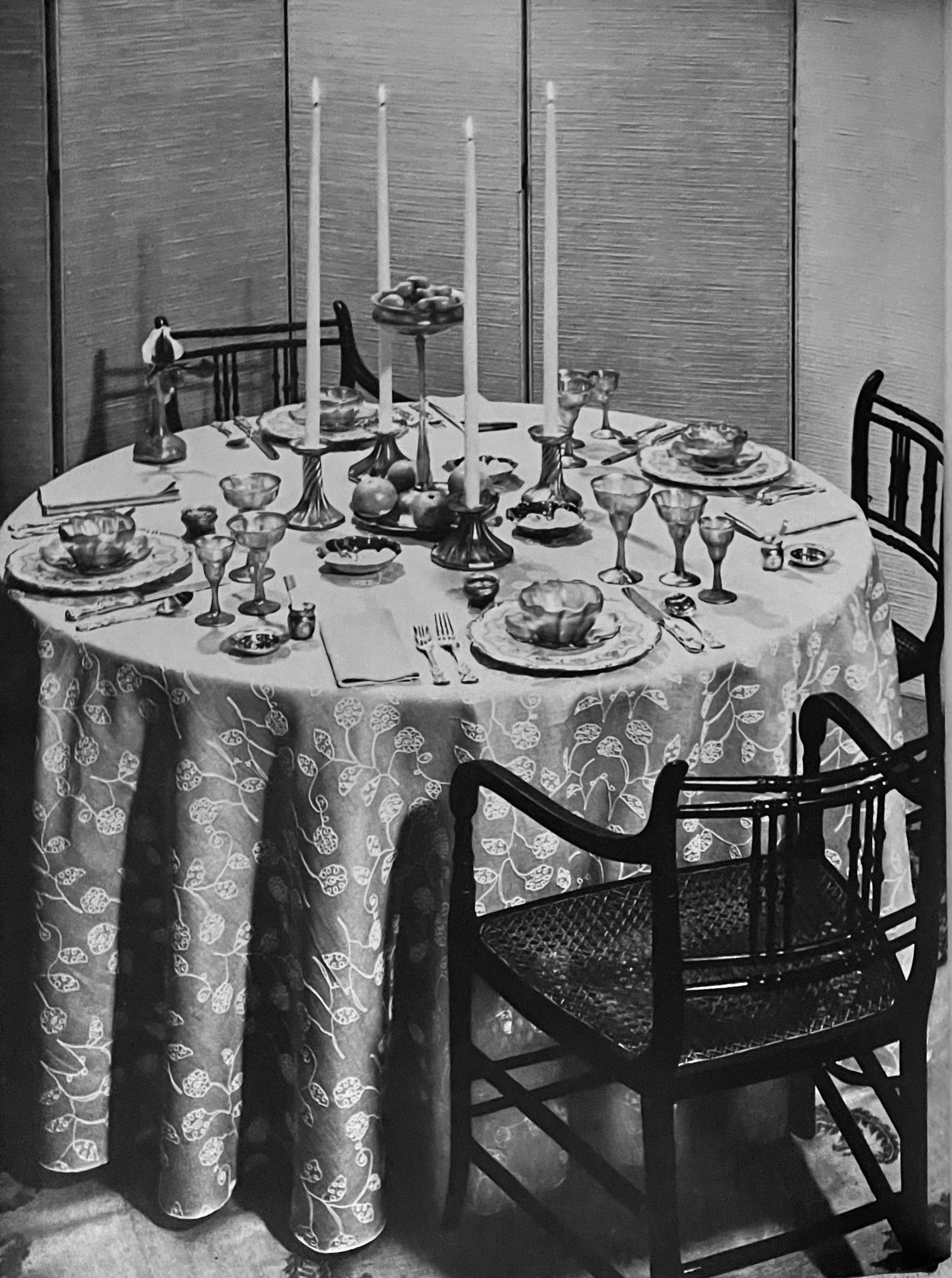
Etiquipedia’s initial thoughts: This is a strange order of courses for a formal, mid-century dinner. It appears to be a soup course, a fish course, a salad course and then a main course. Typical for the era would have been a soup, fish, a sorbet as palate cleanser, a main course, and then a salad. There are no dessert utensils, but at a formal dinner, these would be brought to the table with or without a finger bowl, but with the dessert plate. — Above is “A Dinner with Antique Silver, by Mrs. Charles Suydam Cutting, for Tiffany Hostesses' Show” 

Mrs. Charles Suydam Cutting has set a table that is a jewel of antique silver. She has used her own table ornaments: cigarette boxes for each place with hunting scenes sculptured in low relief; an Irish potato ring for the center of the table; columnar Irish candlesticks; cups, bowls, and all sorts of objects from the Charles II, Queen Anne, and early Georgian periods. 

She has made an unusual arrangement of pomegranates and grapes, red ampelopsis, and brown cypripedium from her greenhouses for the center decoration. Mrs. Cutting's écru fine linen cloth is embroidered with “Dixiana.” The finely monogrammed napkins are from France. She uses a simple English reproduction sterling flatware pattern, and a very plain stemware pattern. The dinner plates are white, with a subtle gold scratch-line decoration on the scalloped border.

Mrs. Cutting has grouped her antique silver objects on the table for decorative as well as for utilitarian purposes. The warm tone of the cream-colored cloth brings forth the glow of the old silver.— From Tiffany Table Settings, 1960


🍽Etiquette Enthusiast, Maura J. Graber, is the Site Moderator for the Etiquipedia© Etiquette Encyclopedia 

Friday, June 3, 2022

Etiquette and Tiffany’s Table Settings


This beautifully set dining table for four features elements from Tiffany’s. It is the first of the settings shown in the 1960 book, “Tiffany Table Settings.” The book was a companion offering to the women who not only participated in the yearly event, but notably to those who couldn’t attend the popular show of tabletop artistry. Etiquipedia will be featuring more from the book in the coming days, along with etiquette critiques of the late-1950’s to 1960 settings.

In 1956 Tiffany & Co., the famous Fifth Avenue jewelers and silver smiths, inaugurated an active program to present table settings of taste and imagination to the public. The purpose of this program a continual round of exhibitions-is to inspire and provoke greater interest in this area of design. When the exhibits are held, thousands of people visit Tiffany's weekly to view the settings by New York's leading hostesses and interior decorators. The store holds that a "per fect party" implies a beautiful table as well as a distinguished menu. Those who are chosen to design tables select Tiffany china, silver, and glass as accessories on their tables, combining these elements with their own furniture, linens, and antiques.

This collection of settings has not been compiled to instruct in the "book of etiquette" sense. Rather, it is hoped that the presentation of these settings will be a source of inspiration and a focus of ideas to any hostess.

There is infinite variety of design in these tables. Some of the set tings are based on the theory of switching objects created for one purpose to other uses, as well as juggling to make new combinations of color, fabric, and shape. Some of the settings are classic examples of subtle orthodox statement. Others are frankly based on fantasy.

The common denominator of good style, however, underlies all the designs, regardless of the occasion or spirit of formality or infor mality. A table set with inexpensive earthenware, for example, on a checked cotton cloth can be as enticing and appetizing as one of rare porcelain, crystal, and silver.

The editors believe that a woman is not using her own creative abilities unless she can turn her imagination to lending a fresh look to her table. It is hoped that this book will encourage a new point of view in this field of interior design. — Tiffany Table Settings, 1960


🍽Etiquette Enthusiast, Maura J. Graber, is the Site Moderator for the Etiquipedia© Etiquette Encyclopedia