Showing posts with label American Etiquette History. Show all posts

Thursday, December 11, 2025

Profiles in Etiquette— Emily Post


 In the 1945 edition of Emily Post's book “Etiquette,” Post quoted a disgruntled reader of her work, bridling at the prospect of imitating New York's “Cafe Society,” a group known to be less mannerly than “pretentious and vulgar.” Just who, the reader demanded to know, are these Best People, whose example Post commends throughout her book? Her answer follows: 
“There is nowhere to go to see Best Society on parade, because parading is one thing the Best Society does not intentionally do. And yet it is true (and this is one of the things harder to make clear) that in the forefront of the public parade are to be found a certain few who are really best. But they are best in spite of, and not because of, the publicity they attract. When I say that ‘people of taste do this or think that,’ I naturally have in mind definite people whose taste is the most nearly perfect among all those whom I know. Or on occasion, perhaps, I go back in memory to the precepts of those whose excellence has remained an ideal. In other words when I write of people of quality or fashion or taste, I always select the individual people who ideally serve as models... In other words... Best Society, Best People, or People of Quality can all be defined as people of cultivation, courtesy, taste, and kindness – people, moreover, who are very rarely disassociated from their backgrounds.” – Emily Post
From “A Short History of Rudeness” by Mark Caldwell


To the Manner Born: The Real Story of Emily Post


In the 1922 original edition of “Etiquette,” Emily Post's guide to the practices and manners of "Best Society," 81 pages are devoted to all matters nuptial. There's a sad irony, then, to the fact that Emily Post became the foremost authority on etiquette as the result of an unhappy marriage. In 1905, as biographer Laura Claridge recounts in “Emily Post: Daughter of the Gilded Age, Mistress of American Manners,” Post's husband, Edwin, was the victim of a blackmail ploy by a newspaper publisher who threatened to reveal Edwin's affair with a starlet. Edwin, who had lost much of his wife's inheritance playing the stock market, set up a sting to expose the publisher's scheme, then confessed to his wife, who had no choice but to support his decision. The successful sting, along with Edwin's infidelities, was widely reported. The publicity caused Emily much humiliation, and the couple divorced the following year.

Love, sex, money and public shame: 48 years after Post's death, we're still often flabbergasted about the right way to conduct our affairs regarding the first three, and desperate to avoid the last. Even as we celebrate a loosening of social strictures—and equate casualness with self expression—with freedom comes anxiety. (Witness the proliferation of advice books dealing with the etiquette of casual Fridays, e-mail and text messages, and even one-night stands.) With the current financial crisis and political uncertainty, how to address an invitation to an afternoon tea may seem trivial, but, says Peggy Post, Emily's great-granddaughter-in-law and a director of the Emily Post Institute, we long for the structure of established rules more than ever in times of social and economic uncertainty. “Etiquette gives people the blueprints to deal with times of stress,” she says. Perhaps this is why Post was so uniquely qualified to write that blueprint: her life was shaped by stress, both personal and societal.

Post was born within months of the depression of 1873, and grew up in a world where the divide between rich and poor was rapidly expanding. As the daughter of Bruce Price, the architect who designed New York's Tuxedo Park, she enjoyed the diversions of the Gilded Age, consorting with the Astors, Morgans and Vanderbilts. But after her divorce from Edwin she set about reinventing herself as a career woman, gradually shedding the persona of a high-society divorcée for that of a serious professional writer. “I suspect it was good for her to fail in her marriage,” says Claridge. “It helped her come into her own. If she hadn't been so brutally divorced, Emily Post wouldn't have come to be.”

She didn't dispense with society altogether, though; instead, she capitalized on her familiarity with the upper classes by writing novels about romances between American blue bloods and European royalty. By 1920, she was such an authority on the mores of the American aristocracy that her friend the Vanity Fair editor Frank Crowninshield inveigled her to write “a book about how to behave,” as she liked to tell it. (In truth, Claridge writes, Post had been angling for the task for some time.) He believed the country was sorely in need of guidance: “All those new war wives desperate to know how to write a thank-you note, all those immigrants who had made it to our country before the rules tightened, all those new money people, ashamed to admit they had no idea how to behave in society.”

Two years later “Etiquette” came out, the result of Post’s queries to her friends and her friends' children, and liberal plagiarizing of similar guides to correct behavior at home and in the world. The book, now in its 17th edition, has been updated over the years by Post’s grandchildren and great-grandchildren. Written as a fast-paced social drama (Post imagines a dinner party gone awry thus: “You have collected the smartest and the most critical people around your table to put them to torture such as they will never forget. Never! You have to bite your lips to keep from crying”), the book today is as delicious, and as dated, as an Edith Wharton novel. But those who think Post was overly concerned with raised pinkies and serving spoons underestimate her, says Claridge.

“People want to laugh at her, to devalue her,” she says. “We don't like to be told how to act, especially about matters that seem fairly trivial. You feel put down when other people know these apparent rules. Emily Post believed in having rules, but thought that everyone should have equal access to them. Your only obligation is to make the other person feel OK.”

Claridge developed a passion for her subject only after she was well immersed in the project. Three years after she started the book, she was diagnosed with a rare form of brain cancer. For a while she lost her memory, including her awareness of who Emily Post was and why she had been writing about her. After six months of chemotherapy to remove the cancer, she regained her memory, and came to see Post as an inspiration. “Even in the hospital, my behavior toward the nurses, toward my roommate, was influenced by her. I realized that life is short, and you want to do the best you can while you’re here. It's the golden rule, and she kind of encouraged that.”

If Post remains linked with superciliousness in the public imagination, it's because of our appetite for instruction, not her insistence on protocol. During the Great Depression, she gave radio broadcasts advocating hospitality, quoting from “Etiquette” and its revisions. As Claridge writes, “Letters flooded the radio office, sometimes begging for help: ‘How many inches should I sit from the edge of the table?’ and ‘When taking my place at table, should I approach my chair from the right or the left side?’” An anxious nation wanted reassurance about how to sit at the table, even if it had no guarantee of where the food on it would come from.

Today we might scoff at the very phrase “Best Society,” and be more likely to eat our meals standing over the sink than at any table. “
But we're still obsessed with etiquette,” says Peggy Post. Great-grandson Peter Post's “Essential Manners for Men,” one of the many manners guides put out by the Post Institute, made the New York Times bestseller list in 2003. Of the hundreds of e-mail queries the institute receives each month, around half are about weddings (the first time many people think about etiquette, Peggy Post says), but topics include gym protocol, tipping and the eternal conundrum “How do I eat a [fill in the blank]?” “People are so afraid of committing a faux pas,” she says. “They don't want to embarrass themselves and don't want to be mean to other people. Most of these are common respect issues.”

At the height of her fame, Post had a radio show and syndicated newspaper column, and advised the White House on protocol. But the image of her as an unbending automaton was fixed. When she attended a dinner at the Gourmet Society, papers made news of the fact that Post had spilled lingonberries on the tablecloth. In fact, her eyesight had been impaired by a recent operation. As Claridge writes, “Forcing Emily Post to stand in for the one thing she had always emphasized should be forgotten and forgiven—an innocent mistake—journalists were gleefully casting the doyenne of etiquette as part of a system they feared, not one that she endorsed.”

It wasn't until after her death that some were able to appreciate the broader implications of Post’s life work. When, two weeks after her death in 1960, Nikita Krushchev staged his shoe-banging tantrum at the U.N., Life magazine suggested the Soviet leader had displayed poor etiquette. In an article titled “What Would Emily Post Have Said?” the magazine argued that there is “a connection worth tracing between manners and politics.” Today, when political candidates make a show of practicing good manners (“Can I call you Joe?”), then fail to treat each other with honesty or respect, they commit the worst sort of faux pas. “She used to say manners are a sensitive awareness of the feelings of others,” says Peggy Post. “It doesn't matter what fork you use. It is a matter of substance over style.”— 
By Jennie Yabroff Newsweek, 2008


 🍽Etiquette Enthusiast, Maura J. Graber of The RSVP Institute of Etiquette, is the Site Editor for the Etiquipedia© Etiquette Encyclopedia

Sunday, September 14, 2025

A Table Etiquette Refresher from 1913

“When in doubt, use your fork” is a pretty fair table rule. The knife, of course, is absolutely tabooed except for cutting and spreading. The spoon is used only for liquids and soft desserts. Vegetables served as side dishes are usually eaten with a fork. –Forks at the table were not commonly used in the United States until the early 1800’s. This partial Sears and Roebuck catalog page above was from a 1912 catalog. Inexpensive silver plated knives, forks and spoons were made available to the masses. Just as today, basic table manners were featured in the news, so that every social class could sharpen their utensil skills.


GOOD TABLE MANNERS

It is sometimes difficult to make young people, particularly boys, appreciate the value of correct table manners. “Aw, what's the difference?” they ask when told not to eat with their knives.

The difference is that as a whole table etiquette is based upon the fundamental principles of convenience, neatness and self-restraint. Disregard of it causes the offender to appear slovenly, greedy and inconsiderate of the sensibilities of others, says the Woman's World.

Sit erect at the table. Don’t sprawl with your elbows on the table. Don't attempt to bring your mouth down to your food; raise the food to your mouth.

Don't shake your napkin out with a flourish; unfold it and spread it across your knees. Raise one corner of it to your lips as occasion arises.

In your own home, or in a house where you expect to be a guest for several meals, fold your napkin when you are through with it. If a guest for one meal only, crumple the napkin slightly and lay it unfolded beside your plate. The assumption is, of course, that it will not be used again until it is washed.

Do not break crackers into your soup. Look at the next person you see doing it and observe what an unsavory looking dish it produces. Never dip crackers or bread into any sort of liquid.

In dipping up soup move the spoon toward the outer edge of the dish. Take the soup from the side of the spoon.

“When in doubt, use your fork” is a pretty fair table rule. The knife, of course, is absolutely tabooed except for cutting and spreading. The spoon is used only for liquids and soft desserts. Vegetables served as side dishes are usually eaten with a fork.

In cutting meat, take the knife in the right hand and the fork in the left, cut off a proper mouthful, lay the knife down on the right side of the plate, transfer the fork to the right hand, holding the tines pointed downward, and raise the meat to the mouth.

It sounds slow, to be sure, but rapid eating is neither healthful nor pleasant to watch. – Organized Labor, 1913


🍽Etiquette Enthusiast, Maura J. Graber of The RSVP Institute of Etiquette, is the Site Editor for the Etiquipedia© Etiquette Encyclopedia

Saturday, June 21, 2025

The Cat Fight Over “Eticat”


CAT FIGHT: Jere Hathaway Wright holds puppets Eticat, left, and Mt. Jewl, after testifying in court Wednesday in Fairfax, Va. – January 1998
🐾🐾🐾🐾🐾🐾🐾🐾🐾🐾🐾🐾🐾🐾🐾🐾
 The judge ultimately ruled against Johnson in the lawsuit: 
Today's etiquette lesson: Sharing with a friend is a nice idea, but better get a trademark first. A Fairfax County judge ruled yesterday that an area woman who created a purple sock puppet named Eticat to teach manners to children cannot successfully sue a former friend who borrowed the idea.– Washington Post, February, 1998


Etiquette Mavens Doff Gloves for Cat Puppet 


FAIRFAX, Va.– The white gloves have come off as two Washington-area manners mavens fight each other in a most uncivil lawsuit over the rights to Eticat, a feline puppet used to teach children etiquette. Dorothea Johnson accuses a former employee, Jere Hathaway Wright, of swiping the puppet idea and starting a competing operation schooling children in the finer points of polite society. 

“All I can say is I believe I was there first,” Wright said in a huff as she clutched the purple-and-black puppet outside a Fairfax County courtroom Wednesday. Johnson is seeking to bar Wright from using the Eticat name. She also wants up to $10,000 in damages. 

A judge who heard two days of testimony is expected to rule in February. “She was a friend, and I feel betrayed,” Johnson said. Wright was broke and looking for work five years ago when Johnson hired her as a consultant for The Protocol School of Washington, Johnson said. “Never did I suspect that she would take my materials and use them in the way that she did,” Johnson testified. 

Johnson, with 40 years of experience, is perhaps the best known of the etiquette tutors who abound in society conscious Washington, where the social graces can help one avoid an international incident. Johnson also works as a consultant to the American diplomatic corps. She claims she was working on an idea to use a cat puppet in her childrens etiquette classes when Wright came on board in 1993. The project was called Eticat and was outlined in confidential documents. 

Although her lawyer calls it theft, Johnson puts her allegation more politely: “Miss Wright misappropriated my idea. The unpleasantness began early on,” Johnson said, when she overheard Wright make some rather indecorous remarks about Johnson’s table manners.– The Associated Press, 1998


🍽️Etiquette Enthusiast, Maura J. Graber, is the Site Editor for the Etiquipedia© Etiquette Encyclopedia

Friday, April 25, 2025

Dinner Etiquette in NYC vs Paris

A gilded terrapin fork and gilded ladle, with terrapin bowls and plates in Limoges French porcelain mixed with Royal Worcester British porcelain. – Many French dinner notions are copied in the U.S. — notably that of serving on unbroken dishes…

A 2nd Debut article from 2020… 

The etiquette of French dinners is more formal than that of American. In Paris, which is all of France, one must never betray any admiration of any effects evolved during the dinner, gastronomic or decorative, much less speak of them. In New York, which by the same token is all of America, it is rather remiss not to express in some uneffusive way, one’s pleasure of taste or sight. “What a charming arrangement of flowers!” “This salad is something to remember!” and others like these, are phrases which no New York hostess thinks of resenting; indeed, rather hopes for. Many French dinner notions are, however, copied here, notably that of serving on unbroken dishes.— New York Times, 1894


🍽️Etiquette Enthusiast, Maura J. Graber, is the Site Editor for the Etiquipedia© Etiquette Encyclopedia

Saturday, April 19, 2025

Etiquette for Political Wives of 1972

“Never let your picture be taken while holding a cocktail glass or a cigaret.” – From the same era, a retro 1970’s GOP Cookbook with a female elephant  chef gracing the cover. 
GOP Lessons in Etiquette for 1972

“Discriminate women never smoke on the street or when dancing; they never let a cigaret dangle from the lips or exhale through the nose.”

Those words of advice appear in a 10-page booklet written for the wives of Republican candidates running for congress. 

The booklet’s cover is illustrated with a picture of a girlish elephant wearing lipstick and a pantsuit and its contents include rules for lady-like behavior on the campaign trail.

Some of the tips offered are:
  • “Never let your picture be taken while holding a cocktail glass or a cigaret.”
  • “Gum chewing: Never!”
  • “When your husband is speaking, watch him proudly.”
  • “Never appear bored, even if you have heard the same speech repeatedly.”
  • “A steely handshake is unlady-like.”
And finally, 
  • “When the meeting starts, always bow your head and close your eyes for the entire invocation.” — The California Aggie, 1972


🍽️Etiquette Enthusiast, Maura J. Graber, is the Site Editor for the Etiquipedia© Etiquette Encyclopedia

Thursday, March 7, 2024

Most Mannered Cities of 1989

Stewart, author of "Can My Bridesmaids Wear Black?" and 14 other books on etiquette, released her list of the 10 best mannered cities in America on Nov. 15. Council Bluffs, which Stewart called the "courtesy capital of the world," ranked second behind.
Etiquette expert says Portland is most mannered city in U.S.

Etiquette authority Marjabelle Young Stewart has selected Portland, Ore., as the most mannered city in the country. Council Bluffs and the Quad Cities in Iowa and Illinois are in the top ten. It was followed by San Diego; Chicago; Washington D.C.; Charleston, S.C.; Seattle, Wash.; the Twin Cities in Minnesota; the Quad Cities; and Los Angeles.

Stewart, author of "Can My Bridesmaids Wear Black?" and 14 other books on etiquette, released her list of the 10 best mannered cities in America on Nov. 15. Council Bluffs, which Stewart called the "courtesy capital of the world," ranked second behind.

Stewart said nominations for the most-mannered cities come from graduates of classes she teaches for business executives. She said she delivers etiquette seminars for major corporations that realize "polish will bring profit."

“Manners will take you anywhere," said Stewart, who now lives in Kewanee, Ill, – 
Des Moines, Iowa (AP) - 1989

🍽Etiquette Enthusiast, Maura J. Graber, is the Site Editor for the Etiquipedia© Etiquette Encyclopedia

Saturday, October 21, 2023

The Thermometer of Character


The oft quoted, Lord Chesterfield, was Philip Dormer Stanhope, the 4th Earl of Chesterfield. An acclaimed wit and admired man of his day, the British statesman was a diplomat and a scholar.

The Manners of a People

ARE the American people impolite? This is a question often asked by travelers, who, coming in contact with the people of other and older nations, are tempted to draw comparisons not always favorable to the American people. Doubtless the older section of the world are better behaved than the newer communities. This is true in our own country, but it does not follow that where men are better behaved they are more virtuous. 

It is a rule, but not without its exceptions, that manners indicate the man. They are the thermometer of character, the outward expression of the moral nature, but sometimes, as Emerson says, “they form at last a rich varnish with which the routine of life is washed, and its details adorned.” 

The strongest type of American has the poorest manners. He is not your well-dressed New Yorker, nor your pretty Philadelphian, but the robust man of the Western plains, uncultivated but rugged; not refined as to expression in social life, but with a big, warm, manly heart. He is as manly as the swift pony he rides. However, it is well to hold to the general rule that the manners of a people reflect the spirit and character of that people. 

A scholar may or may not be refined. Some scholarship is like raw sugar — it has never gone through the refining process. Once I took tea with one of the great men of the world. Fancy my surprise when he poured his tea into the saucer and supped it up like a child. That little act illustrated his character and gave me entrance into a strangely mixed personality. 

The basis of good manners is character which has been touched with culture. Chesterfield somewhere writes: “As learning honor, virtue is absolutely necessary to gain you the esteem and admiration of mankind, politeness and good breeding are equally necessary to make you welcome and agreeable in conversation and common life.” 

Politeness to the English people is a custom. Because it is a custom, it sometimes loses its influence. The barber furnishes his shave and the waitress her service with a conventional but certainly effective, “Thank you.” If you were to strike a cockney on the nose he would probably reply with a, “Thank you.” 

Naturally it was an Englishman Who said of Christ: “He was the first true gentleman that ever lived.” Politeness is kindness of manner; it is art and religion in one. It was Goldsmith who said of Johnson that he had nothing of the bear about him but his skin. To be a gentleman is to be a Christian, for manners are simply the character turned inside out. 

The manners of a people may be seen in the individual, in the toothpick man, the spitting man, the streetcar monopolist, the table pig, the man who never behaves in public places, whether in a hotel or a church. It may be seen in the fellow who easily loses his temper and “sasses back” in the many painful evidences of a lack of self-reliance and self-control. It may be seen in the ill breeding of women who are ignorant of taste in dress and in the social expressions of real intelligence.  

“Ladyhood is an emanation from the heart subtilized by nature.” To hear a pretty girl laugh and talk with painful loudness, to see the evidences of vulgarity in dress and manner, is to lead to the conviction that training in behavior was neglected in the home, or the school, or the social circle. Behavior has to do not only with society, but with life. It is just as necessary to be polite in business as it is in society. Many a man is a bear in the one and a Chesterfield in the other. 

Quoting Emerson again: “The highest compact we can make with our fellow is, ‘Let there be truth between us two forevermore. Our culture will be open to the charge of superficiality until it permeates behavior in the drawing-room, the streetcar, the theater, the funeral, the wedding and business.’”

Worship itself is behavior. It is being polite to God. It is a proper behavior in the presence of the Eternal. The first school of politeness is the home; It is a question whether children who are impolite at home will ever be trained in grace of courtesy outside of the home. 

I plead, then, for the cultivation of a courtesy which smoothes down the wrinkles of business turmoil, oils the machinery of trade and helps men to live together as brethren, not as beasts. I plead for the old, simple virtues of the lady and gentleman, not for elaborate adornment and superficial culture, but for the genuine cultivation of the true, moral nature expressed in manners, both gracious and good. Such a culture is not like the polish on the shoe, but like the gleam of a precious stone struck through and through with an arrow of silver light. – By Reverend William Rader for the San Francisco Call, 1904


 🍽Etiquette Enthusiast, Maura J. Graber, is the Site Editor for the Etiquipedia© Etiquette Encyclopedia

Saturday, January 14, 2023

The Impetus of 90’s Etiquette Era?

On a flight from New York to Paris, the etiquette authority Letitia Baldrige found herself seated next to a nearly nude dude from California. “Bared to the waist, he was,” she said. “The flight attendants didn't say one thing. He was a surfer, very suntanned, and I must say he had a great body.” Contributing to the decline in decorum, in Ms. Baldrige's view, is a growing folksiness in the corporate culture. “Companies are telling employees to first-name everyone, to forget about deference to age and rank,” she said. “All of a sudden, it's not only the C.E.O., but the clergyman and the schoolteacher who are being called Joe. It's spreading like wildfire.”

Informality Reigns, And Good Manners Get a Bad Name – Was this the impetus for the eventual “1990’s Etiquette Era”?


THE pleasure of your company is requested in a new age of informality. Do not bother to R.S.V.P. Do not get done up in black tie. The mood just now is one of casualness in dress, in manners, on all fronts.

This is the time of the artfully unmade bed (rise, take up your downy duvet and toss it); the carry-out dinner; the telephone solicitor who calls at all hours and addresses you by your first name.

A date for the movies and Chinese food nowadays does not necessarily mean two distinct activities. Not in the age of informality. And not in New York, where any number of moviegoers are capable of eating Sichuan from a carton while following the action on the screen. The pros use chopsticks.

Q. Is the informality of the 1990’s anything like the informality of the 60’s?

A. No. Women wore T-shirts and no bras in the 60’s. Today it’s bras and no shirts.

In keeping with the new informality, affluent urbanites who once drove around town in BMW’s have switched to Jeep Cherokees and Ford Explorers. “It feels right now,” said Steven Meier, a Manhattan lawyer who travels to meetings in his trusty Explorer dressed in a sports jacket and khakis.

A blue suit with a Giorgio Armani label hangs in his office closet “in case I have to impress a client.” But he rarely reaches for it. “In today’s economy you don't want to wow ‘em with your elegant shoes, your gold ring, your fancy car,” Mr. Meier said. “That's not the style anymore.”

Along Park Avenue, social couples who once did time on the charity circuit now look upon opulent parties as boring or embarrassing. Let’s have some of that new informality, they say. Which may explain the number of informal charity parties on the calendar this season.

Take, for example, the Lenox Hill Neighborhood Association's Bingo and Barbecue Benefit in June. The association used to hold black-tie auctions and sales of antiques and artworks. A couple of years ago, it sponsored a benefit sale of watercolors from the collections of Louis XIV, the Empress Josephine, Napoleon and members of the French court.

Let them eat barbecue.

“There is a wish for greater informality in these gatherings,” said George Trescher, the marketing consultant who runs most of New York's big charity events. “Particularly if you're trying to mix groups of young and older guests.”


Mr. Trescher, who was tieless at the time, said the dress code has been unraveling for years now. But jeans at the theater? The ballet? The opera? “Yes, yes,” he said. “What's new is that nobody looks askance at it. It's laissez-faire.”

Heads did not turn unduly when Kevin Walz took an aisle seat in the orchestra at the Metropolitan Opera the other night. He was wearing wool pants, no jacket and a plaid shirt unbuttoned at the neck to reveal his undershirt.

“What a bum, huh?” he said, stroking his chin. “I didn't even shave.”

Mr. Walz, a furniture designer, was dressed for a rock concert he planned to attend after “The Marriage of Figaro.” He said a trend toward piggybacking cultural events might have something to do with the new informality.

“Last month I went to the ballet in jeans for an evening of Stravinsky and then down to the Ritz,” he said. ”I snuck out five minutes early so I wouldn't miss the Pixies.”

To observe the new informality on the move, hang around in an airport terminal. Count the sneakers, the shorts, the sweatsuits, even in business class.

“We were talking about that the other day, coming back from Barbados,” said Sisi Cahan of Manhattan, a frequent flier long before they had clubs. “People used to look terrific traveling, and now they look ghastly. I haven't seen anyone attractive in an airport in years.”

On a flight from New York to Paris, the etiquette authority Letitia Baldrige found herself seated next to a nearly nude dude from California.


“Bared to the waist, he was,” she said. “The flight attendants didn't say one thing. He was a surfer, very suntanned, and I must say he had a great body.”

Contributing to the decline in decorum, in Ms. Baldrige's view, is a growing folksiness in the corporate culture. “Companies are telling employees to first-name everyone, to forget about deference to age and rank,” she said. “All of a sudden, it's not only the C.E.O., but the clergyman and the schoolteacher who are being called Joe. It's spreading like wildfire.”

Ms. Baldrige, who lives in Washington and lectures around the country, went on to say that “down here the diplomats try to hold onto some formality in entertaining, but it's getting worse and worse.”

“Some people don't even bother to R.S.V.P.,” she said. “Other people accept for seated black-tie dinners and don't show up. Or they show up with small children. ‘Oh, I couldn't get a baby sitter -- knew you wouldn't mind.’”

For an academic look at the reasons behind the new informality, put in a call to Michael T. Marsden, a professor of popular culture at Bowling Green State University in Ohio.

A secretary answered the phone, informally. (“This is Sylvia.”)

The caller asked for Professor Marsden. (“Hi, this is Mike.”)

Professor Marsden cautioned against comparing the informality of the 1960’s, which was real and deep and wide, to the informality of the 90’s. It could be one of those behavioral blips on the East and West Coasts that never go anywhere.


“In the 60’s, wearing blue jeans was identifying with the working-class culture,” he said. “In today’s, world the up-and-coming executive is supposed to aspire to the leisure life. What better way to show this than to wear a sweatsuit? It's costuming.”

Nonetheless, Professor Marsden went on, society has thrown off some formal trappings taken on in the 80’s. “But not all,” he said. “Look at weddings. Formal weddings are on the rise. As for funerals, when people are laid out at wakes, they're generally dressed formally. It's not likely you’ll find somebody being buried in their sweatsuit.”

In any case, elaborate entertaining is out in New York. No more putting on the dog for company. Caterers who used to gussie up trays of hors d'oeuvres with foie gras medallions say they are making meatloaf, mashed potatoes and beans. “But beans don't have to be beige or boring,” said Susan Simon, whose catering company on the Lower East Side has always been known for its stylish and informal food.

And guests like Mr. Walz, the jeans-at-the-ballet man, find the down-home feeling refreshing. “You even see Pyrex on the table now,” he said. “People are much more casual about entertaining. They're acknowledging that life is tough in New York. What's important is that we're all together, having dinner. So what if there are a dozen kids underfoot and the centerpiece is daisies?”

When not dining at home, some busy New Yorkers are dining out, informally, while doing something else or waiting to do something else. In coin laundries, in bank lines, in doctors' offices, everywhere there is the crinkle of foil unfolding, the snap of aluminum cans opening.

Subways, always informal, have become more so with commuters breakfasting on bagels and coffee and applying major makeup and nail polish. On the F train the other day, Lucinda McBride blotted her lips with a tissue, smiled and said, “My mother said never put on lipstick in public.” She went on to apply eye shadow and mascara as the train rumbled from Brooklyn toward Manhattan.

“This is how I get ready for the office,” Ms. McBride said, studying her face in a mirror. “I've got two kids under 6.”


That's nothing, according to Phyllis Hall, who works for a trade magazine in Manhattan and commutes on a No. 68 N.J. Transit bus with a man who manages to change from sports clothes to a business suit on the turnpike.

“By the time we come out of the Lincoln Tunnel, he's in full business attire,” she said. “He even does cuff links.”

Here is the new informality personified. Except for the cuff links. They must go. – The New York Times, April 1, 1992


🍽Etiquette Enthusiast, Maura J. Graber, is the Site Editor for the Etiquipedia© Etiquette Encyclopedia

Friday, April 30, 2021

Washington Society Destroys Buffet

The American people, in general, we are ashamed to say, have not yet learned how to behave at table; and that species of etiquette, not too prevalent in private, is certainly always absent at public suppers. So it was not strange that we should have had warning visions of a grand rush, then a crush, and a demolition in the twinkling of an eye of all the confectioner's handiwork, the frantic snatching of viands from the tables, the brandishing aloft of wine cup, and plate, and cutlery, laden with articles alike dangerous to toilet and stomach; of munching and crunching sans ceremonis; of defilement and ruin to precious apparel, the result perhaps of weeks of the dressmaker's effort; of the loss of temper, and loud cries of complaint. And indeed we harbored a a fear as a consequence that a graceful assemblage of dignified ladies and gentlemen might be transformed, as if by the wand of some evil spirit, into a social raffle, where he who was rudest should be most successful in appeasing the cravings of the appetite, and in pocketing the delicate ornamentations of the table.  
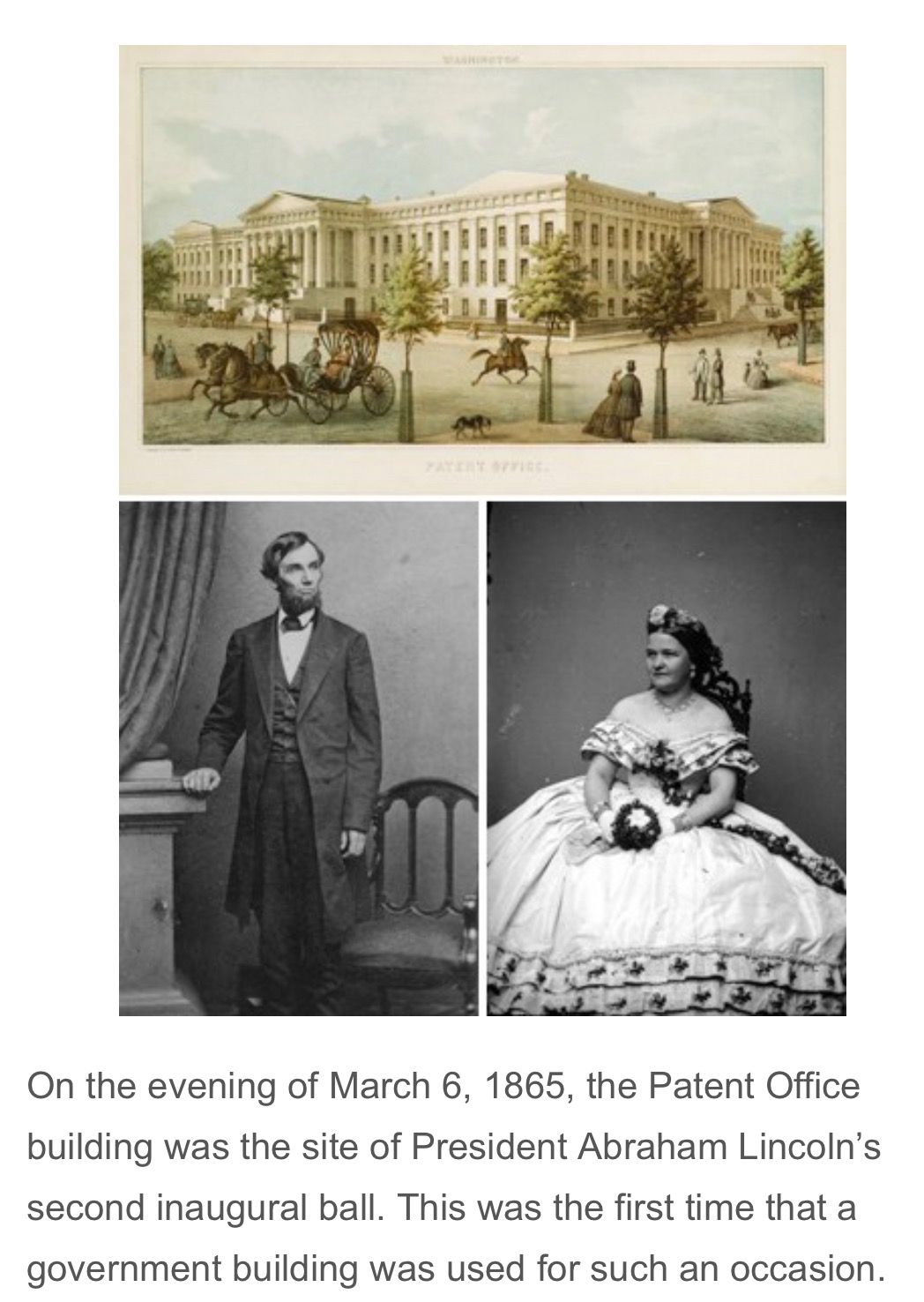
– Photo courtesy of the National Park Service


The Inauguration Ball 
Magnificent Finale of the Season Full and Graphic Description of the Ceremonies and Festivities — Splendid and Magnificent Toilettes of the Ladies —
Terrific Crush at the Supper Table

The Washington “season” is past, and there certainly could not have been a more magnificent nor graceful finale; not alone to the Winter's gaities, but to the ceremonies which have made Abraham Lincoln our President again for the next four years, than the time-honored National Inauguration Ball which came off last night; and it is entirely appropriate that not alone with firing of cannon and waving of banners, in which men alone participate, but with music and dancing should we meet and celebrate this signal occasion, when the gentlemen are expected to be as gallant, and the ladies as lovely as possible.
 

The marble halls of the Patent-office were selected as the most commodious and best adaped in the city. The hall appropriated to dancing is two hundred and eighty feet long, by about sixty feet in width; and the floor is laid in large blocks of blue and white marble. Its decorations were really beautiful -- emblems, banners and devices being tastefully disposed on the walls, while the elaborately frescoed ceiling imparted an air of decided grandeur. Among the decorations the American flag was most prominent, while the various flags of the different army corps formed an appropriate accompaniment. A gallery at the east end was occupied by a fine brass band, which gave music for the promenade, while in the centre, on the south side, a splendid string band furnished music for the dance.

Beside this spacious hall, a wing, three hundred feet in length, was appropriated for the promenade, and a corresponding one on the opposite side for the supper-room. The music was excellent, and had the several halls and the entire building been thoroughly lighted, which they were not, the effect would have been much finer. But gas is certainly not good in Washington, though said to be very abundant. On a dais, at the northern side, were sofas and chairs in blue and gold for the President and family.

All the arrangements see med to be under the management of capability and distinction. The tickets for the ladies were very elaborate and prettily designed, six by ten inches in size, and ornamented with portraits of the President and Vice-President, beside two very good likenesses of the American eagle.

As early as 9 o'clock the carriages began to arrive, and soon the ball-room was thronged. The excellent bands of music soon set the lovers of Terpsichore into the graceful mazes of the dance. At about 10:30 o'clock an avant courrier cleared the way from the main entrance, when His Excellency, accompanied by Speaker Colfax, entered the hall. Following was Mrs. Lincoln upon the arm of Senator Sumner. They walked down the centre of the long hall, and turning at the upper end returned mid-way to the dais, when they became seated. Mr. Lincoln was evidently trying to (throw off care for the time; but with rather ill success, and looked very old; yet he seemed pleased and gratified, as he was greeted by the people. He wore a plain black suit and white gloves.

Mrs. Lincoln looked extremely well, and was attired in the most elegant manner; her dress was made of white satin, very ample and rich, but almost entirely covered by a tunic or rather skirt of the finest point applique. Her corsage, which was low, and the short sleeves, were ornamented richly by a Bertha collar made of the same material, and the shawl, also of the same rich lace, was most exquisite. Passementerie of narrow fluted satin ribbon and nouds completed the dress. Her jewels were of the rarest pearls, necklace, earrings, brooch and bracelets. Her hair, which was put plainly back from her face, was ornamented with trailing jessamine and clustering violets most gracefully. She looked exceedingly well with her soft, white complexion, and her toilet was faultless. Her manners are very easy and affable.

Mr. Robert Lincoln, a fine-looking young man, wearing the uniform of a Captain in the regular army, was also present.

About 11 o'clock Secretaries Seward, Welles, Attorney-General Speed and a large number of diplomats, accompanied by their wives and daughters, made their appearance. Mrs. Secretary Welles, a lady of rather petite figure, was dressed in a mode-colored silk, with black lace shawl. Mrs. Secretary Usher, of about the same stature, wore a rich dress of garnet satin, very plainly but richly made. Mrs. Postmaster- General Dennison, who is a very fine-looking lady, wore a most becoming dress of heavy black velvet, brilliant jewels and hair plainly dressed. Her daughter was in white muslin, embroidered with black. Mrs. Fred. Seward, wife of the Assistant Secretary of State, was attired in a pretty rose-colored silk, handsomely trimmed. Mrs. Senator Harris, who has the appearance of a a well-preserved English lady, wore a most elegant dress of corn-colored silk, trimmed with point appliqué. Mrs. Senator McDougall was also richly attired. The wife of our artist Carpenter was dressed in light silk, with a ruche of tulle. One of the most elaborate and rich dresses in the room was worn by Mrs. George Francis Train; it was a very finely plaided blue silk, trimmed with a flounce of thread lace, almost as deep as her skirt, and other laces to match. Her hair was powdered with gold. Mr. Train was also present.

The multitude of recherche dresses worn by ladies of distinction, it would be impossible to enumerate. There was a prependerance of sensible, high-necked dresses; but a few, and some not American, wore corsages shockingly decolettee. Many ladies who wore velvets, moires and heavier silks, dispensed with hoops altogether, thereby displaying their good taste as well as their regard for the appreciation of some approximation to the female form which still inheres or lingers in the mind of man; one, a matron and evidently a Spanish lady, wore a dress of cloth of gold, with raised crimson velvet flowers, such an one as is seldom seen in this country, or afforded, in any other. In her hair she wore a cluster of five or six enormous diamond rings, strung on a bandeau of velvet. Her laces were also of the finest quality. In her hand she carried a large fan of the gayest and most brilliant workmanship, which seemed to give a breeze of a more ardent clime than ours. A moire antique dress, high-necked and ample-skirted, of the most delicate shade of green imaginable, and worn by a young lady, was indeed exquisite; and also a very light lavender moire antique, trimmed heavily upon the skirt and waist with long silver fringe, was superb. Silks predominated over the more airy textures. Diamonds and other precious jewels were worn in great abundance; and rich laces were plentiful. Some ladies displayed the bad taste of wearing their rings over their gloves. Every lady makes the most of her -- " or somebody's else" -- hair, which is frizzed and puffed and curled in the most extensive manner, and is powdered frequently with diamond and gold dust. One dress of mauve velvet, trimmed with deep point lace, we must not omit to mention. It was royal.

Doubtless the shoddy and petrolia family were represented, to a limited degree; but "oil" will tell very soon, as it spreads so rapidly, and cloth not unfrequently makes the man. Tehre were not, however, any colored persons present, as the Washington Secessionists insisted would be the case.

The Supper

It had been rumored -- and the foundation for the report was only rumor -- that the supper was to be something extraordinary. We were surprised at this, because we knew good taste and modern custom, in small places like New-York, have, of late years, literally eschewed the practice of immense suppers at public balls; and this reform had been necessitated by the fact that such attempts had generally ended in catastrophes to the toilets and tempers of all participants. It was, therefore, with misgivings that we saw it announced that a grand supper would be served in one of the corridors of the extensive building. The American people, in general, we are ashamed to say, have not yet learned how to behave at table; and that species of etiquette, not too prevalent in private, is certainly always absent at public suppers. So it was not strange that we should have had warning visions of a grand rush, then a crush, and a demolition in the twinkling of an eye of all the confectioner's handiwork, the frantic snatching of viands from the tables, the brandishing aloft of wine cup, and plate, and cutlery, laden with articles alike dangerous to toilet and stomach; of munching and crunching sans ceremonis; of defilement and ruin to precious apparel, the result perhaps of weeks of the dressmaker's effort; of the loss of temper, and loud cries of complaint. And indeed we harbored a a fear as a consequence that a graceful assemblage of dignified ladies and gentlemen might be transformed, as if by the wand of some evil spirit, into a social raffle, where he who was rudest should be most successful in appeasing the cravings of the appetite, and in pocketing the delicate ornamentations of the table.

The name of the cuisinier has escaped us, and it is not worth while to hunt it up now. Suffice it to say it was not Delmonico, therefore we did not expect perfection. The hall set apart for supper was the grand corridor in the west wing. The table was set in the centre, and it gave standing-room for about three hundred persons at one time. The cabinets of the works of genius and invention, placed at intervals, served to form alcoves on each side of the supper-table. On one side, some of these were provided with seats; on the other, they were reserved for depositing the extraordinary quantity of material necessary for such a host, and for the operations of the waiters.

The ornamentation of the table, though limited in extent, was in excellent taste, and perhaps quite as profuse as the unfortunately small space devoted to the supper would permit. There were three leading and conspicuous pieces from the confectioner's hands, placed at appropriate points in the centre and at each end of the table; in the centre, our imposing Capitol, perfect in miniature; at one end an exquisite representation of the heroic deeds of the gallant army; at the other, a similar device of the proud achievements of the navy. The representation of the Capitol was admirably executed; no detail seemed to be too minute for imitation. Even the lamps at the entrance seemed to give forth light. 

The columns, pedestals, cornices, frieze entablatures, windows, statuary, and the majestic dome, and towering above all else, the Goddess of Liberty, were all there as perfect as the mould and model could make them. In addition, there were several allegorical representations of the progress of civilization, the genius, the arts, the sciences and literature of the day. The piece on the right, was in honor of the army; and the glory and fame of the defenders of our liberty were illustrated by a pyramid, around which were clustered in tasteful profusion all the insignia of war, the paraphernalia of battle, and the emblems of victory. The navy was honored in the same manner, the representation being surmounted with Admiral Farragut's old flagship Hartford, gallantly riding the white crested waves, while aloft might be seen the Admiral himself lashed to the rigging, emblematical of the old hero's achievements in the Bay of Mobile; then battered Fort Sumter, the sad epitome of secession; then Neptune with chariot and trident, and the Goddess of Liberty, inspiring the brave sailor to greater glory and higher fame. There were other ornamentations, principally pyramids of which the detail is unimportant, for nougate, croquant, and chocolate are the same here as elsewhere.

The bill of fare provided a select and tasteful variety, and no better idea of it can be obtained than by inserting it right here verbatim.

Bill of Fare

Oyster stews, terrapin stews, oysters pickled; beef-roast beef, fillet de beef, beef a la mode, beef a l'anglais; veal -- leg of veal, fricandeau, veal Malakoff; poultry-roast turkey, boned turkey, roast chicken; grouse - boned and roast; game -- pheasant, quail, venison. patetes, patete of duck en galee, patete de foie gras; smoked ham, tongue en gelee, tongue plain; salades, chicken, lobsters; ornamental pyramids -- nougate, orange, caramel with fancy cream candy, cocoanut, macaroon, croquant, chocolate; tree cakes -- cakes and tarts, almond sponge, belle alliance, dame blanche, macaroon tart, tart a la Nelson, tarte a l'Orleans, tarte a la Portuguese, tarte a la Vienne, pound cake, sponge cake, lady cake, fancy small cakes; jellies and creams -- calf’s foot and wine jelly, Charlotte a la Russe, Charlotte a la vanilla, blanc mange, creme Neapolitane, creme a la Nelson, creme Chateaubriand, creme a la Smyrna, creme a la Nesselrode, bombe a la vanilla, ice cream, vanilla, lemon, white coffee, chocolate, burnt almonds, maraschino, fruit ices, strawberry, orange, lemon; dessert -- grapes, almonds, raisins, &c., coffee and chocolate.

A Terrific Crush

This was the programme for the feast. The only thing which did not seem promising was the fact that but three hundred could be comfortably accommodated at one time, while there were five thousand persons to be accommodated, and a large majority of them ladies.

About the hour of 12, the Presidential party were escorted by a private entrance to privileged places. Soon afterward the doors were opened, and a throng of more than a thousand, who had collected at that end of the hall, poured into the supper-room. Of course, when three persons occupy the space barely sufficient for one, a “crush” is the result; and the crush which followed can better be imagined than depicted.

But this was not the worst feature. With that indecency of conduct and want of politeness and etiquette which characterizes many American people at table, and which is the certain accompaniment of a large crowd at a public supper, many gentlemen, and even some of our own sex who delight to be esteemed ladies, seized upon the most ornamental and least nutritious part of the table decorations, demolished them, carried the pieces off in handkerchiefs or crushed them under foot. Then the more substantial viands were served likewise. Large dishes of choice meats, pattetes, salades and jellies were carried off vi et armis into the alcoves, or elsewhere. One gentleman presented a very ludicrous attitude with a large plate of smoked tongue, requiring both hands to hold it, no place to sit down, and no way to eat it! He looked the picture of despair.

In less than an hour the table was a wreck; a few ornaments not destroyed were removed, and the array of empty dishes and the debris of the feast were positively frightful to behold.

The doors were now wide open, and hundreds of ladies in elegant silks, satins and velvets, and gentlemen in dainty broadcloth, surged and struggled back and forth. A few obtained something to eat, others very little, and many more only succeded in ruining their toilets. As much was wasted as was eaten, and however much may have been provided more than half the guests went supperless. But it was a public supper; we were not much disappointed, and though the gentlemen who managed it may have been to blame for the want of room, the fact remains that the supper was a disaster, and detracted from the otherwise pleasant aspect of the occasion.

Up to midnight, there was little opportunity for dancing, owing to the immense number present; but after the departure of the President and party, which occurred soon after 12 o'clock, the assemblage became sensibly smaller, promenading easier, and dancing quite comfortable. Those who love to “thread the mazes of the dance” then indulged themselves to their entire satisfaction, and the ball went on almost until the dawn of day.

Conspicuous upon the floor were the military and naval officers, who seemed to prefer dancing to any other amusement. One set in the Lancers, in which were Admiral Farragut and Gen. Banks, attracted much attention. Among other military and naval officers of distinction on the floor during the evening were Major-Gens. Halleck and Hooker, and Brevet Major-Gens. Webb and Robinson, Brig.-Gen. Harden, and others whose names are forgotten in the recollection of that brilliant throng. Young and graceful Lieut. Cushing was also there, and we learned that he soon expects to unfurl his flag on foreign shores.

The leading men of politics were also there. Secretary Seward, active, agile and graceful, a marked man anywhere. Senators Morgan and Harris, of New-York; Sumner and Wilson, of Massachusetts; Lane, of Indiana; Yates, of Illinois; Chandler, of Michigan; Wilkeson, of Minnesota; McDougal, of California; Nye, of Nevada; Williams, of Oregon; and others. The House was also well represented by Speaker Colfax, and also by numerous members whose names and utterances have so often been printed in the TIMES as to render it unnecessary here. The arrangement of the ladies' retiring-rooms and the gentlemen's cloak and hat-room were among the very best we have ever seen. Everything was safely and degnitely checked, and there were plenty of attendants. The carriage arrangements were also good; and, take it all in all, the whole affair, save the calamity of the supper, was as successful as such a thing can ever be in Washington.

Such an assembly of American ladies, dressed so magnificently, cannot fail to be surpassingly lovely. In no foreign court could such a number of beautiful, graceful and intelligent women be gathered. Well may they shine and rejoice upon such an occasion as this; for well have they done their duty during this terrible war. They have sent their first and latest born, their lovers, husbands and fathers, giving their lives to the sacrifice of liberty and nationality, and as we stood and glanced over that happy, sparkling throng, we thought how many of those smiling lips had grown tremulous as they bade the loved one good-bye and God-speed; how many of those happy hearts had ached through the long absence; how many fair fingers had ministered at home, scraping lint, knitting stockings, or writing to the absent one; or in the hospital with the living and the dying; and it is but meet that now when the voice of peace is being heard in the land, and justice and liberty restored, that they should meet to rejoice and congratulate upon this befitting occasion. The great, warm heart of the nation has little sympathy with that neuralgic nerve which forbids the expression of exuberant feeling at this most suspicions moment. Then let the eyes which have wept by dried and sparkle, and let music fill the air, and ion be unconfined, and, more than all else, let the nation, rejoice in her beautiful, virtuous, Christian women. -E.J.M. —
 Special Correspondence of the New-York Times. WASHINGTON, March 8, 1865


🍽️Etiquette Enthusiast, Maura J. Graber of The RSVP Institute of Etiquette, is the Site Editor of the Etiquipedia© Etiquette Encyclopedia
Monday, April 19, 2021

Serving Etiquette in 1996 Tableware


Was this “zany etiquette?” The New York Times thought so in 1996, even though the United States, along with other parts of the world, was seeing a tremendous resurgence of etiquette books and etiquette schools.


Zany Etiquette in the Gravy

New York Times, 1966


“YOU get the feeling Jane Timberlake was told as a child to sit up straight one time too many. The San Francisco product designer is offering a tabletop collection called ‘Wild Mannered,’ consisting of napkins and chunky plates decorated with dozens of hopelessly demanding, but funny, etiquette dictums, which make you want to leave your elbows on the table or eat salad with the dinner fork. Dishes and linens are sold individually or in five-piece place settings at Mxyplyzyk, 125 Greenwich Avenue (at 13th Street) or the Guggenheim Museum Store.” — New York Times, 1996


Etiquette Enthusiast, Maura J. Graber, is the Site Editor for the Etiquipedia© Etiquette Encyclopedia


Tuesday, February 16, 2021

Advice to Genteel Ladies of 1853

“On no consideration let any lady be persuaded to take two glasses of champagne. It is more than the head of an American female can bear. And she may rest assured, (though unconscious of it herself) all present will find her cheeks flushing, her eyes twinkling, her tongue unusually voluble, her talk loud and silly, and her laugh incessant.” — Above, two champagne coupé glasses with champagne stirrers. Champagne stirrers were popular with Victorian and Edwardian ladies who wished to pop the bubbles in their champagne, so as to reduce the chances of belching or burping when drinking the bubble-filled beverage. By the Roaring Twenties, they were so popular with flappers, they were hooked to long chains and worn as necklaces on nights out to speakeasies. 
Photo source, Etiquipedia Photo private library.


    • Ladies no longer eat salt fish at a public table. The odor of it is now considered extremely ungenteel. 
    • The fashion of wearing black silk mittens at breakfast is now obsolete. 
    • It is an affectation of ultra fashion to eat pie with a fork and has a very awkward and inconvenient look. 
    • Most American ladies beyond the age of 35 look better in caps than without them, even if their hair shows no signs of middle age. 
    • Ladies mustn't cross their knees or read with a gentleman off the same book or newspaper. 
    • At a hotel or boarding house, a lady may "take wine" once with a gentleman, if she knows him, but the next time he asks she should refuse. 
    • On no consideration let any lady be persuaded to take two glasses of champagne. It is more than the head of an American female can bear. And she may rest assured, (though unconscious of it herself) all present will find her cheeks flushing, her eyes twinkling, her tongue unusually voluble, her talk loud and silly, and her laugh incessant.— From Miss Leslie's “The Behaviour Book: A Manual For Ladies,” 1853 Edition


          Etiquette Enthusiast, Maura J. Graber, is the Site Editor for the Etiquipedia© Etiquette Encyclopedia