Showing posts with label McCall’s Book of Everyday Etiquette. Show all posts

Wednesday, July 13, 2022

Etiquette for Debutante Balls

The father of each girl makes a contribution which, even though it is usually quite generous, is not nearly as much as he would have had to spend on an individual party.


Mass Debutante Debuts

In a number of cities there are large cotillions or assemblies at which dozens— or even hundreds— of girls make their debuts at the same time. They are usually charity balls and are managed by a committee which makes the regulations about everything from dress to numbers of escorts.

The father of each girl makes a contribution which, even though it is usually quite generous, is not nearly as much as he would have had to spend on an individual party. At most of these affairs, each girl is expected to subscribe for two escorts. Often private dinner parties are given before the ball to honor each girl separately.

Clothes for guests and parents are the same as they would be at any large dance, but there are sometimes limitations put on the costume of the debutante by the committee. They might require all white, for example, rather than leaving it to the girls whether they wear white or pale pastels.

■Invitations

Personal notes from the mother are usually sent when the party is to be a small one, but for anything large or elaborate, the mother and father would probably send engraved invitations jointly.

■Clothes

Even if she has been going to night clubs since she was fifteen, a debutante at her debut should look young and dewy. She often wears white, though pastels are considered correct these days, and the cut of the dress should never be sophisticated or provocative. At an evening debut, she wears a wide-skirted dance dress. At an afternoon debut, she wears a dress something like a short dress for a bridesmaid. She wears– afternoon or evening– gloves and no hat, but she may wear a flower in her hair.

The mother wears, at a tea, an afternoon dress with no hat, but with gloves. For an evening affair, she would wear a formal evening gown with gloves. She never wears black for any kind of debut.

The father and the guests wear clothes that are appropriate for the time of day and the occasion. — From “McCall’s Book of Everyday Etiquette,” 1960


🍽Etiquette Enthusiast, Maura J. Graber, is the Site Editor for the Etiquipedia© Etiquette Encyclopedia

Tuesday, July 12, 2022

Buffet Hosting Etiquette

Equipment: You will want a large table on which to set out the food. This is the only essential table, but you might also want to set up card tables, or you may have little foldaway tables to set up for guests beside odd chairs that aren't near the coffee table or some side table. For a normal buffet dinner, you will need utensils for eating and for serving (but no dinner knives), serving dishes, dinner plates and dessert plates or bowls with plates to go under them– glasses, cups and saucers, a table cloth, if you are having a table, and napkins– all in the correct numbers for your guest list.


Hosting Buffet Meals

A buffet meal is a wonderfully easy way to give a party. It can be given for a few people or a large crowd (if you have room). It can run smoothly with no help, and it can be indoors or outdoors, a brunch, luncheon, dinner or supper, and as elegant or casual as you like. This section describes a dinner, but most of the information applies to any buffet meal.

The number of guests should be controlled by how many people can sit down in the space available. It's no fun to eat dinner standing up. Sitting down, however, doesn't mean there must be a chair and a table for each guest. Some people might be perfectly happy sitting on the floor and eating from a plate on the piano bench. But there shouldn't be so many people on the floor that all the walking space is taken up.

Seating at a buffet meal is usually arranged in one of three ways: 1. The card-table meal at which a place at a small table is provided for each guest (though he chooses his own spot); 2. Self-service, but places set at a dining table; or 3. Self-service and migration to the living room where some kind of table–coffee table, side table or small folding table is provided for each guest. The only occasion at which the guests are not provided with some kind of table is the huge, late supper affair. At these occasions the guests may be eating at several different times and there are so many that it would be impossible to have a table for each one.

The food, unless you set up card tables so everyone sits at a table, shouldn't require cutting with a knife and you should usually be able to get the whole main course on one plate. You never have soup, but if you want to have a first course, serve it with cocktails before dinner– probably something a bit more substantial than ordinary canapé fare. On the main course plate might be an entree, one or two vegetables or one vegetable and salad. Or you might have only salad if the main dish has vegetables in it. You could have hot bread of some kind– rolls or biscuits perhaps– but it should be buttered in the kitchen since the guests won't be able to juggle butter plates. The last course might be a dessert, or fruit with a selection of cheeses, or (if there has been no salad with the main course) salad with the cheeses. Water or some other beverage usually goes with the main course and coffee is served afterwards.

Equipment: You will want a large table on which to set out the food. This is the only essential table, but you might also want to set up card tables, or you may have little foldaway tables to set up for guests beside odd chairs that aren't near the coffee table or some side table. For a normal buffet dinner, you will need utensils for eating and for serving (but no dinner knives), serving dishes, dinner plates and dessert plates or bowls with plates to go under them– glasses, cups and saucers, a table cloth, if you are having a table, and napkins– all in the correct numbers for your guest list.

The service may be by a maid or by the host and hostess with the help of friends. If there is no maid, the host will be doing a lot more fetching and carrying than he would at a seated dinner. The hostess would probably put everything except the hot dishes on the buffet table before the guests arrived. After the drinks, which are accompanied by the hors d'oeuvres brought into the living room, she puts the hot food on the table and goes among the guests saying that dinner is ready and inviting them to help themselves when they are ready. They probably won't all go at once. Sometimes the guests serve their plates from the table themselves and sometimes the host or hostess, or both, serve the main dishes while the guests pick up the utensils and bread and relishes.

The beverage– water or wine– is sometimes on the far end of the buffet table, or on a side table, for the guests to take as they go by. Or sometimes you wait until everyone is seated and pass the filled beverage glasses on a tray. At a card-table dinner, the water would be already set on the tables before service begins.

You offer seconds, after having refilled the serving dishes, as soon as some of the guests are finished. They won't all finish at once since they haven't all started at once. They then get up and serve themselves, or the host might offer to get something for a guest who can't get to the food table easily.

Dessert comes after the plates have been cleared out of the living room by the hostess and host or the guests themselves. Dessert plates and silver are already on the buffet table and the guests again serve themselves, or the hostess fills the plates herself and passes one to each guest.

Coffee is served after dessert, from the main table or from a tray brought into the living room. When this is finished, you take away the dessert plates, coffee cups, napkins and little tables, empty the ashtrays and sit down comfortably to enjoy your guests.

The maid, if you have would take over some of these duties. She one, would bring in the hot food and sometimes pass plates that have you filled to the guests who have remained seated. She might offer seconds by taking the serving dishes to the guests instead of having them come to the table and she would probably pass the beverage. She would help to clear away empty plates and to clean up after the coffee is finished. The drinks before, after and during dinner are usually served by the host, so he is the person to watch for guests in need of refills of water or wine or what have you.

Guests usually help with the serving at a maidless buffet dinner. They get their own food and sometimes offer to get food for the person with whom they have been sitting. They help clear away and they may pass serving dishes. But judgment should be used here. If there are already so many people up and helping that the hostess can't keep up with them or the room has the atmosphere of a cocktail party, stay where you are.

Arrival and Departure: Guests at a buffet dinner, knowing that it won't run on a rigid schedule, may properly be a little later than they would at a seated dinner-up to half an hour is all right if the dinner is a big one. They leave as they would at any other dinner, with thanks to the host and hostess and a general good-bye to the other guests.

Variations in the Rules: Unlike a seated dinner, you don't get right up when dinner is announced. You may finish your conversation or your drink or cigarette before you go. After you have got your food, you wait for only one other person— usually the one you have been talking to —before you start eating. You don't have to stay in one place to eat. If you want to talk to a different person during the dessert, you change your place after you have filled your dessert plate by just going to where he is and sitting down by him. Any guest, male or female, helps with the clearing and serving when the hostess needs help.— From “McCall’s Everyday Book of Etiquette,” 1960 


🍽Etiquette Enthusiast, Maura J. Graber, is the Site Editor for the Etiquipedia© Etiquette Encyclopedia

Saturday, April 10, 2021

Etiquette for “Touching Up” in Public

At the risk of sounding absolutely inflexible, Etiquipedia disagrees with this advice from the dawn of the Women’s Liberation movement of the 1960’s. Powdering one’s nose at the dinner table, or anywhere in public (except possibly the privacy of one’s automobile), is not condoned as good manners. Limit your touch ups to lipstick. Anything more should be taken care of in the nearest powder-room (called such with good reason!) or ladies room.


Fixing Up in Public


Your clothes should be fitted, worn and anchored so you need not pull them down, tuck them in, or twist them around once they are on. If they don’t stay where they should, excuse yourself and make your adjustments in the ladies room. 

It is common practice these days for a lady to renew her lipstick or powder her nose after dinner at the table if she does it lightly and unobtrusively. But anything more elaborate than that should be taken care of privately. Particularly if it involves hair, which many people find repulsive in juxtaposition with food. — From “McCall’s Book of Everything Etiquette,” 1960


🍽Etiquette Enthusiast, Maura J. Graber, is the Site Editor for the Etiquipedia© Etiquette Encyclopedia


Friday, April 9, 2021

Etiquette for First Fork Placement


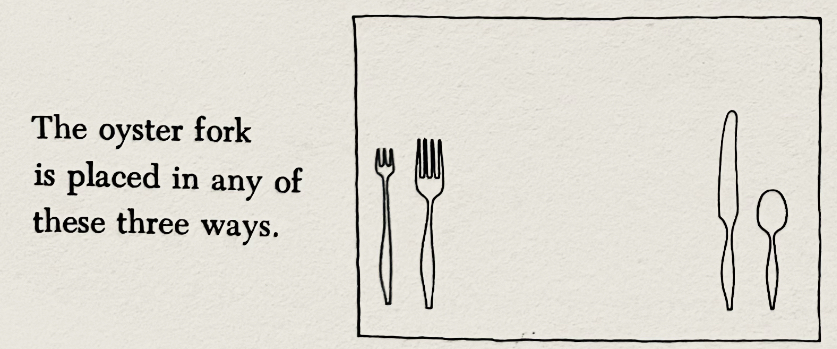
There are 3 different places you can properly find a “first” fork or “oyster fork.” 

Since the Gilded Age in the latter 1800’s, more than 3 forks on the left side of the place setting at one time has been frowned upon. “First” forks, however, cocktail forks, oyster forks, fruit forks, etc..., are allowed to be placed to the right of the setting, with the tines resting in the bowl of the soup spoon (so a diner on one’s right doesn’t think it goes with his or her forks on the left of their setting), or placed flat on the right, next to where the spoon sits. This leaves plenty of room. 

More dinner course forks can always be brought out with subsequent courses. And dessert forks are either allowed to be set above the dinner plate or may be brought out with the dessert course or finger bowl.


Images from the McCall’s “Book of Everyday Etiquette”


🍽Etiquette Enthusiast, Maura J. Graber, is the Site Editor for the Etiquipedia© Etiquette Encyclopedia