Showing posts with label French Etiquette. Show all posts

Friday, May 26, 2023

Old Italian and German Royal Etiquette

 “The King only speaks Italian and French, so the conversation is generally in those two languages. French, of course, is supposed to be a universal language.”  – Photo of Quirinal Palace in Italy taken by Wolfgang Moroder.

The dinners at the Quirinal Palace in Italy are far more simple as to etiquette than that of England. The same formality is observed in the entrance of the King and Queen, but the conversation is more general and the Queen does not wear her gloves. She converses in English fluently. The King only speaks Italian and French, so the conversation is generally in those two languages. French, of course, is supposed to be a universal language.
 
The dinners of Germany are not long, but they are formal and tedious, and the cooking does not commend itself to all tastes. The perfection of a dinner is found in London, generally at the house of Ambassadors, who combine the Excellencies of all nations with the follies of none. After asking the consent of the ladies present, the Italian and Turkish embassies allow the smoking of cigarettes between the salad and dessert. This fashion prevails in France and Russia, ladies smoking quite freely as men. – Harpers Bazaar, 1887

 🍽Etiquette Enthusiast, Maura J. Graber, is the Site Editor for the Etiquipedia© Etiquette Encyclopedia

Tuesday, August 6, 2019

French Wine Etiquette Decalogue

“Don’t heat red wine, but don’t ice it either. The room temperature should be attained naturally, not artificially.” 

Or... the 10 Commandments of Wine Etiquette

PARIS (UPI) The following “Thou shalt nots” of the book of wine etiquette should be carefully memorized by those interested in genteel drinking. This wine “Decalogue” has been prepared by the Paris Institute of Wine and Gastronomy, founded by Carl E. Ullern, a Frenchman, and Frank C. Nesbit, an American. The wine commandments are based on the best French practice; they contain a number of “Shalts” as well as “Shalt nots,” which are as follows: 
  1. Never shake a wine. 
  2. Never put ice in wine, red or white. 
  3. Don't mix wine from two bottles in the same decanter, or in the same glass. 
  4. Don’t heat red wine, but don’t ice it either. The room temperature should be attained naturally, not artificially. 
  5. Use extreme care in decanting red wines. 
  6. Serve all wine in sufficiently large glasses, about half full. 
  7. White wines, which should be chilled or iced, are generally served with hors d’oeuvre, soup or fish. 
  8. Red wines should be served with roast fowl or game—all red meats. 
  9. Champagne should be chilled rather than iced, and can be served throughout the meal. 
  10. Precedence: dry before sweet, in the white wines; light before heavy, as regards alcoholic content, for the red. – Paris, 1934


Etiquette Enthusiast, Maura J Graber, is the Site Editor for the Etiquipedia© Etiquette Encyclopedia 

Wednesday, June 13, 2018

Polishing French Politesse

The last 3 days, the French have been reading up a storm on Etiquipedia, so I wanted to send out a special note of thanks to our French readers, and those readers from all of the other countries, who peruse our articles daily. Below are our “audience stats” for the past 7 days. These are the top 10 countries for the week. France has been #1 three days in a row. Without people from all parts of the world reading Etiquipedia, the work I put into this site would not nearly give me such pleasure. Thanks to all of our readers and to all of our contributors! 

Country and Pageviews 
______________________ 
France 1673 
United States 1655 
United Kingdom 266 
Canada 118 
Australia 89 
Italy 71 
Philippines 60 
India 55 
Netherlands 48 
Indonesia 28 

PARIS - Chic French diners eat asparagus with their fingers and sorbet with their forks.

The words “Bon appétit” should never be uttered at the start of a meal.

The polite passenger always says, “Bonjour” to the driver upon entering the bus.

And, bien sûr, the dinner guest must not leave the table in midmeal to use the powder room, and should she have to go, never, ever use the word “toilette” when asking a host for directions.

Mastering the rules of good manners never has been easy, even for the French.

Despite a centuries-old obsession with behaving well, the French are constantly relearning how to do it, and the last few years have witnessed both the degradation of civility and manners and a revival of interest in them.

On one level disrespect for authority is on the rise. Cars are burned and garbage is thrown out of windows in the troubled gritty suburbs. Verbal and physical attacks against teachers in schools are more widespread than they were a few years ago. Commuters are hit, seats are slashed, graffiti is written on Paris Métro cars.

But on another level is a desire to retain, encourage and even venerate what the French call “politesse.” “It sounds bizarre, but with more and more acts of incivility, people are tolerating them much less,” said Frédéric Rouvillois, the author of “Histoire de la Politesse,” a scholarly tome that traces the history of good manners in France over the last three centuries. “There’s more awareness that courtesy and savoir-faire are useful and necessary tools in society.”

As part of the consciousness-raising, private sessions on proper table settings and dining habits are offered to Parisian ladies of leisure. The Paris transit authority is in the midst of a campaign of respect to improve the quality of travel for its passengers. Humorous posters hung last fall prodded travelers to muzzle their pets; use trash cans for their garbage; speak softly on their cellphones; avoid whacking their neighbors with their backpacks; and, of course, say hello and goodbye to conductors and ticket vendors.

In 2005, in response to complaints about interaction between patients and staff, the Hospital Federation of France began its first national advertising drive for politeness in public hospitals and nursing homes, with a list of rules for how to behave and the motto “Stay polite!”

The Ministry of Education has made good citizenship part of the national curriculum in high schools. The Ministry of Transportation designates an annual “day of steering wheel courtesy” to encourage polite behavior on the road.

“In a society more and more brutal, with deafening vulgarity, it is with delight that we are rediscovering the discreet charm of courtesy,” wrote Point de Vue, a weekly magazine that focuses on old families and the remnants of royalty, in an article some months ago on the return of good manners.

In the perfect French world, rules govern even the most mundane subjects: how to answer the telephone, how to greet a guest at the door, how to address a stranger, what to take to a dinner party, how to behave on the Métro.

“It’s like a sport, you have to train hard,” said Marie de Tilly, a rail-thin expert on manners, who teaches a two-hour course in Paris to women who pay $90 to attend. “But once you train and know the rules, it all comes naturally.” All can be lost in that first moment of acquaintance, Ms. de Tilly told a group of French and American women during a session last month in a hotel room adorned in brocade and silk.

“In the first 20 seconds, others will judge your look, in the second 20 seconds your behavior and the third 20 seconds your first words,” she said. “There is a code. If you don’t follow it properly, it will be very, very hard to make a comeback.”

France has had an uneven history of manners. With the French Revolution, the republican passion for equality trumped the rules of gentility, which glorified hierarchy and differences of class and gender. Men had to be called “Citoyen” (Citizen) rather than “Monsieur.” The use of the familiar “tu” form of “you” replaced the formal “vous.”

The rise of the bourgeoisie in the 19th century swept in a new era of politeness, which declined during and after World War I. The brutality of the war made the rules of gentility seem meaningless. Another low point came with the May 1968 rebellion, which swept in an ideology that challenged all forms of authority.

Certainly, polls show an increase of interest in manners. Ninety-five percent of the French believe that being polite is an asset, according to an Ipsos poll last March. A poll in 2003 indicated that 70 percent of French parents place great importance on manners, compared with 53 percent in 1991 and 21 percent in 1981.
Some rituals of politesse die hard. Dueling may have been banned decades ago, but hand kissing has survived. The master has to be President Jacques Chirac.

Mr. Chirac clearly knows how to do it: he raises the woman’s hand to chest level and bends over to meet it halfway. Sometimes, as when he visited Chancellor Angela Merkel in Berlin last March, he cradles the hand in both of his.

“The French president,” a writer in the Swiss daily Le Matin commented last September after Mr. Chirac kissed Ms. Merkel’s hand once again, “can no longer meet a woman, either a star, a head of state, a first lady or a minister, without doing it.”

The practice, however, the writer added, “has nothing to do with protocol.” – From Elaine Sciolino’s 2007 New York Times article


Etiquette Enthusiast, Maura J. Graber, is the Site Editor for the Etiquipedia© Etiquette Encyclopedia

Wednesday, June 14, 2017

Faire la Bise Etiquette

French etiquette: “To kiss or not to kiss?” That is the question! 
                         

Former French First Lady, Carla Bruni-Sarkozy, mastered the art of the kiss 
Photo: Sipa Press / Rex Features


How to greet people can be bewildering for those new to French culture

My online dictionary gives two definitions of la bise – “the icy blast of winter” and “a kiss”. Evelyn Waugh wrote of two society ladies in London, “They kissed with cold detestation.” Maybe that happens in Paris, but here in the Morvan there is nothing wintry about la bise. 

Miss Graham, our headmistress in the 1950s, frowned upon what she called PDAs: public displays of affection. PDAs are ubiquitous here, in the form of kissing and vigorous handshaking and even hugging – in the street, in the doctor's waiting room, in the supermarket. Miss Graham would shudder, but when I meet Pierre and Nicole in Aldi, la bise as an expression of mutual respect and affection rules OK.

A little online research will lead you to items like To Kiss or Not to Kiss and Faire la Bise: The Art of the Parisian Double Air Kiss. All emphasize that la bise bears no relation to le baiser as immortalised by Rodin, or indeed to “French kissing”. In la bise, the kisses (for there should be at least two) are aimed at alternate cheeks. The online experts cannot seem to agree on which cheek gets the first bise. The thing they all agree about is that the lips doing the kissing remain closed. No slobbering – ça ne se fait pas. Strangely, nobody mentions the importance of holding one's breath while kissing – nobody wants your garlic fumes.

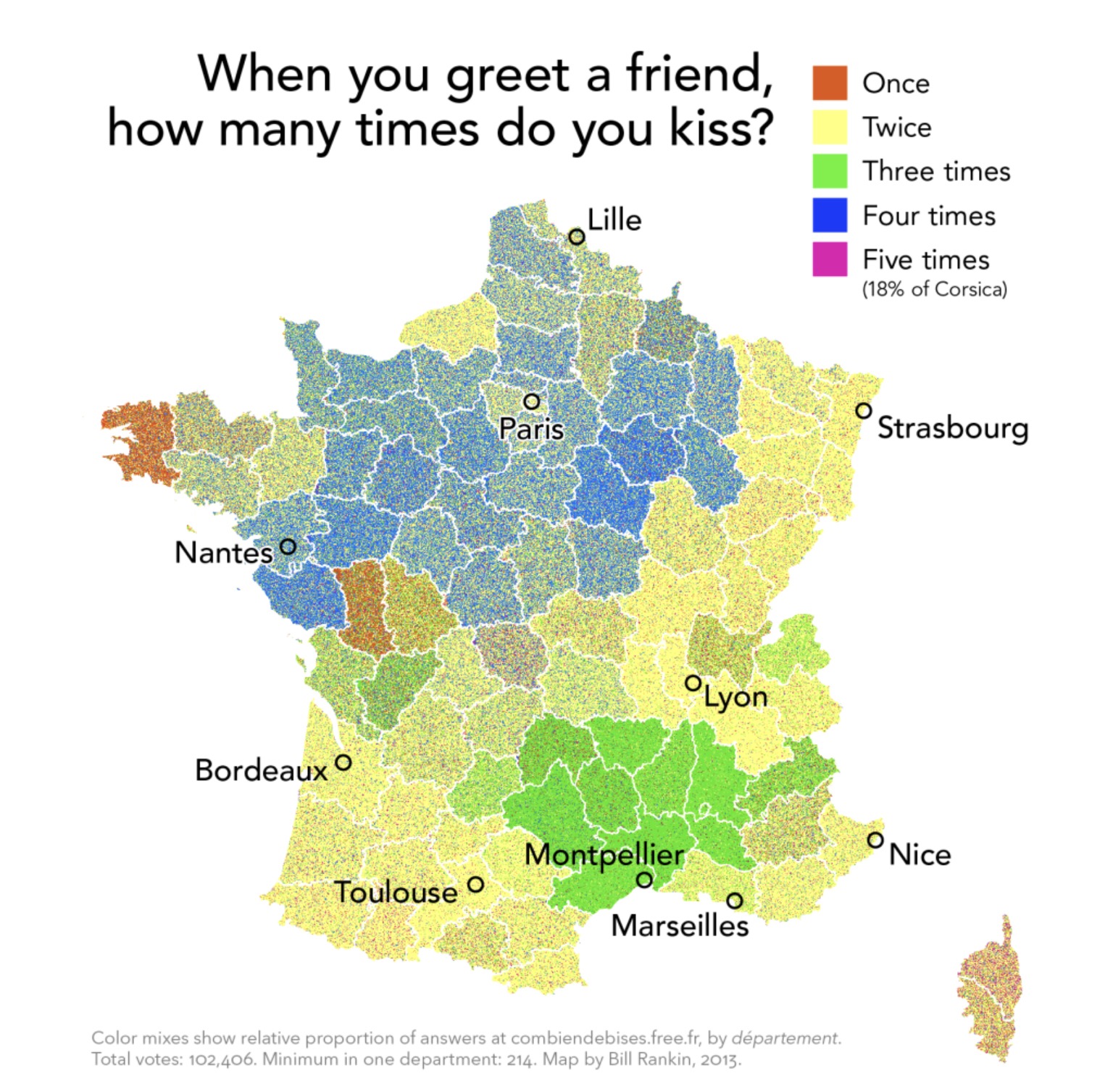
The number (from two to four or even, I am told, five in Corsica) depends less on the degree of affection or acquaintance than on the region. I even found a map of France on the web, showing the number of kisses current in each region. Someone probably got a Master's thesis out of that. 

“A popular French joke is that you may recognize the city you are in by counting the number of cheek kisses, as it is so varied across the country. An online map of France even shows the number of kisses currently claimed to be used in each region. It shows it's more common in the southern parts of France, even between males, whether they be relatives or friends. In the north however, it is less usual for two unrelated males to share 'la bise'. “In the Netherlands and Belgium cheek kissing is commonly used as a greeting between relatives and friends. But women will kiss both women and men, while men will kiss women and refrain from kissing other men. They prefer to shake hands, especially with strangers. Usually three kisses are exchanged in the Netherlands and the Dutch part of Belgium. The same is found to be true in Switzerland. In Francophone Belgium, the custom is usually one or three kisses. “On occasion, you may exchange bises with the same person three times: when you arrive, congratulating an achievement or thanking him or her for a gift, and then again when one is leaving.”


After almost eight years in the Morvan, I offer my own take on la bise. Here, men mostly shake hands with each other with optional back-slapping, but men kiss women. Women kiss women. Everyone kisses children: both sexes hold up their faces to be kissed. So our friend Alain from Auxerre shakes hands enthusiastically with my husband John, while I am treated to la bise. When you have known someone a while and exchanged handshakes, one of you will say, "On fait la bise?" and the kissing can begin.

My advice is go with the flow – and remember next time you meet that person. My extrovert friend Gigi delivers quadruple bises accompanied by a hug, whereas Simone, an equally dear friend but older and more reserved, does two, with no body contact. La bise says "hello" and "goodbye". My cleaning lady Yvonne and I exchange kisses when she arrives for work and again when she leaves.

Dionne Warwick sang: What do you get when you kiss a guy?
You get enough germs to catch pneumonia
After you do, he'll never phone ya
I'll never fall in love again.

In my experience, la bise does not spread contagion. To give an extreme example, the Bazolles oldies' club meets monthly and any woman with a birthday during that month faces what to many Brits would be Ordeal by Kissing. All 50 members claim their osculatory rights. If the lady is at all personable, several sprightly old buffers will queue up twice for the privilege. Amazingly, however, I have had just one cold since we arrived here in 2005. Maybe I had a natural immunity when we settled. My theory, however, is that the absence of mouth-to-mouth contact explains this. –By Rosy Rabson for Telegraph Weekly World, 2013 


Etiquette Enthusiast, Maura J Graber is the Site Editor for the Etiquipedia© Etiquette Encyclopedia 

Sunday, April 9, 2017

Snuff and Etiquette at Versailles

Smoking was popular as well! – The active ingredient in tobacco was named “nicotine” after the French diplomat, Jean Nicot. Nicot introduced snuff tobacco to French Queen, Catherine de Medici, and the French Nobility.

After a French ambassador to Portugal returned to France with an addictive plant discovered in the New World, it caused a sensation in the French Royal Court. French diplomat and scholar, Jean Nicot, had been introduced to tobacco in Lisbon. There, it was being crushed into powder and was used as the remedy for a variety of maladies, ironically including cancer. Snuffing became a popular activity in Paris after the Queen Mother herself, Catherine de Medici, was introduced to snuffing tobacco by Nicot. He had demonstrated the inhalation of powdered tobacco, as a way to cure  de Medici's frequent headaches. It was later named the genus of tobacco cultivars “Nicotiana,” by the Swedish naturalist Carl Linnaeus in Nicot's honor. The active ingredient in tobacco was also named “nicotine” after the French diplomat.

Snuffing remained popular, and addictive, with the French Royals and Nobility. By the 18th century, snuff boxes were as socially important as fine pieces of jewelry. Anyone who was anyone needed
 to have a variété of these boxes. And as fashions changed frequently, so did the styles and designs of snuff boxes. At Versailles, showered with extravagance upon her marriage to Louis XVI, Marie Antoinette was gifted with 52 gold snuff boxes. From all accounts, Marie Antoinette was more likely to carry a box of bon-bons on her person, than a snuff box,  but she is said to have been responsible for the French standardization of the modern-day handkerchief.

Prior to the arrival and ultimate popularity of snuff tobacco in Europe, the handkerchief had become simply another object of fashion. Snuff brought the handkerchief back to its original purpose, and was indispensable for cleaning orange-brown, snuff-stained noses and fingers. White handkerchiefs were hardly appropriate for such a task, so snuff users began to employ large, colorful handkerchiefs to hide those stains. The handkerchief, up to that time, had come in many shapes; square, triangular, etc... According to legend, Marie Antoinette remarked that the square-shaped handkerchief at Versailles was the most pleasing, as well as the most convenient to use. The remark is said to have prompted Louis XVI to make mandatory that all handkerchiefs produced in France to be square in shape.


🍽️Etiquette Enthusiast, Maura J. Graber, is the Site Editor for the Etiquipedia© Etiquette Encyclopedia

Friday, June 17, 2016

A Fateful Breach of Etiquette

Charles Augustin Sainte-Beuve was a literary critic of French literature, but evidently not a student of Tuileries' exacting etiquette.


Under the French Third Republic, Charles Augustin Sainte–Beuve brought disgrace upon himself because at breakfast at the Tuileries, he carelessly opened his napkin and placed it over his two knees. To this, he added the crime of cutting his egg in two, at the middle.

Court etiquette prescribed that the half-folded napkin should be on the left knee, and the top of the egg was to be merely broken with the edge of the spoon and drained with the tip of the spoon. For his failings in these respects, Sainte–Beuve's name was struck off the Imperial visiting list. — London Chronicle, 1909


Etiquette Enthusiast, Maura J Graber, is the Site Editor for the Etiquipedia© Etiquette Encyclopedia 

Friday, June 3, 2016

Japanese Etiquette

Bowing when one is seated on the soft mats of a Japanese house (by far the politest method) is much more complicated. 
Why the Japanese Are Called
 the “French of the East”
 👘⛩🗾🎏👘⛩🗾🎏

They Even Pass Beyond the Gauls in Their Excess of Formality

The Japanese are called the French of the East, and their complicated system of etiquette is indeed not unworthy of the most polished nation of Europe. The old-time ceremonies were long and laborious, and have to a great extent disappeared with the present busy era. But the every-day etiquette still remains, and many of the forms are pretty and quaint, and especially interesting to the foreign traveler in Japan as being so peculiarly oriental. 


It is especially curious to see how even the lowest classes, the coolies and the jinricksha men, keep up a form of etiquette among themselves and are exceedingly polite and ceremonious while pulling their two-wheeled vehicles or pursuing the lowest trades in the humble walks of life. 

One from the West would hardly expect to find a coolie bowing profoundly and apologizing to another in the most courteous of language for some mishap, or shouting out some expression of sympathy when a heavy burden was being carried or pushed along, and yet these are common, everyday occurrences in Tokyo.

In learning the etiquette of Japan a stranger will always do well to remember that self-abasement and humility to the extreme must be the guiding principle on which all actions are to be ruled. In America it is often the duty of a guest to accept little courtesies from his host, not because he thinks it is due him as a superior, but because he is simply the guest, and he receives them as a kindness which hospitality extends to him, and which he cannot refuse without appearing ungracious. 

In Japan the laws of hospitality for the host are no less rigid than in America, To welcome the coming and speed the parting, to entertain with the best that one has in the kindest and most friendly manner, to see that the guest lacks nothing which thoughtfulness might provide—these are rigidly the duty of the Japanese host.

The duty of the guest differs in that each separate act of courtesy, even though accepted in the end, must be met with many protests and expostulations, and must on no account be simply accepted. The extreme to which this is carried would no doubt seem tiresome to those accustomed to the free-and-easy etiquette of American life. 

Tedious Expostulations 

Every Japanese parlor has its place of honor and its honorable and less honorable side, the latter being usually toward the door leading to the other apartments, the bedrooms and the kitchen. The seat of honor is in the part removed from the door, and is in front of a raised alcove, where are placed a hanging scroll, a vase of flowers and the few ornaments which a room possesses. 

It is a matter of time, energy and many bows before a guest can be induced to take this place of honor, and it is a contest in which the host must be the victor in the end, or, if not entirely successful, he must at least persuade his guest to sit in the more honorable side of the room, so that he himself may take the humblest place on the other side. It is also a matter of importance as to who shall precede in entering a room, and much time is spent by two people, one waiting for the other and each refusing to enter first. 


In entertaining many guests the host's duties are arduous, and as each separate guest is bound to consider himself the humblest of all the company, it is no little work to persuade him to the contrary.

There is a great deal in the etiquette of bows. Handshaking is a foreign innovation, and bowing hitherto has been the only mode of salutation. When two acquaintances meet in the street a bow is made by placing the hands in front as far down as they will reach, and then bowing from the waist downward until the upper part of the body is almost at rignt angles with the lower. 


One bow is not usually sufficient at a meeting, for if words are exchanged a bow must accompany each expression of good-will and friendship. Bowing when one is seated on the soft mats of a Japanese house (by far the politest method) is much more complicated. One is not expected to hurry through as in the street, and there is no excuse for the omissions of all the formal phrases of courtesy, each of which must be accompanied by bows made with the hands placed on the floor and the head bent down to them. 


There must always be an exchange of congratulations on the continued good health of the families, thanks for past kindnesses or favor shown by any member of one family to the other, and very often a visit is accompanied by a gift, which is formally presented and accepted.
 —Sacramento Daily Union, 1897


Etiquette Enthusiast, Maura J Graber, is the Site Editor for the Etiquipedia© Etiquette Encyclopedia 

Monday, November 23, 2015

Etiquette of French, British and Spanish Beverages

What is it about the French coffee?  The coffee sweetened with that sparkling beet-root sugar which ornaments a French table, is the celebrated café-au-lait, the name of which has gone round the world. 

We are not about to enter into the merits of the great tea-and-coffee controversy, further than in our general caution concerning them in the chapter on Healthful Drinks; but we now proceed to treat of them as actual existences, and speak only of the modes of making the best of them. The French coffee is reputed the best in the world; and a thousand voices have asked, What is it about the French coffee?

In the first place, then, the French coffee is coffee, and not chickory, or rye, or beans, or peas. In the second place, it is freshly roasted, whenever made—roasted with great care and even
ess in a little revolving cylinder which makes part of the furniture of every kitchen, and which keeps in the aroma of the berry. 

It is never overdone, so as to destroy the coffee-flavor, which is in nine cases out of ten the fault of the coffee we meet with. Then it is ground, and placed in a coffee-pot with a filter through which, when it has yielded up its life to the boiling water poured upon it, the delicious extract percolates in clear drops, the coffee-pot standing on a heated stove to maintain the temperature. The nose of the coffee-pot is stopped up to prevent the escape of the aroma during this process. The extract thus obtained is a perfectly clear, dark fluid, known as café noir, or black coffee. 

It is black only because of its strength, being in fact almost the very essential oil of coffee. A table-spoonful of this in boiled milk would make what is ordinarily called a strong cup of coffee. The boiled milk is prepared with no less care. It must be fresh and new, not merely warmed or even brought to the boiling-point, but slowly simmered till it attains a thick, creamy richness. The coffee mixed with this, and sweetened with that sparkling beet-root sugar which ornaments a French table, is the celebrated café-au-lait, the name of which has gone round the world. 
From 1869: "Chocolate is a French and Spanish article, and one seldom served on American tables." ··· In 1502, Christopher Columbus was the first European to taste cocoa on his fourth voyage to the New World, returned to Europe with the first cocoa beans. Records from the time suggest that recognizing its potential, he took a load of cocoa beans back to Spain.
As we look to France for the best coffee, so we must look to England for the perfection of tea. The tea-kettle is as much an English institution as aristocracy or the Prayer-Book; and when one wants to know exactly how tea should he made, one has only to ask how a fine old English house-keeper makes it. 

The first article of her faith is, that the water must not merely be hot, not merely have boiled a few moments since, but be actually boiling at the moment it touches the tea. Hence, though servants in England are vastly better trained than with us, this delicate mystery is seldom left to their hands. Tea-making belongs to the drawing-room, and high-born ladies preside at the bubbling and loud hissing urn, and see that all due rites and solemnities are properly performed—that the cups are hot, and that the infused tea waits the exact time before the libations commence.

Of late, the introduction of English breakfast-tea has raised a new sect among the tea-drinkers, reversing some of the old canons. Breakfast-tea must be boiled! Unlike the delicate article of olden time, which required only a momentary infusion to develop its richness, this requires a longer and severer treatment to bring out its strength—thus confusing all the established usages, and throwing the work into the hands of the cook in the kitchen. 

The faults of tea, as too commonly found at our hotels and boarding-houses, are, that it is made in every way the reverse of what it should be. The water is hot, perhaps, but not boiling; the tea has a general flat, stale, smoky taste, devoid of life or spirit; and it is served usually with thin milk, instead of cream. Cream is an essential to the richness of tea as of coffee. Lacking cream, boiled milk is better than cold.

Chocolate is a French and Spanish article, and one seldom served on American tables. We in America, however, make an article every way equal to any which can be imported from Paris, and he who buys the best vanilla-chocolate may rest assured that no foreign land can furnish anything better. A very rich and delicious beverage may be made by dissolving this in milk, slowly boiled down after the French fashion. –From Catharine Beecher's and Harriet Beecher Stowe's, 1869, “American Woman's Home"

Etiquette Enthusiast, Maura J. Graber, is the the Site Editor for Etiquipedia© Etiquette Encyclopedia

Friday, October 23, 2015

Etiquette and French Chivalry

During the age of chivalry, knights raised the visor to indicate friendliness. An interesting phase in the development of our etiquette and custom of gentlemen raising their hats.

"The great mediaeval social system known in history as chivalry was founded in France during the 11th century. This system of chivalry revolutionized the manners, morals, tastes, amusements, ethics of France, and, later, of England, Italy, and other European countries. 

The system of knight errantry, or chivalry, began about the middle of the 11th century and was originated by some nobles who had become ashamed of their lives of brigandage. At the age of seven every boy of noble birth was apprenticed to some great Lord as page, and trained to knighthood. He was taught honour, chivalry, truth, refinement. The highest ideals were inculculated in him. 
Frank Alvah Parsons says: 'This system may properly be said to have sounded the deathknell of heathen barbarism and to have marked the beginning of Christian civilization as we know it to-day.'
During the next three centuries many external conditions changed the manners and customs of France, making them heavy, formal, dull. There were the Crusades, in themselves most romantic and with a delightful history, but bringing into France new and strange tastes and customs. And there were the wars which threw the country into chaos. The decline of spirit of mediaevalism and chivalry at the end of the 14th century was followed by the gradual decay of the ideals and the courtesies that began in the time of Henry I." —From Lillian Eichler's, Customs of Mankind


Etiquette Enthusiast, Maura J. Graber is the Site Moderator and Editor for 
Etiquipedia© Etiquette Encyclopedia

Monday, June 29, 2015

Notes on French Etiquette

"Bad table manners, my dear Gigi, have broken up more households than infidelity." ~ Aunt Alicia instructing Gigi on how to properly eat ortolan.


The etiquette in the best old families of France as regards young girls is very strict, says a foreign correspondent, and at 17 they begin to be seen at their mothers’ “at homes,” but at 18 only they make their debut in society, beginning with the opera, Lenten receptions, and what are now generally called “bals blancs.”


The French girl never has any cards of her own; when she is what they call in England “out” her name is written below her mother’s. The letters addressed to her are always delivered first to her parent's hands, who passes them to her opened or unopened, as she thinks fit. 


She wears no jewels beyond one row of pearls around her neck. She rides early before the fashionable hour at the Bois, escorted by her father; her brother may take her out driving, and she is even permitted now to take the reins, a liberty which ten years ago would have stamped her as outrageously fast. French girls of almost any rank, including the bourgeoisie, never walk out alone. They marry young, presumably before 20. —  Marin Journal, 1887


Professional etiquette prevents French judges and judicial officers from riding in omnibuses. — Sausalito News, 1899
"French nobility is touchy!" say the Brits ~ Gabriel Paul Othenin de Cléron , Comte d'Haussoville

Much Bitter Comment Caused by the English Ambassador's Mistake in Precedence

PARIS— Even an ambassador must not tamper with the rules of precedence of the French' nobility, which, since there is no longer a French peerage, are based upon birth and not upon rank. Sir Francis Bertie, the British ambassador, innocently gave serious offense to the Faubourg St. Germain at an embassy dinner party. Among the guests were the Marquis de Ganay and the Comte d'Haussonville.

Thinking of the etiquette of precedence used at home, Sir Francis put the marquis in a more honorable place than the comte and thus committed an unpardonable social solecism. The ambassador's blunder was the subject of much bitter comment in the Faubourg. 


The heinousness of his offense will be at once seen when it is explained that the Marquis de Ganay, though ranking higher than the comte, is a person of yesterday, chiefly notable for his fine racing stable and his friendship with King Edward VII, while the Comte d'Haussonville is the representative of an extremely old and famous family of Lorraine, and is a member of the Academie Francaise.
French Légion d'honneur

An Usher Showed Sculptor or Honor is Worn — Rodin in Quandary on Use of French Decoration 

Paris — Although the decoration of the legion of honor was not conferred. on M. Rodin, the sculptor, by an usher at the Elysee, it was the usher who really placed it on the sculptor and showed him how to wear it. 

M. Rodin is not very, strong on decorations, and had never worn evidence of the honor conferred on him. When he accepted an invitation for dinner at the Elysee this week, some kind friend reminded him that, etiquette required him to wear the insignia of the Legion of Honor. Each friend of whom he asked advice, had a different opinion as to how the plaque was to be worn, so Rodin wrapped it in tissue paper, carried it with him and asked the chief usher to adjust it in the proper place. 

This was done just outside the door of the dining room, much to the horror of assembled guests. —San Francisco Call, 1910

Depiction of Catholic priests blessing a rail engine in Calais, France ~1848

The Frenchmen are easily the politest people in the world, and so the new regulations as to the conduct of railroad servants when the President of the republic is a passenger, will not bear heavily on them.

Every official, from the highest to the lowest, is required to doff his cap and remain bareheaded until the President leaves the station. The station-master alone is permitted to approach the door of the Presidential saloon carriage, and it is ordered that he also shall remain bareheaded while holding it open. These are only a few of the long list of points of etiquette which have taken the form at a ministerial decree. —  The Marin County Tocsin, 1896


Etiquette Enthusiast, Maura J. Graber is the Site Editor for Etiquipedia© Etiquette Encyclopedia

Thursday, June 18, 2015

Etiquette, Versailles and Louis XIV

“The King's Cutlets — In Olden Times the Company Had to Salute Them”
The revival of a somewhat minute system of etiquette in the German court, and particularly in the adoption of rules for the settlement of the numerous questions of precedence which have come up in connection with the extended journeys of Emperor William II, have led some of the European journals to remind their readers that any modern monarch must be at a great disadvantage in setting up a system of court etiquette, as compared with the kings of two or three centuries ago.

Precedence ruled in all things at the court of Louis XIV at Versailles. Even the King's morning toilet was made In the presence of the courtiers, who were continually arriving. As the King put on his outer garments these were handed to him by the noblemen of the highest rank in attendance.
 
The story is told that as the King was putting on his waistcoat one morning it was handed to him by a Count, but before the Count had passed the garment to the King a Duke came in. This made it necessary for the Count to hand the waistcoat at once to the Duke, as it would have been against etiquette for a person of lower rank to pass the garment. And as it must be handed with bare hands, the King had to wait while the Duke removed his gloves. When this operation was performed, and the Duke was about to advance with the waistcoat, the door again opened, and a royal Prince of a younger branch of the family entered.
The Duke, of course, at once presented the waistcoat to the newcomer, as he was of higher rank. But the Prince was also gloved, and when he had performed the somewhat tedious operation of ungloving there arrived another Prince, who happened to be of the elder branch. So the unfortunate King had to wait once more, and, as the room was cold, it is recorded that he took a violent chill. 
At King Louis' dinner, when the cook brought in the meat for the royal plate, he was attended by armed soldiers and preceded by a herald, shouting, “Gentlemen, the King's viands.” Whereupon all the company uncovered, and the sentinels saluted, the roast chicken or the royal mutton cutlets.
When the King was about to drink a chamberlain announced the fact at the top of his voice, and two functionaries, whose duty it was to taste the wine or water in order to prove that it had not been poisoned, stepped forward, poured out a little and drank it off. Then the King drank. The great mass of royal formalities and points of etiquette disappeared with the last century, but the rules of precedence are still very strictly observed in royal courts.— News from Philadelphia, 1895

Etiquette Enthusiast, Maura J. Graber, is the Site Editor for Etiquipedia© Etiquette Encyclopedia

Wednesday, June 17, 2015

French Etiquette and Napoleon Bonaparte

Napoleon Bonaparte outdid Louis XIV when it came to etiquette edicts, while ruling France. 


According to author Dr. Philip Mansel: 

"Napoleon was one of the rudest monarchs in history: he attacked in conversation as well as on the battlefield. He insulted foreign ambassadors, taunted Marshal Berthier, his grand huntsman, and General Caulaincourt, his grand equerry, with their wives’ alleged infidelities, and called Talleyrand, his grand chamberlain (who was also foreign minister), “a lump of shit in a silk stocking”. It was said that Napoleon had a “green laugh”.

Among those who knew him well, Napoleon inspired little personal loyalty: almost all his courtiers turned against him after his defeats in 1814 and 1815, and in both years they forced him to abdicate. Almost all those who followed him to Saint Helena were trying to obtain financial rewards, or material for a book of memoirs, rather than acting out of loyalty. Napoleon maintained court etiquette on the island, keeping courtiers standing in his presence and insisting on being treated as an emperor.

Napoleon’s court also shows him to have been more obsessed with status than other monarchs of the day. He wanted more palaces and more formal etiquette, and was more autocratic than the Bourbons. He had more than 100 chamberlains, and a total of around 3,000 men in his household, whereas Louis XVI had had only four first gentlemen of the chamber, and around 2,000 in his household. In January 1814, when speakers in the chamber of representatives demanded peace, he was infuriated. At a reception in the Tuileries palace, he declared: “Everything resides in the throne. I alone represent the people”. He believed that France needed him more than he needed France.

In June 1815, Napoleon alienated opinion by preferring to wear the elaborate embroidered ‘Petit Costume de l’Empereur’ rather than the uniform of the Paris National Guard. He insisted on sending messages to the chamber of representatives through his chamberlains rather than through a responsible minister. After Waterloo, it voted his deposition."

Saturday, April 25, 2015

Etiquette at Versailles ~A Victorian View

Men's high heeled shoes, tights and garters, all helped to show off their muscular calves which was very fashionable for the day ~ Louis XIV, also known as the "Sun King", (reigning from 1643–1715, one of the longest reigning monarchs in history), decreed, among other oddities, that only nobility could wear heels that were coloured red, and that no one’s heels could be higher than his own.

A Victorian Era Take on the French Royal Court: In the First Quarter of the 18th Century


The tension of the struggle which the previous century had witnessed was withdrawn, and society sprang back with the recoil to a light-hearted gayety, unlike our national earnestness.

The nation took its ease from grave pursuits. Life retained a little of the adventurous. Men had wealth to gratify and leisure to cultivate new tastes; they acquired literary reputations as amateurs or critics. The club and coffee house, the newspaper, the bookseller and publisher, proclaimed the rise of an idle class and a reading public, and heralded the time when plebeian genius no longer needed a patrician Maecenas.

Moral and metaphysical inquiry was the chief stimulus to thought, as faction was to energy. A new premium was set on the acts of society when women became a power, and when the difference between the tie-wig and the full-bottom or the upset of a teacup was fraught with the fate of an empire. The romance of life was concentrated on the pursuit of gallantry.
At Versailles, artificial manners and strict etiquette were combined with loose conduct.

Pope was never more truly the mirror of his own times than when he threw all the passion of which he was capable into the love epistle of Eloisa. Moral refinement fell hopelessly behind advancing civilization. As at Versailles, artificial manners and strict etiquette were combined with loose conduct. It was not 'til decorum was outraged that the moral law was considered. Unless misconduct sinned against taste it was hardly regarded as an offense but at Versailles vice was draped with all the grace and painted with every allurement which civilization could supply.

At St. James's she was sufficiently brazen to move without a blush for her nakedness, and society imitated the coarseness of the Court. Over the social and political memoirs of the day is shed the charm of that class of French literature; there is the same incongruous juxtaposition of serious and gay, politics and scandal, combined with something of the same neatness and finish of mind that touches lightly the light things of society, and something of the same sprightly wit and sparkling epigrams to temper the despotism of the Whig aristocracy. 
                                    
The Dog Barber~ For sport hunting, specially designed enclosures for accomodating dogs (according to the type of game they hunted), kennels at Chantilly also housed not only all of the various valets needed, but a bakery too.

Poetry shared in the same lack of enthusiasm. It was the poetical age of reason. It was still the fashion for men of letters to appear before the public in verse, but prose was usurping the place of poetry. Artistic elegance and scholarly form replaced the varied fancy, the exuberant imagination of the older English school. Poetry subsided into an argumentative, didactic, useful character. It grew classical and courtly, embellished familiar objects and every-day events. But it ceased to be "intellectual opium eating." It was kept in touch with all the movements of the day, scientific, political, religious, social.

And this picture of contemporary life was not conveyed through any literary medium. The generation which placed Roman heroes on the stage in perruques and buckles, or adorned the hand that wrote upon the wall at Belshazzar's feast with ring and ruffle, did not seek the disguise of classical or mediaeval costume. Its active interests were represented in a simple straightforward style in the ordinary dress of the day. The sublimity and greatness of poetry disappeared, but it was instinct with natural life. 


The Edinburgh Review, 1884

Etiquette Enthusiast, Maura Graber, is the Efitor for the Etiquipedia© Etiquette Encyclopedia
Thursday, October 2, 2014

Court Etiquette and Diplomacy in France During the Crimean War

Purportedly representing the interests of the Greek Orthodox Church, Russia sought to serve as the protectorate of the Christian Holy Places lying within Turkish territory. The general opinion in Europe at that time, was that Czar Nicholas I used Turkey’s refusal to grant Russia this privilege, as a pretext to carry out his true desire - namely to destroy the Ottoman Empire. This depiction of Czar Nicholas I puts him as a devil within a religious setting. Note his cloven hoof in place of a left foot. A satirical John Leech cartoon, from "Punch" January 28, 1854

Diplomacy and the Te Deum


Diplomacy is a curious study. The etiquette which governs a diplomatic corps a first-class Court like that of France, would make a book if published, as big as Chesterfield or Jefferson's manual, and would require as many commentaries as Blackstone has furnished the lawyers, or Adams the Clergy. One half of the time of a diplomat is consumed on points of Court etiquette, a quarter on the social department of his legation, and the other quarter on the business proper of his office. And yet there is no published law of etiquette to guide the Minister through the labyrinth of curious customs, compacts, decrees, prohibitions and traditions, which make up the law of Court etiquette. It is all traditionary, and when a doubtful case arises, the whole corps resort to the oldest member, the doyen or dean, whose acknowledged right it is to settle the point in dispute. The contests which often take place within the body of the corps, on minor points of etiquette, must be amusing to those even who are engaged in them. 

Recently, the American Minister at the court of France was invited to attend a Te Deum at Notre Dame in honor of the fall of Sebastopol, and he went. My predecessor, of the TIMES, and our colleague of the Tribune, characterized the act of Mr. Mason as improper and unnecessary; while the journals which have just arrived from the United States, condemned the act in the strongest terms. But it so happens that this is one of those very cases which enter into the labyrinthine field of difficulties referred to above and while I believe that Mr. Mason might've avoided attendance on that occasion, the reasons which guided him ought to be known. 

A Minister is sent abroad to preserve peace, not to provoke war. The first line of his instructions from his government is, to cultivate at all times friendly relations with the Government to which he is accredited. It is a well understood rule at all Courts that an invitation from a Sovereign to the diplomatic corps to be present at any ceremony are which he (the Sovereign) intends to go, is paramount to an order to that effect, and cannot be disobeyed without a good reason. Nothing but absence or ill-health are considered valid excuses. This is one of the most ancient rules which prevail at Courts, and ought to be modified or abolished; but it remains in activity, and it is to be supposed that the American Minister has received no orders to disobey it. 

The American Minister in this instance regarded the invitation as he would an invitation to attend the Emperor's fête, or an official ball, or any other of the Court shows, where the diplomatic corps are always invited, and which could not by any possibility be made to compromise the neutrality of those who attended. He believed that he could only be compromised by remaining away from the Te Deum, for then an explanation would be required, and an explanation in the present state of affairs would've been an embarrassing document to write. Staying away would have committed him, while going there was a mere formality, a civility (in the estimate which Court etiquette puts upon it) which committed nobody. If the American Minister had written a note to the French Minister, saying that he declined to attend the Te Deum, because he did not wish to compromise his neutrality, he would undoubtedly have received for answer, "Sir, we do not consider that your attendance upon the ceremony will compromise your neutrality in the least; we offer you a seat with the diplomatic corps, as is usual on all occasions where His Majesty attends any public ceremonies as a civility; the French Government has no special need of your presence on the occasion, and cares little to whom you give your sympathy in the present war." And then the American minister would've stood in a really compromised position.
              
The Emperor Napoleon leaving the Tuileries on the morning of the Te Deum
The great body of the diplomatic corps went to the Te Deum, and evidently viewed it as a civility which for them was without political signification; but, knowing the feeling which existed in the United States in regard to the war and the difficulty which generally exists in understanding the exigencies of Court etiquette, in a country where the people know little and care less about it, the American Minister and his Secretary, and down to his last attaché, if necessary, should've been taken suddenly and individually on the day in question with an uncontrollable migraine. That is a diplomatic dodge of the most orthodox kind; it is been approved by whole centuries of exercise and is eminently worthy of the absurd system of etiquette in which it finds its origin. It is the system which needs censure more then the act; it is the Minister who has been compromised more than the country.


From "Affairs in France 
The American Minister and the Te Deum
Political, Literary and Miscellaneous Gossip 
Special Correspondence of the New York Daily Times" 
 Paris, Thursday, November 1, 1855

Etiquette Enthusiast, Maura J. Graber, is the Site Editor for the Etiquipedia© Etiquette Encyclopedia