Showing posts with label Table Linen Monogram Etiquette. Show all posts

Sunday, June 18, 2023

Monogramming Etiquette Advice

Your monograms must be correct. They must be chosen with discrimination, suitable for the articles on which they are used, and. they must be correctly placed. 
Monogramming in Good Taste 

Monogramming calls for so much more than mere embroidery of initials. Your monograms must be correct. They must be chosen with discrimination, suitable for the articles on which they are used, and. they must be correctly placed.
 
In every city the leading store handling linens will be able to advise you on this most important problem of good taste. — From “New American Etiquette,” 1941


🍽Etiquette Enthusiast, Maura J. Graber, is the Site Editor for the Etiquipedia© Etiquette Encyclopedia

Saturday, June 3, 2023

Table Setting — The Monograms

“When the bride-to-be is marking her trousseau linens, it is best form for her to use the initials of her maiden name. However, there is no hard and fast rule for this marking, and she may if she prefers use the initials of the first and last names of her maiden name and the initial letter of the groom's last name.”


Monogramming

The pattern or design of the cloth and napkins and the type, design, and size of the monograms embroidered on them should make a perfect unity.

For table-cloths, the size of the monogram should be from two and one-half to five inches. For dinner napkins from one to two inches. For luncheon and breakfast napkins and doilies, from three-quarters of an inch to an inch and a half.

When the bride-to-be is marking her trousseau linens, it is best form for her to use the initials of her maiden name. However, there is no hard and fast rule for this marking, and she may if she prefers use the initials of the first and last names of her maiden name and the initial letter of the groom's last name.

If an initial is used instead of a monogram it should be the initial of your last name. When only one letter is used, it is usually a block letter-sometimes ornate-since a single letter in script is not very effective-looking.

How to Measure for the Placing of the Monogram

Spread the cloth on the table, place the end of your measuring stick at the corner of the table, and point it in the direction of the corner diagonally opposite. Measure from twelve to fifteen inches, mark this off, and place your monogram there unless it will, in this place, interfere with the design in the damask. In that event, raise it or lower it to make it artistically well-placed. On a table-cloth of two yards square or less usually only one monogram is placed. Larger sizes usually have two monograms diagonally opposite each other. 

Dinner napkins should be marked with a smaller monogram of the same design as that used on the table-cloth. They are now usually embroidered in what is known as the “center of the side.” Fold the napkin into thirds, and again into thirds in the opposite way. On the top of the center square with the selvedge toward you, place the monogram in the approximate center. Tea napkins may be monogrammed with the two or three initials used on the other napkins. In very fine linen ones, cut-out monograms are often used. — From “The American Woman’s Cookbook,” 1951


🍽Etiquette Enthusiast, Maura J. Graber, is the Site Editor for the Etiquipedia© Etiquette Encyclopedia

Sunday, December 1, 2019

Gilded Age Tabletops and Etiquette

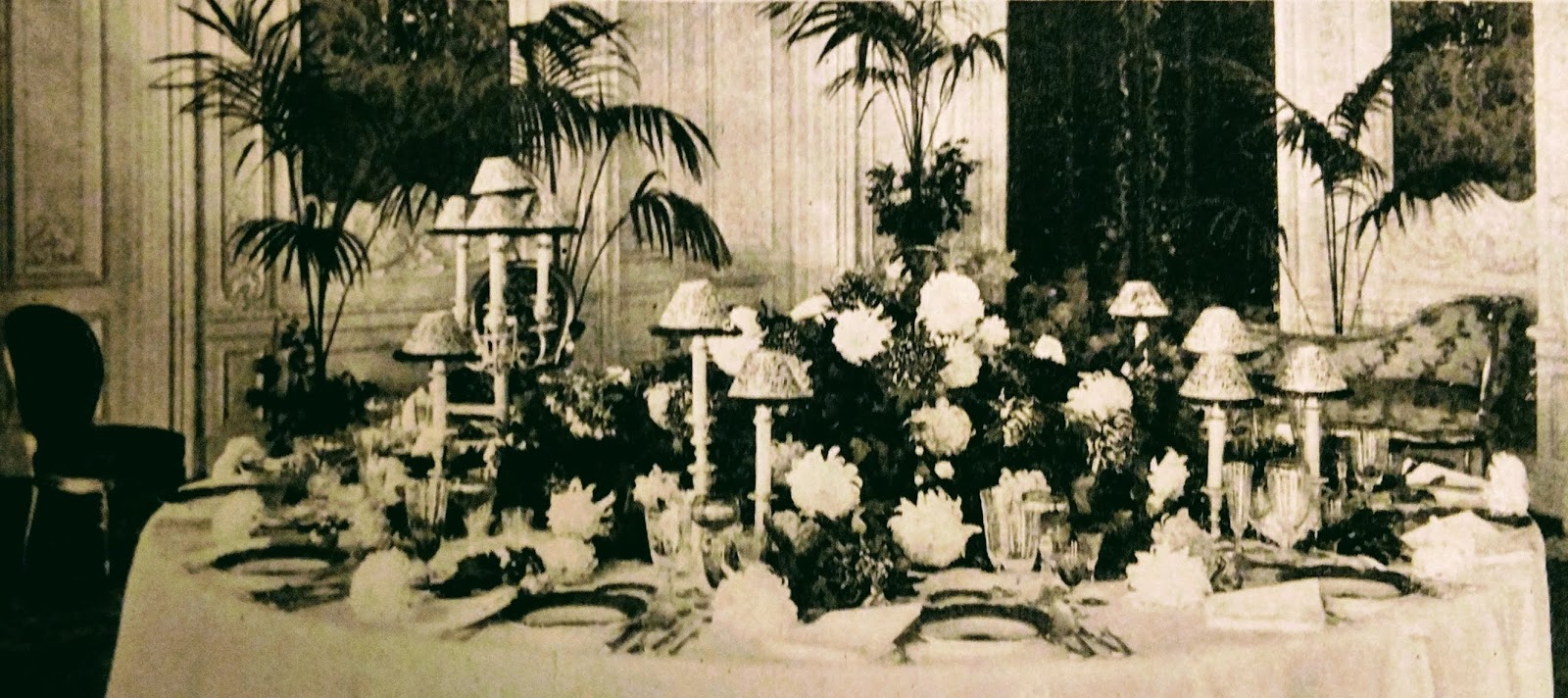
Those pretty candle shades, so much in use, were decorative to the furnishings of the table, but they prevented the most effective and becoming light at Victorian dinner parties.

Etiquette Notes for the Victorian Woman and the Home


A woman who has carefully studied the effects of light at her dinners says that unshaded candles in high, old fashioned candelabra that branch out in many directions, are absolutely the perfection of light for a table, and are, too a most becoming light to the faces of the guests gathered around it. The candelabra should be tall enough to carry the lights fairly high. The pretty candle shades so much in use are decorative to the furnishings of the table, but they prevent the most effective and becoming light.

A knitted table padding is being offered for use under table cloths. It is especially recommended because it does not grow hard after washing, as does the ordinary table pad. For a polished table, too, its protection is claimed to be more perfect. 


Cosmos and pansies are preferred for cloths intended for round tables. Sometimes entire plants are used to form a double border, with a plain linen center, and a plain strip between. The latest and most fashionable tablecloths have centers of plain linen, to which deep floral borders extend from the hem. Poppies, lilacs or goldenrod are favorite designs. Floral designs are preferred, the figures being larger and more pronounced than ever, this season.

Some damasks show the representations of whole plants or of a great branch bearing both flowers and foliage. Lace-trlmmed table linen is more fashionable than it was last season. Three new laces are used in ornamenting it. One is a French lace, resembling heavy linen torchon of elaborate patterns; another is a Russian lace of close meshes and clumsy figures.

Table linen that is not trimmed with lace, should be marked with embroidered initials. The accepted size for letters on tablecloths is two and one-half inches, and for napkins one and one-half inches. The initials should be intertwined, but the old-fashioned monogram style is no longer admissible.

In the serving of a pineapple:  Slice it, dip it in grated coconut, and pile high on a dish of fine white china.

A jelly sauce that is used for meats or the game course, requires that the jelly should be melted to the liquid state, and a tablespoonful of wine added just as it is sent around.
–Sacramento Daily Union, 1898


  🍽Etiquette Enthusiast, Maura J Graber, is the Site Editor for the Etiquipedia© Etiquette Encyclopedia