Showing posts with label Japanese Tea Ceremony. Show all posts

Tuesday, May 11, 2021

Chanoyu Etiquette – Japanese Tea

They were all society people, but they found that Japanese etiquette differed very materially from their own social functions. They studied the slips of paper given them until they knew that the bits of cake given them were to be eaten first, and the bowl of tea to be taken in the right hand and placed on the left palm and so held, no matter how warm the tea, until the first guest had sipped his tea in three gulps and a half when the rest of the company were at liberty to drink the steaming beverage, each bowl being drained in succession. The guests, meanwhile, watching each other with great interest to know what would be expected of them when their turn came. 


San Francisco, California – Do you know what a “chanoyu” is? Well, it is simply a Japanese ceremonial tea. The dainty little Geisha, Mme. Yucca and some members of the company, which, by-the-way, is the only real Japanese troupe ever in this country, who performed recently at the California theater, gave a chanoyu in the Maple room of the Palace Hotel that was a decidedly novel and interesting affair. The decorations were in keeping with the event, all Japanese, of course, with Japanese lanterns and richly embroidered screens which formed a back-ground to the tea-drinking room. The affair was invitational, and to each guest was presented little slips of paper describing etiquette of a Japanese ceremonial tea. 

They were all society people, but they found that Japanese etiquette differed very materially from their own social functions. They studied the slips of paper given them until they knew that the bits of cake given them were to be eaten first, and the bowl of tea to be taken in the right hand and placed on the left palm and so held, no matter how warm the tea, until the first guest had sipped his tea in three gulps and a half when the rest of the company were at liberty to drink the steaming beverage, each bowl being drained in succession. The guests, meanwhile, watching each other with great interest to know what would be expected of them when their turn came. 

Mme. Yucca brewed the tea with her own tiny hands on a raised dais, using a special blend, costing a fabulous sum per pound, and a tiny maid, Miss Otsuru by name, passed the refreshments, making a graceful and profound bow to each guest. One of the features of the evening was a geisha dance by Mme. Butterfly, 300 years old, the dance, not the dancer, bearing the ancient record. It was full of life and grace, combining all of the best movements of the Delsarte system. – Polly Larkin, 1899


Etiquette Enthusiast, Maura J. Graber, is the Site Editor for the Etiquipedia© Etiquette Encyclopedia

Tuesday, November 3, 2020

The Geisha: An Exquisite Hostess

                                                                                
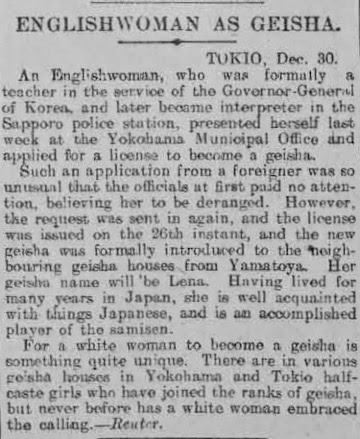
A geisha is a traditional entertainer trained in classical arts such as dance, tea ceremony, and music. In the modern era geisha are understood to be female, but historically there were male geisha as well. In 1913, an Englishwoman applied for a license to become a geisha. There were already many "half-caste" girls who were geisha in Japan, however "Lena" would be the first white woman to hold such a license.  The application was at first thought to be from someone who had to be "deranged," so it was ignored by Yokohama officials. A second application was sent in and she was granted the license on the 26th of December, 1913.


Like ghosts from another time, the real geisha seem to float silently along the streets at twilight, making their way to tea houses and restaurants where they will entertain elite, powerful men.

Trained to be exquisite hostesses, they are accomplished musicians, singers, dancers and most importantly conversationalists. To have a geisha in your company, to be in the presence of a beautiful, articulate, talented companion for the evening, is considered a status symbol. Their clients used to be samurai and shogun. Now it’s politicians, actors and corporate CEOs who hire the geisha by the hour for private dinners at ryotei (traditional Japanese restaurants) and ochaya (tea houses).

They are not courtesans or prostitutes. Before World War II, a geisha’s virginity was auctioned to the highest bidder, but sex is no longer part of the transaction. To be a geisha is to be part of a community, a vocation. They are career women. They are performance artists.

An endangered species, the numbers of real geisha in Japan are dwindling. From a reported 80,000 throughout Japan in the early 20th century, they now number only a few thousand. “In Kyoto, there are about 150 geiko geisha in the local dialect and maiko, geisha in training, left in Kyoto,” according to Anne Alene, an in-country guide for a recent trip to Japan arranged by the Carnegie Museums of Pittsburgh Travel Program.

The group toured the Gion district, one of several historically preserved neighborhoods in Kyoto and the place where the 2005 movie “Memoirs of a Geisha” was filmed. It was based on the novel of the same name by Arthur Golden.

In Kyoto, authentic geisha are not nearly as prevalent as faux geisha young women who dress in traditional Japanese kimono complete with obi, white tabi socks and wooden geta sandals. While they enjoy being stopped by tourists to have pictures taken, wearing traditional ensembles also appeals to the Japanese reverence for ritual and tradition.

“For many Japanese girls, it’s fun to dress up in something they would never ordinarily get to wear,” said Amy Boots, executive director of the Japan-America Society of Pennsylvania.

“I think it might be like doing a Renaissance or Old West-style photo shoot for us.”

Visitors can also give it a try. In Kyoto, there are several places that rent a kimono ensemble or the men’s version, a black kimono with montsuki haori, the short coat over top. 
                                                        
A hand-colored photo of a group of Geishas, 1890
—Photo source Pinterest


“Kimonos have many layers and are difficult to put on without a helper,” said Katsuko Shellhammer, education outreach coordinator for the Japan-America Society of Pennsylvania. “They are also very expensive, and seasonal patterns are important. It can be like wearing a piece of art.”

Department stores in both Tokyo and Kyoto have sections dedicated to kimono wear; you can buy off the rack or have a custom-made kimono and obi from the bolts of material offered. A less expensive option is a used kimono, and there are many stores that deal strictly in pre-owned. Kimonos are often passed down from mother to daughter.

Modernizing the look is all about the material and new, more graphic patterns. Sou Sou, a Japanese clothing company, has taken the plain tabi shoe and sock and covered them in a riot of color and designs. They have also re-imagined other traditional Japanese garments.

Just looking like geisha is not enough for some young women. Turning away from Hello Kitty and the modernity of Japanese life, they make the choice to earn a living as a geisha. Maiko as young as 15 must live in the geisha house, or okiya, learning the nuances of life under the robes and white makeup. The apprentice period lasts between three and five years, during which the okiya and the geisha mother invest in them, paying for lessons and kimonos and providing room and board. Maiko, pronounced MY-ko, are tested before they can advance. At the erikae ceremony, they don the white collar of geisha.

Twice a year, in spring and fall, the public is treated to a display of geisha talents during the Miyako Odori at the theater in the Gion district. The 142nd annual Miyako Odori was held earlier this month during the Carnegie Museums group’s visit. The travelers enjoyed a glimpse into this exclusive world, including a very brief tea ceremony with a complicated etiquette that must become second nature to real geisha.

As the living embodiment of history and fantasy, geisha are not allowed to marry ever. If they do they must leave.

“Geisha and maiko are very special to the Japanese people. They are part of a separate world from ordinary Japanese life,” Boots said. — Pittsburgh Post-Gazette, Kyoto, Japan, 2014


Etiquette Enthusiast, Maura J. Graber, is the Site Editor  for Etiquipedia© Etiquette Encyclopedia 

Monday, September 21, 2020

Japanese Spring Tea Ceremony

The springtime, Hanamatsuri, or “Flower Festival”— One of the key rituals practiced in spring is the tea ceremony, an ancient art that promotes appreciation of nature and beauty. 
-Photo source, Pinterest

The spring season in Japan is typically heralded by Hanamatsuri, or “Flower Festival,” and one of the key rituals practiced at this time of year is the tea ceremony, an ancient art that promotes appreciation of nature and beauty.
The tea ceremony, with its strict rules of etiquette, epitomizes the politeness that is a means of self-preservation in crowded Japan. Rules govern how to brew and serve the fine tea, how to hold and admire the tea bowls, and how the guest verbally responds to the server.
The goal of the ceremony is contentment in one’s lot and the teaching of the virtues of urbanity, respect, cleanliness and imperturbability, according to one published assessment.
More and more ceremonies are being conducted in the misono-dana style, in which participants sit in chairs rather than on their knees on tatami mats. Guests are traditionally served tea and small cakes, typical of those served at similar traditional celebrations in Japan.

Etiquette Enthusiast, Maura J Graber , is the Site Editor for the Etiquipedia© Etiquette Encyclopedia

Friday, August 9, 2019

Etiquette of Japan’s Urasenke Tea

Although the tea ceremony originally was an art practiced only by upper class men, today tea schools have become girls’ finishing schools. “It is true that young people in Japan today lack knowledge in etiquette, but that is because there is so little opportunity to learn or use it in the home,” Yaeko Shiozuki, 1976


History of Japanese Etiquette in Tea Ceremony

Learning to serve or drink a cup ot tea takes months of instruction and embodies a history of Japanese etiquette, says Yaeko Shiozuki of Japan, a woman whose ancestors founded the tea ceremony. Shiozuki, 58, has 3000 tea ceremony students in Tokyo and has used her knowledge of this art and its philosophy to write seven books on manners and etiquette. The ceremony, dating back to the 15th century, enjoys a steady popularity among Japanese men and women of all ages, she said. Founded in Zen Buddhism and long practiced for its spiritual value, it is also a source of good manners in private Japanese life. The ritual includes the proper way to walk, turn around, sit, handle drinking and eating utensils, bow, and many other forms of behavior prescribed by the strict code of etiquette for polite society in the Orient. 

“It is true that young people in Japan today lack knowledge in etiquette, but that is because there is so little opportunity to learn or use it in the home,” said Mrs. Shiozuki as she relaxed in a rattan chair in the spacious, carpeted lobby to her tea ceremony school. “Today's parents grew up in the World War II years when there were few chances to learn this etiquette.” Mrs. Shiozuki, however, comes from an illustrious family whose ties to tradition have transcended wars and the coming of Western ways. Her father, Soshitsu Sen, is the 14th generation of the family that founded the Urasenke Tea Ceremony, the most prominent of various styles, with an estimated five million followers. Her brother, also taking the name Soshitsu Sen, now holds the venerable position that includes among its privileges performing the tea ceremony for visiting state guests. 

Mrs. Shiozuki's name became a household word with the publication in 1970 of her bestseller “A Guide to Ceremonies,” which gives step-by-step instructions for weddings, funerals and other formal occasions. Seated on traditional tatami or straw mats in a Tokyo tea room, officers of Japanese Self-Defense Forces hear lecture on manners from Mrs. Yaeko Shiozuki, whose ancestors founded the tea ceremony. Her other books tell how to give presents, write letters, wear kimonos, meet people, associate with relatives and behave in different areas of society. She also tells how to live in crowded apartment complexes without becoming angry or frustrated. Japanese manners have had to undergo substantial changes with the move from living in traditional straw-matted, or tatami, rooms to the beds, high tables and chairs of Western-style homes, Mrs. Shiozuki said. But she insists that the basics of modern etiquette must still be founded in the tea ceremony. 

“It teaches us how the hostess and guest can make each other feel as welcome as possible. It is more than just actions, but something deep down,” she explained. Although the tea ceremony originally was an art practiced only by upper class men, today tea schools have become girls’ finishing schools. Mrs. Shiozuki's grandfather began to admit women to tea classes during the Meiji era (1862-1912). Now women are 80 per cent of its followers. In the years of Japan's rapid Westernization the number of male students dropped greatly, but now it has begun to increase. “I think, there is a feeling of wanting to go back to the home town and do something the same way their ancestors did,” said Hiroo Masuda, a tea master in one of Mrs. Shiozuki's three schools. “After World War II Japan became too Americanized and threw away many of the old traditions.” There are about a thousand places to learn the tea ceremony in Tokyo alone, with enrollments averaging about 20 to 30 people. –By Kathryn Tolbert, Tokyo (AP), 1976


Etiquette Enthusiast, Maura J Graber, is the Site Editor for the Etiquipedia© Etiquette Encyclopedia

Sunday, December 20, 2015

Etiquette and Japanese Omotenashi

“Customers are gods, as a saying goes in Japan, where staffers press for shoppers in department store elevators and hotel porters line up to bow to guests.” –Japan Times
Omotenashi — A Very Japanese Hospitality
The word “omotenashi,” which, ever since Tokyo won the right to hold the 2020 Olympic Games, is used to describe the Japanese style of hospitality and, when it’s covered by the media, a source of national pride. 
Any foreigner who has lived in Japan for an extended period of time will have been asked this question: "What's your favorite Japanese word?" In my own case I have often answered the enquiry with omotenashi and, without exception, my reply has garnered instant murmurs of approval. The tacit implication is that I have "understood." But what, exactly, is it?
Japanese Tea Ceremony 
Omotenashi is a singularly difficult word to define, let alone translate. It is very close to the Western phrase ‘Hospitality,’ yet it is palpably something else, one of those semi-mystical Japanese keywords that seem to tap into the very heart of the Japanese cultural DNA, yet remain somehow beyond literal explanation. One of my personal favorite attempts to decipher its meaning, comes from an unlikely source, the PR department of a major Japanese cosmetics corporation:

“Omotenashi is a word you have to translate with your heart,”says their copy, “It is a subtle connection in which trust, pleasure and respect are interwoven in an approach steeped in a natural sense of deference; an exquisite approach to the art of receiving guests.” Not a bad stab at it, methinks.

My own attempt goes something like this: “Omotenashi describes an atmosphere of conviviality and welcome in which individual needs and preferences are catered to impeccably, and of which an essential element is the unobtrusive, meticulous attention to detail. The term is primarily used in modern Japan in the hospitality and service industries, most notably in high-end hotels and restaurants, though its use is not exclusive to those trades; it may even be used to describe the hospitality found in the confines of a private home.”— Text By John Ashburne


Etiquette Enthusiast Maura Maura J. Graber is the Site Editor for the Etiquipedia© Etiquette Encyclopedia