Showing posts with label Queen Elizabeth II. Show all posts

Tuesday, January 13, 2026

Famous Faux Pas in History

                       A Second Debut Article from 2014            

                                                            
   Former U.S. President George H. W Bush 

1. George Bush senior may hold the record for the most embarrassing behavior at a state dinner. In 1992, the former president vomited, then fainted, after experiencing sudden and violent gastric distress during a state dinner in Tokyo. Unfortunately, he vomited — as the news reports put it – “copiously” into the lap of then Prime Minister Miyazawa. Mr. Bush, formerly with the diplomatic corps, was always a model of gentlemanliness, manners and propriety. His mortification the next day upon seeing the press reports of the mishap must have been horrific. One writer wondered, "Did Japanese hardliners harbor suspicions that the presidential sickness had been no accident?" After all, 48 years prior, Bush had been shot down by the Japanese while trying to torpedo one of their warships. 
                                    
                                      José María Velasco Ibarra 
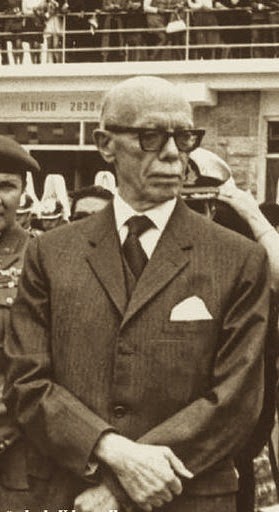
2. José María Velasco Ibarra was President of Ecuador five different times, but sadly, he was always being deposed. On one occasion, he turned up at an embassy reception. Accounts on this vary. He either vomited over the West German ambassador or he urinated in the punch bowl. According to one version of the story, he actually did both. The army immediately deposed him for having “compromised the dignity of the Republic.” 
                  
                    Former British Prime Minister Harold Wilson 

3. The White House state protocol took a holiday it seems, when Prime Minister Harold Wilson visited Washington in the 1960s. It was at a time when the sun appeared to be setting on the British Empire — colonies everywhere were clamoring for independence, it was post-Suez canal, there was the free-falling pound, not to mention labor strikes. Upon arriving at the White House for the formal welcoming ceremonies, Wilson pointed out to then U.S. Chief of Protocol, Jimmy Symington, that two of the Union Jacks were flying upside down — the international sign of distress. The next day, the Washington Post newspaper ran an enormous photo of the flags with the caption, “Oops!” 
      
These people are dancing the Viennese Waltz. They are not dancing to the Austrian State anthem. 

4. As the story goes, former British Foreign Minister George Brown was at a state dinner in Vienna in 1966, and after enjoying some wine, he turned to "an exquisite creature in violet" sitting beside him, upon hearing the orchestra strike up a tune. Saying, “Madame, you look ravishing. May we dance?” The exquisite creature in violet turned to him and said, in perfect English, “No, Mr. Brown, for three reasons. Firstly, this is a state dinner, not a ball. Secondly, were this a ball and not a state dinner, this would still be the Austrian state anthem, and not a waltz. And thirdly, were this a ball and not a state dinner, and were that a waltz and not the Austrian state anthem, I would still be the Cardinal Archbishop of Vienna.” 

                                        
       Polish leader Lech Walesa was unfamiliar with artichokes.

5. When Polish leader Lech Walesa visited Queen Elizabeth II at Buckingham Palace, he was served artichokes. Never having encountered an artichoke before, he began to eat the spiny leaves. The Queen generously offered, “Why don’t you eat the bottom part? It takes so long to eat the leaves.” That’s what's known as noblesse oblige — a French phrase literally meaning "nobility obliges." It is the concept that nobility extends beyond mere entitlements, to acts of generosity and nobility toward those less privileged. 

                                            
Mozaffar ad-Din Shah Qajar did not know the etiquette for eating asparagus. 

6. The Shah of Persia, Mozaffar ad-Din Shah Qajar, visited London in 1902. At the Edwardian Era dinner, he was served asparagus, which was a legume evidently unknown to the occupant of the Peacock Throne. After eating each spear, he would toss the stalk over his shoulder onto the floor. Feelings of anxiety ensued with those dining with the Shāh. Not wanting to embarrass the world leader, and in a show of true diplomacy, everyone else began tossing their stalks onto the floor.


🍽️Etiquette Enthusiast, Maura J. Graber of The RSVP Institute of Etiquette, is the Site Editor of the Etiquipedia© Etiquette Encyclopedia 

Monday, October 9, 2023

Coronation Fever Grips World

A collectible Queen Elizabeth II Coronation tea cup and saucer from 1953, These were popular amongst tourists and the Queen’s subjects, as well.


LONDON (U.P.) Queen Elizabeth II, radiant in a summery cream colored dress, entertained 11 Prime Ministers of her Commonwealth at a state lunch today while thousands of her subjects set up camps, complete with cooking stoves along tomorrow’s Coronation parade route.

Little Prince Charles, 4-year old heir to the throne, delighted the thousands massed outside Buckingham Palace by appearing at a window to hear a guard's band play “Teddy Bear’s Picnic” while his mother received the premiers. Only the weather man refused to cooperate. He forecast occasional showers, blustery winds and “perhaps hail” with only an occasional glimpse of the sun, in prospect.

The great Coronation invasion approached its peak. Ocean liners channel steamers, planes, trains and buses brought more thousands to London. The Queen’s guests at the palace lunch were Prime Ministers Sir Winston Churchill of Britain, Louis St. Laurent of Canada and the premiers of Australia, New Zealand, South Africa, India, Pakistan, Ceylon, Southern Rhodesia, Northern Ireland and Malta. 

Stands With Husband

Queen Elizabeth received her guests in the palace picture gallery, standing with her husband Prince Philip, Duke of Edinburgh, in front of a portrait of King George III who lost the American colonies. The Queen wore, with her cream dress, white gloves, white peep toed shoes and a spray of diamonds.

She was smiling, bubbling with happiness as she talked gaily to the statesmen about her Coronation tomorrow. After the reception the lunch was held in the state dining room. Present, in addition to the premiers, were members of the Royal family and high commissioners of Commonwealth countries.

Weather Uncertain

Every train and bus brought in early birds to claim their spots on the six-mile route that will be crushed with more than 2,000,000 persons by the time Elizabeth and Prince Philip ride by in their golden state coach. The queen's honors list was released late last night and the public particularly was delighted at the Knighting of Gordon Richards, fabulous English jockey who has won 4,662 races in his career. He will ride the favorite, Pinza. against the Queen's horse Aureole in the Derby next Saturday.

👑 👑👑👑👑👑👑
4:34 OUR TIME 
LONDON (UP) Queen Elizabeth II will be crowned at 12:34 p.m. Tuesday (4:34 a.m. PDT) according to the split-second, 10% hour time table worked out for the Coronation.

– From The Madera Tribune, 1953


👑🍽Etiquette Enthusiast, Maura J. Graber, is the Site Editor for the Etiquipedia© Etiquette Encyclopedia🍽👑

Tuesday, November 8, 2022

Foods Fit for an Influential Queen

The world collectively found out about the marmalade sandwich Queen Elizabeth II kept in her handbag in the delightful video aired to celebrate her Platinum Jubilee. 


How Queen Elizabeth Impacted What We Eat and Drink

Her affection for tea, scones, gin, and chocolate cake affected dining habits worldwide. 


The reign of Queen Elizabeth II spanned seven decades, and as people across the globe mourn her passing, it's a good time to examine how she impacted the food that shows up on dining tables around the world. Former Buckingham Palace chef Darren McGrady offers a peek behind the curtain and into the royal dining room in his book, Eating Royally: Recipes and Remembrances from a Palace Kitchen.

McGrady, who was Queen Elizabeth's personal cook for 15 years, shares in his book that she had simpler eating habits than what you might expect. Sure, menus from state dinners and other elegant celebrations fit the glamorous fantasies many people harbor. But in her day-to-day life, the Queen did not exactly snack on caviar. In fact, her diet at home was pretty quotidian, albeit prepared by trained chefs. She enjoyed a simple breakfast of toast with marmalade, and when not entertaining, stuck to light lunches and suppers. McGrady shares in his book that she abhorred dishes with garlic or too many onions. These slightly abstemious leanings made her diet sound austere, but she had other food and drink indulgences like poached salmon, delicate tea cookies, and scones with jam and clotted cream. Here are a few others:

Gin Cocktails

The queen's preference for gin was so strong that she released her own gins from Buckingham Palace and Sandringham House, made with ingredients from the gardens at each. She preferred to drink them in a good gin cocktail, either a gin martini or gin and Dubonnet.

Earl Grey Tea

The queen began every day with a pot of Early Grey, a traditional bergamot-scented black tea she drank with milk and no sugar. Her devotion to the flavor ensured its popularity throughout the world, making it the fifth most popular tea flavor globally, according to Fresh Tea. It is the tea most associated with royalty in general and Queen Elizabeth specifically, and there is no question that its popularity was enhanced by being her majesty's favorite.

Crustless Tea Sandwiches

Traditional British afternoon tea goes back to the 1840s, when the Duchess of Bedford called for a light meal to bridge the gap between lunch and dinner. Queen Elizabeth adhered to a daily teatime meal; her preference for delicate sandwiches with the crusts cut off was well-publicized. Her favorite version was reported to be smoked salmon with cream cheese.

Game Meats and Wild-Caught Fish Dinners

If the old adage is true, one should eat breakfast like a king, lunch like a prince, and dine like a pauper. Queen Elizabeth seemed to have taken this to heart, eating lighter meals composed of simple proteins and vegetables at night. A longtime sportswoman, Queen Elizabeth frequently dined on venison, wild birds, or other game — often sourced on one of her properties — or salmon fished from the River Dee at Balmoral Castle. The queen's preference for game meats even extended to more casual meals; she was, reportedly, a big fan of hamburgers made with ground venison. She usually skipped any potatoes, pastas or grains at her evening repast, but almost always had room for dessert.

Chocolate Biscuit Cake

The queen had a legendary love of sweets, especially anything chocolate. She especially enjoyed a classic icebox-style cake using simple tea biscuits suspended in an egg-enriched ganache and then chilled before coated in a thin layer of chocolate. This was something she requested daily as long as it was around, according to the royal chefs. She even had her chef transport leftovers by train from Buckingham Palace to Windsor to ensure not a morsel was wasted. It was a dessert truly fit for royalty. —
 By Stacey Ballis, originally published on June 2, 2022


🍽Etiquette Enthusiast, Maura J. Graber, is the Site Editor for the Etiquipedia© Etiquette Encyclopedia

Tuesday, September 20, 2022

Duke of Edinburg’s Unaffected Manner

Duke of Edinburg, in formal civilian attire, is a tailor’s delight.


The Duke has an unaffected manner. If he is by the phone when it rings, he will answer it. He took off his coat and helped workmen shift furniture when it arrived at Clarence House, but he will not be forced by opinions of some fanatical minority. Criticism deploring the fact that he and the future Queen went out in Paris on Sunday during their visit to France to enjoy themselves, and that he played polo on Sunday, was met with stony silence and attendance by Elizabeth at Sunday polo games.

When staid critics decided that “Bluebottle” was a frivolous name for a yacht connected with royalty, it did not stop the little ship from being given a fresh coat of blue paint and its name was lettered even more clearly. His uncle, Lord Louis Mountbatten, was his guiding light, who saw that his young nephew had the wherewithal to keep his place among the other underpaid young men from the army and navy who went about town. Later, Lord Louis handed over the presidency of the Playing Fields Association so that the future Queen’s husband could establish himself as a public figure. – San Bernardino Sun, March 1953


🍽Etiquette Enthusiast, Maura J. Graber, is the Site Editor for the Etiquipedia© Etiquette Encyclopedia

Monday, September 12, 2022

Etiquette for Viewing Queen’s Coffin


Ever thoughtful and practical, Queen Elizabeth II chose bright, colorful clothing and hats that could be spotted easily by those waiting in large crowds to catch a glimpse of her.

Rules for those viewing the Queen's coffin in Westminster Hall

The Government has warned people viewing the Queen's coffin to remain silent inside Westminster Hall.

It urged people to “dress appropriately for the occasion to pay your respects”, banning clothes “with political or offensive slogans”.

A spokesman said: “Please respect the dignity of this event and behave appropriately. You should remain silent while inside the Palace of Westminster.”

Queue-jumpers and anyone drunk will be booted out of the queue by stewards and police patrolling the lines.

Visitors will also face airport-style security checks, with tight restrictions on what can be taken in.

Flowers, tributes, candles, flags, photos, hampers, sleeping bags, blankets, folding chairs and camping equipment are all banned, with only one small bag with a simple opening or zip permitted per person. — From mirror.co.uk
🕊Etiquette Enthusiast, Maura J. Graber, is the Site Editor for the Etiquipedia© Etiquette Encyclopedia

Thursday, October 1, 2020

Australian Yacht Etiquette

According to a 2006 Guardian News article, former Royal butler, Paul Burrell, told of a Prince who made a memorable faux pas: “If you're faced with a regiment of cutlery and an army of glasses and you're unsure what to do, watch your host to see what they do. I was once on the Royal Yacht Britannia in the South Pacific and the Queen was hosting a dinner for a local Prince. Dessert was served. The Prince forgot to watch what the Queen did - instead, he popped the grapes into his finger bowl, then some cherries, then when the cream and sugar came out, he poured them in too, making a kind of fruit soup. I was standing behind the Queen looking horrified. He was about to raise the bowl to his lips to drink it when he looked at the Queen and realised he had made a terrible mistake. Not wanting to make him feel awkward, she picked up her finger bowl and took a sip. Now that's class.”


Summer is here in Australia, and so are the holidays.  When we think December holidays we think of lounging beside the cool water, swimming and boats.  For some, chartering a yacht is just the perfect time to reflect and unwind.  To make your yachting experience that much easier, these are the captain’s top tips:


Safety - It’s essential to listen to the safety briefing.  It really does save lives.  Give your captain and crew your attention at the bringing of your trip.
 
‘No Shoe’ Rule - When you board and cross the passerelle or gangway, there will be a basket for your shoes. The yacht’s beautiful teak wood boards are laid and highly polished.  Wearing anything other than shipshape, approved soft-soled deck shoes, can colour and scuff that beautiful wood. Heels will leave indentations and shoes generally will bring in dirt, dust, gum and even tar from roads and sidewalks.  This is your chance for your pedicures to shine, so don’t be afraid to show them off.
 
Service Staff - If you have boarded an American yacht, then the service staff have been trained to interact with clients.  European service staff will more likely give you the service you need and require, however they will keep more invisible and quiet. 
 
Planning Ahead - The company you have booked through will provide a chance for you to fill in a preference sheet.  This will list your likes and dislikes and what you plan to do while on-board.


For many years, Etiquipedia contributor, Elizabeth Soos, has had a keen interest in cultural customs. With her European background and extensive travel, Soos developed an interest in the many forms of respect and cultural expectations in the countries she has visited. With her 20 years’ experience in customer service within private international companies based in Australia, and her lifetime interest in manners and research, she decided to branch out into the field of etiquette and deportment. Through her self-directed studies and by completing the Train-The-Trainer’s course offered by Emma Dupont’s School of Etiquette in London and by Guillaume Rue de Bernadac at Academie de Bernadac based in Paris and Shanghai, she founded Auersmont School of Etiquette.


Etiquette Enthusiast, Maura J Graber, is the Site Editor for the Etiquipedia© Etiquette Encyclopedia

Friday, September 4, 2020

A Presidential Faux Pas

According to Town and Country magazine, following the news in 2018 that George H.W. Bush passed away at the age of 94, Queen Elizabeth wrote of the former U.S. President, “It was with sadness that I learned of the death of President George H. W. Bush last night. President Bush was a great friend and ally of the United Kingdom. He was also a patriot, serving his country with honour and distinction in Office and during the Second World War,” reads the statement from the Queen, which is addressed to both President Trump and the American people. “Prince Philip and I remember our days in Texas in 1991 with great fondness. My thoughts and prayers are with President Bush’s family and the American people.” The Queen then signs the message, “Elizabeth R,” which stands for Elizabeth Regina (Latin for Queen), and is how the Queen signs official documents. —Photo Source, Pinterest 


Tired President Takes His Seat a Bit Too Soon

 
President Bush committed a social gaffe Tuesday night by sitting down before Queen Elizabeth II, breaking royal protocol.
Bush, tired after two days of meetings of the Group of Seven major industrialized democracies, relaxed into a chair while Queen Elizabeth chatted with French President Francois Mitterrand before a dazzling dinner at Buckingham Palace.
The queen turned around and Bush, realizing his breach of etiquette, stood up.
The queen then sat down for a photo opportunity with the G-7 leaders, and Bush formally requested permission to take his seat by her side.
 REUTERS, July 17, 1991
Etiquette Enthusiast, Maura J Graber, is the Site Editor for the Etiquipedia© Etiquette Encyclopedia

Tuesday, September 1, 2020

Etiquette Fit for a Queen

What to do if the Queen drops by...

Your jubilee street party is going swimmingly but suddenly you come face to face with the sovereign herself. Mark Oliver seeks advice on how to behave from etiquette expert Drusilla Beyfus

Photo source, Instagram 
The stakes are arguably even higher if you're an arch-royalist, and are at a street party partaking in those golden jubilee shenanigans. Imagine: you're just munching a hotdog, hands caked in ketchup, when there's a blur of Daimler, a flash of brooch, and suddenly Her Majesty is upon you.

To help us navigate the minefield of royal protocol, we sought the views of the wonderfully named Drusilla Beyfus, author of Modern Manners. Ms Beyfus says: "Pictures of so-called real people with the royals always look so strained because people are still very intimidated."

But she stresses that royalty are much more relaxed these days and there's no reason to panic. Ms Deyfus has met the Queen and insists she was very nice and she says that with just a few pointers, you too can avoid ending up in the Tower. So do I have to curtsey, or is that just for women?

Ms Deyfus says: "For men, you should give a short bow from the neck. But don't go too low. You don't want to appear too theatrical." Or look like you're having a laugh.

"Women can curtsey, and most women do. These days some women don't curtsey but that's alright too and won't cause any great offence," Ms Beyfus says. Debrett's website says the correct form of address is "your Majesty" or "Ma'am".

However, it is bad form to offer the sovereign your hand to shake. Ms Beyfus says: "The thing is, she would probably just shake it if you did but it's best not to. It's very unlikely she would, but if she offers you her hand, then you should shake it." Just try to avoid crushing the royal digits.

Ok, you've survived initial contact. With a little bravery you could try and speak. Ms Beyfus says that in the past it would not have been proper to say anything. "These days you are most likely to be 'presented', for example if you are introduced by the organiser of the street party, and then you just bow or curtsey and say what you are going to say," she explains.

"She's very easy to talk to. But you can't talk for long, and can probably only get one thought out before she moves on. Everything is scheduled very exactly as we saw with the Queen mother's cortege arriving at precisely at Westminster Abbey at midday. People would love the Queen to sit down and chat at their street party but she won't do that."

So how do you choose what to say in your nanosecond of opportunity? Ms Beyfus says: "Of course, the subjects you think you should not mention, you probably should not. Should you mention Sophie Wessex's miscarriage? I think not."

But the Queen may do the running for you - she is after all well practised in the art of small talk. Ms Beyfus says she might always hit you with the classic "and what do you do?" question but this is less likely in as casual a context as a street party. Ms Beyfus says: "The Queen is usually very well briefed about the area, so may very well have some informed comment to make."

But what about food? Should you offer her a cucumber sandwich? Should there be a desperate scramble for a gold platter of Ferrero Rocher?

"I'm not sure about that. She's got a pretty good figure. You shouldn't really offer her food, but I think if you were to say 'here's one of our currant buns' or offered her some special jubilee cake, she may have a nibble." The most decorous thing would be to run it past her lady in waiting.

Now we turn to the really tricky stuff - how do you cope with the Duke of Edinburgh? What if he has you in the crosshairs for one of his trademark cheeky comments?

Ms Beyfus says: "I think it's very difficult and there are no real ripostes to those funny remarks. What I would say though is that they rarely seem to be at individuals. The slanty-eyed thing and remarks like that seem to be made as statements."

Also you may bear in mind that Mr Freedland has warned that you have to careful because Prince Philip often takes what you said and throws it back at you like it was the "most gormless thing" that had ever been said. So be careful with any quips about the bunting.

Finally, what about streaking? Is there any way of carrying it off without imperilling good form? "No, I don't think so," Ms Beyfus says. — The Guardian, 2002


🍽Etiquette Enthusiast, Maura J. Graber of The RSVP Institute of Etiquette, is the Site Editor for the Etiquipedia© Etiquette Encyclopedia

Tuesday, January 2, 2018

Etiquette for Meeting the Queen

Should you meet the Queen, curtsy if you're female, bow if you are male but, not from the waist. Just a lowering of the head is sufficient. 
Actress Elizabeth Taylor Curtsies to Queen Elizabeth II as She Greets Her Before Banquet

On Talking to the Queen...

According to “Debrett's Correct Form,” a book which its publishers describe as “a guide to social and professional etiquette, precedence and protocol,” here's how you should talk to the Queen of England: Address her first as “Your Majesty.” After that, you may call her “ma'am,” which rhymes with 
jam. 

Never address her as “Queen” or refer to her as “you.” For example, “How is Your Majesty feeling?” is proper. “How are you feeling, Your Majesty?” is not. And never, never say, “What's cooking, Queenie?” Should you meet the Queen, curtsy if you're female, bow if you are male but, not from the waist. Just a lowering of the head is sufficient. — San Bernardino Sun, 1977


Etiquette Enthusiast, Maura J. Graber, is the Site Editor for the Etiquipedia@ Etiquette Encyclopedia

Sunday, December 17, 2017

Royal Shopping Etiquette

                                  
Depiction of Harrod's in the 19th Century — Royal tradition ended in 2000, with the removal of royal warrants, and after the death of Princess Diana. Harrods severed its commercial links with the Royal Family by removing warrants from its prestigious shopfront. Workmen have taken down the warrants, which show that the Royals buy goods from the store, from outside the Knightsbridge building. The Royal seal of approval was also removed from the store's vans, marking the end of a 62-year tradition.

Poor Queen - She Can Take Only One Shopping Trip Every Year!

LONDON (UPI)—Queen Elizabeth II likes to have what she calls “a really good poke” 'round everything on the one time a year when she goes shopping—for Christmas presents. Court etiquette prevents her from going out to buy anything except Christmas gifts. Everything else is sent to the palace for her to choose from. So the Queen always looks forward eagerly to her annual expedition to a famous store (Harrods) in the London district of Knightsbridge, near Buckingham Palace, for the pleasure in which other women take as a matter of course. 

She writes her gift list weeks in advance, makes secret inquiries as to tastes, and adds Prince Phillip's gifts to her own. Her Lady-in-Waiting telephones the store manager to say when she is arriving. “No publicity, please,” is the strict rule. One Christmas the newspapers described the toys the Queen had bought. Her eldest children, Prince Charles and Princess Anne, discovered what they were to receive three weeks in advance. This year the queen has a special gift for them.

She is having a “teen-age rumpus room” made in the Victoria Tower of Windsor Castle, which the royal family uses as a weekend home. The sound-proof room will have television, hi-fi equipment, a tape recorder and rugs that can be removed for dancing sessions. It is due to be inaugurated formally with a teen-age cocktail party when Prince Charles, 16 and Princess Anne 14, arrive home for the holidays from Gordonstoun and Benenden Schools, respectively. Normally the Queen has a big house party at her country home at Sandringham during Christmas but this year renovations are in process there, so the royal family will spend Christmas at Windsor. 

It is celebrated in the traditional English manner, with a Yule log burning in the hearth and the rooms decorated with holly, mistletoe and pale Christmas roses. Dinner is the same every year —roast turkey with sausages and chestnut stuffing, sprouts and carrots, followed by hot mince pie and plum filled Christmas pudding. There's fruit, candy and crackers, which are pulled. The hats they contain are put on by everybody. The Christmas dinner is served at 1:00 p.m. instead of in the evening, so all the children over seven can be present. Those under that age eat upstairs in the nursery suite, but come down during the afternoon for the children’s party. 

The
 brilliantly decorated and illuminated Christinas tree is ceremoniously revealed at dusk in the ballroom when the double doors are flung open. There is a gift from everyone in the building. The Queen distributes the packages, such things as socks or china for her staff and servants, puzzles and jokes for the royal family. They exchange their personal gifts on Christmas Eve, just before carol singers come into the hall to sing the Christmas hymns. The Queen and all the Royal family join in. On Christmas morning, everyone attends church and Prince Philip customarily reads the Scripture lesson. – The Desert Sun, December 1964

Etiquette Enthusiast, Maura J Graber, is the Site Editor for the Etiquipedia© Etiquette Encyclopedia 

Sunday, March 5, 2017

Etiquette and the Queen

When traveling abroad, she is happy if her host refrains from putting caviar on the menu because she does not like it. On introduction to the Queen and Philip, their hands not are actually shaken but the fingers simply touched in token of greeting or the Royal couple would have sprained wrists from greeting so many.


Manners Fit For A Queen

LONDON (UPI)—When Queen Elizabeth II is presented with a bouquet of flowers, she prefers them to be light scented. A heavy perfume will set her sneezing. When traveling abroad, she is happy if her host refrains from putting caviar on the menu because she does not like it. When conversing with a stranger, she does not mind if asked a direct question so long as the subject is not of an overly personal nature. 

These snippets of information are culled from a brochure which Buckingham Palace sends out to the British embassies concerned when the Queen goes abroad. The information is intended to be passed on tactfully to the several thousand people who are presented to the Queen on such a visit or who entertain her. Protocol naturally is formal; but is not as elaborate nor complicated as the public often supposes.

Fingers Only

On introduction to the Queen and Philip, their hands not are actually shaken but the fingers simply touched in token of greeting or the Royal couple would have sprained wrists from greeting so many. Gentlemen are expected to give a normal bow as they take the royal hand. Ladies give what Is known at court as “a short curtsy,” a little dip made by placing the left foot just behind the right and inclining the head. The old style, floor-touching curtsy, was abolished because it takes too long for the lady to go down and rise again. The deep dip slowed the receiving line. 

The Queen wears gloves, usually white ones, on outdoor: occasions and with evening dress. She prefers other women do the same because so much hand-shake is involved, but would never refuse to meet a woman whose hands were bare. Most men like to wear gloves for the same reason.

Elizabeth always takes a wardrobe of new clothes with her to compliment her hosts. Guests do not have to follow suit by buying a new outfit but they should be dressed fittingly. Very low-cut dresses always are considered inappropriate. 

Likes Flowers 

Bouquets of flowers should not be heavily scented because the perfume increases in a hot room or bright sunshine. The Queen likes locally grown flowers best and is interested in being told what they are and how they are grown. 

If the bouquet can be given to her by a child, so much the better because the Queen, a mother of four, likes to see children everywhere she can. She is never disturbed if a child suddenly turns shy at the crucial moment. She has long experience in putting them at their ease. Conversation with the Queen and Philip is an easy, natural thing. Both are skilled in leading it.

Etiquette allows them to be asked direct questions so long as they are not too personal. Would-be hosts are told that the Queen’s tastes are simple. Neither she nor the Prince likes soups, oysters, other shellfish or caviar. The Queen is fond of China tea while Prince Philip drinks coffee whenever he can. Both are fond of fresh fruits and enjoy chicken dishes.

Prince Cooks 

They like to sample the local specialities. Prince Philip, who takes great interest in cooking and does a little himself at home, often asks for the recipe of an unfamiliar dish he has enjoyed. The Royal couple do not smoke. They drink wine and champagne at formal meals and the Prince takes an occasional glass of light beer with his lunch. — Desert Sun, 1969


👑Etiquette Enthusiast, Maura J Graber, is the Site Editor for the Etiquipedia© Etiquette Encyclopedia

Saturday, September 24, 2016

Etiquette and Royal Rituals

Queen Elizabeth and the Duke of Edinburgh at the opening of Parliament in 1952

On Rituals of the Royal Court

LONDON (UP) – Queen Elizabeth and the Duke of Edinburgh, as young folks might be expected to do, are chaffing a bit these days at the stupendous ritual and custom that hedges them around in the Royal Court. Wise courtiers say nothing and wait for the irritation to subside, as they know it will in the course of time. It always has. Modernization of Court proceedings is always in progress but it moves slowly. There are certain to be changes during the anticipated long reign of Elizabeth II, but nothing as dramatic as some of the sensational press are now demanding.

For one thing, it is obvious that pressure on the Queen, if the buffering army of functionaries were removed or cut radically, would be greater than it is under the present system. Thus, cutting away too much red tape would expose the Queen to the very evil from which her self-appointed saviors seek to rescue her. The Court of St. James is a very old Court, and, in a county where tradition is venerated as nowhere else, there is a reluctance to drop customs for any reason whatsoever. It is quite true that there are servants in the Royal households who have servants to wait upon them. But it has always been that way, and despite the unionization of the Palace help, there might be considerable unrest if this were changed.

It comes down to a question of whether the nation wants a Court or doesn't want one. And Elizabeth is known to love the pomp, the panoply, the ceremonial which blazes about the British throne. The Royal household is an immense establishment. There are eleven private secretaries and assistants to the sovereign. There are 23 officials in the privy purse, treasury and Royal charities office. There are 36 Royal chaplains. There are 20 physicians and surgeons and a special coroner. And many others. Before Queen Mary’s time there were even greater numbers of royal Courtiers, but the redoubtable old lady—as other Queens before her—chopped away a few of the jobs. And her grand-daughter, will doubtless whittle away a few more.

By Court etiquette, Elizabeth must not do anything directly. She can give orders to her private secretary, to her ladies of the bed-chamber or ladies in waiting, to her principal advisers and these, in turn, relay her orders to the lower echelons. This has irked the Duke of Edinburgh more than any single rule of the palaces, and he has broken it more than once by strolling down corridors asking the desired information or giving orders in person. Queen Elizabeth is expected to shorten the chain of command down the line from the throne as her contribution to the streamlining of etiquette.

Another windmill at which the critics are tilting is the strict procedure for public engagements. The newspapers contend that the Queen should not be tied up a year ahead to visits such as the one to New Zealand. The implication is that these things ought to be spun-of-the-moment affairs quickly accomplished by plane instead of great processions by sea with public interest drummed up over a period of time, this is a rather naive approach. 

New Zealand will invest a fortune in the Queen's visit and it may well be the event of the year there. Security has to be considered. Shops will get ready for extra business. New Zealanders from out-country may want to arrange to be at the points visited by the Queen. She will open playgrounds, lay cornerstones, attend ceremonials, make speeches. — The Edinburgh Courier, 1953


👑Etiquette Enthusiast, Maura J Graber, is the Site Editor for the Etiquipedia© Etiquette Encyclopedia

Monday, March 17, 2014

Etiquette and Creation of Modern State Banquets in Great Britain

HRH Queen Elizabeth II ~ Address her as ‘Your Majesty’ at first and after that, as ‘Ma'am’ - rhyming with jam or ham, not palm, or harm.


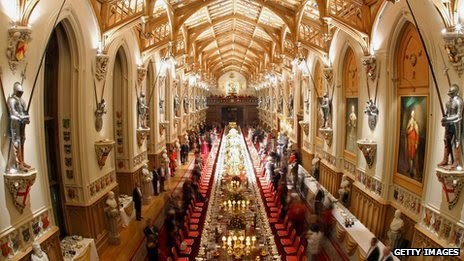
The Royal Household staff start laying the table for a banquet two days before the event, although preparations will have been underway for days before this. One of the most striking elements on the banqueting table is the magnificent service of silver gilt. It comprises not only the dining place itself, but also decorative items such as dessert stands and centerpieces. Numbering over 4,000 pieces, the service was commissioned by George IV when he was Prince of Wales, and it was supplied by the Royal goldsmiths Rundell, Bridge and Rundell.

At a famous dinner held at Carlton House in 1811, the Prince sat against a backdrop of silver guilt at the head of a table that stretched the entire length of the building. Along the centre of the table was running stream of water with banks of moss and aquatic flowers, cascading from a waterfall and falling into a series of pools at the foot of the table. Real fish swam in the stream. In this contemporary caricature (below), the fish are disconcerting the guests by staring at them.

29 June 1811, Hand-coloured etching ~ A farmer (John Bull) and his family gape in amazement at the arrangements for the Regency fête on 19 June. The narrow table extends across the design receding from left to right, the cloth hanging over the seats of chairs in the foreground. The famous canal decorates the centre of the table with its gold and silver fish, and the table is laid with gold plate, and ornate cut-glass goblets and decanters labelled 'Dry Champain', 'Claret', and 'Burgundy'. There are three-branched gold candelabra. The Prince's chair is on the extreme right; beside it stand a man in livery and an attendant in plain clothes. Behind the chair large ornate gold salvers are arranged on shelves covered with white drapery. This was 'a kind of circular buffet . . . lined by festoons and antique draperies of pink and silver'. The sightseers are on the farther side of the table (left) with their backs to the windows, John in the centre; he says, pointing: "Why Odd Zookers this is marvellous fine indeed. Oh Nan how we should relish a rasher on one of they monstracious beautifull Plates, why now I think I shan't grumble to pay three or four Bank Tokens towards this grand treat—methinks I should Just like a nippikin too." His wife puts out her hands protestingly: "Oh John one of our milk white Chickens roasted by myself by our wood fire would be Luscioscious indeed." His daughter says: "La Feather do zee how they gilded Fishes be stareing at yow." There are three loutish sons; one says: "I say Sue I thinks I should not like that dry Shampain, but a Dobbin of our home brewed in that there gilded gold thing would be dreadfully noice indeed"; another (looking up at the (invisible) ceiling : "Dang it if the top 0 the pleace beant all Eel pottles I'll be hang'd.
👑👑👑👑👑👑👑👑👑👑👑


The Grand Service includes 14 tureens, 20 sauce tureens, 140 dishes, 288 dinner plates, 118 salts, 12 ice pails, 12 mirrored plateaux, 58 desert stands and centerpieces and 107 candelabra. Unlike a modern dinner service, it has no single style of decoration. The goldsmiths of the day were influenced by Greek, Roman, Egyptian and other styles.

Originally some parts of the service for plain silver, although items intended for the desert course we're always gilt. However, George IV gradually ordered every piece to be gilded. This may have been because of the impression gained by one visitor to a ball at Carton House in n 1814: "All was in gold or silver gilt which made the silver plate, set out in the deep recessed windows, look cold and poor, although in reality it was very massive and handsome."

Today the Grand Service is kept under the care of the "Yeoman of the Silver Pantry." When not in use, it is kept in a controlled atmosphere. For a State Banquet it must be at its most gleaming and every piece is taken apart, thoroughly washed and cleaned with soft brushes, then dried and polished with soft cloths before being placed on the table. When everything is dismantled, there are over 8,000 components to clean. It takes 8 people 3 weeks to prepare.The Grand Service provides cutlery for every course and includes more obscure items like marrow scoops, ice spades and olive spoons. Today over 2000 pieces of cutlery are needed to serve and eat the banquet all drawn from the Grand Service.

The Queen's table is always decorated in the most magnificent style. She and her most important guest are usually flanked by the grandest pair of candelabra in the service -- which stand at 1.25 metres (4 ft) tall. These were designed by the sculptor John Flaxman and relate episodes from myths of Bacchus and Mercury. The Queen uses a salt that is not part of the Grand Service but was made much earlier, in 1721, by Nicholas Clausen.
 
Don't think about asking the Queen to "Please pass the salt."  She has her own salt dip, or salt cellar, and it is not part of the 8,000 plus pieces used for State Dinners.

At Windsor, on the single long table, a candelabrum portraying St. George and the Dragon is used -- this stands even taller at almost 1.5 metres (5 ft.) This huge piece was William IV's contribution to the elder brother's dinner service -- a final addition to the grandeur that has served every monarch since George IV.
  • Takes two days to lay the 175ft-long dining table at Buckingham Palace
  •  Each place setting measures 45cm and a rod is used to achieve the exact alignment of chair and table
  • 1,104 glasses are used, six for each guest
  • George IV's 4,000-piece Grand Service is used
  • Takes eight people three weeks to clean the service
  • 170 linen napkins, with the Queen's monogram, are folded by one man in the shape of a Dutch bonnet 

The Etiquette at the Table: 


At the dining table, don't start eating until the The Queen has started her meal. 

When it comes to utensils, start at the outside (with the outermost spoon or fork) and work in. If you drop something, don't make a fuss - servants will spot it and deal with it.


Watch for clues and cues with regard to how to properly use your utensils.  Let others who have been there before, guide your actions.


It goes without saying that taking large gulps of your wines, talking with your mouth full, any loud slurping or chewing, and eating with your mouth open, are all the poorest of table manners.


Don't think about asking the Queen to "Please pass the salt."  She has her own salt dip, or salt cellar.


When she has finished her course and stops eating, you have finished your course, too.


Asking for seconds is never allowed, as is asking to be excused to use the restroom facilities. 


Sources; BBC News, The Royal Collection and "For the Royal Table: Dining at the Palace"

🍽Etiquette Enthusiast, Maura J. Graber of The RSVP Institute of Etiquette, is the Site Editor for the Etiquipedia© Etiquette Encyclopedia