Showing posts with label Servants' Etiquette. Show all posts

Tuesday, November 30, 2021

Gilded Age Etiquette of Bachelors and Servants

Many bachelors hire some middle-aged woman who not only does the cooking, but takes care of the apartment, valets him, and waits at table when he has guests to dinner. Others employ a man to look after them, who is valet and general factotum, and others again, with larger establishments, a man and wife. The former does the valeting, the waiting, and is steward and butler, while the woman attends to the cooking and laundry. 


A Bachelor’s Servants

As soon as a bachelor begins to branch out a little and to have an apartment or a house or a country establishment, though the latter be only a fishing or a hunting box, he must hire servants. The general servant is perhaps the one most universally employed. 

Many bachelors hire some middle-aged woman who not only does the cooking, but takes care of the apartment, valets him, and waits at table when he has guests to dinner. Others employ a man to look after them, who is valet and general factotum, and others again, with larger establishments, a man and wife. The former does the valeting, the waiting, and is steward and butler, while the woman attends to the cooking and laundry. 

There are quite a number of bachelor households of this description in our large cities, the occupants being several in number and clubbing together. One is appointed treasurer, and the butler and cook are hired at a stated price and receive a certain sum for catering. When good servants of this kind are found they are treasures.

All menservants should be clean shaven. A short bit of side whiskers—à la mutton chop—is allowed; but under no circumstances should they have bearded faces or wear a mustache. Their linen and attire should be faultless. In the treatment of servants a man must exercise an iron will. He can be kind and considerate, but he must never descend to dispute with one, and certainly not swear at him. To be on familiar terms with one’s servants shows the cloven foot of vulgarity.

Discharge a servant at once when he is disrespectful or when he is careless in his duties or in his conduct. When asking for anything there is no necessity of forgetting the elements of true politeness, nor is it a blot on your deportment to utter a civil “thank you” for a service performed. All servants should address you as “Sir,” and when called should reply “Yes, sir,” and certainly not “All right.” Your menservants touch their hats to you on receiving orders in the open, on being addressed, and upon your appearance. 

Encourage your servants now and then by a kind word, and see that they have good and wholesome food, clean and comfortable quarters. Once in a while give them a holiday, or an evening off, a cash remembrance at Christmas, and from time to time, some part of your wardrobe or cast-off clothing. They are just like children, and must be treated with the rigor and mild discipline which a schoolmaster uses toward his pupils. In all their movements they should be noiseless and as automatic as possible in their actions.

And now for particular servants hired by a bachelor:

The groom is, with the exception of the general servant, the first domestic likely to be in the employ of an unmarried man of moderate means. When a bachelor becomes a horse owner he can never be too particular about his turnouts and his liveries. The groom in the city or at a fashionable watering place should have two liveries—one for dress occasions and the other for what is known as a “stable suit.” The latter, which is a simple English tweed or whipcord, made with a cutaway coat of the same material, will answer perfectly well for the country, where it is ridiculous to have elaborate liveries. A square brown Derby is worn with this suit, brown English driving gloves, and a white plastron or coachman's scarf. This flat scarf is the badge of distinction between the house and stable servant. 

No tie pin nor trinkets of any description should be allowed servants. The best dress livery is a frock coat, single-breasted, of kersey, the color of your livery; white buckskin riding breeches, top boots, top hat, white plastron, standing collar, and brown driving gloves. One distinctive color should be used, not only for your liveries but also for your traps, as well as one kind of harness. The cockade on the hat is the privilege abroad of ambassadors; it is bad form. 

Besides the care of your horse or horses, your groom must be a species of outside general servant, ready to go on errands or attend to the numerous duties of a manservant about a country place. By no means can he be substituted for a valet, a butler, or an indoor servant. 

When he brings your trap to the door he holds the animals’ heads until you are seated, when he touches his hat and lets go the reins. If he is to sit behind in the trap he must hold himself upright with folded arms. He alights immediately the trap is stopped, running all errands, and holding the horses until the drive is resumed. He sometimes accompanies his master when the latter rides. He brings his horse to the door and holds it until the mount. He follows, occasionally, on another horse at a respectful distance. 

Should you be wealthy enough to have also a coachman, your groom can act as second man on the box. A coachman’s dress livery consists of a double-breasted long coachman's coat, top boots, and buckskin breeches, white flat plastron, high collar and top hat, and brown driving gloves. When both servants are employed the groom is under the orders of the coachman as regards the stable work.

The Valet— Of course, a valet is a luxury. A man can valet himself very easily, and if the instructions given in the chapters on the Care of Clothes and The Toilet are followed carefully, I hardly think that you would need such a personage. A woman can be perfectly trained to valet a man. Your general servant can also, and is required to fill this position. 

If you live at a club the club valet will attend to your clothes, and perform the duties of a private servant. There are “valeting companies” organized in many large cities, which take entire charge of your wardrobe, and again there are valets who are hired by several men clubbing together, and who are very capable servants. The individual valet, however, is a very valuable aid to a young bachelor of wealth, especially if he is a man of leisure, or if he goes out a great deal in society. 

A valet’s duties are first and principally the entire charge of his master's wardrobe and toilet, the details of which have been given in previous chapters. They begin an hour or so before the master rises, when clothes are to be pressed and put in order, boots and shoes to be polished and placed on their trees, and the costume of the day to be made ready. If possible, a small room is provided for him as his workshop.

At the hour for rising, the valet enters his master's room very quietly, and, if he is awake, pulls up the shades and lets in the daylight. The bath is then prepared, and while that is being taken the newspapers, mail, and breakfast tray are brought in, and the valet waits for orders. Some men require their valets to shave them, but the majority simply intrust the care of their razors to them, preferring to perform that operation themselves. 

The valet assists his master in dressing, and, when the toilet is finished, ties or buttons the boots, arranges the spats, and gives a final brush to the clothes. He then fetches the stick, gloves, and hat. During the day he may be employed on errands, in answering tradespeople, in paying bills, or in any minor occupations of that kind. A first-class servant of this character should not only be steward but secretary. When writing letters for his master he should write them in the third person, and also sign them “Respectfully yours, John Smith, valet.”

A valet is told of the engagements of the day, and has the clothes arranged accordingly, and he must be at his post. In the evening the dress suit is laid out, with choice of ties and two coats, the formal and informal, or Tuxedo. A valet must be at the rooms when his master retires. 

In traveling he takes care of the luggage, tickets, and all the little annoying details. He travels second class abroad, and in this country he should never be allowed to be a passenger in a drawing-room car with his master. The valet wears no livery. He dresses quietly in a plain sack suit of dark material, and wears a Derby hat. Should he be required to wait on table, he dresses in semi-livery if the affair is a luncheon, and in evening dress if it is a dinner.

The Butler– The butler is a very rare functionary in a bachelor's establishment, only the wealthiest being able to afford him. The valet or general servant acts as butler, and when in this position he should always have a black coat on when answering the bell.

I have used the terms throughout this chapter of “master” and “servant.” Employer and employee are correct only when the relations between the two persons are not of a domestic character.

The most fashionable and efficient menservants are of English, Scotch, or Irish birth or descent. Japanese make excellent valets. Colored coachmen and grooms are not the vogue in New York or vicinity, but they are seen in the South. Very wealthy bachelors have introduced a fad for East Indian servants, but at present only a few of these have been employed, and those at Newport. — 
The Complete Bachelor, by Walter Germain, 1896


🍽Etiquette Enthusiast, Maura J. Graber of The RSVP Institute of Etiquette, is the Site Editor for the Etiquipedia© Etiquette Encyclopedia

Friday, June 26, 2020

Japanese Smile Etiquette

“Even in the Japanese culture, non-verbal expressions use the eyes more than the mouth, which makes it easier for the Japanese to determine if a smile is genuine or fake, smiling is still a way to show respect or to hide what you’re actually feeling. This is also the reason why Japanese emoticons used in texting and chatting on the Internet are often mostly expressed with the eyes than the mouth. - ^_^ - Japanese emoticon to express happiness, main focus on the eyes.” — Diplomatic protocol, etiquette and communication expert Gabriella Kanyok 

Unique to Japan... A Land Where Laughter Has no Relation to Happiness?

File Under “More Unique Things About Japan”  


One English author and academic claims; “Perhaps one of the severest of etiquettes in Japan is that of smiles. When you have lived in that land of smiles, you will learn in time that when you can understand a Japanese smile, you may hope to understand the people. A daughter-in-law must always present a smiling face to her mother-in law; the servant must smile when his mistress dismisses him. But the news of a death must be told with laughter. Laughter is reserved for very special occasions and has no relation to joy. Smiles are used on every occasion to conceal real feelings. They are not always significant of pleasure. 

“No wants has the Japanese.” The same writer continues, “He can live in his clothes without a tent, he can live on rice or offal of the sea, and he is so accustomed to carrying heavy weights and running long distances that he can be his own commissariat and even his own horse.” If the Japanese are somewhat lax in regards their religion, they are at any rate, believers in cleanliness. The writer says: “Personal cleanliness is a virtue which all Japanese servants possess. It is no unusual thing for a Japanese servant to apologize to a mistress for not having had time to bathe more than three times that day.” — Weekly Journal, 1905


Etiquette Enthusiast, Maura J. Graber, is the Site Editor for the Etiquipedia© Etiquette Encyclopedia

Friday, August 2, 2019

The Well-Dressed Servants of 1931

A fairly small establishment can get along with a butler, chauffeur, footman, cook, valet, wife’s maid two chambermaids and two kitchen maids, if there are no children requiring nursemaids and a governess, the servants are usually under a secretary. – Photo source, Pinterest


NEW YORK.—Costuming servants, I am told by people who know people who have servants, is a big problem in the town’s lavish homes. The butler must be attired properly for the time of day. The chauffeur must present the right “front” as he waits for his master outside the bank. And one of the cares of living on Park Avenue is whether the footman should appear in knee pants. Then there’s the color scheme. Green or maroon is favored by most families for the servants' livery. The Vanderbilts are marooners, but the Whitneys deck their men servants in blue. 

One of the finest staffs of servants in the country waits on the family of Edward F. Hutton, the stock broker. The exact number serving the Huttons is not available, but they have about 32 in their Florida home alone. Even John D. Rockefeller, Sr., a leading livery tailor says, has a less elaborate menage. Like other extremely wealthy families, the Huttons have head butlers and chauffeurs, with staffs of subordinates. The Huttons ordered seven butler outfits from a tailor at the same time, so he figured they must have several butlers. Their chauffeurs are six. 

A fairly small establishment can get along with a butler, chauffeur, footman, cook, valet, wife’s maid two chambermaids and two kitchen maids, if there are no children requiring nursemaids and a governess, the servants are usually under a secretary. The butler ranks next. He never wears livery, if he is young and the family smart, he may wear a cutaway in the morning. The old family butler retains a gray-sack coat. In the afternoon, the well-dressed butler changes to a tail coat with his striped trousers. For evening, he changes trousers and emerges in formal dress, like his master’s, except that he wears a black vest with his tail coat, wing collar and white tie.– From “Broadway Echoes,” 1931


Etiquette Enthusiast, Maura J Graber, is the Site Editor for the Etiquipedia© Etiquette Encyclopedia 

Tuesday, April 5, 2016

New Etiquette for "Below Stairs"

The ladies' maids and valets of the guests will not dine with the help of the house, and the chambermaids, according to the etiquette of high life below stairs, will not sit down with the scrubwoman, and in some places will also decline to eat at the same table as the bellboys. 
Are All Dreadfully Particular 

In the furnishing and fitting of some of the new apartments, and apartment hotels, several interesting features have been under discussion, says the New York Sun. In other days, in the old class of such buildings in this city, a dining room for children and servants was considered sufficient for all requirements. 

To-day in building a hotel, there must be a succession of dining rooms. The ladies' maids and valets of the guests will not dine with the help of the house, and the chambermaids, according to the etiquette of high life below stairs, will not sit down with the scrubwoman, and in some places will also decline to eat at the same table as the bellboys. 

The clerks, telephone girls and numerous other members of the staff form another set. At some of the hotels the clerks are served in the cafe, but it has been found that it is better that the clerical force and the housekeeper and the different heads of departments have a dining room of their own. 

The chauffeur still remains an indefinite proposition. Until lately he has declined in private houses to be classed as a servant, and only last year there was a protest about his wearing livery.  It is quite à la mode this season to register at a resort hotel “Mr. and Mrs. and chauffeur,” just as it has been “maid” or “man servant” on the out going ships— Sausalito News, 1908


Etiquette Enthusiast Maura J Graber is the Site Editor for the Etiquipedia© Etiquette Encyclopedia

Sunday, September 20, 2015

Etiquette and Gilded Age Servants

The “hired girl” is a phrase which has been banished from good society, and we say instead “the maids.” – Servants are very imitative, and if those who employ them are gentle, soft voiced and uniformly polite they become so too. 

It is of great importance that girls who wish to show perfect breeding at every turn should know how to properly treat servants. These dependents, either in one's own household or in the homes of one's friends, are entitled to courtesy and consideration, and there is a well defined etiquette in regard to them.

Some girls act as if their inferiors were not to be recognized except when service is required of them and then adopt a manner of haughty disdain, demanding everything and taking the attitude that the servant is a mere machine. There is, of course, the other extreme that of intimacy with a servant, and the latter attitude is as much to be as the former.

Every girl of wealth in these luxurious days has her own maid and this domestic naturally comes into close contact with her. It is the maid's business to be at the beck and call of her young mistress at all hours, but the mistress should remember that the maid is human and not make unreasonable demands on her. 

It is unreasonable to expect perfection, for none of us possess it in any capacity, and it is unreasonable to expect an intelligence equal to your own, for if the maid had it she would be something of a higher order than a menial. Politeness is an important part of good manners with servants, and you are not only served better when you are courteous but you present to them a model of manners.

Servants are very imitative, and if those who employ them are gentle, soft voiced and uniformly polite they become so too. One should always preface or end an order with “Please,” and one should say “Thank you” in acknowledgment of service. Do not say “Thanks,” even to a servant as the word is no longer considered good form. Always say “Good morning” to the servants of your household and, also to other people's servants when they are known to you, as in the homes of your intimate friends.

As a rule, young girls rarely give orders to servants with the exception of their own maids, but often give orders for their mothers. There is only one correct form in which to do this. You must not say, “Mary, mother wishes you to go up to her room.” But supposing your mother's name to be Mrs. Brown, you should say, “Mary, Mrs. Brown wishes you.” etc... The formal prefix applies not only to your mother, but to all the other members of your family. Never say “father,” “sister” or “brother” to a maid, but always “Mr. Brown,” “Mr. Harold,” if that is your brother's name, and “Miss Beatrice,” supposing that to be your sister's. 

Do not call or refer to the domestics in your mother's establishment as “girls.” The “hired girl” is a phrase which has been banished from good society, and we say instead “the maids” or “the women” when speaking of the servants if they are all of one sex. 

When you are staying in other people’s houses never give orders of any sort to the maids unless it be that one has been assigned to you for your own personal use, in which case, of course, you treat her as you would your own. Otherwise, when you wish things done, ask permission of the hostess to use a servant for this or that. And when at the table you must not request things directly of the maid, as etiquette requires, that you make your request to the hostess. –1909


Etiquette Enthusiast, Maura J. Graber, is the Site Editor for the Etiquipedia© Etiquette Encyclopedia

Thursday, March 19, 2015

Regency Etiquette, Servants and Society

Regency Era British Authoress, Frances "Fanny" Trollope, was a keen observer of the life and people she met on her travels.

The greatest difficulty in organising a family establishment in Ohio, is getting servants, or, as it is there called, "getting help," for it is more than petty treason to the Republic, to call a free citizen a servant. The whole class of young women, whose bread depends upon their labour, are taught to believe that the most abject poverty is preferable to domestic service. Hundreds of half-naked girls work in the paper-mills, or in any other manufactory, for less than half the wages they would receive in service; but they think their equality is compromised by the latter, and nothing but the wish to obtain some particular article of finery will ever induce them to submit to it. A kind friend, however, exerted herself so effectually for me, that a tall stately lass soon presented herself, saying, "I be come to help you." The intelligence was very agreeable, and I welcomed her in the most gracious manner possible, and asked what I should give her by the year.


"Oh Gimini!" exclaimed the damsel, with a loud laugh, "you be a downright Englisher, sure enough. I should like to see a young lady engage by the year in America! I hope I shall get a husband before many months, or I expect I shall be an outright old maid, for I be most seventeen already; besides, mayhap I may want to go to school. You must just give me a dollar and half a week, and mother's slave, Phillis, must come over once a week, I expect, from t'other side the water, to help me clean." I agreed to the bargain, of course, with all dutiful submission; and seeing she was preparing to set to work in a yellow dress parseme with red roses, I gently hinted, that I thought it was a pity to spoil so fine a gown, and that she had better change it. "'Tis just my best and my worst," she answered, "for I've got no other."


And in truth I found that this young lady had left the paternal mansion with no more clothes of any kind than what she had on. I immediately gave her money to purchase what was necessary for cleanliness and decency, and set to work with my daughters to make her a gown. She grinned applause when our labour was completed, but never uttered the slightest expression of gratitude for that, or for any thing else we could do for her. She was constantly asking us to lend her different articles of dress, and when we declined it, she said, "Well, I never seed such grumpy folks as you be; there is several young ladies of my acquaintance what goes to live out now and then with the old women about the town, and they and their gurls always lends them what they asks for; I guess you Inglish thinks we should poison your things, just as bad as if we was Negurs." And here I beg to assure the reader, that whenever I give conversations they were not made À LOISIR, but were written down immediately after they occurred, with all the verbal fidelity my memory permitted.
                               
"I fear it may be called bad taste to say so much concerning my domestics, but, nevertheless, the circumstances are so characteristic of America that I must recount another history relating to them." Fanny Trollope, in her book "Domestic Manners of the Americans" 

This young lady left me at the end of two months, because I refused to lend her money enough to buy a silk dress to go to a ball, saying, "Then 'tis not worth my while to stay any longer." I cannot imagine it possible that such a state of things can be desirable, or beneficial to any of the parties concerned. I might occupy a hundred pages on the subject, and yet fail to give an adequate idea of the sore, angry, ever wakeful pride that seemed to torment these poor wretches. In many of them it was so excessive, that all feeling of displeasure, or even of ridicule, was lost in pity. One of these was a pretty girl, whose natural disposition must have been gentle and kind; but her good feelings were soured, and her gentleness turned to morbid sensitiveness, by having heard a thousand and a thousand times that she was as good as any other lady, that all men were equal, and women too, and that it was a sin and a shame for a free-born American to be treated like a servant.


When she found she was to dine in the kitchen, she turned up her pretty lip, and said, "I guess that's 'cause you don't think I'm good enough to eat with you. You'll find that won't do here." I found afterwards that she rarely ate any dinner at all, and generally passed the time in tears. I did every thing in my power to conciliate and make her happy, but I am sure she hated me. I gave her very high wages, and she staid till she had obtained several expensive articles of dress, and then, UN BEAU MATIN, she came to me full dressed, and said, "I must go." "When shall you return, Charlotte?" "I expect you'll see no more of me." And so we parted. Her sister was also living with me, but her wardrobe was not yet completed, and she remained some weeks longer, till it was.
             
The famous Georgian era painting, "Heads of Six of Hogarth's Servants," was seen as almost subversive in its day. It is unique among other paintings of the time, as the artist William Hogarth, chose to depict 5 servants of his household, in a manner more like those of the wealthier classes in the mid to late 1700s.  With the butler, closely surrounded by the others in the center of the painting, it depicts a close knit group. And it is just their heads depicted, as opposed to the servants performing their routine household duties. Thus, the artwork not only dignifies them, but humanizes them as well. The painting was displayed conspicuously in his estate home in full view of Hogarth's somewhat bemused guests, while at the same time the servants' facial expressions were purposely painted to convey all of the sincerity and deference expected of servant-class members of the era.
                   
I fear it may be called bad taste to say so much concerning my domestics, but, nevertheless, the circumstances are so characteristic of America that I must recount another history relating to them. A few days after the departure of my ambitious belle, my cries for "Help" had been so effectual that another young lady presented herself, with the usual preface "I'm come to help you." I had been cautioned never to ask for a reference for character, as it would not only rob me of that help, but entirely prevent my ever getting another; so, five minutes after she entered she was installed, bundle and all, as a member of the family. She was by no means handsome, but there was an air of simple frankness in her manner that won us all. 

For my own part, I thought I had got a second Jeanie Deans; for she recounted to me histories of her early youth, wherein her plain good sense and strong mind had enabled her to win her way through a host of cruel step-mothers, faithless lovers, and cheating brothers. Among other things, she told me, with the appearance of much emotion, that she had found, since she came to town, a cure for all her sorrows, "Thanks and praise for it, I have got religion!" and then she asked if I would spare her to go to Meeting every Tuesday and Thursday evening; "You shall not have to want me, Mrs. Trollope, for our minister knows that we have all our duties to perform to man, as well as to God, and he makes the Meeting late in the evening that they may not cross one another." Who could refuse? Not I, and Nancy had leave to go to Meeting two evenings in the week, besides Sundays.


One night, that the mosquitoes had found their way under my net, and prevented my sleeping, I heard some one enter the house very late; I got up, went to the top of the stairs, and, by the help of a bright moon, recognised Nancy's best bonnet. I called to her: "You are very late." said I. "what is the reason of it?" "Oh, Mrs. Trollope," she replied, "I am late, indeed! We have this night had seventeen souls added to our flock. May they live to bless this night! But it has been a long sitting, and very warm; I'll just take a drink of water, and get to bed; you shan't find me later in the morning for it." Nor did I. She was an excellent servant, and performed more than was expected from her; moreover, she always found time to read the Bible several times in the day, and I seldom saw her occupied about any thing without observing that she had placed it near her.


At last she fell sick with the cholera, and her life was despaired of. I nursed her with great care, and sat up the greatest part of two nights with her. She was often delirious, and all her wandering thoughts seemed to ramble to heaven. "I have been a sinner," she said, "but I am safe in the Lord Jesus." When she recovered, she asked me to let her go into the country for a few days, to change the air, and begged me to lend her three dollars. While she was absent a lady called on me, and enquired, with some agitation, if my servant, Nancy Fletcher, were at home. I replied that she was gone into the country. "Thank God," she exclaimed, "never let her enter your doors again, she is the most abandoned woman in the town: a gentleman who knows you, has been told that she lives with you, and that she boasts of having the power of entering your house at any hour of night." She told me many other circumstances, unnecessary to repeat, but all tending to prove that she was a very dangerous inmate. 


I expected her home the next evening, and I believe I passed the interval in meditating how to get rid of her without an eclaircissement. At length she arrived, and all my study having failed to supply me with any other reason than the real one for dismissing her, I stated it at once. Not the slightest change passed over her countenance, but she looked steadily at me, and said, in a very civil tone, "I should like to know who told you." I replied that it could be of no advantage to her to know, and that I wished her to go immediately. "I am ready to go," she said, in the same quiet tone, "but what will you do for your three dollars?" "I must do without them, Nancy; good morning to you." "I must just put up my things," she said, and left the room. About half an hour afterwards, when we were all assembled at dinner, she entered with her usual civil composed air, "Well, I am come to wish you all goodbye," and with a friendly good-humoured smile she left us.


This adventure frightened me so heartily, that, notwithstanding I had the dread of cooking my own dinner before my eyes, I would not take any more young ladies into my family without receiving some slight sketch of their former history. At length I met with a very worthy French woman, and soon after with a tidy English girl to assist her; and I had the good fortune to keep them till a short time before my departure: so, happily, I have no more misfortunes of this nature to relate.
 
          
Such being the difficulties respecting domestic arrangements, it is obvious, that the ladies who are brought up amongst them cannot have leisure for any great development of the mind: it is, in fact, out of the question; and, remembering this, it is more surprising that some among them should be very pleasing, than that none should be highly instructed. 

Had I passed as many evenings in company in any other town that I ever visited as I did in Cincinnati, I should have been able to give some little account of the conversations I had listened to; but, upon reading over my notes, and then taxing my memory to the utmost to supply the deficiency, I can scarcely find a trace of any thing that deserves the name. Such as I have, shall be given in their place. But, whatever may be the talents of the persons who meet together in society, the very shape, form, and arrangement of the meeting is sufficient to paralyze conversation. The women invariably herd together at one part of the room, and the men at the other; but, in justice to Cincinnati, I must acknowledge that this arrangement is by no means peculiar to that city, or to the western side of the Alleghanies.

Sometimes a small attempt at music produces a partial reunion; a few of the most daring youths, animated by the consciousness of curled hair and smart waistcoats, approach the piano forte, and begin to mutter a little to the half-grown pretty things, who are comparing with one another "how many quarters' music they have had." Where the mansion is of sufficient dignity to have two drawing-rooms, the piano, the little ladies, and the slender gentlemen are left to themselves, and on such occasions the sound of laughter is often heard to issue from among them. But the fate of the more dignified personages, who are left in the other room, is extremely dismal.

The gentlemen spit, talk of elections and the price of produce, and spit again. The ladies look at each other's dresses till they know every pin by heart; talk of Parson Somebody's last sermon on the day of judgment, on Dr. T'otherbody's new pills for dyspepsia, till the "tea" is announced, when they all console themselves together for whatever they may have suffered in keeping awake, by taking more tea, coffee, hot cake and custard, hoe cake, johny cake, waffle cake, and dodger cake, pickled peaches, and preserved cucumbers, ham, turkey, hung beef, apple sauce, and pickled oysters than ever were prepared in any other country of the known world. After this massive meal is over, they return to the drawing-room, and it always appeared to me that they remained together as long as they could bear it, and then they rise EN MASSE, cloak, bonnet, shawl, and exit.


From "Domestic Manners of the Americans," first published in 1832, by Frances 'Fanny' Trollope, 1780—1863 (Mother of the author Anthony Trollope)


Etiquette Enthusiast, Maura J. Graber, is the Site Editor for the Etiquipedia © Etiquette Encyclopedia 

Wednesday, September 3, 2014

Etiquette and Retro Advertising for the Gracious Home of 1930

"Conversations with the cook or maid can be so conveniently carried on by telephone from your bedroom or your living-room. The day's routine can be arranged in no time at all ... meals planned, orders given and without one unnecessary step. And all this over your regular Bell telephones, which you use to call friends across the street, or across the continent. Telephone convenience is a mark of the modern home ... as important to the smaller household, as it is to the larger."

The Gracious Home Reflects the Ease with which it is Managed


Telephones in important parts of the house simplify the direction of the domestic establishment ... yet from them you can call other homes, other cities, other countries.            

 ^     ^     ^


The House that is managed with a minimum of effort is pleasant to live in, or to visit. And telephone convenience within the home plays a large part in this scheme of things. It enables women to give all of their household directions for the day within a few minutes' time. To make sure, with no unnecessary bother, the domestic affairs are progressing smoothly. And to keep fresh their energies for the varied activities of their interesting lives.

This household administration is conducted over the regular Bell telephones ... the same instruments with which you call friends across the street, or in other cities, or even in other lands.
"Calls to the butler's pantry ... before luncheon, while you are dressing for dinner ... assure the smooth functioning of your household and save time, effort and trouble."
At moderate cost you can have telephone service in all parts of your home. Even in smaller houses, enough telephones add enormously to the efficiency of household affairs ... to your ease in calling friends, or in receiving services from the outside.
"Telephones located in all parts of your home ... the laundry, the maid's room, the garage ... play their important part in the ease and efficiency of modern housekeeping."
Your local Bell Company will be glad to help plan the arrangements which will give you the greatest satisfaction. Just call the Business Office today. 
Advertisement for Bell Telephone Company, from Vogue Magazine, 1930

Thursday, July 3, 2014

Family Etiquette and All It Implies, Pt 2

Yes... You have to come with us! They've been married ten years and you're the anniversary gift. You're the only gift we could find of tin. 

Anniversaries

The observance of family festivals is a great bond of union when there are different ages and temperaments and interests represented in the family circle. In the home holidays, all meet on a common ground, and get once more into touch with each other. Yet the observance of such festivals should never be more elaboratethan the purse will justify, nor should it be allowed to become a burden upon any one, even the most willing. The festive spirit is lost if it becomes obligatory.

The observance of wedding anniversaries is usually an honored custom in the case of happy marriages, where children grow up who take delight in making much of the days which are sacred to their parents. Where this observance is not a matter of form or done with any ulterior motive, but is spontaneous and joyous, it adds much to the family happiness and strengthens the bonds, not only between parents but between parents and children.

It is customary to make gifts of the sort signified in the name of the anniversary, and much ingenuity can be exercised in carrying out the idea. The anniversaries are named as follows:

At the end of the first year comes a cotton wedding; at the end of the second, a paper wedding; the third, a linen wedding; the fifth, a wooden; the tenth, a tin wedding; the fifteenth, a crystal; the twentieth, linen; the twenty-fifth, silver; the thirtieth, pearl; fortieth, ruby; fiftieth, a golden wedding; and the sixtieth, a diamondwedding. These anniversaries may be added to, as by celebrating a leather wedding the third year, instead of two of linen; a woolen one the seventh; and a china one the twelfth.

A birthday anniversary is a momentous event in the life of a child. Disregard of it is a heart-breaking slight. The celebrations of these events, even in families where they are numerous and resources few, can be made joyous if there is love enough to do it, even without money.

The Giving of Presents
      
          
Guess who's coming as Lord Grantham's birthday present? Life holds too much of defeat for the average person, for its minor victories to be passed over in silence and indifference. 

The members of a family who have each other's welfare at heart, often have the impulse to give each other something which they may know is needed or wanted. While this impulse should be cultivated even with the most limited means, and the sense of generosity preserved even among the poorest,—where, to be frank, it is more apt to be found than among the rich,—there should be no counting upon such presents, nor obligation to make them imposed. This destroys their value as expressions of affection, and makes the custom harmful. For that reason it is not well to adhere to times and seasons, but at any time when the right opportunity offers and the impulse moves, give the gift that one desires to give.

Where such an impulse is characteristic of a family, the members will naturally take pride in expressing in that way their appreciation of individual achievement, as when a member graduates from a high school or college, or attains his majority, or makes some special advance in any way. The spirit which welcomes achievement and recognizes it, becomes an incentive, perhaps the strongest there is, and surely the most noble, that of satisfying and pleasing a loved one. Life holds too much of defeat for the average person, for its minor victories to be passed over in silence and indifference.

Intimate Friends

                             
If one holds friends a little lower than one's family, and expends upon them effort to charm second only to the effort habitually given to those whom one loves, then intimacy becomes a privilege. 

One's attitude toward intimate friends is either a pleasant memory or a sad revelation. If one holds them a little lower than one's family, and expends upon them effort to charm second only to the effort habitually given to those whom one loves, then intimacy becomes a privilege, no matter what the circumstances, and alifelong gratification and pleasure. If, however, one considers that intimate friends are entitled to less courtesy than the public, and are to be made to serve one's purpose more effectually than mere acquaintances do, then the burden of friendship is great, and soon dropped.


Affection is not mercenary. One word in regard to the single monopolizing friendship. Many a marriage has been wrecked, and many a mother's friendship turned away, because some one friend, of about one's own age and tastes, of pronounced influence and exorbitant demands, has usurped, at first perhaps unconsciously but ever surely, the place inone's life, and at last in one's heart, that some member of the family should have taken.

Some people seem naturally predisposed to this sort of friendship, and as soon as the intellectual zest is gone from absorbing companionship with one person, they turn to another. One such instance showed through twenty years a series of such friendships on the part of a well-meaning but foolish woman, in which her husband figured briefly, passing on and off the stage as violently as, and even more speedily than, the other "friends." Too great familiarity with new acquaintances is impolite as well as unwise. It cannot fail of seeming forced, and even if the friendship is to be close and permanent, a hastily-laid foundation is never the most secure. One should never call a friend by his Christian name until he requests one to do so.

Illness in the Home

                      
The well should make all wise sacrifices for the sake of the ill…

Illness means that the order of the home life must be seriously disturbed. Consideration for the one who is ill, and effort to alleviate the suffering, should take the place of every other thought and ambition. It is necessary, of course, that the routine of living should be sufficiently preserved for the health of the others not to be affected, but matters of comfort and well-being for all take precedence of everything else.

The well should make all wise sacrifices for the sake of the ill, such as being quiet about the house; never complaining at late or simple meals; setting aside personal plans and comfort in order to assist, if needed, in the care of the ill; looking out for the relief and comfort of the nurse, upon whom the major part of the responsibility rests; never grudging time or money in the effort to restore health; and, above all, making these sacrifices in the spirit of love and not in that of martyrdom.

Many people, who make even unreasonable sacrifices for others in times of emergency, do it so ungraciously, that one does not feel that they are entitledto the thanks which they still actually deserve and should receive.

Courtesy demands that the claims of the nurse and doctor be settled promptly and generously. They were prompt in meeting the emergency. There should be no delay in acknowledging the obligation to them, even though their promptness is looked upon, by them and by society, as part of their professional duty.

The convalescent takes such abnormally keen delight in being remembered, that it is obligatory upon the rest of his family and his friends not to forget him. Kindly messages should be frequent. Trifling gifts frequently are better than large gifts occasionally, unless the large gift is something greatly desired.

One should never fail to offer the easiest and best seat in the room to an invalid, an elderly person, or a lady.

Courtesy to Servants

                        
The servant has every human right to civility... 
It is safe to predict that, if the acumen of the business man, and the courtesy of the social leader and woman of true refinement were brought to bear upon the servant problem, that would soon assume a different aspect.

If the consideration that would be shown an ailing guest were shown an ailing servant, service would be more generously and more faithfully rendered. The waitress at the table is entitled to courtesy, but not to apologetic efforts to diminish her task. Appreciation may be shown in a "Thank you," or, "If you please," but such notice of her should be unobtrusively spoken, soas not to interfere with the general conversation about the table.

The servant has every human right to civility, and the withholding of wages is no more culpable, if more illegal, than is the withholding of civil treatment, and the infliction of the indignity of impatience and harsh and unmerited reproof.

All servants need careful training.Neatness is the first requisite. The lack of it most seriously reflects upon the management of the household. Servants should be trained to answer the door-bell promptly, reply civilly to questions, and in all things represent their master and mistress in a dignified and courteous way. They should not admit one person whocalls socially, and deny another, unless under special and exceptional orders. They should not fail to deliver promptly all notes, messages, and cards which may be received. Verbal messages should be received and given with accuracy.

The direct neglect of orders is unpardonable in an intelligent servant who has been well trained, and will not occur, even in the absence of the mistress, if the training has been explicit and complete and the servant is honorable,—as he should be in order to retain any position. A certain degree of initiative, too, should be cultivated in a servant who is given responsibility, so that he may meet an emergency with resourcefulness, in the absence of orders or specific instructions.The servant needs to respect his master and mistress.

The firm, strong, honest, and just control is respected by servants, and is much preferred to the irresolute one, even when the latter overflows frequently in lax kindness. Each man needs to be made to do his duty, and the power that forces him to do it should be gracious but must be firm.

To be familiar with servants is a fatal mistake, and eventually upsets and destroys all discipline. Servants should never be reproved in the presence of guests, or members of the family, or other servants, but should be talked with singly, and considerately, but plainly. – From Edith Ordway's 1918, "Etiquette of To-Day"


Etiquette Enthusiast, Maura J. Graber, is the Site Editor for the Etiquipedia© Etiquette Encyclopedia

Wednesday, May 14, 2014

Upstairs-Downstairs; Etiquette and Lives of Household Servants

“We are all dependent, in one way or another, upon others. At one time we serve, at another we are served, and we are equally worthy of honor and respect in the one case as in the other. The man or the woman who serves us may or may not be our inferior in natural capacity, learning, manners, or wealth. Be this as it may, the relation in which we stand to him or her gives us no right beyond the exaction of the service stipulated or implied in that relation. The right to tyrannize over our inferiors in social position, to unnecessarily humiliate them, or to be rude and unkind can not exist, because it would be an infringement of other rights. Servants have rights as well as those whom they serve, and the latter have duties as well as the former. We owe those who labor for us something more than their wages.”– From “How to Behave” 1887
Servants: A life below stairs

From Upstairs, Downstairs to Gosford Park and Downton Abbey, TV dramas and films have made us care about the characters below stairs. Domestic service was Britain's biggest employer a century ago, but how have things changed over the years?


"It is a form of marriage to a point as you are devoted to that family," says 78-year-old Rick Fink.
The servants clear from the dinner.
If there are guests, those servants will be expected to stay upstairs to wait on the family during the rest of the evening as well.
Fink has more than 55 years of experience managing estates and working as a butler. He started off in the Royal Navy in 1953, and one of the first guests he served as a young steward was Prince Phillip.

"I was petrified, but this was the Queen's husband. He just came aboard and he was tanned with blonde hair and looked fabulous and I had to ask him what he wanted to drink."

Now Fink runs the Butler-Valet School, training butlers for service in stately homes and private residencies. Some aspects of the role are timeless and governed by an unspoken etiquette and code of conduct.
"The true gentleman is never arrogant, or overbearing, or rude to domestics or employees. His commands are requests, and all services, no matter how humble the servant, are received with thanks, as if they were favors. We might say the same with still greater emphasis of the true lady. There is no surer sign of vulgarity than a needless assumption of the tone of authority and a haughty and supercilious bearing toward servants and inferiors in station generally. It is a small thing to say, "I thank you," but those little words are often better than gold. No one is too poor to bestow, or too rich to receive them." From "How to Behave" 1887
"[A butler] needs to be reliable, discreet, trustworthy, and your life revolves around your employer," says Fink.

"I would never sit in the drawing room or have dinner at their dining room table. I keep myself the other side of the baize door."
Lady Sybil learns to cook from the help: A great deal of nostalgia surrounds the traditional notion of domestic service, with the scandals above and below stairs in Downton Abbey proving a ratings success. But life for a domestic worker has evolved.
There is a great deal of nostalgia surrounding the traditional notion of domestic service, with the scandals above and below stairs in ITV's Downton Abbey proving a ratings success. But life for a domestic worker has evolved.

With the help of labour-saving devices, a household can now be run by fewer people. Employers can contact staff on a mobile phone rather than have to ring a bell or track them down in the grounds of the estate.

The inventory is itemised on a computer so there is no need to count the silverware and the dishwasher takes on the burden of washing up. Although not the Waterford Crystal.

According to the Office for National Statistics from the 2012 Labour Force Survey, about 65,000 people are employed as domestic workers by households in the UK.

This includes domestic personnel "such as maids, cooks, waiters, valets, butlers, laundresses, gardeners, gatekeepers, stable-lads, chauffeurs, caretakers, governesses, babysitters, tutors, secretaries", to name just a few.

It excludes the provision of services such as cooking, gardening etc by independent service providers (companies or individuals).
Dinner in the servant's hall: Servant status was reinforced at mealtimes. "There would be a strict order of coming in to eat and strict rules about where different ranks of servants sit, and you might also have rules such as no speaking unless you were addressed by one of the senior servants," says Dr. Lucy Delap.In 1901 the vast majority of the 1.5 million people employed as domestic servants in Britain lived with their employer to attend to their every whim, whatever the time of day.
The figure includes those who may work for more than one household and may live in or away from their employer. Fink is surprised at just how many job adverts he sees these days for "live-out" domestic workers.

The situation was very different in 1901 when the vast majority of the 1.5 million people employed as domestic servants in Britain would have lived with their employer to attend to their every whim, whatever the time of day.
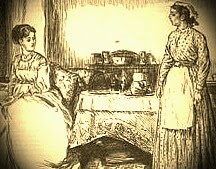
Attending to their every whim, whatever the time of day... The ladies maid - the mistress of the house's personal attendant, helping her to dress and do her hair.
Many aristocrats could afford a large team of live-in servants at their country estate, and there was a distinct social hierarchy in the servants' quarters.

According to Dr Lucy Delap, director of studies in history at St Catharine's College, Cambridge, servant status was reinforced at mealtimes.

"There would be a strict order of coming in to eat and strict rules about where different ranks of servants sit, and you might also have rules such as no speaking unless you were addressed by one of the senior servants," says Delap.

"The senior servants had a great deal of power, so the butler for example in some households would put down his knife and fork, and everyone else had to fit in whether you had finished or not. So servants had to learn to be fast eaters."
The pecking order and "who's who" of domestic service ~ Poor manners and classism recommended in "The Laws of Etiquette," from 1836. No wonder the author wanted to remain anonymous, and simply calls himself "A Gentleman."
"When women appear at the door of the coach to obtain admittance, it is a matter of some question to know exactly what conduct it is necessary to pursue. If the women are servants, or persons in a low rank of life, I do not see upon what ground of politeness or decency you are called upon to yield your seat. Etiquette, and the deference due to ladies have, of course, no operation in the case of such persons. Chivalry -- (and the gentleman is the legitimate descendant of the knight of old) -- was ever a devotion to rank rather than to sex. Don Quixote, or Sir Piercy Shafestone would not willingly have given place to servant girls. And upon considerations of humanity and regard to weakness, the case is no stronger. Such people have nerves considerably more robust than you have, and are quite as capable of riding backwards, or the top, as yourself."
The butler - in charge of the house, coachmen and footmen. He looked after the family and the wine cellar

The housekeeper - responsible for the housemaids and carried the keys to the china and linen cupboards

The ladies maid - the mistress of the house's personal attendant, helping her to dress and do her hair

The valet - the master's manservant, attending to his requests and preparing his clothes and shaving tools

The cook - ran the kitchen and larder, overseeing the kitchen, dairy and scullery maids

The governess- educated and cared for the children with the head and under nurse

The hallboy - worked 16-hour days, lighting all the lamps and candles and polishing the staff boots before they woke up

The tweeny - in-between stairs maid earned £13 a year, worked seven days a week from 5am-10pm and looked after slop duty.


Main article by Lucy Wallis for BBC News, published 21 September 2012


🍽️Etiquette Enthusiast, Maura J. Graber of The RSVP Institute of Etiquette, is the Site Editor for Etiquipedia© Etiquette Encyclopedia