Showing posts with label Italian Etiquette. Show all posts

Wednesday, May 1, 2024

Spotlight on Petra Carsetti


IN JULY 2021 THE ITALIAN PETRA CARSETTI JUMPED TO THE NEWS FOR WINNING A WORLD RACE OF WHAT?

Meet Italian Etiquette Authority and Etiquipedia Contributor, Petra Carsetti, Author of Galatime and Galatime Act II

Petra Carsetti was born into a gastronomic minded family… true lovers of excellent foods and wines. From an early age she showed a great passion for the table, which she later developed by working in important, well-known Italian restaurants. Since 2005, she has written many books on food and wine, along with guides to Italian restaurants, specializing also in galateo and etiquette at the Accademia Italiana Galateo and ANCEP (the Association of Ceremonialists for Public Institute). She teaches etiquette in schools to adults and children, is a consultant for various political and economic authorities, and she has a weekly column in a historic newspaper. She also writes for various other newspapers, is a frequent television guest. Very active on Instagram @galateopetra_carsetti, Petra is happily married to well-known wine and food aficionado, journalist and author, Carlo Cambi and together they have one daughter.

Below are links to just a few of Petra Carsetti’s numerous articles on etiquette and table settings you’ll find on Etiquipedia:

The following is a Q. & A. with Petra:

What was the impetus for starting your Etiquette business?
In reality, I've always had the impulse! Since I was a child I paid particular attention to how to set a table, empathize with people in front of me and know how to converse with everyone.

Why did you start? 
The 2016 the earthquake in the central part of Italy forced me to change my life. I therefore decided to enroll at the Italian Etiquette Academy to become a teacher of etiquette. In 2021 I also began to write books about etiquette.

What do you enjoy teaching the most regarding Etiquette? Surely the thing I like most is to make people understand that etiquette is the best tool for respect towards others and the use of kindness is the only true weapon to develop real progress towards the world and towards oneself.

What do you find rewarding about teaching Etiquette? 
I really love the amazement that I find in kids and teenagers when I teach them etiquette! They are always full of enthusiasm and curiosity.

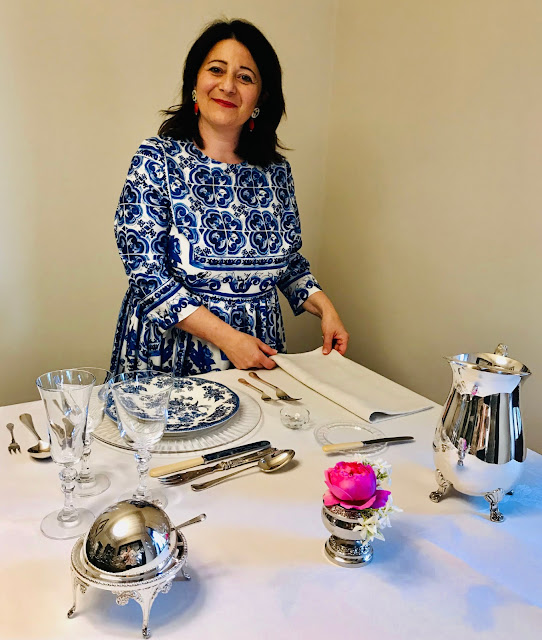
What types of classes do you offer? 
I give lessons for all ages. I enter primary and secondary school, organize workshops around Italy, chair private and public events to deal with etiquette issues at 360°.

What age group do you enjoy working with most? And why? 
As already written, I love working with kids because there is a purity without superstructures that allow me to awaken hidden passions and make them feel more confident about themselves and the world around them.

Who are some of the older etiquette authors or authorities you enjoy reading most? 
Surely one of them is Monsignor Giovanni della Casa, he is the founder of good manners in Italy and his rules (from about 1550) are still valid today. Another author is a woman, she is Elda Lanza and she wrote a book with a very clear title: Il tovagliolo va a sinistra (The napkin goes to the left, first edition 2016)

If you would like to reach Petra, you can find her on Instagram. She is very active there @galateopetra_carsetti — Petra’s etiquette books, Galatime and Galatime Act II are both available on Amazon.


🍽Etiquette Enthusiast, Maura J. Graber, is the Site Editor for the Etiquipedia© Etiquette Encyclopedia

Thursday, February 15, 2024

More Italian Etiquette with Galatime II

At the same time we can also decorate the table with small and harmonious ceramic objects (see for example in the photos the delight of the small Oriente Italiano egg by Ginori 1735 in periwinkle colour), but we avoid using fish-themed decorations if it is a meat dinner or using too much silver if it’s a rustic lunch. It is also possible to use a centerpiece that includes flowers, fruit or even vegetables; in the evening the combination of candles and flowers is permitted, but is mostly recommended for weddings.


From the new book by contributors, Petra Carsetti and Carlo Cambi, 

Galatime ACT II: Life as a stage of elegance


Many are unaware that candles during the day should not be used, not even for the centerpiece. They are only allowed for evening meals (usually after 8) and must be not too high (for the same principle as the flowers), nor too low not to make the hands and cuffs of the diners hot; the candles will be lit before sitting at the table and turned off when everyone has left, never in the presence of diners.

At the same time we can also decorate the table with small and harmonious ceramic objects (see for example in the photos the delight of the small Oriente Italiano egg by Ginori 1735 in periwinkle colour), but we avoid using fish-themed decorations if it is a meat dinner or using too much silver if it’s a rustic lunch. It is also possible to use a centerpiece that includes flowers, fruit or even vegetables; in the evening the combination of candles and flowers is permitted, but is mostly recommended for weddings.

We think that a beautiful table is the functional one and without ostentation: the furniture of the table with its elements of quality - even if few and not necessarily luxury - are just as important- as many as the quality of the ingredients of a menu! Menu that is key in organizing a successful invitation.

The first reason why it is good to prepare the menu in advance is that among our guests there may be vegetarian, vegan people, with intolerances and allergies or with religious precepts such as to require them to avoid certain foods. Thinking about suitable recipes means first of all having respect for our diners but also then not having problems in the kitchen having to make up for it with a delicious recipe at the last moment. If this were to happen, it would deprive us of the opportunity to be with our guests in serenity and for as long as we want to allow each other.— By Petra Carsetti and Carlo Cambi, 2023


Petra Carsetti was born into a gastronomic minded family… true lovers of excellent foods and wines. From an early age she showed a great passion for the table, which she later developed by working in important, well-known Italian restaurants. Since 2005, she has written many books on food and wine, along with guides to Italian restaurants, specializing also in galateo and etiquette at the Accademia Italiana Galateo and ANCEP (the Association of Ceremonialists for Public Institute). She teaches etiquette in schools to adults and children, is a consultant for various political and economic authorities, and she has a weekly column in a historic newspaper. She also writes for various other newspapers, is a frequent television guest and is very active on Instagram @galateopetra_carsetti

 🍽Etiquette Enthusiast, Maura J. Graber, is the Site Editor for the Etiquipedia© Etiquette Encyclopedia

Thursday, November 25, 2021

Italian Place-Setting Etiquette for Wines


A semi-formal place setting example from the new Italian etiquette book, by Petra Carsetti and Carlo Cambi,
GalaTime: it is always time for good manners”!

Taking as a reference the arrangement assumed by sommeliers (now more in vogue and certainly more used today) it must be specified that the water glass is placed in front of the tip of the main knife because it is a simple tumbler and has no stem: a low glass (that's why in the front row) which will be followed by the second-order glasses of service, starting therefore from those for the white and then for the reds (gradually more and more structured). 

In this case, in order to better enhance the organoleptic properties of the wines and their scents, glasses of different shapes and sizes are set, both for whites and reds such as tulip or balloon (the latter must be placed at the table at the time of serving the specific wine and not before). If you follow the rules of the sommelier, the “battery” of the glasses should be made up of at least six different containers for the wine (which must not be set all together but with a maximum of 3 glasses.) Translated from “Galatime,” by Petra Carsetti and Carlo Cambi


Petra Carsetti was born into a gastronomic minded family… true lovers of excellent foods and wines. From an early age she showed a great passion for the table, which she later developed by working in important, well-known Italian restaurants. Since 2005, she has written many books on food and wine, along with guides to Italian restaurants, specializing also in galateo and etiquette at the Accademia Italiana Galateo and ANCEP (the Association of Ceremonialists for Public Institute). She teaches etiquette in schools to adults and children, is a consultant for various political and economic authorities, and she has a weekly column in a historic newspaper. She also writes for various other newspapers, and in September she will come out with her new book, “GalaTime: it is always time for good manners”!


Etiquette Enthusiast, Maura J. Graber, is the Site Editor for the Etiquipedia© Etiquette Encyclopedia

Friday, October 29, 2021

Table Etiquette and Beverages


Tipologie di bicchieri e tazze secondo il codice internazionale. Or… Types of glasses and cups according to the international code.- From “GalaTime: it is always time for good manners”!


When setting the table, always pick up every object on the table with a cloth, a towel or gloves (preferably white and cotton) so as not to leave fingerprints and streaks; I have happened to see some people holding the glasses by putting their fingers inside the glass. Never do this! Always pick up glasses from the stem or from the bottom, checking that there are no lime stains, that they are clear and transparent.

As we have already said, make certain that they do not have the smell of a cupboard, because it can happen that if glasses are not often used, scents or smells can emanate from them and alter the scents of the wines. It should also be emphasized that etiquette requires that wine or other beverage glasses are never colored. They may have small decorations, but they are always transparent.

Plan for that every four diners at your dinner table, you will have at least one jug of water, a wine decanter, a salt shaker each time. (If you are a guest, never ask the hostess for salt if it is not already on the table).

Water and all other beverages are not properly brought in plastic containers to the table: crystal, silver or glass are absolutely the materials which are preferred when entertaining; we can decide to decant a wine in special decanters, but nowadays, in agreement with the sommellerie, the original bottle on the table is granted, perhaps accompanied by a coaster, to avoid staining the tablecloth. 

Although already mentioned in another chapter, it is reiterated that the cans of the various beverages on the market are banned from the table and not only for a good aesthetic taste linked to the art of the device, according to etiquette, but above all because we know well that many they contain too much sugar which is harmful to both the figure and our health. Therefore, let us eliminate them from the diet, especially that of our children, so as not to accustom them to a wrong taste: better then replace these drinks with home-made infusions or healthy citrus juices. – Translated from “Galatime,” by Petra Carsetti and Carlo Cambi


Petra Carsetti was born into a gastronomic minded family… true lovers of excellent foods and wines. From an early age she showed a great passion for the table, which she later developed by working in important, well-known Italian restaurants. Since 2005, she has written many books on food and wine, along with guides to Italian restaurants, specializing also in galateo and etiquette at the Accademia Italiana Galateo and ANCEP (the Association of Ceremonialists for Public Institute). She teaches etiquette in schools to adults and children, is a consultant for various political and economic authorities, and she has a weekly column in a historic newspaper. She also writes for various other newspapers, and in September she will come out with her new book, “GalaTime: it is always time for good manners”!


Etiquette Enthusiast, Maura J. Graber, is the Site Editor for the Etiquipedia© Etiquette Encyclopedia

Saturday, October 16, 2021

Etiquette and Table Service Styles

This post below is from “Galatime” the new Italian Etiquette book by Petra Carsetti and her husband, Carlo Cambi – I am very pleased to say that I will be sharing more from Petra’s new book in the coming weeks:
“The etiquette of the new millennium for those who love to live well and in harmony with others; for those who are curious to know the origins of “good manners,” for those who want to socialize with certainty of manners and education of thought. It is a sort of invitation to the renaissance of the encounter. But it is also an essay, which can be read almost in the form of a novel, on the history of costume, as well as a friend to ask for advice on doing the right thing at the right time. Because beyond the fashions, the ways count. To understand this there is Galatime”

English, Russian, French and Italian Service


Here is a review of the main existing services:

Russian (or guéridon) service takes advantage of a trolley placed near the table from which a waiter (a servant in the house) divides and makes the dishes that are served to the right of the diner; this type of service requires expert hands in portioning.

English service: the waiter (or the servant) from the serving dish divides and serves the diner directly from the left with tongs; this method is widely used in receptions and banquets because the service is very quick and fast, but often if it is not performed by expert hands, it could lead to splashes of sauce, stains and food falling from the serving plate directly on the tablecloth or on the clothes of bystanders.

French service which in turn is divided into: 
1. Direct, in which a servant or a waiter hands a serving dish to the left of the diner with a serving utensil (or utensils) from which he will serve himself according to his own taste and hunger; this type of service allows guests either to be able to take the desired food without exaggerating the portion if it is not to one's liking or by abounding a little more (never excessively) if it is a very popular dish;
2. Indirect when the different foods are served in trays set on other tables or trolleys and each table serves itself using the servers found in each individual serving dish. It is a very informal method that can be taken into consideration, for example, in dinners with a large number of guests; naturally if you choose this type, you must set up tables with free spaces to be able to move, food warmers for dishes that must be kept warm, far from those that must be kept cold.
Italian service (or al plate, service surassiette) is that which involves the preparation of the dish in the kitchen and then brought directly to the diner, served from the right. This system is the most used, perhaps the most elegant and refined (it is no coincidence that in starred restaurants it is the only type of service, in which the dishes are often covered by a cloche) but it has the flaw that the guest cannot decide the quantity of food to be taken and therefore he will be forced to eat a large portion even if he does not find it to his liking. In a formal meeting at home, if there is no domestic help, it would impose a prolonged or continuous absence on the hostess. 

From all these types of service we learn to choose the one that best suits your occasion, knowing however that the dishes are always removed from the right and put back clean from the left; one or more trolleys are set up to place both the dirty dishes (on the floor below, covered with a cloth) that will never be stacked one on top of the other on the table, but cleared one at a time with the respective cutlery even if they are not used (maybe put all in a special container), and the clean dishes that will have been prepared previously on the upper level of the trolley and then given to diners without having to be absent continuously.
From “Galatime. È sempre tempo di buone maniere”
It should be specified that the cheese must of course be brought just before serving the pasta or soup and removed immediately afterwards; the menage must be removed when the saucer or crescent for the salad is removed; first the serving dishes must be removed and then the dinner plates. Finally, remember that everything must be cleared before dessert, except the glass of water (with its carafe) and the centerpiece. – From “Galatime,” by Petra Carsetti and Carlo Cambi


Petra Carsetti was born into a gastronomic minded family… true lovers of excellent foods and wines. From an early age she showed a great passion for the table, which she later developed by working in important, well-known Italian restaurants. Since 2005, she has written many books on food and wine, along with guides to Italian restaurants, specializing also in galateo and etiquette at the Accademia Italiana Galateo and ANCEP (the Association of Ceremonialists for Public Institute). She teaches etiquette in schools to adults and children, is a consultant for various political and economic authorities, and she has a weekly column in a historic newspaper. She also writes for various other newspapers, and in September she will come out with her new book, “GalaTime: it is always time for good manners”!


Etiquette Enthusiast, Maura J. Graber, is the Site Editor for the Etiquipedia© Etiquette Encyclopedia

Wednesday, August 7, 2019

Italian Hand Kiss Etiquette

An Italian man kisses the right hand of his mother, aunt or elderly friend and the left hand of his sweetheart.


If the woman who visits Rome wishes to follow tradition and “do as the Romans do,” she will be careful never to take her escort’s arm in a Catholic church. Indeed, the guides instruct those who stroll innocently arm in arm about St. Peter’s looking at the pictures, frescoes and altars of that wonderful cathedral, that they are committing an impropriety. Italians are very particular about the etiquette of kissing the hand. 
A man kisses the right hand of his mother, aunt or elderly friend and the left hand of his sweetheart. It is not permitted him to kiss the palm of the hand except in great and affectionate intimacy. It is regarded as a token that he is very much in love. Upon arriving at a formal dinner a gentleman takes the hand of his hostess and bends low over it as if about to kiss it, but does not do so. After dinner etiquette demands that he take her hand again and kiss it. —New York World, 1893


Etiquette Enthusiast, Maura J Graber, is the Site Editor for the Etiquipedia© Etiquette Encyclopedia

Monday, May 28, 2018

Etiquette and a Royal Alpine Hostess

The Italian Alps (above) – “The Queen was overtaken by a severe snowstorm, which obliged her and her few attendants to take refuge in a hut belonging to the Alpine Club, which was soon full of climbers of all nationalities, who, when they knew who she was, at once offered to leave the humble quarters entirely at her disposal. “On no account,” exclaimed the Queen, “the hut must do for all. I am the hostess, and we will spend the night as comfortably as we can.

Margherita on the Mountains –  Italy’s Queen’s Prowess as an Alpine Climber

Queen Margherita, the delicate woman of fashion, the somewhat indolent beauty of the Quirinal, where the strict and severe etiquette of the House of Savoy surrounds her as with a cloak, has left Rome, and has arrived at Gressoney, in the midst of the Alps, where a metamorphosis takes place and the admired Sovereign becomes an Alpine climber in the real meaning of the word. She dresses in the peasant costume with short skirt, good stout boots and Tyrolese hat, and, alpenstock in hand, does her climbing either on foot or riding a favorite donkey. 

During a famous ascent in 1888 of the Peak of the Giant, 12,4000 feet above the level of the sea, the Queen was overtaken by a severe snowstorm, which obliged her and her few attendants to take refuge in a hut belonging to the Alpine Club, which was soon full of climbers of all nationalities, who, when they knew who she was, at once offered to leave the humble quarters entirely at her disposal. “On no account,” exclaimed the Queen, “the hut must do for all. I am the hostess, and we will spend the night as comfortably as we can.” After this, the Italian Alpine Club presented their Sovereign with a magnificent diploma, of which she is very proud, and replaced the hut with a refuge to which they gave the name of “Regina Margherita.”

The Italian Sovereign during her stay at Gressoney stops at the villa of the Barons de Peccoz. In the Peccoz family, the duty of accompanying the Princes of the House of Savoy in their Alpine climbs seems almost hereditary. The late Baron, who in his youth accompaned the Duke of Genoa and Prince Thomas, father and brother of the Queen, in all their mountain excursions, was the faithful guide of Queen Margherita, until in the summer of 1895, when, while ascending a mountain at her side, he suddenly fell at her feet and died in a few moments. Now his sons have taken his place. The sturdy mountaineers of this part of the Alps tramp many miles to see her, and when she enters any of their villages, they receive her with flowers and enthusiastic manifestations of devotion—her climbing powers, added to her kindness and personal attractions making her come next to the Madonna in their hearts. One might ask. where Margherita feels more a sovereign – in the Quirinal, or on the Alps? — Rome correspondence Pall Mall Gazette, 1897


Etiquette Enthusiast, Maura J. Graber, is the Site Editor for the Etiquipedia© Etiquette Encyclopedia

Wednesday, October 7, 2015

Etiquette and Hands at the Table

Renaissance etiquette and one's hands at the table– On the Continent of Europe, propriety enjoins diners to sit with both hand in full view of the company; most correctly, unused hands should rest on the table's edge, being visible only from the wrists. 
Anglo-Saxon table manners allow, even prefer, the diner should eat where only one hand need be used, with the left hand lying on his or her lap.  It is a limitation upon one's ability to grab things, like the decision to use only the right hand, or only three fingers.  On the Continent of Europe, however, propriety enjoins diners to sit with both hand in full view of the company; most correctly, unused hands should rest on the table's edge, being visible only from the wrists.  (Erasmus had commanded boys to “have both hands on the table, not clasped together, nor on the plate.”)  The Anglo-Saxon custom of permitting guests to sit with one hand hidden seems, to Continentals, at best a sad sign of naiveté.

One reason for hands being kept in sight used to be the people had to learn not to scratch at table. Della Casa’s, “Galateo” says, for instance, that waiters were not to scratch their heads– or anything else –“nor place their hands on any part of the body which is kept covered, nor even appear to do so, as do some careless servants who hold them inside their shirt or keep them behind their backs hidden under their clothes. They must rather keep their hands in sight and out of suspicion... .” 

This rule holds even more strongly for diners, who are constantly warned not to stroke their beards, twiddle their mustaches, rub and pat themselves, or scratch their heads. Erasmus says it is unsightly to scratch, especially if it is done through habit rather than necessity. John Russell's “Boke of Nurture” counsels against “clawing your back as if after a flea; or your head as if after a louse.” Fleas, like gristle in the mouth or fibers wedged between the teeth, are to be ignored by polite people. The discomfort they cause must be heroically endured and not only hidden from view, but kept from the suspicions of others. – Margaret Visser’s, 1991, “The Rituals of Dinner” 


🍽Etiquette Enthusiast, Maura J. Graber is the Site Editor for the Etiquipedia© Etiquette Encyclopedia

Sunday, September 6, 2015

Etiquette and Success

With no manners, it means he's no social success.


“Success without culture is like old-fashioned strawberry short cake without the whipped cream. It has no flavor."

"There are certain little courteous observances, certain social formalities that bespeak the true lady, the true gentlemen. Some of us call it good form. Some of us call it culture. Some of us call it etiquette. But we all admit that it makes the world a better place to live in.


In Italy, young men and women are considered ben educato, not when they can read and write, but when they know the established forms of convention—when they can show by a correct dignity and ease of manner that they are perfect in their knowledge of the rules of good society. And, after all, don't you yourself judge people by what they do, and say, and wear? Don't you read in their manner and appearance the secret of their inner worth? Isn't character and disposition revealed in the outer personality?


Perhaps you have heard the story of the "gentleman" who prided himself on being perfect in the art of etiquette. On one occasion, he passed a lake and heard a drowning man call for help. Quickly he threw off his coat and was about to plunge into the water, when he suddenly remembered that he had never been introduced to the struggling victim. Putting on his coat again, he proceeded on his way quite self-satisfied.


This is an instance where common-sense would have been the better part of etiquette. Too rigid an observance of the laws of good society makes them nothing short of an absurdity. The purpose of correct manners is not to enable us to strut about in society and command the admiring glances of the people around us—as the peacock, in its vanity, parades before onlookers in a proud dignity that is quite obviously assumed. The true service of etiquette is so to strengthen and simplify the social life that we are able to do what is absolutely correct and right without even stopping to think about it.” — From Lillian Eichler's, 1924, “Book of Etiquette–Volume I.”

Etiquette Enthusiast, Maura J. Graber is the Site Moderator for Etiquipedia© Etiquette Encyclopedia

Sunday, July 5, 2015

Etiquette and Diplomacy Gone Awry

Baron Saverio Fava founded the Italian Ministry in Washington, D.C.. He served as the first Italian Ambassador of the then recently unified Italy to the U.S. from 1881-1893. As Ambassador, Baron Fava also served as the Dean of the Diplomatic Corps. Prior to service in the U.S., Fava served Italy as an Ambassador in Brazil and Romania.

The Baron vs the Lieutenant
“A Story of American Independence and Official Etiquette” ???

The Washington Capital publishes the following story of Lieutenant Lucien Young, the naval officer who is not permitted to publish his book on Hawaii, because it is considered to reflect on the record of the Cleveland administration. That scene of the present incident is laid during the Harrison regime, when Benjamin P. Tracy was Secretary of the Navy.
             
It was Lieutenant Young, according to the story, who a few years ago offered to teach Baron Fava, the Italian Embassador, a lesson in American manners. The international episode was the request made by the Embassador to the Secretary of the Navy for a report upon a subject of great importance to him, which he begged might be delivered the same evening, in order that he could forward it to his Government in the morning mail. Lieutenant Young was detailed to prepare the information. 


He worked all day and all the evening, with only a sandwich and a cup of coffee, excused himself from a dinner party and from an engagement he had made to take some ladies to a ball. The memorandum was completed about midnight, when he got a cab and drove to the Italian legation. It was closed and dark, and no one answered his summons. Then he went to Baron Fava's residence, where he was told that the Embassador was dining out. He went to the house where the dinner had been given and learned that the Baron was at the ball which he himself wanted to attend, but found there the Baron had left a few minutes before.

Then Young gave up the search and went to his club. The first man he saw after entering the door was the Italian Embassador drinking wine with a party of friends. Lieutenant Young approached him with a proper salute and, after a few words of explanation, offered him the. papers. The Baron haughtily declined them. "You impertinent fellow," said he; "why did you follow me all over the town? I am the Embassador of Italy, and I do my business at the legation of my Government. You should have had the papers there before I left this afternoon. Instead of that you disturb my friends by entering their houses and intrude upon my club. I will report your impertinence to the Secretary of the Navy tomorrow."  

Lieutenant Lucien Younger has an interesting and colorful history, complete with a ship being named in his honor and complaints of anti-semitism.

The sea dog from Kentucky was very red in the face by this time, and made the following remarks: "You ungrateful old macaroni-chewing monkey tamer, I am a member of this club and you are only a guest, but if you will come out into the street for five minutes I will teach you a lesson in North American manners. There are the papers I have spent fifteen hours in preparing for you," and he threw them on the table. "You can take them or leave them, as you like." The Baron called upon Secretary Tracy the next day and complained that Lieutenant Young had insulted him. The Secretary sent for the offender, who related the affair as I have told it, including the benediction he had pronounced. The Secretary had pressing business in the next room for a few moments and when he recovered himself asked what the Embassador had to suggest. Baron Fava demanded that the lieutenant be reprimanded. "Consider yourself reprimanded," said the Secretary gravely, and Lieutenant Young bowed and left the room.
—The Washington Capital, 1895


Etiquette Enthusiast, Maura J. Graber, is the Site Editor  for the Etiquipedia© Etiquette Encyclopedia

Saturday, April 18, 2015

19th C. Italian Etiquette vs American... cont.

More on...

 "How Italians Educate Their Children:
A regimen which gives prominence to fine manners, free intercourse of the different classes in Italy, and why it pays to be polite."
I do not think that Mr. Jarves had any Italian offspring like Madoonna in mind when he wrote his 1880 article on Italian parenting and etiquette, but still, she is sending his message, "Italians do it better," all the same ~ The talent, or "smartness" which finds success in any chosen line is considered to be the most enviable quality children can show. Absorbed in their own business or pleasure, they are disinclined to make time, as do Italian and French fathers, to instruct and initiate their children in the customs and wisdom of the world, while winning their confidence in multiform sympathetic ways.

The sincerity of affection of American fathers for their children cannot be questioned, but the quality of its practical manifestation as a whole is open to comment. American fathers are too reserved and undemonstrative; two little given to intimate association with the joys, chagrins, and personal training of their children. From want of practice they do not know how, as do European fathers, to participate in their lives and become their confidential companions. They are over-solicitous to see them on an independent, self-made footing early in life, working out their own careers prematurely, in their separate responsibility, while relieving them of theirs in the matter.

The talent, or “smartness” which finds success in any chosen line is considered to be the most enviable quality children can show. Absorbed in their own business or pleasure, they are disinclined to make time, as do Italian and French fathers, to instruct and initiate their children in the customs and wisdom of the world, while winning their confidence in multiform sympathetic ways. A New-England father, cold and commanding in deportment, when not forgetful and indifferent; austere and abrupt and speech, if not taciturn and careless, bountifully provides the means of education, comfort, and entertainment of his offspring, and is prompt to enunciate Lycurgian rules and abstract apothegms for their guidance by already physically and mentally over-taxed mothers, or those whom he liberally pays to vicariously execute the most needful of his own duties, in the inculcation of those habits and principles on which the future welfare of his family depends.
 
Hence, between American fathers and sons there is less free intercourse and affectionate courtesy, with intermingling of pleasures and interests, than in European families. Domestic life has more centrifugal than centripetal force. In infancy there is begotten a restraint which tinges all subsequent intercourse between them, and leaves uncomfortable associations on both sides. This state of domestic life is more a defect of the head than heart, chiefly arising from the neglect to cultivate those endearing habits and manners which should be the crowning grace of intellectual accomplishments and parental authority.

The tact with which cultivated Italians pay compliments is equal to their fastidious sense of personal beauty. Nothing elicits more heartfelt admiration than grace or brightness, particularly in children. The most common place are noticed, while any special attraction gets enthusiastically praised. Their quick eyes, even in adults, seize on any distinguishing feature, if it be only a well shaped ear or nose, or other minor organ, and cordially praise that, politely ignoring the homely ones out of consideration of the feelings of their possessor. Their aesthetic sympathies are so keen that they detect charms which untrained senses overlook. They are much less prone than Anglo-Saxons to see only defects and crudely condense them into one sweeping condemnation of absolute ugliness or badness, with no discrimination of mitigating or compensating details.
 
In social intercourse they are less inclined to the superficial, impressive, and wholesale prejudices of people of coarser fibre and colder hearts, in regard to persons of unprepossessing appearance. Instead, they charitably discover something to recommend the most forbidding in looks, if, like themselves, well bred, while their respect to age is particularly commendable. Whether this conduct springs from charity of heart or policy of head, it is certainly good breeding. 
The habit of considering others sometimes brings unexpected results. There lived in Florence some years back and Irish painter of merit, who was on the verge of starvation from inability to sell his works. One evening as it so happened that the journal he had taken up at a café to distract him was asked for by a stranger. He immediately handed it to the inquirer, saying another would serve his purpose as well. This led to an acquaintance, which ended in his selling all of his Winter's work to his new friend, who was an amateur, and placing him at once in a comfortable position. 
Another more remarkable instance is the following: An elderly gentleman, partially paralyzed, was traveling by himself in a railway carriage, in which was a young lady, unknown to him. Accidentally dropping the newspaper he was reading, and finding it difficult to recover it, she promptly assisted him, following it up by other little services and pleasant conversation. When the train stopped she considerately assisted him out. He begged her address, which she gave him, and soon the incident faded out of her mind. 
A year afterward, to her astonishment, she received a letter from the old gentleman's lawyer with the intelligence that he had died, and bequeathed her $150,000, "because of her politeness to a stranger." This was indeed casting her bread of civility on the waters of life to some purpose, and forcibly illustrates the power of "politesse de coeur," as the French aptly designate this humane accomplishment.
Matthew Arnold defines civilization as the “humanizing of man in society.” Politeness is one of the most efficient agents in affecting this transmutation of human nature. Poetry, music, painting, and sculpture or even less direct agencies in its improvement, for polite manners are apostolic in their proselytizing functions. No supreme civilization is reached, however, on a single line of progress. To form a complete, well-rounded humanity, scope must be given to every healthful aspiration and no faculty left to lie dormant. The ideal race is yet to be created out of the perfections of all. Hebrewism has given us religion, the spiritual aspects of faith, sacrifice, obedience, duty, and worship as its supreme ideal; Hellenism, the might of philosophy, beauty, and mind in heroic guise of earthly mold; Rome, The power of unity and supremacy of law. 
Germany now proffers inquiry, scientific analysis, and thought; the Latin races, their sensitiveness to beautiful form and behavior; their delicacy of apprehension and technical touch; England, her broad eclecticism, practical skill, and resolute utilitarianism, while inventive, receptive America, the mosaic of nations, opens her doors with the impartial welcome to all but benign influences. Let us hope that humanities highest polish and finest amalgamation will finally be ours. But to secure, this something besides a deep-seated passion for beauty, abstract truth, or prosaic utility is required. 
Progress toward the ideal to be lasting, must be as deeply rooted in the heart as the head. It's complete code exists only in the divine principles of the gospel of Jesus Christ, who is the most beautiful manifestation of spirit in the flesh vouchsafed to men. He was the complete gentleman. His perfect brotherhood, gentleness, truth, sympathy, sacrifice, intuition, forbearance, courtesy, kindness to women and children; His energy, courage, and righteous anger; His devotion to His one great object, the alleviation of life's miseries, succor of the afflicted, healing of the sick, regeneration of all man; His exalted, purifying doctrines and practice- all this, combined with an aesthetic temperament that made Him, the most radical of reformers, enjoy nature and art, wear fine apparel, and come "eating and drinking;" a Saviour appreciating the refinements and blessings of life, not despising and fearing them like a misery-coveting, cowardly ascetic; this makes Jesus, after 18th centuries of example, still the "first gentleman" of all time, universal Teacher and ideal man of humanity. 


From “How Italians Train Their Youth,” an article originally published in the NY Times, sent from Florence, Italy, August 10, 1880, by James Jackson Jarves


🍽️Etiquette Enthusiast, Maura J. Graber of The RSVP Institute of Etiquette, is the Site Editor for Etiquipedia© Etiquette Encyclopedia

Friday, April 17, 2015

Etiquette and 19th C. Italian Youth

“The Grand Duchess sent for her daughter, a girl of 17, who had been to her first ball the night before, but was not yet considered as having ‘come out.’After presenting her, during the chat that ensued she was required by her mother to stand, while we remained seated, which to my American notions and experience of the homage paid by their elders to our young girls, seemed to me quite an awkward and painful reversal of the proper order of things.” 

How Italians Educate Their Children:

A regimen which gives prominence to fine manners, free intercourse of the different classes in Italy, and why it pays to be polite.   
Where every one obeys its rules it allows a more familiar and genial intercourse between all ages and conditions of society...

Italian children are drilled in society manners as soon as they can toddle about. Especially are they taught deference and polite attention to ladies and older persons. Complimentary phrases of speech, and an easy, graceful demeanor become as natural to them in a short time as to their parents. Too much stress in comparison with more important things in no doubt is attached to etiquette alone. But where every one obeys its rules it allows a more familiar and genial intercourse between all ages and conditions of society than when there is no prescribed code of manners to emeliorate social contrast and protect individual position, and everybody is on the defensive lest the artificial barriers of differing social positions be invaded.
A state of society in consequence has been long established that admits and encourages pleasant but respectful familiarity between the varied ranks of the population. I will illustrate the practical working of this system in Italy. One of the ancient palaces in my vicinity is occupied by several families of the nobility. In the upper story there is a girl's school for children of the better classes. The daughter of the porter of the palace is received in it without pay, given the same advantages as the daughters of the Countesses and the Marquises her father served, and, treated precisely the same by all, is spared those petty but spirit-wounding reminders of social distinctions and pretensions with which
Anglo-Saxon girls delight to afflict those they assume to look down upon. Another school girl, of similarly humble position, is frequently invited by one of the noble ladies to be the companion of her daughter when she visits her villa during the vacations, partaking of all her privileges. Of course, such familiar intercourse can exist with mutual advantage, and no confusion of the essential proprieties of life, only in a country where society is on an established basis, and the refinement, and polish that belong more particularly to the more favored individuals extend to the less fortunate and become the rule of all. 
19th century Italian women with their children ~ “Italian children are drilled in society manners as soon as they can toddle about. Especially are they taught deference and polite attention to ladies and older persons.”
Royalty is perhaps the most rigid of all the ranks in exacting obedience in children to those rules of etiquette which are considered proper to their age, without regard to their future position. On one occasion, when, by request, I had called on the sister of one of the great sovereigns of Europe, the conversation turned on children. The Grand Duchess sent for her daughter, a girl of 17, who had been to her first ball the night before, but was not yet considered as having "come out." After presenting her, during the chat that ensued she was required by her mother to stand, while we remained seated, which to my American notions and experience of the homage paid by their elders to our young girls, seemed to me quite an awkward and painful reversal of the proper order of things. But I am now persuaded that the European system of discipline of youth, in parting it in seasoned self-restraint, and deference to age, is more salutary to character than the license to self-indulgence not only tolerated but encouraged in America.
Anglo-Saxons, for sanitary reasons, do not permit their children to keep late hours with their elders, eat late meals and go to late amusements, as do Italians, no doubt prematurely maturing the minds and customs of their offspring at the expense of health. Apart from these cogent considerations, the habit of constant familiar intercourse with their parents and elders gives them a quiet, respectful demeanor, and puts them at their ease in any society. Early accustomed to be noticed and praised for good looks, behavior, or points of dress, they seek to emulate the aesthetic style of the adult society of which they make a part.
Socially, an accomplished Italian is, undoubtedly, more or less of an actor, but in legitimately seeking to please he pays a complement to society and an homage to virtue.
According to our ideas, no doubt they often seem tame and colorless, or else unnaturally restrained in one direction and developed in another; but they are early fitted for their future positions without disturbance to the social machinery about them. At their ease and self-reliant in society, when Anglo-Saxon children would be constrained or awkward, they lose much in other respects, in force of character, independence, and self judgment, where initiative action is required, in which essential points American youth excel. The social restraints, narrowness of intercourse, and excessive formula of etiquette a fashionable Italian life, with its extremes of bigotry or atheistical materialism, would ill suit the Anglo-Saxon freer spirit, greater breadth of view and latitude of personal action.

Socially, an accomplished Italian is, undoubtedly, more or less of an actor, but in legitimately seeking to please he pays a complement to society and an homage to virtue. There are instances, doubtless, in which skillful acting is a hypocritical pretense to cover up some base end, but such are the exceptions to a general rule of politeness which is based on the genuine disposition to please and be pleased in social intercourse.


Article Originally Published in the NY Times, Sent From Florence, Italy, 
August 10, 1880, by James Jackson Jarves


Etiquette Enthusiast, Maura J. Graber, is the Site Editor for the Etiquipedia© Etiquette Encyclopedia

Wednesday, December 3, 2014

Italian Dining Etiquette

If you're in Italy, most likely a large amount of your time will be spent eating. Make sure you do it right and read the do's and don'ts of the Italian dining table. 

Since Italian writer, Monsignor Giovanni Della Casa, published his 1558 treatise "The Galateo of Giovanni della Casa" (the word for "etiquette" in Italian is still "il galateo") on polite behavior in the 16th century, etiquette has become an important part of Italian society. It was the first of the modern books on etiquette that was not written for a special class of people. Centuries later, Alberto Presutti is convinced that etiquette still holds the key to "an effective communication between each one of us".  

Alberto 
Presutti, a Florence-based etiquette instructor who offers courses on anything from dining to business etiquette, gave The Local his tips on Italian dining…

Don't arrive early or on time. Fashionably late is the norm, as Italians are not famed for their punctuality. It pays to remember this fact when you’re invited to a dinner party. “Always arrive a few minutes after the appointed time – never before,” advises Presutti. “Take for granted that your host will still be preparing the food.”
"Buon Appetito" is likely one of the first expressions you learn in Italian. It's also one of the first you should forget.
One of the first phrases you may have learned in Italian is “buon appetito”; it’s also the first one you should forget. “Wishing someone ‘buon appetito’ in Italy is impolite,” says Presutti. “This is because in Italian courts in medieval times, the prince would sometimes offer banquets to his best servants and wish them “buon appetito” – meaning: ‘eat as much as you can because you may not be invited to another feast if you don’t behave yourselves.” Coincidentally, Etiquipedia has heard that this is the case in France as well. So forget the French phrase "bon appétit" if visiting there.
Place napkins on your lap only after the food has been brought to the table.
Hands should be seen. “Wrists should be on the table, but never your elbows. And don’t cross your hands,” warns Presutti. “That’s considered rude - it may look to others as if you’re hiding something," or even - God forbid - "touching yourself".

Regarding napkins, says Presutti, “These should be placed on your lap only after the food has been brought to the table. Use one by all means to wipe your mouth, but take care that the dirty part of your napkin is hidden.”

Regarding bread, rolls or breadsticks, Presutti advises “In Italy, we are big bread-eaters,” says Presutti. “It must always be served on a small plate to the left of your main plate, and broken off rather than cut with a knife – it’s the Christian way.” Stuffing yourself with bread before the meal arrives should be avoided. Presutti suggests nibbling on some grissini (breadsticks), which looks more elegant, if you really can’t wait to eat.
This knife and fork set, while unusual, is obviously for the fish course.

Always try to reach for the right fork. “In Italy, fish must be served with a special three-pronged fork and a knife similar to a butter knife,” says Presutti. However, he warns, don’t whatever you do use the knife to cut the fish. “The purpose of the knife is to remove the skin of the fish – you can use the fork to cut the flesh.”

Most people know that food and wine in Italy are like yin and yang. Don’t expect to have one at a meal without the other. “You’ll find that the wine will only be brought out with the food. This is because each wine is designed to go with a specific dish. Red wine will always be served with meat, whereas white wine will always be produced for fish –because it has a more delicate taste.”
Forget about your diet. “Being on a diet and having a meal are considered a contradiction in terms - so avoid mentioning to the host that you’re trying to lose weight,” says Presutti. Having said that, you will be forgiven for declining dessert. If you’re a vegetarian, you may be happier visiting a different country altogether: “In Italy, vegetarians are regarded as aliens from another planet.” And take note that a gathering with Italians can tend to be a bit noisy, with several people all speaking at the same time and talking over one another. Culturally, this is normal Italian social interaction and should not be mistaken for rudeness.
As with dining in any other country, watch your host. “You should only pick up your cutlery when the most important person in the room starts eating,” recommends Presutti. “At a private dinner party, this could be the hostess or simply the oldest guest at the table. At a business lunch, it would be the boss.” However, he adds, “in a restaurant, it’s fine to start first if your meal arrives before the others.”

With regard to the head of the table; “In Britain, hosts will nearly always sit at the far ends of a table - but in Italy, they sit in the middle of the longer sides of the table,” says Presutti. What if it’s a round table? “Imagine that there’s an invisible line going through the centre: the hosts will sit at either end.”


The main article referenced for this post appeared in Italy's, "The Local"


Etiquette Enthusiast, Maura J. Graber, is the Site Editor for the Etiquipedia© Etiquette Encyclopedia