Showing posts with label Reaching for the Right Fork. Show all posts

Monday, October 12, 2020

Social Dilemma Solved by Sardines


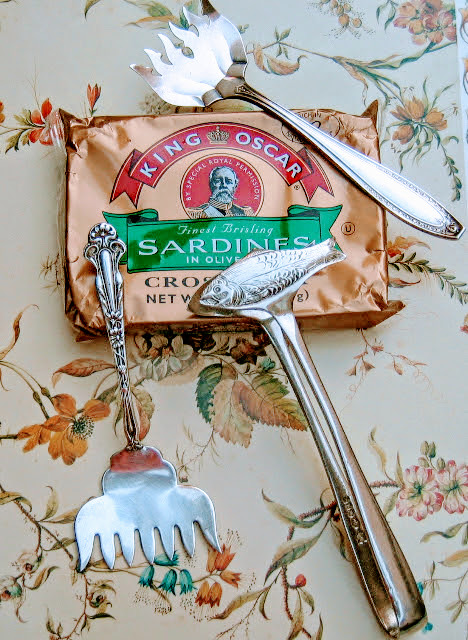
Antique silver sardine servers — Knives are really only used with any dish that requires to be cut, such as cutlets, oxtail, filets de boeuf, grenadines of veal, hashed venison or beef, for these and similar dishes, a knife is a requisite. Sweetbreads are never eaten with a knife, for if they are properly cooked, they are so tender that a knife is quite wrong and out of place. Any mince with poached eggs, or puree of meat, game, or poultry, is also eaten with a fork only. It is usual to eat salads with both knife and fork, mayonnaise also. Omelettes, both savoury and sweet, are eaten with the fork alone; toasted cheese or Welsh rarebit with both knife and fork, which would also be used for most savouries, such as “sardines on toast,” “bloaters,” Anchovy toast, with poached eggs, all kinds of  ‘devils,’ ‘ham toast.’ Forks only would be used in eating ‘macaroni au gratin,’ ‘soufflés,’ whether savoury or cheese, ‘scalloped oysters,’ ‘tartlettes,’ whether savoury or sweet, creams, jellies, iced puddings, blancmanges, indeed all kinds of sweets of sufficient consistency to admit of it. — Lady Constance Eleanora C. Howard

SOCIAL DILEMMA 

Unexpected guests for an evening will often tax your ingenuity for a suitable luncheon. You can solve this social dilemma by having on hand always Booth’s Crescent Brand Sardines. One tin will make a splendid luncheon for four, and a more delicious, tid-bit was never tasted by anyone, than these savory little fish from the Bay of Monterey. They are larger than ordinary sardines and better, so much better that you will wonder why they are called sardines. 

Try a can and you’ll buy a case, for you’ll never want to be without them. 20 cents a tin at grocers everywhere. One tin is enough for a luncheon for four. Put up by Monterey Packing Company, Monterey, California. F. K. Booth, Sole Agent, San Francisco. Booklet of recipes for serving Crescent Brand Sardines mailed free if you send the name of your grocer. — Stockton Independent, 1910

Antique porcelain sardine box with antique silver set of sardine knife and fork, sardine lifters and sardine tongs — “Early tinned and canned items were too expensive for those in the lower, and even middle-class income brackets, at the time. Sardines were one imported tinned food that the wealthy could afford to serve, so sardine servers, dishes and tongs, were offered in abundance at the time. Tinned sardines and other such foods, suddenly offered an elegant way to not only outdo one’s neighbors, but another way illuminate one’s home.” — Maura Graber in “Reaching for the Right Fork”


Etiquette Enthusiast, Maura Graber, is the Site Editor for the Etiquipedia© Etiquette Encyclopedia

Wednesday, August 21, 2019

Affectation vs Tact and True Politeness

“It’s not the correct fork which exhibits good manners, but the person eating from the fork.”  
– Maura J. Graber
“Consideration of others is the foundation of all good manners, and the man or woman who lacks that, has mere affectation in the place of tact and true politeness.” –Above- A gilded age, ice cream fork.


The Occult Law of Trifles in Etiquette

One of the want breaches of etiquette of which you may be guilty is to attempt to teach your acquaintances etiquette. If you invite a friend to luncheon at a restaurant for instance, or accept her invitation, you thereby confess that a degree of social equality exists between you and her. And if she eats her oysters with an ordinary fork instead of with the trident that has been specially provided for that purpose it is not within your province to correct her; unless she has previously recognized you as the guardian of her manners. 

If she chooses to convey ice cream to her mouth by means of a spoon instead of a fork, let her do it unmolested. The matter is not of the slightest consequence, and to be in constant fear of transgressing some occult law of etiquette one’s self, or of associating with persons who do so, is to prove one's self not to the manner born and by nature a snob. Even if your country guest eats with her knife in public, you will prove yourself a provincial by paying any attention to it. If it happens to be her custom, to which she has been reared, and if you have a cosmopolitan mind, it will be too insignificant a thing to worry you. However technically perfect your own manners may be, they will exhibit a glaring deficiency if you correct those of other grown persons. 

Besides you are not sure of infallibility, and it is not impossible that you may occasionally rebuke a person who knows even more on the subject than you do and is behaving quite properly in the eyes of the cultivated world. When she eats her cheese with her knife, she is merely following the English habit, and it is quite permissible to take olives, corn, undressed lettuce and lump sugar in the fingers. Again, many of the actions that you consider faulty may be due to the absence of mind engendered by lively conversation, white others are accidents to which anybody is liable. 

Most persons whom one meets socially, have a sufficient knowledge of etiquette to be at home among the people with whom they associate, and that is all that is necessary. A really well bred person never rests her faith on such minute trifles as the angle at which the knife is left or the number of crumbs to be permitted to fall from the piece of bread. Consideration of others is the foundation of all good manners, and the man or woman who lacks that, has mere affectation in the place of tact and true politeness. – Judie Chollet, Wilmington Morning Star, 1894


Etiquette Enthusiast, Maura J Graber, is the Site Editor for the Etiquipedia© Etiquette Encyclopedia

Thursday, January 24, 2019

Domestic Notes on Table Etiquette

 An antique, King’s pattern, corn stripper or kernel scraper. Victorians loved green corn, and by the late 1800’s and early 1900’s had produced numerous patented items, like the one above, for making the eating of green corn from the cob a more graceful process.

A writer in Harper's Bazaar takes up her pen to put us all to rights on our behavior at the table. We give a part of her lecture as follows: A cream-cake, and anything of similar nature, should be eaten with knife and fork, never bitten. Asparagus may be taken from the finger and thumb. Peas and beans, we all know, require the fork only. Potatoes, if mashed, should be mashed with the fork. Green corn should be eaten from the cob, but it must be held with a single hand. Celery, cresses, radishes, and all that sort of thing, are, of course, to be eaten from the fingers; the salt should be laid upon one's plate, not upon the cloth. 

Fish is to be eaten with the fork, without the assistance of the knife; a bit of bread in the left hand sometimes helps one to master a refractory morsel. Berries, of course, are to be eaten with a spoon. It is not proper to drink with a spoon in the cup; nor should one, by the way, ever quite drain the cup or glass. Spoons are sometimes used with puddings, but forks are the better style. A spoon should never be turned over in the mouth. 

Ladies have frequently an affected way of holding the knife half way down its length, as if it were too big for their little hands, but this is as awkward a way as it is weak. The knife should be grasped freely by the handle only, the forefinger being the only one to touch the blade, and that only along the back of the blade at its root, and no further down. In sending one's plate to be helped a second time, one should retain one's knife and fork, for the convenience of waiter and carver. At the conclusion of a course, where they have been used, knife and fork should be laid side by side on the plate, never crossed; the old custom of crossing them was in obedience to an ancient religious formula. 

The servant should offer everything at the left of the guest, that the guest may be at liberty to use the right hand. If one has been given a napkin-ring, it is necessary to fold one's napkin and use the ring; otherwise the napkin should be left unfolded. One's teeth are not to be picked at the table; but if it is impossible to hinder it, it should be done behind the napkin. One may pick a bone at the table, but, as with corn, only one hand is allowed to touch it; yet one can usually get enough from it with knife and fork, which is certainly the more elegant way of doing; to take her teeth to it gives a lady the look of caring a little too much for the pleasures of the table; one is, however, on no account to suck one's fingers after it. 

Wherever there is any doubt as to the beat way to do a thing, it is wise to follow that which is the most rational, and that will almost invariably be found to be the proper etiquette. There is a reason for everything in polite usage; thus the reason why one does not blow a thing to cool it, is not only that it is an inelegant and vulgar action intrinsically, but because it may be offensive to others– cannot help being so indeed; and it, moreover, implies haste, which, whether resulting from greediness or from a desire to get away, is equally rude and objectionable. Everything else may be as easily traced to its origin in the fit and becoming. 

If to conclude, one seats one’s self properly at the table, and takes reason into account, one will do tolerably well. One must not pull one's chair too closely to the table, for the natural result of that is the inability to use one's knife and fork without inconveniencing one's neighbors; the elbows are to be held well in and close to one's side, which cannot be done if the chair is too near the board. One must not lie or lean along the table, nor rest one's arms upon it. – Pacific Rural Press, 1879


Etiquette Enthusiast, Maura J Graber, is the Site Editor for the Etiquipedia© Etiquette Encyclopedia

Wednesday, December 6, 2017

Etiquette and “the Right Fork”


Using Your Utensils

Using “first” forks — Cocktail forks, oyster forks, escargot forks, and the like, are used with the right hand only. If snail or escargot tongs are being used, they are held in the left hand to hold the snail shell in place.

All spoons are used with the right hand, including individual caviar spoons and caviar spades.

Using dessert forks alone— Pie forks, ice cream forks, fruit forks can all properly used in the right hand, if no cutting with a knife is involved, with one notable ex-ception being the mango fork. A mango fork is held in the left hand while using a fruit knife or fruit spoon in the right hand.

Using dessert spoons alone — Ice cream, pots de crème, and other soft desserts eaten with spoons in the right hand.

Using a dessert fork and spoon together — Dessert eaten using 2 utensils is nearly always done in the Continental style, except this is done with a fork and spoon as opposed to with a fork and knife. The fork is held in the left hand with tines facing down, and the spoon is held in the right hand. The fork is used to hold or keep a dessert in place as the spoon cuts off small bites. This works well with desserts such as Baked Alaska or certain types of cakes.

An exception to this rule is pie or cake, à la mode. These are both eaten with a dessert fork and spoon. The spoon is used to cut and then place a bite of cake or pie and a bit of ice cream on the fork, which is held in the right hand and used to eat the dessert.

For all other dining with a knife and fork, the fork is in the left hand and the knife in the right when dining in the Continental style.

Fork tines point down for all cutting and eating in Continental dining, save for stringy pasta.

Fork tines point down only for cutting food, in the American style of dining.


Etiquette Enthusiast, Maura J. Graber, is the Site Editor for the Etiquipedia© Etiquette Encyclopedia