Showing posts with label The 3 Fork Etiquette Rule. Show all posts

Monday, November 25, 2024

Etiquette of Forks Resting in Spoons


Another Q&A with @Etiquipedia on Instagram 🤔


Hello, I have a question... I understand that the fork resting on the spoon is for oysters. My question is whether there is a specific spoon for that purpose, and if the spoon is there only to serve as a support for the fork and is removed along with the plate once the oysters are finished, or if it is used for the next course.

Etiquipedia’s Reply – There is an interesting history to explain this placement of the oyster fork. It confuses many people. The fork rests there only because when place settings were very wide, due to so many utensils for multi course meals, the fork could be confused as being part of the diner's setting to the right.

Originally, in the U.S., after forks became common place in the early 1800s, up to four or more forks could be found to the left of a place setting. At some point, by the Gilded Age, it was determined by those who were leaders in society, that no more than three forks should be to the left of a place setting. The first fork was then moved to the right of the place setting if there were 3 more forks at the place setting. That means that the first fork could then properly be at the left (if it is one of only 3 forks), at the right, or at right but turned and resting in the soup spoon.

That is the soup spoon. It is not an extra spoon. Its purpose is not to hold the fork, however, if it is there, one can turn a first fork inward and rest it in the spoon for the soup course, to let the person to the right know that it is not his or her fork.

So to answer your query, it is not an extra spoon. It has a purpose, it is just being utilized as a silent signal to those dining on the right hand side. – By Maura J. Graber, November, 2024 


🍽Etiquette Enthusiast, Maura J. Graber, is the Site Editor for the Etiquipedia© Etiquette Encyclopedia

Sunday, April 11, 2021

Etiquette and Flatware Placement

What’s wrong with this illustration? The cocktail, or oyster fork, on the left makes four forks — there should be no more than three. It would be easy to encroach on the next place setting, and better to place the cocktail fork to the right of the soup spoon.  “Place settings should be orderly and symmetrical, with convenient room on either side for each person’s comfort. The basic minimum place setting in flatware include six pieces: knife, fork, teaspoon, soup spoon, salad fork, and butter knife or spreader.”


Whatever the menu calls for, no more than three forks should be set at the left and three knives and the oyster fork at the right. If more pieces are required, they can be brought in as needed. This will avoid a cluttered appearance. Desert flatware, except at family meals, when it is placed with the rest of the utensils, is brought with the dessert service and finger bowl. The finger bowl is set on the dessert plate, with or without a doily, and the desert fork on the left and the desert spoon on the right.

The diner, following the hostess, should remove the flatware to the table, and place the finger bowl above the fork on the left. Spoons for coffee served with the dessert, come with the service at that time. Otherwise, when this service is set up in another room, to be served at the end of the meal, they are placed on each individual saucer.

The cutting edges of all knife should be turned toward the plate. Lay all flatware one inch from the edge of the table, inline with the service plate and napkin, making a neat, parallel row. The exception would be at a round table; there the row of utensils would start at the table edge, on the outside, but the last piece to be used should be one inch in, and next to the plate. Place them far enough apart for convenience, yet sufficiently close to avoid and untidy or careless appearance.

Place settings should be orderly and symmetrical, with convenient room on either side for each person’s comfort. The basic minimum place setting in flatware include six pieces: knife, fork, teaspoon, soup spoon, salad fork, and butter knife or spreader.— Patricia Easterbrook Roberts, 1960


Etiquette Enthusiast, Maura J. Graber, is the Site Editor for the Etiquipedia© Etiquette Encyclopedia

Friday, April 9, 2021

Etiquette for First Fork Placement


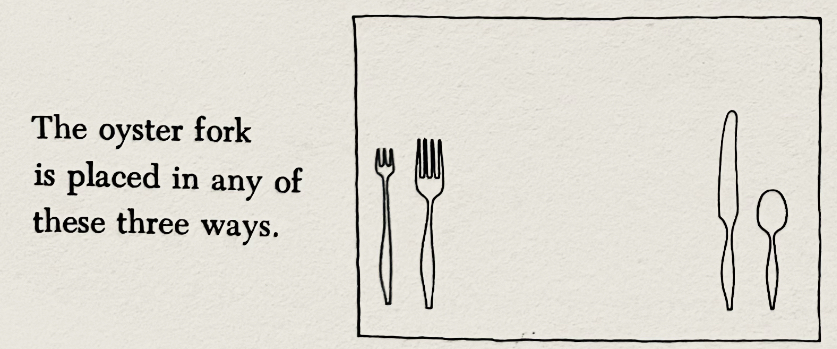
There are 3 different places you can properly find a “first” fork or “oyster fork.” 

Since the Gilded Age in the latter 1800’s, more than 3 forks on the left side of the place setting at one time has been frowned upon. “First” forks, however, cocktail forks, oyster forks, fruit forks, etc..., are allowed to be placed to the right of the setting, with the tines resting in the bowl of the soup spoon (so a diner on one’s right doesn’t think it goes with his or her forks on the left of their setting), or placed flat on the right, next to where the spoon sits. This leaves plenty of room. 

More dinner course forks can always be brought out with subsequent courses. And dessert forks are either allowed to be set above the dinner plate or may be brought out with the dessert course or finger bowl.


Images from the McCall’s “Book of Everyday Etiquette”


🍽Etiquette Enthusiast, Maura J. Graber, is the Site Editor for the Etiquipedia© Etiquette Encyclopedia

Thursday, October 8, 2015

Etiquette and Table Settings


3 Ways to Set a Dinner Table 
from ProFlowers.com
Food? Check. Drinks? Check. Table setting? Almost. While a simple plate, fork, spoon and knife set-up may do the job, if you really want to impress your dinner guests, take the extra time to set a formal dining room table. Before you feel the need to start shopping around for an oyster fork, ProFlowers has outlined the three main table settings—basic, informal and formal—for you to choose from based on your style and dinner plan.
They’ve also included some fun table-setting trivia so you can spend your meal impressing guests after setting the perfect tablescape. Bon Appétit!

A basic setting need not have a spoon, unless it is for a particular food or course.

A cup and saucer are only proper at informal dinner settings, at lunch settings and breakfast settings. 
The fork is the only utensil allowed at all 3 sides of a setting. A maximum of 3 are allowed on the left, 1 is allowed on the right for the appetizer, and 1 is allowed above the plate for a dessert course.

Ultimately, good food and good company make for the best dinner parties. Bring together your table setting with a fabulous bouquet. From rustic to elegant, a floral centerpiece can set the tone for your meal.

ProFlowers sells a wide variety of fresh-cut flowers, mixed bouquets and potted plants, shipped fresh from the grower.

Etiquette Enthusiast, Maura J. Graber is the Site Moderator for Etiquipedia© Etiquette Encyclopedia

Monday, August 31, 2015

Proper Place Setting Etiquette

Correctly drawn diagram of a place setting, with no more than 3 forks on the left. If a 4th fork was to be added on the left, it would replace the cocktail fork, and the cocktail fork would be moved to the right of the place setting, and to the right of the knife. 
In the United States' Colonial period, the only flatware on a dining table was a knife, fork, and possibly a spoon, for each person. With stacked tablecloths, one atop another for each course, explain Wendell and Wes Schollander, in the book Forgotten Elegance, "Part of the reason for this was that the tablecloth was removed after every course. To have a lot of silver and many glasses on the table would have made the removal of the tablecloth too hard.           
The fork is the only utensil that can be found at three sides of a place setting. 
When the change to service à la Russe took place in the 1860s and 1870s, the tablecloth stayed in place throughout the entire meal. In addition, the servants were busy carving and serving food. It now made sense to put out all the silver the diner would need and leave it there throughout the entire meal. The footman had other things to do and less time to hand out silverware. In addition, the mechanization of the production of silverware, together with a drop in the price of silver, meant the host now acquired more silverware. 
 An individual"bird knife and fork" in the Chantilly pattern. The game course could consist of partridge, pheasant, duck, woodcock, snipe or other popular birds eaten in the 1800's. The bird knife was the forerunner of the steak knife we know today, after a serrated edge was added.
There were some practical limits. Clearly if the hostess put out the eight or ten forks one would use at a formal meal, the diners would be too spread out to comfortably talk to each other. Convention quickly settled on three or four forks as the maximum number the hostess could put out so guests could still talk easily to their neighbors. For some twenty years after the Civil War there was disagreement about whether three or four forks were proper.        
The three forks on the left, as set for a formal meal, match with the corresponding knives on the right. This formal dinner setting's menu included a caviar first course, a cream soup second course, a fish course, a dinner course, then a salad course, then dessert. The utensils directly above the plate are always for dessert, (save the salt, pepper, or condiment spoon and possibly a butter spreader.)

In the end, three forks won out – perhaps because the game course became less common. But, because this was a change and an arbitrary number, it was necessary to keep reminding people that they should never put out more than three forks at a table setting." –From the book, "Forgotten Elegance"


Etiquette Enthusiast, Maura J. Graber, is the Site Editor for Etiquipedia© Etiquette Encyclopedia