Showing posts with label Etiquette History in France. Show all posts

Monday, December 28, 2020

Comte De Chambord’s Etiquette at Home


His table had the simplicity of a private home; but all was served on massive plate, engraved with the heraldic fleur-de-lis of the Bourbons. When dinner was announced, the Count and Countess walked out first and took the center places at the dinner-table; the visitors who were especially honored were placed on the left of the Count and the right of the Countess.  — Prince Henri, Count of Chambord (September 1820 – August 1883) was disputedly King of France from August 2 to 9, 1830 as Henry V, although he was never officially proclaimed as such. Afterwards, he was the Legitimist pretender to the throne of France from 1844 until his death in 1883.


He is said to have been more a man of science and learning than a politician or a statesman; his tastes were quiet, his habits were retired, and almost too simple for his position for those who think that Princes should not forget the old saying that Majesty without its externals is a jest, and that they must not be too much like other people. This the Comte de Chambord recognized, and in his home there was just enough of necessary etiquette to mark the Chief of the Royal line. 

His table had the simplicity of a private home; but all was served on massive plate, engraved with the heraldic fleur-de-lis of the Bourbons. When dinner was announced, the Count and Countess walked out first and took the center places at the dinner-table; the visitors who were especially honored were placed on the left of the Count and the right of the Countess. These seats of honor were differently filled at every meal, by a graceful innovation of the host, that all might enjoy the privilege in turn. No one ventured to address him, but his kindness enabled every one to have an opportunity of conversing with him. 

In the case of any visitor of note, he was honored with a private interview in the study of the Comte de Chambord, who delighted in prolonged conversation and free discussion of every topic. The interview lasted during the pleasure of the Royal host, who gave permission to retire by a significant smile and bend—motioning as if about to rise, but without actually leaving his seat. The Comte de Paris, on the contrary, lives exactly like a private individual, and waves all etiquette.He is considered to be personally devoid of all ambition, but anxious to do what might be considered his duty. —The Century, 1884


Etiquette Enthusiast, Maura J. Graber, is the Site Editor for the Etiquipedia© Etiquette Encyclopedia

Wednesday, October 24, 2018

Pompous Etiquette at Versailles

The honor of handing the clean shirt to those persona was reserved to the sons and daughters of France, or, in their absence, to the Princes of the blood or those legitimatized, or in default of these, to the Grand Chamberlain or the First Gentleman of the Bedchamber. The shirt having been regularly and formally delivered, the First Valet of the Wardrobe and the First Valet de Chambre held up the garment by the right and left sleeves respectively, while two other valets extended a dressing gown in front of the King to serve as a screen. 
Etiquette in Ye Olden Time


A hundred years ago the court of France was ruled by an etiquette so pompons and ceremonious as to make the King’s life a burden to himself and a jest to a philosopher. He was never alone, except at rare intervals. The eyes of forty or fifty persons saw him dress and undress, and the operation of putting on his shirt was something fearful. The Grand Master of the Wardrobe drew off the King’s nightshirt by the right arm, and the First Valet of the Wardrobe by the left arm, and both of them united in handing the nightshirt to an Officer of the Wardrobe. Another Valet of the Wardrobe brought a clean shirt, but he had no right to hand it to the persons who were to put it on the King. 

The honor of handing the clean shirt to those persona was reserved to the sons and daughters of France, or, in their absence, to the Princes of the blood or those legitimatized, or in default of these, to the Grand Chamberlain or the First Gentleman of the Bedchamber. The shirt having been regularly and formally delivered, the First Valet of the Wardrobe and the First Valet de Chambre held up the garment by the right and left sleeves respectively, while two other valets extended a dressing gown in front of the King to serve as a screen. Behind this screen his Majesty at last got the shirt on his back. Every day, immediately after being dressed, the King said his prayers. And it is to be hoped that he never failed to offer up a devout thanksgiving for having passed safely through the awful process of putting on his shirt, and that the coming man would be able to make for the coming King’s shirts that could be put on with more ease and less ceremony. — Morning Press, 1883

Etiquette Enthusiast, Maura J. Graber, is the Site Editor for the Etiquipedia© Etiquette Encyclopedia
Saturday, April 1, 2017

Squalor and Etiquette at Versailles

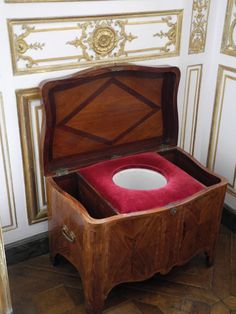
A royal chamber pot from Versailles -There were no bathrooms as we would know them. Courtiers and royalty used decorative commodes in each room, while commoners simply relieved themselves in the hallways or stairwells. No one bothered to house-train the royal dogs, and servants did not consider cleaning up after them to be part of their job description.

The palace of Versailles was once the most lavish large home in the world, the residence of the French royal family along with hundreds of their courtiers and servants. Containing half-a-million square feet, the palace compound has 700 rooms and 67 staircases. With lofty ceilings, gilded crown moldings, decorative floors, and 6000 paintings, there were also extensive servants’ quarters, kitchens, stables, and services.

Versailles was the creation of Louis XIV of France, who obsessively enlarged and enhanced his residence for more than 30 years during the 1600s. Today it’s toured by three million visitors annually, all hoping for a glimpse of the royal lifestyle.


This was the royal family’s private chapel for religious services

The Baroque aesthetic was to leave no surface unadorned. Every royal chamber has gilded paneling and crown molding; every wall has brocaded or flocked wall coverings; every ceiling is covered with allegorical paintings of Greek gods; every floor is patterned parquet or colored tiles. The hallways were done up with contrasting colors of veined marble. Everything inside, from furniture to finishes, is a visual froth of embellishments. Versailles in its day was so visually overpowering that it inspired copycat palaces all across Europe.

The chateau began as a hunting lodge built by Louis XIV’s father, fifteen miles southwest of Paris. Louis grew up during a tumultuous French civil war called the Fronde, during which he was surrounded by conspirators, had no pocket money and slept on ragged sheets. His mother even had to pawn the crown jewels. After consolidating his power as King, Louis compensated for childhood privations by building himself the most luxurious palace imaginable. He continued enlarging it throughout much of his life.


The public could watch the royals from behind the golden railing (at the bottom of the photo), so that there was no privacy for the royal family, even in bed.

The original hunting lodge was embedded within a vast series of newer buildings. Floors were added on top of existing structures, courtyards were filled in by new living spaces, wings were built, stables were constructed, staircases were built and then moved, service hallways added and then altered. The place became a complex maze containing sparkling state apartments as well as uncomfortable attic garrets tucked beneath the roof.

Ongoing construction at the palace provided job security to hundreds of masons, carpenters, plasterers, gilders, painters and landscapers. An immense support staff was maintained, consisting of cooks, valets, gardeners, grooms, hairdressers, and tailors. Vegetables and fruits to feed the masses were provided by a large potager, or kitchen garden.

But life in a palace wasn’t necessarily peaceful or enjoyable. The place was a vast hive of activity. Hundreds of courtiers lived alongside the royal family at Versailles, with their families as well. Nobles who could afford it often moved out of the crowded palace and constructed their own houses beyond the golden gates in the town of Versailles.

Versailles became a tourist destination almost from the beginning. The first visitor’s guide was published in the late 1600s. Anyone was granted entry to the grounds and the palace as long as the dress code was observed. (Hats and swords for men could be rented from the concierge at the gate.) Entry included the ability to enter into the royal apartments. 

A gilded railing separated the royal half of each room from the spectators’ portion. Behind these gilded railings, a series of private doors were built into the back paneling of the royal apartments, leading to secret hallways and stairs which allowed royalty to move from one room to another while remaining hidden from public view. Years later, in 1789, Queen Marie-Antoinette temporarily escaped the revolutionary mob by slipping through one of these doors to the king’s chamber.

Marie-Antoinette (married to Louis XIV’s great-great-grandson, Louis XVI) chafed at being on display even when in her bedroom. When she gave birth to her first child at Versailles, the entire royal family and all the major state officials came to witness the event. Hordes of other inquisitive people crowded in as well, in such numbers that spectators were crushed against the furniture and walls and movement was impossible.

It’s difficult to believe today when gazing at the gleaming golden palace, but life at Versailles was actually quite dirty. There were no bathrooms as we would know them. Courtiers and royalty used decorative commodes in each room, while commoners simply relieved themselves in the hallways or stairwells. No one bothered to house-train the royal dogs, and servants did not consider cleaning up after them to be part of their job description. The constantly-altered chimneys did not draw well, so everything inside was covered with soot. The filth and disorder at Versailles during the ancient regime were noted in many records of the time.

Life at Versailles was not just foie-gras served on golden plates. In need of cleaning, requiring expensive maintenance, and with in-laws living in the wings, Versailles was not so very different from many homes today. — A previous version of this article appeared in the Bloomington, Herald-Times in 2009


 🍽Etiquette Enthusiast, Maura J. Graber of The RSVP Institute of Etiquette, is the Site Editor for the Etiquipedia© Etiquette Encyclopedia