What to Wear and When to Wear It
By the late 1800’s fashions were changing rapidly — “Women’s dresses often featured a combination of textiles and adornments such as lace, bows, and ruffles as a result, according to Vogue. Jewel tones were favored, as light colors were impractical on the streets of New York. Corsets were still popular in the late 1800s, and the elite always wore hats, often adorned with feathers, when stepping out of their homes. For women of the era, formal occasions called for tulle dresses that exposed the décolletage, fur-lined cloaks, and elbow-length gloves. Men wore top hats and tuxedos, which arrived in the U.S. in the 1880s.” - Erica Tempesta for DailyMail.com |
FASHION—
Do not be too submissive to the dictates of fashion; at the same time avoid oddity or eccentricity in your dress. There are some persons who will follow, in defiance of taste and judgment, the fashion to its most extreme point; this is a sure mark of vulgarity. Every new style of dress will admit of adaptation to individual cases, thus producing a pleasing, as well as fashionable effect. Not only good taste, but health is often sacrificed to the silly error of dressing in the extreme of fashion. Be careful to have your dress comfortable and becoming, and let the prevailing mode come into secondary consideration; avoiding, always, the other extreme of oddity or eccentricity in costume.
STYLE AND FORM OF DRESS—
Be always careful when making up the various parts of your wardrobe, that each article fits you accurately. Not in the outside garments alone must this rule be followed, an ill-fitting pair of corsets, or wrinkles in any other article of the under-clothes, will make a dress set badly, even if it has been itself fitted with the utmost accuracy. A stocking which is too large, will make the boot uncomfortably tight, and too small will compress the foot, making the shoe loose and untidy. In a dress, no outlay upon the material will compensate for a badly fitting garment. A cheap calico made to fit the form accurately and easily, will give the wearer a more lady-like air than the richest silk which either wrinkles or is too tightly strained over the figure. Collars or sleeves, pinned over or tightly strained to meet, will entirely mar the effect of the prettiest dress.
ECONOMY—
And by economy I do not mean mere cheapness. To buy a poor, flimsy fabric merely because the price is low, is extravagance, not economy; still worse if you buy articles because they are offered cheap, when you have no use for them. In purchasing goods for the wardrobe, let each material be the best of its kind. The same amount of sewing that is put into a good material, must be put into a poor one, and, as the latter will very soon wash or wear out, there must be another one to supply its place, purchased and made up, when, by buying a good article at first, this time and labor might have been saved. A good, strong material will be found cheapest in the end, though the actual expenditure of money may be larger at first.
COMFORT—
Many ladies have to trace months of severe suffering to an improper disregard of comfort, in preparing their wardrobe, or in exposure after they are dressed. The most exquisite ball costume will never compensate for the injury done by tight lacing, the prettiest foot is dearly paid for by the pain a tight boot entails, and the most graceful effects will not prevent suffering from exposure to cold. A light ball dress and exquisite arrangement of the hair, too often make the wearer dare the inclemency of the coldest night, by wearing a light shawl or hood, to prevent crushing delicate lace or flowers. Make it a fixed rule to have the head, feet, and chest well protected when going to a party, even at the risk of a crushed flower or a stray curl. Many a fair head has been laid in a coffin, a victim to consumption, from rashly venturing out of a heated ball room, flushed and excited, with only a light protection against keen night air. The excitement of the occasion may prevent immediate discomfort in such cases, but it adds to the subsequent danger.
DETAILS—
Be careful always that the details of your dress are perfectly finished in every point. The small articles of a wardrobe require constant care to keep in perfect order, yet they will woefully revenge themselves if neglected. Let the collar, handkerchief, boots, gloves, and belts be always whole, neat, and adapted to the dress. A lace collar will look as badly over a chintz dress, as a linen one would with velvet, though each may be perfect of its kind. Attention to these minor points are sure tests of taste in a lady's dress. A shabby or ill fitting boot or glove will ruin the most elaborate walking dress, while one of much plainer make and coarser fabric will be becoming and lady-like, if all the details are accurately fitted, clean, and well put on. In arranging a dress for every occasion, be careful that there is no missing string, hook, or button, that the folds hang well, and that every part is even and properly adjusted. Let the skirts hang smoothly, the outside ones being always about an inch longer than the under ones; let the dress set smoothly, carefully hooked or buttoned; let the collar fit neatly, and be fastened firmly and smoothly at the throat; let shoes and stockings be whole, clean, and fit nicely; let the hair be smooth and glossy, the skin pure, and the colors and fabric of your dress harmonize and be suitable for the occasion, and you will always appear both lady-like and well-dressed.
HOME DRESSES
 |
| Public Promenade Dress for 1842 – Pinterest |
MORNING DRESS—
The most suitable dress for breakfast, is a wrapper made to fit the figure loosely, and the material, excepting when the winter weather requires woolen goods, should be of chintz, gingham, brilliante, or muslin. A lady who has children, or one accustomed to perform for herself light household duties, will soon find the advantage of wearing materials that will wash. A large apron of domestic gingham, which can be taken off, if the wearer is called to see unexpected visitors, will protect the front of the dress, and save washing the wrapper too frequently. If a lady's domestic duties require her attention for several hours in the morning, whilst her list of acquaintances is large, and she has frequent morning calls, it is best to dress for callers before breakfast, and wear over this dress a loose sack and skirt of domestic gingham. This, while protecting the dress perfectly, can be taken off at a moment's notice if callers are announced. Married ladies often wear a cap in the morning, and lately, young girls have adopted the fashion. It is much better to let the hair be perfectly smooth, requiring no cap, which is often worn to conceal the lazy, slovenly arrangement of the hair. A few moments given to making the hair smooth and presentable without any covering, will not be wasted. Slippers of embroidered cloth are prettiest with a wrapper, and in summer black morocco is the most suitable for the house in the morning.
DRESS FOR MORNING VISITS—
A lady should never receive her morning callers in a wrapper, unless they call at an unusually early hour, or some unexpected demand upon her time makes it impossible to change her dress after breakfast. On the other hand, an elaborate costume before dinner is in excessively bad taste. The dress should be made to fit the figure neatly, finished at the throat and wrists by an embroidered collar and cuffs, and, unless there is a necessity for it, in loss of the hair or age, there should be no cap or head dress worn. A wrapper made with handsome trimming, open over a pretty white skirt, may be worn with propriety; but the simple dress worn for breakfast, or in the exercise of domestic duties, is not suitable for the parlor when receiving visits of ceremony in the morning.
EVENING DRESS—
The home evening dress should be varied according to circumstances. If no visitor is expected, the dress worn in the morning is suitable for the evening; but to receive visitors, it should be of lighter material, and a light head-dress may be worn. For young ladies, at home, ribbon or velvet are the most suitable materials for a head-dress. Flowers, unless they be natural ones in summer, are in very bad taste, excepting in cases where a party of invited guests are expected. Dark silk in winter, and thin material in summer, make the most suitable dresses for evening, and the reception of the chance-guests ladies in society may usually expect.
 |
| A dress for marketing– Here a dress of the most inexpensive kind is the best. There is no surer mark of vulgarity, than a costly dress in the market. |
WALKING DRESSES—
Walking dresses, to be in good taste, should be of quiet colors, and never conspicuous. Browns, modes, and neutral tints, with black and white, make the prettiest dresses for the street. Above all, avoid wearing several bright colors. One may be worn with perfect propriety to take off the sombre effect of a dress of brown or black, but do not let it be too glaring, and wear but little of it. Let the boots be sufficiently strong and thick to protect the feet from damp or dust, and wear always neat, clean, nicely fitting gloves. The entire effect of the most tasteful costume will be ruined if attention is not paid to the details of dress. A soiled bonnet cap, untidy strings, or torn gloves and collar will utterly spoil the prettiest costume. There is no surer mark of vulgarity than over dressing or gay dressing in the street. Let the materials be of the costliest kind, if you will, but do not either wear the exaggerations of the fashion, or conspicuous colors. Let good taste dictate the limits where fashion may rule, and let the colors harmonize well, and be of such tints as will not attract attention.
FOR MORNING CALLS—
The dress should be plain, and in winter furs and dark gloves may be worn.
The dress should be of light silk, the bonnet dressy, and either a rich shawl or light cloak; no furs, and light gloves. In summer, a lace or silk mantle and white gloves should be worn.
SHOPPING DRESSES—
Should be of such material as will bear the crush of a crowded store without injury, and neither lace or delicate fabrics should ever be worn. A dress of merino in winter, with a cloth cloak and plain velvet or silk bonnet is the most suitable. In summer, a dress and cloak of plain mode colored Lavella cloth, or any other cool but strong fabric, with a simply trimmed straw bonnet, is the best dress for a shopping excursion.
 |
| Women’s fashions for winter in England |
STORM DRESSES—
A lady who is obliged to go out frequently in bad weather, will find it both a convenience and economy to have a storm dress. Both dress and cloak should be made of a woolen material, (varying of course with the season,) which will shed water. White skirts are entirely out of place, as, if the dress is held up, they will be in a few moments disgracefully dirty. A woolen skirt, made quite short, to clear the muddy streets, is the proper thing. Stout, thick-soled boots, and gloves of either silk, beaver-cloth, or lisle thread, are the most suitable. The bonnet should be either of straw or felt, simply trimmed; and, above all, carry a large umbrella. The little light umbrellas are very pretty, no doubt, but to be of any real protection in a storm, the umbrella should be large enough to protect the whole dress.
MARKETING—
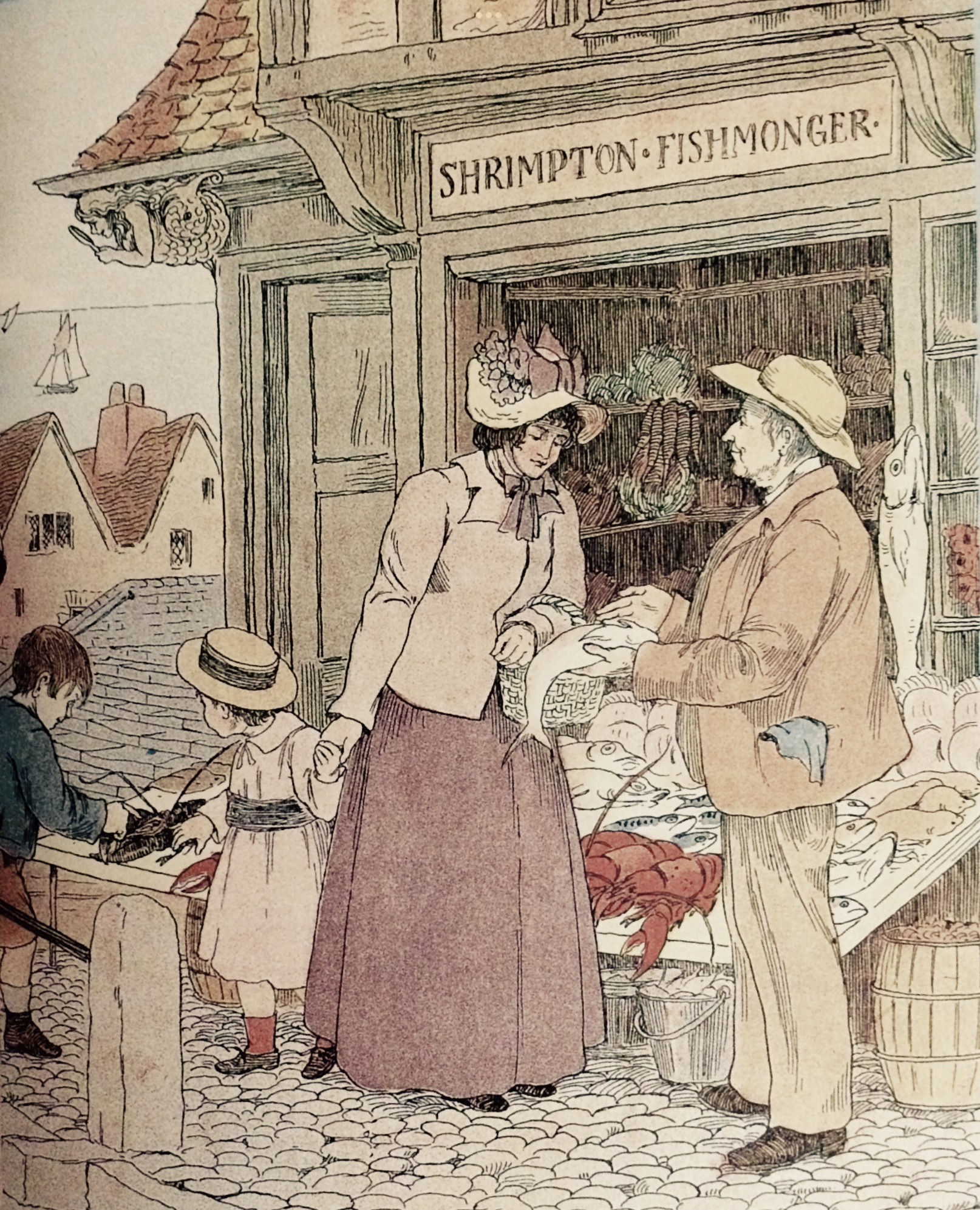
Here a dress of the most inexpensive kind is the best. There is no surer mark of vulgarity, than a costly dress in the market. A chintz is the best skirt to wear, and in winter a dark chintz skirt put on over a delaine dress, will protect it from baskets, and the unavoidable soils contracted in a market, while it looks perfectly well, and can be washed if required.
 |
| “A friendly hint to young ladies who wear those dear delightful barége dresses. Always let the slip (or whatever the mysterious garment is called) be as long as the outer dress?”— Punch |
TRAVELING—
Traveling dresses should be made always of some quiet color, perfectly plain, with a deep mantle or cloak of the same material. When traveling with a young babe, a dress of material that will wash is the best, but it should be dark and plain. A conspicuous traveling dress is in very bad taste and jewelry or ornaments of any kind are entirely out of place. Let the dress be made of dark, plain material, with a simple straw or felt bonnet, trimmed with the same color as the dress, and a thick barege veil. An elastic string run through a tuck made in the middle of the veil, will allow one half to fall over the face, while the other half falls back, covering the bonnet, and protecting it from dust. If white collars and sleeves are worn, they should be of linen, perfectly plain. Strong boots and thick gloves are indispensable in traveling, and a heavy shawl should be carried, to meet any sudden change in the weather. Corsets and petticoats of dark linen are more suitable than white ones, as there is so much unavoidable dust and mud constantly meeting a traveler.
.jpg) |
| Woman in Ball Costume 1860 |
EVENING DRESSES—
Must be governed by the number of guests you may expect to meet, and the character of the entertainment to which you are invited. For small social companies, a dark silk in winter, and a pretty lawn, barege, or white muslin in summer, are the most appropriate. A light head-dress of ribbon or velvet, or a plain cap, are the most suitable with this dress. For a larger party, low-necked, short-sleeved silk, light colored, or any of the thin goods made expressly for evening wear, with kid gloves, either of a color to match the dress or of white; black lace mittens are admissible, and flowers in the hair. A ball dress should be made of either very dressy silk, or light, thin material made over silk. It should be trimmed with lace, flowers, or ribbon, and made dressy. The coiffure should be elaborate, and match the dress, being either of ribbon, feather, or flowers. White kid gloves, trimmed to match the dress, and white or black satin slippers, with silk stockings, must be worn.
 |
| “There is such a variety of opinion upon the subject of mourning, that it is extremely difficult to lay down any general rules upon the subject.” –Mourning Dresses for1860 |
MOURNING—
There is such a variety of opinion upon the subject of mourning, that it is extremely difficult to lay down any general rules upon the subject. Some wear very close black for a long period, for a distant relative; whilst others will wear dressy mourning for a short time in a case of death in the immediate family. There is no rule either for the depth of mourning, or the time when it may be laid aside, and I must confine my remarks to the different degrees of mourning.
For deep mourning, the dress should be of bombazine, Parramatta cloth, delaine, barege, or merino, made up over black lining. The only appropriate trimming is a deep fold, either of the same material or of crape. The shawl or cloak must be of plain black, without border or trimming, unless a fold of crape be put on the cloak; the bonnet should be of crape, made perfectly plain, with crape facings, unless the widow's cap be worn, and a deep crape veil should be thrown over both face and bonnet. Black crape collar and sleeves, and black boots and gloves. The next degree is to wear white collar and sleeves, a bow of crape upon the bonnet, and plain white lace facings, leaving off the crape veil, and substituting one of plain black net. A little later, black silk without any gloss, trimmed with crape, may be worn, and delaine or bombazine, with a trimming of broad, plain ribbon, or a bias fold of silk.
The next stage admits a silk bonnet trimmed with crape, and lead color, dark purple, or white figures on the dress. From this the mourning passes into second mourning. Here a straw bonnet, trimmed with black ribbon or crape flowers, or a silk bonnet with black flowers on the outside, and white ones in the face, a black silk dress, and gray shawl or cloak, may be worn. Lead color, purple, lavender, and white, are all admissible in second mourning, and the dress may be lightened gradually, a white bonnet, shawl, and light purple or lavender dress, being the dress usually worn last, before the mourning is thrown aside entirely, and colors resumed.
It is especially to be recommended to buy always the best materials when making up mourning. Crape and woolen goods of the finest quality are very expensive, but a cheaper article will wear miserably; there is no greater error in economy than purchasing cheap mourning, for no goods are so inferior, or wear out and grow rusty so soon.
From “The Ladies’ Book of Etiquette and Manual of Politeness” by Florence Hartley, 1860
Etiquette Enthusiast, Maura J. Graber, is the Site Editor for the Etiquipedia© Etiquette Encyclopedia



.jpg)


