Showing posts with label Etiquette for Dinner Guests. Show all posts

Monday, January 6, 2025

Etiquette for the Nosy at Dinner

Unless you have knowledge of markings of different companies, it may not only be tacky and impolite to check the makers of china plates, cups, etc… when a guest at a table, but you could accidentally break something very valuable or see a never removed discount price sticker still on the dish. If you really are enamored with a certain patterned dish or cup, etc… as a guest, you could also give the host or hostess a compliment on the dish and say that you’d love to know more about it, or something similar. Your host or hostess may be very obliging.

 Don't Turn China Over


Dear Mrs. Tobin; 
Is it proper to turn over, say a cup or plate, when dining at a friend’s home? I was severely criticized when all I wanted to do was read the manufacturer’s mark. –Curious in San Diego


Dear Curious: 
I think it looks crass. It would be better to tell your hostess how lovely her china is and let her fill you in on the details. If it's a pretty pattern and beautiful workmanship it really doesn’t make any difference whether it’s from a pottery in Japan, France, England or the catalog from a discount house in the United States. – By Riv Tobin, Copley News Service, 1977


🍽️Etiquette Enthusiast, Maura J. Graber, is the Site Editor for the Etiquipedia© Etiquette Encyclopedia

Thursday, November 17, 2022

Social Graces from Mrs. Adams

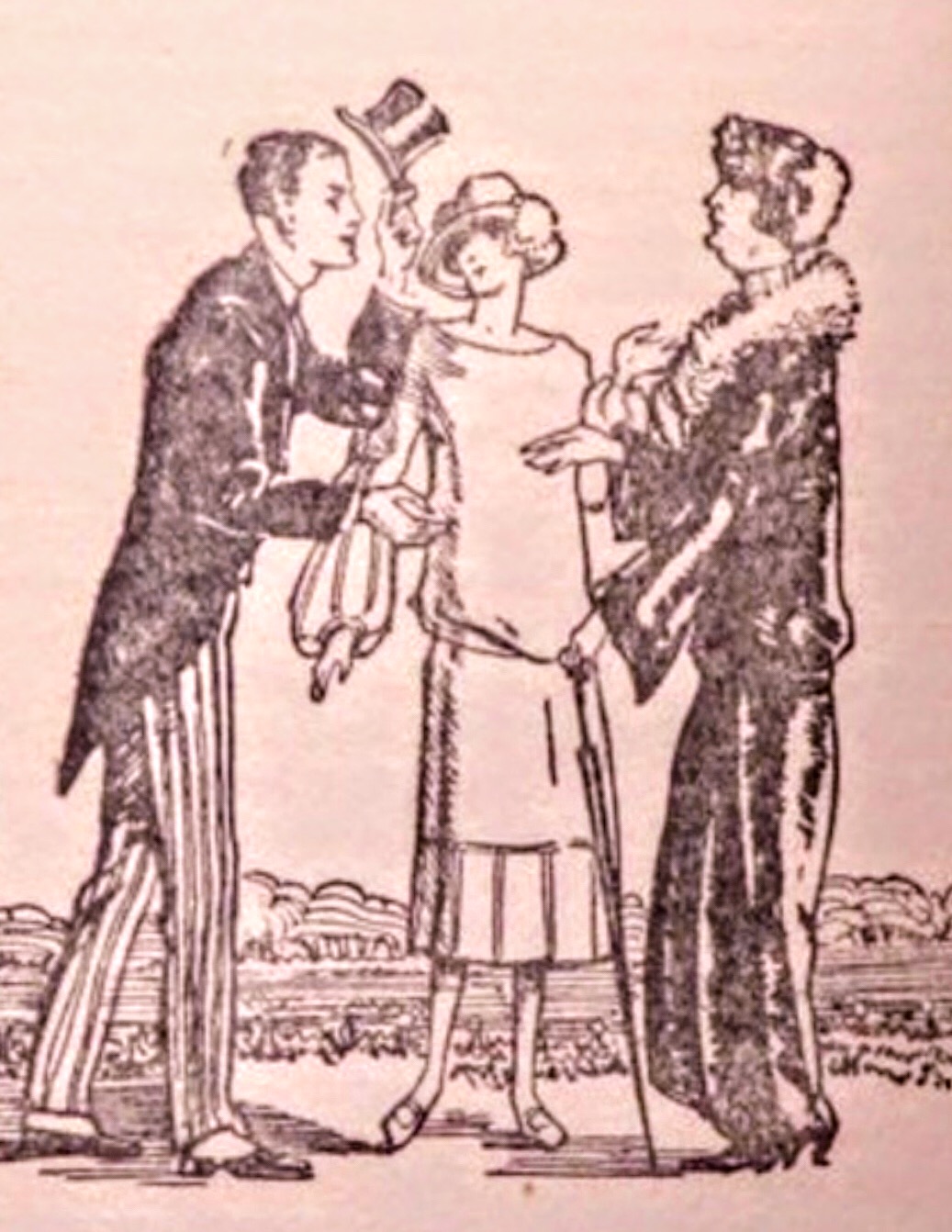
When making introductions one should remember that a man is always presented to a woman, a younger person to an older one and an unmarried woman to a matron. When introducing friends a good form to use is. “Miss Brown, let me present Mr. Jones.” If introducing a relative one should say, “Miss Black, may I present my cousin. Mr. White?”

Introducing Friend or Relative

Dear Mrs. Adams: 1. What is the proper way to introduce a friend or relative? 
2. In congratulating a bride or bride- groom-to-be, what must one say? 
3. What is an appropriate gift for a groom to present to his bride-to-be? 
4. On being invited to dine, how long before dinner should one arrange to arrive? When leaving, must one bid only the hostess or all the guests good-bye? –A Green One

1. When making introductions one should remember that a man is always presented to a woman, a younger person to an older one and an unmarried woman to a matron. When introducing friends a good form to use is. “Miss Brown, let me present Mr. Jones.” If introducing a relative one should say, “Miss Black, may I present my cousin. Mr. White?”
2. To the bride-to-be, one may say, “Let me offer hearty good wishes for your future happiness.” To the groom-to-be, one may say, “Accept my sincerest congratulations.” 
3. A piece of jewelry is the most appropriate gift. 
4. A dinner guest is to arrive at the hostess' home at the hour named in her invitation. When leaving, the guest politely thanks the hostess for the hospitality enjoyed. If there are few friends at the dinner, the person leaving may bid them all good evening; but if there are many guests present, she should bid a formal farewell to those friends nearest her.

Mother Insists

Dear Mrs. Adams: I am a girl of 15, and my mother insists that I shall go with a man of 26. I do not care for him. She compelled me to accept a gold watch from him as a Christmas present. What would you advise me to do in such a case? –Anxious 

While your mother may prove to be your best friend, I cannot help suggesting, in this case that you accept the young man's attentions, but treat him with indifference. He will soon understand that his company is not desired, and will not force his attentions on you. — San Francisco Call, 1910


🍽Etiquette Enthusiast, Maura J Graber, is the Site Editor for the Etiquipedia© Etiquette Encyclopedia

Friday, July 8, 2022

Enjoying a Gilded Age Dinner Party

Fleeting as is time, there is enough of it for all things, and when conversation is in order, let eating be suspended. Exciting topics may be banished without excluding those which have an exhilarating interest.

Primus, a dinner party pre-supposes enjoyment of the viands; secundus, it does not require that a guest shall express his pleasure by waving his napkin, gesticulating with his knife, fork, or spoon, or talking while his mouth is full of food. Fleeting as is time, there is enough of it for all things, and when conversation is in order, let eating be suspended. Exciting topics may be banished without excluding those which have an exhilarating interest.

Long stories are to be avoided, and so is the habit of asking questions; but there is a subtle way of wishing, or, at least, of being willing to hear more that gives the inflection without being too interrogative; and if it be not expedient to tell all we know in response to its gentle insinuation, it does not compel an ungracious refusal or a chilling reticence. A lady is entitled to special attention from her escort, but she should not monopolize his time. 

Not merely the pairing but the grouping of guests is considered by an accomplished hostess, and a lady may exercise her conversational graces impartially to right and left and likewise across the table, provided its width and adornments do not interfere; but neither in front of nor behind an intervening guest should anybody attempt to converse. When a word or sentence to one so separated suggests itself, the intervening person should be included in the conversation. In other words, the conversation becomes general to a lesser or greater extent, according as the subject under discussion may interest those present. 

Architecture may be frozen music to you in the most rigid sense, and you may be seated next to someone who draws out its harmonies in grand and classic shapes, and to whose latest triumphs the company may allude in brief, but pleasing terms. You feel called upon to add something to the general tribute, but can think of nothing apt. Said a young girl who was thus placed, “I could not think of anything to say that would indicate an intelligent knowledge of the subject and I did not feel privileged to lead the conversation from the channel in which it had been directed, so I could only speak of a mite of a country house which always comes to mind because of the beautiful roses that grow all about it and seem intent upon surmounting its diminutive height. I scarcely know how it happened, but in a very short time he was telling me how artistically the rose works into decorative purposes, and from that passed to other things until I felt the subject to be more interesting than I ever supposed it could become to one who knows next to nothing about architecture, and who cannot become familiar with it.” 

Such a frank avowal is not discreditable to one who has tact enough to make up for it, and tact quite often takes the place of many qualities commonly supposed to belong to the mental equipments of bright women. It made a good listener in the instance referred to, and it gave a good talker the opportunity to air his gifts agreeably. Worries and all disquieting subjects should not be mentioned outside the circle they affect, and even though in taking leave of your entertainers, be gracious but not effusive in expressing your pleasure. 

It is to your hostess that you will make acknowledgment in a few words. Just what they shall be, no pen can write and few people need be told; but they will give the impression that you have enjoyed your evening. Beware—this to the young — that your words do not savor of the fact that your enjoyment has been a surprise to yourself. To youth is also addressed this injunction: do not attempt to compliment your hostess upon her ménage. 

Verbally expressed compliments of any kind are rarely the prerogative of the young. If the hostess be your dearest school-friend, tell her privately, when you are admitted to a boudoir chat, how much you admire her qualities as housewife and hostess; but do not allow your appreciation to effervesce when she is doing her best to bear her blushing honors with meekness and dignity, for it is a hard combination for a young hostess to sustain. “Although I have remained late, the evening has seemed very short,” says one; “Time is very unkind, and so I must say good evening,” says another. A matron who has enjoyed years of complete social success extends her hand to a younger entertainer and says, “Before saying adieu, let me thank you for a most delightful evening;” but she does not prolong her leave-taking further than to add a brief good-night.

There was a time when appreciation of the dinner was expressed in the leave-taking, but the custom does not prevail among men and women of the younger generation. It was a pleasing and proper acknowledgment when an invitation to one’s table signified the most sacred form of social hospitality, but though an invitation to dine still suggests a desire for some degree of social intimacy, the giving of dinners has grown to be more of a formality since that time. — Eliza Lavin in “Good Manners,” 1889


🍽Etiquette Enthusiast, Maura J. Graber, is the Site Editor for the Etiquipedia© Etiquette Encyclopedia

Wednesday, August 7, 2019

Etiquette and Mutual Regard at Table


A desire for fresh smelling breath? Food allergies? Or “pickiness?”– “There are certain foods Queen Elizabeth has restricted palace chefs from using and advised other royals against eating. Garlic is apparently the ingredient she dislikes most. 
It’s been long rumored that the Queen hates garlic and banned palace chefs from cooking with it, and the Queen’s daughter-in-law, Camilla Parker Bowles, Duchess of Cornwall, confirmed the royal family is indeed not supposed to eat garlic...
 Another cooking ingredient largely off the royal table is onions. It is unclear if chefs are advised to keep them away from the Queen (and the rest of the royal family) due to because of smell or taste, but cooks are permitted to use onions sparingly. Darren McGrady, a former royal chef who worked at Buckingham Palace for more than 15 years, told Recipes Plus that cooks ‘can never serve anything with garlic or too many onions.’ ‘The Queen would never have garlic on the menu,’ he added. Certain ingredients used to cook up dishes aren’t the only things reportedly off limits. Members of the royal family aren’t supposed to eat shellfish of any kind—due to the higher risk of food poisoning—or meat that's cooked rare, according to a 2000 BBC report. Long pasta and tomato sauces shouldn’t grace the royal dinner table unless it’s for a very specific special occasion.” – Newsweek, 2018 

NEW YORK – Few situations are more discouraging for a host or hostess than to prepare a wonderful meal, only to find there is a guest who cannot or will not eat one or several of the dishes prepared. Few situations are more embarrassing or uncomfortable for a guest than to have to struggle with food he or she detests, or to refuse it for reasons of health. Both situations could be avoided easily if there were a few simple rules of etiquette developed to forestall them. Etiquette, in the best sense, exists to prevent embarrassment or awkwardness, and with so many people now on special diets, some rules for discovering and accommodating the restrictions are needed. There are, of course, basic differences between not liking something and not being able to eat it because of health. The basic question is one of fixing responsibility.


Should a host or hostess ask every guest in advance what he or she does not like or cannot eat? Or should guests volunteer that information when invited? Telling a host that you do not like a certain ingredient or dish is difficult and possibly rude, because it is presumptuously asking for special attention. But years ago, after preparing ratatouille for a dinner party, I discovered, too late, that one guest hated both eggplant and zucchini. That guest did not create a problem, because there were many other things to eat, but I felt badly because I could easily have prepared a different vegetable dish. Since then, I always ask guests whose food tastes I do not know, if there is anything they hate. Among the more surprising answers have been chicken, liver and other organs, lamb, fish, mushrooms, eggplant and even garlic, although when I come across someone who does not like that odoriferous bulb, I consider severing the friend ship at once. But when a prospective guest cannot eat an ingredient because he or she is allergic to it or seriously ill, it would seem that it is the responsibility of that person to offer that information.


If, for example, someone has been told to cut down on salt, that person might choose to eat just a small amount of a particular dish made with salt at a dinner party. On the other hand if the elimination of salt (or cholesterol or milk products or eggs) is critical, then the guest should make that known. Those on reducing diets might refrain from saying so and just eat small amounts, passing up the the most fattening dishes. But if the quick loss of weight is imperative, they might say so and offer to bring their own poached breast of chicken to the party. Anyone violently allergic to some commonly used (and perhaps uncommonly used) ingredient should also let that be known. – By Mimi Sheraton, New York Times News Service, 1983


Etiquette Enthusiast, Maura J Graber, is the Site Editor for the Etiquipedia© Etiquette Encyclopedia
Thursday, July 11, 2019

More Table Etiquette Explained

“A visitor, who was sitting on the right of the host was seemingly very fond of the entree (mushroom timbales) and remarked that she preferred these lighter dishes to the more heavy roasts, whereupon the host asked the waitress to serve her with another timbale. The waitress, knowing there were no more in reserve, endeavored to appear as though she had forgotten the order. The man of the house, however, did not let the matter rest, but in rather a pompous fashion, again ordered the extra serving. He was much embarrassed when told that there were no more. The rule is a pretty safe one to follow, that as long as the mistress orders the meals and knows what is in the house, it is her prerogative to take the lead in such matters.” – Photo of a Mushroom Timbale from Pinterest

If the waitress is well trained, it is but rarely that she need be spoken to, as it is her affair to watch out if the water or butter or anything else is needed by anyone at the table. It is a pretty definite rule that no guest should ask the waitress for anything, but should address any such request to her hostess. An exception might be made to this rule in case such request would cause embarrassment; for instance, the waitress might have forgotten to place an extra knife or to pour any water; In this case it would then be all right to just whisper to the waitress as she passed near by rather than to call attention to the fact before the whole table. It is conceded that the mistress, not the man, of the house must give all commands and orders to the maid; otherwise, it might cause embarrassment, and misunderstanding. 
As an example, I recall an experience at a dinner at which X was a guest: A visitor, who was sitting on the right of the host was seemingly very fond of the entree (mushroom timbales) and remarked that she preferred these lighter dishes to the more heavy roasts, whereupon the host asked the waitress to serve her with another timbale. The waitress, knowing there were no more in reserve, endeavored to appear as though she had forgotten the order. The man of the house, however, did not let the matter rest, but in rather a pompous fashion, again ordered the extra serving. He was much embarrassed when told that there were no more. The rule is a pretty safe one to follow, that as long as the mistress orders the meals and knows what is in the house, it is her prerogative to take the lead in such matters. 
In houses where napkin rings are used, for family and house guests, napkins should be kept neat and folded and rolled into the ring at the end of the meal. It is usual for the guest at only one meal to place the napkin on the table without folding it. It is a nice custom for the waitress to stand back of and pull out the chair of the mistress of the house, but in some families where there are young sons it is well for them to be trained in this act of courtesy. If there is a woman guest, it is optional whether the waitress should do this or the host. I have been a frequent visitor in a charming home where there are five sons, and have been so interested in watching their little imitations of father’s table manners and small courtesies. Each son, in turn, was taught to pull out the chair for mother and render other small courtesies such as are the hall-mark of good home training. 
The boys and girls returning from boarding school are very apt to bring back with them table manners that are apparently necessary in dealing with a large group, one of them being the habit of holding the sugar bowl or salt-cellar in the hand while serving themselves. This should never be permitted in a private home, and this applies to any dish of any kind. Children away at school are very apt to be critical of the food they receive, and the habit often returns home with them. Any unfavorable comment on food at the table is, of course, not good form. Dinner table conversation should be interesting, avoiding any but the lightest discussion of serious subjects. If children are taught correct dinner table conversation and the simplest rules of table etiquette they, and their parents, will be saved many embarrassing moments. – By Florence Austin Chase, 1929

Etiquette Enthusiast, Maura J Graber, is the Site Editor for the Etiquipedia© Etiquette Encyclopedia
Sunday, January 20, 2019

Tackling Bad Table Manners

A meal is not a marathon; there are no prizes for speed. So don't race. Eat small bites, one at a time, and never take two bites from the same forkful or two sips from the same spoonful. 

Bad Table Manners Will Give Indigestion to Others

There are two ways to get indigestion. One is to eat. The other is to watch someone else eat. For every chow-hound who gets dyspepsia from wolfing his food, there's a spectator with dyspepsia from watching him. Give pig’s knuckles to a pig and if the pig doesn’t suffer, a fussy onlooker will. Greasiness in managing a barbecued rib, will cause queasiness in many a solar plexus if not the eater’s, the spectator’s. Bad table manners, in other words, not only offend another’s sensibilities. They offend his digestive tract as well. Many people will forgive the former, but never the latter. So, in the interest of preventive medicine, if not of etiquette, it's wise to winnow out the truly horrendous “boners.” 
  • Eating shouldn’t be auditory. Chew quietly, with your lips closed. Keep sound effects at a minimum. Don't chew and chatter simultaneously. 
  • If you’re a professional hostess flatterer, say: “M-mm, good!” and let it go at that. Licking your fingers or smacking your lips contributes nothing and detracts much. 
  • A meal is not a marathon; there are no prizes for speed. So don’t race. Eat small bites, one at a time, and never take two bites from the same forkful or two sips from the same spoonful. 
  • While handling the cutlery, keep your arms at your sides. Flapping elbows both imperil neighbors’ ribs and show gusto unsuitable to the occasion. 
  • Liquids should be sipped, not gulped. Soup slurping is a cardinal sin. Thanks to the law of gravity, it's generally unnecessary to “wash down” your food. If you get a hot bite, of course, water makes a good fire extinguisher, but otherwise drink only when your mouth is empty. Even then, wipe your mouth with a napkin before drinking. Food marks on a glass rim aren't the most appetizing sight. 

If you think the following don’ts pertain only to the high-chair set, you’re wrong. Some adults haven’t heard of them, either. 
  • Don’t eat windmill style. 
  • Don’t root in your plate. 
  • Don’t blow on your food to cool it. 
  • Don’t make goulash where goulash wasn’t intended. Keep separate portions separate. 
  • Don’t submerge everything in catsup or gravy. Catsup is particularly risky. Used in excess, it’s clearly a slur on the cuisine. 

Q & A ON P’S & Q’S – 
(Q) “I find it disgusting when somebody blows his nose at the dinner table. Don’t you agree?” J. B. 
(A) What disgusts one man doesn’t daunt another. Etiquette, as it happens, ordinarily doesn’t require a person to leave the table to blow his nose. It’s considered sufficient to bury your head, shield your nose well and not make a production of it. Nose-blowers, in any case, should never apologize. This merely calls attention to the act. – Don Goodwin, Copyright 1964


Etiquette Enthusiast, Maura J Graber, is the Site Editor for the Etiquipedia© Etiquette Encyclopedia 

Thursday, November 8, 2018

Dinner Party Etiquette

A gentleman should seat a lady by standing behind her chair and pulling it back with both hands. When she is half-seated, the chair should gently be pushed forward so that her chair is under her hips. After seating her, the gentleman takes the seat to her left. Good posture is important; do not slouch. Put your back against the back of your chair. Whenever possible, push sleeves up above the elbows before eating.


Say “Hello” to the hostess before you accept any drink.

Taking Your Seat At The Table: Men and women are expected to enter and sit in a chair from their left sides. This prevents bumping the neighbor when seating. The exception is when the chairs are too close to enter from the side and must be pulled out to sit. Exit the chair the same way you entered. Do not forget to push the chair back in when you leave. 


 A gentleman should seat a lady by standing behind her chair and pulling it back with both hands. When she is half-seated, the chair should gently be pushed forward so that her chair is under her hips. After seating her, the gentleman takes the seat to her left. Good posture is important; do not slouch. Put your back against the back of your chair.

Note: Men are seated to the left of the woman so as to have their right hand available to assist the woman.


Sit Up Straight. Push your back against the back of the chair.

Push sweater sleeves up above just to, or above, the elbow before eating.

Rest Your Wrists On The Table. No elbows on the table at any time.

Your Space At the Table: Your space should be confined to the imaginary box around you. If you must move your feet, do so in your own foot space (close to the floor and within the chair legs). If you are not eating, your hands should be on your lap or on the table right in front of you. While you are eating, try to put your non-eating hand on your lap. If you must rest your hands on the table, do so with your wrists only. Place your wrists in front of you on the edge of the table. Do not put your elbows on the table.

Purses, Briefcases, Eyeglasses, And Eyeglass Cases: Do not place any item on the table. A small purse should go on your lap, under the napkin. A large purse, briefcase, and other personal items should go under your chair, out of the way. Never block the path of other guests or the serving staff. An eyeglass case belongs in your purse or pocket. Never put your eyeglasses on the table. Your cell phone should be set to vibrate or switched off and put away. It is extremely rude to make or accept a phone call (or text) during a meal.

Lavatory or Bathroom: Women excuse themselves go to the “powder room” and men go to “freshen up.”

Proper Way To Leave A Dinner Party: The general rule for leaving a dinner party is approximately forty-five minutes after dinner is over


Contributor Bernadette Petrotta is the Director and founder of The Polite Society School of Etiquette. Her book is "The Art and Proper Etiquette of Afternoon Tea," among her others, can be found on Amazon


Etiquette Enthusiast, Maura J. Graber, is the Site Editor for the Etiquipedia© Etiquette Encyclopedia


Monday, September 10, 2018

Etiquette for Salt And Such


Individual salt cellars have the ability to elevate any place setting. They can take a look from “How nice...” to “How elegant!” Or, from “Drabulous to fabulous!” as a friend once enthused. And though we are not suggesting that salts and peppers are set on a table merely for decorative purposes, Etiquipedia kindly requests that you politely taste your food first, prior to adding anything like salt. Even after tasting the food, do not send a “non-verbal” complaint to the host or hostess by making a show of heavily salting and peppering your meal. As a thoughtful guest, please remember that you are not there to eat, but to dine and enjoy the company of your hosts.

– Photo of a Michael Aram salt cellar and salt spoon


Salt Etiquette, 
with a Touch of Pepper

🍴Polite guests always taste food prior to adding salt –or adding any spice or condiment– out of respect and graciousness to those who have prepared a meal, or invited one to a meal.

🍴If you are a guest, even after tasting the food, take care not make a show of salting your food. This is rude. It implies that the meal is “less than it should be.” It also could imply that you have an unsophisticated palate and are not able to taste subtle flavors in the meal. If invited to dinner in a private home, “non-verbal complaints” like salting food before tasting, or pouring catsup all over your food, is most impolite.


🍴In some countries, like Portugal, it is impolite to even ask for salt. It is considered an insult to the chef, whether you are a guest in someone’s home, or in restaurants.  If salt, pepper, other spices or condiments are not on the table, do not ask for them to be brought to you.

🍴The etiquette rule above applies in the reverse situation, as well. If one is hosting someone from another culture or country, and they prefer to have salt and pepper at the table, though it is not the norm for you, feel free to provide these items to make your guests feel more welcome. 

🍴 If invited as a guest to eat in a restaurant, or perhaps a wedding reception or birthday celebration, and someone else is paying the tab, such non-verbal complaints about the meal are impolite, as well. Remember, you are a guest!

🍴If asked to pass the salt, always pass it with the pepper, so that the two do not get separated.

🍴 Always say, "Excuse me" if you need to reach in front of someone caught up in conversation, when passing salt (or anything else) at the table.

🍴Be aware of those around you at the table. If the salt is nearest you (this also applies to butter, rolls, etc...) don't allow yourself to be so caught up or lost in your conversation, that someone has to reach in front of you to pass the requested item.


🍴 Judith Martin shakes out “The Salt and Pepper Question”
Q: In a set of identical salt and pepper shakers, should the salt be placed in the shaker with one or two holes? My friend's feeling is that the salt is used more, therefore it should go in the two-hole shaker; I feel that because it pours faster, the salt belongs in the shaker with one hole. We resolve to abide by your decision. 
A: If Miss Manners were to tell you, in a blustery way, to use salt cellars and pepper grinders, would you consider it a cop-out, as it were? Yes, of course you would. The truth is that Miss Manners didn't know that salt pours faster than pepper, and is now sitting here with little black and white specks all over her lap. Just a minute. (Brush, brush, brush.) 
All right now, the decision is that your friend's reasoning is incorrect, but her conclusion is correct. (Miss Manners used to get her arithmetic papers back with that remark.) Salt goes in the two-hole shaker, not because it is used more often, but because more of it is used. Put another way; over-peppered food tastes worse than over-salted food. – Miss Manners, Copyright (c) 1979 and United Feature Syndicate 


Etiquette Enthusiast, Maura J. Graber, is the Site Editor for the Etiquipedia© Etiquette Encyclopedia

Wednesday, November 22, 2017

A Thanksgiving Etiquette Tale

Circumstances alter cases in matters of etiquette... At the end of the Thanksgiving dinner a few days afterward, Edith was observed looking hopelessly at a last bit of pudding on her plate.

It’s Not So Easy, Edith

Circumstances alter cases in matters of etiquette, as well as in the more important affairs of life. Little Edith, visiting in the country, was much interested in an old lady, who, when a plate of fruit was passed her at an evening party, replied: “Thank you, I don't care for any now, but I should like to put an apple in my pocket to take home.” At the end of the Thanksgiving dinner a few days afterward, Edith was observed looking hopelessly at a last bit of pudding on her plate. “Can't you finish it dear?” asked a sympathetic auntie. “No.” replied she, with a sigh, “Not now, but I should like, if you please, to put it in my pocket to eat this evening.” — Youth’s Companion, 1891


Etiquette Enthusiast, Maura J. Graber, is the Site Editor for the Etiquipedia© Etiquette Encyclopedia